
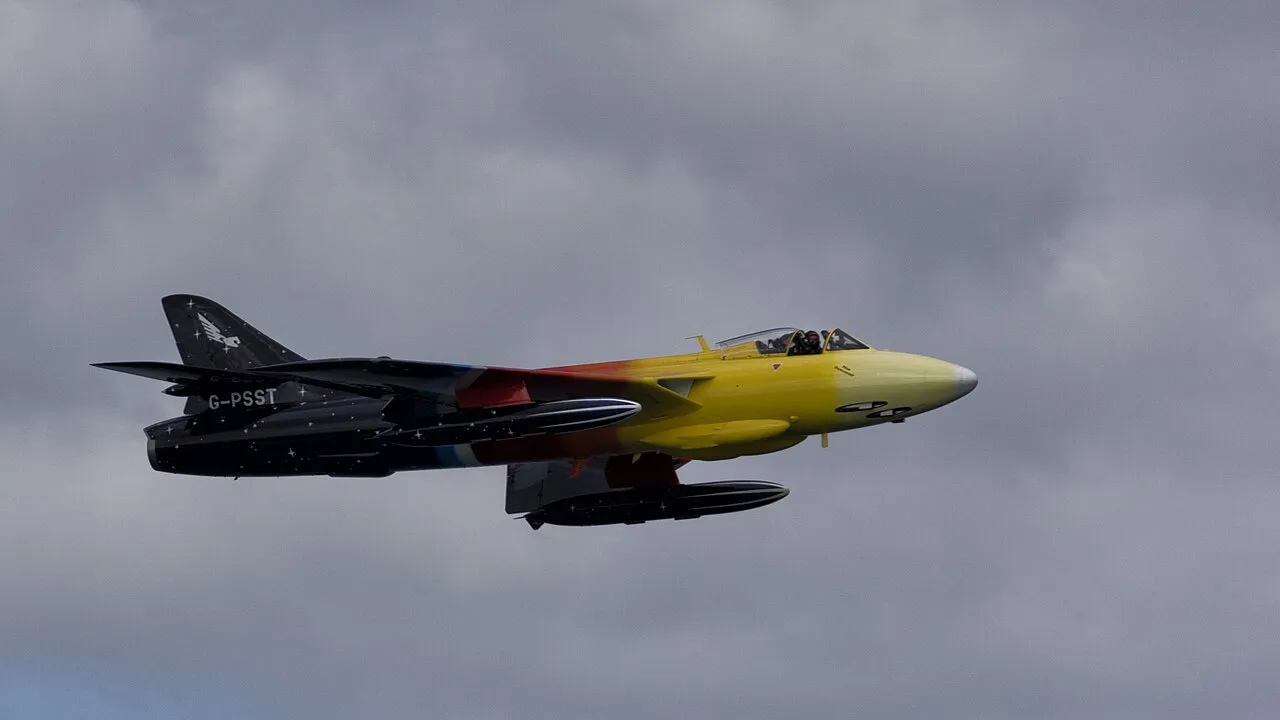
For sixteen years she was the most photographed privately owned jet in Britain: a Hawker Hunter painted banana yellow at the nose, fading through red and blue into deep-space black at the tail, with a scatter of stars down the fuselage. Airshow crowds called her Miss Demeanour. On Tuesday evening she went into the Pacific Ocean about five miles off Morro Bay, California, wearing grey camouflage and an American civil registration.
The pilot got out. The jet did not.
At roughly 6:50 p.m. local time on 22 September, the aircraft — an MK-58 Hawker Hunter registered N345AX and flown by the adversary-air contractor ATAC — lost thrust from its single Rolls-Royce Avon. On air traffic control audio captured by LiveATC.net and reported by ABC News, the call was as unambiguous as they come: “Mayday, mayday, mayday. I have lost thrust in my engine.”
Kurzinfo
| Flugzeug | Hawker Hunter F.58A / MK-58, registration N345AX |
| Operator | Airborne Tactical Advantage Company (ATAC), a Textron subsidiary |
| Mit Sitz in | Naval Air Station Point Mugu, California |
| Wann | Tuesday 22 September 2026, approximately 6:50 p.m. local |
| Wo | Roughly five to six nautical miles northwest of Morro Bay, California |
| Ursache | Loss of thrust from the single Rolls-Royce Avon turbojet; under investigation |
| Crew | One pilot, ejected, recovered by the US Navy, no significant injuries |
| Rettung | Station Search and Rescue Lemoore, MH-60S Seahawk |
| Former identities | RAF XF947, Swiss Air Force J-4104, G-PSST “Miss Demeanour” |
| Status | Aircraft destroyed; NTSB and FAA investigating; ATAC Hunter fleet grounded |
Mayday Off Morro Bay
The sortie began and was supposed to end at Point Mugu, ATAC’s main West Coast base on the Ventura County shoreline. Instead the Hunter came down in open water off San Luis Obispo County, well after sunset.
The Coast Guard says it was notified of a downed aircraft about six miles northwest of Morro Bay at roughly 7:07 p.m., and dispatched a rescue boat from its Morro Bay station. The pilot was already being pulled out by the Navy: Station Search and Rescue Lemoore, which keeps four MH-60S Seahawks on call for exactly this, ran an open-ocean recovery in the dark and flew him to a hospital in Fresno. According to the NTSB, he ejected.
By Wednesday, ATAC was able to say he had walked away from it.
The aircraft itself has not been so easy to account for. The Coast Guard reported finding no jet and no wreckage on the night, and mariners were asked to watch for debris and report any pollution to Sector Los Angeles-Long Beach. A Hunter that hits the Pacific at night five miles offshore does not leave much on the surface to find.
She Used to Be the Most Famous Hunter in Britain
Strip away the grey paint and N345AX has one of the longest CVs in the business. Hawker built her at Blackpool in 1956 as an F.4, serial XF947, and the RAF sent her to 3 (Fighter) Squadron at Geilenkirchen in West Germany, then to 229 Operational Conversion Unit at Chivenor. Her flying career with the RAF was short. She finished as a ground instructional airframe, numbered A2568, with the Fleet Air Arm at Arbroath.
That should have been the end. Instead Hawkers bought her back in 1971, rebuilt her as an F.58A, and sold her to Switzerland, where she entered service in February 1972 as J-4104 and spent most of the next quarter-century towing targets. The Swiss retired her in 1996.
In 1997 Jonathan Whaley bought her and put her on the British civil register as G-PSST — Personal Super Sonic Transport, which is the kind of joke you make when you own a Hunter. Jet Heritage restored her at Bournemouth. Then, over the winter of 1998 and 1999, she got the paint job that made her famous: a nose-to-tail re-entry burn, yellow through orange and red into a starfield. She became Miss Demeanour, and for the next decade and a half she was almost certainly the hardest-working privately owned warbird in the United Kingdom, on the circuit nearly non-stop from 1999 to 2015.

What ended it was not an accident but arithmetic. Her engine was time-expired and she went up for sale in 2014. The following year the Shoreham disaster grounded British Hunters and left the survivors facing maintenance requirements that made private operation close to impossible. No European buyer appeared.
She was deregistered in 2017 and sold to Lortie Aviation of Quebec, which leases Hunters out through a subsidiary. By 2019 the starfield was gone, replaced by two-tone grey, and she was back in the air flying contract training for Canadian, American and French forces. Most of the people she flew against in the last seven years of her life had no idea what she used to look like.
Why a 1950s British Fighter Was Still Flying Combat Training in 2026
ATAC was founded in 1994 at Newport News, Virginia, and bought by Textron in 2016. Its business is red air: being the enemy, on contract, so that navy and air force squadrons do not have to burn their own airframe hours and their own pilots playing the bad guy. Its fleet is a museum that goes to war every weekday — Dassault Mirage F1s, IAI Kfirs, eine A-4 Skyhawk, L-39 Albatroses, and the Hunters.
The company is blunt about why the Hunter earns its place.
That is the whole argument for flying a seventy-year-old design in 2026. The Hunter is fast enough to be a credible transonic threat, docile enough to be flown precisely and cheaply, and there are still enough airframes and Avon engines in the world to keep a fleet going. A Navy public information officer told ABC News that ATAC currently operates 22 of them.

Two Hunters in Twelve Months
This is the second time in a year that an ATAC Hunter has lost power and gone into the sea off California. The Aviationist, which reported both, notes that in the October 2025 case the pilot was also recovered alive. Two power losses in twelve months on the same type, with the same operator, in the same stretch of ocean, is the sort of pattern that gets a fleet stopped.
It did. The Navy grounded ATAC’s Hawker Hunters while the mishap is investigated, a decision Rupp described as standard practice and one ATAC supported. The NTSB and the FAA are both investigating.
There is one wrinkle worth flagging, because it will confuse anyone checking the paperwork. FAA records list the aircraft as 53 years old, which dates it from the early-1970s rebuild that turned her into an F.58A. The airframe itself left the Hawker factory in 1956. Both numbers are true; they just measure different things.
What Is Actually Gone
Aircraft are written off every week and most of them are interchangeable. This one was not. There was exactly one Miss Demeanour, and for a generation of British airshow-goers she was the jet you pointed at and the paint scheme you tried to describe to people who had not been there.
The starfield came off in 2019. The aeroplane underneath it kept flying for another seven years, doing serious work, until an engine quit over cold water after dark and a pilot pulled the handle and lived. As endings for seventy-year-old fighters go, that one is close to the best available.
Miss Demeanour displaying at the Duxford Autumn Airshow in 2013, in the colours that made her famous.
Sources: ABC News; KSBY; CBS Los Angeles; the Federal Aviation Administration; the Aviation Safety Network; Thunder & Lightnings; the Warbird Registry; DVIDS; The Aviationist.


Nice write-up Joseph