
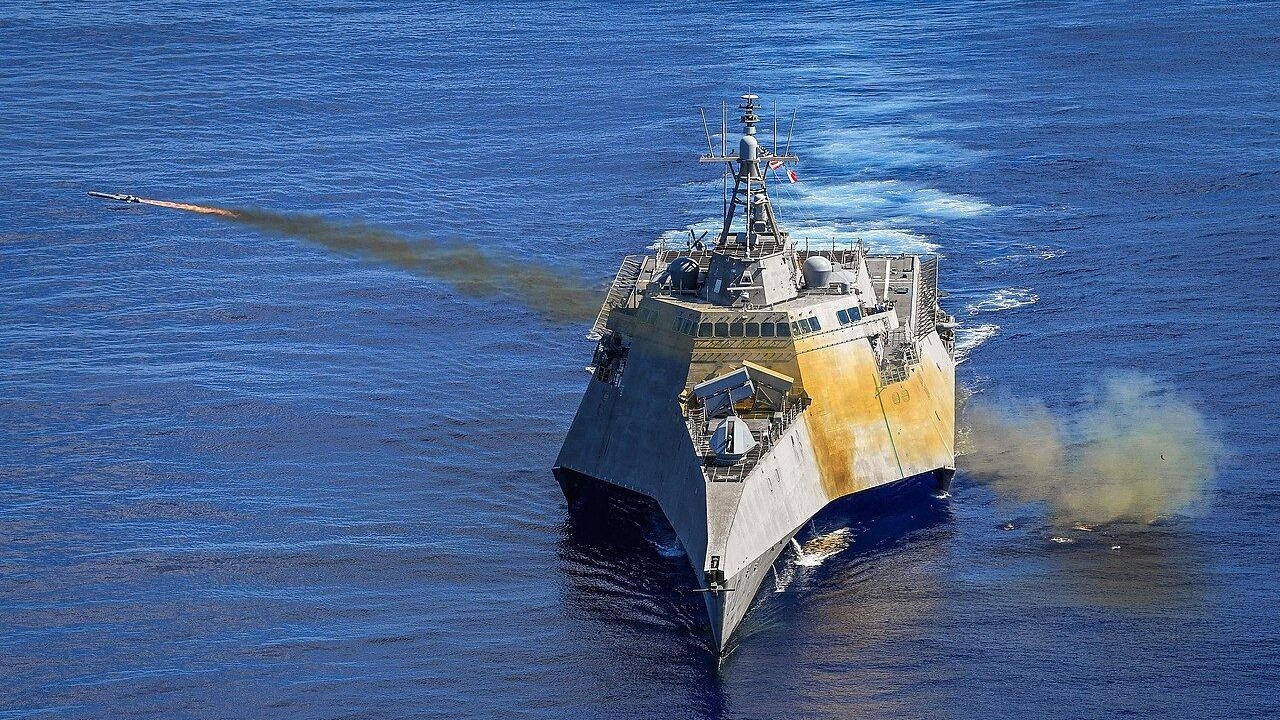
Ten years ago tonight, at about seven in the evening on 9 October 2016, the destroyer USS Mason was north of the Bab el-Mandeb strait in the Red Sea when two missiles came off the Houthi-held coast of Yemen. Mason fired two SM-2s and an Evolved SeaSparrow, and threw out a Nulka decoy that hovers in mid-air pretending to be a ship. Neither missile hit. A decade on, nobody has publicly said which of those layers did the work.
That uncertainty is the best introduction to the subject there is. An anti-ship missile has to find one moving hull in a featureless ocean, minutes after launch, while that hull is doing everything it can to look like something else. The defender only has to make it choose wrong once.
So how does it choose? Anti-ship missile guidance is not one trick but a relay of them: a launch solution handed over by the shooter, a long blind cruise, a seeker that wakes up late, and a last few seconds in which the missile decides what it is looking at. Each stage solves a problem the previous one creates.
Datos rápidos
The three phases: Launch with a target position or bearing, mid-course navigation by inertial and GPS with optional datalink updates, terminal homing on the missile’s own seeker
Active radar seekers: Harpoon, Exocet: the missile transmits and homes on the echo; works in any weather, but the ship can hear it coming
Imaging infrared seekers: NSM, JSM, LRASM: passive, emit nothing, compare a heat picture of the target against an onboard library to pick a specific ship and aimpoint
Why fly low: From a radar 30 m above the sea, a missile 5 m above the waves stays below the horizon until roughly 32 km out, under two minutes at high subsonic speed
Harpoon pop-up: Block 1 climbed to about 1,800 m before diving on the target; Block 1B dropped it for a sea-skimming finish; Block 1C made it selectable
Ship defences: Area missiles such as SM-2, point-defence missiles such as ESSM, guns such as the 4,500-round-per-minute Phalanx, and soft kill: chaff and the hovering Nulka decoy
The shooter does the finding
The first thing to understand is that an anti-ship missile rarely finds its target from scratch. Something else found it first: a maritime patrol aircraft, a ship’s radar, a submarine’s sonar, a satellite, an intercepted transmission. The launch platform turns that into a firing solution and loads it into the missile before it leaves the rail.
The trouble is that the solution goes stale the moment the missile fires. A subsonic missile cruising at around 300 metres per second needs roughly eleven minutes to cover 200 km. A warship at 30 knots moves about ten kilometres in that time, in a direction nobody can predict. Whatever the missile was told at launch, the ship will not be there when it arrives.
Mid-course guidance is therefore about getting to the right neighbourhood, not the right spot. Early missiles flew on inertial navigation alone, gyroscopes and accelerometers counting every turn and push since launch. Ship-launched Harpoon Block 1C could already be given waypoints before launch, so it could approach from an unexpected direction, and Block II added a GPS-aided inertial unit borrowed from the JDAM bomb kit for accuracy near coastlines. Newer weapons add a datalink, so the shooter or a third party can update the target’s position in flight. Harpoon Block II+ has one; the Joint Strike Missile has a two-way link.
A long-form guide to the anti-ship cruise missile and how the weapon class evolved.
Waking the seeker
At some point the missile has to stop navigating and start looking. When it does that is one of the most important tactical choices in anti-ship missile guidance.
The original Harpoon shows the trade-off cleanly. In its standard mode the missile cruised low and switched on its active radar seeker at a preset distance from the target’s expected position. The operator could set that switch-on point nearer or farther. Late activation gives the target’s electronic support gear less warning and less time to jam, but demands a more precise target location. Early activation forgives a sloppy fix, and hands the defender a longer warning.
There was also a Bearing-Only Launch mode for when the shooter knew roughly where the enemy was but not how far away. The missile was fired down a bearing with its radar on from the start, sweeping 45 degrees either side of its track. If it found nothing, it destroyed itself. A planned Block 1D was to add a cloverleaf search pattern to keep hunting until its fuel ran out. It was cancelled in 1993.
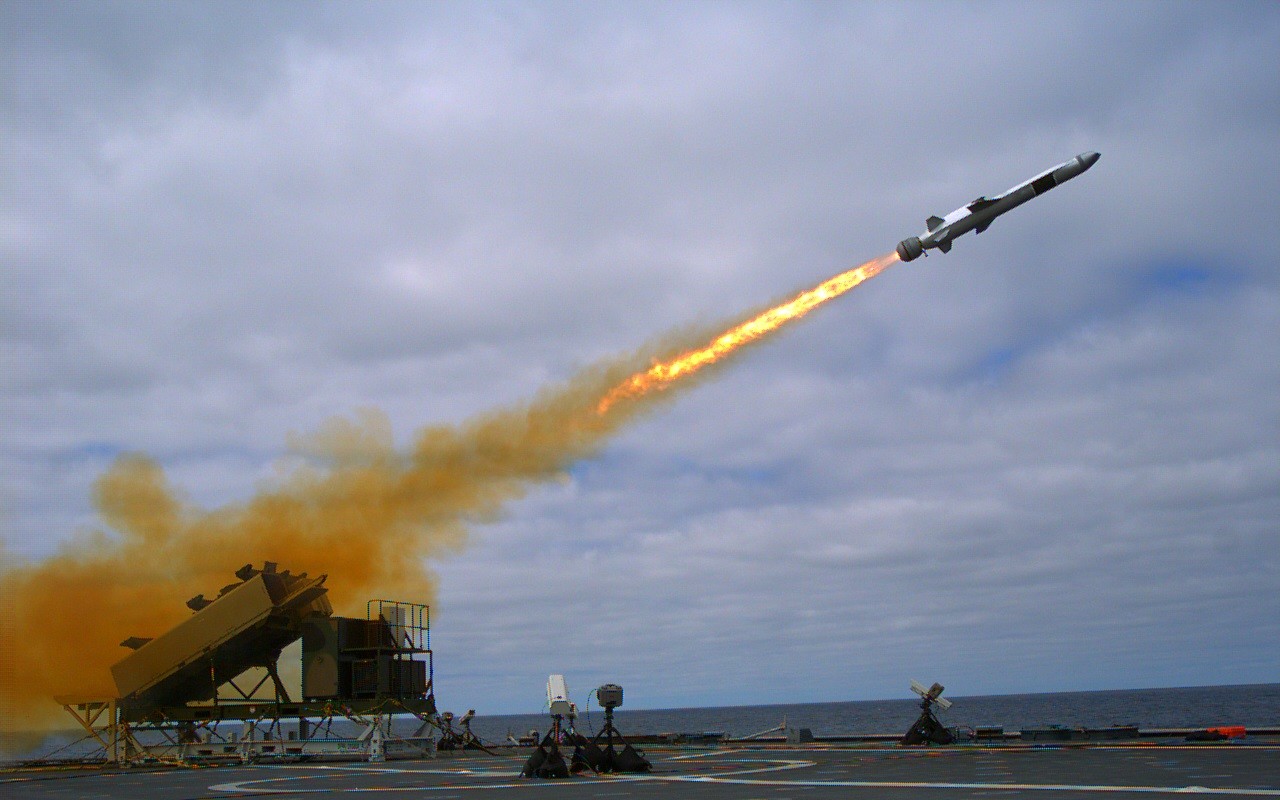
Whatever the mode, the seeker opens a window in front of the missile, sometimes called the acquisition basket, and everything inside that window becomes a candidate. That is where the real problem starts. The ocean is mostly empty, which sounds like good news for the missile until you realise that it makes every object it does find look like a target.
Active radar: shouting at the sea
Exocet and Harpoon both use active radar homing. The missile carries a small radar in its nose, transmits, and steers towards the strongest suitable echo. Exocet is guided inertially in mid-flight and switches on its radar only late in the flight, which keeps it quiet for as long as possible.
From the seeker’s point of view a warship is spectacularly easy to see. It is a pile of flat steel surfaces, right angles and masts sitting on a sea that, at low grazing angles, scatters much of the radar energy away. A 1973 Naval Research Laboratory study found that the median radar echo of a ship grows with its displacement, and for warship-sized hulls the figures run into the thousands to tens of thousands of square metres. If you want a refresher on why that matters for detection range, Afterburner’s explainer How Does Radar Work? covers the basics.
The weakness is that a radar seeker cannot tell you whose ship it is looking at, only that something large is there. And it announces itself. The moment it starts transmitting, every warship in range with an electronic support receiver knows a radar-homing missile is inbound and roughly where from.
The Falklands War showed both sides of that coin. On 25 May 1982 two air-launched Exocets were fired at British warships. By most accounts, including the analysis published by GlobalSecurity, chaff fired by the frigate HMS Ambuscade pulled the missiles off. They flew through the cloud, their seekers searched again, and found the next large echo in the basket: the container ship Atlantic Conveyor, loaded with helicopters. Both hit. Twelve men died. The seeker had done exactly what it was designed to do.
MBDA’s own film of the Exocet MM40 Block 3, which added GPS waypoints so the missile can approach a target from a chosen direction.
Exocet has since moved on. The Block 3 accepts GPS waypoints so it can attack from different angles, and the newer Block 3c variant adds a digital radio-frequency seeker developed by Thales, reported to be more resistant to jamming and able to discriminate between surface vessels using advanced waveforms. The theme of every modern upgrade is the same: not seeing the ship, but knowing which ship it is.
Passive eyes: imaging infrared
The answer several Western designers have chosen is to stop transmitting altogether. Kongsberg’s Naval Strike Missile and its air-launched sibling, the Joint Strike Missile, use an imaging infrared seeker. So does Lockheed Martin’s AGM-158C LRASM, whose sensor package was designed by BAE Systems.
An imaging infrared seeker does not see a hot dot, the way an early heat-seeker did. It sees a picture: the shape of the hull, the superstructure, the funnel, the heat signature of the machinery spaces, all in thermal contrast against cooler water. Software compares that picture against an onboard library of ship classes, decides whether the target is the right type, and then picks an aimpoint on it. NSM combines its seeker with an onboard target database for exactly this, and the JSM adds passive radio-frequency homing for radar-emitting targets. Our earlier piece How a Heat-Seeking Missile Works explains the seeker physics; the anti-ship version is the same idea with far more processing behind it.
Two advantages follow. A passive seeker gives the target no radar emission to detect, so the electronic warning that saved so many ships from radar-guided missiles never comes. And it is immune to radio-frequency jamming, because there is no radio receiver to jam. LRASM adds a passive electronic support package that listens for enemy radars along the route, so it can steer around defences before the seeker ever opens its eyes.
DARPA demonstrated the principle in August 2013. A B-1 bomber released an LRASM prototype over the Point Mugu Sea Range; about halfway to the target area the missile switched from its pre-planned route to autonomous guidance, detected a moving 260-foot target ship on its own and guided itself into the desired location on it.
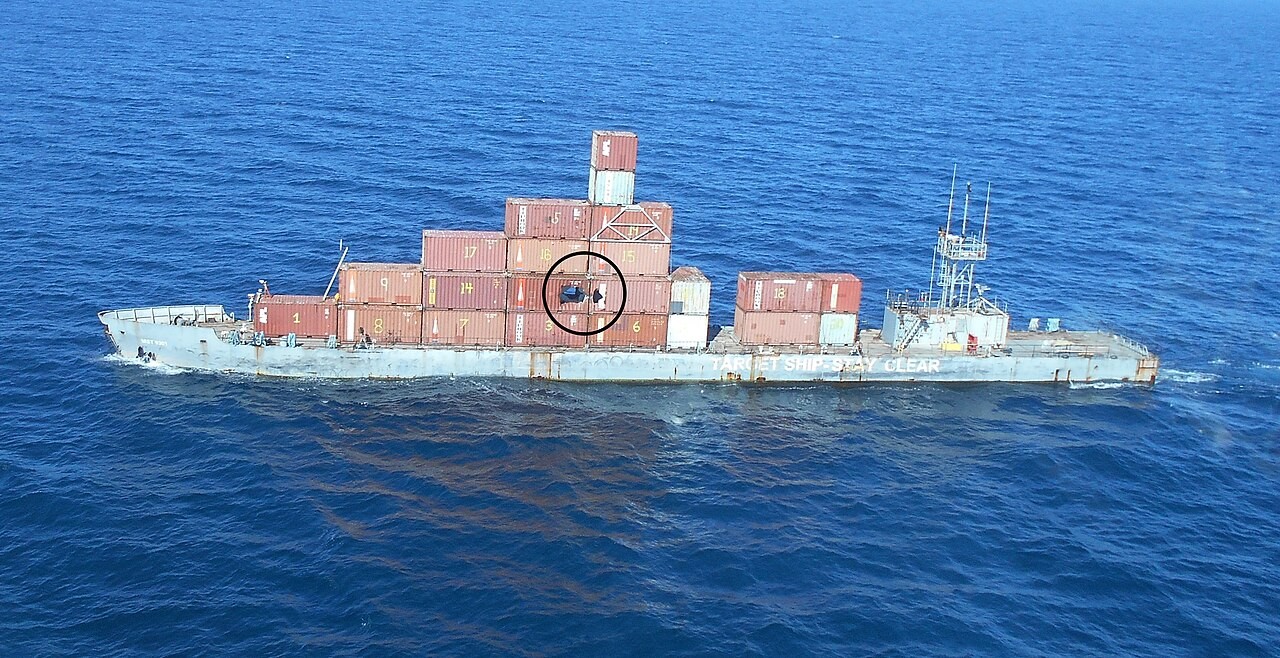
BAE Systems, which built that sensor, put the point of the test in one sentence.
Infrared has limits. It generally sees less far than radar, and fog, heavy rain and spray degrade a thermal picture. That is one reason the classification software and the mid-course updates matter so much: the seeker has to be pointed at the right patch of sea before it opens. The same family of seekers now arms the F-35, as we covered in Un destructor de barcos que cabe dentro del F-35, and the Royal Navy recently used NSM to help sink the former USS Klakring, as reported in Sea Venom and NSM: Royal Navy Sinks Ex-USS Klakring.
Navy Lookout’s video of a Naval Strike Missile test firing.
Low and fast, or high and steep
How the missile flies the last few kilometres is as important as how it sees. The classic answer is sea-skimming: cruise a few metres above the waves and stay below the radar horizon of the target ship for as long as physics allows.
The geometry is unforgiving for the defender. Using the standard radar-horizon formula with the usual four-thirds Earth radius for atmospheric refraction, a radar 30 metres above the waterline and a missile 5 metres above the sea can first see each other at about 32 km. At roughly 300 metres per second, that leaves around 100 seconds from first detection to impact, and much less if the radar is lower, the missile flies lower, or waves and spray hide it in the clutter.
The alternative is the pop-up. The original Harpoon finished its run with a climb to about 1,800 metres before diving on the target, which gives the seeker a better look and drives the warhead down through the deck rather than into the side. The penalty is exposure: a missile that climbs is a missile the ship’s radars can see. The Block 1B deleted the pop-up for a pure sea-skimming finish, and the Block 1C let the crew choose. NSM goes a different way, flying over and around land if needed and then making random manoeuvres in the terminal phase to spoil the defender’s aim.
Why a ship is both easy and hard to hit
Easy, because a warship is enormous, slow by missile standards, hot, metallic and alone on a flat surface. There is no terrain to hide behind and no way to stop being a ship.
Hard, for three reasons. First, finding it at all at long range needs someone else’s sensors, and those sensors are themselves targets. Second, the sea is rarely as empty as it looks: a seeker opening its basket near a task force may see escorts, auxiliaries, merchant ships and fishing boats, and choosing the wrong one wastes the missile or worse. Third, the ship shoots back, and seduces.
The defence: shoot, seduce, survive
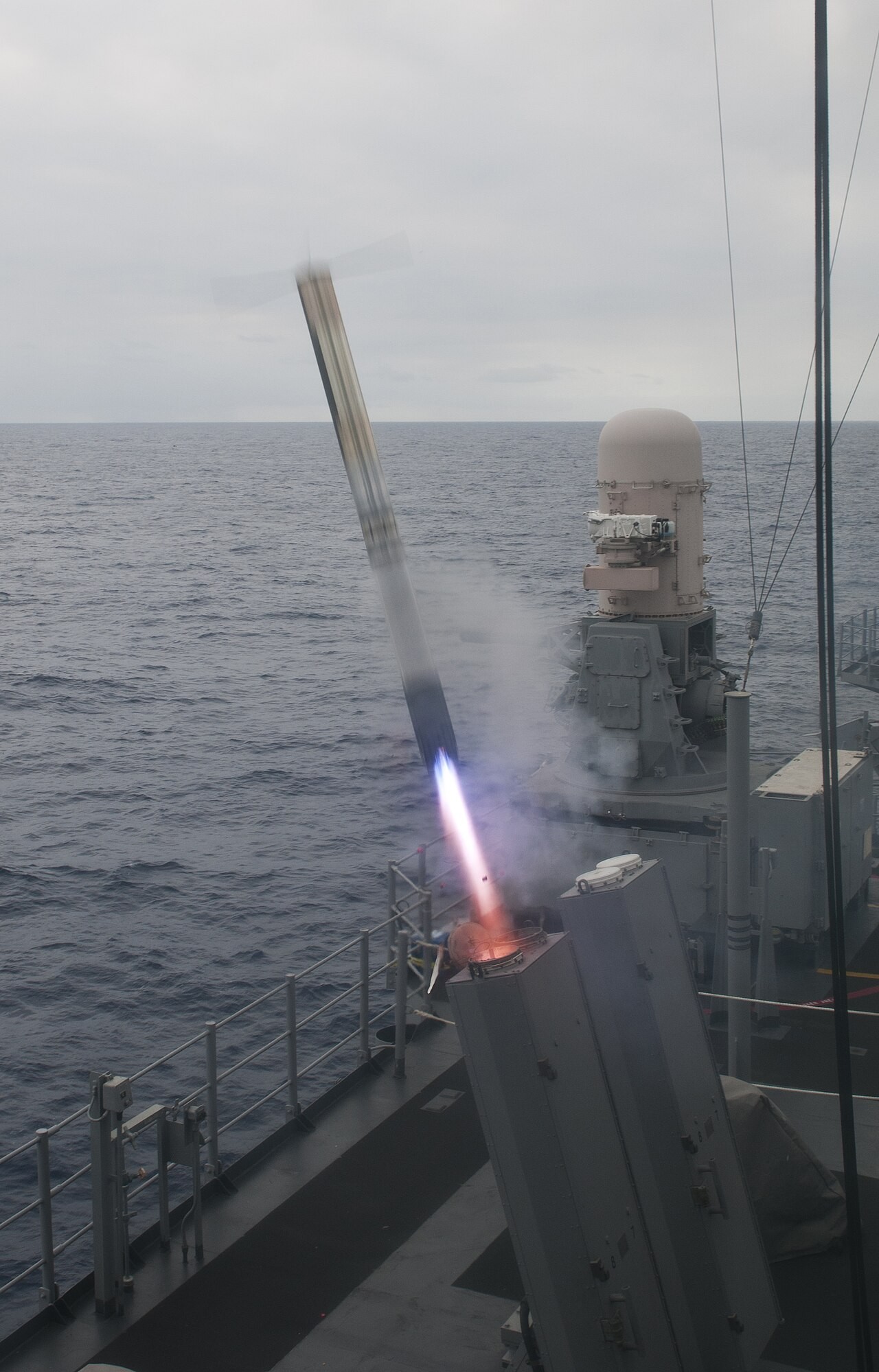
A modern warship’s defences are layered to match the missile’s phases. Long-range area missiles such as SM-2 try to kill the shooter or the missile far out. Point-defence missiles such as ESSM take over closer in; the Block 1 uses semi-active radar homing, the Block 2 adds an active seeker, and four of them fit in a single Mk 41 launch cell. The last ditch is a gun. Phalanx pairs a 20 mm six-barrel M61 Vulcan with its own Ku-band radar and an infrared camera, fires up to 4,500 rounds per minute, and is designed for the final kilometre or two.
Soft kill works on the seeker rather than the airframe. Chaff fills the radar basket with false echoes. Nulka, designed in Australia and built by what is now BAE Systems Australia, goes further: it is a rocket that hovers alongside the ship, transmitting a signal designed to look, to a radar seeker, like a more attractive target than the real ship. By July 2017 it had been fitted to more than 150 Australian, Canadian and US warships.
None of it works if it is switched off. On 17 May 1987 an Iraqi aircraft, long reported as a Dassault Mirage F1, fired two Exocets into the frigate USS Stark in the Persian Gulf. Her Phalanx was in standby and her decoy launchers were not armed. Thirty-seven sailors were killed. The questions that still surround that night are the subject of Nadie se pone de acuerdo sobre qué atacó a los Stark..
Five years earlier, the destroyer HMS Sheffield had been hit by an AM39 Exocet launched from an Argentine Super Étendard, and twenty of her crew died. The Falklands Exocet campaign, from Sheffield to Atlantic Conveyor, is told in Tres misiles Exocet que aterrorizaron a la Marina Real..
BAE Systems Australia on the history of Nulka, the hovering rocket that pretends to be a ship.
Back to the Red Sea
Which brings us back to USS Mason. Sources quoted by USNI News confirmed the decoy launch alongside the three interceptors. The Pentagon said the second missile fell into the sea without being struck; whether the first was killed by an SM-2, lured by Nulka or simply failed has never been publicly settled.
That is the honest shape of the contest. Anti-ship missile guidance keeps adding layers of judgement: GPS waypoints to choose the approach, datalinks to refresh a stale fix, passive seekers to stay silent, and target libraries to tell a destroyer from a tanker. Ship defence keeps adding layers of doubt. The missile has to be right once, at the very end. The ship only has to make it hesitate.
Sources: DARPA news release on the first LRASM flight test, September 2013; BAE Systems release via Army Recognition, 10 September 2013; Designation-Systems.net, Boeing AGM/RGM/UGM-84 Harpoon; Wikipedia articles Harpoon (missile), Exocet, Naval Strike Missile, Joint Strike Missile, AGM-158C LRASM, Phalanx CIWS, RIM-162 ESSM, Nulka, Radar horizon and SS Atlantic Conveyor; Skolnik and Shaddix, NRL Memorandum Report 2548, 1973; USNI News, 11 October 2016; TWZ on USS Mason, October 2016, and on the B-2 LRASM SINKEX, 29 June 2026; Military.com, 11 October 2016; GlobalSecurity.org, Exocet combat record; U.S. Navy release on USS Gabrielle Giffords and NSM, 1 October 2019.


0 Comments