
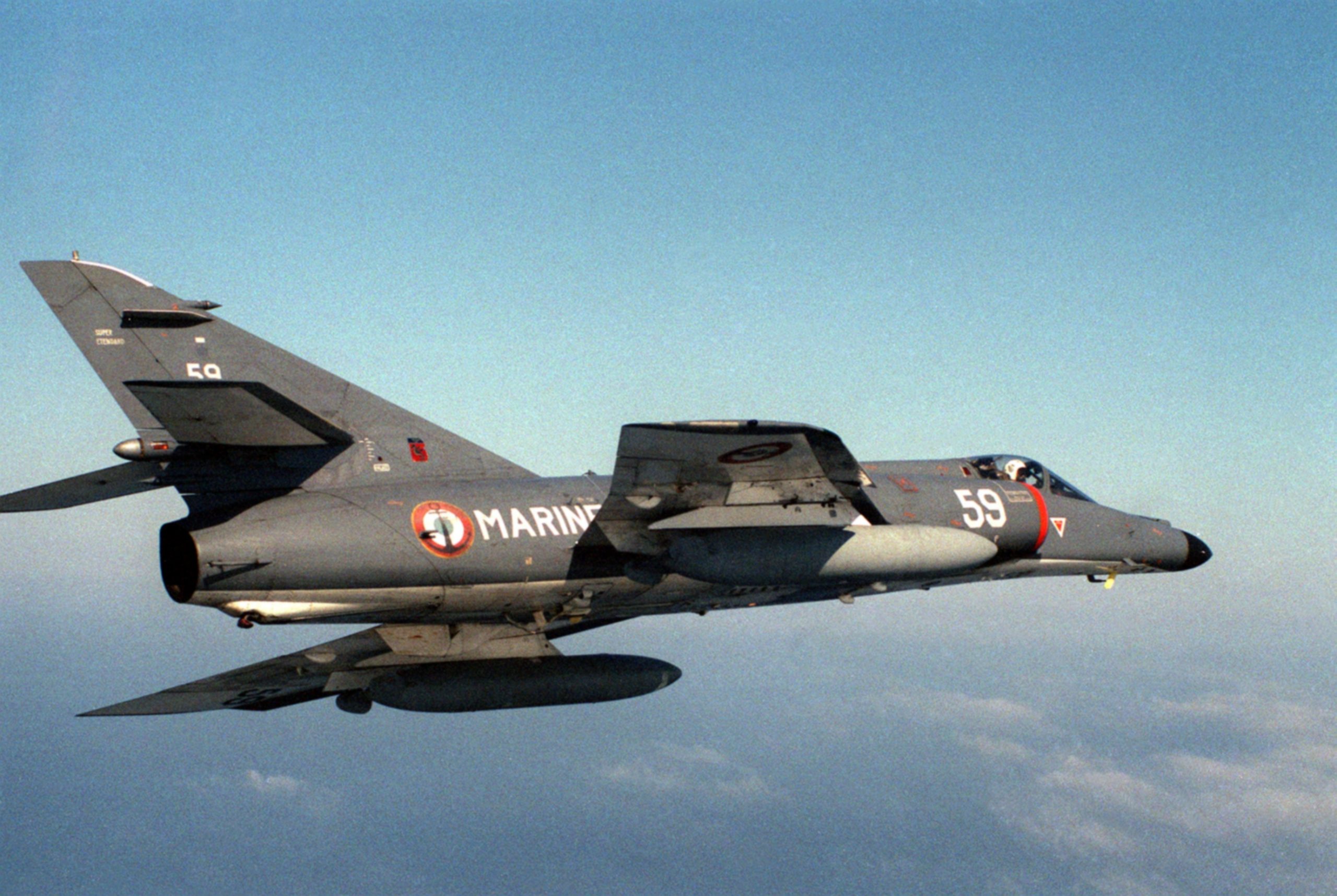
Dassault Super Étendard
The Exocet Striker
A compact French carrier-borne strike fighter that rewrote the rules of naval warfare — the jet whose AM39 Exocet missiles sank HMS Sheffield and the Atlantic Conveyor in the 1982 Falklands War, and which France flew from its carriers for nearly four decades.
The little strike jet that sank a warship
In the early 1970s the French Navy needed a new carrier aircraft to replace its ageing Étendard IV. It first looked at a navalised version of the Anglo-French SEPECAT Jaguar, but the marinised Jaguar M proved troublesome, and in 1973 the Aéronavale turned instead to Dassault’s proposal for a modernised development of its own Étendard IV. The result was the Super Étendard — broadly similar in shape to its predecessor but with a new wing, an uprated non-afterburning SNECMA Atar 8K-50 engine, and, crucially, modern attack avionics built around the Thomson-CSF Agave radar.
The prototype first flew on 28 October 1974, and the type entered French naval service in 1978. On paper it was unremarkable: a subsonic, single-engined, single-seat jet weighing about 12 tonnes fully loaded. What made it matter was the weapon it was designed to carry — the Aérospatiale AM39 Exocet sea-skimming anti-ship missile. Together, the Agave radar and the Exocet turned a modest carrier jet into a ship-killer that could strike from beyond a target’s horizon.
That combination was proven in the most dramatic way possible in 1982, when Argentina’s tiny force of Super Étendards used Exocets to sink two British ships in the South Atlantic. The jet went on to serve France over Lebanon, Bosnia, Kosovo, Afghanistan, Libya, Iraq and Syria, and to carry France’s airborne nuclear deterrent, before it was finally retired from carrier decks in 2016.
01Why France built the Super Étendard instead of a navalised Jaguar
The Super Étendard exists largely because a different aircraft failed. In the late 1960s France planned to replace its Étendard IV carrier jets with a marinised version of the SEPECAT Jaguar — the Jaguar M. But carrier trials exposed handling and engine-response problems, and the programme became entangled in cost and industrial politics. In 1973 the Aéronavale cancelled the naval Jaguar and accepted Dassault’s cheaper, lower-risk alternative: an updated Étendard IV. Because it reused a proven airframe layout, the Super Étendard could be fielded quickly — but it also inherited the older jet’s modest, subsonic performance. Dassault built roughly 85 of them, 71 for France and 14 for Argentina.
What makes it special
The Exocet & Agave radar ship-killer
The Super Étendard’s reason for being was the AM39 Exocet anti-ship missile. Its nose-mounted Thomson-CSF Agave radar could detect a ship at long range, hand off target coordinates to the missile, and let the pilot launch from tens of kilometres away. The Exocet then dropped to just a few metres above the waves and flew on its own radar to the target — a “fire-and-forget” sea-skimmer that gave a small jet the reach to sink a warship.
Built for the carrier deck
Everything about the airframe was shaped by the cramped decks of France’s Clemenceau-class carriers. It had folding wingtips to save hangar space, a reinforced structure and arrestor hook for catapult launches and arrested landings, and high-lift slats and flaps to keep approach speeds low. Compact and rugged rather than fast, it was optimised to operate reliably from a small deck at sea.
One modest engine — and a nuclear role
Power came from a single SNECMA Atar 8K-50 turbojet of about 49 kN — and, unusually for a fighter, it had no afterburner, capping the jet at around Mach 1. What it lacked in speed it made up in versatility: later upgrades let it carry laser-guided bombs, the AS-30L missile and the ASMP nuclear stand-off missile, making it a carrier-based leg of France’s nuclear deterrent.
02The Super Étendard Modernisé: a 1970s jet dragged into the digital age
By the 1990s the original Super Étendard was badly dated, and France could not yet field its replacement. Rather than retire the fleet, the Navy launched the Super Étendard Modernisé (SEM) upgrade. Around 50 airframes received a new central computer, a modern Thomson-CSF Anemone multi-mode radar with roughly double the range of the old Agave, a redesigned HOTAS cockpit, and later additions such as GPS-aided navigation, night-vision-goggle compatibility, improved countermeasures and the Damocles laser-designation pod. The SEM transformed a dedicated anti-ship jet into a flexible precision-strike and reconnaissance platform that stayed useful over Afghanistan and Libya into the 2010s.
03How a subsonic jet sinks a warship: the Exocet attack profile
The Super Étendard never needed to be fast, because the Exocet did the fighting. A typical attack saw the jet fly low to stay under the enemy’s radar horizon, pop up briefly to sweep with the Agave radar and fix the target’s position, feed those coordinates into the missile, then launch and turn away — often without ever seeing the ship. The AM39 dropped to sea-skimming height and closed at high subsonic speed, appearing on a defender’s radar only in the final seconds. Against warships not braced for it, that left almost no time to react — the lesson the Royal Navy learned the hard way in 1982.
Full specifications
Baseline note: the figures below describe the Dassault Super Étendard as delivered to the French Navy from September 1978 and to Argentina from 1981 — a single-seat carrier strike aircraft built around one non-afterburning SNECMA Atar 8K-50 of 49 kN, Thomson-CSF Agave radar, an inertial navigation and attack system, and clearance for the Aérospatiale AM39 Exocet anti-ship missile. It is the right baseline because every one of the 85 production aircraft left Bordeaux-Mérignac in that configuration, and because it is the standard the aircraft was in on 4 May 1982, the day it made its name. Deltas for the Super Étendard Modernisé (SEM) of the 1990s and 2000s — Anemone radar, UAT-90 computer, laser designation, night vision — and for the Argentine aircraft are in grey. Four warnings before the numbers. First: this is not the Étendard IV. Dassault sold the programme to the French government in 1973 as a modest, low-risk reworking of the existing Étendard IVM, and commonality figures of the order of ninety per cent were quoted at the time. What was delivered shared much less than that: a different engine, a new wing with new high-lift devices, a new nose housing a radar built to find ships, a new nav-attack system and a heavier structure. Roughly the only major items carried straight across were the two 30 mm cannon and the general shape. Figures from an Étendard IV table do not belong here, and figures from this table do not belong there. Second, the speed. Published maxima split into two clusters: about 1,180–1,205 km/h near sea level, which is close to Mach 0.97, and Mach 1.3 at 11,000 m, which several reference works repeat without qualification. A 49 kN dry turbojet hauling a twelve-tonne airframe with a 45-degree wing does not hold Mach 1.3 in level flight; the high figure describes a dive or a very light, very clean aircraft, and the Super Étendard should be understood as a high-subsonic aeroplane. In the strike role it spent its working life below 500 kt at low level anyway. Third, the weights. Empty weight appears as 6,450 kg or 6,500 kg and maximum weight as 11,500 kg or 12,000 kg, the difference being whether the source is quoting a catapult limit or a land-runway limit; the higher pair is used here and the lower pair is noted in the rows. Fourth, the SEM count. The number of French airframes modernised is given as 47, 48 or 53 in otherwise reputable sources, because each figure counts a different standard at a different date. Where a single number is needed, about fifty is the honest answer.
Dimensions & weights
- Crew
- 1 (there was never a two-seat Super Étendard. French and Argentine pilots converted on the Étendard IVM and on simulators, which is part of why the Argentine squadron of 1982 was so thinly worked up: its pilots had a few dozen hours each on type and none of them had ever fired an Exocet)
- Length
- 14.31 m (46 ft 11 in) — a little over 90 cm longer than the Étendard IVM, almost all of it in the reprofiled nose that had to swallow the Agave radar
- Wingspan
- 9.60 m (31 ft 6 in), a shade over the Étendard IV’s. This is a very small aeroplane: an F-4 Phantom II spans nearly two metres more and weighs twice as much empty
- Wingspan, wings folded
- 7.80 m (25 ft 7 in). The outer panels fold hydraulically at roughly the mid-span; the saving of 1.80 m is modest, but on a Clemenceau-class deck of 265 m every metre of parking was fought over
- Height
- 3.86 m (12 ft 8 in); 3.85 m is also published and the difference is measurement convention, not a design change
- Wing area
- 28.4 m² (306 sq ft)
- Wing geometry
- 45° of sweep at the quarter chord, with leading-edge droop and double-slotted trailing-edge flaps. The high-lift system is the reason a 12-tonne aeroplane with 423 kg/m² of wing loading could be brought aboard at all, and it is one of the genuinely new pieces of engineering the programme delivered
- Empty weight
- 6,500 kg (14,330 lb). Several reputable tables give 6,450 kg (14,220 lb); the spread is about one per cent and probably reflects different equipment fits rather than a real disagreement
- Maximum take-off weight
- 12,000 kg (26,455 lb). The commonly quoted 11,500 kg (25,350 lb) is the catapult figure, and the one that mattered in service — nobody was flying a Super Étendard off a runway on operations
- Internal fuel
- 2,612 kg (5,758 lb). Against a 6,500 kg empty weight that is a respectable fraction on paper, but the Atar 8K-50 is a 1950s-architecture turbojet and drinks accordingly
- External fuel
- up to two 1,100 litre tanks of 879 kg each (242 imp gal / 291 US gal; 1,938 lb), with 600 litre (479 kg) and 625 litre (499 kg) tanks also cleared. On the Exocet mission one 1,100 litre tank was carried purely to balance the missile on the opposite wing, which is an elegant answer to an awkward problem
- Maximum external load
- ~2,100 kg (~4,630 lb) across six hardpoints, four underwing and two under the fuselage. It is a paper maximum: with fuel occupying at least one station, a realistic strike fit was two 250 kg bombs or one guided weapon plus a pod, and the type never in its life carried anything close to two tonnes of ordnance on an operational sortie
Performance
- Maximum speed, sea level
- 1,180–1,205 km/h (733–749 mph; 637–651 kt), about Mach 0.97 — the honest number, and the one the aircraft actually flew to
- Maximum speed, 11,000 m
- Mach 1.3, about 1,380 km/h (857 mph; 745 kt). Repeated without qualification in most reference works, and not believable as a level-flight figure for a 49 kN dry turbojet; read it as a dive or as a number inherited from Étendard IV literature. See the baseline note
- Service ceiling
- 13,700 m (44,900 ft), which is more than the aeroplane ever needed. Its working altitude on a strike sortie was measured in tens of metres
- Rate of climb, sea level
- 100 m/s (19,700 ft/min) — unremarkable, and achieved clean. With an Exocet and a tank the aeroplane is a considerably duller performer
- Combat radius, anti-ship
- ~850 km (~530 miles; ~460 nmi) on a hi-lo-hi profile with one AM39 Exocet and one 1,100 litre tank. The Argentine sorties of 1982 exceeded this and could only do so with KC-130H tanker support in both directions
- Combat radius, low-level strike
- ~650 km (~400 miles; ~350 nmi) is the figure usually given for an all-low profile with iron bombs, but French Navy planning figures have not been published and any number of this kind is an estimate
- Ferry range
- 1,820 km (1,130 miles; 980 nmi)
- Endurance
- 1 hr 45 min clean, up to 2 hr 15 min with drop tanks. Over Afghanistan in the 2000s this was the binding constraint on every mission the type flew, and the reason SEM sorties were routinely tanked by American KC-135s and KC-10s
- Fuel fraction
- 2,612 kg internal against a 12,000 kg maximum — about 22 per cent, low by the standards of any strike aircraft designed since. Almost every operational sortie in the type’s 38-year career gave up at least one pylon to fuel
- Wing loading, maximum weight
- 423 kg/m² (86.6 lb/sq ft) — high for a carrier aircraft, and the number that the leading-edge droop and double-slotted flaps exist to make survivable on the approach
- Thrust-to-weight
- 0.42 at maximum weight, 0.77 empty. For comparison, a contemporary F-14A cleared 0.9 on afterburner; the Super Étendard had no afterburner to reach for and never pretended to be a fighter
- Launch and recovery
- steam catapult launch and arrested landing; cleared for Clemenceau, Foch and, from 2001, Charles de Gaulle (the Argentine aircraft flew from the naval air station at Río Grande in Tierra del Fuego in 1982, not from the carrier Veinticinco de Mayo, whose deck and catapult were marginal for the type and which was withdrawn to port after 2 May)
Propulsion & systems
- Engine
- 1 × SNECMA Atar 8K-50 single-shaft axial turbojet, no afterburner — the last new member of a family that began with German war-surplus work at BMW and ended, in this aircraft, in 2016
- Rated thrust
- 49.0 kN (11,025 lbf) dry
- Engine lineage
- the Atar 9K-50 of the Mirage F1 with the afterburner deleted, the turbine reworked and the accessories navalised. It gave roughly 15 per cent more thrust than the Atar 08 of the Étendard IV on similar fuel flow, and that margin is the single change that made a radar, an inertial system and a 655 kg missile possible on the same airframe
- Radar
- Thomson-CSF Agave, an X-band multifunction set optimised for surface search, ranging and missile targeting, developed from the Cyrano line. It was small enough for a nose this size and it was the first French airborne radar built to hand a target straight to an anti-ship missile — the whole aircraft is arranged around that transaction (SEM: Thomson-CSF Anemone, credited with roughly double the detection range, with better ground mapping and better performance in sea clutter)
- Nav-attack system
- inertial navigation and attack system with a UAT-40 central digital computer and a head-up display — the first French combat aircraft with an integrated inertial nav-attack fit, which is why a single pilot could fly 800 km over featureless ocean at 50 m and arrive where the missile needed him to be (SEM: UAT-90 computer, new displays, HOTAS controls and GPS; Standard 5 added a Fightacs navigation and tactical system and an IDM data modem)
- Self-protection
- Sherloc radar warning receiver, chaff and flare dispensers, and a Barracuda jamming pod carried externally on a pylon that would otherwise hold a weapon (SEM Standard 4 added Alkan 5081 dispensers. There was never an internal jammer, and against a modern integrated air defence the type’s survival argument was terrain, sea clutter and small size)
- Carrier equipment
- hydraulically folding outer wing panels, arrester hook, catapult nose-tow on an extendible nose leg that squats the aircraft into a nose-up launch attitude, strengthened undercarriage and a fixed non-retractable in-flight refuelling probe offset to starboard ahead of the windscreen
- Tanking
- buddy refuelling pack on the centreline, letting one Super Étendard refuel another. Before the E-2C Hawkeye and the Rafale this was the only organic tanking the French carrier air wing had, and a strike package routinely gave up one of its own aircraft to fuel the rest
- Ejection seat
- Martin-Baker Mk 4 in early aircraft, Mk 6 in the modernised fleet — a British seat, and the detail that quietly finished Argentina’s last attempt to fly the type: the cartridges are on the embargo list that London has maintained since 1982
- Nuclear fit
- AN 52 free-fall bomb, a weapon of the order of 15 kt, from the aircraft’s entry into service; replaced by the ASMP stand-off missile, in service on the Super Étendard from 1 June 1989 with Flottille 11F and later 17F (the naval strategic strike role passed to the Rafale M with ASMP-A around 2010, after which the SEM was a conventional aircraft only)
- Gun installation
- two 30 mm DEFA revolver cannon in the lower fuselage sides, 125 rounds each. Inherited essentially unchanged from the Étendard IVM, and one of the very few major items that genuinely did carry across between the two aircraft
04The Super Étendard’s cost: why no clean price exists
The Super Étendard was a French state naval procurement, not a jet sold widely on an open market, so no reliable, consistent flyaway unit price circulates in public sources. Argentina’s 1979 order of 14 aircraft plus missiles is sometimes cited to estimate a per-aircraft figure in the low tens of millions of dollars for the 1980s, but that bundled airframes, weapons, spares and support and should be treated as an order-of-magnitude guide only. No credible cost-per-flight-hour figure for the type exists in open sources. Any exact dollar price you see attached to the Super Étendard is, in practice, an estimate.
Armament & payload
The Super Étendard carried one anti-ship missile at a time, and on 4 May 1982 that was enough to sink a Royal Navy destroyer
The Super Étendard was designed around a single weapon and everything else on the aeroplane was arranged to serve it. One AM39 Exocet hung on the starboard inner pylon, balanced by a 1,100 litre tank to port; the Agave radar existed to find the ship, the inertial system existed to get the aircraft to the launch basket without radiating, and the pilot’s job was to climb briefly, take one radar picture, hand the bearing and range to the missile and turn away. Everything else the type carried — cannon, Magic dogfight missiles, iron bombs, rockets, later laser-guided weapons and a nuclear stand-off missile — was capability added to a hull that had already justified itself. It is a very small aeroplane with a very short weapons list, and that list is the point: 2,100 kg of external load is less than a Second World War Lancaster carried, but one item on the rack could sink a destroyer. Mark and operator variation is severe here. The Argentine aircraft of 1982 were baseline machines with Agave and no laser capability of any kind; French Standard 4 and 5 aircraft of the 2000s carried Damocles pods and GBU-49s that the 1982 airframes could not have used; the Iraqi lease aircraft of 1983–85 were configured for Exocet and effectively nothing else.
Gun
- Two 30 mm DEFA 552 revolver cannon, 125 rounds each, 250 rounds total — the same installation as the Étendard IVM and one of the very few components carried straight across.
- Some sources list the DEFA 553; the two are close relatives of the same revolver family and the distinction rarely matters at reference level.
- Rate of fire of the order of 1,200–1,300 rounds a minute, which at 125 rounds a gun means roughly six seconds of firing.
- Retained on the SEM to the very end, when most contemporaries had given the space to fuel or electronics. It was rarely the reason a Super Étendard was airborne: this is a missile-and-bomb aeroplane, and its combat record contains almost no strafing.
Air-to-air
- Matra R550 Magic and, later, Magic 2 infrared missiles, normally two on the outer wing pylons.
- Self-defence only. There was never a radar-guided air-to-air missile for this aircraft: Agave and Anemone could see an aircraft but could not support a Super 530 or an AIM-7 class weapon.
- The Argentine Exocet sorties of 1982 carried no air-to-air missiles at all. Weight and drag went to fuel and the AM39, and a Super Étendard caught by a Sea Harrier would have had the cannon and nothing else.
- In practice the type’s air-to-air record is empty in both directions: no Super Étendard shot down an aircraft, and none was shot down by one.
Air-to-surface guided
- Aérospatiale AM39 Exocet, one round, sea-skimming, active radar terminal homing, 165 kg warhead, launch range up to about 70 km depending on release altitude and speed. This is the weapon the aeroplane exists for.
- AS-30L laser-guided missile, up to two, carried with the ATLIS II designator pod from SEM Standard 3 in 1997 — the weapon that first gave the type a precision punch against a point target rather than an area.
- ASMP stand-off nuclear missile, one round, ramjet-powered, Mach 2 to 3, TN 81 warhead in the 100–300 kt class, about 80 km reach at low level and several times that from height. In French naval service on the type from 1 June 1989.
- No anti-radiation missile and no television-guided weapon were ever integrated. Against a defended coastline the Super Étendard relied on going low and being small.
Bombs
- SAMP 250 kg and 400 kg general-purpose bombs on the standard French carriage; conventional, unguided, and the type’s daily work over Lebanon and Bosnia.
- BLG-66 Belouga cluster bomb, a 305 kg dispenser of anti-armour and area bomblets.
- GBU-12 Paveway II 500 lb class laser-guided bomb from Standard 3, with GBU-49 and the small GBU-58 added at Standard 5 in 2006 — the weapons it dropped over Afghanistan, Libya and Iraq.
- AN 52 free-fall nuclear bomb, one round, a 15 kt class weapon carried from the aircraft’s entry into service until the ASMP replaced it in 1989.
Rockets
- Matra pods of 18 × SNEB 68 mm rockets, up to four pods on the wing stations.
- A 1950s weapon on a 1970s aeroplane: useful against soft targets and shipping in the early years, and part of the standard French naval inventory the type inherited.
- Effectively obsolete on this airframe by the 1990s, when a laser-guided bomb from a safe height replaced everything a rocket dive could do.
- No rockets were carried on any Falklands sortie; the Argentine aircraft flew with Exocet and fuel and nothing else.
Pods & other stores
- ATLIS II laser designator pod from SEM Standard 3 in 1997, replaced by Thales Damocles at Standard 4 and given a night capability at Standard 5.
- CRM-280 reconnaissance pod at Standard 4, which is how the SEM absorbed the tactical reconnaissance task after the Étendard IVP was retired in 2000.
- Barracuda jamming pod and chaff and flare dispensers for self-protection.
- Buddy in-flight refuelling pack, and 600, 625 and 1,100 litre drop tanks — on almost every operational sortie at least one pylon was fuel rather than weapon.
- Over Afghanistan from 2001 the Super Étendard spent much of its time as a flying laser designator for Rafales, which is an unglamorous but genuinely useful last act.
Three typical loadouts
- Argentine anti-ship strike, Río Grande, 4 May 1982
- One AM39 Exocet on the starboard inner pylon, one 1,100 litre tank on the port inner pylon, guns loaded, no air-to-air missiles. Two aircraft launched, took fuel from a KC-130H outbound, ran in below 50 m, climbed briefly for a single radar sweep, fired from some 30 to 50 km and turned for home with a second top-up inbound. Total external stores: one missile and one tank.
- French nuclear alert, Flottille 11F, from June 1989
- One ASMP stand-off missile, two 1,100 litre tanks, two Magic 2 for self-defence. The aircraft was small, subsonic and short-legged, and the entire concept rested on launching a Mach 3 ramjet missile from outside the target’s inner defences. It is the least likely nuclear delivery system any nuclear power has fielded from a carrier deck.
- French buddy-lasing sortie, Standard 4/5, Afghanistan and Libya, 2001–2011
- One Damocles designator pod, two GBU-12 laser-guided bombs, one or two drop tanks, one Magic 2. Launched from Charles de Gaulle, the SEM would designate for its own bombs or for a Rafale’s, loiter as long as the fuel allowed and recover. Endurance, not payload, was the limiting factor on every one of these missions.
Sourcing caveat. Station-by-station clearances for this aircraft have never been published in a form a general reader can verify, and the 2,100 kg external load figure is a maximum that no realistic combat fit approached — fuel always took at least one pylon. The AM39 was carried one at a time, not two, despite occasional claims to the contrary; the asymmetry was trimmed out with a tank on the opposite wing. Nuclear carriage figures come from open French sources and the ASMP yield is quoted as a range because the exact figure is classified. Nothing in the Argentine inventory of 1982 included a laser-guided weapon of any kind.
Variants
Dassault promised the French Navy a cheap update of the Étendard IV and delivered a new aeroplane built around a missile
The Super Étendard exists because a different aeroplane was cancelled. Through the early 1970s the French Navy expected to replace its Étendard IVs with a navalised SEPECAT Jaguar M, which flew, made arrested landings and was then killed by the French government in 1973 — a decision in which Dassault’s lobbying was not a minor factor. What the Navy got instead was pitched as the cheap, safe option: take the Étendard IVM already on the deck, fit a better engine and a modern radar, and keep the tooling. On 4 September 1973 a contract for 100 aircraft was signed on that basis.
The aeroplane that emerged was a good deal newer than the pitch. The first of three prototypes — all three converted from existing Étendard IVM airframes, numbers 13, 18 and 68 — flew at Istres on 28 October 1974. The first true production machine flew on 24 November 1977 and Flottille 11F at Landivisiau took the type on charge in September 1978. By then the order had been cut from 100 to 71 for budgetary reasons, and with 14 for Argentina the production run closed in 1983 at 85 aircraft. That is a small number for an aircraft with this much history attached to it.
Its second life was the modernisation. From the early 1990s roughly fifty French airframes went through a rolling upgrade that swapped Agave for Anemone, UAT-40 for UAT-90, and eventually gave a 1970s subsonic strike aircraft a laser designator, GPS, night-vision compatibility and a data modem. The SEM standards are best understood not as separate marks but as a series of fleet-wide software and equipment states, which is why published conversion totals disagree: they are counting different states on different dates.
The Falklands is the reason anyone outside France remembers this aeroplane, and the detail deserves care because a great deal of loose writing has grown around it. Argentina ordered fourteen aircraft in 1979. When the war began, five airframes and five AM39 Exocets had arrived and had been issued to 2 Escuadrilla Aeronaval de Caza y Ataque; France embargoed the remaining nine aircraft and their missiles on 2 April 1982 and withdrew its technical support, leaving a squadron with a few dozen hours a pilot on type, no French help and no possibility of resupply. The unit deployed to Río Grande in Tierra del Fuego, kept four aircraft serviceable and worked the fifth as a source of spares. Every one of the five missiles had to count, and there was no second chance if a fuse or a seeker failed.
A first attempt on 2 May was abandoned when the KC-130H tanker rendezvous failed. On 4 May two aircraft, Capitán de Fragata Augusto Bedacarratz in 3-A-202 and Teniente Armando Mayora in 3-A-203, were vectored onto a British picket by a Neptune patrol aircraft, ran in at low level, climbed briefly for a single radar sweep and launched both missiles at about 11:04 from some 32 to 48 km. Neither pilot had ever fired an Exocet before. One missile struck HMS Sheffield on the starboard side at deck level 2; the other went into the sea about half a mile off her port beam. Twenty of her company died, she was abandoned, and she sank under tow on 10 May — the first Royal Navy ship lost to enemy action since 1945. On 25 May, Capitán de Corbeta Roberto Curilovic and Teniente de Navío Julio Barraza put both of their missiles into the container ship Atlantic Conveyor on her port quarter. Three Chinook heavy-lift helicopters, six Wessex and a Lynx went down with her, along with the runway matting and tentage for a forward airstrip; a fourth Chinook, Bravo November, survived only because it was airborne at the time. Twelve men died including her master, Captain Ian North, and her loss forced 3 Commando Brigade to walk across East Falkland. She sank under tow on 28 May. The fifth and last AM39 went on 30 May, in a joint attack with four A-4C Skyhawks against what the Argentines believed was HMS Invincible; two Skyhawks were shot down, no British ship was hit, and the missile’s fate has never been established, though HMS Avenger claimed to have shot it down with her 4.5-inch gun.
What is established and what is disputed should be stated separately. Established: five AM39s were fired by 2 Escuadrilla, one hit Sheffield, two hit Atlantic Conveyor, one missed and one is unaccounted for; both ships were lost; the missile that hit Sheffield destroyed her electrical distribution and breached the pressurised fire main, so that the fire could not be fought and the ship could not be saved. Disputed: whether the Sheffield warhead detonated. The Royal Navy Board of Inquiry of 1982 concluded that it did not, and that the fire was fed by unburnt missile propellant and the ship’s own combustibles — the finding that stood for three decades and that most published accounts still repeat. In 2015 the Ministry of Defence reassessed the evidence using damage-analysis methods unavailable in 1982 and concluded that the warhead did detonate inside the hull. Both positions are on the record from the same institution. For Atlantic Conveyor the accounts likewise conflict over whether the warheads went off on impact or after penetrating, and there is a widely held view that the two missiles were decoyed off an escorting frigate by chaff and re-acquired the far larger container ship behind it. A sixth Exocet used against the Royal Navy in that war was not an air-launched round at all: it was a ship’s MM38, improvised onto a trailer at Stanley, which damaged HMS Glamorgan on 12 June. Meanwhile Britain ran a worldwide effort to keep Argentina from buying more AM39s on the open market, France blocked a Peruvian delivery that might have been passed on, and the SAS plan to raid Río Grande and destroy the aircraft on the ground, Operation Mikado, was never executed.
French service was longer, busier and much less famous. The type’s first French combat was over Lebanon in Operation Olifant: Super Étendards from Foch and Clemenceau struck Syrian positions on 22 September 1983, one evaded an SA-7 near Bourj el-Barajneh on 10 November, and on 17 November they hit a Baalbek barracks in reprisal for the Drakkar bombing that had killed 58 French paratroopers three weeks earlier. It flew over Bosnia from 1993 under Operation Balbuzard and through Deliberate Force in 1995, initially with unguided bombs; laser designation arrived at the end of 1995 and matured with Standard 3 in 1997. It flew more than 400 sorties over Serbia and Kosovo from Foch in 1999. It went to war from Charles de Gaulle over Afghanistan from 21 November 2001 in Operation Héraclès, again for Anaconda in March 2002, and repeatedly thereafter to 2011, increasingly as a flying laser designator for Rafales. It flew interdiction over Libya with Task Force 473 in Operation Harmattan from March 2011, and it finished over Iraq and Syria in Operation Chammal in the winter of 2015–16. In all of that, one thing never happened: no French Super Étendard ever fired an Exocet in anger. The only combat launches of the missile from this aircraft were Argentine and Iraqi.
- Super Étendard prototypes (first flight 28 October 1974 / 3 conversions)
- Three Étendard IVM airframes, numbers 13, 18 and 68, rebuilt as prototypes rather than built new — the clearest evidence of how the programme was sold. Number 68 survives at Toulouse and number 18 at Rochefort.
- Super Étendard (delivered 1977–1983 / 71 for France)
- The production standard and the baseline for this page: Atar 8K-50, Agave radar, inertial nav-attack, AM39 Exocet, AN 52 nuclear bomb. Ordered as 100, cut to 71. Equipped Flottille 11F at Landivisiau from September 1978 and Flottille 17F from September 1980; Flottille 14F flew the type for part of the 1980s until it stood down, and Flottille 12F operated it briefly around the turn of the century between its Crusaders and its Rafales.
- Super Étendard (Argentine) (ordered 1979 / 14 ordered, 5 delivered)
- Standard aircraft with Agave and AM39. Five airframes and five missiles reached Argentina before France embargoed the remaining nine aircraft and their missiles on 2 April 1982. They were assigned to 2 Escuadrilla Aeronaval de Caza y Ataque and flown from Río Grande in Tierra del Fuego. The balance of the order was delivered only after the war.
- Super Étendard (Iraqi lease) (October 1983–August 1985 / 5 aircraft)
- A French government loan to Iraq as a stopgap until the Mirage F1EQ-5 could carry Exocet. The first arrived on 8 October 1983, the first operational sortie was flown in the small hours of 24 March 1984 against shipping off Bushehr, and the aircraft went on to hit a long list of tankers and merchantmen in the Tanker War. One was lost on 16–17 September 1984 when the pilot flew into the sea manoeuvring to break an Iranian radar lock. The remaining four were returned to France from 15 August 1985.
- Super Étendard Modernisé, Standard 1 and 2 (1990s / about 50 airframes)
- The core rebuild: Thomson-CSF Anemone radar in place of Agave, UAT-90 central computer, new cockpit displays and HOTAS controls, improved electronic warfare fit. Conversion ran at roughly fifteen aircraft a year. Totals of 47, 48 and 53 all appear in print.
- Super Étendard Modernisé Standard 3 (1997)
- Added the ATLIS II laser designator pod and clearance for the GBU-12 Paveway II and AS-30L. This is the state in which the type became a precision-attack aircraft rather than an iron-bomb aircraft, and it is the state in which the type flew its 400-odd sorties over Serbia and Kosovo in 1999.
- Super Étendard Modernisé Standard 4 (early 2000s / 47 aircraft)
- Thales Damocles designator pod, CRM-280 reconnaissance pod, Alkan 5081 countermeasures dispensers. The reconnaissance pod matters: it let the SEM absorb the tactical reconnaissance task when Flottille 16F and the Étendard IVP retired in July 2000.
- Super Étendard Modernisé Standard 5 (from 2006)
- Night-vision-compatible cockpit, night capability for Damocles, Saturn Have Quick secure radio, an improved data modem, a Fightacs navigation and tactical system, and GBU-49 and GBU-58 laser-guided bombs. The final French standard and the one that flew over Libya, Iraq and Syria.
- Super Étendard Modernisé (Argentine) (agreed January 2018, delivered 2019 / 5 aircraft)
- Five ex-French SEMs bought with eight Atar 8K-50 engines, spares and a simulator for a price variously reported as 12 to 14 million euros. France notified Argentina that they were delivered in non-airworthy condition. Not one of the five has flown in Argentina: the Martin-Baker Mk 6 ejection seats need British cartridges that the post-1982 embargo will not release, and structural cracks, parachute and engine problems were reported alongside them.
Disposition and survivors. No Super Étendard flies anywhere today. France retired the type on 12 July 2016 at Landivisiau, after the last catapult launch from Charles de Gaulle on 16 March 2016 at the close of the Chammal deployment against Islamic State; Flottille 17F, the last operator, converted to the Rafale M that summer. Argentina’s original aircraft had effectively stopped flying around the middle of the 2010s and were formally retired on 17 May 2023, and on 20 August 2026 the Argentine Navy abandoned the attempt to return the five ex-French SEMs to service under its Plan Dédalo restructuring, ending naval fixed-wing combat aviation in Argentina outright. Of the 85 production aircraft and 3 prototypes, a substantial number survive — all of them original airframes, because nobody has ever built a reproduction of a 1970s carrier jet and nobody will. French examples are held at the Musée de l’Air et de l’Espace at Le Bourget and the Musée de l’Aéronautique navale at Rochefort, with further airframes in store, on gate duty at naval air stations and scattered among French technical schools. In Argentina, aircraft of 2 Escuadrilla are preserved at the Museo de la Aviación Naval at Bahía Blanca and displayed at Comandante Espora, and the five grounded SEMs remain there as well. Precise national survivor totals have never been published for this type, and any figure quoted to the unit should be treated with suspicion.
Operators
A carrier strike fighter that only ever served three air arms — the French Navy that bought 71 of them, the Argentine Navy that made the type notorious with five Exocets in 1982, and an Iraqi Air Force that borrowed five for about eighteen months.
Eighty-five Super Étendards were built between 1977 and 1983, and every one of them was a naval aeroplane. The French Aéronavale took 71 — against an original intention of 100 — put the first into service on 28 June 1978, rebuilt the survivors from 1986 as the Super Étendard Modernisé with Anémone radar and new avionics, and flew them over Bosnia, Kosovo, Afghanistan, Libya and Iraq before retiring the last of them with flottille 17F at Landivisiau on 12 July 2016. Argentina was the only export customer, and it is the Argentine aircraft the type is remembered for: five of the fourteen ordered reached Río Grande with five AM39 Exocets before France embargoed the rest, four were serviceable during the 1982 Falklands conflict, and their missiles crippled HMS Sheffield on 4 May and Atlantic Conveyor on 25 May — both sank under tow days later. Counts here are airframes taken on charge by each service, so the five French aircraft loaned to Iraq in 1983 and the five ex-French Super Étendard Modernisé sold to Argentina under a contract signed in January 2018 appear under two owners each; the five Argentine SEM were delivered in 2019 but never made airworthy and never flew a service sortie.
In service with
- No current military operator
- —
Formerly operated by
- French Naval AviationFrance · 71 delivered, against a contract awarded on 4 September 1973 for 100 aircraft, cut back in stages; first aircraft taken on charge 28 June 1978 and the first units, flottilles 11F and 17F, equipped from September 1978, with the last French delivery in 1983; modernised from 1986 as the Super Étendard Modernisé — the first rebuilt aircraft handed over at the end of 1993 and the last in 1998, the modernisation run is variously given as 48 or 71 airframes and the Standard 4 and Standard 5 sub-totals are not reliably sourced; five were loaned to Iraq in 1983 and four came back; last catapult launch from the Charles de Gaulle 16 March 2016 and formal retirement at Landivisiau on 12 July 2016, replaced by the Rafale M
- 71 · 1978–2016
- Argentine Naval AviationArgentina · 19 airframes taken on charge in all — 14 ordered in July 1979 as the only export sale, of which five arrived with five AM39 Exocet missiles between August and November 1981 before France suspended deliveries at the outbreak of the Falklands conflict; four were serviceable with the 2da Escuadrilla Aeronaval de Caza y Ataque at Río Grande in 1982, the squadron fired all five Exocets and lost no aircraft, and the remaining nine machines were delivered from late 1982, the fleet complete by 1984; the survivors had stopped flying by the middle of the 2010s, and a further five ex-French Super Étendard Modernisé bought under a contract signed in January 2018 were delivered in 2019 but never certified airworthy — British export controls blocked the pyrotechnic cartridges for their Martin-Baker ejection seats and a domestic substitute failed its ground tests; the defence ministry publicly conceded in May 2023 that they would not be recovered and the navy confirmed the type’s final withdrawal under Plan Dédalo on 20 August 2026
- 19 · 1981–2026
- Iraqi Air ForceIraq · five French Navy aircraft loaned by France, not sold, to give Iraq an Exocet launcher while it waited for Exocet-capable Mirage F1EQ fighters; the first arrived on 8 October 1983 and maritime operations over the Persian Gulf began in March 1984, with 34 attacks on shipping carried out that year; one aircraft was lost on 22 September 1984 and France stated that the other four were returned in 1985, although Iran claimed three shot down by its interceptors
- 5 · 1983–1985
3 operators, 0 current. Dates are first delivery to last retirement, and the basis of the quantity column is stated above. Air forces with a MiGFlug Order of Battle page are linked (3 so far); the rest follow as the database grows.
From carrier jet to Exocet legend
Programme launched
France cancels the navalised Jaguar M and accepts Dassault’s modernised Étendard IV — the Super Étendard.
First flight
The prototype flies on 28 October 1974, powered by the new non-afterburning Atar 8K-50 engine.
Enters French service
Deliveries to the Aéronavale begin; Flottille 11F becomes the first operational squadron the following year.
The Falklands
Argentine Navy Super Étendards sink HMS Sheffield (4 May) and the Atlantic Conveyor (25 May) with air-launched Exocets.
Loaned to Iraq
France lends five Super Étendards to Iraq, which uses them to attack tankers in the Gulf during the Tanker War against Iran.
Super Étendard Modernisé
Around 50 French airframes are rebuilt with new radar, computer and cockpit, becoming precision-strike SEMs.
Modern wars
French SEMs fly strike and reconnaissance over Afghanistan and, in 2011, over Libya alongside the Rafale.
French retirement
The last French Super Étendards are withdrawn on 12 July 2016, replaced on carrier decks by the Rafale M.
From the deck: twelve Super Étendard stories
The jet that replaced a failure
A troubled navalised Jaguar opened the door for Dassault’s own design.
Read the full story
The sinking of HMS Sheffield
On 4 May 1982 a single Exocet crippled a modern Royal Navy destroyer.
Read the full story
The Atlantic Conveyor
A second Exocet strike on 25 May sank a ship carrying vital helicopters.
Read the full story
The hunt for the last Exocets
Argentina had only five air-launched Exocets — and Britain feared every one.
Read the full story
Agave, Exocet and the horizon
The radar-and-missile pairing let a small jet strike ships it never saw.
Read the full story
France’s jets in Iraqi service
In 1983 five Super Étendards were loaned to Iraq to attack Gulf shipping.
Read the full story
Folding wings and a low deck
Every design choice served the cramped decks of France’s carriers.
Read the full story
A carrier leg of the deterrent
Fitted for the ASMP missile, the jet carried French nuclear weapons to sea.
Read the full story
Precision over Afghanistan
Rebuilt SEMs traded anti-ship work for laser-guided strikes and recon.
Read the full story
Back into action
French Super Étendards struck ground targets in the 2011 Libya campaign.
Read the full story
The long goodbye
Argentina’s Super Étendards outlived France’s — barely.
Read the full story
The lesson of the sea-skimmer
A modest jet taught every navy to fear the anti-ship missile.
Read the full story
The Super Étendard in pictures
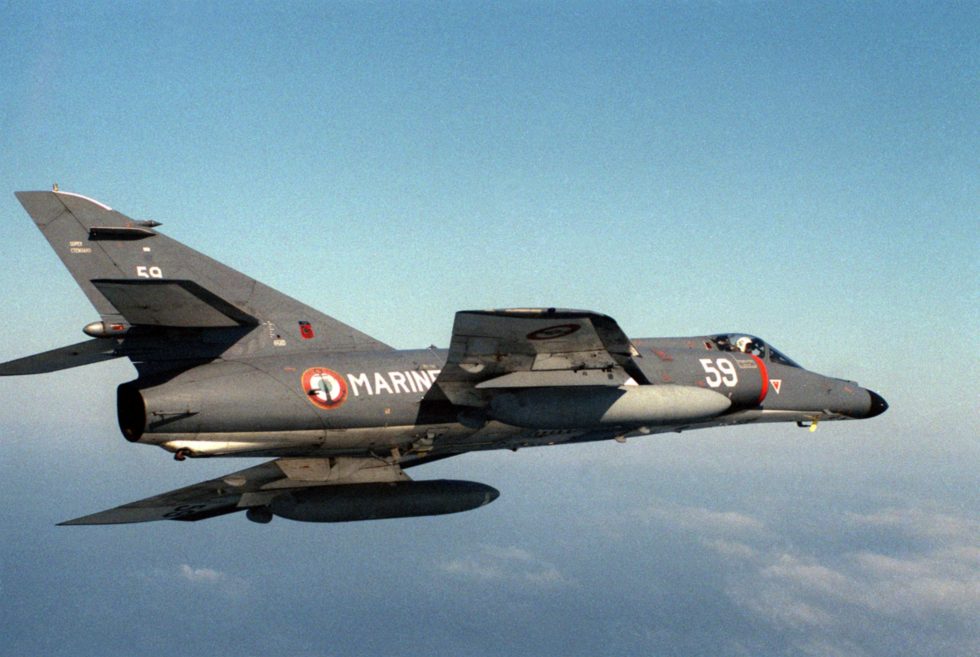
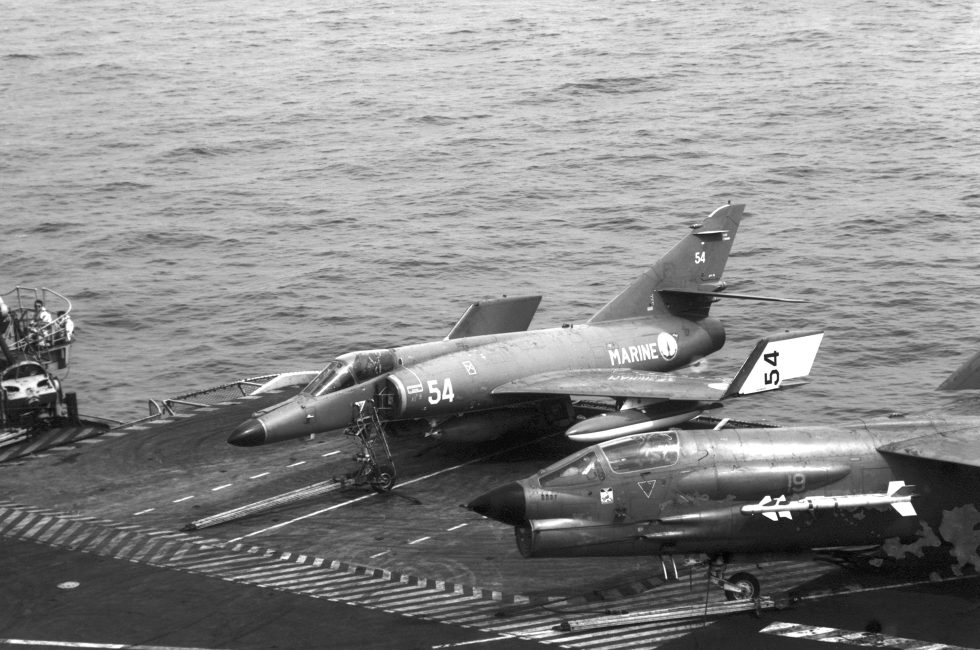
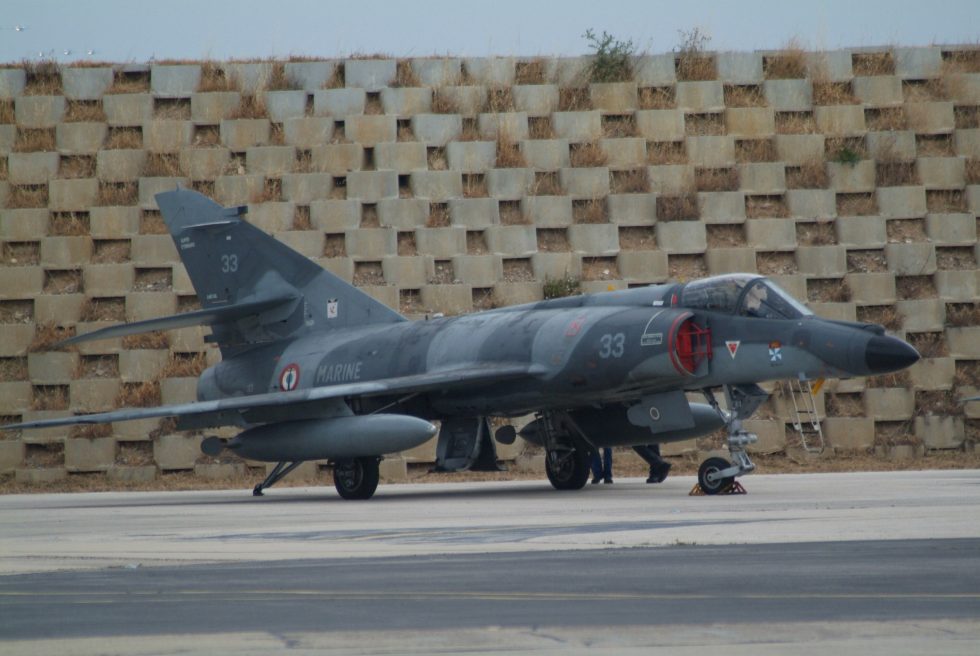
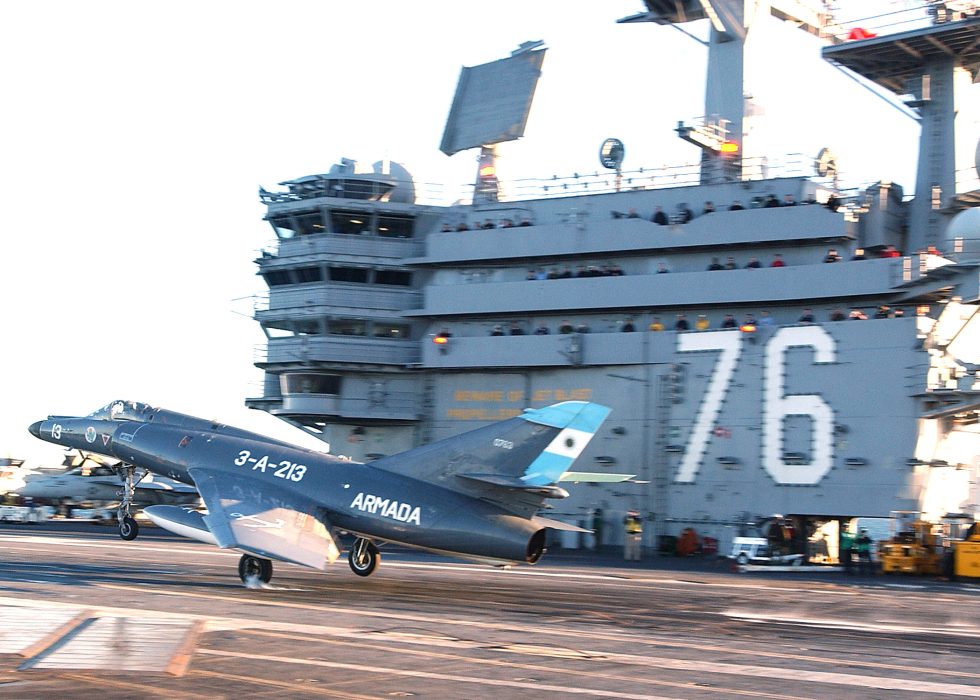
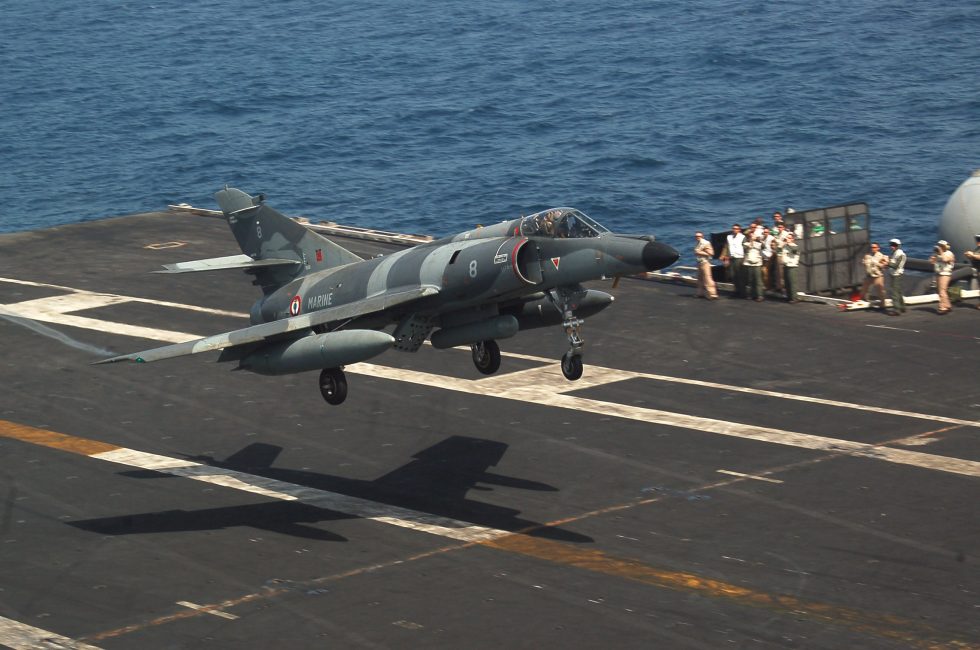
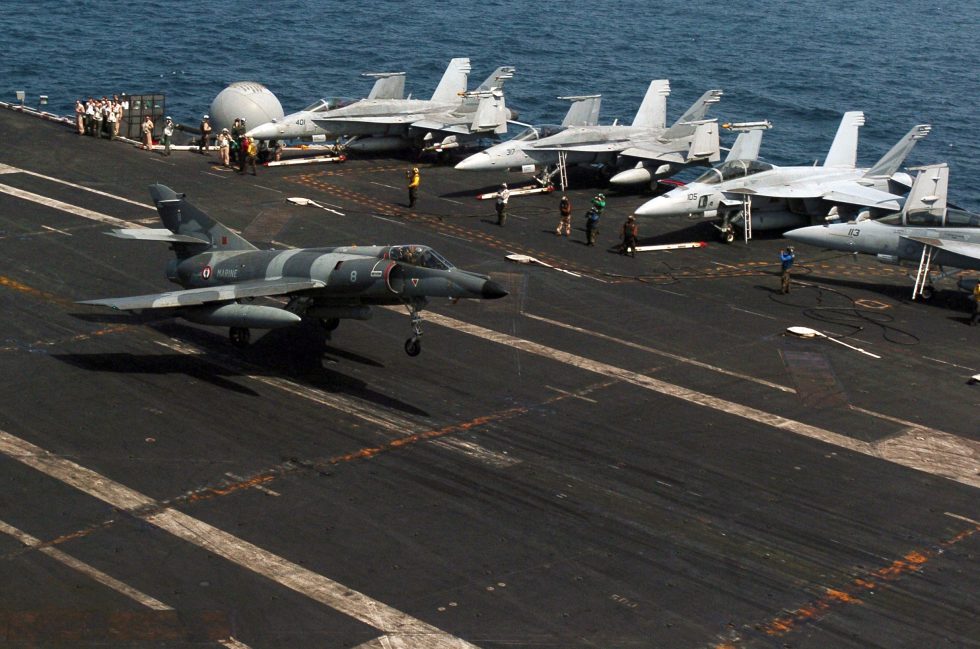
The Super Étendard in motion
A hand-picked video feature on the Super Étendard — its Falklands Exocet strikes, its carrier operations and its long French service — is coming soon to this exhibit. In the meantime, explore the stories, gallery and operations map above.
The Super Étendard in motion
PA38CBA — one of the most-watched Super Étendard films on YouTube.
Where the Super Étendard flew
The score that defines it
The Super Étendard is remembered for one thing above all: the Exocet. Its combat legacy is not air-to-air kills but ships sunk — and the shock those sinkings sent through every navy in the world. In just three weeks in 1982, a tiny Argentine force turned a modest carrier jet into one of the most consequential strike aircraft of the late 20th century.
Compare the combat record of every military aircraft. Figures as of July 2026.
Everything people ask about the Super Étendard
Can I fly in a Super Étendard?
Why is the Super Étendard so famous?
Did a Super Étendard really sink HMS Sheffield?
Was the Super Étendard supersonic?
Did Iraq really fly French Super Étendards?
What is the Super Étendard Modernisé (SEM)?
Is the Super Étendard still in service?
You can’t fly the Super Étendard.
These, you can.
Some legends only live in museums — others are fuelled and waiting. MiGFlug has put civilians in real military jet cockpits since 2004.
 Fly the L-39 AlbatrosThe world’s most-flown jet trainer — aerobatics included
 Fly the F-104 Starfighter“The missile with a man in it”
 Fly the MiG-21The Cold War’s most-produced jet
 Fly the T-33 Shooting StarAmerica’s first jet trainer
 Fly the DH VampireA piece of early jet history
 Fly the S.211Agile Italian jet trainer
 Fly the MB-326The classic Aermacchi jet
 Fly the MiG-15The Soviet legend of the Korean War
Continue the tour
Every fact, checked
- Dassault Aviation — Super ÉtendardThe manufacturer’s own history of the aircraft’s development and service.
- U.S. Naval Institute — Legacy of the ExocetAnalysis of the Falklands Exocet strikes and their lasting effect on naval warfare.
- The Aviation Geek Club — Iraqi Super ÉtendardsDetail on the 1983 French loan and the Tanker-War tanker attacks.
- Military Factory — Super ÉtendardSpecifications, dimensions, armament and variant reference.
- Federation of American Scientists — Super ÉtendardOverview of the engine, avionics and the SEM upgrade programme.
- Fly a Jet Fighter — Super Étendard factsBackground on the type’s origins, carrier role and combat career.
- The National Interest — Falklands Super ÉtendardsThe Sheffield and Atlantic Conveyor sinkings and the Exocet threat.
- EurAsian Times — Argentine retirementArgentina’s late-life Super Étendard fleet and its withdrawal.