
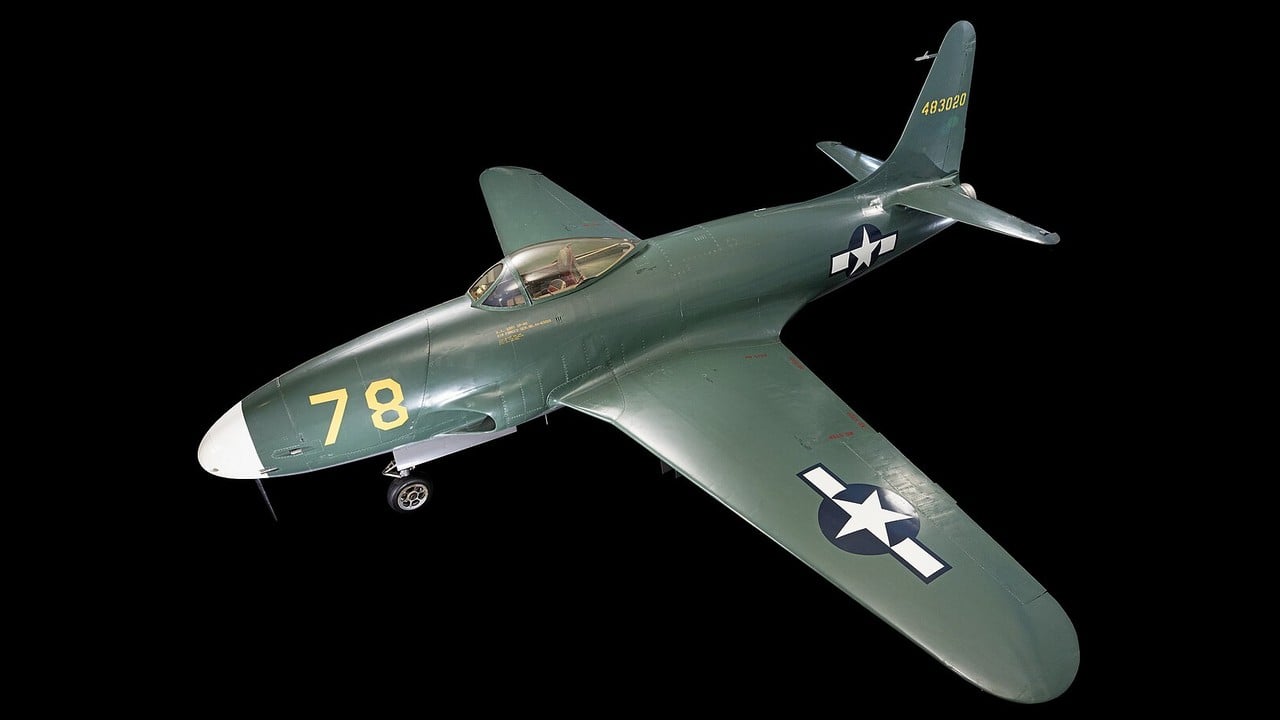
Early on the morning of 8 January 1944, busloads of generals and political guests pulled up beside the dry lake bed at Muroc Army Air Field in California, today’s Edwards Air Force Base. They had come to watch a small, dark green fighter with no propeller. Lockheed’s chief engineering test pilot, Milo Burcham, taxied it past the crowd, turned onto the lake bed and opened the throttle.
Watching from the Bell hangar was Tex Johnston, who was testing America’s first jet, the Bell P-59 Airacomet. He saw the newcomer roar down the lake, dive at the spectators and climb away in a string of aileron rolls. By the time it landed, he knew his own jet had just been left behind.
The aircraft was the XP-80, nicknamed Lulu-Belle, prototype of the Lockheed P-80 Shooting Star. It became the first jet fighter the US Army Air Forces used operationally, the first American jet to top 500 mph in level flight, and the jet that opened the US Air Force’s account in Korea. It was also the first project of a secretive Lockheed team that would become famous as the Skunk Works.
Datos rápidos
- Tipo: Single-seat jet fighter, later fighter-bomber
- Diseñador: Kelly Johnson’s Lockheed team, the original Skunk Works
- Prototype: XP-80 Lulu-Belle (44-83020), built in 143 days
- Primer vuelo: 8 January 1944, Muroc Army Air Field, pilot Milo Burcham
- Motor: One turbojet: Halford H-1B Goblin in the XP-80, Allison J33 in production aircraft
- Velocidad máxima: 502 mph for the XP-80; about 580 mph for the F-80C
- Armamento: Six .50-calibre machine guns, plus rockets, bombs or napalm
- Combatir: Korean War, 1950–1953
- Family: T-33 trainer (6,557 built) and F-94 Starfire interceptor
A jet fighter built in a circus tent
The trigger was German. In spring 1943, Allied intelligence learned of the Messerschmitt Me 262, and the P-59 was proving barely faster than the piston fighters it was meant to replace. In June 1943, the Army’s Air Technical Service Command told Lockheed it urgently needed a jet fighter to counter the German threat.
Lockheed’s young engineer Clarence “Kelly” Johnson, already known for the P-38 Lightning, promised a flying prototype within 180 days. There was no room for it in Lockheed’s crowded Burbank plant, so his hand-picked team of around 128 engineers and mechanics worked under a rented circus tent ringed with packing crates. The formal contract did not arrive until 16 October 1943, months after work had begun.
The name came from a smell and a comic strip. According to Lockheed Martin, a plant next door filled the tent with a foul odour, and engineer Irv Culver, a fan of Al Capp’s Li’l Abner, started answering the phone with “Skonk Works.” The joke stuck, became “Skunk Works,” and is now a registered trademark.
A borrowed British heart
America had no suitable jet engine of its own ready in 1943, so the XP-80 was designed around the British Halford H-1B Goblin. The first engine was wrecked during a ground run when the thin-skinned intake ducts collapsed and were sucked into it, despite a British warning that they were too weak. De Havilland sent a replacement that had been intended for its own jet fighter prototype, the future Vampire.
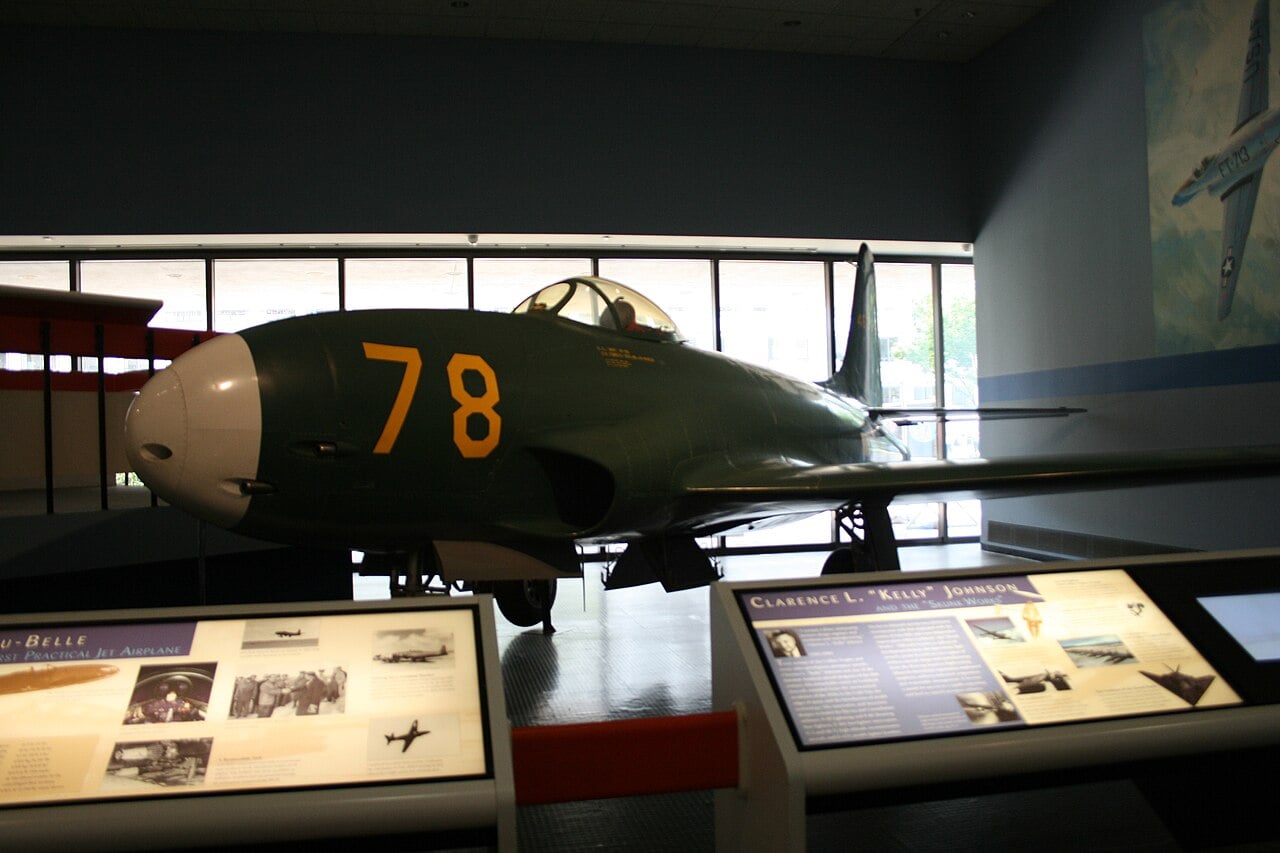
Lockheed’s own history puts the design-and-build time at just 143 days, well inside Johnson’s promise. The result was a clean, straight-winged single-seater with tricycle landing gear, a bubble canopy, intakes on the fuselage sides and six .50-calibre machine guns in the nose. Painted in Army dark green, it was nicknamed Lulu-Belle, and also “the Green Hornet.”
Five minutes over Muroc
That first flight on 8 January 1944 lasted only about five minutes. Burcham landed early, and according to Aviation History, he had been unsettled by how sensitive the controls were. Johnson’s answer was blunt.
Burcham went back up, and the testing continued. Lulu-Belle eventually reached 502 mph at 20,480 feet, making it the first American jet to exceed 500 mph in level flight. Tex Johnston had already drawn his conclusion and sent a telegram to Bell’s chief test pilot.
The Goblin was not reliable enough for production, so Lockheed redesigned the fighter around the bigger General Electric I-40, which entered production as the Allison J33. The two XP-80A prototypes, the Gray Ghost y el Silver Ghost, were larger and about 25 percent heavier. Burcham did not hide his disappointment: he said the nimble airplane he had loved had become a “dog.”
The price of speed
Early jet testing was deadly. Burcham was killed on 20 October 1944 when the engine of the third YP-80A failed on takeoff after a fuel pump failure. Four pre-production YP-80As went to Europe, two to England and two to Italy. According to US Air Force historians, the two in Italy flew limited reconnaissance missions in early 1945, but no P-80 ever fought in World War II.
On 6 August 1945, the day of the Hiroshima bomb, America’s top-scoring ace, Major Richard Bong, took off from Burbank for the acceptance flight of a production P-80A. It was only his 12th flight in the type. The main fuel pump failed, and the investigation found that he had apparently not switched on the backup pump. Bong bailed out, but he was too low for his parachute to open. He was 24.
A British Movietone newsreel from August 1945 presents the new P-80 as the world’s fastest plane, as the US Army claimed at the time.
The Shooting Star soon became America’s showpiece. On 27 January 1946, Colonel William Councill flew a P-80 nonstop from Long Beach to New York in 4 hours 13 minutes. On 19 June 1947, Colonel Albert Boyd flew the modified P-80R racer to a world speed record of 623.73 mph. A year later, on 11 June 1948, the new Fuerza Aérea de los Estados Unidos renamed the type the F-80.
Korea: from jet fighter to bomb truck
When North Korea invaded the South in June 1950, F-80Cs made up roughly half of the USAF’s fighter strength, and they went to war at once. In the first days, F-80 pilots shot down North Korean Il-10 ground-attack aircraft, the first USAF victories scored with jets. The National Museum of the US Air Force calls the F-80 the first USAF jet used in combat.
Then the MiG-15 arrived. On 8 November 1950, Lieutenant Russell Brown claimed a MiG-15 in an F-80C, long celebrated as the first jet-versus-jet kill. Soviet records say the MiG made it home, so the claim remains disputed. The wider story of those first jet battles is told in MiG Alley: Donde nació el combate aéreo..
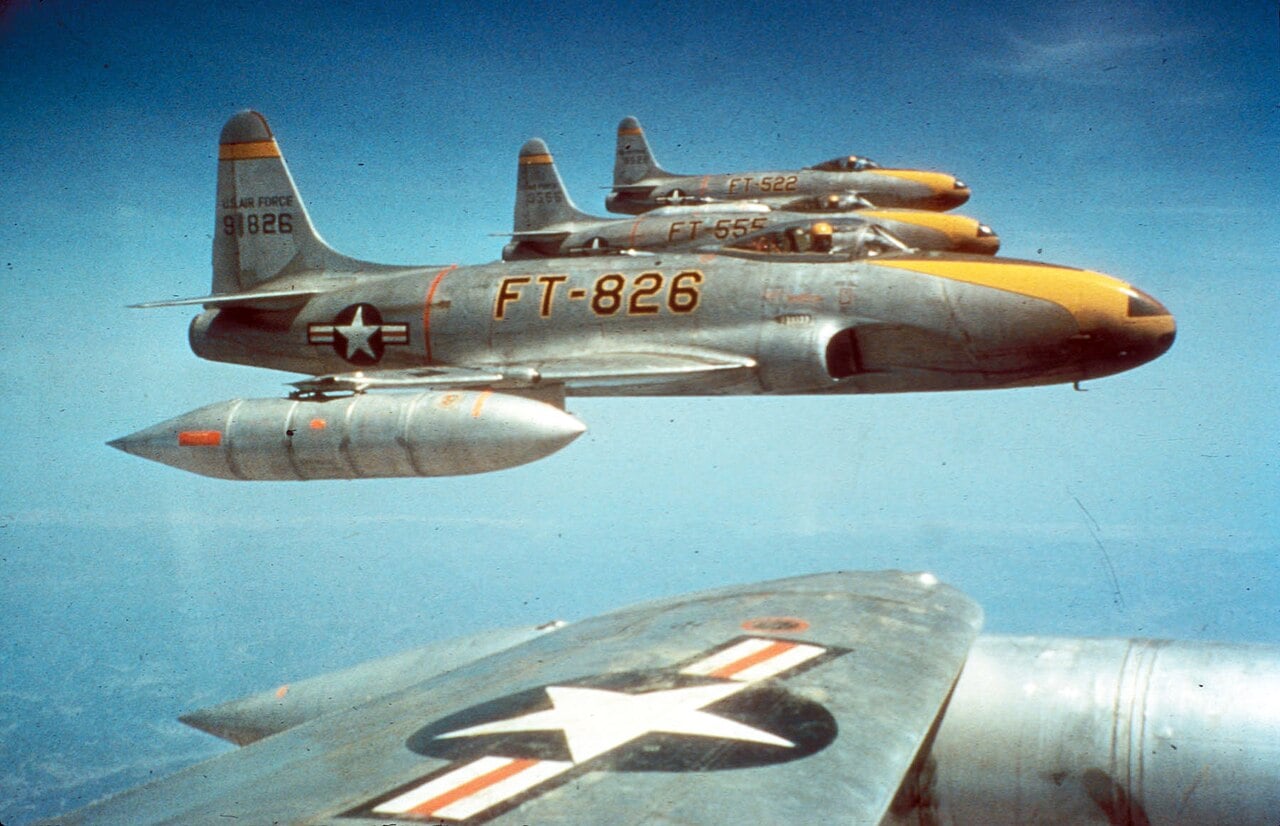
Whoever won that first duel, the straight-winged Shooting Star, with a top speed of about 580 mph in F-80C form, was outclassed by the swept-wing MiG. The F-86 Sabre took over the fight for air superiority, and the F-80 became a fighter-bomber, attacking with rockets, bombs and napalm. Squadrons based in Japan used enlarged “Misawa” tip tanks to give the jet more range. The 8th Fighter-Bomber Wing kept flying the F-80 until May 1953.
It was costly work. According to USAF figures cited on Wikipedia, 368 F-80s were lost during the war, 277 of them on operations: 113 to ground fire and just 14 to enemy aircraft. Major Charles J. Loring Jr. was posthumously awarded the Medal of Honor for his actions in an F-80 of the 80th Fighter-Bomber Squadron on 22 November 1952.
The family: T-Bird and Starfire
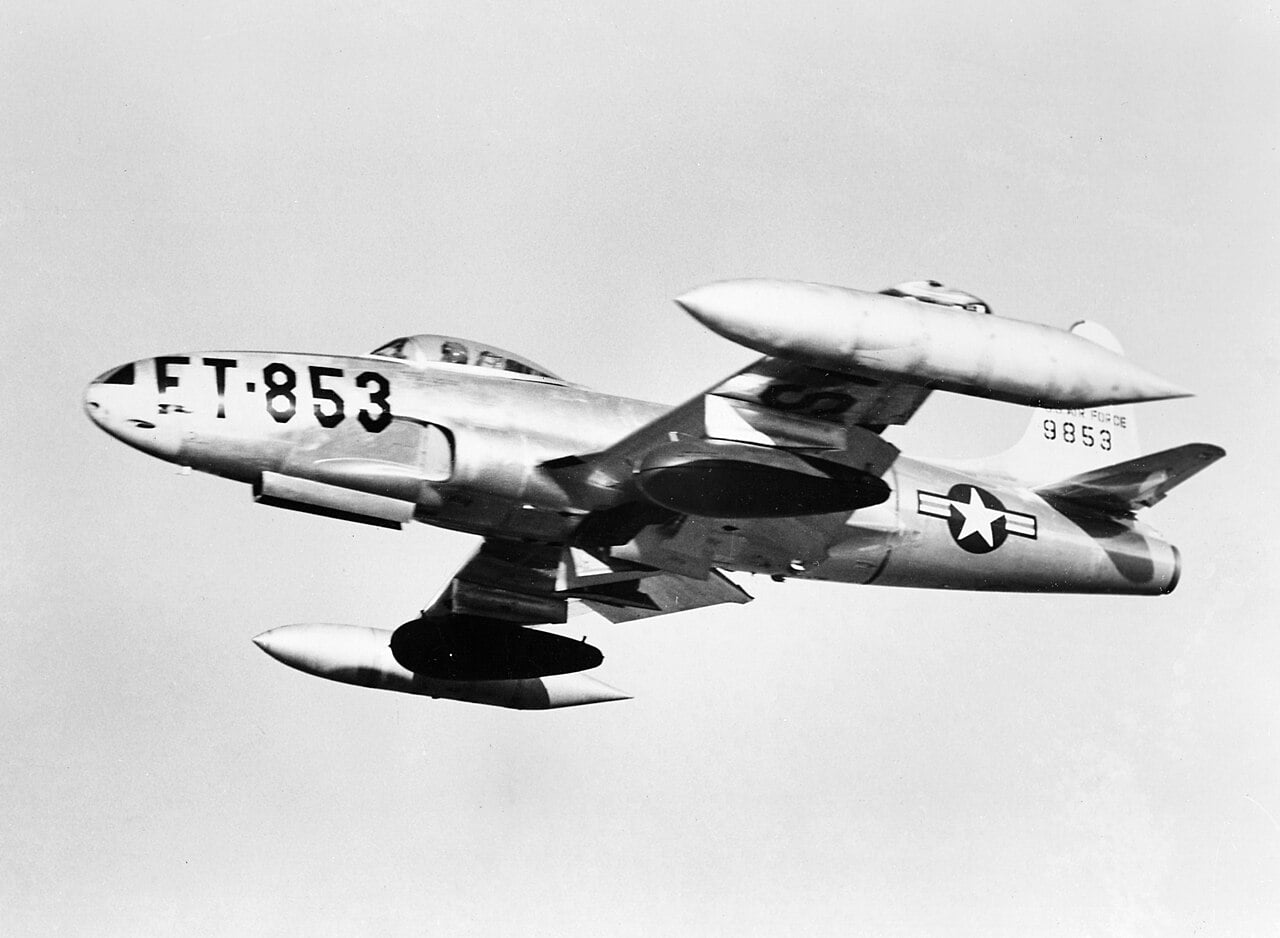
The P-80’s accident rate in its first years led the Air Force to order a dedicated jet trainer. Lockheed stretched the fuselage and added a second seat for an instructor, and the TF-80C first flew on 22 March 1948. As the T-33 Shooting Star, better known as the T-Bird, it far outnumbered its parent: 6,557 were built, including 656 by Canadair for the Royal Canadian Air Force as the Rolls-Royce Nene-powered CT-133 Silver Star and 210 by Kawasaki in Japan.
The T-Bird trained generations of jet pilots in roughly 25 countries. Bolivia retired the last military examples in July 2017, and a few still fly in private hands.
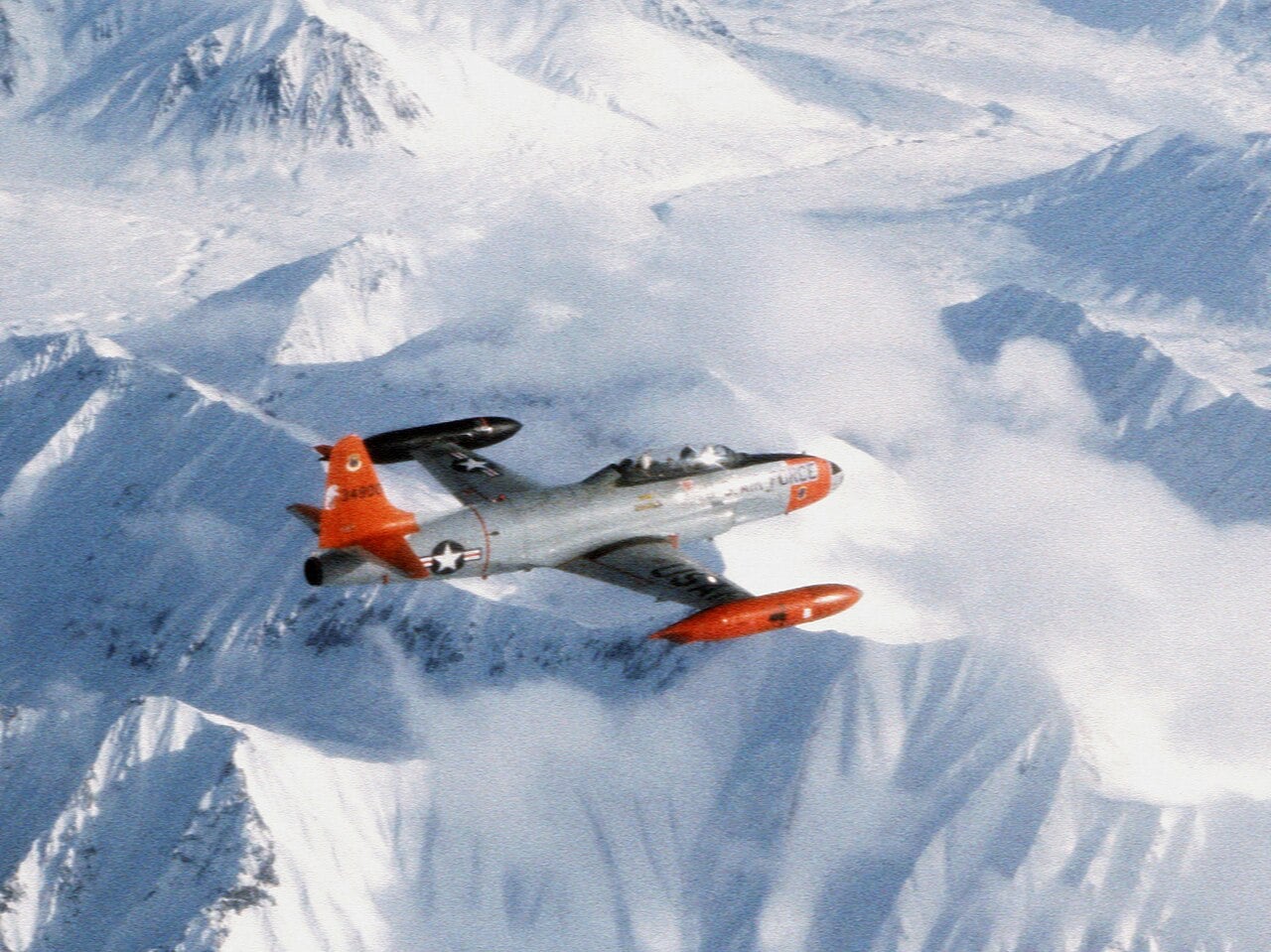
Two TF-80C airframes also became the prototypes for the F-94 Starfire, which first flew on 16 April 1949. With radar in a longer nose and an afterburner on its J33, it became the first operational USAF fighter fitted with an afterburner. Afterburner tells its story in Lockheed F-94 Starfire: America’s First Afterburner Jet.
Michigan Engineering on how Kelly Johnson designed the P-38 Lightning and the P-80 Shooting Star.
The first Skunk Works legend
The last American F-80s left service in 1959, and Chile retired the last fighters anywhere in 1974. Lulu-Belle went to the Smithsonian in 1949 and is still part of the National Air and Space Museum’s collection.
The pattern it set lasted much longer than the jet. Kelly Johnson’s team started on a handshake, worked in secrecy and delivered fast. The same Skunk Works later produced the U-2 and the SR-71.
Historian Mark Felton on the YP-80As sent to Italy in the final months of World War II.
In 1943, about 128 engineers and mechanics in a smelly circus tent took an engine borrowed from Britain and built a jet in 143 days, starting long before any contract was signed. Within seven years their fighter was at war, and its two-seat offspring was teaching the world to fly jets. Not bad for a plane its own test pilot first landed after five minutes.
Sources: Wikipedia (Lockheed P-80 Shooting Star; Richard Bong; Lockheed T-33; Lockheed F-94 Starfire), Lockheed Martin (Skunk Works origin story), National Museum of the US Air Force (F-80C fact sheet), Air Force Materiel Command History Office, Aviation History / HistoryNet, This Day in Aviation, Vintage Aviation News
0 Comments