
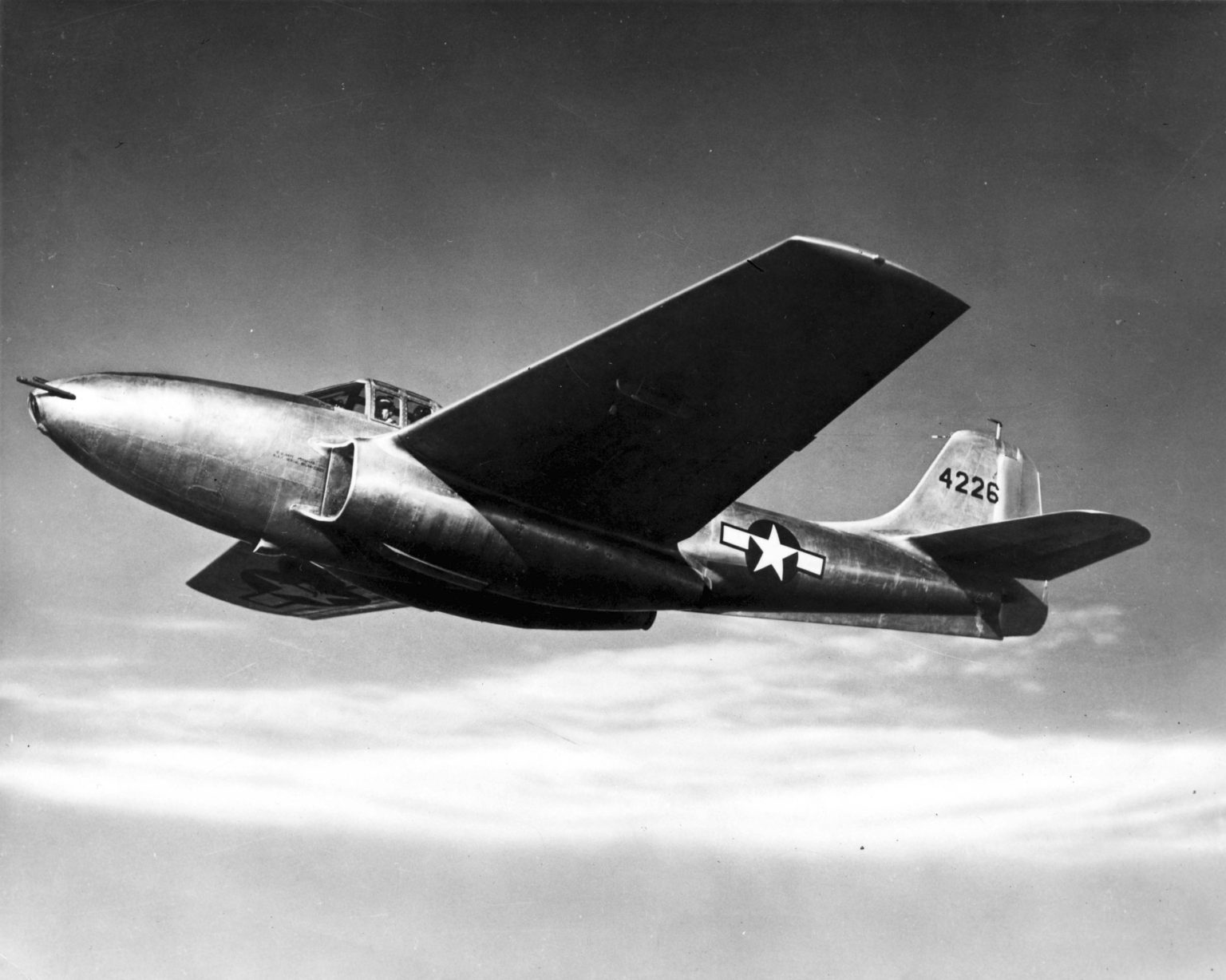
Bell P-59
“Airacomet”
America’s first jet aircraft — a wartime secret built around a British-designed turbojet. It was too slow to fight, never fired a shot in anger, and yet it carried the United States across the threshold into the jet age.
America’s first jet: born in secrecy, retired without a fight
In April 1941, with the United States still officially neutral, US Army Air Forces chief General Henry “Hap” Arnold visited Britain and was shown something extraordinary: the little Gloster E.28/39, flying on a jet engine designed by Frank Whittle. America had nothing like it. Arnold came home determined to close the gap, and secured British agreement to share Whittle’s engine. In September 1941 he handed the job to two firms: General Electric, with its turbine and turbosupercharger expertise, would license-build the engine; Bell Aircraft of Buffalo would build the aeroplane around it.
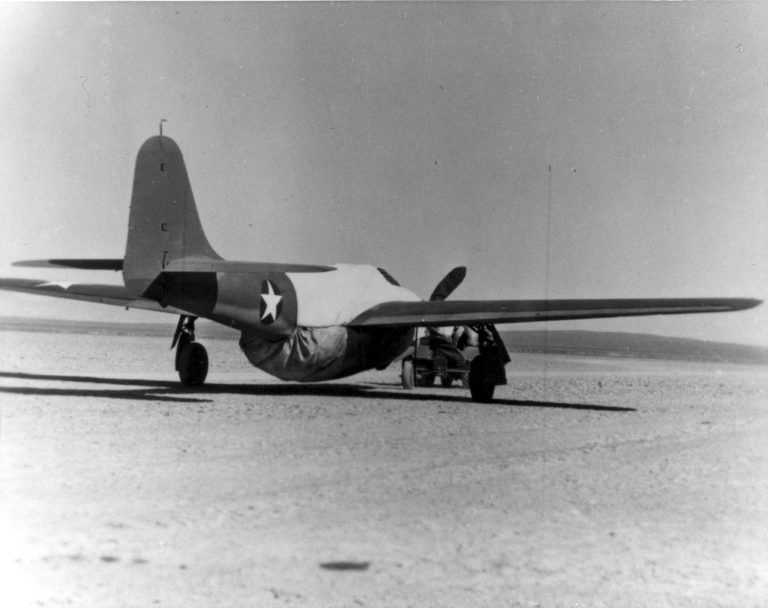
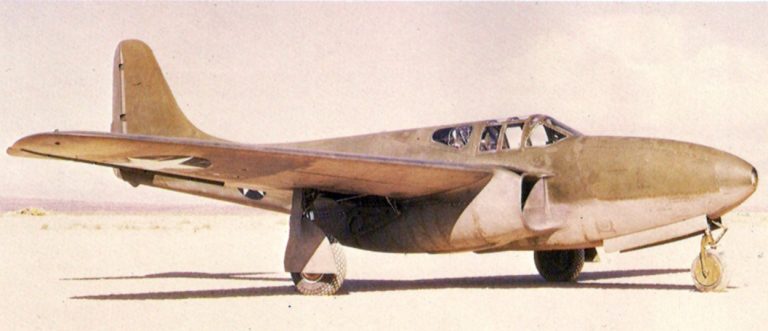
The whole programme was wrapped in extraordinary secrecy. Bell’s engineers worked behind windows welded shut and painted over, under 24-hour guard. The aircraft was deliberately mis-designated “XP-59A” to make it look like a continuation of a cancelled piston-engined fighter project, and the engine was code-named “I-A” to pass as a turbosupercharger. When the prototype was shipped to the remote Muroc Dry Lake in the California desert for testing, ground crews fitted a dummy wooden propeller to its nose whenever it was parked outside — so that any curious eyes would see nothing more than an ordinary fighter.
On 1 October 1942, Bell test pilot Robert Stanley lifted the XP-59A a few feet off the lakebed — the first flight of an American jet aircraft. Formal flights followed the next day, and Colonel Laurence Craigie became the first US military pilot to fly a jet. It was a genuine milestone, achieved barely thirteen months after the contract was signed.
And then came the disappointment. The Airacomet flew, but it was badly underpowered. Even the definitive P-59B managed only about 413 mph (660 km/h) — scarcely faster than the best piston fighters of the day, and far slower than Germany’s Me 262. Its engines were sluggish to respond and the airframe made an unsteady gun platform; in mock dogfights it was outflown by P-47 Thunderbolts and P-38 Lightnings. By 1944 the USAAF had concluded the type was not suited to combat. It never fired a shot in anger. Instead the roughly 66 Airacomets built became America’s first jet trainers, giving the 412th Fighter Group a nucleus of pilots and ground crews who understood jets. The lessons — and a Bell single-engine study — fed straight into the Lockheed P-80 Shooting Star, the fighter that would do what the P-59 could not.
01The Bell P-59 Airacomet’s secret birth: how a British jet engine crossed the Atlantic
The P-59 exists because of a transatlantic technology transfer. Britain had a working turbojet — Frank Whittle’s — and, courting American support in 1941, agreed to share it. A complete Whittle W.1X engine and drawings for the more powerful W.2B were flown to the United States, where General Electric at Lynn, Massachusetts, was chosen to reproduce them as the I-A. GE was picked precisely because its long experience with turbosuperchargers gave it the metallurgy and turbine know-how the job demanded.
Bell Aircraft, meanwhile, designed a conventional twin-engine airframe around two of these engines, buried in the wing roots either side of the fuselage. The result flew only thirteen months after the go-ahead — a remarkable pace — but it was fundamentally limited by engines that, even in their final form, produced only around 2,000 lb of thrust each. The airframe was never the problem; the young, low-thrust engines were.
What makes it special
Built around a borrowed British turbojet
The Airacomet’s heart was not American in origin. Its two General Electric I-A / J31 turbojets were license-built copies of Frank Whittle’s British design, buried in the wing roots on either side of the fuselage. GE won the work on the strength of its turbosupercharger expertise. It was the first jet engine mass-produced in the United States — the true breakthrough at the core of the aircraft.
A deliberately conventional airframe
Bell wrapped the radical new engines in an aggressively ordinary aeroplane: a straight wing, tricycle landing gear and gentle, forgiving handling. That was the point — with the propulsion so experimental, the airframe was kept safe and docile. It made the P-59 an excellent first jet to learn on (one was even converted into the world’s first two-seat jet), but it left no margin to chase speed.
Underpowered — the fatal flaw
Even in its final P-59B form, each J31 gave only about 2,000 lb (8.9 kN) of thrust, and the engines were slow to spool up. Top speed stalled at roughly 413 mph — barely ahead of piston fighters — and the poor throttle response made the jet an unsteady gun platform. In 1944 mock combats it was beaten by P-47s and P-38s, sealing its fate as a trainer rather than a warplane.
02The P-59 Airacomet’s dummy propeller: the disguise that hid America’s first jet
One of the enduring images of the programme is the dummy propeller. When the secret prototype sat outside at Muroc Dry Lake, ground crews bolted a wooden four-blade propeller to its nose, so that from a distance it looked like a conventional piston fighter rather than the revolutionary jet it was. The story has become the symbol of just how tightly the whole project was guarded: mis-designated on paper, its engine disguised as a turbosupercharger, and its true nature literally masked on the flight line. The propeller was, of course, removed before every flight.
03Why the Bell P-59 Airacomet never saw combat
The Airacomet was a technical success and a tactical failure. Its engines, derived from an early British design, simply did not produce enough thrust: top speed hovered around 413 mph, no better than a good propeller fighter and well short of the 500-plus mph the German Me 262 and He 280 were built for. Worse, the engines accelerated slowly and the aircraft proved an unsteady platform for its guns. When the USAAF flew it against P-47D Thunderbolts and P-38J Lightnings in early 1944, the piston fighters won. A Materiel Command evaluation concluded the P-59 was not operationally or tactically suited for combat. Production was cut from hundreds to around 66, and the type was steered into the training role instead — where its docile handling and twin engines made it genuinely useful for turning propeller pilots into jet pilots.
Full specifications
Figures below are for the definitive production P-59B. Several period figures vary between sources and are given as commonly cited values; the earlier XP-59A and YP-59A were lighter and slightly slower.
Baseline note: the figures below describe the P-59A, the first of the two production marks — twenty aircraft, 44-22609 to 44-22628, delivered in the autumn of 1944 with two General Electric J31-GE-3 centrifugal-flow turbojets. It is the fairest single column because it is the first Airacomet built to a settled standard rather than as a test article: the three XP-59A prototypes flew on weaker engines and a larger wing, the thirteen YP-59A service-test machines were a moving target, and the P-59B differs from the P-59A only in fuel and engine rating. Deltas for the XP-59A, the YP-59A and the P-59B are in grey. Three cautions before the numbers. First, the engines. Most references give the P-59A two J31-GE-3 of 1,650 lbf and reserve the 2,000 lbf J31-GE-5 for the P-59B, but the specification table most often copied online attributes the -5 to the P-59A. The widely quoted performance set of 413 mph and 46,200 ft travels with the 2,000 lbf engines, so read the Performance column as a best-case production figure rather than as what a J31-GE-3 aircraft did on a hot day at Muroc. Second, only 66 Airacomets of all marks were built and the flight-test programme was short and secret; the published numbers descend from a handful of Bell and Wright Field reports and are repeated rather than re-derived. Third, this aeroplane was a disappointment measured against its own service, not against the state of the art in 1942: it was the first American jet and it was slower than the P-47D and P-51D it was meant to surpass, and both halves of that sentence are true at the same time.
Dimensions & weights
- Crew
- 1 — five airframes were later fitted with a second, entirely open observer cockpit in the nose, complete with a small biplane-style windscreen, in place of the armament bay, so that a flight-test engineer could record data. It is the least glamorous cockpit ever fitted to a jet fighter
- Length
- 11.84 m (38 ft 10 in). The Smithsonian measures its XP-59A at 11.80 m (38 ft 8 in), so the prototype and production fuselages are effectively the same length
- Wingspan
- 13.87 m (45 ft 6 in). The XP-59A was appreciably larger at 14.90 m (48 ft 11 in) by the Smithsonian’s own measurement of 42-108784; the span was cut back for the service-test and production aircraft
- Height
- 3.76 m (12 ft 4 in) on the nosewheel — the Airacomet was designed around a tricycle undercarriage from the first drawing, because there was no propeller to keep out of the ground
- Wing area
- 35.86 m² (386 sq ft) — an enormous wing for a 5-tonne fighter, and the single number that explains most of the type’s character
- Aspect ratio
- 5.36 — short and broad. Bell had no swept-wing data and no reason to want any: the engines could not push the aeroplane near a speed where sweep would have earned its keep
- Aerofoil
- NACA 66-014 at the root, NACA 66-212 at the tip — a laminar-flow family, thick at the root to bury the engines and the main gear. The thickness is one reason the aeroplane ran out of speed so early
- Wing loading
- 140 kg/m² (28.6 lb/sq ft) at gross weight — barely more than half a P-51D’s. The Airacomet turned beautifully and climbed poorly, which is the wrong way round for an interceptor and precisely the trade a big wing buys
- Empty weight
- 3,704 kg (8,165 lb). The XP-59A was lighter at 3,320 kg (7,319 lb) as the Smithsonian records its own aircraft
- Gross weight
- 5,008 kg (11,040 lb) — roughly the loaded weight of a P-47D, on rather less than a third of its power at low level
- Maximum take-off weight
- 6,214 kg (13,700 lb) with the drop tank and external stores that the type almost never carried operationally
- Internal fuel
- ~1,098 litres (~290 US gal) in four self-sealing cells in the inner wing. The P-59B added a 125-litre (33 US gal) cell in each outer panel for ~1,348 litres (356 US gal) total — the whole point of the B model, and a plain admission that the A had not enough range to be useful
- External tankage
- 1 × ~568 litres (~150 US gal) jettisonable tank, carried by both production marks
Performance
- Maximum speed
- 665 km/h (413 mph) at 9,145 m (30,000 ft) — and this is the type’s epitaph in one line, because it is slower than a P-47D-25 at 690 km/h (429 mph) and a P-51D at 703 km/h (437 mph), both of which had been in squadron service for a year and cost a fraction as much to run
- Maximum speed, XP-59A
- 628 km/h (390 mph) on the 1,250 lbf General Electric I-A engines, as the Smithsonian records for 42-108784. The prototype was slower than almost every operational fighter of 1942, jet or not
- Cruising speed
- 604 km/h (375 mph) — unusually close to the maximum, which is what a clean airframe with a low-thrust engine looks like on paper and felt like nothing at all in the air
- Time to 9,145 m
- 15 min 30 s to 30,000 ft. A P-47D needed about 13 minutes and a Spitfire IX rather less; the Airacomet was the slowest-climbing new fighter the USAAF had accepted in years
- Rate of climb, sea level
- ~16 m/s (~3,200 ft/min) is the figure in general circulation, but it is not carried by the primary specification sheets and should be treated as indicative. The sourced measure is the time to altitude above, and it is the more damning of the two
- Service ceiling
- 14,080 m (46,200 ft) — the one genuinely modern number in the column, and a straight consequence of the big low-loaded wing. Bell’s Jack Woolams took an XP-59A to an unofficial 14,510 m (47,600 ft) in the summer of 1943, higher than any American aeroplane had been
- Range
- 604 km (375 mi) on internal fuel — a combat radius so short that the type could not have escorted anything anywhere. Early centrifugal turbojets were ruinously thirsty and the P-59 carried no more fuel than a piston fighter
- Ferry range
- 1,530 km (950 mi) with the drop tank
- Thrust-to-weight
- 0.30 at gross weight on two 1,650 lbf engines; 0.36 if the 2,000 lbf J31-GE-5 figures are used. Either way there was no reserve for combat manoeuvring, and throttle response was so slow that pilots learned to plan a go-around a long way out
- Directional behaviour
- "Snaking" above ~470 km/h (~290 mph) — a lateral and directional oscillation that never fully went away. It is why the Airacomet was judged a poor gunnery platform, and it mattered more than any single performance figure: a fighter that cannot be aimed is not a fighter
- Mock combat result
- Beaten by the P-38J and P-47D, February 1944 — the USAAF flew the trials honestly and reported the answer honestly. The older piston fighters outperformed the jet, and the production order was cut in half as a direct result
Propulsion & systems
- Engines
- two General Electric J31-GE-3 centrifugal-flow turbojets — the production form of the GE I-16, itself the developed I-A, itself an American reworking of the Power Jets W.2B/23. The J31 was the first turbojet mass-produced in the United States
- Rated thrust
- 7.3 kN (1,650 lbf) each, 14.7 kN (3,300 lbf) total. The XP-59A flew on I-A engines of 5.6 kN (1,250 lbf) each; the P-59B used the J31-GE-5, usually given as 8.9 kN (2,000 lbf), although the standard reference on the engine itself lists 1,650 lbf as the J31’s maximum and the higher rating is not universally accepted
- Engine architecture
- single centrifugal compressor stage, ten reverse-flow combustion chambers, single-stage axial turbine, pressure ratio 3.8:1 — simple, robust, and about as much thrust as a 1942 turbine could be asked for. Reverse-flow combustors kept the engine short at the cost of frontal area
- Engine size and weight
- 1.83 m long, 1.05 m diameter, 386 kg dry (72 in, 41.5 in, 850 lb) — a thrust-to-weight ratio of about 1.9:1, respectable for the day
- How the engine reached America
- Whittle W.1X flown to the United States on 1 October 1941 in a Consolidated B-24 — with W.2B/23 drawings and Power Jets engineers alongside, after General Henry "Hap" Arnold watched the Gloster E.28/39 at taxi trials in April 1941. General Electric was given the manufacturing contract on 4 September 1941 because of its turbosupercharger expertise, and Lawrence Bell agreed to build the airframe the following day. This was the Tizard-era transfer working exactly as intended, and it is the reason the American jet industry started with a British engine
- Engine milestones
- I-A first run 18 April 1942 — six months before the aeroplane flew. Some 241 J31s were built before the line closed in 1945; the engine also powered the mixed-propulsion Ryan FR-1 Fireball
- Installation
- both engines buried in the wing roots, one each side of the fuselage, with short lateral intakes — a clean, low-drag arrangement that made the aeroplane easy to service and gave the pilot an unobstructed nose for guns. It also put the whole propulsion system inside the thickest, draggiest part of the wing
- Structure and controls
- all-metal flush-riveted stressed skin, shoulder-mounted wing, conventional manual controls, tricycle undercarriage — no powered controls, no ejection seat, no radar. Bell built a thoroughly conventional 1942 airframe and put two turbines in the wing roots, which is precisely what the contract asked for
- Sighting and instrumentation
- reflector gunsight and gun camera — and, on five aircraft, the open nose observer’s cockpit replacing the gun bay. One XP-59A served as a mother ship for radio-control trials with a modified YP-59A drone in late 1944 and early 1945, using Sperry equipment; the drone crashed on take-off on 23 March and a P-59B took its place
- Production
- 66 airframes, 1942–1945 — 3 XP-59A, 13 YP-59A, 20 P-59A and 30 P-59B. Eighty P-59Bs had been ordered; the last fifty, 44-22659 to 44-22708, were cancelled. The preliminary order for 100 production machines was confirmed on 11 March 1944 and cut to 50 on 10 October 1944, although some accounts date the cut to October 1943
- Unit cost
- Not reliably published — the Airacomet was funded as a development programme rather than a mass-production contract, and it does not appear in the standard USAAF unit-cost tables that give the P-47D at about US$85,000 and the P-51D at about US$51,000. Any single dollar figure quoted for a P-59 should be treated with suspicion
- Redesignation
- ZF-59A and ZF-59B, June 1948 — the Z prefix meaning obsolete. Five and a half years after the first American jet flight, the first American jet was formally written off as a museum piece
04The P-59 Airacomet’s cost: what America’s first jet was worth
The P-59 was a secret wartime development contract, not a catalogue purchase, so a clean flyaway unit price was never published in the way modern aircraft costs are. The programme began with a $1.6 million research-and-development contract in 1941, and total procurement was tiny — only around 66 aircraft ever built — which kept unit costs high by the standards of mass-produced fighters. Any precise dollar figure attached to an individual Airacomet should be read as an estimate.
No reliable cost-per-flight-hour figure exists for the type either. As a short-lived experimental and training aircraft that never entered squadron combat service, its operating economics were never recorded in a form comparable to later, mass-produced jets.
Armament & payload
The Airacomet carried a heavy cannon in an aeroplane too unsteady to aim it
On paper the production Airacomet was well armed: a 37 mm M10 autocannon and three .50 in Brownings in the nose, all of them free of the propeller arc that had constrained every American fighter before it, and all of them grouped tightly enough to put a punishing weight of fire into a small cone. In practice the armament was the clearest casualty of the airframe’s worst habit. Above roughly 290 mph the P-59 snaked in yaw and roll, and the USAAF found it a poor gunnery platform — an unqualified verdict for a machine whose only reason to exist as a fighter was to shoot things down. The 37 mm M10 made matters worse: it was the same class of low-velocity, slow-firing, jam-prone weapon that had frustrated P-39 pilots, and forty-four rounds bought only a few seconds of firing. No Airacomet ever fired its guns in anger. Fits varied more than a production fighter’s should: two of the three XP-59As and most YP-59As carried a pair of 37 mm M10s, the production marks carried one M10 and three .50 in guns, and five airframes had the armament bay removed altogether for an observer’s cockpit.
Gun
- One 37 mm M10 autocannon in the nose with 44 rounds, on the P-59A and P-59B
- Three 12.7 mm (.50 in) AN/M2 Browning heavy machine guns alongside it, 200 rounds per gun
- Two 37 mm M10 cannon on two of the three XP-59As and on most of the thirteen YP-59As — a heavier but even slower-firing fit that was abandoned for production
- The M10 fired at roughly 150 rounds per minute at a modest muzzle velocity; against a manoeuvring fighter it demanded a steadier aeroplane than Bell had built
- No cannon or gun installation ever cured the snaking, and the gunnery verdict was never revised
Air-to-air
- None beyond the guns. The Airacomet never carried a guided air-to-air weapon, and none existed for it to carry
- It never met an enemy aircraft: no P-59 of any mark was deployed to a combat theatre, and the type has no victory and no combat loss to its name
- Its only recorded air combat was a mock one. In February 1944 the USAAF flew the P-59 against a P-38J Lightning and a P-47D Thunderbolt and the piston fighters won
- The one air-to-air asset it did possess was altitude: a ceiling above 46,000 ft that neither of its rivals could reach, and no thrust with which to exploit it
Air-to-surface guided
- None. No guided air-to-surface weapon of any kind was carried, trialled or planned
- The type pre-dated every American tactical guided weapon by a decade, and was withdrawn before the first of them reached a squadron
- Its only genuine contribution to guidance was as a target and as a controller: the Airacomet was the first American jet converted to remote control, using Sperry equipment, and the first to fly as a drone director
- Ground attack, guided or unguided, was never a mission the P-59 was asked to perform operationally
Bombs
- Two 454 kg (1,000 lb) AN-M65A1 general-purpose bombs on underwing racks — the paper maximum
- Smaller general-purpose bombs in proportion, using the same racks
- Maximum external ordnance was therefore about 907 kg (2,000 lb), a respectable figure that no P-59 unit ever had cause to use
- Carrying it at all cost most of a range that was already the type’s worst single failing at 375 miles clean
Rockets
- Eight 27 kg (60 lb) rockets under the wings, the figure carried by the standard specification tables
- The 60 lb designation refers to the warhead rather than the round, and the exact American store intended is not clearly documented; treat the fit as a paper capability
- No operational rocket sortie was ever flown by the type
- The unguided rocket was in any case a weapon for a stable aiming platform, which the Airacomet demonstrably was not
Pods & other stores
- One jettisonable fuel tank of about 568 litres (150 US gal), carried by both production marks and by far the most useful external store the type had
- Gun camera, and the standard reflector sight
- Flight-test instrumentation, including the open nose observer’s cockpit fitted to five aircraft in place of the entire armament bay
- Radio-control equipment on the drone and drone-director conversions, the last useful work most Airacomets found
- No reconnaissance camera nose, no radar and no external pod of any other kind was developed for the type
Three typical loadouts
- Comparative combat trials, February 1944
- One 37 mm M10 with 44 rounds · three .50 in AN/M2 with 600 rounds · clean wings, full internal fuel. The configuration in which the Airacomet was flown against a P-38J and a P-47D and comprehensively beaten, and the trial that halved the production order.
- Jet conversion training, 412th Fighter Group, Muroc, 1944–45
- Guns fitted but usually unloaded · clean wings · internal fuel only. The type’s real work: teaching the first American cadre of jet pilots about slow throttle response, long take-off runs, high approach speeds and the absence of a propeller to slow them down — every lesson that would keep P-80 pilots alive.
- Maximum external load demonstration
- Full gun armament · two 454 kg (1,000 lb) AN-M65A1 bombs · one 568 litre drop tank, to a take-off weight of 6,214 kg (13,700 lb). A capability recorded in the specification and, so far as the record shows, never used for anything.
Sourcing caveat: ammunition capacities, rocket counts and stores limits for the P-59 come from a small number of wartime specification sheets that were classified when written and have been copied without re-checking ever since. The rocket fit in particular is poorly attested. Because no Airacomet flew an armed operational sortie, none of these figures was ever tested against reality.
Variants
The Airacomet’s own designation was a deception, and its most valuable variant was never built
The P-59 begins with a lie told on purpose. Bell had already had a piston-engined pusher fighter called the XP-59 — a development of the XP-52, with the propeller behind the pilot — and it had been cancelled. When the jet contract was signed in September 1941 the USAAF resurrected the dead number and added a suffix, so that paperwork crossing desks in Washington and Buffalo would read as a continuation of a known piston project rather than as the most secret aeroplane in America. The deception ran all the way down to the flight line: at Muroc the prototype was fitted with a dummy wooden propeller whenever it was on the ground, and canvas over anything that gave the game away.
What follows the deception is a short and slightly sad list. Three prototypes, thirteen service-test machines, fifty production aircraft of two marks, and a set of one-off conversions. The type never left the United States except as a swap and a curiosity, never flew a combat sortie, and was formally declared obsolete in June 1948, when the surviving aircraft were redesignated ZF-59A and ZF-59B.
The most consequential entry in the list is the one that was never built. The XP-59B was a study for a single-engined Airacomet with the turbojet in the fuselage; Bell’s Buffalo plant had no capacity for it, and the requirement passed instead to Lockheed, where it became the XP-80. The Airacomet’s greatest contribution to American aviation was to hand the job on, and then to teach the pilots who would fly the aeroplane that replaced it.
- XP-59 (1941, none built)
- The unrelated aircraft whose number was borrowed as cover: a piston-engined pusher-propeller fighter developed from the Bell XP-52, cancelled before construction. Its only lasting significance is that the jet was called XP-59A to look like a variant of it.
- XP-59A (1942–43, 3 built, 42-108784 to 42-108786)
- The prototypes, on two General Electric I-A engines of 1,250 lbf. Built in secret on the second floor of a disused Trico plant in Buffalo, with a hole broken through the brick wall to get the first airframe out, then shipped by rail to Muroc on 12 September 1942 and unloaded on the 19th under a dummy propeller. Larger-winged and slower than the production aircraft at 390 mph.
- YP-59A (1943–44, 13 built, 42-108771 to 42-108783)
- Service-test batch, ordered in March 1942 before the prototypes had flown and delivered from July 1943 on the more powerful General Electric I-16, standardised as the J31. The improvement was negligible: about 5 mph. Diving trials in 1944 cost one aircraft a belly landing and another its entire empennage, which broke away in flight.
- RJ362/G (1943–44, 1 aircraft, 42-108773)
- One YP-59A sent to the Royal Air Force in exchange for the first production Gloster Meteor I, EE210/G. British pilots, who already had two jet types of their own to compare it with, found it unfavourable on every count. The exchange nonetheless gave the USAAF its first close look at a Meteor.
- YF2L-1 (1943–44, 2 aircraft, 42-108778 and 42-108779)
- Two YP-59As delivered to the US Navy as BuNos 63960 and 63961 for carrier suitability evaluation. They were found completely unsuitable: approach speeds too high, throttle response too slow and thrust too low for a wave-off, which is a fair summary of every early jet’s problem with a deck and an unusually blunt one here.
- P-59A (1944, 20 built, 44-22609 to 44-22628)
- First production mark, delivered in the autumn of 1944 with J31 engines, one 37 mm M10 cannon and three .50 in Brownings. Redesignated ZF-59A in June 1948. This is the baseline column above.
- XP-59B (1942–43, project only)
- Study for a single-engined Airacomet with the turbojet in the fuselage instead of two in the wing roots. Bell had no plant capacity, so the requirement went to Lockheed and Kelly Johnson’s team, and emerged as the XP-80 Shooting Star. The most important P-59 variant is the one that became a different aeroplane.
- P-59B (1944–45, 30 built of 80 ordered, 44-22629 to 44-22658)
- Definitive mark: an extra 33 US gal fuel cell in each outer wing panel and, in most accounts, the 2,000 lbf J31-GE-5. The final fifty on the contract, 44-22659 to 44-22708, were cancelled. Assigned to the 412th Fighter Group at Muroc, the USAAF’s first jet unit, to convert pilots onto turbojets. Redesignated ZF-59B in June 1948.
- US Navy P-59B transfers (1945–46, 3 aircraft)
- Three P-59Bs passed to the Navy, which kept the Army designations rather than reissuing them as F2L. With the two YF2L-1s they gave the Navy five Airacomets, all used as trainers and flight-test hacks rather than as fighters — the same conclusion the USAAF had reached.
- Drone and drone-director conversions (1944–46)
- One XP-59A flew as a mother ship for radio-control trials with a modified YP-59A drone in late 1944 and early 1945, the first American jet converted to remote control, using Sperry equipment; the drone crashed on take-off on 23 March 1945 and a P-59B replaced it. Five aircraft in all were fitted with the open nose observer’s cockpit associated with this and other test work.
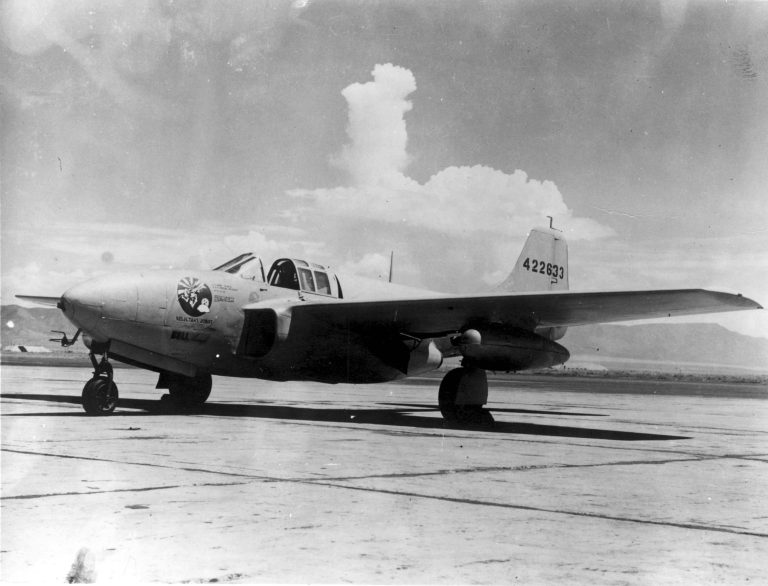
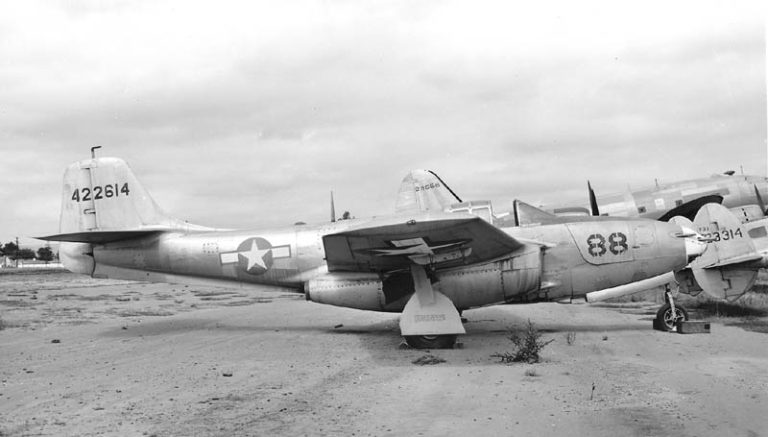
Survivors, stated precisely. Six original Airacomets survive of the sixty-six built, and there are no reproductions, no replicas and no composite airframes — when a P-59 is on a museum floor it is a real one. The first American jet aeroplane, XP-59A 42-108784, is held by the Smithsonian National Air and Space Museum and displayed in the Boeing Milestones of Flight Hall in Washington, DC; it flew a total of 59 hours 55 minutes and carries the open nose observer’s cockpit fitted for flight-test work. P-59B 44-22650 is at the National Museum of the United States Air Force at Wright-Patterson AFB near Dayton, Ohio. P-59A 44-22614 is at the March Field Air Museum at March Air Reserve Base, Riverside, California. P-59B 44-22633 stands on a pylon at Edwards AFB, on the dry lake where the type first flew. P-59B 44-22656 is at Pioneer Village in Minden, Nebraska, the least likely address in this list. The sixth is YP-59A 42-108777, held by the Planes of Fame Air Museum at Chino, California, and under long-running restoration to flying condition — reported at roughly three-quarters complete, with the wing spar replaced, the fuselage rewired and the engines and undercarriage overhauled. No Airacomet has flown since the 1940s; if 42-108777 ever does, it will be the oldest airworthy jet aircraft in the world.
From British secret to the dawn of the US jet age
A jet from Britain
General Hap Arnold sees the Gloster E.28/39 and secures Whittle’s engine; in September, GE and Bell get the secret contract.
America’s first jet flight
On 1 October the XP-59A lifts off Muroc Dry Lake with Robert Stanley at the controls — the first US jet aircraft to fly.
Into the shadows
YP-59A service-test aircraft appear; one is traded to Britain for a Gloster Meteor, and the 412th Fighter Group forms to train jet pilots.
Judged unfit for combat
Mock dogfights see P-47s and P-38s outfly the Airacomet; Materiel Command rules it unsuited to combat and production is slashed.
Production ends
Only about 66 are completed. The Airacomet settles into training and trials duty, never having fired a shot in anger.
Passing the torch
The Lockheed P-80 Shooting Star — whose lineage traces to a Bell single-engine study — becomes America’s first operational jet fighter.
Last of the line
The US Navy’s handful of evaluation Airacomets are retired; the type passes into museums as a first-of-its-kind.
Twelve P-59 Airacomet stories
Why “Airacomet”
Bell blended its “Aira” house name with “comet” for its streaking new jet.
Read the full story
Arnold’s British revelation
A 1941 visit to Britain showed the US Army chief a jet — and started the whole programme.
Read the full story
Windows welded shut
Bell’s jet was built behind painted-over windows under 24-hour guard.
Read the full story
The dummy propeller
A fake wooden propeller on the nose hid the jet whenever it sat outside at Muroc.
Read the full story
Twenty-five feet
On 1 October 1942 Robert Stanley eased the XP-59A a few feet off the desert — and into history.
Read the full story
Craigie’s flight
The day after the first hop, an Army colonel became the first US military pilot to fly a jet.
Read the full story
The two-seat Airacomet
One P-59 was rebuilt with a second cockpit — the world’s first two-seat jet.
Read the full story
Beaten by piston fighters
In 1944 mock combats, P-47s and P-38s comfortably outflew the jet.
Read the full story
A jet for a jet
The US traded a YP-59A to Britain in exchange for a Gloster Meteor.
Read the full story
Woolams’s barefoot walk
A test pilot bailed out when the tail tore off — then walked two miles through snow in his socks.
Read the full story
America’s first jet school
Denied combat, the P-59 became the aircraft that taught the USAAF how to fly jets.
Read the full story
The stepping stone to the P-80
The P-59 led directly to the Shooting Star, the jet that finally delivered.
Read the full story
The Airacomet in pictures
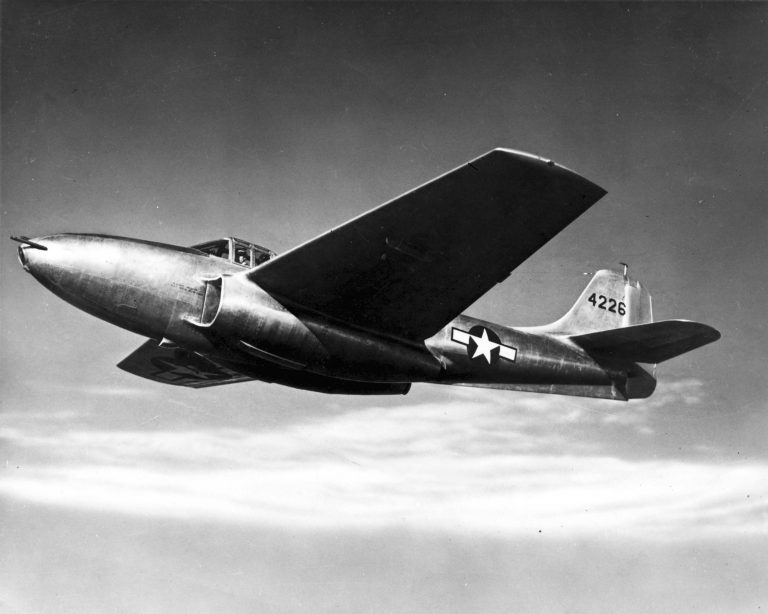
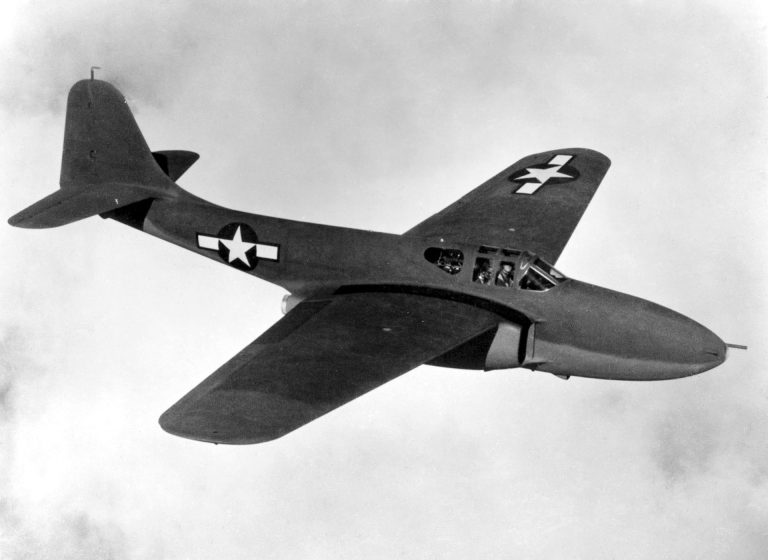
The Airacomet in motion
A curated video feature for the Bell P-59 Airacomet is coming soon. In the meantime, explore the photo gallery above and the operator map below.
Where the Airacomet served
Where the record stands
The P-59 never fired a shot in anger. It was judged too slow and too underpowered to fight, and by 1944 the USAAF had ruled it out as a combat aircraft. Its record is therefore not written in kills but in firsts: the first American jet to fly, the world’s first two-seat jet, and the aircraft that gave the United States its first cadre of jet-trained pilots and ground crews. Its true achievement was to prove jet propulsion practical and to open the road to the P-80 Shooting Star.
Compare the combat record of every military aircraft. Figures as of July 2026.
Everything people ask about the P-59 Airacomet
Can I fly in a P-59?
Was the P-59 really the first American jet?
Why did the P-59 never see combat?
What was the dummy propeller for?
How many P-59 Airacomets were built?
What engines did the P-59 use?
What did the P-59 lead to?
You can’t fly the Airacomet.
These, you can.
Some legends only live in museums — others are fuelled and waiting. MiGFlug has put civilians in real military jet cockpits since 2004.
 Fly the L-39 AlbatrosThe world’s most-flown jet trainer — aerobatics included
 Fly the F-104 Starfighter“The missile with a man in it”
 Fly the MiG-21The Cold War’s most-produced jet
 Fly the T-33 Shooting StarAmerica’s first jet trainer
 Fly the DH VampireA piece of early jet history
 Fly the S.211Agile Italian jet trainer
 Fly the MB-326The classic Aermacchi jet
 Fly the MiG-15The Soviet legend of the Korean War
Continue the tour
Every fact, checked
- Smithsonian National Air and Space Museum — Bell XP-59A AiracometMuseum record for the first XP-59A, the first US jet and world’s first two-seat jet.
- National Museum of the US Air Force — Bell P-59B Airacomet fact sheetOfficial USAF specifications, production totals and development history.
- Joe Baugher — Bell P-59 AiracometDetailed serial-by-serial history, variant breakdown and performance figures.
- HistoryNet — How the P-59 Became America’s First Jet FighterNarrative of the secret programme, first flight and the combat evaluations.
- Vintage Aviation News — The Surviving AiracometsSurvey of the P-59 airframes preserved in US collections today.
- This Day in Aviation — 1 October 1942Dated account of the XP-59A’s first flight at Muroc Dry Lake.
- Air & Space Forces MagazineBackground on Arnold’s 1941 British trip and the origins of US jet development.
- Edwards Air Force Base — History (Muroc)Context on Muroc Dry Lake as the secret test site for America’s first jet.