
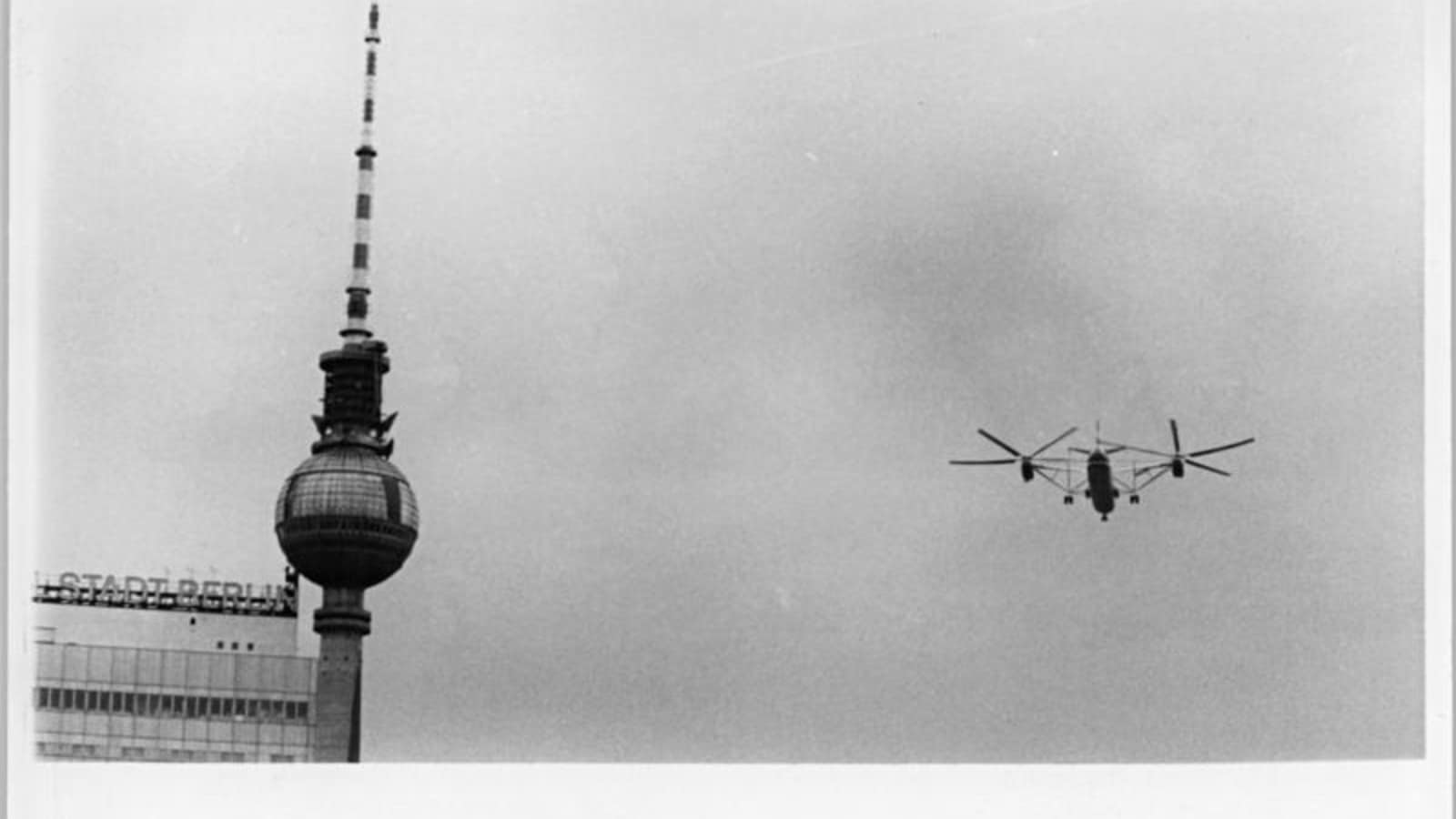
On 6 August 1969, a Soviet helicopter lifted 40,204.5 kilograms — just over 40 tonnes — to a height of 2,255 metres. That is roughly the weight of a loaded articulated lorry, carried straight up by rotors.
No helicopter has lifted more, before or since. The aircraft that did it was the Mil V-12, and it is the largest helicopter ever built by a margin that nothing has come close to challenging in fifty-seven years.
Informations clés
Taper: Mil V-12 (production designation Mi-12, NATO: Homer) — heavy-lift helicopter
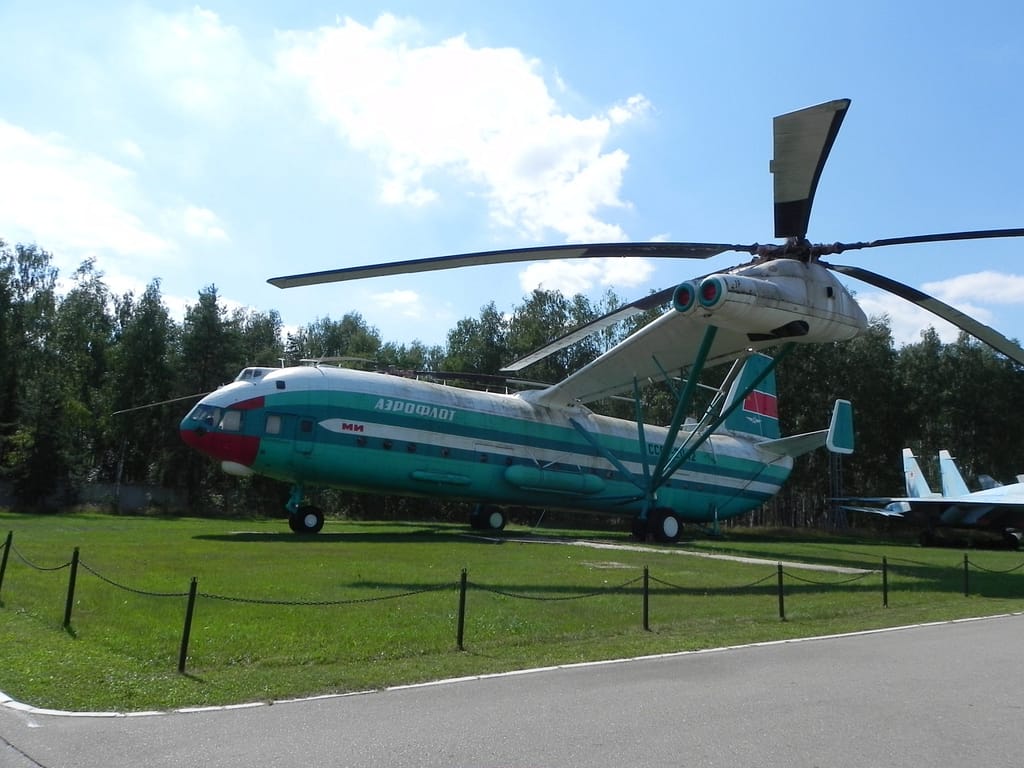
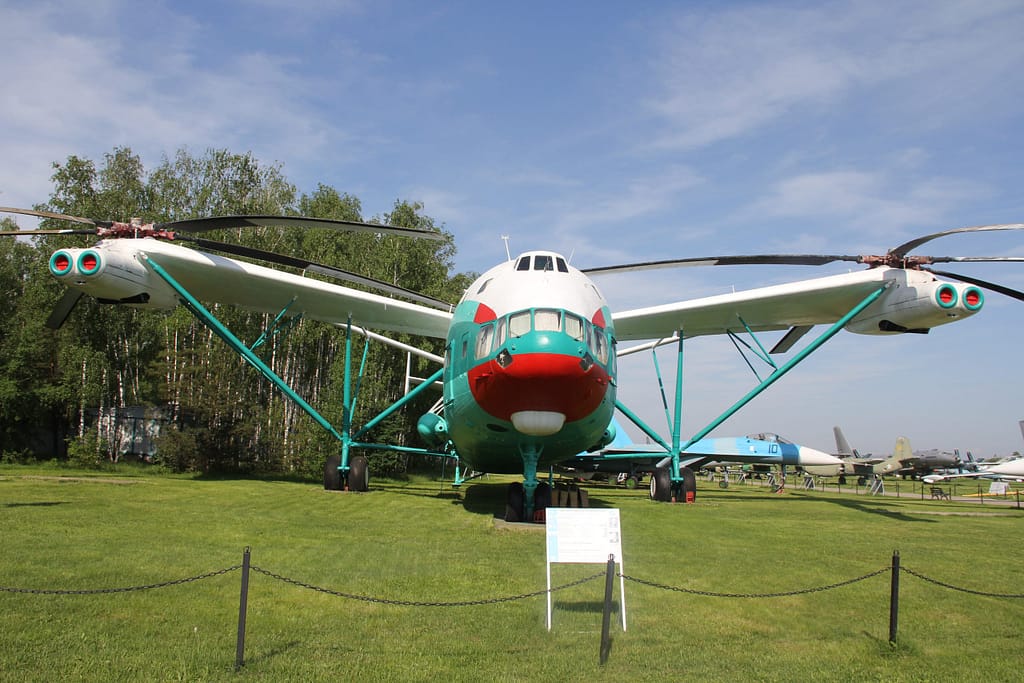
Mise en page: Two five-blade rotors side by side on inverse-taper wings, cross-shafted
Diamètre du rotor : 35.0 m each; span across the rotor tips about 67 m — wider than a Boeing 747
Moteurs : Four Soloviev D-25VF turboshafts, roughly 6,500 shp each
Weights: Empty about 69,100 kg; maximum take-off 105,000 kg
Construit: Two, both of which flew; both wore the registration CCCP-21142
Enregistrer: 40,204.5 kg lifted to 2,255 m on 6 August 1969 — never surpassed
Survivants : One at the Mil plant at Panki-Tomilino, one at the Central Air Force Museum, Monino
Why it has two rotors side by side
Mil studied the obvious options first. A single main rotor big enough to lift twenty-five tonnes runs into blade and gearbox limits that were not solvable in the 1960s. A tandem layout like the Chinook's does not scale gracefully to that weight either.
The transverse layout solved a different problem: it let Mil take two complete rotor, gearbox and engine assemblies from the existing Mi-6 — a proven, in-service system — and mount one at each wingtip. That is an enormous reduction in development risk. It also disposed of the tail rotor, which on a large single-rotor helicopter absorbs power for no lift at all.
The rotors overlap by about three metres and are cross-shafted, so they stay synchronised and so the aircraft stays controllable if an engine fails. The port rotor turns anticlockwise and the starboard clockwise, putting the advancing blades inboard. The stubby wings are inverse-tapered — wider at the tip than the root — to sit under the downwash without blanking it.
Un début difficile
The first flight attempt, on 27 June 1967, ended badly: a control feedback oscillation built up and the aircraft made a hard landing that burst a tyre and bent a wheel hub. Western press reports at the time claimed it had been destroyed. It had not. The first successful flight came on 10 July 1968, from Panki to Lyubertsy, with Vasily Koloshenko at the controls.
A second prototype followed in 1973. Those two were the entire production run.
Mustard’s film on the V-12 — nearly three million views, and the clearest account of why the layout was chosen.
Paris, 1971
The V-12 flew to the Paris Air Show at Le Bourget in 1971, stopping at Groningen on the way, and was, predictably, the largest thing there. It won the Sikorsky Prize. Mikhail Mil himself never saw it — he had died in January 1970.
The mission disappeared
The V-12 existed for one reason: to carry the components of intercontinental ballistic missiles to launch sites in parts of the Soviet Union with no roads and no railways. Its cargo hold was sized around that job — 28 metres long and 4.4 metres square.
Then the requirement evaporated. Solid-fuelled ICBMs on road and rail mobile launchers no longer needed to be flown to remote fixed sites, and reconnaissance satellites had made the concealment argument moot anyway. The air force declined to put the aircraft through state acceptance trials. The Mi-6 and Mi-10 could handle everything the military actually needed lifting, and nothing in the civil economy could justify the running costs.
The programme stopped in 1974. A planned Mi-12M with more powerful engines never got past a mock-up.
About that record
One point of care, because it is widely misreported. Many sources — including Russian-language ones and parts of Wikipedia's own prose — give the payload as 44,205 kg. The FAI's record file and Wikipedia's specification table both give 40,204.5 kg. Use the lower figure.
A second point: it is accurate to say no helicopter has ever lifted more. It is not accurate to say the record still stands as a current FAI record, because the FAI has since retired or superseded those particular categories in a rules change. The achievement is untouched; the paperwork has moved on.
And a sanity check worth making, since the numbers get quoted loosely: 69,100 kg empty plus a 40-tonne payload comes to more than the 105,000 kg maximum take-off weight, before fuel. The record flight was an overload attempt. Normal cabin payload was around 25 tonnes.
Period Soviet footage of the V-12 flying — worth watching for the sheer implausibility of it leaving the ground.
Two were built. Neither entered service. One record was set, and it has outlasted the country that set it. Somewhere at Panki-Tomilino, the first one is still sitting outside — the largest helicopter anyone has ever managed to fly, built for a job that stopped existing before it was finished.
Sources: Gordon & Komissarov, Mil’s Heavylift Helicopters (Red Star 22, 2005); FAI record files 9916, 9917 and 9937 (archived); Vertical Flight Society Vertipedia; Aviatsiya Rossii, 2016; Jane’s All the World’s Aircraft 1975–76; Wikipedia cross-checks.


0 commentaire