
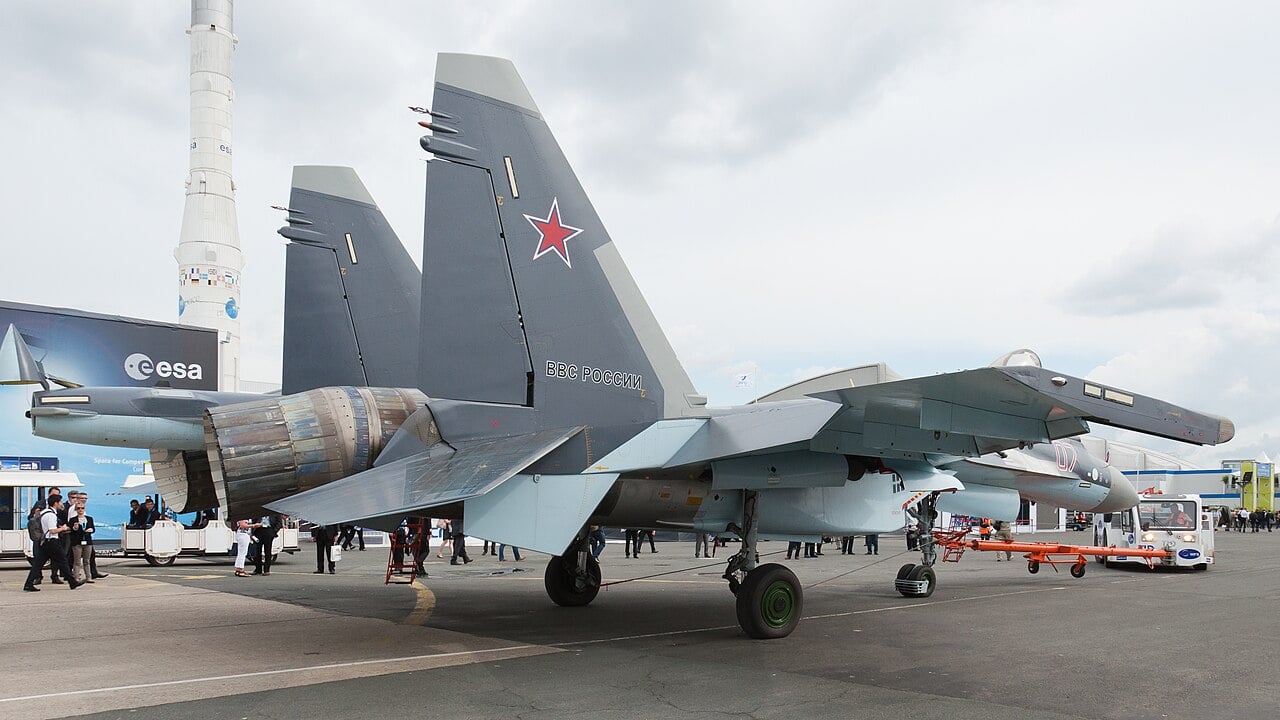
Two Russian Su-35S fighters collided in the air over Russia’s Kursk region on Sunday. One pilot was killed. The other ejected and was injured.
That is the entire confirmed account, and even it is not confirmed in any official sense. The report comes from Fighterbomber, a pro-war Russian Telegram channel with reported ties to the Russian Aerospace Forces, and from the local outlet Pepel. Kursk. Russia’s Defence Ministry has said nothing. Ukraine has claimed nothing.
The cause is unknown. Some Russian bloggers have gestured at Ukrainian involvement without offering evidence, and no Ukrainian official has claimed the aircraft. For a fighter that has spent four years killing at ranges where nobody can see it happen, losing two airframes to each other is a bleakly fitting way to make the news.
Informations clés
| Ce qui s'est passé | Two Su-35S fighters collided in mid-air |
| Où | Kursk region, Russia, bordering Ukraine |
| Quand | Reported Sunday 7 September 2026 |
| Victimes | One pilot killed; one ejected and injured |
| Source | Fighterbomber Telegram channel and Pepel. Kursk |
| Official confirmation | None. No Russian MoD statement, no Ukrainian claim |
| Cause | Unknown |
| Aircraft type | Su-35S Flanker-E, single-seat, twin-engine, thrust-vectoring |
Why this one is hard to verify
Fighterbomber is not a neutral source, but it is not a useless one either. The channel has repeatedly acknowledged Russian losses that the Defence Ministry never addressed, including the June 2024 drone strike that damaged a Su-57 on the ground at Akhtubinsk. When it reports bad news, that news has tended to be real.
What it is not is verifiable. Meduza, which picked the story up on Sunday evening, was careful to note that the collision has not been officially confirmed. Every English-language outlet carrying it, including Kyiv Post, Militarnyi and UNITED24, traces back to the same two Russian-language sources. Broad republication is not the same as independent corroboration, and this story currently has none.
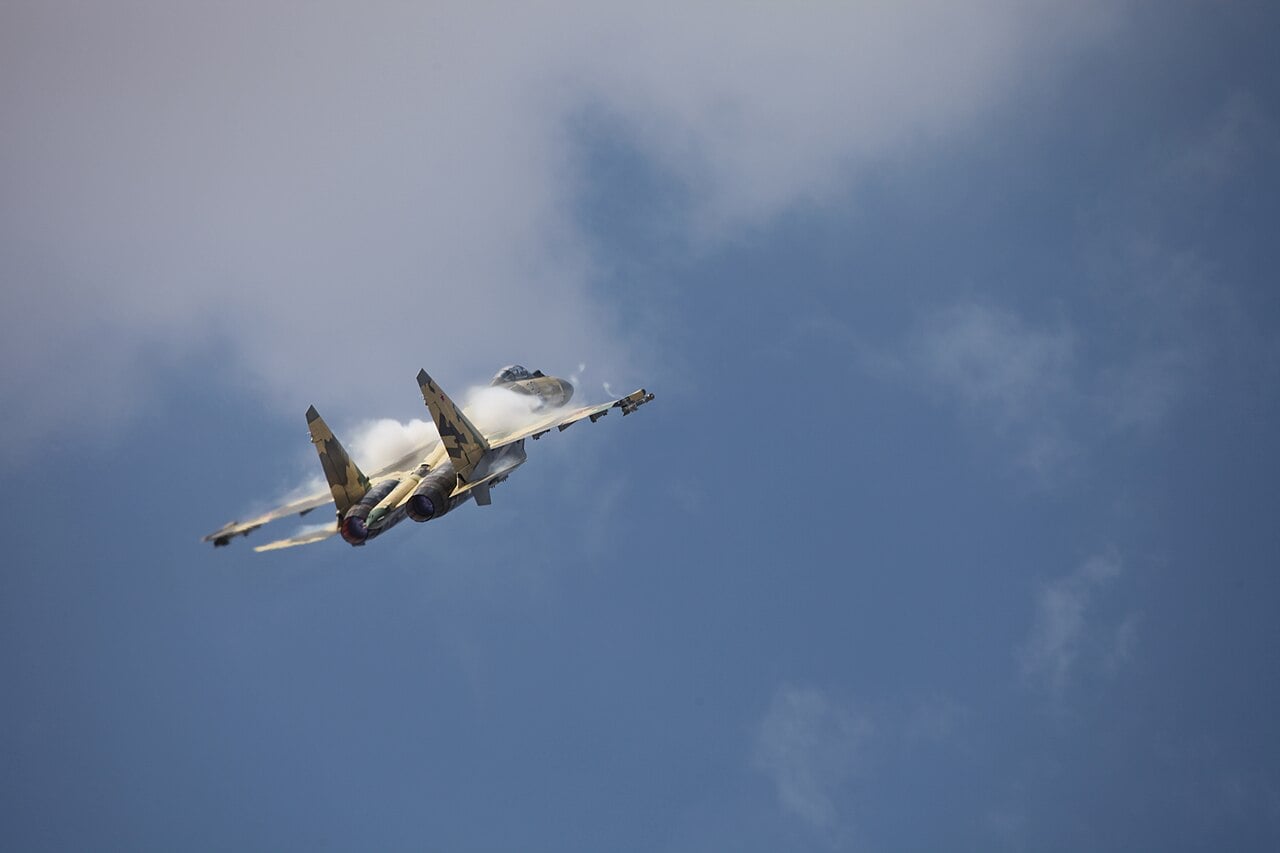
Mid-air collisions between fighters are not exotic. They happen in formation join-ups, in tail chases, in air combat training, and in the crowded seconds around a rejoin. Kursk borders Ukraine and remains an active operating area for Russian aviation, so the jets could plausibly have been on a combat air patrol, a transit, or a training sortie. Without an official cause, all of that is speculation.
A fighter built for the merge that never gets one
The Su-35S descends from the Su-27M, a deep modernisation of the Soviet Union’s premier air-superiority fighter whose first prototype flew in 1988. The definitive production Su-35S first flew in May 2011 and entered Russian service in 2014.
It is a serious machine. AL-41F1S engines with thrust-vectoring nozzles give it the post-stall party tricks that made it an airshow legend. It carries the Irbis-E passive electronically scanned array radar, which its manufacturer credits with detecting large targets out to roughly 400 kilometres, plus the Khibiny jamming suite, an infrared search-and-track set, fourteen hardpoints and more than 8,000 kilograms of stores. Its first combat deployment, to Syria in January 2016, cast it as an intimidation asset, shadowing Turkish and Israeli aircraft over contested airspace.
Then it got a real war, and the war never asked it to dogfight. After Ukraine’s mobile surface-to-air missile force made penetrating flights prohibitively expensive in early 2022, the Su-35 settled into patrolling behind its own lines, escorting Su-34s lobbing glide bombs, and firing the very-long-range R-37M at Ukrainian fighters from standoff distance.
That admission came even after Ukraine received American F-16. Kyiv’s Vipers fly the war they are permitted to fly: low, far behind the line, superb against cruise missiles and drones. Against a Su-35 holding an R-37M at altitude, they mostly do not get the chance.
A loss ledger nobody agrees on
Count the Su-35s Russia has lost and you get a different answer from every source. The International Institute for Strategic Studies counted more than five destroyed by May 2023. The War Zone’s open-source accounting put the visually confirmed figure at eight by June 2025. Ukrainian claims run to roughly 25. Fighterbomber, reporting this week’s collision, put the total at ten. None of these can be reconciled, and anyone quoting a single clean number is guessing.
The confirmed entries make unflattering reading for a premier air-superiority fighter. Two were downed by Patriot batteries over Bryansk within eight days in May 2023. One was destroyed near Tokmak in September 2023 by Russia’s own S-300, a friendly-fire kill by a system that could not tell whose Flanker it was tracking. The first loss of the war, on 3 April 2022 near Izium, ended with the pilot captured.
Across four full years, not one Su-35 loss has been independently confirmed as an air-to-air kill. Its killers, so far as anyone can prove, have all fired from the ground, and one of them was Russian. Now two more appear to have been taken out by each other.
On that narrow point, the Russian and Ukrainian accounts broadly agree. Where they diverge is on what it cost. The Royal United Services Institute concluded in a January 2026 assessment that Russia’s fighter fleet has managed only a handful of air-to-air kills in four years, despite expending R-37Ms against an opponent flying older jets with weaker warning sensors.
And here is the number that should worry Kyiv more than any loss tally. RUSI assesses that only around 20 Su-35S and Su-30SM2 airframes combined have been lost or damaged beyond repair since February 2022, while the Komsomolsk-on-Amur line has delivered every year of the war. By that reading, Russia ended the war’s fourth year with slightly more modern fighters than it started with. Ukraine is attriting the Su-35 more slowly than Russia is building it.
Which is what makes an own-goal over Kursk quietly expensive. Ukraine has spent four years struggling to shoot these aircraft down. On Sunday, by every account available, two of them did the job without any help at all.
A walk through the Flanker family’s evolution from the Su-27M to the Su-35S.
Foire aux questions
What happened to the two Su-35 fighters in Kursk?
Did Ukraine shoot down the two Su-35s over Kursk?
How many Su-35s has Russia lost in the war in Ukraine?
Has a Su-35 ever been shot down by another fighter?
What makes the Su-35S different from other Flankers?
Is Russia running out of Su-35 fighters?
Sources: Meduza; Pepel. Kursk; The Defence Blog; Kyiv Post; Militarnyi; 19FortyFive; The War Zone; Royal United Services Institute; International Institute for Strategic Studies.
0 commentaire