
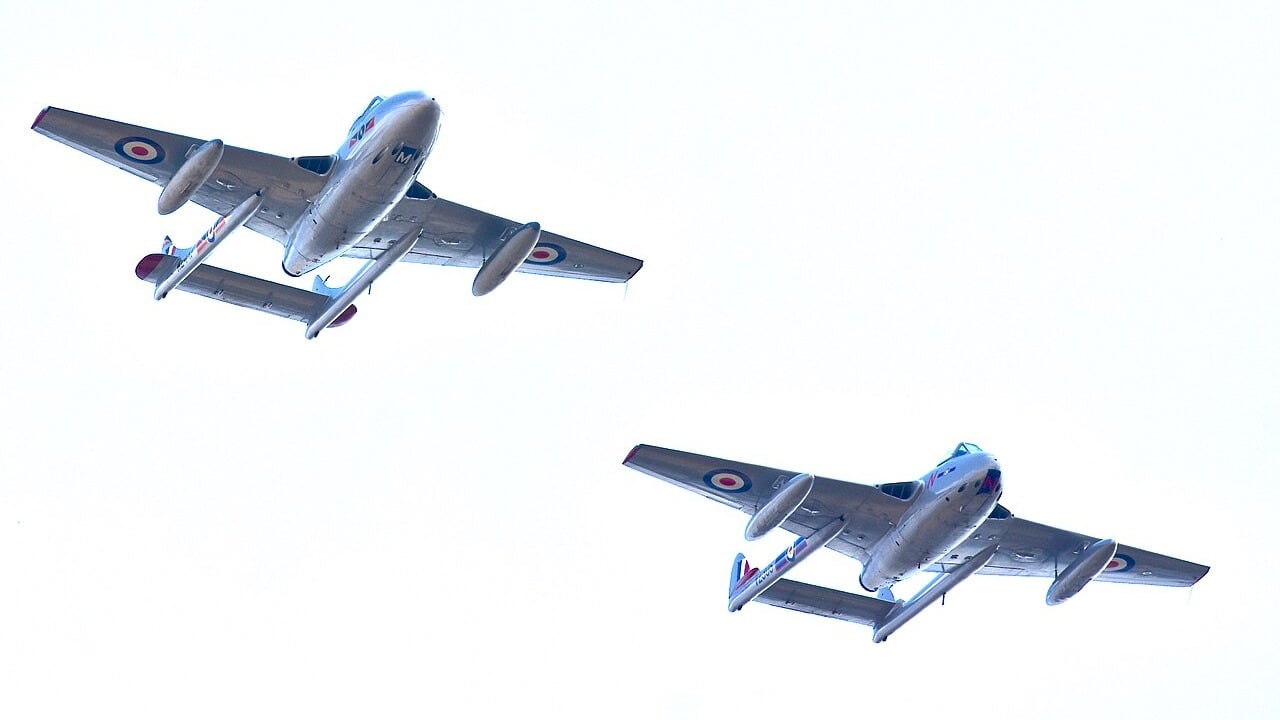
Somewhere this morning an aeroplane took off that does not meet its own type design. Perhaps its annual inspection lapsed three weeks ago. Perhaps an airworthiness directive has not been complied with, or a piece of equipment outside the minimum equipment list is unserviceable, or the airframe took damage beyond the published limits and now has to reach a shop two hundred miles away. It flew anyway, entirely legally, with a piece of paper in the cockpit that said so.
Both sides of the Atlantic have built a mechanism for this. Both start from the same premise, phrased almost identically: an aircraft that does not meet the applicable airworthiness requirements but is capable of safe flight. And from that shared sentence the two regulators proceed to write completely different rules.
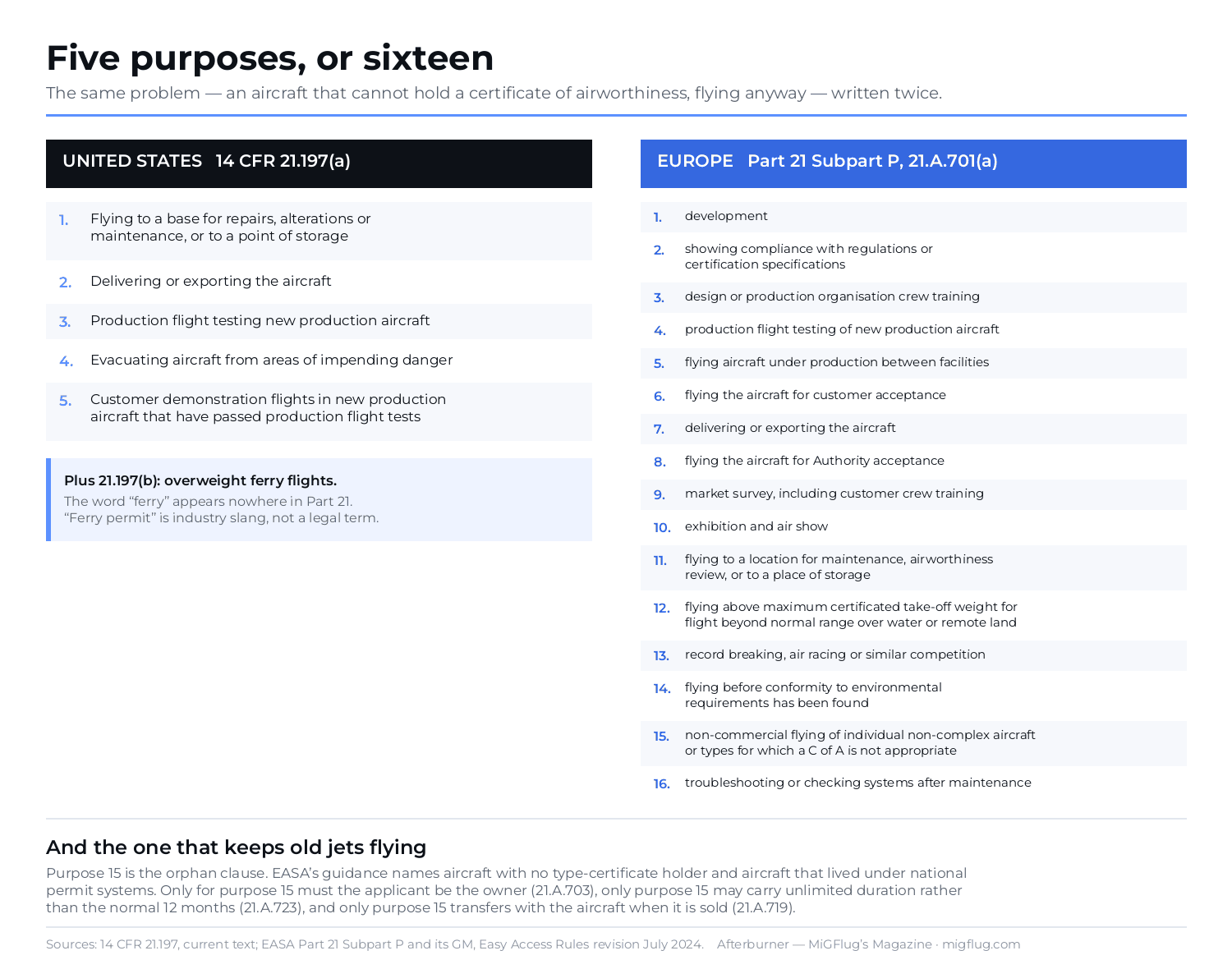
The American version lists five purposes. The European version lists sixteen. That gap is not pedantry — it is the reason a great many elderly jets are airworthy in Europe and would be far harder to keep flying in the United States, and the reason the two systems feel so different to anyone who has dealt with both.
Informations clés
United States: special flight permit, 14 CFR 21.197 and 21.199 — five listed purposes, plus overweight ferry flights
Europe: permit to fly, Part 21 Subpart P — sixteen listed purposes
Both require: an aircraft that does not meet airworthiness requirements but is capable of safe flight
“Ferry permit”: industry slang. The word “ferry” does not appear anywhere in 14 CFR Part 21
EASA duration: maximum 12 months, except purpose 15, which may be unlimited
Key US catch: a special flight permit is not authority to deviate from Part 91
A word about the term everybody uses
Ask any American pilot about this and they will say “ferry permit”. The FAA itself says it: the Philadelphia Flight Standards District Office’s guidance opens by calling it “A Special Flight Permit (SFP), commonly referred to as a Ferry Permit”.
It is worth knowing that the phrase has no regulatory existence whatsoever. Search the current text of 14 CFR Part 21 and the word “ferry” appears zero times. Not in 21.197, not in 21.199, not anywhere in the part. Part 91 does use “ferry flight”, but in 91.611, which governs flying a multi-engine aeroplane with one engine inoperative — a completely different animal that has nothing to do with special flight permits.
So the thing is called a special flight permit, and the thing everyone calls a ferry permit is the same thing wearing a nickname. The nickname is also slightly misleading, because ferrying is only one of the purposes the regulation allows.
What the FAA rule actually permits
14 CFR 21.197(a) lists five purposes for which a special flight permit may be issued: flying the aircraft to a base where repairs, alterations or maintenance are to be performed, or to a point of storage; delivering or exporting it; production flight testing new production aircraft; evacuating aircraft from areas of impending danger; and conducting customer demonstration flights in new production aircraft that have satisfactorily completed production flight tests.
Paragraph (b) adds a sixth case of a different kind: operating above maximum certificated take-off weight for flight beyond the normal range over water, or over land where adequate landing facilities or fuel are not available. The excess weight is limited to the additional fuel, fuel-carrying facilities and navigation equipment needed for the flight. This is the clause that puts a Cessna with a ferry tank where the back seats used to be over the North Atlantic.
What 21.197(b) looks like in practice: an oceanic crossing in a light single, with the fuel load that makes it possible.
Paragraph (c) covers a third situation — a continuing authorisation written into an operator’s operations specifications, available to Part 119 certificate holders with an approved programme and to Part 91 Subpart K fractional operators. For everyone else, every permit is a one-off application.
The catch that surprises owners
Here is the detail that causes more trouble than any other, stated plainly in the FAA’s own field guidance.
A special flight permit solves exactly one problem: it substitutes for the airworthiness certificate that the aircraft can no longer support. It does nothing at all about the operating rules. The pilot still needs to be current and qualified, the flight still obeys every rule in Part 91, and the permit does not create permission to fly an aircraft the pilot could not otherwise legally fly.
The same guidance notes two further practical points. A review of applicable airworthiness directives has to be carried out to establish whether the aircraft is even eligible. And the permit is issued by the office with jurisdiction over the area where the flight originates, not where it is going — which matters when the aeroplane is sitting in a field two states away from its owner.
Applying, and who may sign
Under 21.199(a) the applicant submits a statement giving the purpose of the flight, the proposed itinerary, the crew required to operate the aircraft and its equipment, the ways in which the aircraft does not comply with the applicable airworthiness requirements, any restriction the applicant considers necessary for safe operation, and anything else the FAA needs in order to prescribe operating limitations. Paragraph (b) lets the FAA make, or require, any inspections or tests necessary for safety.
That fourth item is the heart of it. You are required to write down, honestly, exactly what is wrong with the aeroplane. The limitations that come back are built from that admission.
Applications go through the online airworthiness certification tool or on paper using FAA Form 8130-6, and the permit need not come from the FAA directly: Designated Airworthiness Representatives are authorised to issue special flight permits, which is usually the faster route.
A walk through 21.197 and the limitations that typically come attached.
Europe splits the job in two
The European equivalent is the permit to fly, in Part 21 Subpart P of Regulation (EU) No 748/2012. The first thing to understand is that it is not one approval but two, and they can be issued by different bodies.
Step one is the flight conditions. Point 21.A.708 defines them as the configurations for which the permit is requested; any condition or restriction necessary for safe operation, including restrictions on itineraries or airspace, conditions on the flight crew, restrictions on carrying anyone other than flight crew, operating limitations and specific procedures, a flight test programme where applicable, and the continuing-airworthiness arrangements; the substantiation that the aircraft can fly safely under those restrictions; and the method used to control the aircraft’s configuration.
Those conditions must be approved before the permit exists. Where the approval touches the safety of the design, 21.A.710 sends it to the Agency itself or to a suitably approved design organisation exercising the privilege in 21.A.263(c)(6) — the privilege we looked at when we covered the EASA Design Organisation Approval. Where it does not, the competent authority or an approved organisation handles it. The approval is documented on EASA Form 18B.
Step two is the permit itself, under 21.A.711. The competent authority issues it on EASA Form 20a; an appropriately approved design, production or continuing-airworthiness organisation may issue it on Form 20b under its own privileges, and must send a copy to the authority within three days.
Purpose 15, and the jets it keeps in the air
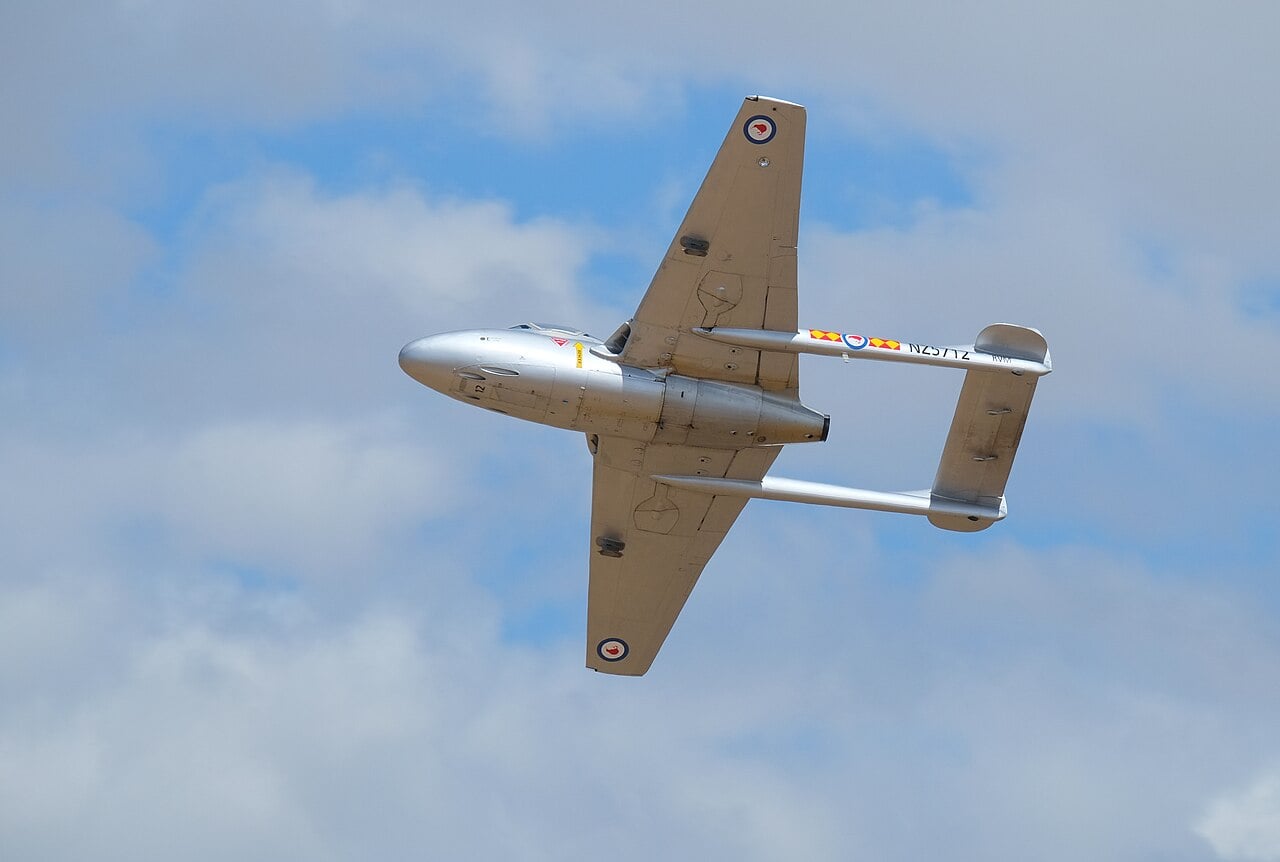
Fifteenth on the European list is a purpose with no American counterpart at all: non-commercial flying of individual non-complex aircraft, or of types for which a certificate of airworthiness or restricted certificate of airworthiness is not appropriate.
EASA’s guidance material spells out who that means. It describes aircraft that cannot practically meet all the applicable certification specifications — among them aircraft with no type-certificate holder still in existence, which the guidance calls “generically termed orphan aircraft”, and aircraft that previously lived under national permit-to-fly systems and were never shown to meet the full modern requirements. The guidance adds a limit: this route should only be used where a certificate of airworthiness cannot be issued for reasons outside the owner’s control, such as the absence of properly certified spare parts.
Read that description again and a particular hangar comes to mind. A 1950s fighter whose manufacturer was absorbed into a conglomerate four mergers ago. A trainer built in a country that no longer exists. There is no type-certificate holder to issue a service bulletin, because there is no type-certificate holder. Purpose 15 is the clause that lets those aircraft fly as something other than museum pieces.
Three further details apply to purpose 15 and to nothing else on the list, and together they show how carefully it was drafted. Under 21.A.703(a) the applicant must be the owner, where for every other purpose any natural or legal person may apply. Under 21.A.723(b) the permit may be issued for unlimited duration, where every other permit to fly is capped at twelve months. And under 21.A.719(b) it transfers with the aircraft when ownership changes, provided the aircraft stays on the same register, where every other permit to fly is strictly non-transferable.
In other words, Europe recognised that for this one category the permit is not a temporary fix at all. It is the aircraft’s permanent legal basis for existing, and the rules were adjusted to let it behave like one.
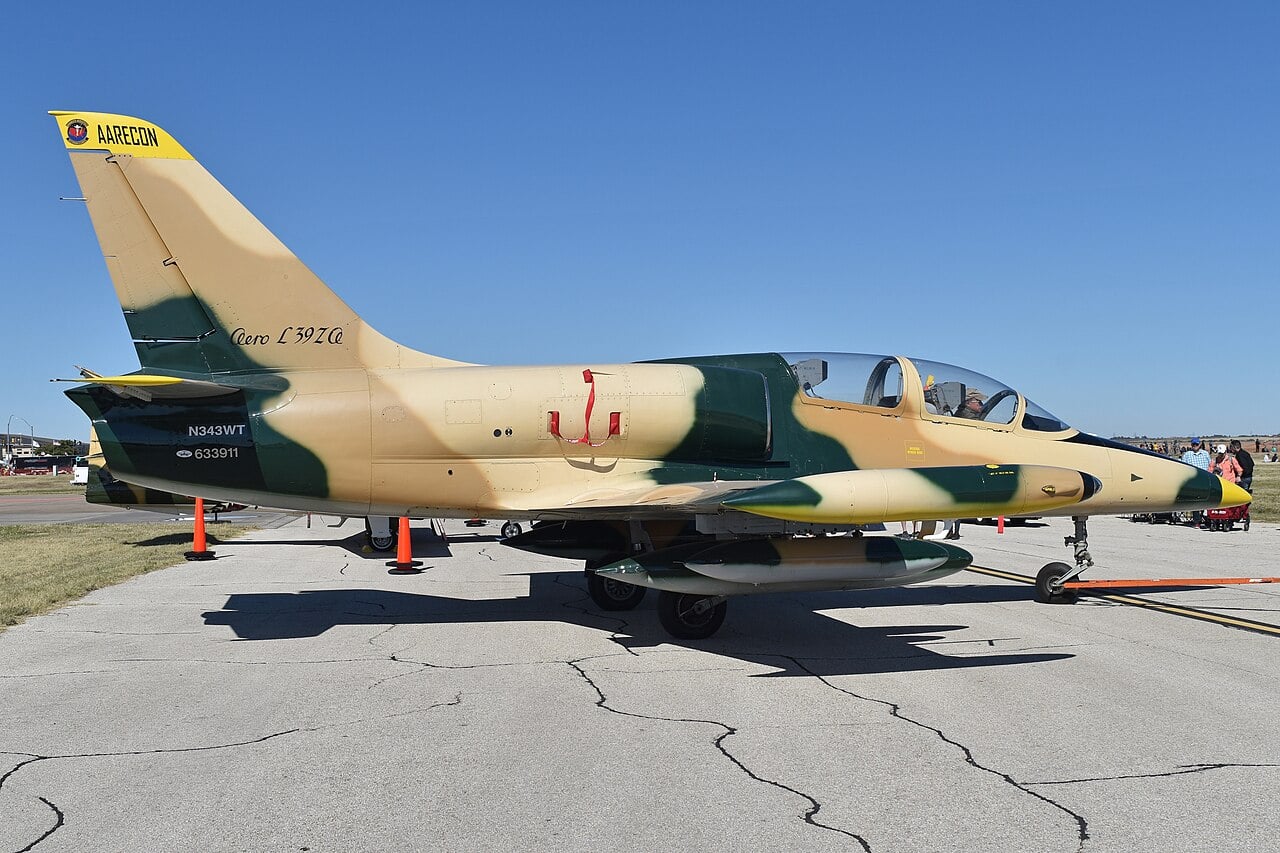
The United States solves the orphan problem by a different route entirely — the experimental category, in which ex-military jets are certificated for exhibition and air racing with their own operating limitations. It gets to a similar place by a different legal road, which is why an American warbird operator and a European one can describe the same aircraft in paperwork that shares almost no vocabulary.
What “capable of safe flight” is actually doing
Both systems hang everything on that phrase, and Europe is the one that bothered to define it. The guidance material to 21.A.708(c) is unusually candid about where the line sits.
And then, having opened that door a crack, the same guidance closes it again in the next breath — stating that the definition should not be read as allowing a test pilot with a parachute, operating over a sparsely populated area, to set out on a flight in the full knowledge that the aircraft will probably be lost. The applicant must take reasonable care and be satisfied there is a reasonable probability the flight will be completed without damage or injury.
It is a rare moment of a regulator writing down the thing everyone was thinking. Yes, this category exists partly for flights that might not end well. No, that is not a licence to write the aeroplane off on purpose.
The practical end of all this paperwork: a light aircraft crossing an ocean it was never designed to cross, on a permit written specifically to allow it.
Two philosophies, one problem
Set the lists side by side and the difference is one of ambition. The American rule is a logistics tool: it exists to move an aeroplane from where it is to where it can be fixed, sold, exported or stored, and to let a new one be tested before delivery. Five purposes, all of them about getting the aircraft somewhere.
The European rule does all of that and then keeps going, into air shows, record attempts, air racing, market surveys, troubleshooting flights after maintenance, and finally into the permanent accommodation of aircraft that will never hold a certificate of airworthiness again. It is less a tow rope than a parallel regime.
Neither is obviously better. The American approach keeps a bright line between certificated aircraft and everything else, and pushes the awkward cases into the experimental category where they get their own rules. The European approach absorbs the awkward cases into the main system and manages them with conditions. But if you have ever wondered why a European airfield on a summer weekend contains so many aeroplanes that by rights should have been retired in 1975, the answer is the fifteenth item on a list in Subpart P.
Sources: 14 CFR 21.197 and 21.199, and 14 CFR 91.611, current text via the Electronic Code of Federal Regulations; EASA Part 21 Subpart P with its AMC and GM, Easy Access Rules for Initial Airworthiness, revision of July 2024; FAA Philadelphia Flight Standards District Office, Special Flight Permits guidance, April 2024; UK Civil Aviation Authority, Part 21 temporary Permits to Fly.



0 Comments