
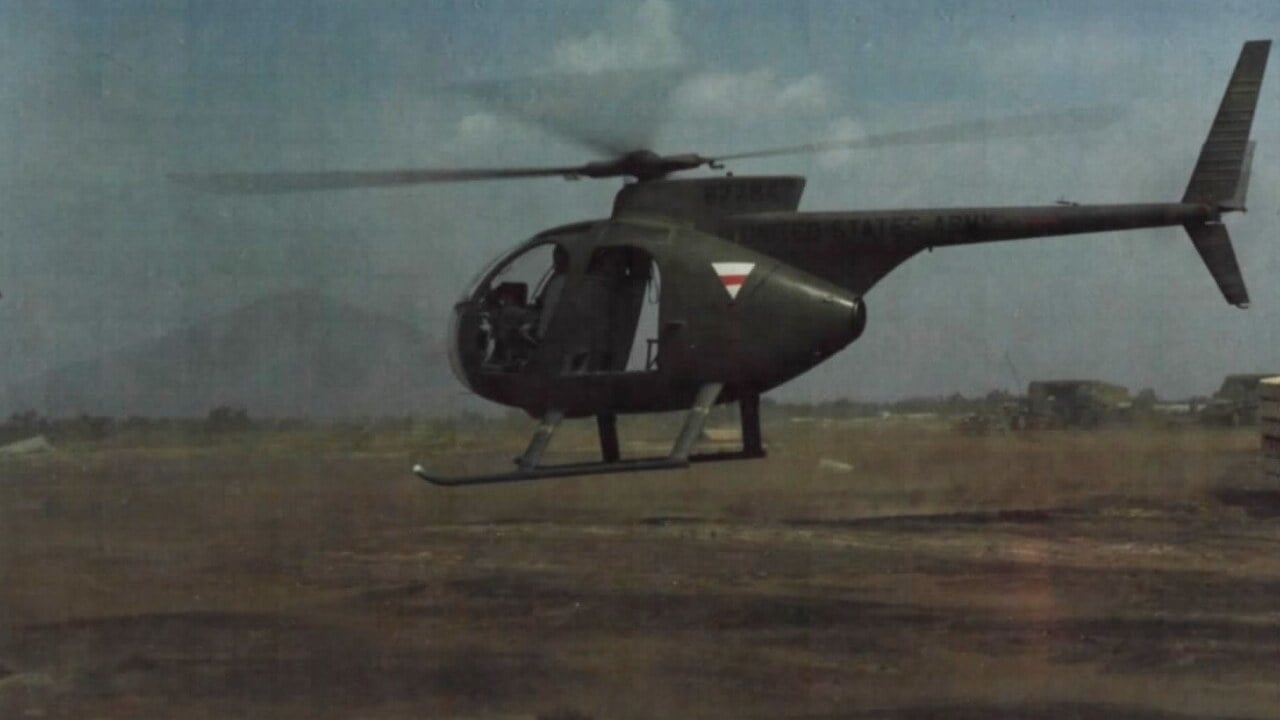
At 8:28 on the morning of 7 April 1966, a small, egg-shaped helicopter settled onto the sand at Ormond Beach, Florida. Its pilot had taken off from Culver City, California, at 2:20 the previous afternoon and had not landed since. A boy on the beach asked where he had come from. “From California,” said Hughes test pilot Bob Ferry. The boy looked at the machine and asked: “In that?”
Yes, in that. The Hughes YOH-6A had just flown 3,561.55 km nonstop, still the longest nonstop distance on record for a helicopter. It was the flashiest proof yet that the US Army’s new Light Observation Helicopter was something special. Within two years its pilots would be flying it at treetop height over Vietnam, deliberately trying to get shot at.
Quick Facts
- Type: Light observation helicopter, Hughes Model 369
- Crew: Usually pilot and observer
- Engine: One Allison T63 turboshaft
- First flight: 27 February 1963
- US Army service: From 1966; first in Vietnam December 1967
- Built: About 1,420 OH-6As, plus 387 licence-built by Kawasaki in Japan
- Record: 3,561.55 km nonstop, Culver City to Ormond Beach, 6-7 April 1966 (Bob Ferry)
- Nickname: Loach, from LOH (Light Observation Helicopter)
- Descendants: MH-6/AH-6 Little Bird, Hughes/MD 500 series
An egg built to win a contract
The OH-6 was born from US Army Technical Specification 153, issued in 1960 for a Light Observation Helicopter, or LOH, to replace the piston-engined Bell H-13 Sioux. The new machine had to carry people, escort, evacuate casualties, observe and attack. Twelve companies took part. Hughes Tool Company’s Aircraft Division offered the Model 369.
Its teardrop fuselage looked odd, and soldiers soon called it the “flying egg”. But the shape, internal bulkheads and self-sealing fuel tanks made it unusually crashworthy, and the big plexiglass nose gave a superb view. A four-bladed, fully articulated main rotor made it far more agile than the H-13. It flew for the first time on 27 February 1963.
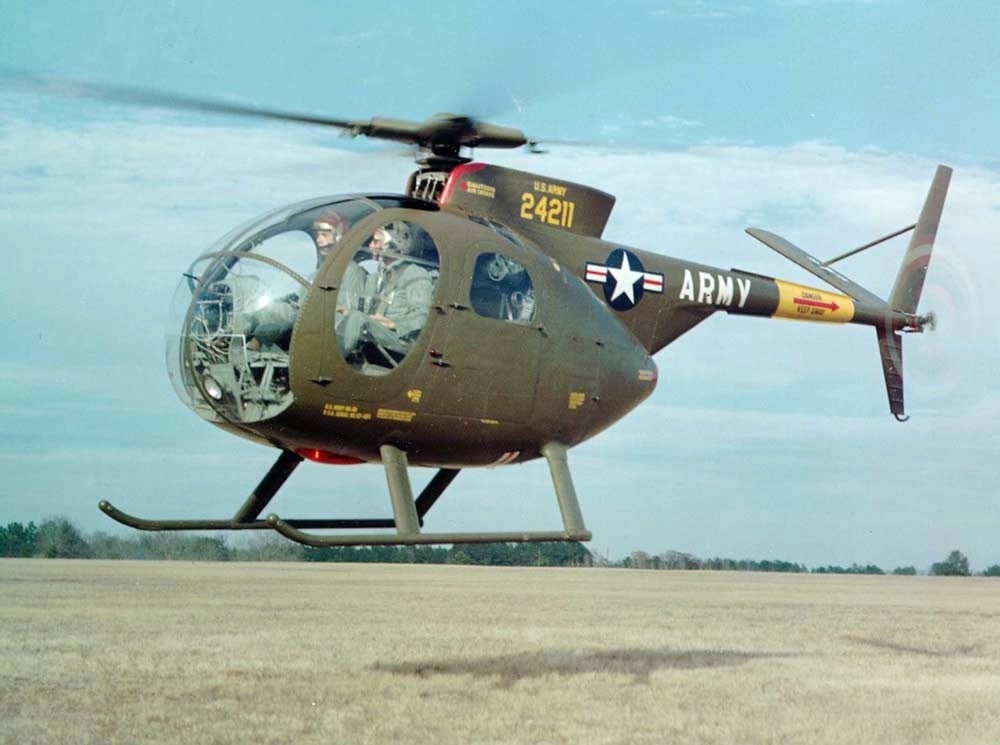
The fly-off at Fort Rucker, Alabama, pitted Hughes against Fairchild-Hiller and Bell. Bell’s YOH-4 was eliminated as underpowered, and in May 1965 Hughes won with a startlingly low price: $19,860 per airframe without engine, against Hiller’s $29,415. Reports later said Howard Hughes had deliberately bid below cost, and the company lost heavily on the contract.
The gamble backfired. When prices rose, the Army reopened the competition, and in the sealed bids that followed, Hughes came in at $56,550 per airframe against Bell’s $54,200. Bell won with its Model 206, which became the OH-58 Kiowa. Hughes still built about 1,420 OH-6As.
Coast to coast on carrot juice
Hughes needed headlines, and in the spring of 1966 the YOH-6A delivered them, setting more than 20 world records for speed, distance and time to climb. On 26 March, Jack Schwiebold flew a closed-circuit distance of 2,800.20 km without landing at Edwards Air Force Base.
Then came the big one. For Bob Ferry’s coast-to-coast attempt, the helicopter was stripped to an empty weight of just 1,025 pounds. Duplicate controls, unused seats and even the door handles came out. Ferry lost 20 pounds himself, flew in knitted slippers and an old leather cap, and loaded 1,860 pounds of fuel, taking off at more than three times the empty weight.
There was no autopilot and no radio navigation. A de Havilland CV-7 chase plane was supposed to guide him and certify the record, but it lost him for an hour after take-off, then again at sunrise, and finally had to land at Tallahassee to refuel. Ferry climbed as high as 24,000 feet at night to ride the tailwinds, keeping warm in an electrically heated jacket.
A US Army training film on the OH-6’s characteristics and basic manoeuvres, from the type’s early service years.
Ferry gave up on Miami, then on Daytona Beach. Past St. Augustine, the low-fuel light came on, and he landed on the beach at Ormond with power rather than risk a dead-stick landing on a hidden log. He had been in the air for 15 hours and 8 minutes. When his ground crew drained the tanks, about 10 pounds of fuel were left.
The FAI still lists Ferry’s 3,561.55 km as the current distance record for helicopters weighing 1,000 to 1,750 kg. The overall helicopter entry has been retired under changes to the FAI sporting code, but no helicopter has flown farther without landing.
Bait in the treetops
The OH-6A entered US Army service in 1966, and the first arrived in South Vietnam in December 1967. Crews turned the LOH acronym into a nickname: the Loach. It was easy to maintain, its compact 26-foot rotor fitted into tiny landing zones, and its thin aluminium skin crumpled and absorbed energy in a crash while the structure protected the crew. Many crews walked away from forced landings that would have been fatal in other helicopters.
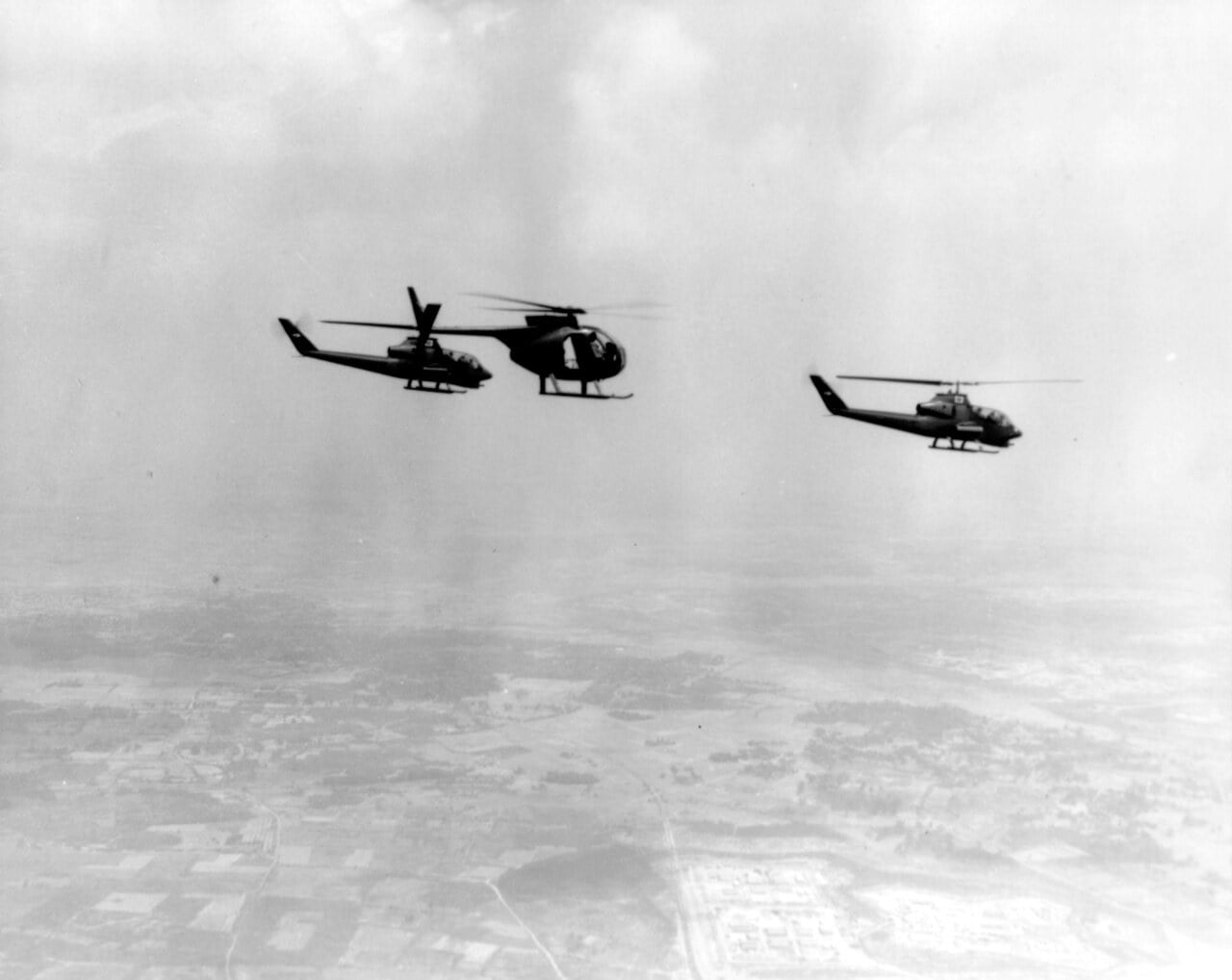
Its job was the most dangerous in Army aviation. In a “hunter-killer” team, a Loach flew low and slow over the jungle looking for the enemy, while an AH-1 Cobra gunship circled above. When the Loach drew fire, its observer marked the spot with a smoke grenade, and the Cobra rolled in. Before Cobras arrived, armed UH-1 Hueys played the killer role.
ITN archive footage of US air cavalry flying hunter-killer missions near Hue in 1972.
The pairing became so effective that enemy troops often chose not to fire at the vulnerable Loach at all, rather than bring the Cobra down on themselves. Losses were still heavy, mostly to ground fire, and the arrival of the shoulder-launched SA-7 missile in the early 1970s made every low pass more dangerous. By the end of the war, the Kiowa was replacing the OH-6 in most Army units, and some scout crews complained it was nowhere near as nimble.
The Loach also took over part of the observation work done by the Cessna O-1 Bird Dog, after a 1964 Pentagon decision left the Army flying mostly rotorcraft.
Little Bird and the MD 500
The egg refused to retire. After the failed Iran hostage rescue of April 1980, the Army built a special aviation task force and needed a tiny helicopter that could land almost anywhere and fit easily inside Air Force transports. It chose the OH-6A. Next to the task force’s bigger helicopters it was nicknamed the Little Bird.
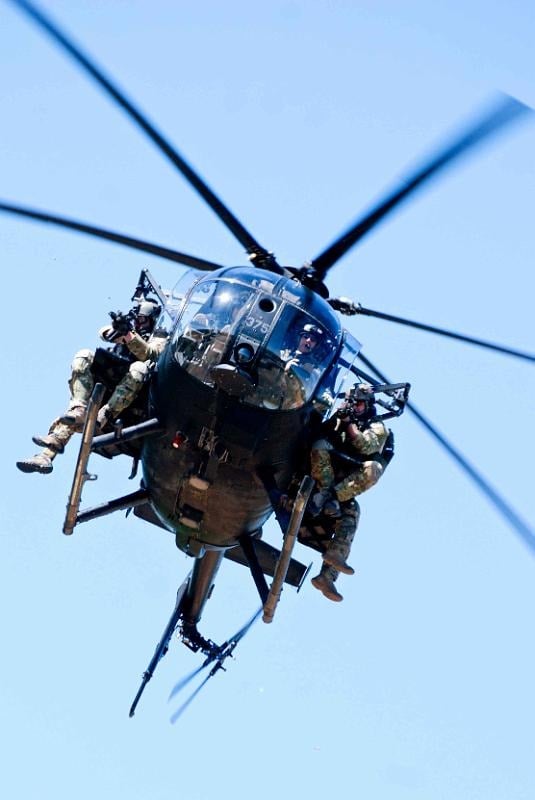
That task force grew into the 160th Special Operations Aviation Regiment, the Night Stalkers. Its transport Little Birds became MH-6s, carrying commandos on benches outside the cabin, and its armed versions became AH-6s. Descendants of the Loach still fly with the regiment today.
Vietnam veteran Eric Brethen, who flew both the OH-6 Loach and the AH-1 Cobra, tells his combat story.
On the civil side, Hughes turned the Model 369 into the Model 500. After McDonnell Douglas bought Hughes Helicopters in January 1984, it became the MD 500 series, including the tail-rotorless MD 520N with the NOTAR system. Kawasaki built 387 OH-6s under licence in Japan for the Japan Ground Self-Defense Force, the navy, the coast guard and civil operators.
Bob Ferry stayed at Hughes and, according to former Hughes engineer Don Porter, later made the first flight of the AH-64 Apache in September 1975. It is a fitting line: from a record-breaking egg to the AH-64 Apache, the Loach was where Hughes learned to build machines that soldiers trusted.
Sources: FAI records database (records 784 and 785), Vertical magazine (Don Porter, Vertical Rewind), Air Force Test Center History Office, Wikipedia (Hughes OH-6 Cayuse)
Header photo: P4 Wendell D. Garrett, US Army / NARA via Wikimedia Commons, public domain
0 Comments