
Cessna O-1
“Bird Dog”
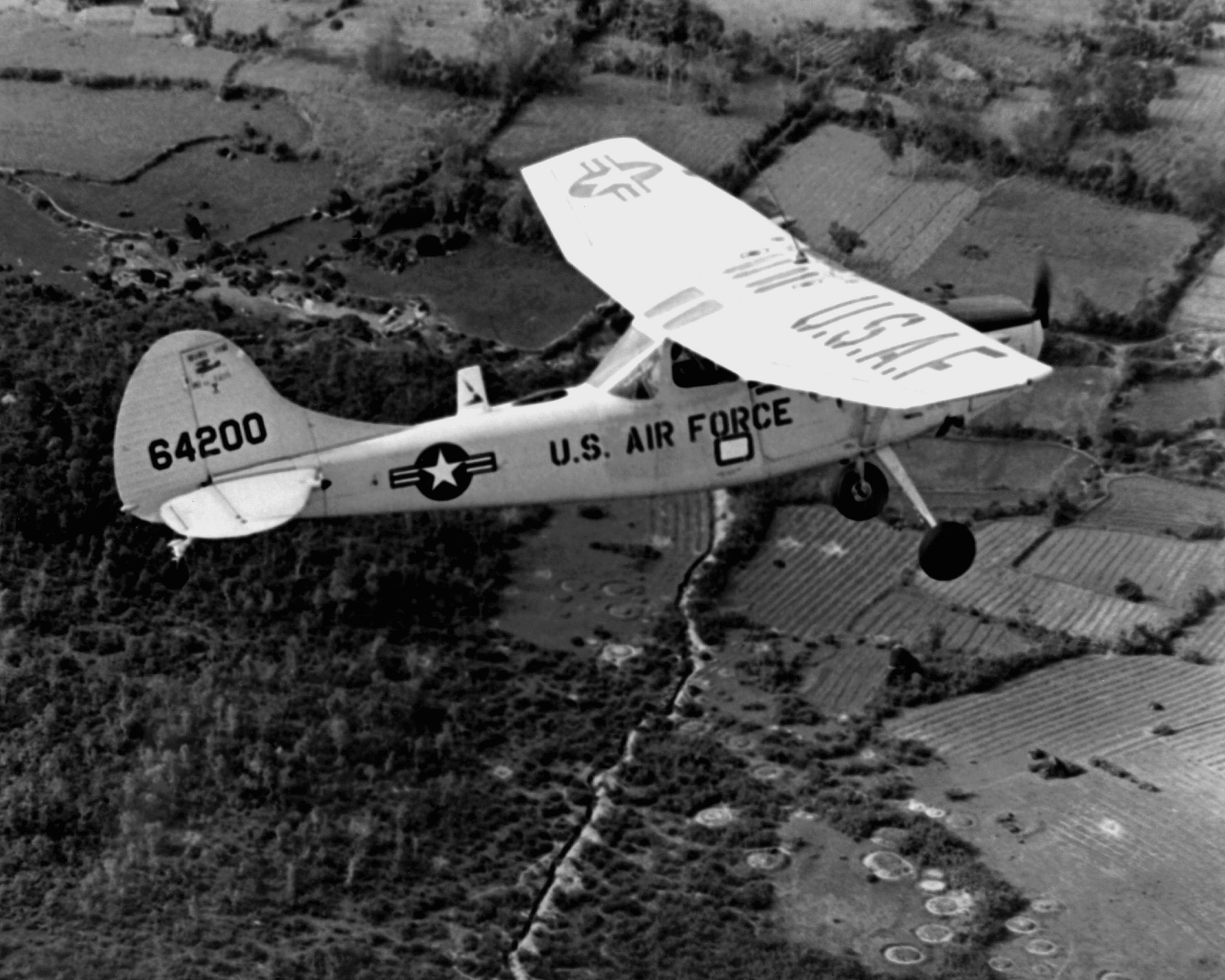
The little Cessna that went to war — the U.S. Army, Marine and Air Force spotter that directed the guns over Korea and marked targets for the fighter-bombers over Vietnam, usually low, slow and under fire.
The Cessna that flew to war
In 1950 the U.S. Army wanted a cheap, simple liaison and observation aeroplane to replace the tired taildraggers it had flown since the Second World War. Cessna answered with a militarised version of its civil Model 170 — a high-wing, two-seat, tandem machine with a bigger engine, a cut-down rear fuselage and a wrap-around greenhouse of glass for the observer. It won the competition, and the Army bought it as the L-19. A company contest named it the Bird Dog, because, like a hunting dog, its job was to range ahead, find the quarry and point it out for others to strike.
The Bird Dog went to war almost immediately. Over Korea it flew artillery-spotting, reconnaissance and liaison, droning slowly above the front while crews called down fire and reported troop movements. It was unarmed, unarmoured and painfully slow — and utterly essential. In 1962 the U.S. tri-service designation reshuffle renamed it the O-1, and by then it had found the mission that would define it: forward air control in Vietnam.
In Vietnam the O-1 became the eyes of American air power. A FAC pilot would fly for hours at treetop height, learning the ground so intimately that he could spot a track, a bunker or a boat that was out of place. When he found a target he rolled in and fired a white-phosphorus marking rocket — “Willie Pete” — to lay a spot of white smoke, then talked the fast jets and fighter-bombers onto it. It was slow, low and lethal work: the Bird Dog flew straight over guns that could not miss, and many did not come home. The little Cessna and its crews earned a reputation for a particular kind of courage.
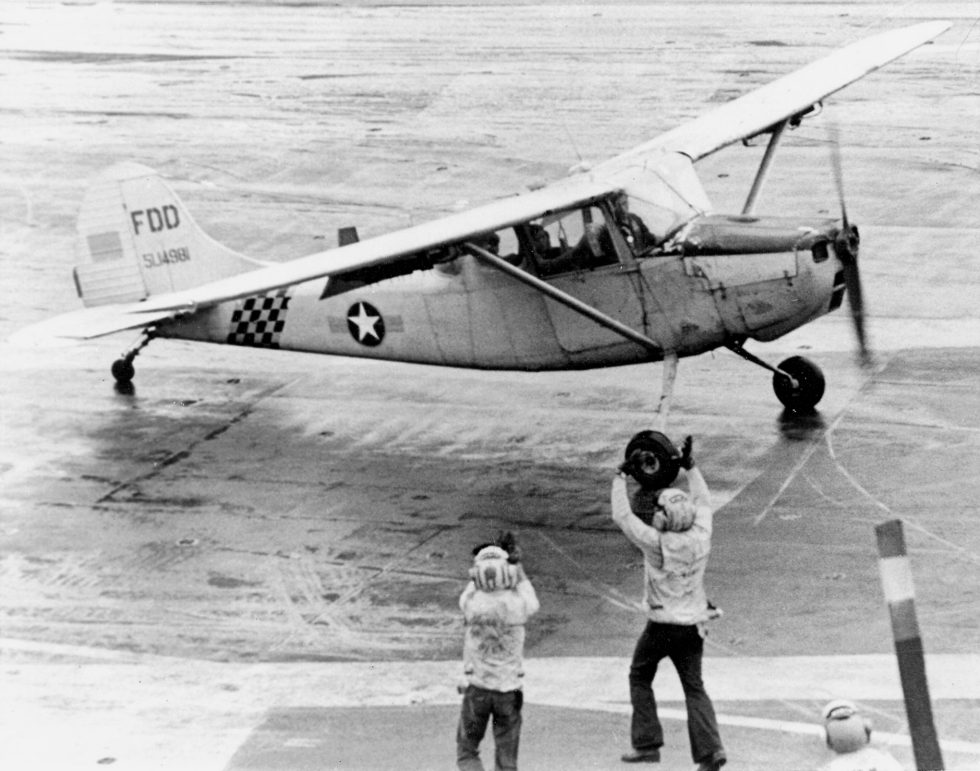
Two moments fixed the O-1 in memory. On 24 February 1967, Captain Hilliard Wilbanks, out of rockets, banked back over a South Vietnamese ranger battalion pinned by a far larger enemy force and fired his personal rifle out of the cockpit window to break up the assault, again and again, until he was shot down and killed. He received the Medal of Honor. Then, on 29 April 1975, as Saigon fell, a South Vietnamese major named Buang-Ly loaded his wife and five children into a two-seat O-1, flew out to sea and found the carrier USS Midway. He dropped a hand-written note asking them to clear the deck; the captain ordered helicopters pushed into the ocean to make room, and Buang-Ly landed his overloaded Bird Dog safely aboard. That very aircraft is preserved today at the National Naval Aviation Museum in Pensacola.
More than 3,400 Bird Dogs were built, and the type served a long list of allied air arms — France flew it in Algeria, Italy built it under licence, and Canada, Japan and others operated it for decades. Faster, purpose-built controllers like the O-2 and OV-10 eventually took over the FAC role, and the O-1 left U.S. service in the 1970s. But hundreds survive, and the Bird Dog is now one of the most popular military warbirds flying — a small, honest aeroplane with an outsized war record.
01How the Cessna O-1 Bird Dog got its name — and its Cessna 170 bloodline
The Bird Dog began life as the Cessna Model 305, a military development of the four-seat civil Cessna 170. Cessna cut it down to two tandem seats, added a more powerful six-cylinder Continental engine, extended the rear glazing for all-round vision and strengthened the airframe for rough-field work and steep observation turns. When the Army adopted it in 1950 as the L-19, Cessna ran an employee contest to name it; the winning entry, “Bird Dog,” captured the aircraft’s job perfectly — a hunter that finds the game and points it out. The name stuck through the 1962 redesignation to O-1 and remains what almost everyone calls it today.
What makes the O-1 Bird Dog special
A warplane built from a light aircraft
The O-1 was deliberately simple: a fabric-and-metal high-wing taildragger derived from the civil Cessna 170, seating a pilot and observer in tandem. That simplicity was the point — it was cheap to build, easy to maintain in the field, and could operate from short, rough strips close to the front. Nothing about it was exotic; everything about it was useful.
A cockpit built to see
What set the Bird Dog apart from a stock Cessna was visibility. The cabin was wrapped in glass, with a cut-down rear fuselage and transparent panels overhead and in the doors, so the crew could look down and behind almost without obstruction. For an observation and forward-air-control aircraft, the ability to see the ground — and keep a target in sight through a hard turn — mattered more than speed.
Slow on purpose — and armed with smoke
Powered by a single 213-hp Continental O-470, the O-1 cruised around 100–115 mph. Slow flight was a feature, not a flaw: it let the crew study the ground for hours. Under the wings it usually carried 2.75-inch white-phosphorus marking rockets — not to destroy the target, but to mark it with white smoke for the strike aircraft the FAC controlled.
02The O-1 Bird Dog’s glasshouse cockpit: why visibility beat speed
An observation aircraft is only as good as the view from it. Cessna gave the Bird Dog a greenhouse canopy, generous side and overhead glazing and a lowered rear deck so the two crew could scan almost the entire hemisphere below and behind them. Pilots learned to fly “heads-out,” reading the ground in extraordinary detail — a fresh track in the grass, a wisp of cooking smoke, a sampan where none should be. In the FAC role that intimate knowledge of a patch of country, built up over hundreds of low-level hours, was worth more than any sensor of the era.
03The O-1 Bird Dog and the art of forward air control: marking with ‘Willie Pete’
The forward air controller was the link between troops on the ground and aircraft overhead. Flying low and slow, the O-1 pilot found the target, worked out the safest attack direction, and fired a white-phosphorus rocket to lay a bright plume of smoke exactly where the bombs should fall. He then cleared the fast movers in, correcting them off the smoke — “hit my smoke,” “fifty metres north.” It demanded nerve: to mark accurately the Bird Dog had to fly straight and predictable over defended ground, trading its own safety for the accuracy of the strike it directed.
Cessna O-1 Bird Dog full specifications
Baseline note: the figures below describe the O-1E — the L-19E of 1956, renamed in the 1962 tri-service redesignation, the strengthened mark with four underwing hardpoints that most forward air controllers flew, that Captain Hilliard Wilbanks was flying when he earned the Medal of Honor, and that most surviving airframes represent. Deltas for the L-19A/O-1A, the TL-19D/O-1D trainer and the Marine OE-2/O-1C are in grey. Four disagreements are worth settling before the tables start. Production: Cessna’s own total of 3,431 is the figure usually printed, a serial-block reconstruction gives 3,420 with 595 L-19Es rather than 469, and an AOPA account says 3,395 with the line closing on 22 January 1957 — which cannot be right, because L-19E deliveries ran on into 1963. Speed: the flight manual and most reference works give 115 mph maximum, the National Museum of the United States Air Force prints 150 mph, the Smithsonian 130 mph and one warbird museum 146 mph. The low number is a loaded aeroplane in level flight and the high ones are light-weight or redline figures; an O-1E with rocket tubes, three radio sets and two men aboard never saw 150 mph and never once needed to. Height: 7 ft 4 in is the standard figure, but the Air Force museum’s own fact sheet says 9 ft 2 in for the aircraft in its own gallery. Weight: 1,614 lb empty is an L-19A number, reprinted for decades against O-1Es that had accumulated pylons, seat armour and ten years of avionics, and it flatters them badly.
Dimensions & weights
- Crew
- 2 in tandem — pilot in front, observer behind, in a cabin glazed to an extent no other military aeroplane of the period matched. Angled side windows let both men look almost vertically down past the fuselage, transparent panels in the wing centre section let them look up into the turn, and a cut-down rear fuselage with its own window let them look directly aft. Everything about the airframe was arranged around the act of seeing the ground
- Length
- 7.87 m (25 ft 10 in) — unchanged across every piston mark. The Bird Dog was a Cessna 170 fuselage that had been redrawn rather than restyled, mated to Cessna 170B wings and a Cessna 195 tail
- Wingspan
- 10.97 m (36 ft 0 in). The Marine OE-2 used the wider-chord Cessna 180 wing instead, the one genuine aerodynamic departure in the whole programme
- Height
- 2.24 m (7 ft 4 in) over the fin in the three-point attitude. The Air Force museum prints 9 ft 2 in for its own O-1G, which is not reconcilable with any other published figure and looks like a measurement taken to the top of an aerial
- Wing area
- 16.2 m² (174 sq ft) — a large wing on a very light aeroplane, and the whole reason the type could work off 200 m of laterite in the rain
- Aspect ratio
- 7.45 — aerofoil NACA 2412, the same forgiving section Cessna used on its light singles. Nothing here was drawn for speed; everything was drawn for slow flight with the stick well back and the nose held up
- Empty weight
- 732 kg (1,614 lb). This is the L-19A figure and it is quoted almost everywhere for the O-1E as well. A late FAC aeroplane with four pylons, rocket tubes, three radio sets, armour plate behind the seats and a survival kit was heavier, and squadron weight-and-balance sheets said so even when the reference books did not
- Maximum take-off weight
- 1,102 kg (2,430 lb). Some sources give 2,400 lb for the normal category limit. The margin between empty and gross is barely 370 kg — two men, full fuel and four rockets consumed nearly all of it, which is why the Bird Dog carried so little and why what it did carry mattered so much
- Wing loading
- 68 kg/m² (13.9 lb/sq ft) at maximum weight. For comparison, an OV-10 Bronco sits near 60 lb/sq ft and an OV-1 Mohawk above 50. The Bird Dog was in a different category of aeroplane entirely, and it is the low wing loading, not the engine, that explains everything the type could do
- Power loading
- 5.2 kg/hp (11.4 lb/hp) on one 213 hp engine. Modest by fighter standards and extremely good for the weight, which is why a lightly loaded Bird Dog would climb at close to 1,000 ft/min off a short field
- Internal fuel
- 155 L (41 US gal, 34 imp gal) in two unprotected wing tanks. No self-sealing liner, no inerting, no armour around them. A single rifle round through a wing was a genuine emergency, and in Vietnam it happened often
- Underwing hardpoints
- 4 on the O-1E and the O-1F/O-1G forward air control conversions, carrying roughly 100 kg (220 lb) in total. The earliest L-19As had wing racks for light stores; the pylons that mattered were the ones that took rocket tubes
Performance
- Maximum speed
- 185 km/h (115 mph, 100 kn) at sea level, clean. This is the honest number for a loaded aeroplane, and it is the number that killed people: 115 mph is not fast enough to leave a machine-gun position behind, and every Bird Dog crew knew it
- Cruising speed
- 167 km/h (104 mph, 90 kn) at 1,525 m (5,000 ft). Working speed over a target was slower still, often around 130 km/h (80 mph), because the mission was to see rather than to arrive
- Stalling speed
- Around 87 km/h (54 mph, 47 kn) with full flap and power off. Published stall figures for the type vary by several miles per hour between the flight manual, the civil type certificate and museum sheets; the practical point is that the gap between stall and cruise was small enough that the aeroplane was flown near the bottom of its envelope all day
- Flap travel
- 60° of slotted flap — pilots describe deploying full flap as opening a pair of barn doors. The drag rise is violent enough that most operators land on 30° or 40°, but the full setting turns the Bird Dog into a lift with a propeller and is exactly what made short strips possible
- Rate of climb
- 5.8 m/s (1,150 ft/min) at sea level at light weight. At maximum weight on a hot afternoon in the Central Highlands it was a great deal less, and getting out of a valley after a marking pass was one of the recurring problems of the job
- Service ceiling
- 5,640 m (18,500 ft). Almost entirely theoretical: forward air controllers worked between 450 and 1,500 m because they had to see individual men under trees, and altitude was the one form of protection the mission itself forbade
- Absolute ceiling
- 7,560 m (24,800 ft) — a figure that appears in the tables and essentially nowhere in the type’s operational life
- Range
- 850 km (530 miles, 460 nmi) at economical cruise. Ferry flights of far greater distance were flown by adding cabin tanks, including transatlantic and trans-Pacific deliveries that are, given the aeroplane, faintly absurd
- Endurance
- Around 4 hours 30 min at loiter power. Typical forward air control sorties ran three hours, limited by the crew’s eyes and bladders as much as by fuel, and the standard practice was to relieve one FAC on station with another rather than let a working area go uncovered
- Take-off distance to 15 m
- 170 m (560 ft) at maximum weight. Ground roll alone was far shorter, and lightly loaded Bird Dogs routinely operated from strips that would not take a jeep in the wet
- Landing distance from 15 m
- 180 m (600 ft). The combination of 60° flap, a large wing and spring-steel undercarriage that would absorb an arrival rather than a landing is why the type ended up towing gliders off farm fields for the next fifty years
Propulsion & systems
- Engine
- 1 × Continental O-470-11 — air-cooled horizontally opposed six-cylinder, 213 hp (159 kW). A commercial light-aircraft engine, deliberately so: the US Army wanted something its own mechanics could work on in a field, from a parts bin that already existed. The choice looks unambitious and was in fact the single soundest decision in the programme
- Displacement
- 7.7 L (470 cu in), whence the designation. Low compression, low stress, 80/87 grade fuel, and an overhaul life long enough that the engine was almost never the reason a Bird Dog stopped flying
- Propeller
- Two-blade fixed-pitch McCauley, 2.29 m (90 in) diameter — a very long, slow-turning propeller chosen for static thrust rather than cruise efficiency. It is why the aeroplane accelerates off a short field the way it does, and why it makes the deep unhurried noise that people who served in Vietnam still recognise instantly
- Engines by mark
- O-470-15 on the TL-19D/TO-1D/O-1D, driving a constant-speed propeller — a better aeroplane to fly and the only piston Bird Dog with a variable-pitch prop. The Marine OE-2/O-1C had a 265 hp O-470-2. The Italian SM.1019 rebuild replaced the whole thing with a 317–400 shp Allison 250 turboprop
- Fuel and tankage
- 80/87 avgas in two gravity-fed wing tanks, unprotected. There was no self-sealing bladder, no foam, no cross-feed complexity and no fire suppression. This was a 1949 civil design militarised in a hurry, and its systems never stopped showing it
- Undercarriage
- Fixed tailwheel with spring-steel main legs of the pattern Cessna used for the next forty years. No shock struts to service, no hydraulics, nothing to leak. Aircraft were routinely fitted with floats or skis, and the Italian civil fleet still flies at least one Bird Dog on floats
- Structure
- All-metal stressed skin, strut-braced high wing. That was the point of the 1950 competition: the US Army was replacing fabric-covered Stinsons and Pipers that rotted in the field, and wanted an aeroplane that could stand outside in Korea and still be serviceable. The L-19E added local structural strengthening after early airframes showed fatigue at the wing attachments
- Flight controls
- Manual, cable and rod, no boost of any kind. Dual controls throughout, though the rear rudder pedals fold flat so the observer can move about, and the rear stick is noticeably taller than the front one. An observer could and sometimes did fly the aeroplane home
- Radios
- Three sets on the FAC fit — FM to the ground unit, VHF to the strike aircraft and the airborne command post, UHF or HF to the control centre. Only one could be worked at a time. That single limitation shaped forward air control tactics more than any performance figure in these tables
- Crew protection
- Essentially none — no self-sealing tanks, no ejection seats, and armour limited at best to plate behind the seats on late aircraft. The Marine OE-2 was the exception, delivered with crew armour and a supercharged engine, and only 25 to 27 were built
- Night and weather capability
- None worth the name. There was no radar, no infrared, no low-light sensor and no usable instrument approach capability in the field. Weather closed the mission; darkness ended it. Night forward air control passed to flare ships and later to the O-2 and OV-10
04The Cessna O-1 Bird Dog’s operating costs: cheap to run, then and now
The Bird Dog was, by design, one of the most economical military aircraft of its era — a light-plane airframe and a single piston engine kept both purchase and running costs low, which is precisely why the Army bought thousands of them. Reliable period cost-per-flight-hour figures are hard to pin down in open sources, so any single number should be treated as an estimate. As a civilian warbird today the O-1 is comparatively affordable to operate — owners commonly cite something on the order of $150–300 per flight hour for fuel, oil and routine maintenance, far less than any jet warbird, though a major engine or airframe overhaul can dwarf those hourly running costs. Treat these as ballpark figures, not audited accounts.
Armament & payload
The Bird Dog carried four rockets that killed nobody and a radio that killed a great deal
The O-1 is one of the few military aeroplanes whose armament section is genuinely a category error. It had no gun, no bomb sight, no gun sight and, in the mission that made it famous, no ambition to hurt anyone directly. Its four underwing pylons carried tube launchers for 2.75 in folding-fin rockets fitted with white phosphorus warheads — “Willie Pete” — which do not destroy targets so much as write on the ground in white smoke. The forward air controller found something, dived, fired one rocket, pulled off, and then talked a flight of F-100s or A-1s onto the smoke by voice: fifty metres north of my smoke, run in from the south, you are cleared hot. Nothing else in the American arsenal in Vietnam concentrated so much destructive authority in one man in so vulnerable a machine. A FAC in a 115 mph Cessna could commit a four-ship of fast movers, and no ordnance was released in his working area without his clearance. Fits varied enormously by mark, service and theatre: US Army artillery-spotting Bird Dogs often flew with nothing on the pylons at all, USAF forward air controllers carried two or four marking rockets, the Ravens in Laos loaded all four tubes, and South Vietnamese and clandestine operators improvised gun and bomb fits that appear in no official document.
Marking rockets
- 2.75 in (70 mm) folding-fin aerial rockets with M156 white phosphorus warheads, fired from tube launchers on the underwing pylons. Two or four rockets was the common in-country load; four tubes gave eight on some fits
- White phosphorus was chosen because it is instantly, unmistakably visible from a fast jet at 400 kn against jungle canopy. A high-explosive marker would have been useless: the point is the smoke column, not the crater
- Firing was by eye. There was no sight beyond a grease-pencil mark on the windscreen on many aircraft, and accuracy came from the pilot knowing his own dive angle and his own aeroplane rather than from any instrument
- The tactical cost was severe. Marking meant descending into small-arms range, holding a straight predictable dive, and then pulling off at 115 mph in front of everyone who had just been told exactly where the aeroplane was going
- Smoke grenades hand-thrown from the window were the fallback when the rockets ran out, and were also used to mark friendly positions and wind for the incoming strike
Guns, official and improvised
- No built-in gun on any production mark. The Bird Dog was procured as an observation aeroplane and the 1948 Key West Agreement made armed fixed-wing aviation a US Air Force matter, which the Army had no appetite to fight over a 213 hp Cessna
- Crews carried personal weapons as a matter of course — carbines, M16s, sidearms, grenades — nominally for survival after a forced landing, in practice for whatever presented itself
- On 24 February 1967 near Di Linh, Captain Hilliard A. Wilbanks of the 21st Tactical Air Support Squadron spent his marking rockets on a Viet Cong force about to overrun an ARVN Ranger battalion, then made repeated firing passes at around 30 m (100 ft) with an M16 poked out of the side window, reloading between passes. The Rangers withdrew. He was hit on the third pass, crashed, and died during the helicopter evacuation. The Medal of Honor followed on 24 January 1968
- Improvised gun fits appear in South Vietnamese, Laotian and clandestine service — light machine guns on pylons, rifle-calibre pods borrowed from other types — but they were never standard, never officially sanctioned in USAF service, and the airframe had neither the payload nor the speed to make strafing a serious proposition
- The lesson the Air Force actually drew was structural, not tactical: the OV-10 Bronco that replaced the O-1 was designed from the outset with four built-in 7.62 mm machine guns, so that the next Wilbanks would not need a rifle
Other underwing stores
- Four pylons on the O-1E and the O-1F/O-1G conversions, rated for roughly 100 kg (220 lb) in total — wired and plumbed for rocket tubes rather than for ordnance
- Parachute flares for illuminating a night contact until a flare ship or a gunship could arrive. Flares were the store that mattered second most after the rockets
- Leaflet dispensers and loudspeaker fits for psychological operations, a routine and unglamorous part of the in-country workload
- Message and supply drops to isolated outposts, and the wire-laying and casualty-evacuation odd jobs that earned the type its Korean nickname, the jeep with wings
- Light bombs were cleared on the earliest L-19A wing racks and were occasionally hung by allied operators. They were pointless: four small bombs is a fraction of what one strike aircraft delivers, and every pylon carrying a bomb is a pylon not carrying the marker that brings the strike aircraft in
Radios, the working armament
- Three sets in the forward air control fit: FM to the ground commander, VHF to the fighters and the airborne battlefield command and control centre, UHF or HF to the direct air support centre
- Only one radio could be worked at a time. A FAC talking to his ground unit was, at that moment, not talking to the fighters rolling in, and the mental workload of switching sets while flying a marking pass in a valley is the most demanding thing about the mission and the least visible in any specification table
- Radio relay was a mission in its own right. A Bird Dog orbiting at 1,500 m could connect a patrol in a valley to a headquarters that could not otherwise hear it, which is why the type was kept on station in areas with no strikes planned at all
- Artillery adjustment was worked the same way and predates the FAC role by fifteen years: observe the fall of shot, compute the correction in your head, pass it by voice. This was the whole job in Korea and remained the US Army’s reason for keeping the Bird Dog long after the Air Force had given it up
- The successor aircraft were bought largely for their radios. The OV-10 carried eight sets, several of them secure, and the difference in what one crew could coordinate was greater than the difference in speed
Sensors and the observer
- There were none. No radar, no infrared, no side-looking sensor, no camera as standard equipment. The sensor was a trained man with binoculars, an acetate-covered map and a grease pencil
- The glazing was the technology. Angled side windows for near-vertical downward vision, transparent panels in the wing centre section for upward vision in the turn, and a cut-down rear fuselage with rear glazing — a deliberate, unfashionable design decision that made the aeroplane genuinely better at its job than faster machines were
- Handheld photography was universal and unofficial. Crews shot 35 mm film out of the window and handed the rolls to intelligence sections that had asked for nothing of the kind
- Local knowledge was the real sensor. FACs were assigned a working area and flew it daily for months; the skill was noticing that a track had been widened, that a paddy dyke was newly cut, that a village was too quiet. No aeroplane in Vietnam replicated this, and the OV-10 crews inherited the practice rather than the equipment
- Vietnamese observers and, in Laos, Hmong and Lao backseaters were carried as interpreters, spotters and political cover. In the Raven programme the backseater was often the only person aboard who knew who lived in the village below
What it never carried, and the bill
- No armour to speak of, no self-sealing tanks, no ejection seats, no fire suppression. The single exception was the Marine OE-2, delivered with crew armour and a supercharged engine, of which only 25 to 27 were built
- No air-to-air capability of any kind, no guided weapons, and no laser designator. Precision guidance arrived with the Pave Nail OV-10 after the Bird Dog had already been withdrawn from the USAF forward air control role
- No night or all-weather capability. Cloud below the ridgelines ended a mission, which in the monsoon meant the ground units the FAC supported were on their own
- The bill for all of this is precise and grim: 469 O-1s lost in Vietnam to all causes — 178 US Air Force, 7 US Marine Corps, and 284 from the US Army, the Republic of Vietnam Air Force and clandestine operators. Three fell to hand-held surface-to-air missiles; almost everything else was small-arms and automatic-weapons fire from below
- Among the Raven FACs flying O-1s in Laos the attrition was worse still: one participant’s reckoning had 90 per cent of the aircraft hit by ground fire, 60 per cent shot down and roughly 30 per cent of the pilots killed. Twenty-three Air Force Ravens died. These are combat-pilot loss rates in an unarmed light aeroplane
Three typical loadouts
- USAF in-country forward air control, South Vietnam, 1966–68
- Two tube launchers with four 2.75 in white phosphorus marking rockets; three radio sets; binoculars, map board and grease pencil; smoke grenades in the cabin; personal weapon. Three hours on station over an assigned working area between 450 and 900 m, orbiting until something moved.
- US Army field artillery adjustment, Korea, 1951–53
- Nothing on the wings. Pilot and observer, a radio to the fire direction centre, a map and a pair of eyes, orbiting over the front at whatever height the flak allowed. This was the mission the aeroplane was designed for and the one it did for twenty-four years; the FAC role was an improvisation on top of it.
- Raven FAC, Long Tieng, northern Laos, 1969
- Four pylons loaded with marking rockets, a Hmong or Lao backseater as interpreter and spotter, sterile aircraft, civilian clothes and no identification. Sorties flown at treetop height against targets the US government was not admitting to attacking, in aeroplanes maintained to a standard nobody in Saigon would have signed off.
Sourcing caveat: Bird Dog weapon fits were never standardised and are poorly documented, because for most of the type’s life the official position was that it carried no weapons at all. Rocket loads above are the common USAF practice described in Southeast Asia forward air control accounts; improvised gun and bomb fits by South Vietnamese, Laotian and clandestine operators are attested by participants rather than by technical orders, and quantities should be read as typical rather than authorised. The Vietnam loss totals are the standard published figures and count all causes, not combat alone.
Variants
The Bird Dog wore twenty designations, and only two of them describe a genuinely different aeroplane
The variant list is mostly bureaucracy. Cessna froze the Model 305 airframe in 1949 and spent the next fourteen years building it with different instrument fits, and the 1962 tri-service redesignation then renamed every one of them, so that an aeroplane could be an L-19A, an O-1A and then an O-1G without a rivet changing. Two exceptions are real: the Marine OE-2, which took the Cessna 180 wing, a 265 hp engine, crew armour and a redesigned fuselage and was in every meaningful sense a different aircraft; and the Italian SIAI-Marchetti SM.1019, which put an Allison turboprop in the nose and produced the machine the Bird Dog might have been if anyone had had the money in 1949.
One correction is worth making plainly, because it is repeated constantly. The Bird Dog was licence-built in exactly one country: Japan, where Fuji built about 60 for the Japan Ground Self-Defense Force. Canada did not build them — the Canadian Army bought 29 US-built L-19As from 1954 and flew them until 1973, and the four L-19Ls sometimes listed as a Canadian variant were militarised Cessna 182Ds, a different aeroplane entirely. Italy did not build them either. The Italian Army’s L-19s came from the United States under the Mutual Defense Assistance Program; SIAI-Marchetti’s contribution was the SM.1019 turboprop redesign of 1969, a derivative rather than a licence copy. France, the largest European user, likewise bought rather than built: 64 L-19As delivered from March 1954 for Indochina, then around 126 machines for metropolitan and Algerian service, with the last French L-19E ferried home from Berlin as late as April 1993.
- Model 305A and L-19A / O-1A (prototype flown 14 December 1949; 2,486 built 1950–54)
- The original and by far the most numerous mark, ordered off a 418-aircraft contract won against Piper, Taylorcraft and Temco in April 1950. Continental O-470-11, fixed-pitch propeller, wing racks for light stores. Redesignated O-1A in 1962.
- TL-19A / TO-1A, L-19-IT and TL-19D / TO-1D / O-1D (66 conversions; 310 TL-19Ds built 1956–58)
- Instrument trainers with dual controls. The TL-19D, Cessna Model 305B, had the O-470-15 and a constant-speed propeller — the only piston Bird Dog with variable pitch, and by common consent the nicest to fly. Many were later converted for forward air control as O-1Ds.
- L-19E / O-1E (Cessna 305C; 469 or 595 built 1956–63, sources disagree)
- The definitive mark and the baseline for the tables above: locally strengthened airframe, higher permitted weights, four underwing hardpoints. This is the Vietnam forward air control aeroplane and the one most survivors are.
- O-1F and O-1G (Cessna 305E and 305D; conversions, not new-build)
- US Air Force forward air control conversions — O-1F from the TO-1D, O-1G from the O-1A — with the radio fit and rocket pylons that made the FAC mission possible. The distinction between an O-1A and an O-1G is a wiring loom and a set of pylons.
- OE-1 / O-1B (60 L-19As plus 2 L-19Es, 1951–53)
- US Marine Corps aircraft, flown in Korea by observation squadrons for artillery and naval gunfire spotting. Ed McMahon, later Johnny Carson’s announcer, flew 85 combat missions in one and collected six Air Medals in 1953.
- OE-2 / O-1C (Cessna 321; 25 or 27 built 1955)
- The one substantially redesigned Bird Dog: Cessna 180 wings, a 265 hp supercharged O-470-2, crew armour, a revised cabin and a heavier structure. Better in every measurable way and built in trivial numbers, because by 1955 the Marines had decided helicopters were the answer.
- XL-19B and XL-19C (one and two aircraft, 1952 and 1954)
- Turboprop testbeds — a Boeing XT50-BO-1 in the XL-19B, a Continental XT51-T-1 in the pair of XL-19Cs, both rated around 210 shp. Neither was adopted, but they established that the airframe would take a turbine, which is precisely what the Italians did fifteen years later.
- L-19L (Cessna 182D; 4 built for Canada)
- Not a Bird Dog at all: a militarised Cessna 182 delivered to the Canadian Army and given an L-19 designation for administrative tidiness. It appears in variant lists as evidence of Canadian production, which it is not.
- Fuji licence production (Japan; about 60 aircraft)
- The only genuine licence manufacture of the type, for the Japan Ground Self-Defense Force. These are usually folded into the 3,431 headline total, which is one reason that total does not reconcile with Cessna’s own delivery records.
- SIAI-Marchetti SM.1019 (Italy; prototype 24 May 1969, 86 built)
- A turboprop Bird Dog for the Italian Army, chosen over the Aermacchi AM.3: Allison 250-B15 or 250-B17 of 317 to 400 shp, lengthened fuselage, revised tail. One prototype, 81 SM.1019As and 4 SM.1019Bs. A derivative built under agreement with Cessna, not a licence copy of the O-1, and the last new-build aeroplane on the 1949 airframe.
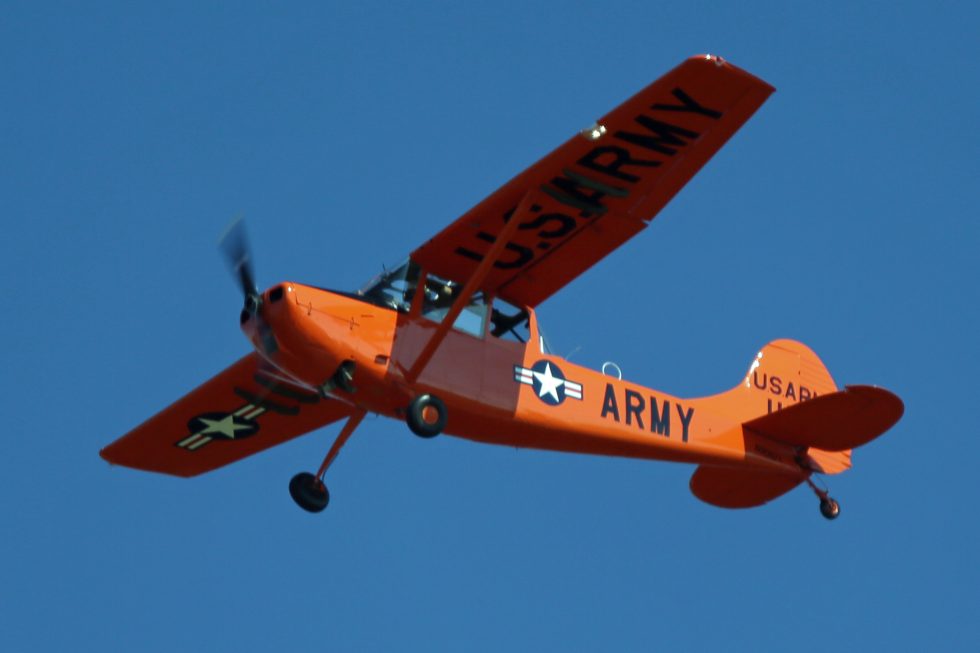
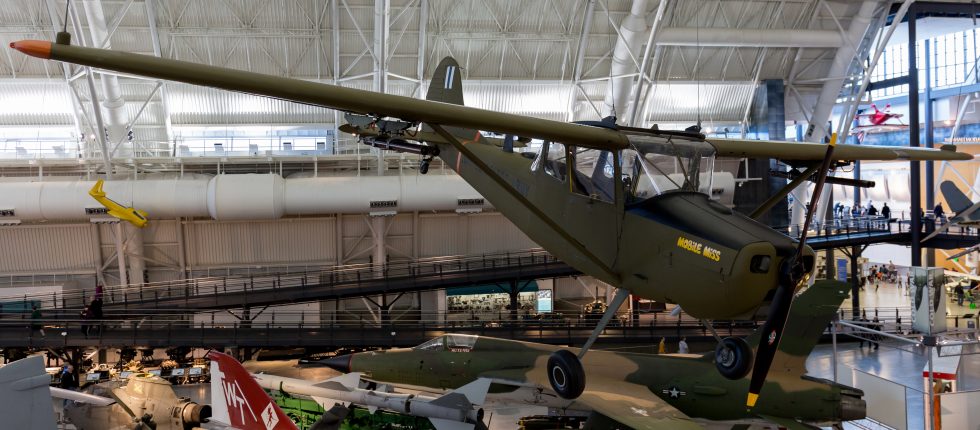
Survivors: the Bird Dog population is unusually large and unusually genuine. There are no reproductions — nobody builds a replica 1950s all-metal Cessna when real ones can still be bought — so essentially every airworthy example is an original military airframe, though a good many have been rebuilt from more than one wreck and the tie between a given registration and a given serial number can be loose. More than 330 were on the US civil register in June 2009 and around 300 in 2011, and the number has stayed broadly flat since; further fleets fly on Canadian, French and Italian registers, and the type remains a mainstay of glider towing, where the low speed, high thrust and enormous field of view make it close to ideal. The Royal Canadian Air Cadets towed Schweizer gliders behind ex-Canadian Armed Forces L-19s for years, and Italian clubs still fly ex-Esercito machines including one on floats. Museum airframes run into the dozens: Major Buang-Ly’s O-1, flown off Con Son island on 29 April 1975 with his wife and five children aboard and landed on USS Midway after Captain Lawrence Chambers had US$10 million of UH-1s pushed over the side to clear the deck, is at the National Naval Aviation Museum at Pensacola; the National Museum of the United States Air Force displays O-1G 51-11917 in its Southeast Asia gallery; the Smithsonian has an O-1A with over 10,000 hours at Udvar-Hazy; and the Museum of Army Flying at Oakey, Queensland holds “Bunny 2”, an aeroplane assembled by Australian ground crew from parts scrounged around Vietnam and shipped home in crates marked as spares. The last US Army Bird Dog was retired in 1974; the Maltese Air Wing, which received five O-1Es in 1992, was among the last military users.
The O-1 Bird Dog: from Army spotter to warbird
First flight
Cessna flies the Model 305, a militarised two-seat development of the civil Cessna 170, for the U.S. Army liaison competition.
Enters service as the L-19
The Army adopts the aircraft as the L-19 Bird Dog; deliveries begin as the Korean War breaks out.
Korea
Bird Dogs fly artillery-spotting, reconnaissance and liaison over Korea, directing fire from just above the front line.
Redesignated O-1
The Pentagon’s tri-service designation reform renames the L-19 the O-1 — “O” for observation.
The FAC war in Vietnam
The O-1 becomes the primary forward-air-control aircraft in Vietnam, marking targets with white-phosphorus rockets for strike aircraft.
Wilbanks’ Medal of Honor
Capt Hilliard Wilbanks fires his rifle from the cockpit to save a pinned ranger battalion, and is killed — awarded the Medal of Honor.
Landing on the Midway
Maj Buang-Ly flies his family out of falling Saigon and lands an overloaded O-1 aboard USS Midway; the aircraft is preserved at Pensacola.
Retirement and second life
The O-2 and OV-10 take over the FAC role; the O-1 leaves U.S. service but flies on in large numbers as a civilian warbird.
From the cockpit: twelve Bird Dog stories
A light plane goes to war
The Bird Dog started as a militarised Cessna 170 that won the Army’s 1950 liaison contest.
Read the full story
Why ‘Bird Dog’
Cessna ran an employee contest; the winning name captured the aircraft’s whole purpose.
Read the full story
Eyes over the front
Unarmed and slow, the Bird Dog spotted for the artillery and reported the ground truth in Korea.
Read the full story
The forward air controller
In Vietnam the O-1 became the eyes of American air power, marking targets for the fast jets.
Read the full story
Marking with white phosphorus
The O-1’s weapon was smoke: a rocket that told the fighters exactly where to aim.
Read the full story
Hilliard Wilbanks’ last flight
Out of rockets, a FAC pilot fired his rifle from the cockpit to save a trapped battalion.
Read the full story
The landing on the Midway
A South Vietnamese major flew his family out to sea and put an overloaded O-1 down on a carrier.
Read the full story
The Bird Dog afloat and ashore
The U.S. Marine Corps flew the O-1 for observation and control alongside the Army and Air Force.
Read the full story
A Cessna for the world
France, Italy, Canada, Japan and many others flew the Bird Dog for decades.
Read the full story
What it’s like to fly
Pilots praise the Bird Dog’s honest handling, huge view and short-field manners.
Read the full story
Handing over the mission
Faster, tougher O-2s and OV-10s eventually took over the dangerous FAC job.
Read the full story
The most beloved warbird spotter
Hundreds survive, and the Bird Dog is now one of the most popular military warbirds flying.
Read the full story
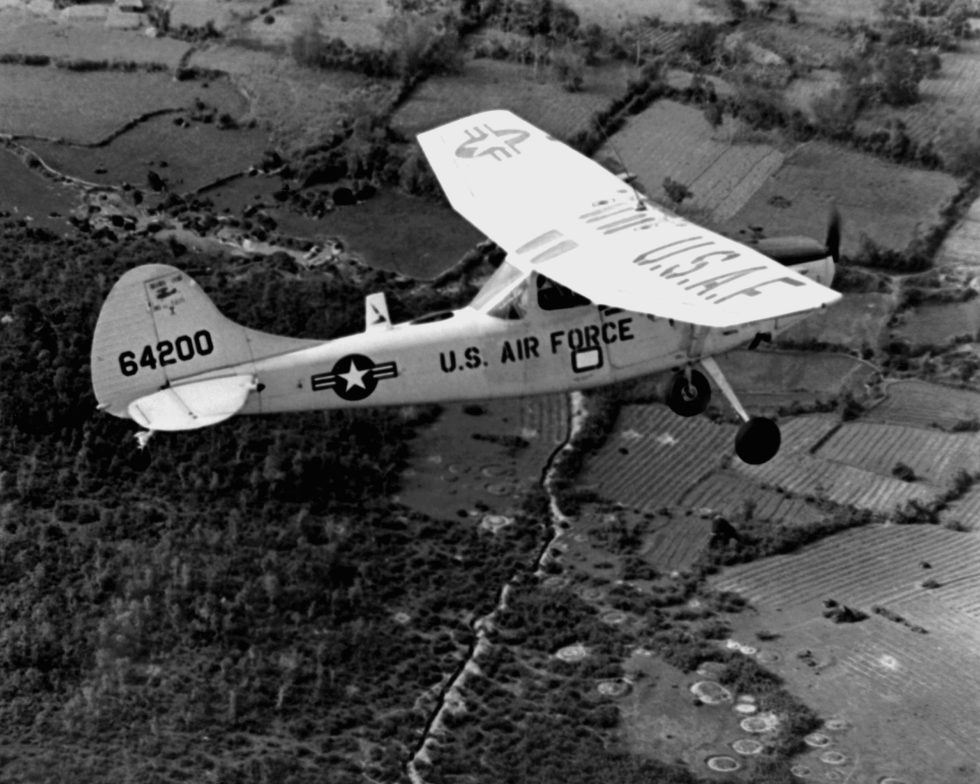
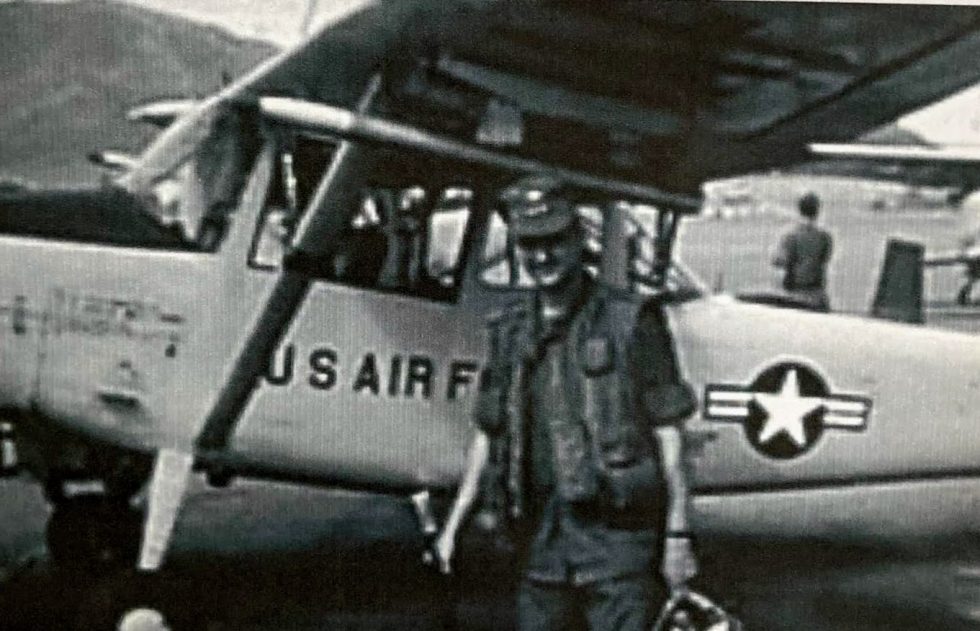
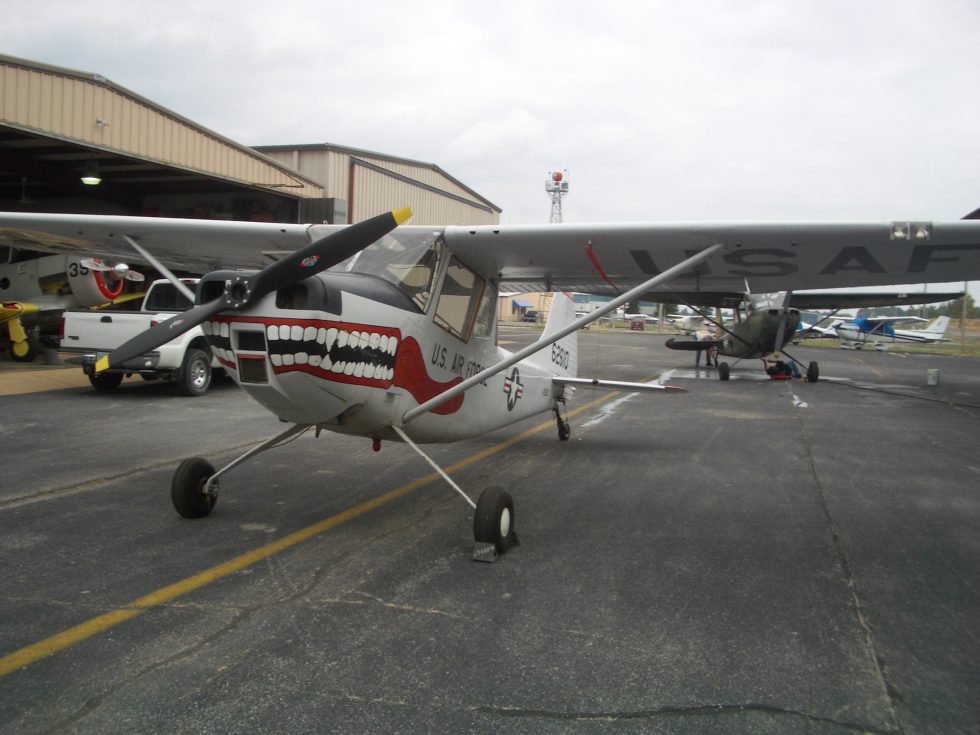
The O-1 Bird Dog in pictures
The O-1 Bird Dog in motion
militaryvideocom: Forward Air Controller & the O-1 Bird Dog, Vietnam War. Period U.S. military documentary footage of Bird Dog forward-air-control crews at work over Vietnam — more than 100,000 views.
Where the O-1 Bird Dog served
The O-1 Bird Dog’s war record
The Bird Dog was an observation and forward-air-control aircraft, not a fighter, so its record is not measured in aerial kills. It is measured in the strikes it directed, the artillery it corrected, the lives it saved on the ground — and in the extraordinary courage of crews who flew low and slow over defended country, unarmed but for a handful of smoke rockets and, on one famous day, a rifle.
Compare the combat record of every military aircraft. Figures as of August 2026.
Everything people ask about the O-1 Bird Dog
Can I fly in a Cessna O-1 Bird Dog?
What is the Cessna O-1 Bird Dog?
Why was it called the Bird Dog?
What did the O-1 do in Vietnam?
Did an O-1 really land on an aircraft carrier?
How many were built, and are any still flying?
What replaced the O-1 Bird Dog?
You can’t fly the O-1 Bird Dog with us.
These, you can.
Some legends only live in museums — others are fuelled and waiting. MiGFlug has put civilians in real military jet cockpits since 2004.
 Fly the L-39 AlbatrosThe world’s most-flown jet trainer — aerobatics included
 Fly the F-104 Starfighter“The missile with a man in it”
 Fly the MiG-21The Cold War’s most-produced jet
 Fly the T-33 Shooting StarAmerica’s first jet trainer
 Fly the DH VampireA piece of early jet history
 Fly the S.211Agile Italian jet trainer
 Fly the MB-326The classic Aermacchi jet
 Fly the MiG-15The Soviet legend of the Korean War
Continue the tour
Every fact, checked
- Smithsonian National Air and Space Museum — Cessna O-1A Bird DogAirframe history, development from the Cessna 170 and service overview.
- National Naval Aviation Museum, PensacolaHome of Maj Buang-Ly’s O-1 and the USS Midway landing story.
- National Museum of the U.S. Air Force — O-1 fact sheetReference for O-1 specifications, FAC role and preserved airframes.
- USS Midway MuseumThe carrier’s own account of the 29 April 1975 Bird Dog landing.
- Air & Space Forces MagazineForward-air-control history and Capt Hilliard Wilbanks’ Medal of Honor.
- HistoryNet / Aviation HistoryBird Dog combat accounts from Korea and Vietnam.
- Congressional Medal of Honor SocietyOfficial Medal of Honor citation for Hilliard A. Wilbanks.
- International Bird Dog AssociationSurviving-airframe registry and warbird operating notes.