
Bell OH-58 Kiowa
The Army’s Scout
The military JetRanger that scouted for the US Army for half a century, from Vietnam to Iraq and Afghanistan, and as the Kiowa Warrior flew close to half of all Army reconnaissance and attack missions in those wars.
The OH-58: how the “ugly duckling” became the Army’s eyes for fifty years
In October 1960 the US Navy, acting for the Army, invited helicopter makers to compete for a Light Observation Helicopter. Bell’s entry, the YOH-4A, first flew on 8 December 1962 and was nicknamed the Ugly Duckling; in May 1965 the Army chose the Hughes OH-6 Cayuse instead. Bell responded by giving its design a sleeker fuselage with more room for cargo and passengers and selling it to civilians as the Model 206A JetRanger, which first flew on 10 January 1966 and became one of the most successful light helicopters ever built. Then, in 1967, Hughes could not meet its production commitments, the Army reopened the competition, and Bell underbid its rival. The militarised JetRanger became the OH-58A Kiowa, named, by Army custom, after a Native American people.
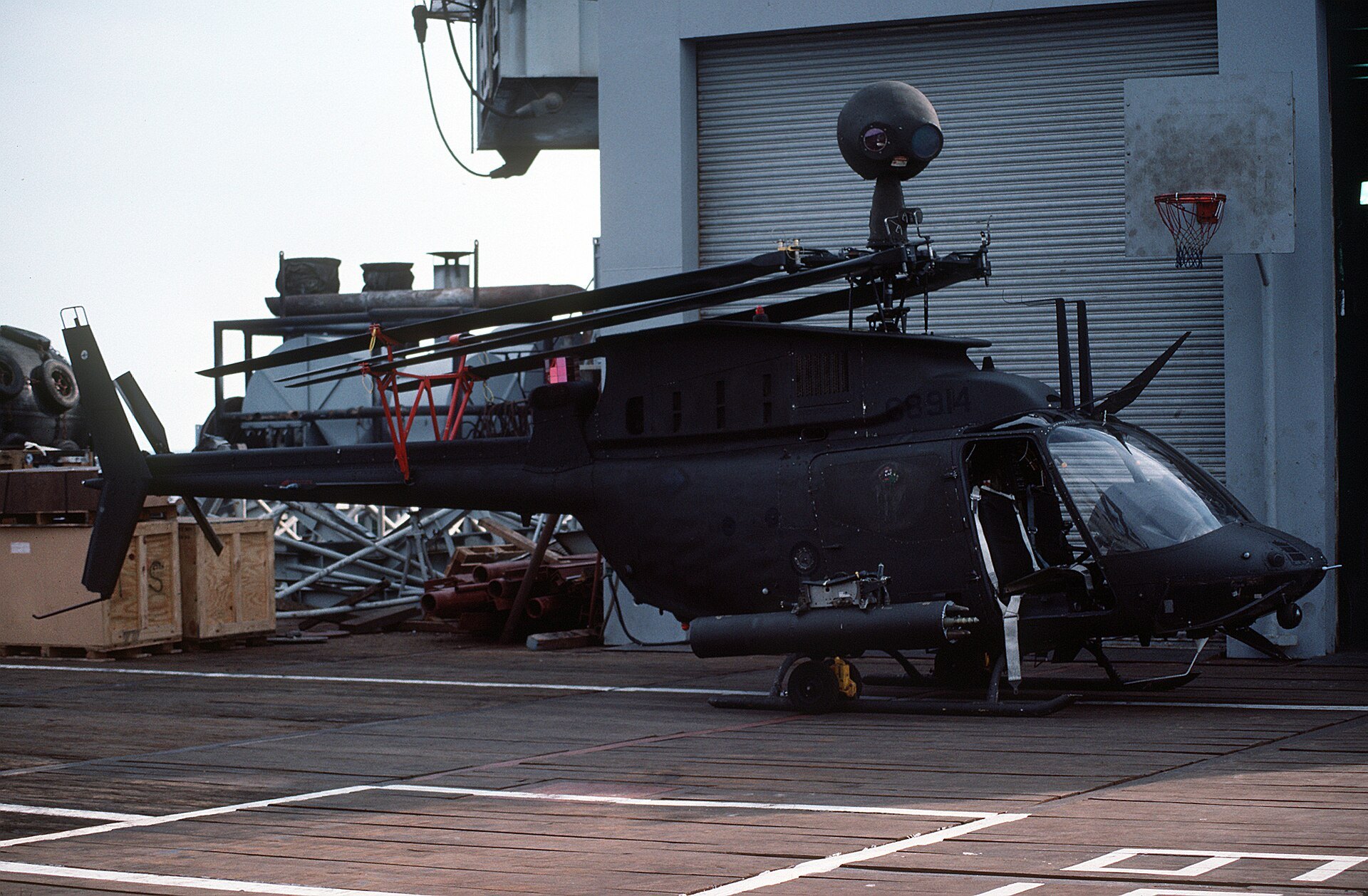
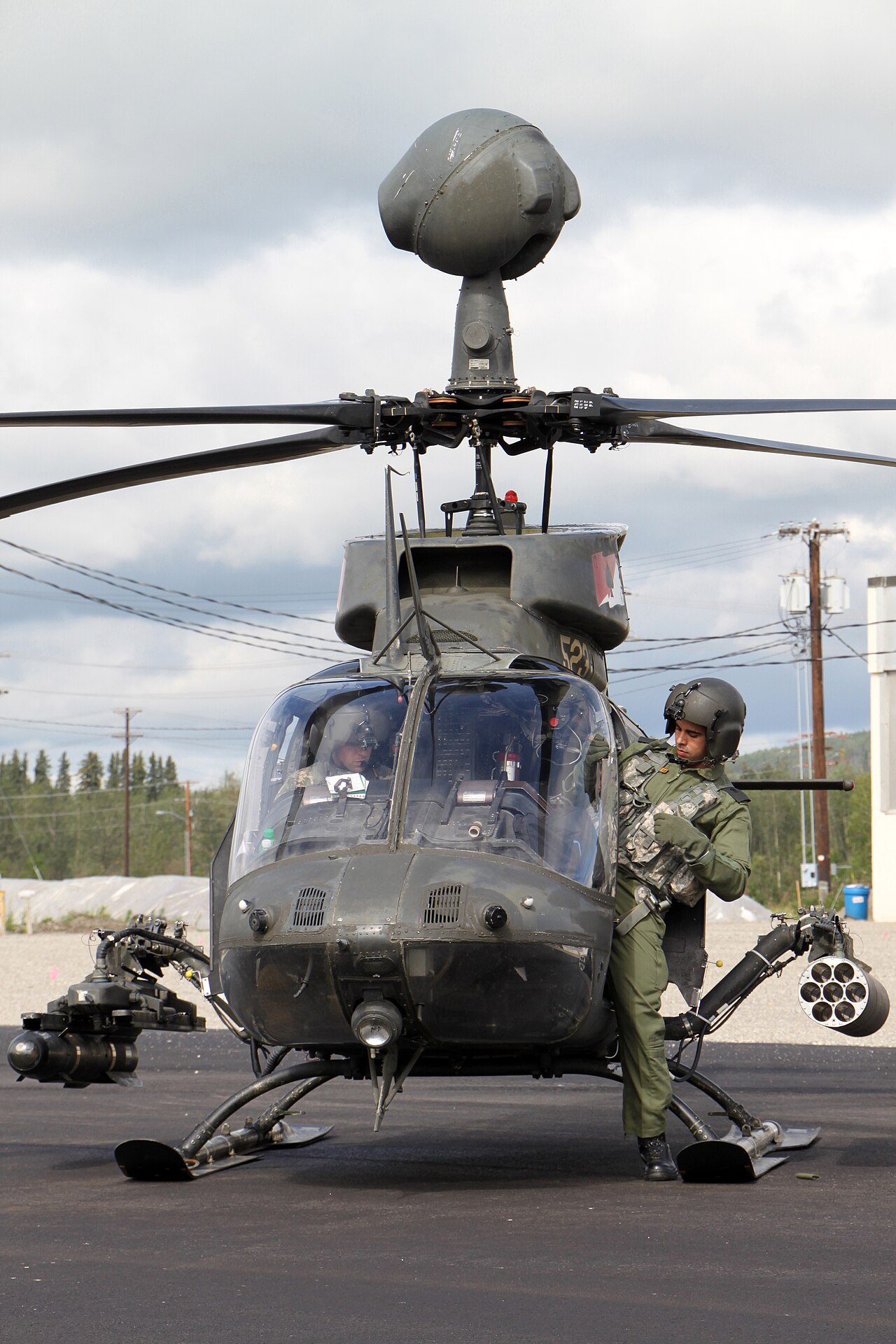
Major General John Norton received the first OH-58A at Bell’s Fort Worth plant in May 1969, and within two months the first batch was arriving in Vietnam. There the Kiowa flew alongside the OH-6 as an artillery spotter, command ship and scout, finding targets for AH-1 Cobra gunships and the guns on the ground; around 45 were destroyed in combat and accidents. After the war the Army wanted more. It gave the OH-58C a stronger engine and infrared exhaust suppressors, and in 1981 chose Bell to develop the OH-58D under the Army Helicopter Improvement Program. The D-model, first flown on 6 October 1983, had a four-blade rotor, more power and its unmistakable Mast-Mounted Sight, a sensor ball above the rotor that let the crew look over trees and hills while the helicopter stayed hidden behind them.
Armed with Hellfire missiles, rockets and a .50-calibre machine gun, the OH-58D Kiowa Warrior became the Army’s armed scout. It fought tanker-war gunboats in the Persian Gulf, went to Desert Storm in strength, and in Iraq and Afghanistan was worked harder than any other Army aircraft, accounting for nearly half of all Army reconnaissance and attack missions, according to Bell. More than 35 were lost in those wars. The Army divested it from 2014 in favour of AH-64 Apaches teamed with drones, after three attempts to build a replacement scout failed. Greece, Croatia and Tunisia took surplus Kiowa Warriors, Taiwan and Saudi Arabia still fly their own, and Austria flies the OH-58B, while dozens of older Kiowas found second careers with American sheriffs’ departments.
01The OH-58 at sea: Operation Prime Chance and the birth of the Kiowa Warrior
In 1987, during the Iran–Iraq war, Iranian gunboats were attacking shipping and laying mines in the Persian Gulf at night, and the US Navy was escorting reflagged Kuwaiti tankers. It needed a small, armed helicopter that could find and fight boats in the dark from ships and barges. The Army’s answer was the OH-58D, whose thermal sight could pick out targets at night. Bell produced an armed version in less than 100 days, and in Operation Prime Chance 15 OH-58Ds of Task Force 118 were shipped to the Gulf aboard Navy vessels. From early 1988 they took over from the special operations AH-6 and MH-6 teams, flying mostly night reconnaissance patrols from the converted oil barges Hercules and Wimbrown VII and from frigates and destroyers.
Crews received Navy deck-landing and underwater survival training, rotated between ships and a land base every week or two, and lost no personnel. According to Army accounts, after two incidents the gunboats no longer ventured out at night. When the mobile sea base Hercules was deactivated in September 1989, all but five helicopters went home. The weapons and fire-control systems improvised for Prime Chance became the basis for the production Kiowa Warrior: from May 1991 every new OH-58D was built in the armed configuration, and in 1992 Bell began converting the rest.
02The OH-58’s long retirement: three failed replacements and a final live-fire
The Army tried repeatedly to replace the Kiowa. The stealthy RAH-66 Comanche was cancelled in 2004 after about US$9 billion had been spent on two prototypes; the Bell ARH-70 Armed Reconnaissance Helicopter followed it in 2008; and an Armed Aerial Scout fly-off was abandoned in 2013. Facing budget cuts, the Army decided in its 2013 Aviation Restructure Initiative to divest some 340 Kiowa Warriors and use AH-64 Apaches teamed with RQ-7 Shadow drones as scouts instead.
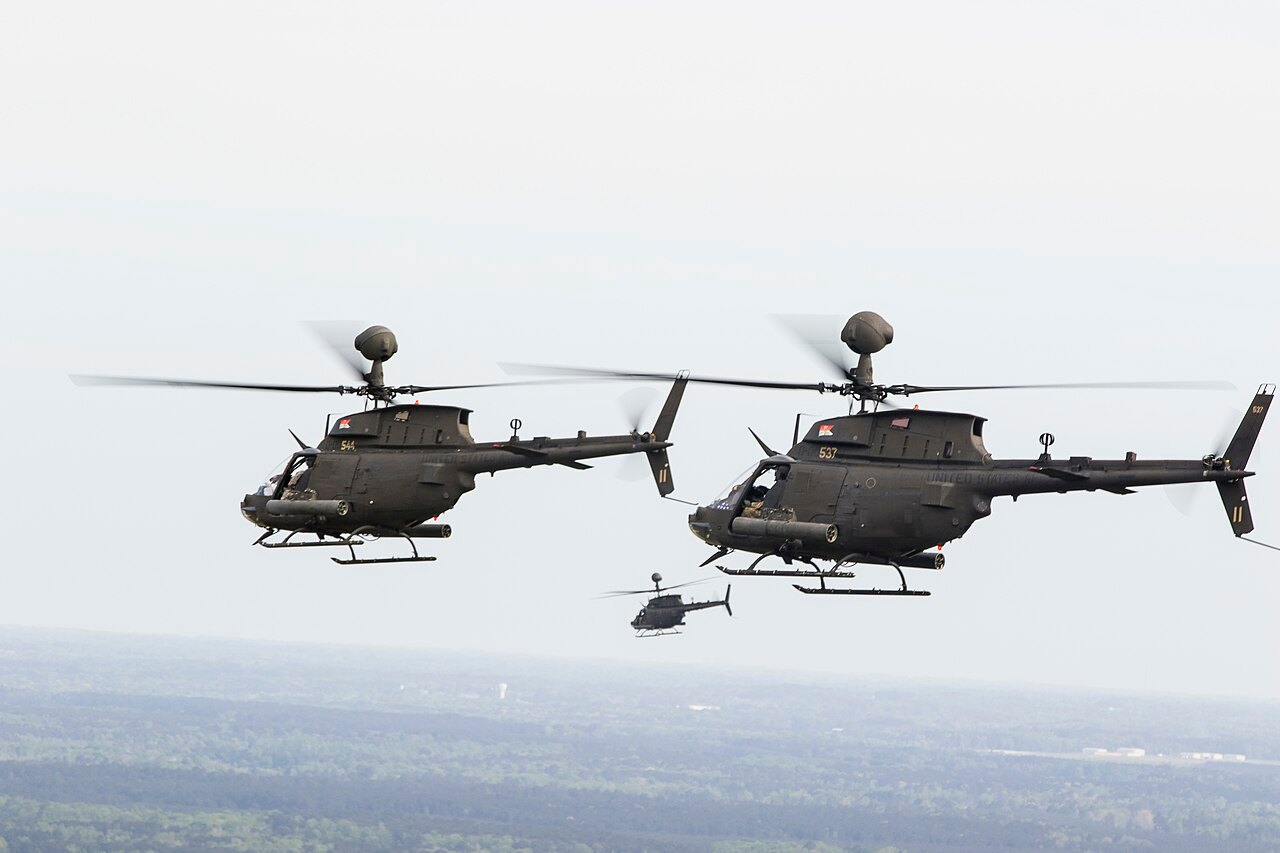
The retirement was emotional. On 15 April 2016, 32 Kiowa Warriors of the 82nd Airborne Division flew a final formation over Fort Bragg. The last squadron, 1st Squadron, 17th Cavalry, deployed to South Korea that summer, and on 25 January 2017 its helicopters performed a symbolic “passing of the torch” to Apaches during a last live-fire exercise at Rodriguez Range. Brigade commander Col. Erik Gilbert admitted the Apache could not match how fast a Kiowa could be pushed off a C-130 and be flying within half an hour. A fourth replacement, the Future Attack Reconnaissance Aircraft, was cancelled in February 2024 after at least US$2 billion had been spent, leaving the armed scout mission to Apaches and unmanned aircraft.
What makes the OH-58 special
The Mast-Mounted Sight
The OH-58D’s defining feature is the ball above its rotor. The Mast-Mounted Sight carried a television camera, a thermal imager and a laser rangefinder and designator on a gyro-stabilised platform, so a crew could hover behind a tree line with only the sight exposed, find targets by day or night and lase them for its own Hellfires, Apaches or artillery. An Army instructor pilot later said that before the Kiowa, helicopters could not fight very well at night: there were only flares to light up the sky.
A JetRanger at heart
The Kiowa was a militarised Bell 206 JetRanger, and that made it light, simple and cheap to operate. Fort Rucker’s aircraft specialists called it very inexpensive per hour and a good stick-and-rudder trainer, and civilian helicopter pilots found the cockpit instantly familiar. Its size also made it deployable: a Kiowa could be pushed off a C-130 and be flying within about 30 minutes, where an Apache had to be winched out of a C-17 and took around three hours, according to the 82nd Airborne’s aviation commander.
Wire cutters and a quiet rotor
Flying nap-of-the-earth among power lines is deadly, and the OH-58 was the first helicopter to test the knife-like wire strike protection system above and below the cockpit, which protects about 90 percent of the frontal area by guiding wires into cutters. The Army later fitted it to most of its helicopters. The OH-58D’s four-blade rotor replaced the original two-blade design, making it quieter and improving low-level performance, both valuable to a scout trying not to be noticed. Later upgrades added ballistic floor armour, crashworthy seats and missile warning.
03The OH-58’s variants: from JetRanger scout to Kiowa Warrior
- OH-58A: original two-blade, four-seat observation helicopter based on the Bell 206A; served from 1969, also used as the Australian CA-32 and Canadian CH-136. In 1992, 76 were modified for National Guard counter-drug work.
- OH-58B: export version for Austria, still in service.
- OH-58C: uprated engine, infrared exhaust suppression, early flat-plate windscreen and night-vision-compatible cockpit; some armed with air-to-air Stingers. Used as a trainer until 2020.
- OH-58D: Army Helicopter Improvement Program scout with four-blade rotor, Mast-Mounted Sight and more powerful engine; in service from 1985.
- OH-58D Kiowa Warrior: armed version with universal pylons for Hellfire, Stinger, Hydra 70 rockets and a .50-calibre gun. Bell 406CS Combat Scout: export derivative for Saudi Arabia.
- OH-58F: Army-designed upgrade with nose-mounted sensor in place of the mast sight and a new cockpit, first flown in 2013; cancelled in 2014.
Bell OH-58D Kiowa Warrior specifications
Specifications
- Crew
- 2 pilots
- Length
- 12.85 m (42 ft 2 in)
- Height
- 3.93 m (12 ft 10 in)
- Main rotor diameter
- 10.67 m (35 ft), 4 blades
- Empty weight
- 1,737 kg (3,829 lb)
- Max take-off weight
- 2,495 kg (5,500 lb)
- Powerplant
- 1 × Rolls-Royce T703-AD-700A turboshaft, 650 shp (485 kW)
- Maximum speed
- 240 km/h (149 mph)
- Cruise speed
- 204 km/h (127 mph)
- Range
- 260 km (161 mi)
- Endurance
- About 2 hours
- Service ceiling
- 4,575 m (15,000 ft)
- Armament
- Two pylons for Hellfire missiles, a 7-shot Hydra 70 or APKWS rocket pod, Stingers and a .50-calibre machine gun
Costs & production
- Cost per flight hour
- Hedged estimate only: no official figure was found in the sources opened. As a militarised JetRanger the Kiowa was, in Fort Rucker’s words, very inexpensive to operate per hour; a reasonable estimate for the OH-58A/C is in the low thousands of US dollars per hour, higher for the sensor-laden OH-58D. Army studies cited by the press put the Apache’s operating cost at about 50 percent more than the Kiowa’s
- Production
- About 2,200 to 2,300 built for military customers between 1966 and 1989; OH-58D production of new airframes ended in 2000
- Programme
- The Army spent at least US$9 billion on the cancelled Comanche and at least US$2 billion on the cancelled FARA in trying to replace the Kiowa (Defense News)
04The OH-58’s operating costs: cheap scout, expensive replacements
Part of the Kiowa’s appeal was cost. It shared most of its design with the civilian JetRanger, so parts, training and maintenance practices were familiar, and Fort Rucker’s aircraft specialists described it as very inexpensive to operate per hour. No official cost per flight hour was found in the sources opened for this page, so the figure in the table is a broad estimate. The OH-58D, with its mast sight, weapons and heavier engine, cost noticeably more to keep flying than the A and C models.
The irony is that the cheap scout proved expensive to replace. The Comanche consumed about US$9 billion before cancellation in 2004, and FARA at least US$2 billion more before its end in 2024. When it divested the Kiowa the Army calculated that Apaches and drones could perform more of the armed reconnaissance mission than an upgraded Kiowa could, even though the Apache costs more per hour, and it used the savings from retiring an entire fleet to fund Apache modernisation. Surplus Kiowas were offered free to allies, who paid only for transport, refurbishment and training.
The OH-58 from Light Observation Helicopter to last live-fire
Ugly Duckling
Bell’s YOH-4A flies on 8 December in the Light Observation Helicopter competition, which it loses to Hughes.
JetRanger
The reshaped Bell 206A flies on 10 January.
Kiowa chosen
The Army reopens the competition; Bell underbids Hughes and the 206A becomes the OH-58A.
Into service and to Vietnam
The first OH-58A is delivered in May; the first batch reaches Vietnam within two months.
OH-58D flies
The Army Helicopter Improvement Program prototype with Mast-Mounted Sight flies on 6 October.
Prime Chance
Armed OH-58Ds fly night patrols against gunboats in the Persian Gulf from barges and warships.
Desert Storm and the Kiowa Warrior
Some 130 OH-58Ds deploy to the Gulf War; all new D-models are built as armed Kiowa Warriors from May.
Shot down over North Korea
An OH-58C strays across the DMZ on 17 December; one pilot is killed and the other held for 13 days.
Iraq and Afghanistan
Kiowa Warriors fly nearly half of all Army reconnaissance and attack missions; more than 35 are lost.
Final formation
On 15 April, 32 Kiowa Warriors fly a farewell formation over Fort Bragg.
Last live-fire
On 25 January the last Army Kiowa Warrior squadron passes the torch to Apaches in South Korea.
A new life in Greece
Ex-US Army Kiowa Warriors arrive at Volos for the Hellenic Army, part of 70 granted in 2018.
Stories & eyewitnesses: the OH-58 in war and peace
Two months to war
The first Kiowas went almost straight from Texas to Vietnam.
Read the full story
Hunting gunboats at night
Operation Prime Chance put Army scouts on oil barges in the Gulf.
Read the full story
Desert Storm’s busiest scout
In 1991 the Kiowa had the best maintenance ratio of any Army combat helicopter.
Read the full story
Thirteen days in North Korea
A navigation error over snow-covered mountains became a diplomatic crisis.
Read the full story
Half of all missions
In Iraq and Afghanistan the Kiowa Warrior was the Army’s most used aircraft.
Read the full story
Thirty-two over Fort Bragg
The 82nd Airborne said goodbye with a mass formation in 2016.
Read the full story
Passing the torch in Korea
A last live-fire exercise in January 2017 closed the Kiowa Warrior’s Army career.
Read the full story
To the boneyard
Tennessee’s Guard pilots flew their Kiowas to Arizona themselves.
Read the full story
From Fort Hood to the sheriff
The last OH-58A at Fort Rucker went to police work in 2017.
Read the full story
Kiowas for Greece
Seventy Kiowa Warriors left the Arizona desert for the Hellenic Army.
Read the full story
The OH-58 in pictures
Where the OH-58 flies and flew
The OH-58’s record
The Kiowa flew in Vietnam, the Persian Gulf tanker war, Panama, Desert Storm, Iraq and Afghanistan, first as an unarmed spotter and later as the armed Kiowa Warrior. It was worked harder and lost more often than most Army aircraft because its job was to go first and look.
See how training and combat types compare in the military aircraft statistics database. Figures are approximate.
Everything people ask about the OH-58
Can I fly in a Bell OH-58 Kiowa?
Is the OH-58 Kiowa the same as a Bell JetRanger?
What is the ball on top of the OH-58D?
What is the Kiowa Warrior?
When did the US Army retire the Kiowa?
What replaced the OH-58 Kiowa?
Who still flies the Kiowa?
You can’t fly the OH-58.
These, you can.
Most of this museum you can only look at. These genuine military jets you can fly yourself with MiGFlug — with aerobatics and time on the controls.
 Fly the L-39 AlbatrosThe world’s most-flown jet trainer — aerobatics included
 Fly the F-104 Starfighter“The missile with a man in it”
 Fly the MiG-21The Cold War’s most-produced jet
 Fly the T-33 Shooting StarAmerica’s first jet trainer
 Fly the DH VampireA piece of early jet history
 Fly the S.211Agile Italian jet trainer
 Fly the MB-326The classic Aermacchi jet
 Fly the MiG-15The Soviet legend of the Korean War
Continue the tour
Every fact, checked
- The End of an Era: OH-58 KiowaDVIDS/Tennessee National Guard: history, Prime Chance, MMS, last Guard aircraft to AMARG
- Army’s Last Kiowa Scout Helicopter Squadron Switching to ApachesMilitary.com, 2016: Col. Erik Gilbert on the last squadron and deployability
- Kiowa Warriors pass torch to Apache attack helicopters in South KoreaStars and Stripes, January 2017: final live-fire exercise
- Last Kiowa Warrior retires into law enforcementRedstone Rocket: last Fort Rucker OH-58A, training role, RAID programme
- Kiowa helicopters make final flight at JRTC & Fort PolkVertical/US Army: last OH-58C units, transfer to sheriffs’ offices
- After nearly 50 years as the Army’s workhorse, the venerable Kiowa helicopter is taking flight again for GreeceBusiness Insider/US Army: Greek transfer, Bell combat-hour and mission figures
- Croatia, Tunisia First To Receive U.S. Kiowa WarriorsAIN, June 2016: divestment of 340 OH-58Ds, Fort Bragg final formation
- Bell OH-58DPima Air & Space Museum: OH-58D development, combat losses, displayed airframe
- US Army spent billions on a new helicopter that now will never flyDefense News, February 2024: FARA cancellation, Comanche cost