
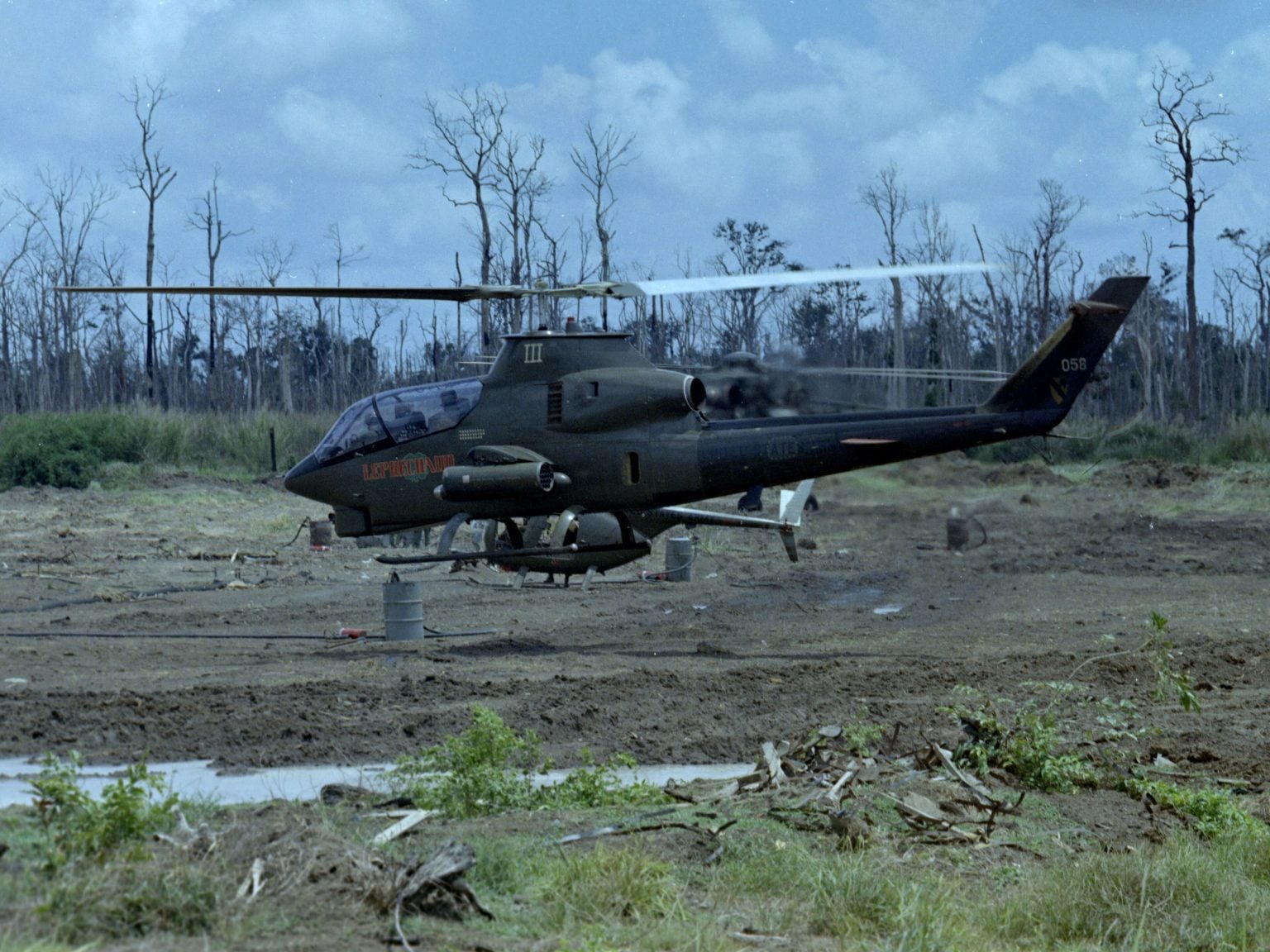
Bell AH-1 Cobra
“The world’s first attack helicopter”
Bell took the UH-1 Huey’s engine, rotor and transmission and wrapped them in a slim gunship fuselage barely a metre wide, with a tandem stepped cockpit, stub wings and a chin turret. Rushed to Vietnam in 1967, the single-engine “HueyCobra” grew into the twin-engine AH-1W SuperCobra and today’s four-blade AH-1Z Viper, and has served roughly 20 nations for more than half a century.
The Bell AH-1 Cobra: how the world got its first attack helicopter
By the mid-1960s the U.S. Army had proved the idea of air mobility with the UH-1 Huey, but its armed “gunship” Hueys were a compromise: a troop transport bristling with weapons, slow, and easy to hit. The Army wanted a dedicated machine built from the ground up to escort helicopters and attack ground targets. Its long-term answer, the ambitious Lockheed AH-56 Cheyenne, was years away and in trouble.
Bell’s response was a gamble. As a private venture the company built the Model 209, mating the Huey’s proven engine, rotor and transmission to a brand-new, needle-thin gunship fuselage. It first flew on 7 September 1965. The fuselage was only about a metre wide; crew sat in tandem, the gunner low in the nose and the pilot stepped up behind, with stub wings for weapons and a chin turret under the nose. The Army bought it as an interim gunship — the AH-1G HueyCobra — and rushed it to Vietnam.
The Cobra reached Vietnam in 1967 as the first helicopter designed purely to fight. From that single-engine root grew two long branches: the U.S. Army’s single-engine AH-1G / Q / S TOW-armed line, and the U.S. Marine Corps’ twin-engine AH-1J SeaCobra, AH-1T and AH-1W SuperCobra, which in turn led to today’s four-blade AH-1Z Viper. Half a century on, Cobras still fly.
01Why the AH-1 Cobra exists: gunship Hueys, the Cheyenne and Bell’s private-venture gamble
Armed Hueys could escort air assaults, but carrying troops and heavy weapons in the same airframe made them slow and vulnerable. The Army’s formal solution, the compound Lockheed AH-56 Cheyenne, was technically advanced but delayed and eventually cancelled.
Bell, betting the Army would need something sooner, spent its own money on the Model 209. Because it reused the Huey’s dynamic components, it could be fielded quickly and supported with parts already in the supply chain. The gamble paid off: the AH-1G was ordered as an interim type and became one of the most important helicopters ever built.
02The AH-1 Cobra’s name: HueyCobra, SeaCobra, SuperCobra and Viper
The original single-engine Army machine was the AH-1G HueyCobra, reflecting its Huey roots. The Marine Corps twin-engine versions were named for the sea — the AH-1J/T SeaCobra and the definitive AH-1W SuperCobra (the “Whiskey Cobra”). The latest rebuild, with a four-blade rotor and modern sensors, is the AH-1Z Viper (“Zulu Cobra”), fielded alongside the UH-1Y Venom under the Marines’ H-1 upgrade programme.
How the AH-1 Cobra works: a Huey’s heart in a gunship’s body
The Huey’s heart in a new body
The Model 209 kept the UH-1’s Lycoming T53 turboshaft, its two-blade “semi-rigid” main rotor and its transmission, so it flew and was maintained like a machine the Army already knew. Only the fuselage was new — which is why the first Cobras could be fielded so quickly.
A fuselage barely a metre wide
The Cobra’s defining feature is its slimness: a fuselage only about 0.99 m (38 in) across. The crew sit in tandem — gunner in front, pilot stepped up behind — giving both a clear view while presenting a very narrow target to ground fire, with armour around the cockpit.
Stub wings and a chin turret
Short stub wings carry rockets and missiles and add a little lift in fast flight, while a chin turret under the nose holds a trainable gun. Later Cobras added TOW and Hellfire anti-armour missiles and a three-barrel 20 mm cannon, turning the gunship into a tank-killer.
03The AH-1 Cobra’s weapons: chin turret, rockets, TOW and Hellfire
Early AH-1Gs carried a chin turret with 7.62 mm miniguns and/or a 40 mm grenade launcher, plus 2.75-inch (70 mm) rocket pods on the stub wings. From the early 1970s the TOW wire-guided missile gave the Cobra a genuine anti-tank punch, first proven in Vietnam in 1972.
Later marks standardised on the three-barrel 20 mm M197 cannon in the turret. The twin-engine AH-1W and AH-1Z added the laser-guided AGM-114 Hellfire, and the Viper can also carry AIM-9 Sidewinder air-to-air missiles and modern precision rockets. Exact fits vary by variant and customer.
04Single-engine or twin: the AH-1G/S Army line versus the AH-1J/T/W/Z Marine line
The U.S. Army flew single-engine Cobras: the original AH-1G, the interim TOW-capable AH-1Q, and the definitive AH-1S/P/E/F “modernised” Cobras with an uprated T53 engine and TOW.
The U.S. Marine Corps, operating over water, wanted the redundancy of two engines. Its AH-1J SeaCobra introduced a twin-engine layout; the AH-1T and then the much more powerful AH-1W SuperCobra followed. The AH-1W was ultimately rebuilt into the four-blade AH-1Z Viper, the version still in front-line service today.
05Who builds the AH-1 Cobra: Bell Helicopter and licence production in Japan
The Cobra is designed and built by Bell (Bell Helicopter, now Bell Textron) of Fort Worth, Texas — the same company that built the Huey it was based on. The single-engine AH-1S was also built under licence in Japan by Fuji Heavy Industries for the Japan Ground Self-Defense Force. The modern AH-1Z Viper is produced for the U.S. Marine Corps and a growing list of export customers.
AH-1 Cobra specifications: dimensions, performance and cost
Figures below span the Cobra family and are dominated by the single-engine AH-1G and the modern AH-1Z Viper; treat any single number as an estimate that varies by variant, fit and source.
Baseline note: this is a family page, and the figures below describe the AH-1W SuperCobra — the twin-engine Marine Corps mark delivered from 1986, retired from US service in October 2020 and still the version most export operators fly. The single-engine AH-1G HueyCobra of 1967 and the rebuilt AH-1S/P/E/F that followed it are much smaller, lighter and less powerful machines; the four-blade AH-1Z Viper is effectively a new aircraft on the same layout. Deltas for both ends of the family are in grey. One published figure has been corrected here: several reference tables, Wikipedia's included, give the AH-1W a 45 ft 7 in main rotor with a 1,515 sq ft disc. Those two numbers are inconsistent with each other and the second belongs to the 44 ft rotor of the single-engine AH-1G. The AH-1W's rotor is 48 ft.
Dimensions & weights
- Crew
- 2 — co-pilot/gunner in the front seat, pilot behind and above him, both with full flight controls
- Length, rotors turning
- 17.68 m (58 ft 0 in) — AH-1Z 17.75 m (58 ft 3 in)
- Fuselage length
- 13.87 m (45 ft 7 in)
- Fuselage width
- 0.97 m (3 ft 2 in) — the number the whole design exists to produce. A Huey cabin is 2.5 m wide.
- Height
- 4.19 m (13 ft 9 in) — AH-1Z 4.37 m (14 ft 4 in)
- Main rotor diameter
- 14.63 m (48 ft 0 in), two blades, semi-rigid teetering (AH-1G: 13.41 m / 44 ft 0 in, the Huey's own rotor. AH-1Z: 14.63 m / 48 ft 0 in with four bearingless composite blades)
- Disc area
- 168.1 m² (1,809 sq ft) — AH-1G 141.3 m² (1,520 sq ft)
- Tail rotor
- 2.97 m (9 ft 9 in), two blades, moved from the port to the starboard side early in production to improve its effectiveness (AH-1Z: four blades)
- Stub wing span
- 3.28 m (10 ft 9 in), four stations (AH-1Z: six, including two wingtip rails)
- Empty weight
- 4,630 kg (10,200 lb) — AH-1G 2,754 kg (6,073 lb); AH-1Z 5,580 kg (12,300 lb)
- Maximum take-off weight
- 6,690 kg (14,750 lb); some references give a 7,620 kg (16,800 lb) maximum gross. AH-1G 4,309 kg (9,500 lb); AH-1Z 8,390 kg (18,500 lb)
- Wing stores capacity
- AH-1Z: 2,615 kg (5,764 lb) across six stations; the AH-1W's four stations carry appreciably less, and in practice the limit is take-off weight in the heat rather than the pylons
- Disc loading
- 39.8 kg/m² (8.15 lb/sq ft)
Performance
- Never-exceed speed
- 352 km/h (219 mph, 190 kt) — AH-1Z 411 km/h (255 mph, 222 kt); AH-1G 277 km/h (172 mph, 150 kt)
- Cruising speed
- 254 km/h (158 mph, 137 kt) at altitude — AH-1Z 296 km/h (184 mph, 160 kt)
- Rate of climb
- 8.2 m/s (1,620 ft/min) — AH-1Z 14.2 m/s (2,790 ft/min), a measure of how much the four-blade rotor and uprated drivetrain changed the aircraft
- Service ceiling
- 3,720 m (12,200 ft) — AH-1Z above 6,100 m (20,000 ft)
- Hover ceiling, out of ground effect
- Not published as a single figure for either mark; both are weight- and temperature-critical, and Marine crews in Afghanistan routinely traded fuel against ordnance to get airborne at all
- Range, internal fuel
- 587 km (365 mi, 317 nmi); with a 20-minute reserve some sources give 648 km (403 mi, 350 nmi). AH-1Z 685 km (426 mi, 370 nmi)
- Combat radius
- ~231 km (~144 mi, ~125 nmi) for the AH-1Z with a 1,130 kg (2,500 lb) payload — a short-legged aircraft by design, meant to work from a ship or a forward site rather than from a rear base
- Endurance
- ~2 h 30 min on internal fuel, less with a heavy load
- First flight
- 7 September 1965 (Model 209, eight months after Bell approved the project and slightly under budget)
- Combat debut
- June 1967, Vietnam — the first purpose-built attack helicopter to enter service anywhere
- Vietnam record
- Over one million operational hours flown by the Cobra fleet; roughly 300 lost in combat
- Shipboard compatibility
- AH-1Z blades and tail fold for hangar stowage on an amphibious assault ship; the type is designed to be maintained at sea, which is a large part of why the Marines wanted two engines in the first place
Propulsion & systems
- Engines
- 2 × General Electric T700-GE-401 turboshaft (AH-1G: one Lycoming T53-L-13 of 820 kW / 1,100 shp, the Huey's engine. AH-1J: two Pratt & Whitney Canada T400-CP-400 in a coupled package. AH-1Z: two T700-GE-401C)
- Power
- 1,260 kW (1,690 shp) each, derated from 1,340 kW (1,800 shp) because the drivetrain, not the engines, sets the limit (AH-1Z: 1,340 kW / 1,800 shp each, on a strengthened transmission)
- Rotor system
- Two-blade semi-rigid teetering main rotor, directly descended from the UH-1C's "540" head (AH-1Z: four-blade hingeless, bearingless composite rotor with no lubrication points, field-replaceable blades and roughly twice the load capacity — the single biggest change in the type's history)
- Fuel
- ~1,150 litres (~304 US gal) internal, self-sealing; up to two 380-litre (100 US gal) external tanks on the inboard pylons at the cost of two weapon stations
- Sights and sensors
- AH-1W: AN/AAQ-16 NiteHawk FLIR in the Night Targeting System, with laser rangefinder and designator, added from the early 1990s (AH-1G had an optical M73 sight and nothing else; AH-1S added the M65 TOW sight and a laser rangefinder. AH-1Z: Lockheed Martin Target Sight System with mid-wave thermal imager, colour television and laser designator, plus the Thales TopOwl helmet display — both crew can slave weapons by looking)
- Self-protection
- AN/APR-39 radar warning, AN/AAR-47 missile warning, AN/ALE-47 chaff and flare dispensers, AN/ALQ-144 infrared jammer; armoured seats and dual redundant flight controls
- Cockpit
- Tandem, stepped, with the gunner forward for visibility over the nose and the pilot raised behind him; both stations fully dual-controlled, so the aircraft can be flown from either seat and control handed over in a fight (AH-1Z fits an all-glass cockpit with fully redundant displays)
- First flight, by mark
- Model 209: 7 September 1965. AH-1J: 1969. AH-1W: 16 November 1983. AH-1Z: 7 December 2000
- Service entry
- June 1967 (AH-1G, US Army); 1971 (AH-1J, USMC); March 1986 (AH-1W); February 2011 (AH-1Z initial operational capability)
- Number built
- 1,116 single-engine AH-1G, plus roughly 1,270 twin-engine airframes and a very large number of rebuilds; 89 AH-1S built under licence by Fuji Heavy Industries in Japan between 1984 and 2000; 189 AH-1Z delivered to the US Marine Corps, the last in November 2022
- Unit cost
- ~US$31 million flyaway for a new-build AH-1Z; the 1966 US Army contract for the first 110 AH-1Gs worked out at a small fraction of that in real terms, which was rather the point of a private venture built from an existing helicopter
06AH-1 Cobra variants: from the AH-1G HueyCobra to the AH-1Z Viper
AH-1G HueyCobra — the original single-engine Army gunship (Vietnam, from 1967).
AH-1Q / AH-1S / AH-1P / AH-1E / AH-1F — progressively modernised single-engine Army Cobras with TOW missiles and an uprated engine.
AH-1J SeaCobra / AH-1T — the first twin-engine Marine Cobras.
AH-1W SuperCobra — the powerful twin-engine Marine gunship with TOW and Hellfire.
AH-1Z Viper — the current four-blade rebuild with modern sensors, fielded alongside the UH-1Y Venom.
07The AH-1 Cobra’s operating costs: what a Cobra costs to buy and fly
Cost figures vary widely with variant, contract and customer. The modern AH-1Z Viper flyaway price is frequently reported in the region of USD 27–31 million, with full Foreign Military Sales packages (training, spares, weapons) running higher per aircraft.
Cost per flight hour is commonly estimated at roughly USD 4,000–7,000 or more, but published figures differ depending on what is counted (fuel only, or fuel plus maintenance, overhaul and support) and on the variant. Treat any single number as an estimate.
Armament & payload
Bell built the Cobra around a chin turret and two stub wings, and sixty years of upgrades have not changed that arrangement
Every Cobra carries its gun in a powered chin turret slaved to the gunner's sight, and its stores on stub wings that are structural rather than bolted on. The gun has settled: after a decade of experimenting with miniguns and grenade launchers in the AH-1G's M28 turret, the three-barrel 20 mm M197 became the standard on the twin-engine marks and has stayed there ever since. The missiles have not settled at all. The Cobra was the aircraft on which the US Army first made the wire-guided TOW work from a helicopter, and it is the same airframe that now shoots Hellfire, laser-guided APKWS rockets and, on the AH-1Z, the AIM-9 Sidewinder from wingtip rails — a genuinely unusual capability for an attack helicopter. What it has never carried is bombs. Fits differ sharply between marks and operators: an AH-1S in Japanese or Korean service and an AH-1Z on a US amphibious ship have almost nothing in common beyond the shape.
Gun
- 20 mm M197, three barrels, roughly 675 rounds per minute, 750 rounds, in the A/A49E-7 chin turret — the standard from the AH-1J onwards and still fitted to the AH-1Z.
- AH-1G M28 turret: two 7.62 mm M134 miniguns, or two 40 mm M129 grenade launchers, or one of each. The mixed fit was the common Vietnam configuration.
- M35 system: a single 20 mm M195 cannon on the port inboard pylon of some AH-1Gs, with its ammunition in a pannier on the other side.
- The turret traverses about 110° either side and depresses steeply, so a Cobra can shoot well off the nose without pointing the aircraft — the thing an armed Huey could not do.
Air-to-air
- AIM-9L/M Sidewinder on the AH-1Z's wingtip rails, one a side — cleared on the AH-1W before it and rare on any attack helicopter.
- The M197 is the practical air-to-air weapon, and it has been used as one: Iranian AH-1J SeaCobras fought Iraqi Mi-25s repeatedly during the 1980–88 war, in the only sustained helicopter-versus-helicopter combat on record.
- Single-engine AH-1G/S marks carried no air-to-air weapon of any kind.
- No radar, and no ambition to have one.
Air-to-surface guided
- BGM-71 TOW — up to eight in two four-round M65 launchers on the outboard stations. First fielded on the AH-1Q from 1975 and refined through the AH-1S; the weapon that turned an escort gunship into a tank killer.
- AGM-114 Hellfire — up to eight on the AH-1W, up to sixteen on the AH-1Z in four M299 quad rails. Fire-and-forget in practice, since the AH-1Z can designate for itself or take a laser spot from someone else.
- AGM-122 Sidearm — a short-range anti-radiation missile built on a Sidewinder body, developed specifically so Marine Cobras could kill the radars pointed at the landing force. Now largely withdrawn.
- AGM-179 JAGM on the AH-1Z, replacing Hellfire with a dual-mode laser and millimetre-wave seeker.
- AGM-65 Maverick was cleared on the AH-1W and almost never carried.
Bombs
- None carried. The Cobra has never been a bomber and has never had a pylon rated or a sight cleared for free-fall weapons.
- This is a real difference from the Mi-24, which regularly flew with ten 100 kg bombs, and it reflects two different ideas of what an attack helicopter is for.
- The nearest thing is the SUU-44 flare dispenser carried on some night-capable AH-1Gs.
- Everything the Cobra drops, it aims.
Rockets
- 70 mm Hydra 70 in seven-tube LAU-68 or nineteen-tube LAU-61 pods — the mainstay since 1967 and still the most-fired Cobra weapon.
- APKWS II — a laser guidance kit that screws between a standard Hydra 70 motor and warhead, turning a fifty-year-old rocket into a precision weapon at a fraction of a Hellfire's cost. Widely used on the AH-1Z.
- 127 mm Zuni in four-round LAU-10 pods — a heavy Marine Corps rocket carried by no other attack helicopter.
- 2.75 in flechette warheads for area suppression, a Vietnam-era load that has never quite gone away.
Pods & other stores
- M18 and SUU-11 7.62 mm minigun pods, and the XM18E1 on early aircraft — the AH-1G's way of adding fire beyond the turret.
- M118 40 mm grenade launcher pods on some single-engine marks.
- Two 380-litre (100 US gal) external fuel tanks, at the cost of two weapon stations — the standard trade for a long transit or an overwater leg.
- The Night Targeting System pod on the AH-1W, and on the AH-1Z the Target Sight System built into the nose rather than podded.
Three typical loadouts
- Vietnam escort, AH-1G, 1968
- M28 turret with a minigun and a 40 mm grenade launcher, two nineteen-tube and two seven-tube Hydra 70 pods. Flown in hunter-killer teams with an OH-6A scout: the little helicopter finds the enemy at treetop height, the Cobra rolls in from above. Twice the ammunition of an armed Huey, half the transit time and three times the loiter.
- Marine close air support, AH-1W, 2005
- Eight TOW or eight Hellfire, two seven-tube Hydra 70 pods, full 750-round M197 magazine, Night Targeting System with laser designator. Working from an amphibious ship or a desert forward arming point, usually paired with a UH-1N so that one aircraft can talk on the radios while the other shoots.
- Modern Viper, AH-1Z
- Sixteen Hellfire or JAGM in four quad rails, a pod of APKWS laser-guided 70 mm rockets, an AIM-9 on each wingtip, the M197 in the turret, and the Target Sight System doing the finding. A far more capable aircraft than the Whiskey, and still built around a 1965 layout. Take-off weight, not pylon capacity, decides what actually goes on the wings.
Sourcing caveat: US Marine Corps and Army armament subsystem manuals are the authority for these fits, but Cobra operators have been unusually free with local modifications — Israel fitted Spike, Iran built its own copies and its own weapons for them, and several air arms have flown mixed loads that appear in no clearance document. Weapons listed here are those with credible evidence of operational carriage.
Variants
Bell spent a million dollars of its own money on a gunship the Army had not asked for, and had it in Vietnam inside two years
The Army's official answer to the gunship problem was the Advanced Aerial Fire Support System, which produced the Lockheed AH-56 Cheyenne — fast, sophisticated, and cancelled in 1972 after ten years without entering service. Bell was not invited to compete. In January 1965 the company put up one million dollars of its own money for a design its engineer Mike Folse had built around a deliberate piece of procurement logic: the Army could not buy a wholly new helicopter without a formal competition, but it could buy a modification of something already in its inventory. So the Model 209 took the UH-1C's "540" rotor, its T53 engine, its transmission and its tail rotor — roughly eighty per cent of its parts already carried Huey part numbers — and hung them on a new fuselage 0.97 m wide with a stepped tandem cockpit, armoured seats, a chin turret and stub wings.
It flew on 7 September 1965, eight months after go-ahead, in front of about twenty Army officials who had not previously known it existed. It beat armed Chinooks, Seasprites and Sikorskys in an April 1966 evaluation, won a first contract for 110 aircraft, and reached Vietnam in June 1967. Nothing else in the history of attack helicopters has moved that fast, and the reason is precisely that it was not a clean-sheet aircraft.
The Marine Corps wanted it too, but not with one engine. Operating from ships and over water, a single-engine failure is not a forced landing but a swim, and the Corps insisted on a twin — over the objections of a Department of Defense that wanted commonality. That insistence produced the AH-1J of 1968 and, through the AH-1T, the AH-1W of 1986, and it is why the Cobra line survived the US Army's switch to the Apache by two decades and more. The AH-1Z that closes the family replaces the two-blade teetering rotor with a four-blade bearingless composite one, doubles the stores capacity and adds a modern sight, and is the only version still in production.
- Model 209 (1965, 1 built)
- The private-venture prototype, with retractable skids and a ventral dive brake, both deleted for production.
- AH-1G HueyCobra (1967–1973, 1,116)
- The original: one T53 engine, M28 turret, four rocket stations. Roughly 300 lost in combat in Vietnam. Withdrawn from US Army service in 2001.
- AH-1Q and AH-1S/P/E/F (1975–1980s)
- The TOW Cobras. The Q added the M65 sight and eight TOW; the progressive S, P, E and F rebuilds brought an uprated engine, composite blades, a flat-plate low-glint canopy, a T-shaped instrument panel, a laser rangefinder and infrared and radar jammers.
- AH-1J SeaCobra (1969–1975, 69 USMC)
- The first twin, with a coupled T400 power package and the 20 mm M197 turret. Reached Vietnam in the closing months of US involvement.
- AH-1J International (202 to Iran, 1974–1978)
- The largest single Cobra export ever made, delivered to the Shah and inherited by the Islamic Republic. Iran has kept them flying under embargo for nearly fifty years and has built its own derivatives, the Panha 2091 and the IAIO Toufan.
- AH-1T Improved SeaCobra (1977–1979, 57)
- Lengthened fuselage and the Model 309 KingCobra's dynamic system; the stepping stone to the Whiskey.
- AH-1W SuperCobra (1986–1998, 179 new plus 43 conversions)
- T700-401 engines, Hellfire, TOW, Sidewinder and Sidearm, and later the NiteHawk targeting system. The USMC flew its last on 14 October 2020.
- AH-1Z Viper (2000–present, 189 to the USMC)
- Four-blade bearingless rotor, six stations, Target Sight System, glass cockpit, TopOwl helmet display. Developed alongside the UH-1Y Venom under the H-1 upgrade programme with about 85 per cent parts commonality between the two. Final USMC aircraft delivered November 2022; the line stays open for export.
- Fuji AH-1S (Japan, 1984–2000, 89)
- Licence-built for the Ground Self-Defense Force. Japan decided in December 2022 to retire its 47 remaining aircraft and replace the capability with uncrewed systems.
- Bell 309 KingCobra (1971, 2 built)
- An all-weather demonstrator, single and twin engine, that lost out but whose dynamic system went into the AH-1T.
Closing caveat, and two corrections. First: Turkey's T129 ATAK is not a Cobra derivative. It is a licence-built and heavily reworked AgustaWestland A129 Mangusta, an Italian design with no Bell lineage at all; Turkey does separately operate genuine AH-1W and AH-1P/F Cobras, which is where the confusion comes from. Second: the Philippine Air Force's two ex-Jordanian AH-1S were retired on 28 December 2024, so the Philippines is a former operator, and Nigeria's twelve AH-1Z were still in production and delivery as of early 2026 rather than in service. Kenya received a small number of ex-Jordanian AH-1Fs whose serviceability has been publicly questioned. Israel retired its last 33 Cobras from front-line service in late 2013 after more than thirty years over Lebanon.
The AH-1 Cobra: a timeline from the Model 209 to the Viper
Model 209 first flight
Bell flies its private-venture Model 209 on 7 September 1965 — the prototype of the Cobra.
AH-1G HueyCobra ordered
The U.S. Army orders the design into production as the AH-1G HueyCobra, an interim gunship.
Combat debut in Vietnam
The AH-1G reaches Vietnam — the first helicopter designed purely as an attack aircraft goes to war.
The Marines go twin-engine
The U.S. Marine Corps adopts the twin-engine AH-1J SeaCobra for over-water operations.
TOW kills tanks
TOW-armed Cobras knock out tanks during North Vietnam’s Easter Offensive, proving the anti-armour role.
The AH-1W SuperCobra
The powerful twin-engine AH-1W SuperCobra enters Marine Corps service.
The Army retires its Cobras
The U.S. Army retires its single-engine Cobras, handing the deep-attack role to the AH-64 Apache.
The AH-1Z Viper and beyond
The four-blade AH-1Z Viper enters Marine and export service; the Cobra family passes 50 years in the air.
The AH-1 Cobra in action: notable missions and variants
Vietnam, 1967: the first attack helicopter goes to war
The Army rushed its new gunship into combat within months.
Read the full account
The Model 209: Bell bets its own money
A company-funded prototype became one of history’s great gunships.
Read the full account
1972: TOW missiles turn the Cobra into a tank-hunter
A wire-guided missile gave the gunship a punch against armour.
Read the full account
The SeaCobra: two engines for the Marines
Flying over water, the Marine Corps wanted engine redundancy.
Read the full account
1991: SuperCobras in the Gulf War
Marine AH-1W crews hunted armour in the 1991 liberation of Kuwait.
Read the full account
The AH-1Z Viper: a four-blade rebuild
A new rotor and modern sensors keep the Cobra in front-line service.
Read the full account
The Toufan: Cobras that never stopped flying
Iran bought SeaCobras before 1979 and flies them still.
Read the full account
The Cobra over Lebanon
Israeli Cobras flew anti-armour and close-support missions for decades.
Read the full account
Jordan’s Cobras go to Marawi and beyond
Surplus Cobras found new front-line careers overseas.
Read the full account
1999: the Army passes the torch to the Apache
The service that invented the attack helicopter moved on.
Read the full account
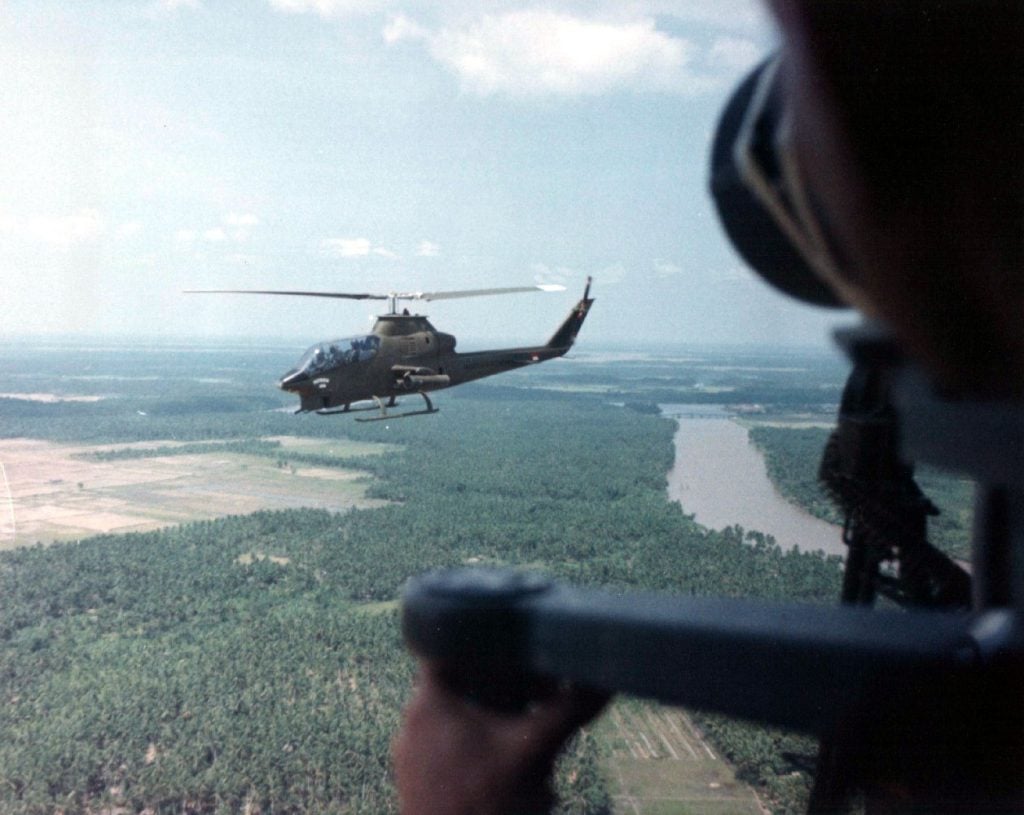
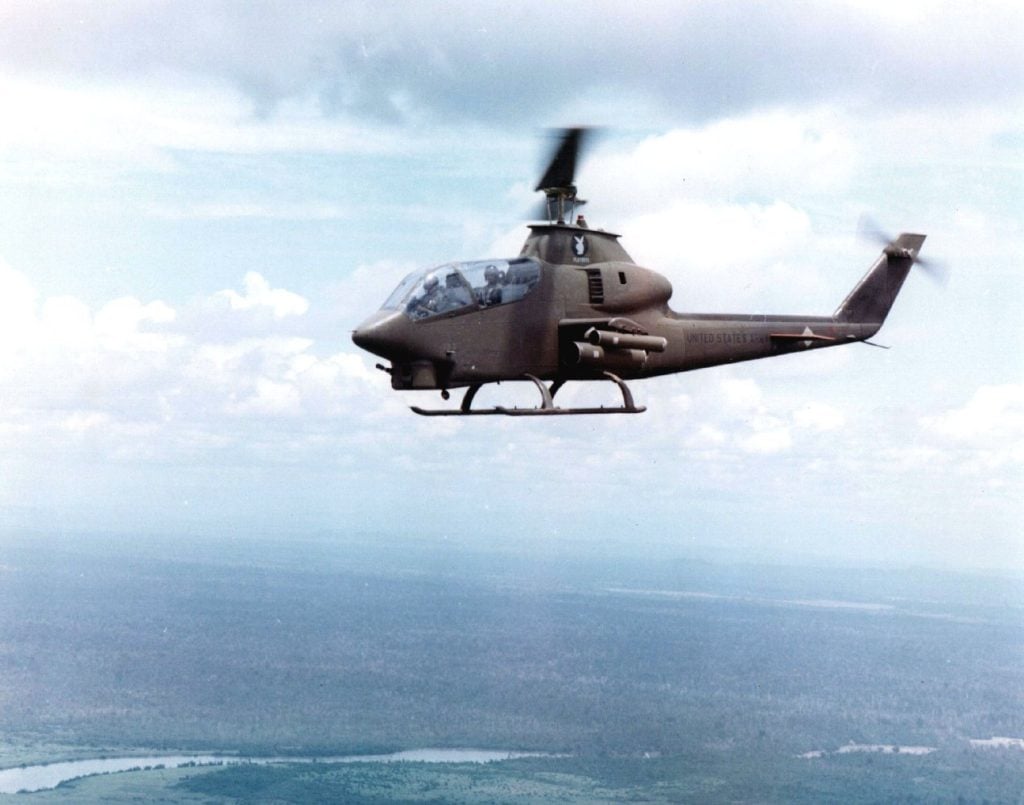
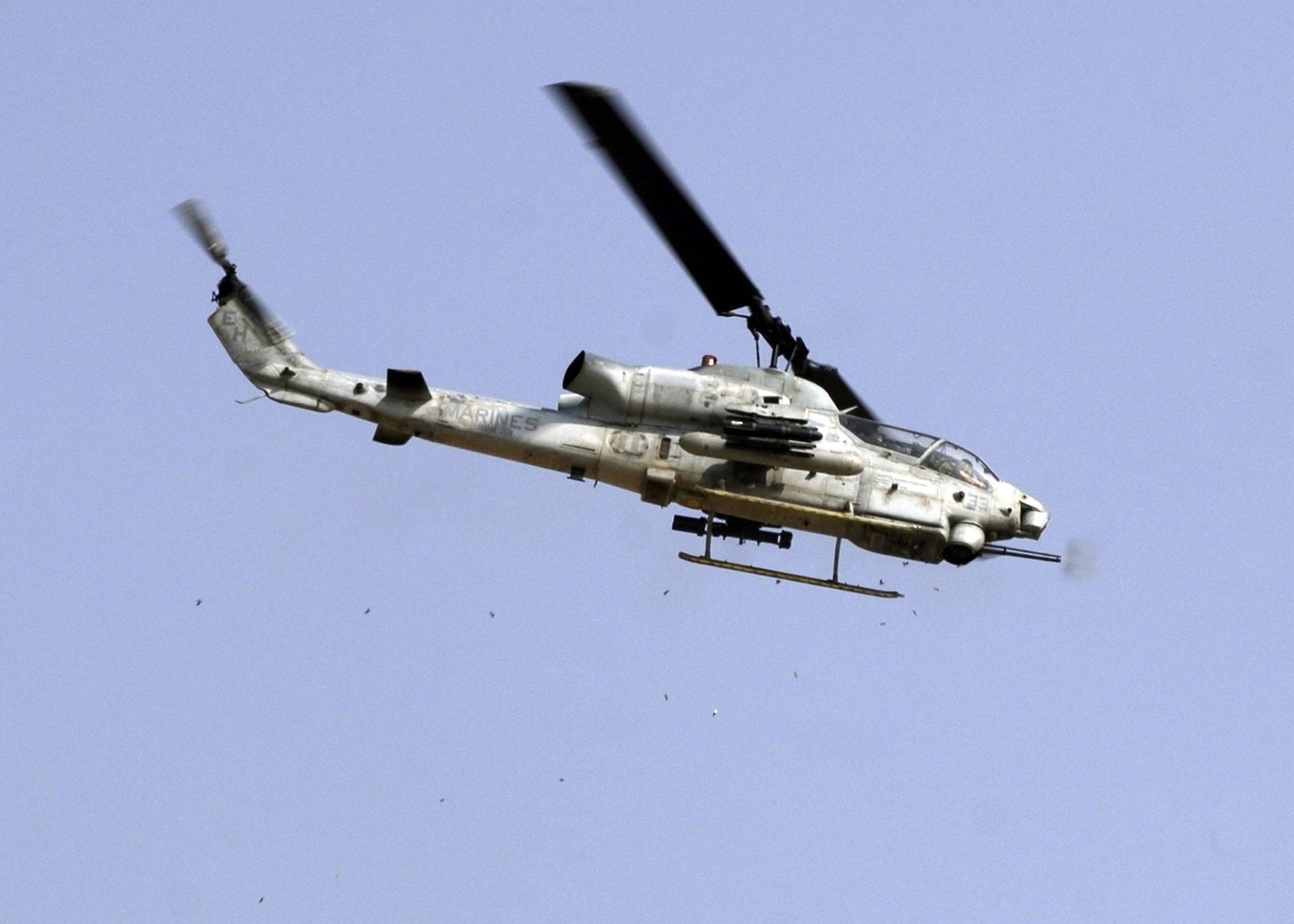
AH-1 Cobra photos: the first attack helicopter up close
The AH-1 Cobra on screen: why a 1960s gunship is still flying
Red Wrench Films · “How The AH-1 Cobra Is STILL In Service” — a well-regarded aviation-history channel traces the Cobra from the single-engine HueyCobra to the twin-engine AH-1Z Viper (around half a million views).
Where the AH-1 Cobra flies: origin, combat use and operators
Operators today
The Cobra survives as a Marine Corps aircraft and as a set of ageing export fleets, most of which are on their way out
The US Marine Corps is the only operator flying a modern Cobra in quantity: 189 AH-1Z Vipers, the last delivered in November 2022, with the production line kept open for export. Everything else in this chart is a legacy fleet. Taiwan's AH-1Ws and South Korea's AH-1S are 1990s and 1980s aircraft; Japan has formally decided to retire its Fuji-built AH-1S rather than replace them; Pakistan's AH-1Fs date from the mid-1980s and have been sustained largely on transfers from Jordan. Czechia is the newest customer, taking AH-1Z alongside UH-1Y. Turkey is a special case: it flies real Cobras, but its large modern attack fleet is the T129, which is an Italian A129 derivative and not a member of this family at all.
These are estimates. Many airframes counted on paper are stored, in deep overhaul, or not operational. Sources: IISS The Military Balance and FlightGlobal World Air Forces; entries that could not be corroborated are omitted. The US and Czech figures are firm delivery counts. The rest are less certain in different ways: Taiwan took 63 AH-1Ws from 1995 and has lost at least two; South Korea was delivered 81 AH-1S and is replacing them with the indigenous LAH-1 Miron, so the serviceable total is falling; Japan's 47 is the number named in its own December 2022 retirement decision, not a current count; Iran's AH-1J International fleet has been under embargo since 1979 and any figure for it is a guess; Turkey's total mixes a handful of AH-1Ws with older AH-1P/F airframes and the split is not reliably published; Jordan and Bahrain both fly mixed and partly retired fleets, and Bahrain's includes six or more of twelve AH-1Z delivered against an order still running. Nigeria's twelve AH-1Z were on order but not in service as of early 2026 and are excluded. Kenya's small ex-Jordanian AH-1F force could not be corroborated. The Philippines retired its two AH-1S on 28 December 2024.
The AH-1 Cobra in combat: from Vietnam to today
The Cobra is one of the most combat-tested attack helicopters ever built, in action almost continuously since 1967. U.S. Army Cobras fought throughout the Vietnam War; U.S. Marine SuperCobras served in the Gulf War, Iraq and Afghanistan; and export Cobras have seen combat in the hands of Iran, Israel, Turkey, Pakistan, the Philippines and Kenya, among others. Specific loss and mission figures vary widely between sources and should be treated as estimates.
Compare the Explore the combat record of every military aircraft. Data as of July 2026.
AH-1 Cobra: frequently asked questions
Can I fly in an AH-1 Cobra?
What is the AH-1 Cobra?
Who makes the AH-1 Cobra?
What is the difference between the AH-1 Cobra and the AH-1Z Viper?
Is the AH-1 Cobra still in service?
What weapons does the AH-1 Cobra carry?
How is the AH-1 Cobra related to the UH-1 Huey?
Which countries operate the AH-1 Cobra?
You can’t fly the AH-1 Cobra.
These, you can.
Some legends only live in museums — others are fuelled and waiting. MiGFlug has put civilians in real military jet cockpits since 2004.
 Fly the L-39 AlbatrosThe world’s most-flown jet trainer — aerobatics included
 Fly the F-104 Starfighter“The missile with a man in it”
 Fly the MiG-21The Cold War’s most-produced jet
 Fly the T-33 Shooting StarAmerica’s first jet trainer
 Fly the DH VampireA piece of early jet history
 Fly the S.211Agile Italian jet trainer
 Fly the MB-326The classic Aermacchi jet
 Fly the MiG-15The Soviet legend of the Korean War
More from the Military Aircraft Encyclopedia
AH-1 Cobra: sources & further reading
- BellBell — official AH-1Z Viper product page: specifications and role of the current Cobra.
- U.S. Marine Corps AviationU.S. Marine Corps Aviation — the SeaCobra / SuperCobra / AH-1Z Viper in Marine service.
- U.S. ArmyU.S. Army — history and doctrine of the Cobra as the first attack helicopter.
- National museums of the U.S. armed forcesNational museums of the U.S. armed forces — AH-1 airframes on display and history.
- Army TechnologyArmy Technology — detailed AH-1Z Viper dimensions, powerplant and armament.
- GlobalSecurity.orgGlobalSecurity.org — variant histories and program background for the AH-1 family.
- Smithsonian National Air and Space MuseumSmithsonian National Air and Space Museum — context on U.S. rotary-wing combat aviation.
- MiGFlug AfterburnerMiGFlug Afterburner — the magazine behind this encyclopedia, on military aviation and jet flights.
Hero and gallery photography: U.S. Air Force / NASA, public domain. Combat statistics as of July 2026. Spotted an error? Every page in the Aircraft Museum is fact-checked before publication — write to us and we'll correct it.