
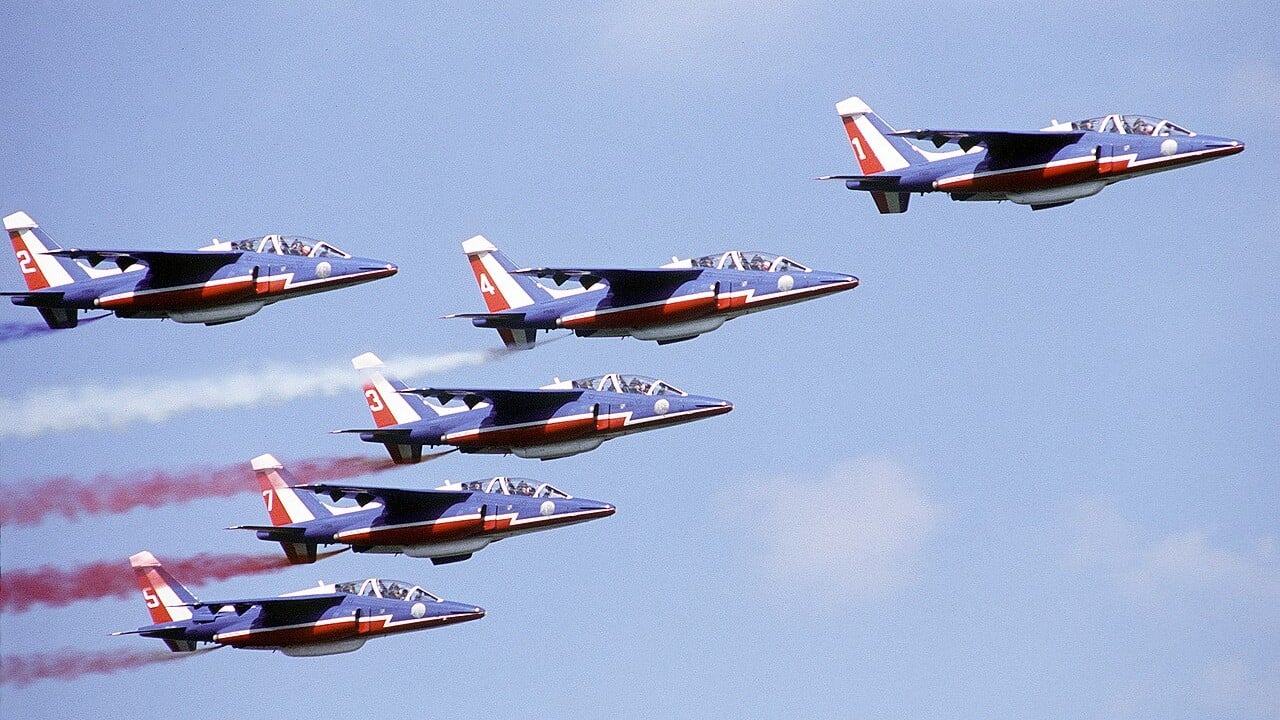
Ask a Patrouille de France pilot about the jet they fly, and you may get an unexpectedly modest answer. They all come from the Rafale o il Mirage 2000, one of them told British forces broadcaster BFBS this year, and by comparison the little red, white and blue display jet is, in his words, a bit like a moped.
That moped is the Dassault/Dornier Alpha Jet, and it has had a far more eventful life than its role as France's aerobatic ambassador suggests. It was born of a political handshake across the Rhine, built in three countries, flown in anger over Liberia and against Boko Haram, and it still flies on several continents more than half a century after the programme began.
Informazioni rapide
- Manufacturers: Dassault (France) and Dornier (West Germany), with SABCA (Belgium)
- Primo volo: 26 October 1973, Istres
- Entrato in servizio: 1977 to 1979 (first production aircraft flew 4 November 1977)
- Costruito: 480, from 1973 to 1991
- Motori: Two SNECMA Turbomeca Larzac turbofans
- Versions: Alpha Jet E (Ecole, trainer) and Alpha Jet A (Appui Tactique, close support)
- Still flown by: Patrouille de France, Top Aces and several air forces
A trainer for France, a bomber for Germany
In the 1960s Europe's air forces needed something to replace first-generation jet trainers such as the Fouga Magister. An Anglo-French effort to build one had grown into the SEPECAT Jaguar, a fine strike fighter but no basic trainer. So in 1967 France opened talks with West Germany, keen on closer military ties and on weaning the Germans off American aircraft. A joint specification followed in 1968, now for a subsonic jet, and in July 1969 the two countries agreed to buy 200 aircraft each.
Then the requirement split in two. Germany decided to keep training its pilots in the United States and no longer needed a trainer. It needed a replacement for its Fiat G.91 light attack jets instead. The compromise was one airframe in two versions: a simple trainer for France and a close air support aircraft for Germany. The Luftwaffe also insisted on two engines, after the painful accident record of its single-engine F-104 Starfighters.
Dark Skies on the Franco-German jet many people have never heard of.
Three industrial teams competed. On 23 July 1970 the Breguet, Dassault and Dornier design, the TA501, was declared the winner. Work was carefully shared out with no duplication: Dassault-Breguet built the front and centre fuselage, Dornier the wing, tail and rear fuselage, and Belgium's SABCA the nose and flaps. Final assembly took place in all three countries. The first French prototype flew at Istres in October 1973, the first German one at Oberpfaffenhofen in January 1974.
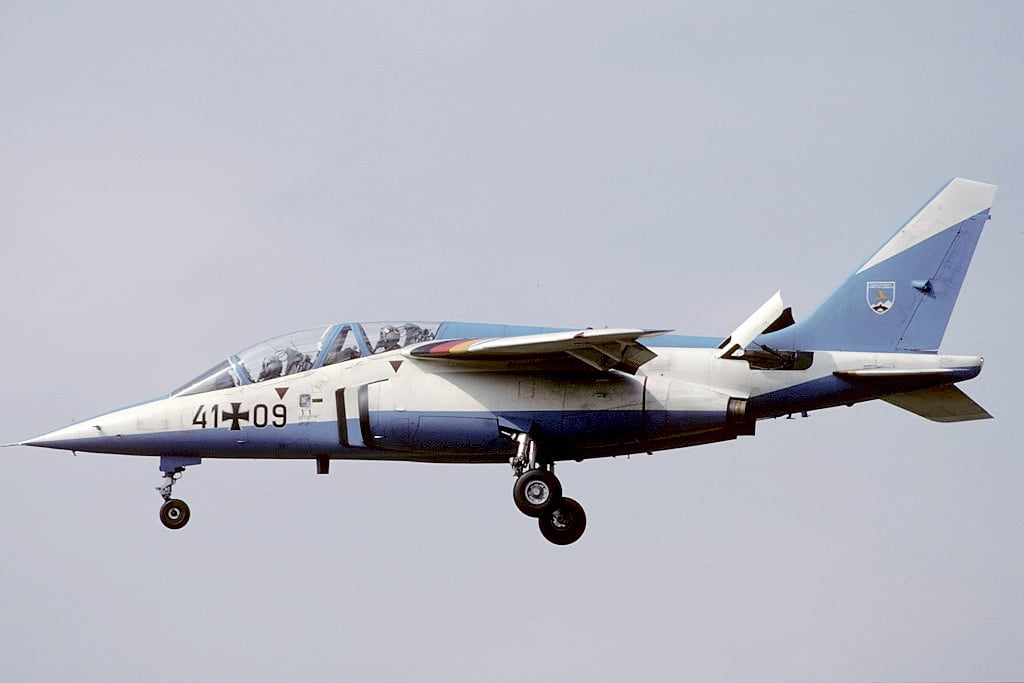
The two versions are easy to tell apart. French Alpha Jet E trainers, the E standing for Ecole, have a rounded nose. German Alpha Jet A close support jets, A for Appui Tactique, have a sharp, pointed one. France took 176 Alpha Jet Es by 1985, fewer than the 200 planned, and the Luftwaffe 175 Alpha Jet As by 1983. In all, 480 were built.
Into combat, far from the Rhine
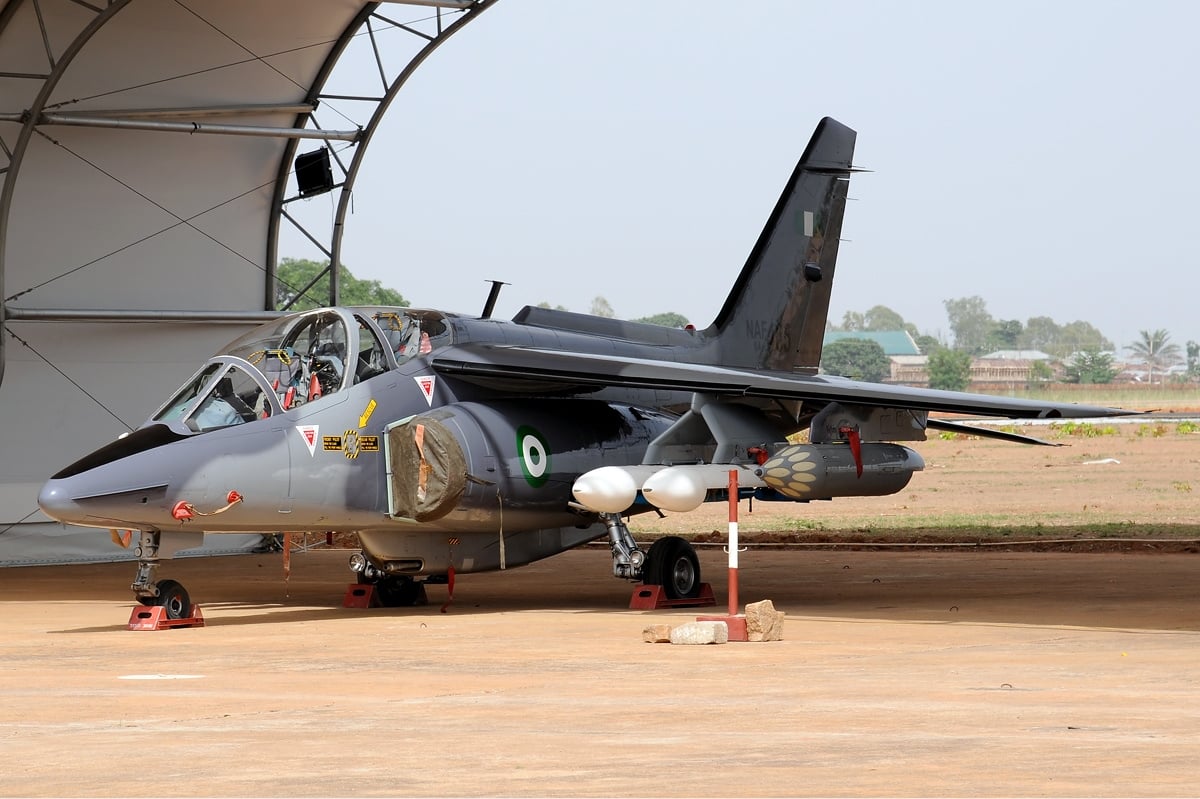
The Alpha Jet's combat career happened mostly in Africa. In 1990 Nigeria sent four of its Alpha Jets to support the West African ECOMOG peacekeeping force in the Liberian civil war. They struck rebel headquarters, convoys, shipping and gun positions at Roberts International Airport. By Wikipedia's account, Nigerian Alpha Jets flew around 3,000 combat missions for ECOMOG without a single loss, though some came back with anti-aircraft damage. From 2013 Nigeria brought idle Alpha Jets back to flying condition to strike Boko Haram.
Germany's jets saw a different kind of front line. During the 1991 Gulf War, 18 Luftwaffe Alpha Jets deployed to Turkey as part of a NATO force protecting the country against a possible Iraqi attack. After the Cold War, though, Germany had no use for them. It began phasing them out in 1992 and the last left service in 1998. Fifty went to Portugal, 25 to Thailand to replace OV-10 Broncos on border patrol, and some to private owners such as Austria's Flying Bulls.
Exports kept the production lines busy. Belgium and Egypt assembled their own French-standard aircraft, the Egyptian ones at Helwan under a 1978 licence agreement with the Arab Organization for Industrialization. That same year Dassault teamed with Lockheed to offer the Alpha Jet to the US Navy as a carrier trainer, a contest eventually won by the T-45 Goshawk, a derivative of the British Hawk.
RMC Decouverte on the tight formation flying of the Patrouille de France Alpha Jets.
Still flying, still showing off
France retired the Alpha Jet from student pilot training in 2023 but kept it as an adversary aircraft at Cazaux and, most visibly, with the Patrouille de France. The team's jets swap their gun for a smoke generator, and in 2026 they wore a Stars and Stripes tail marking to help celebrate 250 years of American independence. The pilots, it turns out, envy one thing about Britain's Red Arrows.
Private operators keep the type busy too. Canada's Top Aces flies Alpha Jets as contract adversary aircraft, playing the enemy for air force training. Not bad for a jet that one of its own display pilots compares to a moped.
A full Patrouille de France formation flight seen from the cockpit.
Sources: Wikipedia (Dassault/Dornier Alpha Jet; Patrouille de France), BFBS Forces News, MiGFlug Aircraft Encyclopedia
0 Comments