
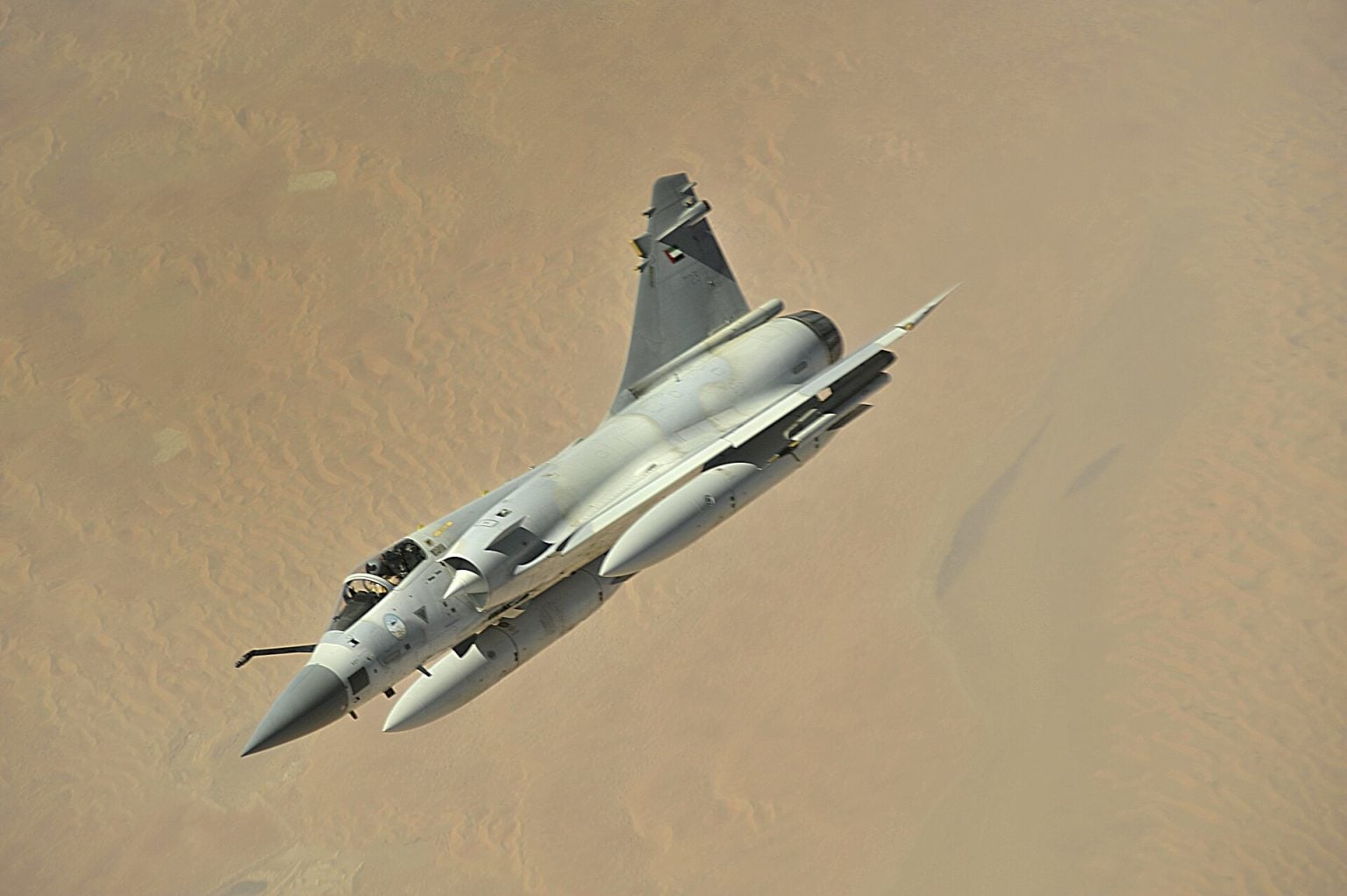
Dassault Mirage 2000
The delta that went global
France’s delta-winged, single-engine, fly-by-wire multirole fighter — a genuine Mach 2 interceptor at a single-engine price that armed nine air forces across four continents, fought from Kargil to the Aegean, and is still on the front line four decades on.
The export champion France couldn’t stop selling
When France cancelled its costly swing-wing Super Mirage G8 and ACF projects in 1975, Dassault fell back on the shape it knew best: the pure delta. The lightweight air-defence fighter that emerged — first flown on 10 March 1978 — entered French service in 1984 as the Mirage 2000C, replacing the Mirage III and F1 in the interceptor role.
Where the Mirage III made Dassault’s name, the Mirage 2000 made it a global institution. Of roughly 601 built, more than a third went abroad — to India (the largest export customer, around 50 “Vajra”), the UAE (bespoke 2000-9s), Taiwan, Greece, Egypt, Peru, Qatar and Brazil. Its appeal was a rare balance: real Mach 2 delta performance and modern fly-by-wire agility, at a price far below twin-engine rivals.
Four decades on the type is still fighting. From the family grew the multirole 2000-5 with RDY radar and MICA missiles, the 2000D and 2000N strike variants, and the export 2000-9. In 2024–25 France transferred Mirage 2000-5s to Ukraine, where they were reported downing Russian cruise missiles — putting a Cold-War delta into a very modern war. Few fighters have stayed relevant, and exportable, for so long.
01The Mirage 2000’s family tree: how one delta became an interceptor, a striker and a nuclear bomber
The Mirage 2000 began as a pure air-defence interceptor, the single-seat 2000C and two-seat 2000B. From it Dassault grew a whole family: the multirole 2000-5 and 2000-5F, with the pulse-Doppler RDY radar and MICA missiles; the two-seat 2000D conventional-strike aircraft and its 2000N nuclear-strike sibling (retired in 2018); and the top-of-the-line export 2000-9 built for the United Arab Emirates.
Production ran from 1978 to 2007, with roughly 601 aircraft completed — though exact totals and dates vary slightly by source. It is a separate machine from the earlier Mirage III/5 and the Mirage IV bomber, which share the delta silhouette but belong to an older generation entirely.
What makes the Mirage 2000 special
Delta wing, tamed by fly-by-wire
The low-drag tailless delta gives the Mirage 2000 high speed, a big internal fuel and weapons volume and superb high-altitude performance — but classic deltas bled energy in turns. Dassault made the jet deliberately aerodynamically unstable and tamed it with a quadruplex fly-by-wire system, restoring the tight, carefree agility the Mirage III never had.
The single SNECMA M53
A single, mechanically simple M53-P2 single-shaft afterburning turbofan — around 95 kN (21,400 lbf) in reheat — drives the jet past Mach 2.2. Compact and easy to maintain, it is the powerplant that keeps a Mach 2 fighter affordable to run, and the reason budget-conscious air forces could field one at all.
RDM to RDY radar
Early 2000Cs carried the multimode RDM (later RDI) radar. The multirole 2000-5 and 2000-9 introduced the RDY pulse-Doppler radar — true look-down / shoot-down, multi-target track-while-scan and beyond-visual-range capability with the MICA missile, turning an interceptor into a modern multi-target shooter.
02The Mirage 2000’s delta: why Dassault made it unstable on purpose
A pure delta is wonderful at speed and terrible in a turning fight: it sheds energy fast and lands nose-high. The Mirage III lived with those penalties. For the Mirage 2000, Dassault moved the balance point so the airframe was naturally unstable, then let a quadruplex analogue fly-by-wire system do the constant balancing a pilot never could. The result was a delta that kept its supersonic dash and range but finally turned like a proper dogfighter — the jet the Mirage III always wanted to be.
03The Mirage 2000’s one-engine bet: simplicity as a strategy
Most Mach 2 fighters of its era used two engines. The Mirage 2000 used one, and that was the whole point. A single M53 meant fewer parts, easier maintenance and lower running costs — a jet a mid-size air force could actually sustain. The trade-off is less raw thrust than twin-engine rivals like the F-15 or Su-27, but for an interceptor built around climb, dash and a quick intercept, the M53 was enough — and it made the Mirage 2000 one of the most exportable fighters of its generation.
Full Mirage 2000 specifications
Baseline note: the figures below describe the single-seat Mirage 2000-5F and its export twin the -5 Mk2 — the RDY-radar, MICA-armed standard that represents the type at its most capable and the one still being flown in combat. Deltas for the original 2000C interceptor, the two-seat 2000N and 2000D strike aircraft and the Emirati 2000-9 in grey. Dassault publishes little raw data; airframe figures below are the reference-work values for the common Mirage 2000 airframe, which the marks share.
Dimensions & weights
- Crew
- 1 (2 in the B, N and D — and the two-seaters have no internal cannon at all)
- Length
- 14.36 m (47 ft 1 in)
- Wingspan
- 9.13 m (29 ft 11 in)
- Height
- 5.20 m (17 ft 1 in) — the fin is noticeably taller than the Mirage III’s, which is what lets the pilot keep control beyond 25° angle of attack
- Wing area
- 41 m² (441 sq ft), leading edge swept 58°, trailing edge swept forward 3.5°
- Empty weight
- 7,500 kg (16,535 lb) — barely half an F-15C, and the reason the aeroplane turns the way it does
- Internal fuel
- ~3,950 litres (~3,160 kg; ~6,970 lb), more than 750 litres up on the Mirage III thanks to the blended wing root
- Maximum fuel
- ~8,000 litres (~1,760 imp gal) with external tanks
- Gross weight
- 13,800 kg (30,420 lb)
- Maximum external load
- ~6,300 kg (~13,900 lb) of fuel and ordnance
- Maximum take-off weight
- 17,000 kg (37,480 lb)
- Store stations
- 9 — four under the wings and five under the fuselage
- Wing loading
- 337 kg/m² (69 lb/sq ft) at gross weight, falling to about 220 kg/m² (45 lb/sq ft) at normal combat load — against roughly 537 kg/m² (110 lb/sq ft) for an F-16
Performance
- Maximum speed, altitude
- 2,336 km/h (1,452 mph), Mach 2.2
- Maximum speed, low level
- 1,110 km/h (690 mph), 600 kn at sea level
- Demonstrated low-speed handling
- 190 km/h (118 mph; 103 kn) at 25° angle of attack, flown in public at Farnborough in September 1978 — the demonstration that made the argument for the whole aeroplane. Later testing reached 30° with tanks and weapons aboard
- Service ceiling
- 17,060 m (55,970 ft)
- Rate of climb
- 285 m/s (56,100 ft/min)
- Time to 15,000 m
- Under 4 minutes (49,200 ft) — Dassault’s own claim for the intercept profile, which is what the aircraft was built for
- Combat radius
- ~1,480 km (~920 mi) hi-lo-hi with external tanks
- Range
- 1,550 km (963 mi) clean
- Ferry range
- 3,335 km (2,072 mi) with auxiliary fuel
- Load factor limits
- +9 / −3.2 g in the unrestricted flight control law; the second law limits g when tanks or ground-attack stores are carried, to stop the pylons being torn off
- Thrust-to-weight
- 0.70 at gross weight — single-engined and modest on paper, which the low wing loading more than repays in a turn
Propulsion & systems
- Engine
- 1 × SNECMA (now Safran) M53-P2 afterburning turbofan (the first 37 Mirage 2000C had the lower-rated M53-5)
- Thrust
- 64.3 kN (14,455 lbf) dry, 95.1 kN (21,380 lbf) with afterburner
- Intakes
- Side intakes with movable half-cone shock bodies — the souris, or mice — positioned by the air data computer; large enough to keep the engine fed at extreme angles of attack, with small strakes along each intake adding directional stability
- Fuel and refuelling
- ~3,950 litres internal; removable refuelling probe bolted on ahead of the cockpit, offset slightly to starboard
- Radar
- Thales RDY multi-target pulse-Doppler: 24 targets detected, 8 tracked, 4 engaged simultaneously with MICA. About 110 km (60 nmi) in air-to-air mode, 37 km look-down, 240 kg, a 655 mm flat-plate antenna at up to 120 kW. RDY-2 with synthetic-aperture mapping and moving-target indication on the 2000-5 Mk2 and -9. The 2000C’s RDM and later RDI were air-to-air only and could support just one Super 530D at a time — that single limitation is why the -5 exists
- Flight controls
- Quadruplex analogue fly-by-wire on four computers, with the centre of gravity deliberately behind the neutral point. Two control laws: unrestricted with air-to-air stores only, and a g-limited law when tanks or air-to-ground stores are carried
- Cockpit and sights
- Night-vision-compatible glass cockpit adapted from Rafale development, dual-linked wide-angle head-up display, HOTAS controls — a complete rebuild of the 2000C’s dial-and-scope layout
- Defensive aids
- ICMS Mk2 integrated suite on the -5F, with three radar detectors and an infrared sensor; Serval warning receiver, Sabre jammer and Spirale chaff and flare dispensers on the 2000C, N and D
- Ejection seat
- Martin-Baker Mk 10 series, zero-zero
- First flight
- Prototype No. 01 on 10 March 1978, just 27 months after go-ahead; first production 2000C 20 November 1982; first Mirage 2000-5 prototype 24 October 1990
- Service entry
- Mirage 2000C with the Armée de l’Air in 1983; Mirage 2000-5F redelivered to France in 1998 and 1999
- Number built
- 601 across all marks, 1978 to 2007. The final aircraft was delivered to the Hellenic Air Force on 23 November 2007 and the line closed behind it
04The Mirage 2000’s cost: why the numbers are slippery
Affordability was the Mirage 2000’s selling point, but firm figures are hard to pin down. A historic unit cost around US$23 million is often quoted, yet it varied enormously by variant, year and customer — a basic 2000C, a bespoke Emirati 2000-9 and a nuclear-capable 2000N were very different aircraft at very different prices. No reliable open-source cost-per-flight-hour figure exists either. What is clear is the comparison that mattered to buyers: a genuine Mach 2 fighter for markedly less than a twin-engine F-15, Su-27 or Tornado. Treat all specific dollar figures here as approximate.
Armament & payload
The Mirage 2000 went from firing one missile at a time to firing four, and that single change defines its two halves
The original Mirage 2000C was a good interceptor with a bad limitation: its RDI radar could illuminate one target for one semi-active Super 530D, and until that missile arrived the aircraft was committed. Everything that made the Mirage 2000-5 was built to undo that. The RDY radar detects 24 aircraft, tracks eight and guides four MICA at once, and MICA itself comes in two interchangeable seekers — active radar and imaging infrared — on one airframe, so a pilot can fire without ever transmitting. Below the waterline the aircraft is a competent bomber too: the 2000D flew precision strikes over Bosnia, Kosovo, Afghanistan, Libya, Mali and Iraq, and dropped the last NATO munition of the Libyan campaign. Clearances vary sharply by mark and customer: only French aircraft ever carried a nuclear weapon, Indian aircraft fly Israeli stores that no French aircraft has, the two-seaters carry no internal gun, and the Ukrainian aircraft are a French air-defence fit with SCALP and AASM added.
Gun
- 2 × DEFA 554 30 mm revolver cannon, later designated GIAT (now Nexter) 30-550 F4, one in each wing root
- 125 rounds per gun, with a pilot-selectable rate of either 1,200 or 1,800 rounds per minute
- No two-seat Mirage 2000 has an internal gun. The 2000B trainer, the 2000N and the 2000D all gave up both cannon to the second cockpit
- The 2000D got a gun back only through its RMV mid-life update, and only as a podded one: the CC422 30 mm gun pod on a fuselage station
- A real weapon rather than a token — 30 mm against a drone or a truck is exactly the cheap effector modern air forces have been rediscovering they need
Air-to-air
- MBDA MICA EM (active radar) and MICA IR (imaging infrared) — up to six carried, four guided at once by the RDY. One airframe, two seekers, and the infrared version needs no radar emission at all
- Matra Super 530D semi-active radar missile, the 2000C’s beyond-visual-range weapon, paired with the RDI radar and fired strictly one at a time
- Matra Super 530F, the earlier and shorter-legged version, on the first Mirage 2000C aircraft with RDM radar
- Matra R550 Magic II infrared dogfight missile — the standard short-range weapon across every export fleet, and still carried by Ukrainian aircraft alongside MICA
- R-73 (AA-11 Archer) on Indian Mirage 2000H, integrated around 2005 — a Russian missile on a French fighter, which is an entirely Indian kind of solution
Air-to-surface guided
- AS.30L laser-guided missile, two carried — the 2000D’s precision weapon over Bosnia and Kosovo, and one of the first Western weapons to make self-designated laser attack routine
- MBDA Apache anti-runway dispenser and its descendant SCALP EG, the stand-off cruise missile now carried by Ukrainian Mirage 2000-5F
- AM39 Exocet anti-ship missile, two carried, on Greek Mirage 2000EG and 2000-5 Mk2 aircraft — the Aegean requirement in one store
- ASMP and the improved ASMP-A stand-off nuclear missile, one on the centreline of a Mirage 2000N. French aircraft only; never exported, never fitted to any other mark
- Export-specific stores: PGM 500 and PGM 2000 modular weapons on Emirati aircraft, Crystal Maze and Spice on Indian aircraft, Safran AASM Hammer on French and Ukrainian ones
Bombs
- GBU-12 and GBU-16 Paveway II laser-guided bombs, the everyday weapons of the 2000D
- GBU-24 Paveway III for hardened targets, one carried
- GBU-49 dual-mode laser and satellite-guided bomb; GBU-48 and GBU-50 added by the 2000D RMV update
- Mk 82 unguided bombs, still cleared and still occasionally the right answer
- Smart Anti-Airfield Weapon on Indian aircraft — a stand-off glide weapon for cratering runways from outside short-range defences, which is the job the Apache dispenser used to do from directly overhead
Rockets
- Matra 68 mm unguided rocket pods, 18 rockets per pod — unusually for a modern fighter, these are a genuine cleared fit rather than a legacy entry
- Typically carried in pairs on the inboard wing stations for strafing and area attack, largely in the export fleets rather than by France
- They have almost never been the weapon of choice in the type’s combat record, which is dominated by laser-guided bombs and the AS.30L
- The Mirage 2000 dates from the last generation of fighters designed when a rocket pod was still assumed equipment; everything since has skipped it
Pods & other stores
- ATLIS II laser designator pod on early aircraft, then the Thales PDL-CT and PDL-CTS, and finally Damocles on the Mirage 2000D — a thirty-year march from a daylight television tracker to a thermal-imaging designator
- CC422 30 mm gun pod, carried by the two-seaters, which have no built-in cannon
- 1,300-litre underwing drop tanks, and the distinctive 2,000-litre bulbous-nosed tank designed for the Mirage 2000N because the ASMP occupied the centreline station and left nowhere else for fuel
- Sabre jammer and Spirale chaff and flare dispensers on French aircraft; the -5F carries its ICMS Mk2 suite internally rather than in a pod
- Reconnaissance is a mark-specific fit: the Emirati Mirage 2000RAD is a purpose-built recce version, eight of which were delivered
Three typical loadouts
- Air defence alert, Mirage 2000-5F
- Six MICA in a mixed active-radar and infrared fit, two 1,300-litre tanks, both cannon loaded. Four of the six can be guided at once. This is the configuration French aircraft stood alert in, the configuration Taiwan scrambles against Chinese incursions, and broadly the configuration Ukraine flies.
- Nuclear alert, Mirage 2000N — historical, to June 2018
- One ASMP-A stand-off nuclear missile on the centreline, two 2,000-litre bulbous-nose tanks, two Magic II for self-defence, no gun. Flown at low level under an Antilope 5 terrain-following radar. The role passed to the Rafale and the Mirage 2000N was withdrawn in June 2018.
- Precision strike, Mirage 2000D
- Two GBU-12 with a Damocles designator pod, two drop tanks, two MICA IR, CC422 gun pod. The Sahel and Iraq configuration — and, with GBU-48 and GBU-50 added, the configuration the 55 RMV-standard aircraft will fly until at least 2035.
Sourcing caveat: clearances follow Dassault and MBDA product information, French Ministry of the Armed Forces statements and the standard reference works. One figure needs flagging: some general references on the Mirage 2000 state that six MICA can be fired and supported simultaneously, while descriptions of the RDY radar itself state that the radar detects 24 targets, tracks eight and engages four. The radar figure is the better attested and is used here — six is the number the aircraft can carry, four is the number it can guide. Manufacturer literature routinely lists weapons that have been offered rather than qualified, and export fleets diverge sharply: Indian, Emirati and Greek aircraft carry stores that no French Mirage 2000 has ever been wired for.
Variants
Dassault went back to the delta wing it had spent a decade trying to escape, and this time made it work
The Mirage III was a commercial triumph with two well-known faults, both of them consequences of its tailless delta. It bled energy savagely in a sustained turn, because a delta with no tailplane trims in pitch by deflecting its own trailing edge upwards, which spoils the lift it is trying to make. And it approached and landed fast and long, for the same reason: there are no flaps on a tailless delta, so approach speed stays high. Dassault spent the late 1960s and early 1970s trying to get away from the shape entirely — the swept-wing Mirage F1, the variable-geometry Mirage G, the Anglo-French AFVG, the twin-engined Super Mirage G8A — and in December 1975 the government cancelled the lot as too expensive.
What was left was a cheap single-engined delta project called Delta 1000, and what rescued it was electronics. Put the centre of gravity behind the neutral point, so the aircraft is aerodynamically unstable and its natural tendency is to pitch up rather than resist; give the wing full-span leading-edge slats and four elevons; and let four analogue computers fly it. The trim penalty largely disappears, the approach becomes controllable, and the delta’s advantages — low drag, huge internal volume, small radar cross-section, no tailplane to build — are kept. In September 1978, seven months after first flight, a Dassault pilot flew the prototype past the Farnborough crowd at 190 km/h with the nose 25 degrees up. That was the whole argument, made in one pass.
The second half of the story is the radar. By the late 1980s the Mirage 2000C could still only engage one target at a time while F-16s were fielding better sets, so Dassault privately funded the Mirage 2000-5: RDY radar, MICA, a Rafale-derived cockpit. Every capable Mirage 2000 flying today is descended from that decision.
- Mirage 2000C (France; 124 delivered from 1983)
- The single-seat interceptor. The first 37 had M53-5 engines and RDM radar; later aircraft had the M53-P2 and, from 1987, the much better RDI with Super 530D. Retired from French service in 2022.
- Mirage 2000B (France; 30)
- Two-seat conversion trainer with the 2000C’s systems. No internal cannon — the second cockpit took the space.
- Mirage 2000-5F (France; 37 Mirage 2000C rebuilt, redelivered 1998–99)
- RDY radar, six MICA, ICMS Mk2 countermeasures, a night-vision glass cockpit taken from Rafale development, and clearance for the oversized Mirage 2000N tanks. These are the aircraft France has been sending to Ukraine.
- Mirage 2000N (France; 75; in service 1988, retired June 2018)
- Two-seat nuclear strike aircraft: strengthened for low-level flight, Antilope 5 terrain-following radar, ASMP then ASMP-A on the centreline. The first 30 aircraft, the N-K1, were nuclear-only and carried AN.52 free-fall bombs until ASMP was ready. The role passed to the Rafale.
- Mirage 2000D (France; 86; first production flight 31 March 1993, in service April 1995)
- The conventional strike derivative of the 2000N, and the most heavily used French Mirage 2000 in combat. 55 aircraft are being brought to RMV standard for €532.5 million, with the CC422 gun pod, MICA in place of Magic, and GBU-48 and GBU-50; the first was accepted in April 2025 and the fleet is expected to serve until at least 2035.
- Mirage 2000-5 Mk2 (Greece; 25, plus 10 Mirage 2000EG upgraded)
- Export -5 with the RDY-2 radar, MICA and Exocet. Greece’s older Mirage 2000EG and 2000BG were retired in 2021.
- Mirage 2000-9 (United Arab Emirates; 32 new-build plus 30 earlier aircraft upgraded)
- Built to an Emirati specification: RDY-2 with synthetic-aperture mapping, a forward-looking infrared targeting pod, PGM guided weapons and Rafale-derived processing. The most capable export Mirage 2000, and the last new-build standard.
- Mirage 2000H / 2000I (India; 50 including 8 two-seaters)
- Indian aircraft, delivered from 1985 and upgraded from 2011 under a €2.2 billion contract to something close to -5 Mk2 standard with RDY-2 and MICA. They carry R-73, Crystal Maze and Spice, and flew the 2019 Balakot strike.
- Mirage 2000-5Ei / -5Di (Taiwan; 53)
- Taiwanese -5 standard, delivered from 1997 and still the Republic of China Air Force’s dedicated interceptor. Flown hard against continuous incursions, and expensive to keep flying with no local support base.
- Mirage 2000EM/BM, 2000P/DP, 2000RAD (Egypt 20, Peru 12, UAE 8)
- Smaller export batches to 2000C standard, plus the Emirati 2000RAD, the only purpose-built reconnaissance variant the type ever had.
Closing caveat: the Mirage 2000 line closed in 2007 and every aircraft flying today is being kept going by upgrade rather than replacement, so a designation tells you less than it used to. Indian, Emirati, Greek and French airframes have all been rebuilt to different standards under different national programmes, and a "Mirage 2000-5" in one air force is not the same aeroplane as a "Mirage 2000-5" in another.
The Mirage 2000, decade by decade
The delta revived
France cancels the swing-wing Super Mirage / ACF and, in December, launches a lightweight pure-delta air-defence fighter — the Delta 2000.
First flight
The prototype flies on 10 March 1978 (some sources cite 1 March), proving the unstable delta and fly-by-wire concept.
Enters French service
The single-seat 2000C joins the Armée de l’Air as an interceptor, replacing the Mirage III and F1.
Nuclear strike
The two-seat 2000N, carrying the ASMP stand-off nuclear missile, enters service as part of France’s airborne deterrent.
Gulf War debut
French Mirage 2000s fly combat air patrol and air-defence sorties during Operation Desert Storm.
The Aegean kill
On 8 October a Hellenic Air Force Mirage 2000 is credited with downing a Turkish F-16 over the Aegean — the type’s clearest air-to-air victory.
Kargil War
IAF Mirage 2000s fly high-altitude laser-guided-bomb strikes on entrenched Himalayan positions, widely credited as decisive.
Export peak
The multirole 2000-5 arrives with RDY radar and MICA; Taiwan and the UAE sign major export deals.
Production ends
The line closes after roughly 601 aircraft built across all variants over nearly three decades.
Mirage over Ukraine
France transfers Mirage 2000-5s to Ukraine, which presses them into air defence against Russian missiles and drones.
From the flight line: twelve Mirage 2000 stories
The delta that finally turned
Dassault made it unstable on purpose
Read the full story
The Aegean kill
A Mirage 2000 is credited with downing an F-16
Read the full story
Kargil, at the top of the world
LGBs over Tiger Hill
Read the full story
Balakot — the disputed strike
Two nations, two irreconcilable stories
Read the full story
The jet everyone bought
Nine air forces, four continents
Read the full story
Taiwan’s controversial deal
Bought under Beijing’s glare
Read the full story
MICA and the RDY radar
Fire-and-forget, near and far
Read the full story
One engine, kept simple
The M53’s maintainable muscle
Read the full story
The silent strike variant
France’s airborne deterrent
Read the full story
Sahel to Syria
France’s workhorse fighter-bomber
Read the full story
Mirage over Ukraine
A 1980s delta joins a 2020s war
Read the full story
Not the same as a Mirage III
Same silhouette, different generation
Read the full story
The Mirage 2000 in pictures
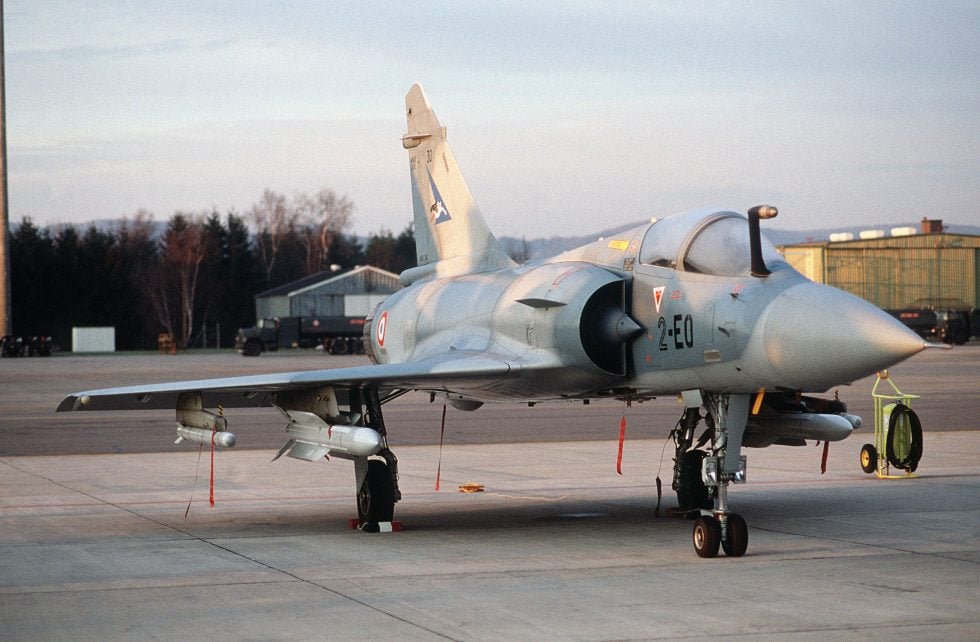
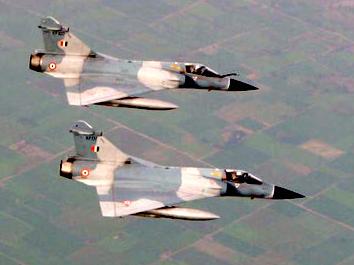
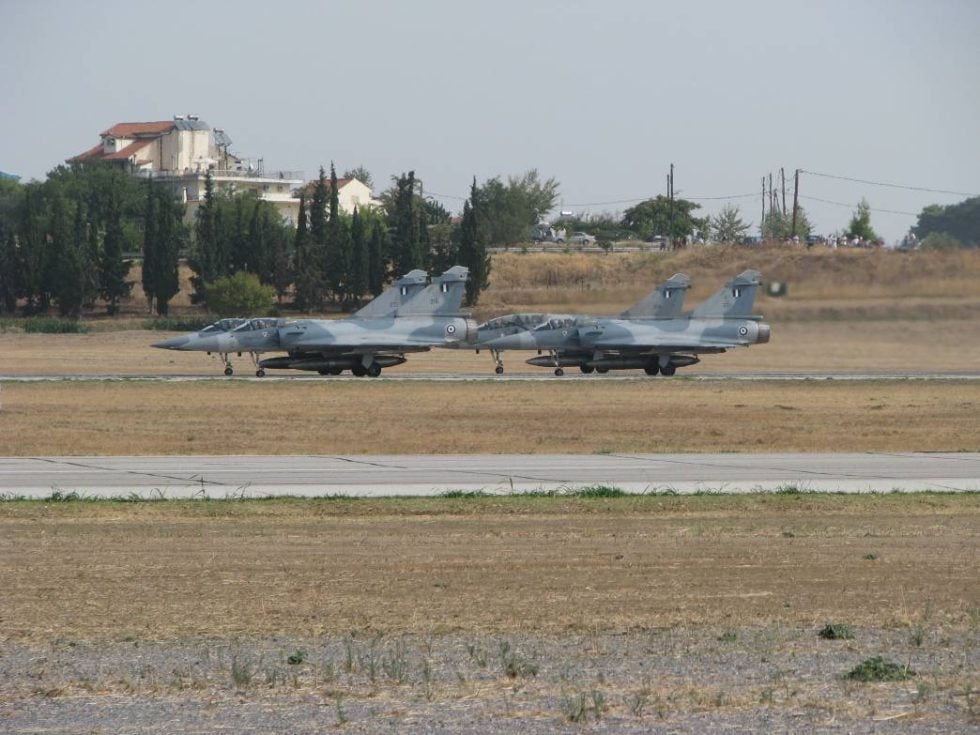
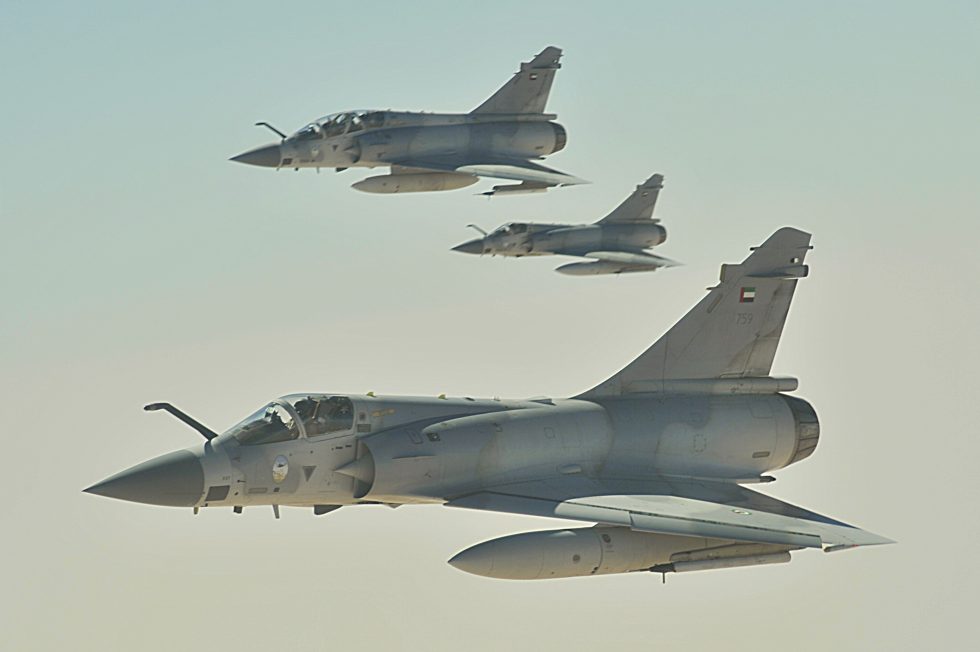
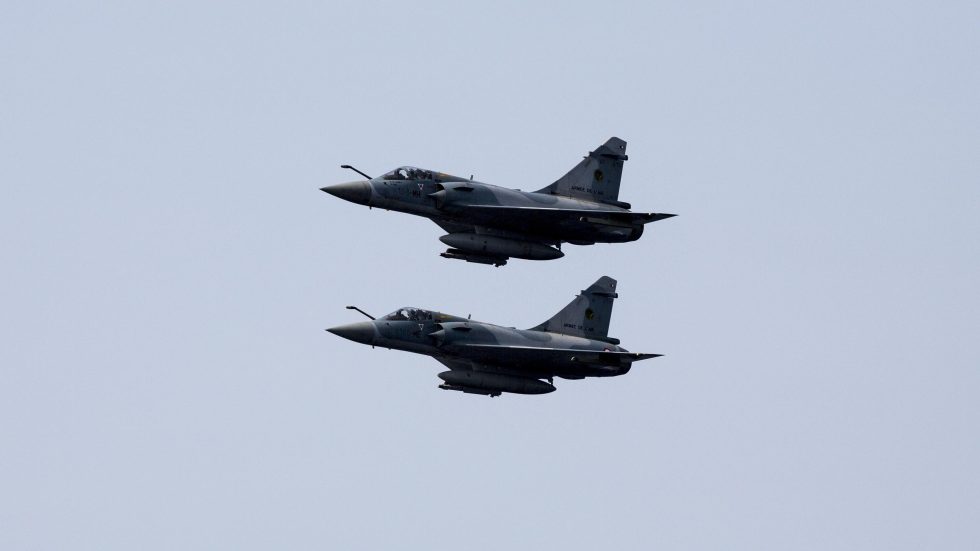
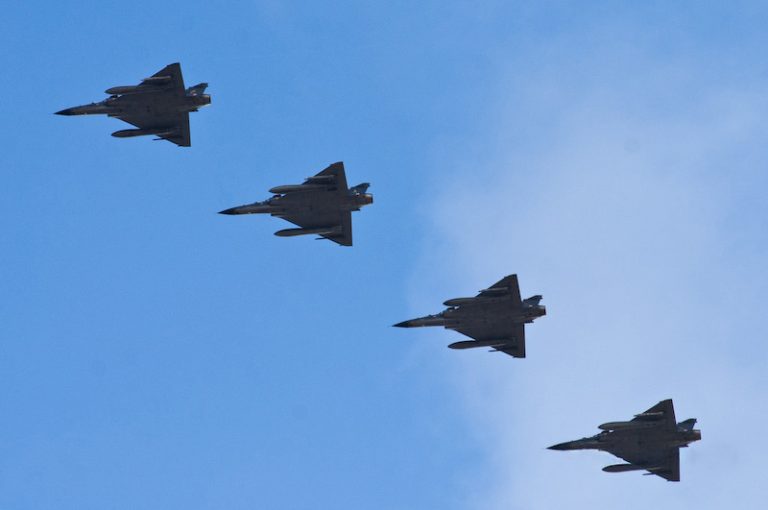
The Mirage 2000 in motion
A dedicated Mirage 2000 video is coming soon.
The Mirage 2000 in motion
Megaprojects — one of the most-watched Mirage 2000 films on YouTube.
Where the Mirage 2000 flies
Operators
France took 315 of the 601 Mirage 2000s built and still flies the type as its second combat aircraft behind the Rafale, while seven export customers bought the rest new and Brazil, Ukraine and India later took used French airframes on top.
The Mirage 2000 is the aeroplane that kept Dassault in the fighter business between the Mirage III generation and the Rafale, and France is the operator that defines it: 124 Mirage 2000C interceptors, 30 two-seat 2000B, 75 nuclear-strike 2000N and 86 conventional-strike 2000D, with 37 of the 2000Cs later rebuilt as Mirage 2000-5F. Commercially the type was made in Asia and the Gulf — the United Arab Emirates ordered 68 new aircraft, Taiwan 60, India 59 and Greece 55 — and outside France and Greece it never reached a NATO air force, which is why production stopped at 601 aircraft in 2007. What is left in French service is a two-variant force: the 2000N went in 2018 and the 2000C in 2022, and the 50 Mirage 2000D, 22 Mirage 2000-5F and 7 Mirage 2000B on charge at the end of 2025 are the whole of it, the 2000D fleet having just completed a mid-life upgrade meant to carry it past 2030. Quantities in the table are airframes on charge now, at the date given in each note, and for a former operator the number that operator held; totals ever ordered or delivered are in the notes, not the column. Second-hand transfers mean French airframes appear twice: the twelve Brazilian aircraft were ex-French 2000C and 2000B, the Ukrainian aircraft are ex-French 2000-5F drawn from the fleet counted under France, and India’s 24 second-hand machines bought in 2021 are chiefly spares donors. The two DGA trials aircraft are held by the armament agency and are additional to the French air force figure, not inside it. The French numbers are a snapshot at 31 December 2025 from the 2026 edition of Chiffres clés de la Défense; the 601 aircraft built are accounted for by the order figures above, not by this column.
Current strength, largest fleet first. Where a figure is a range or an estimate the bar is drawn at the middle of it and the number keeps its published form.
In service with
- French Air and Space ForceFrance · 79 aircraft on charge at 31 December 2025 — 50 Mirage 2000D for conventional strike, 22 Mirage 2000-5F for air defence and 7 Mirage 2000B used as trainers for both fleets; 315 taken on charge in all, comprising 124 Mirage 2000C, 30 Mirage 2000B, 75 Mirage 2000N and 86 Mirage 2000D, with 37 of the 2000Cs converted to Mirage 2000-5F standard in the late 1990s; the 2000N left service in June 2018 and the 2000C in June 2022; the last of 52 mid-life-upgraded Mirage 2000Ds — 50 for the air force plus two trials aircraft — was handed over on 16 June 2026, extending the fleet beyond 2030
- 79 · 1984–
- United Arab Emirates Air ForceUnited Arab Emirates · the largest export order: 36 aircraft delivered from 1989 — 22 Mirage 2000EAD multirole, 8 Mirage 2000RAD reconnaissance and 6 two-seat 2000DAD — followed by the 1998 Bader 21 contract for 62 Mirage 2000-9, of which 32 were new-build and 30 were existing Emirati aircraft retrofitted to the same standard, deliveries and retrofits running to about 2007; offered for sale since the UAE ordered the Rafale in 2021
- 56–60 · 1989–
- Republic of China Air ForceTaiwan · 60 aircraft ordered in 1992 and delivered between May 1997 and November 1998 — 48 single-seat Mirage 2000-5Ei and 12 two-seat 2000-5Di; most of the fleet remains in service at Hsinchu in the air-defence role, with about 54 still on strength after six were lost in crashes, Taiwan’s highest-altitude interceptor and its most expensive type to run
- 53 · 1997–
- Indian Air ForceIndia · India does not publish fleet totals; 59 new-build aircraft were delivered from 29 June 1985 against the April 1982 order for 40 and later batches, reported as 46 single-seat Mirage 2000H and 13 two-seat 2000TH, and 51 surviving airframes were contracted in 2011 for upgrade to Mirage 2000I/TI standard, completed with HAL at Bangalore; three squadrons remain operational as the Vajra, the type that struck Balakot in February 2019; a further 24 retired French Mirage 2000s were bought in September 2021 chiefly as a source of spares and airframes rather than as additional flying strength
- ~50 · 1985–
- Hellenic Air ForceGreece · 40 aircraft — 36 Mirage 2000EG and 4 two-seat 2000BG — bought under the Talos contract and delivered in 1988 and 1989, later reworked as 2000EGM/BGM; an August 2000 contract added 15 new-build Mirage 2000-5 Mk2 (10 single-seat, 5 two-seat) delivered to November 2007 and converted 10 of the existing airframes to the same standard; the remaining RDM-standard aircraft were withdrawn from 2021–2022, leaving the 25 Mirage 2000-5 Mk2 as the operational fleet alongside the F-16 and Rafale
- 25 · 1988–
- Egyptian Air ForceEgypt · 20 taken on charge — 16 Mirage 2000EM and 4 two-seat 2000BM delivered from 1986; secondary compilations put the number still flying nearer 15.
- ~18 · 1986–
- Peruvian Air ForcePeru · 12 delivered from December 1986 — 10 Mirage 2000P and 2 two-seat 2000DP — from an original order for 26 cut back for economic reasons; around nine were reported airworthy in 2026, the survivors having been kept flying far longer than planned and now due for replacement
- ~9 · 1986–
- Ukrainian Air ForceUkraine · Ex-French Mirage 2000-5F. Three arrived on 6 February 2025 and the French fleet fell from 28 to 23 airframes over 2024, so all five had left French charge by the end of that year. One was lost to an equipment failure in July 2025, the pilot ejecting safely. France has never published a running total; five is the delivered figure and four the number thought to be flying.
- ~4 · 2025–
- DGA Flight Test CentreFrance · Two Mirage 2000D held by the Direction générale de l’armement’s flight test centre for trials work; both are among the 86 Mirage 2000D built, but they are held by the DGA and are not inside the 79 aircraft the Armee de l’air et de l’espace reports on charge.
- 2 · —
Formerly operated by
- Qatar Emiri Air ForceQatar · 12 Mirage 2000-5EDA and 2000-5DDA delivered from 1997 and withdrawn once 36 Rafale were in service; no formal retirement was announced. The French adversary-air company ARES was reported in November 2021 to have bought the fleet, but the aircraft were still described as Qatari-owned and in storage in Qatar in March 2026, so the sale appears not to have completed.
- 12 · 1997–2021
- Brazilian Air ForceBrazil · 12 second-hand French aircraft — 10 Mirage 2000C and 2 two-seat 2000B, designated F-2000 and F-2000B — delivered between September 2006 and August 2008 as an interim air-defence force pending the F-X2 competition, and retired in December 2013 without a direct replacement until the Gripen E arrived
- 12 · 2006–2013
11 operators, 9 current. Dates are first delivery to last retirement, and the basis of the quantity column is stated above. Air forces with a MiGFlug Order of Battle page are linked (11 so far); the rest follow as the database grows.
Four decades in the fight
The Mirage 2000 has seen combat on three continents, from high-altitude precision strikes to a rare delta-versus-Viper dogfight. Several of its most famous actions are politically contested — always cite them as claims, not settled scores. What is beyond dispute is how long the type has stayed on the front line.
Its record spans the 1991 Gulf War, the 1996 Aegean F-16 shootdown, the 1999 Kargil War, the disputed 2019 Balakot strike, French operations over Libya and the Sahel, and Ukraine’s 2024–25 air-defence missions. Compare the combat record of every military aircraft. Figures as of July 2026.
Everything people ask about the Mirage 2000
Can I fly in a Mirage 2000?
How fast is the Mirage 2000?
Is the Mirage 2000 single or twin engine?
Is the Mirage 2000 the same as a Mirage III?
What did the Mirage 2000 do at Kargil?
What happened at Balakot in 2019?
Is the Mirage 2000 still in service?
How many Mirage 2000s were built?
You can’t fly the Mirage 2000.
These, you can.
Some legends only live in museums — others are fuelled and waiting. MiGFlug has put civilians in real military jet cockpits since 2004.
 Fly the L-39 AlbatrosThe world’s most-flown jet trainer — aerobatics included
 Fly the F-104 Starfighter“The missile with a man in it”
 Fly the MiG-21The Cold War’s most-produced jet
 Fly the T-33 Shooting StarAmerica’s first jet trainer
 Fly the DH VampireA piece of early jet history
 Fly the S.211Agile Italian jet trainer
 Fly the MB-326The classic Aermacchi jet
 Fly the MiG-15The Soviet legend of the Korean War
Continue the tour
Every fact, checked
- GlobalSecurity.org — Mirage 2000Development, variants, radar and operator overview.
- Dassault AviationManufacturer variant and service history for the Mirage 2000 family.
- MilitaryFactory.comSpecifications and production data cross-check.
- The AviationistThe 1996 Aegean Mirage 2000 vs F-16 shootdown, in context.
- ReutersSatellite-imagery reporting on the disputed 2019 Balakot strike.
- Atlantic Council / ASPIIndependent damage assessment of the Balakot raid — the basis for the disputed framing.
- The War Zone (TWZ)France’s 2024–25 transfer of Mirage 2000-5s to Ukraine.
- FlightGlobalOperator fleet numbers and retirement / transfer status.