
Shenyang J-8
“Finback”
China’s first home-designed fighter — a twin-engine, high-altitude interceptor grown from the MiG-21 that ran from a nose-intake original to the side-intake J-8II, and whose name is tied to the 2001 Hainan Island collision.
The Shenyang J-8: China’s first home-grown interceptor
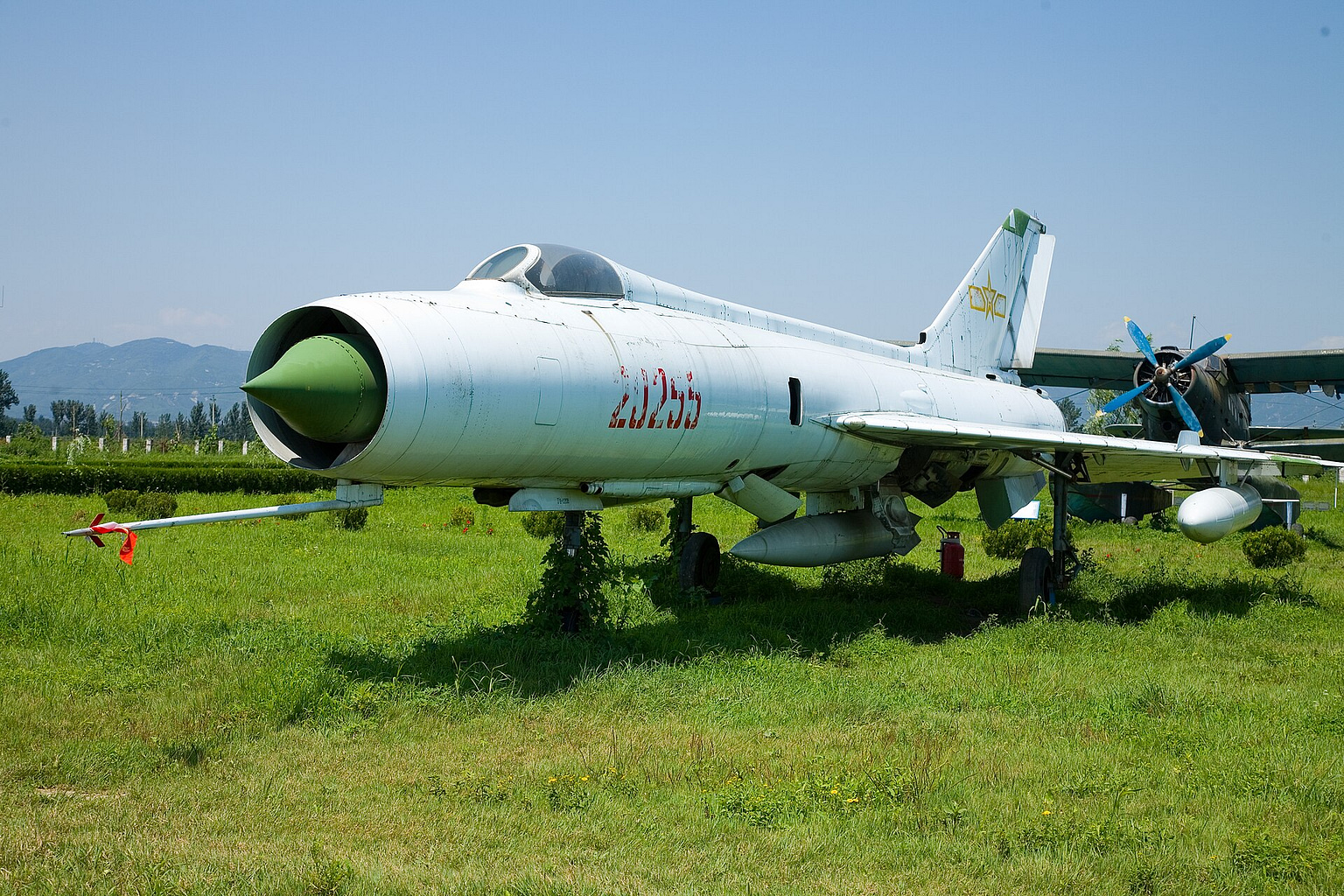
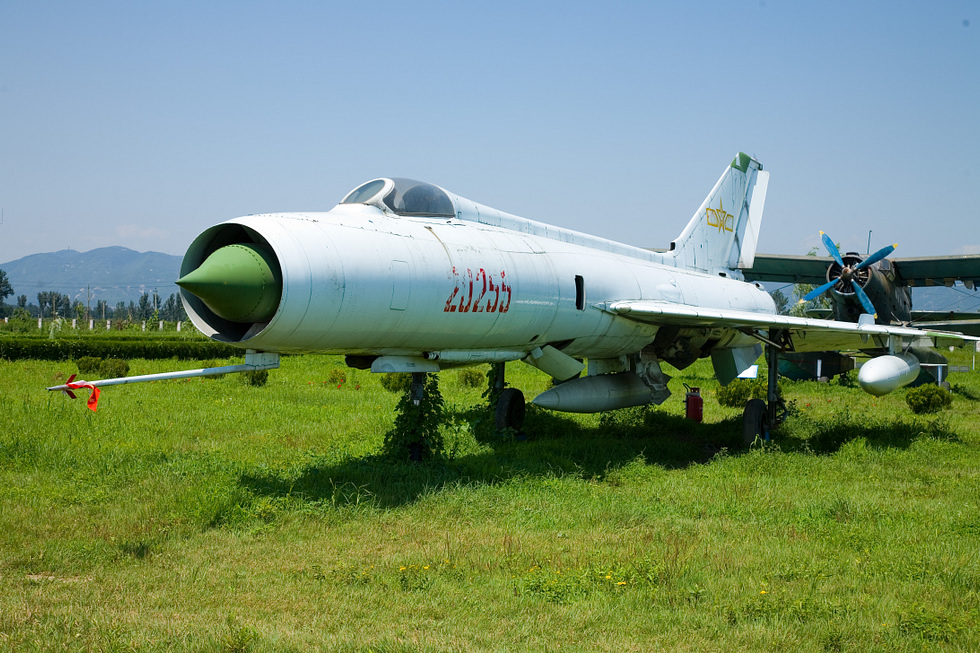
By the mid-1960s the young Chinese aircraft industry had learned to build the Soviet MiG-21 — the licence-and-reverse-engineered Chengdu J-7 — but it wanted something the little delta could not offer: the speed, ceiling and endurance to catch high-flying reconnaissance aircraft and bombers over a vast country. The answer, launched at Shenyang around 1964, was the J-8: in essence a scaled-up, twin-engine J-7. It kept the MiG-21 family’s tailed-delta layout and its nose air intake with an adjustable centre-body, but stretched the fuselage to swallow two engines and more fuel.
Progress was painfully slow. The prototype flew on a date commonly cited as 5 July 1969, but the Cultural Revolution had gutted China’s design institutes, and the aircraft did not reach operational units until around 1980–1981. Only a small number of the original nose-intake J-8 were built; its biggest limitation was hiding in plain sight. The nose intake left room for only a small ranging radar, so the aircraft was a clear-weather point interceptor armed with cannon and short-range heat-seeking missiles.
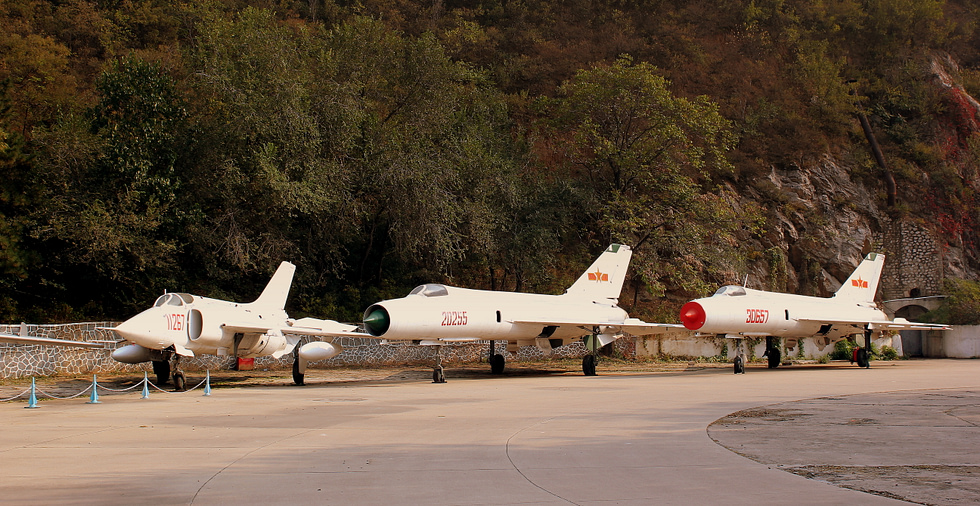
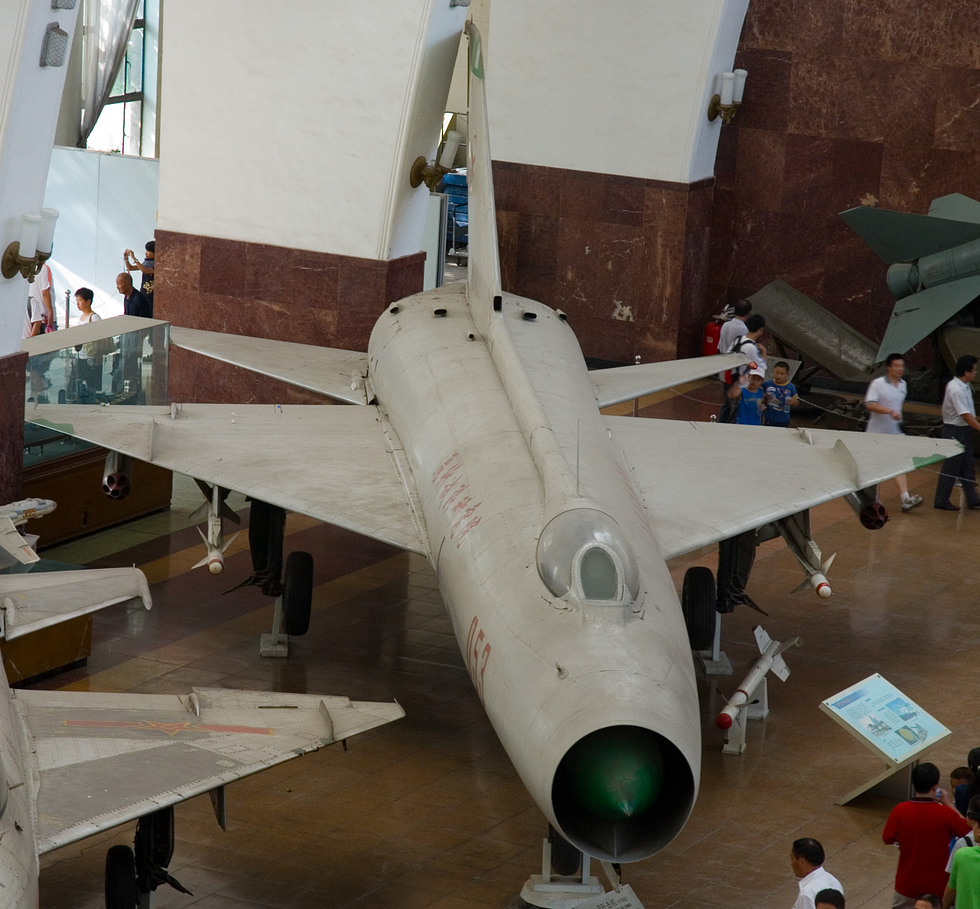
The fix reshaped the aircraft. From 1979 engineers proposed moving the engine intakes to the fuselage sides, freeing the entire nose for a solid radome and a far larger radar. The reworked machine — the J-8II, NATO reporting name “Finback” — first flew on 12 June 1984 and shared more than seventy per cent new structure with its predecessor. Where the original J-8 looked like an oversized MiG-21, the J-8II resembled an F-4 Phantom or MiG-23, with twin lateral intakes and a pointed radar nose. It became the definitive form of the type.
For all the airframe work, the J-8’s long struggle was with what sat behind the radome. Fielding a capable interception radar and beyond-visual-range missiles proved genuinely hard for the Chinese industry of the day. In the late 1980s the United States even agreed to help, under a programme nicknamed “Peace Pearl,” in which Grumman would fit the J-8II with F-16-generation avionics — a collaboration frozen after 1989 and formally cancelled in 1990. Only with later variants such as the J-8F, around 2003–04, did the type finally gain a modern pulse-Doppler radar and active-radar missiles.
To much of the world, though, the J-8 is remembered for a single morning. On 1 April 2001 a Chinese Navy J-8II collided with a United States Navy EP-3E surveillance aircraft off Hainan Island in the South China Sea. The two governments told very different stories of how the collision happened; the Chinese pilot, Wang Wei, was lost, and the crippled EP-3 landed on Hainan, its crew held for eleven days. That incident, examined soberly further down this page, is how many people first heard the aircraft’s name.
By the 2000s the J-8 was being overtaken by the J-10 and the Flanker-derived J-11, which offered the all-aspect, beyond-visual-range capability the early J-8s lacked. The interceptor role faded, but some reconnaissance J-8 variants reportedly lingered in limited service into the 2020s — and the programme itself taught China’s industry how to design, build and refine a modern twin-engine fighter.
01The Shenyang J-8’s origins: from the MiG-21 and J-7 to a twin-engine interceptor
The J-8 did not begin with a blank sheet. China had spent the early 1960s absorbing the Soviet ميغ-21, which it built as the Chengdu J-7. That aircraft was fast and nimble but short-legged, lightly armed and limited by a single engine and a small nose-intake radar. To reach higher and faster, Shenyang’s engineers took the familiar delta-and-tail layout and enlarged it around two engines and more fuel.
The result was recognisably part of the Soviet fighter family it descended from: the original J-8 kept the MiG-21-style nose intake with its shock-cone centre-body and looked like an oversized J-7. That pragmatic path suited an industry still learning, but it also capped the aircraft’s potential — and set up the far more ambitious redesign that produced the side-intake J-8II a decade and a half later.
What makes the J-8 special
Two engines instead of one
The defining choice was to twin the powerplant. The original J-8 used two Liyang WP-7B turbojets; the J-8II moved to uprated WP-13-series engines (roughly 65–69 kN each in afterburner), with the WP-13BII on the late J-8F. Two engines gave the thrust and ceiling the interception mission demanded — and the redundancy a single-engine J-7 could never offer over open water.
Nose intake to lateral intakes
The single most consequential change in the type’s history was moving the air intakes from the nose to the fuselage sides on the J-8II. That freed the entire nose for a solid radome and a much larger radar, transforming a clear-weather point interceptor into an aircraft with genuine all-weather ambitions — and giving the “Finback” its F-4-like look.
Built to fly high and fast
The J-8 family was optimised as a fast-climbing, high-ceiling interceptor — the same niche as the MiG-25, on a smaller airframe. Top speed is commonly cited at about Mach 2.2 with a service ceiling around 18,000–20,000 m. Its job was to climb quickly, run down a high-flying intruder and destroy it with missiles, not to dogfight.
02The J-8’s radar problem: China’s long struggle for a fighter radar
Even after the J-8II gave China room for a proper radar, fielding a capable set proved painfully hard. The original nose-intake J-8 had only a short-range ranging radar reportedly good to barely ten kilometres. The J-8I added a Type 204 monopulse fire-control radar, and early J-8Bs still lacked any beyond-visual-range capability, with detection ranges around forty kilometres.
Progress crawled through successive radars — Type 208A, then the KLJ-1 pulse-Doppler with look-down/shoot-down capability on the J-8H — before the J-8F’s Type 1492 radar finally enabled the active-radar PL-12 missile around 2004. That radar saga, more than any airframe issue, kept the J-8 a step behind its Western and Soviet contemporaries and shaped its entire upgrade history.
03Peace Pearl: when the United States helped upgrade a Chinese fighter
At the height of the 1980s anti-Soviet alignment between Washington and Beijing, the United States agreed to modernise the J-8II’s avionics under a programme nicknamed “Peace Pearl.” In 1987 the U.S. Air Force contracted Grumman to fit roughly 50–55 J-8IIs with the Westinghouse AN/APG-66 radar — the same family as early F-16s — plus U.S. inertial navigation, a head-up display, multifunction cockpit displays and ejection seats, in a deal reportedly worth around 500 million dollars.
Two J-8II airframes were flown to Grumman’s Bethpage, New York plant for integration. Then the June 1989 Tiananmen Square crackdown brought U.S. arms cooperation to a halt; the programme was formally cancelled in 1990, cost overruns adding to its collapse, and the airframes were returned to China, which completed its J-8IIs domestically without the American avionics.
Full J-8II specifications
Airframe & Performance
- طاقم
- 1 (two-seat trainers exist)
- طول
- ~21.4–21.6 m
- طول الجناحين
- ~9.3 m
- ارتفاع
- ~5.4 m
- Max takeoff weight
- ~17,800 kg (up to ~18,900 kg cited)
- Max speed
- ~Mach 2.2 · commonly cited
- سقف الخدمة
- ~18,000–20,000 m
- نطاق القتال
- ~800 km (~1,200 km with refuelling)
- Ferry range
- ~2,000–2,200 km
- معدل الصعود
- ~200 m/s
Propulsion & Systems
- Engines
- 2 × Liyang WP-13-series
- Thrust (each)
- ~65–69 kN with afterburner
- Radar
- Type 204 to Type 1492 across variants
- Cannon
- 1 × 23 mm Type 23-3 twin-barrel
- Missiles
- PL-2 / PL-5 / PL-8, later PL-11 & PL-12
- First flight
- 1969 (J-8) · 12 Jun 1984 (J-8II)
- Introduced
- ~1980 (J-8) · late 1980s (J-8II)
- Operators
- China only (PLAAF & PLAN)
- Unit cost
- No reliable public figure
- Cost per flight hour
- No reliable public figure
04The J-8’s operating costs: why no reliable price exists
The J-8 was a Chinese state product, built for the PLA and never sold on any open market — an export variant, the F-8IIM, found no buyers. As a result there is no meaningful flyaway unit price و no credible cost-per-flight-hour figure for the type in the public record; a state-run industry did not price military aircraft the way Western procurement did. One reference point survives from the abortive Peace Pearl upgrade, whose avionics package was reportedly costed at roughly 10 million dollars per aircraft in late-1980s money — but that covered the American electronics, not the airframe. Any precise dollar figure attached to a J-8 online is, in practice, an estimate.
From drawing board to limited service
Programme launched
Shenyang begins the J-8 as China’s first indigenously designed fighter — a twin-engine enlargement of the MiG-21/J-7 for the high-altitude interception role.
First flight
The original nose-intake J-8 flies on a date commonly cited as 5 July; development then drags through the disruption of the Cultural Revolution.
Enters service
The original J-8 finally reaches PLA units in small numbers, a clear-weather point interceptor with only a short-range ranging radar.
The redesigned J-8II
The side-intake J-8II “Finback” flies on 12 June, its solid nose freed for a much larger radar — more than seventy per cent new structure.
Peace Pearl
The United States contracts Grumman to fit the J-8II with F-16-generation avionics; the programme is frozen after 1989 and formally cancelled in 1990.
Hainan Island incident
On 1 April a Chinese Navy J-8II collides with a U.S. Navy EP-3E off Hainan; pilot Wang Wei is lost and the EP-3 lands on the island with its 24 crew.
The mature J-8F
The J-8F brings a Type 1492 pulse-Doppler radar and the active-radar PL-12 missile — the beyond-visual-range capability the early J-8s had lacked.
Superseded, then reconnaissance
The J-10 and J-11 take over frontline duties; some reconnaissance J-8 variants reportedly linger in limited service into the 2020s.
Twelve J-8 stories
The MiG-21’s big brother
China’s first home-designed fighter was really a J-7 stretched to swallow a second engine.
Read the full story
A fighter held hostage by its era
The J-8 took some fifteen years from drawing board to squadron because of the Cultural Revolution.
Read the full story
The nose that held it back
The first J-8’s biggest limitation was hiding in plain sight — its air intake.
Read the full story
Moving the nose to make room for radar
To give the J-8 a real radar, engineers moved its air intakes to the sides.
Read the full story
Two hearts for the high hunt
What separated the J-8 from the J-7 was simple: one more engine.
Read the full story
China’s long struggle for a fighter radar
For two decades the J-8’s Achilles’ heel was the box behind its radome.
Read the full story
When America armed a Chinese fighter
In the 1980s, Grumman was quietly modernising a Chinese jet with F-16 radar.
Read the full story
Collision over the South China Sea
A routine intercept ended in a fatal mid-air and an eleven-day standoff.
Read the full story
The pilot who never came home
The J-8’s most famous pilot vanished into the South China Sea at 33.
Read the full story
Giving the interceptor longer legs
A single probe on the nose turned a short-ranged interceptor into a longer-reach one.
Read the full story
The spy version that outlasted the fighter
Stripped of guns and packed with cameras, recon J-8s may be the last still flying.
Read the full story
The stepping stone to China’s aerospace rise
The J-8’s real value may be everything China learned building it.
Read the full story
The J-8 in pictures
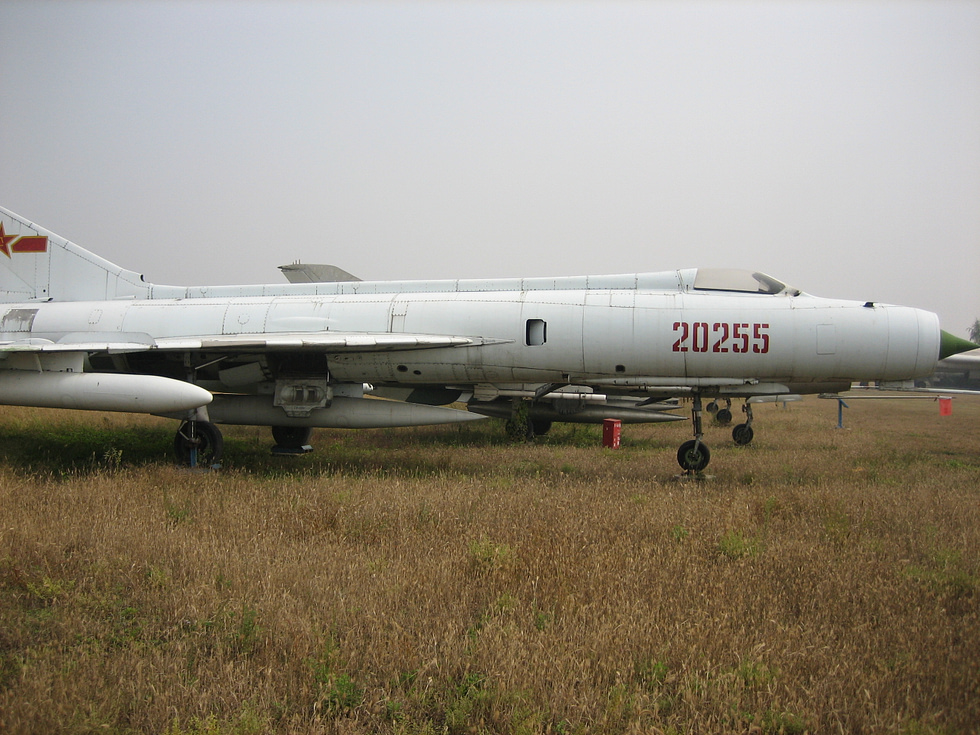
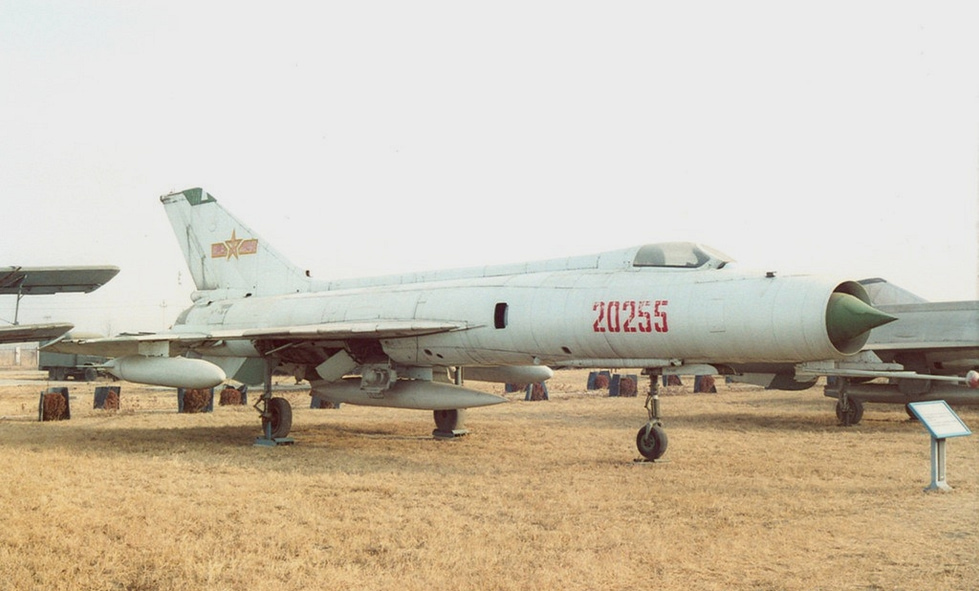

Where the J-8 flew
An interceptor that rarely fired in anger
The J-8 has no confirmed record of air-to-air victories in combat. For four decades its service has been one of vigilance — patrols, scrambles and interceptions along China’s coasts and borders that ended without a shot. The exception the world remembers is not a victory in any ordinary sense: the fatal mid-air collision with a U.S. Navy EP-3E off Hainan Island on 1 April 2001, in which the J-8II’s pilot, Wang Wei, was lost. That incident, described factually in the stories and Q&A on this page, is how many first heard the aircraft’s name.
See the wider combat record of every military aircraft. The 2001 Hainan Island incident is presented neutrally, from both the U.S. and Chinese accounts, elsewhere on this page.
Everything people ask about the J-8
Can I fly in a J-8?
How fast is the J-8?
What is the difference between the J-8 and the J-8II?
What happened in the 2001 Hainan Island incident?
Is the J-8 still in service?
What weapons does the J-8 carry?
You can’t fly the J-8.
These, you can.
Some legends only live in museums — others are fuelled and waiting. MiGFlug has put civilians in real military jet cockpits since 2004.
 Fly the L-39 AlbatrosThe world’s most-flown jet trainer — aerobatics included
 Fly the F-104 Starfighter“The missile with a man in it”
 Fly the MiG-21The Cold War’s most-produced jet
 حلّق بطائرة تي-33 شوتينغ ستارAmerica’s first jet trainer
 Fly the DH VampireA piece of early jet history
 Fly the S.211Agile Italian jet trainer
 Fly the MB-326The classic Aermacchi jet
 Fly the MiG-15The Soviet legend of the Korean War
Continue the tour
Every fact, checked
- GlobalSecurity.org — Shenyang J-8IIDevelopment history, the intake redesign, radar and armament, and programme dates.
- The War Zone — When Grumman helped modernise a Chinese fighterDetailed account of the Peace Pearl programme, the APG-66 radar and its cancellation.
- The Aviation Geek Club — The Hainan incidentNarrative of the 1 April 2001 collision, the EP-3E and pilot Wang Wei.
- U.S. Naval History & Heritage Command — EP-3 collisionThe U.S. institutional record of the Hainan incident, detainment and homecoming.
- MilitaryFactory — Shenyang J-8Specifications, dimensions, weights and a variant-by-variant list.
- The National Interest — F-16 “DNA” and the J-8IIThe Peace Pearl programme’s origins, costs and termination after 1989.
- AeroCorner — Shenyang J-8Reference figures for dimensions, engines, performance and armament.
- MiGFlug Afterburner — MagazineMiGFlug’s own long-form aviation history and analysis.