
Shenyang J-8
“Finback”
China’s first home-designed fighter — a twin-engine, high-altitude interceptor grown from the MiG-21 that ran from a nose-intake original to the side-intake J-8II, and whose name is tied to the 2001 Hainan Island collision.
The Shenyang J-8: China’s first home-grown interceptor
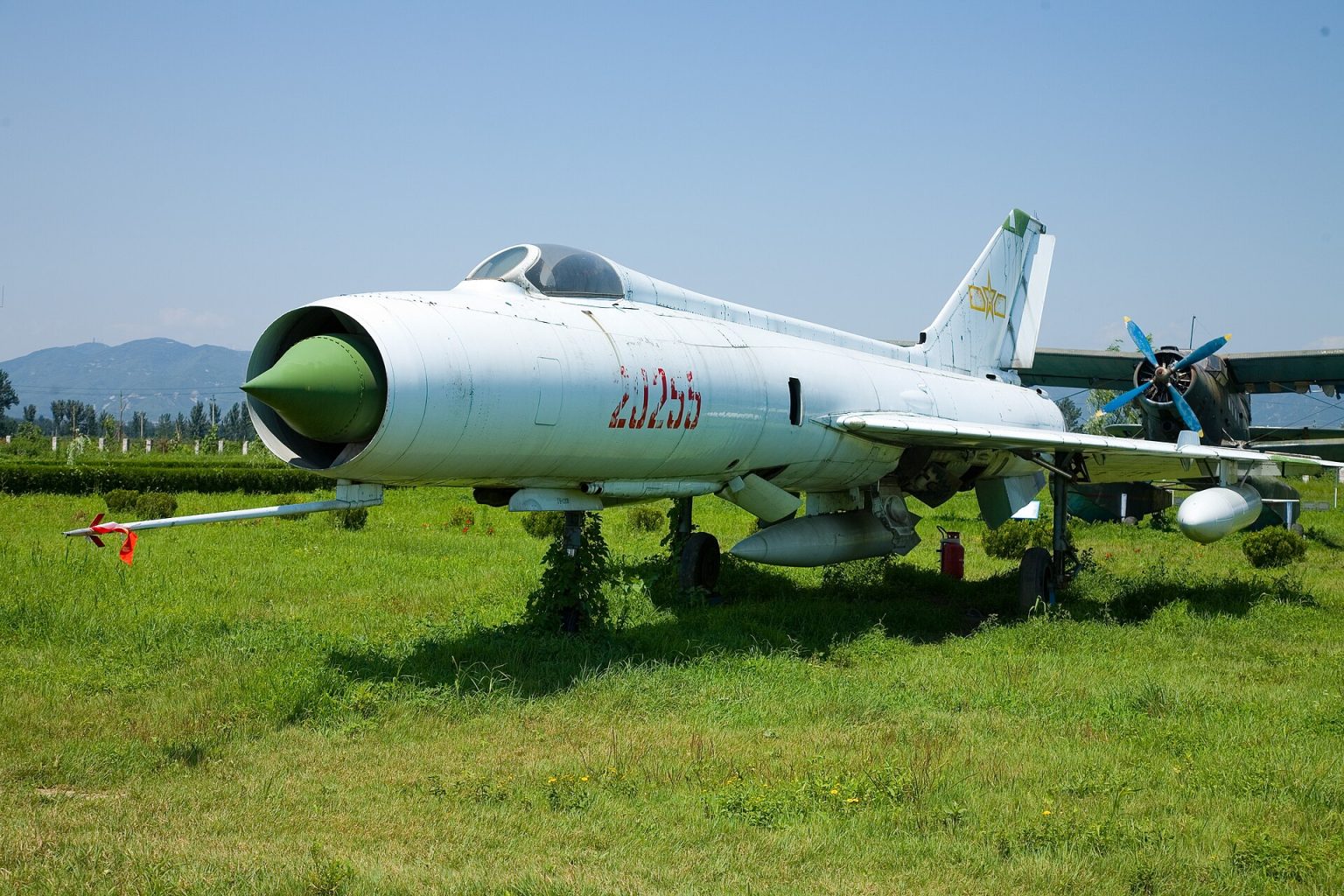
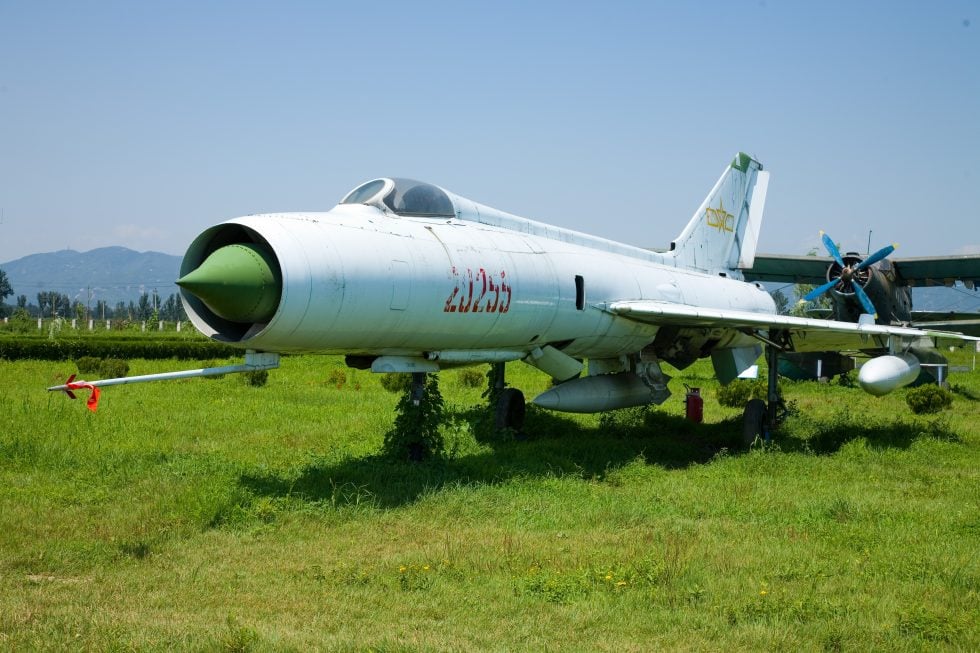
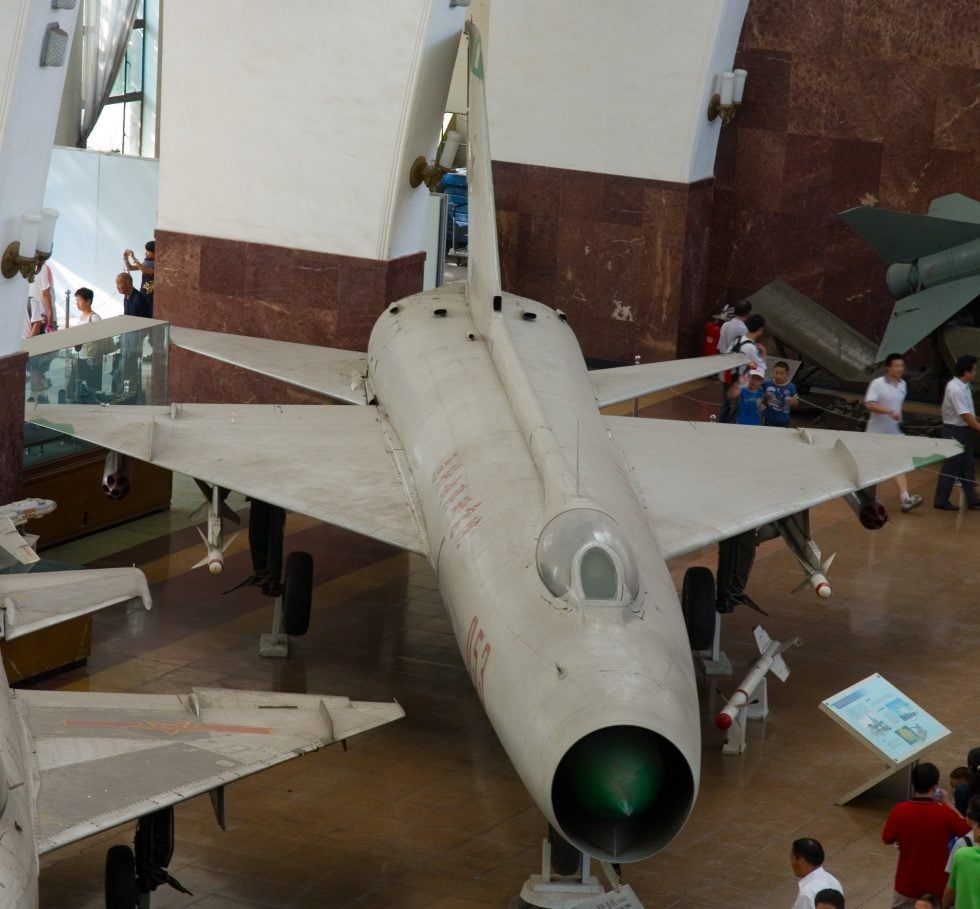
By the mid-1960s the young Chinese aircraft industry had learned to build the Soviet MiG-21 — the licence-and-reverse-engineered Chengdu J-7 — but it wanted something the little delta could not offer: the speed, ceiling and endurance to catch high-flying reconnaissance aircraft and bombers over a vast country. The answer, launched at Shenyang around 1964, was the J-8: in essence a scaled-up, twin-engine J-7. It kept the MiG-21 family’s tailed-delta layout and its nose air intake with an adjustable centre-body, but stretched the fuselage to swallow two engines and more fuel.
Progress was painfully slow. The prototype flew on a date commonly cited as 5 July 1969, but the Cultural Revolution had gutted China’s design institutes, and the aircraft did not reach operational units until around 1980–1981. Only a small number of the original nose-intake J-8 were built; its biggest limitation was hiding in plain sight. The nose intake left room for only a small ranging radar, so the aircraft was a clear-weather point interceptor armed with cannon and short-range heat-seeking missiles.
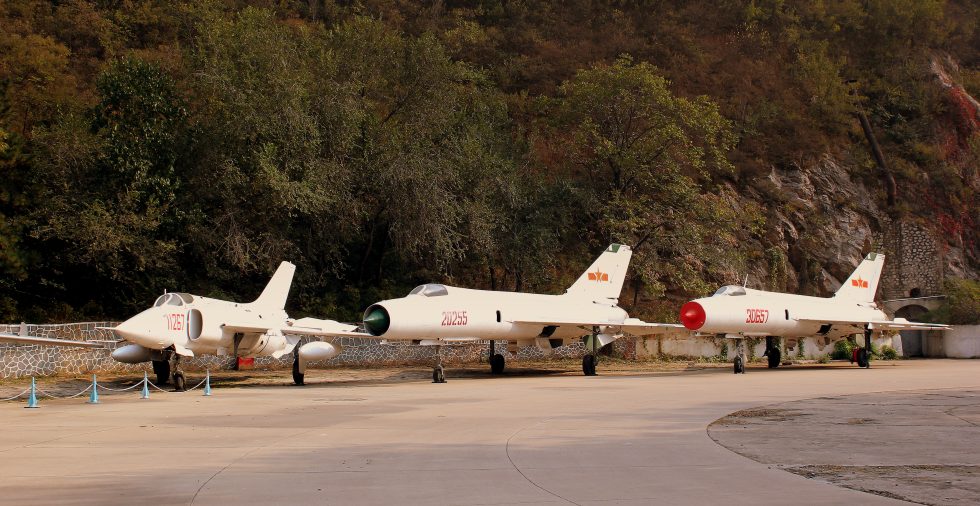
The fix reshaped the aircraft. From 1979 engineers proposed moving the engine intakes to the fuselage sides, freeing the entire nose for a solid radome and a far larger radar. The reworked machine — the J-8II, NATO reporting name “Finback” — first flew on 12 June 1984 and shared more than seventy per cent new structure with its predecessor. Where the original J-8 looked like an oversized MiG-21, the J-8II resembled an F-4 Phantom or MiG-23, with twin lateral intakes and a pointed radar nose. It became the definitive form of the type.
For all the airframe work, the J-8’s long struggle was with what sat behind the radome. Fielding a capable interception radar and beyond-visual-range missiles proved genuinely hard for the Chinese industry of the day. In the late 1980s the United States even agreed to help, under a programme nicknamed “Peace Pearl,” in which Grumman would fit the J-8II with F-16-generation avionics — a collaboration frozen after 1989 and formally cancelled in 1990. Only with later variants such as the J-8F, around 2003–04, did the type finally gain a modern pulse-Doppler radar and active-radar missiles.
To much of the world, though, the J-8 is remembered for a single morning. On 1 April 2001 a Chinese Navy J-8II collided with a United States Navy EP-3E surveillance aircraft off Hainan Island in the South China Sea. The two governments told very different stories of how the collision happened; the Chinese pilot, Wang Wei, was lost, and the crippled EP-3 landed on Hainan, its crew held for eleven days. That incident, examined soberly further down this page, is how many people first heard the aircraft’s name.
By the 2000s the J-8 was being overtaken by the J-10 and the Flanker-derived J-11, which offered the all-aspect, beyond-visual-range capability the early J-8s lacked. The interceptor role faded, but some reconnaissance J-8 variants reportedly lingered in limited service into the 2020s — and the programme itself taught China’s industry how to design, build and refine a modern twin-engine fighter.
01The Shenyang J-8’s origins: from the MiG-21 and J-7 to a twin-engine interceptor
The J-8 did not begin with a blank sheet. China had spent the early 1960s absorbing the Soviet MiG-21, which it built as the Chengdu J-7. That aircraft was fast and nimble but short-legged, lightly armed and limited by a single engine and a small nose-intake radar. To reach higher and faster, Shenyang’s engineers took the familiar delta-and-tail layout and enlarged it around two engines and more fuel.
The result was recognisably part of the Soviet fighter family it descended from: the original J-8 kept the MiG-21-style nose intake with its shock-cone centre-body and looked like an oversized J-7. That pragmatic path suited an industry still learning, but it also capped the aircraft’s potential — and set up the far more ambitious redesign that produced the side-intake J-8II a decade and a half later.
What makes the J-8 special
Two engines instead of one
The defining choice was to twin the powerplant. The original J-8 used two Liyang WP-7B turbojets; the J-8II moved to uprated WP-13-series engines (roughly 65–69 kN each in afterburner), with the WP-13BII on the late J-8F. Two engines gave the thrust and ceiling the interception mission demanded — and the redundancy a single-engine J-7 could never offer over open water.
Nose intake to lateral intakes
The single most consequential change in the type’s history was moving the air intakes from the nose to the fuselage sides on the J-8II. That freed the entire nose for a solid radome and a much larger radar, transforming a clear-weather point interceptor into an aircraft with genuine all-weather ambitions — and giving the “Finback” its F-4-like look.
Built to fly high and fast
The J-8 family was optimised as a fast-climbing, high-ceiling interceptor — the same niche as the MiG-25, on a smaller airframe. Top speed is commonly cited at about Mach 2.2 with a service ceiling around 18,000–20,000 m. Its job was to climb quickly, run down a high-flying intruder and destroy it with missiles, not to dogfight.
02The J-8’s radar problem: China’s long struggle for a fighter radar
Even after the J-8II gave China room for a proper radar, fielding a capable set proved painfully hard. The original nose-intake J-8 had only a short-range ranging radar reportedly good to barely ten kilometres. The J-8I added a Type 204 monopulse fire-control radar, and early J-8Bs still lacked any beyond-visual-range capability, with detection ranges around forty kilometres.
Progress crawled through successive radars — Type 208A, then the KLJ-1 pulse-Doppler with look-down/shoot-down capability on the J-8H — before the J-8F’s Type 1492 radar finally enabled the active-radar PL-12 missile around 2004. That radar saga, more than any airframe issue, kept the J-8 a step behind its Western and Soviet contemporaries and shaped its entire upgrade history.
03Peace Pearl: when the United States helped upgrade a Chinese fighter
At the height of the 1980s anti-Soviet alignment between Washington and Beijing, the United States agreed to modernise the J-8II’s avionics under a programme nicknamed “Peace Pearl.” In 1987 the U.S. Air Force contracted Grumman to fit roughly 50–55 J-8IIs with the Westinghouse AN/APG-66 radar — the same family as early F-16s — plus U.S. inertial navigation, a head-up display, multifunction cockpit displays and ejection seats, in a deal reportedly worth around 500 million dollars.
Two J-8II airframes were flown to Grumman’s Bethpage, New York plant for integration. Then the June 1989 Tiananmen Square crackdown brought U.S. arms cooperation to a halt; the programme was formally cancelled in 1990, cost overruns adding to its collapse, and the airframes were returned to China, which completed its J-8IIs domestically without the American avionics.
Full J-8II specifications
Baseline note: the figures below describe the J-8II family in its mature form — the J-8F of the 2000s, with the solid radar nose, the lateral intakes and two WP-13B turbojets. Deltas for the original nose-intake J-8 and J-8I, and for the J-8D, the J-8H and the JZ-8 reconnaissance conversions, are given in grey. Four warnings before the numbers. First, the designations are a trap. The nose-intake all-weather aircraft was the J-8I and was later redesignated J-8A; the side-intake aircraft was the J-8II and is usually called the J-8B in service; Roman numerals mark the factory sequence and Latin letters the service sequence, and a great many published tables mix the two systems inside a single row. Second, and more importantly, J-8I and J-8II are not two marks of one aeroplane. Around seventy per cent of the airframe structure and systems were reworked between them, the nose is a different concept, the gun is a different gun and the mission is a different mission. Treating them as one type is the single commonest error made about this aircraft. Third, China has never published a flight manual for the J-8 in any language. The performance tables in circulation descend from a small number of export brochures for the F-8IIM — an aeroplane that was offered but never sold — and from Jane’s entries that copy one another, which is why a Mach 2.4 claim and a service ceiling of 11,000 m sit side by side in the same table without anyone noticing the contradiction. Fourth, the engines. Every mark before the J-8II flew on the WP-7 family of about 43 kN in reheat; the J-8B flew on the WP-13A II at roughly 66 kN; the 68.6 kN quoted here belongs to the WP-13B of the J-8F. Using the last figure with the first aeroplane’s weights, which several online tables do, inflates the thrust-to-weight ratio by more than half.
Dimensions & weights
- Crew
- 1 — one pilot, in a fighter designed to fly high-altitude radar intercepts at night in weather. The Soviet answer to that problem was a second crewman in the Tu-128 and the Yak-28P; the Chinese answer was to leave the pilot alone with a radar scope, a compass and a ground controller talking to him on an open channel. Only the J-8II’s never-built trainer derivative would have had a second seat
- Length
- 21.39 m (70 ft 2 in) over the nose probe, 20.53 m (67 ft 4 in) without it. The J-7 it descends from is 14.9 m; more than six metres of extra fuselage went in to carry two engines, the fuel to feed them and, eventually, a radar dish
- Wingspan
- 9.344 m (30 ft 8 in). Almost identical to the J-7 — the wing was scaled up rather than redrawn, which is the whole design philosophy of the J-8 in one measurement
- Height
- 5.41 m (17 ft 9 in) to the top of the fin, against 5.06 m (16 ft 7 in) for the nose-intake J-8I. The taller fin came with the J-8II and the larger single ventral fin it had to balance
- Wing area
- 42.2 m² (454 sq ft), against 23.0 m² (247 sq ft) on the J-7. A 60° thin-section delta with two boundary-layer fences per side; the J-8C and J-8H went to four fences a side to tame the outer panel at high angles of attack
- Wing planform
- Tailed delta, mid-set, with conventional slab tailplane — not a true delta in the Mirage sense. Retaining a horizontal tail is why the J-8 turns and lands better than a Mirage III and why it never had the Mirage’s internal volume
- Empty weight
- 10,371 kg (22,864 lb). Roughly double the J-7’s 5,290 kg. Two engines, two intake ducts and a radar nose is an expensive way to gain one radar
- Normal take-off weight
- 15,288 kg (33,704 lb) — internal fuel, gun loaded, two missiles
- Maximum take-off weight
- 18,879 kg (41,621 lb) with three drop tanks and a full stores load. The nose-intake J-8I was a far lighter aircraft: about 9,820 kg empty and roughly 13,850 kg at normal take-off weight, with published maxima that disagree by several tonnes and should not be trusted
- Internal fuel
- ~4,900 kg (~10,800 lb, on the order of 6,100 litres) — a derived figure, not a published one. No credible Chinese or Western source gives an internal fuel capacity for the J-8II; the number here is what is left when empty weight, the pilot, the gun and two missiles are subtracted from normal take-off weight, and it should be read as an order of magnitude rather than a specification
- External stores
- Seven hardpoints — one centreline and six under the wing, of which the centreline and the two inboard wing stations normally carry drop tanks. Maximum external load is usually given as about 2,000 kg (4,410 lb) of ordnance, which for an aircraft of this size is modest and reflects an interceptor that was never expected to carry bombs
- Wing loading
- 362 kg/m² (74.2 lb/sq ft) at normal take-off weight, 447 kg/m² (91.6 lb/sq ft) at maximum. Low by the standards of its contemporaries, which is the one genuine dividend of scaling up a lightweight delta: the J-8 has more wing than it strictly needs and is pleasant to fly slowly
- Ventral fin
- One large folding fin under the rear fuselage on the J-8II, the shape copied from the MiG-23 and hinged to starboard so the aircraft can sit on its undercarriage. The nose-intake J-8 and J-8I had two small fixed fins instead, in the style of the J-7
Performance
- Maximum speed
- Mach 2.2 (about 2,340 km/h, 1,264 kn true) at 11,000 m. Export brochures for the F-8IIM claim Mach 2.4 and no independent source supports it; the honest position is that Mach 2.2 is the figure Chinese sources have used consistently since 1980
- Speed at sea level
- About 1,300 km/h (700 kn), roughly Mach 1.05 — a figure quoted rather than documented. The J-8 was never intended to work down low, and its whole reason for existing lives above 15,000 m
- Rate of climb
- 224 m/s (44,100 ft/min) at sea level. This is the number that justifies the aeroplane. Nothing else in Chinese service in 1980 climbed like it, and it is what a two-engine J-7 buys you
- Service ceiling
- 18,000 m (59,050 ft) for the J-8F. Earlier marks with the lighter WP-7 engines are usually credited with 20,000 m or a little more, and the original 1965 requirement was written around reaching a target at 20,000 m — the J-8II is heavier and its ceiling suffered for the radar it gained
- Combat range
- 1,000 km (540 nm) with three drop tanks. This is a genuinely poor figure for an aircraft of nearly nineteen tonnes, and it is the direct consequence of two thirsty 1950s-generation turbojets
- Combat radius with refuelling
- 900 km (486 nm) with one in-flight refuelling. Applies only from the J-8D onwards; before 1996 no Chinese fighter could be refuelled in the air at all
- Ferry range
- About 2,000 km (1,080 nm). The nose-intake J-8I is credited with the same order of range on much less fuel, which tells you how much the J-8II’s extra weight and drag cost
- Take-off run
- 630 m (2,070 ft) at normal weight. Short, and deliberately so — the People’s Liberation Army expected to disperse to secondary strips under attack
- Landing run
- 900 m (2,950 ft) with the braking parachute streamed. Without the chute it is a great deal longer, and the chute is a single-use item that has to be repacked between sorties
- Unstick speed
- 330 km/h (178 kn) — high, and a consequence of a delta wing with no leading-edge devices and no manoeuvre flaps
- Touchdown speed
- 224 km/h (121 kn). Comfortably faster than a Phantom crosses the ramp, on a narrow-track undercarriage
- Sustained turn
- +4.7 g at 5,000 m — the only load figure Chinese sources publish, and it is a sustained rather than a limit number. No structural design limit for the J-8II has been published in the open literature, which is itself revealing: this was never sold on its manoeuvring
Propulsion & systems
- Engines
- 2 × Guizhou WP-13B afterburning turbojets — the WP-13 being the Chinese development of the Tumansky R-13, itself the MiG-21bis engine. Two of them in a fighter of this size is the J-8’s founding idea and its permanent burden
- Dry thrust
- 47.1 kN each (10,590 lbf, 4,800 kgf); 94.2 kN (21,180 lbf) total
- Reheat thrust
- 68.6 kN each (15,420 lbf, 7,000 kgf); 137.2 kN (30,840 lbf) total. The J-8B entered service on the WP-13A II at about 65.9 kN each, and the original J-8 and J-8I flew on the WP-7A and WP-7B at roughly 43 kN
- Thrust-to-weight
- 0.74 at maximum take-off weight, about 0.91 at normal take-off weight. Respectable on paper; the turbojets give it away in fuel burn, where a contemporary turbofan of the same thrust would have used a third less
- The engine that never came
- WP-14 Kunlun — the first fully indigenous Chinese fighter engine, intended for the J-8C and not ready in time. Its absence killed the J-8C after the aircraft had already been certified in 1995, and forced the J-8F to be built around the older WP-13B instead. More Chinese aircraft programmes of this era were wrecked by engines than by airframes
- Intakes
- Rectangular lateral intakes with variable ramps on the J-8II, replacing the J-8I’s nose intake and translating shock cone. The change was made for one reason only: to free the nose for a radar dish
- Radar
- Type 1473 / JL-10A pulse-Doppler in the J-8F, with look-down capability and support for active-radar missiles. The J-8B began life with the Type 208 monopulse set, which had no look-down capability worth the name; the J-8D used the SL-8A; the J-8H is credited with the KLJ-1 / Type 1492. Western literature is inconsistent about which Chinese radar designation belongs to which mark and the mapping above should be treated as the best available reading rather than settled fact
- Fire control and databus
- Digital mission computer on a MIL-STD-1553B-type databus from the J-8F. The J-8B of 1988 had none of this, and the Grumman Peace Pearl programme of 1986–1990 was precisely an attempt to buy it — ring laser gyro inertial navigation, a head-up display, a mission computer and an AN/APG-66 derivative radar. When that collapsed, China spent the following fifteen years building the same capability itself
- In-flight refuelling
- Detachable probe on the starboard side of the nose from the J-8D of 1996 — the first Chinese fighter able to take fuel in the air, matched to H-6U tankers. This is what put naval J-8s over the middle of the South China Sea
- Self-protection
- Radar warning receiver, chaff and flare dispensers, and podded jamming — KG-300G and KG-600 class pods on later marks. The original J-8 had essentially nothing, and the first J-8IIs very little
- Ejection seat
- Chinese-developed rocket-assisted seat with a nominal zero-height, low-speed capability on later marks. Martin-Baker seats were part of the Peace Pearl package and never arrived. On 1 April 2001 a J-8II pilot ejected after a mid-air collision and was never recovered
04The J-8’s operating costs: why no reliable price exists
The J-8 was a Chinese state product, built for the PLA and never sold on any open market — an export variant, the F-8IIM, found no buyers. As a result there is no meaningful flyaway unit price and no credible cost-per-flight-hour figure for the type in the public record; a state-run industry did not price military aircraft the way Western procurement did. One reference point survives from the abortive Peace Pearl upgrade, whose avionics package was reportedly costed at roughly 10 million dollars per aircraft in late-1980s money — but that covered the American electronics, not the airframe. Any precise dollar figure attached to a J-8 online is, in practice, an estimate.
Armament & payload
The J-8II was built around a radar it would not have for fifteen years
The J-8II was built around a radar, and for the first decade of its service it did not have one worth the name. Everything about the aircraft’s armament follows from that. The gun is a single twin-barrel 23 mm Type 23-III in a ventral fairing, seven hardpoints hang under the aircraft, and until the late 1990s the only thing they could usefully carry was a pair of rear-aspect infra-red missiles descended, through two generations of copying, from the AIM-9B Sidewinder. An interceptor that can only shoot at what it can see, from behind, is not an interceptor at all — it is a fast day fighter with a very large nose.
What changed the aircraft was the arrival of radar-guided weapons at the very end of its development. The J-8H and late J-8F could carry the PL-11, a semi-active homer developed from the Italian Aspide, and then the PL-12 — an active-radar missile of genuinely modern conception, fire-and-forget, comparable in class to the AIM-120. Putting a PL-12 on a 1960s airframe with two 1950s-lineage turbojets is a strange and rather Chinese solution: the missile outclasses the aeroplane by three decades. It is also why perfectly obsolete J-8Fs remained worth flying into the 2020s, because a missile that does its own terminal guidance does not much care what launched it.
Air-to-ground was always an afterthought. The J-8 can carry five 500 kg or ten 250 kg unguided bombs and rocket pods, and did so on ranges rather than in anger; the only serious strike role the family ever acquired was defence suppression, with the YJ-91 anti-radiation missile derived from the Russian Kh-31P on the J-8H and the variant widely reported as the J-8G. There is no precision-guided bomb capability on any J-8 that entered service. Chinese stores clearances have never been published; several of the weapon associations below rest on export brochures for the F-8IIM, on photographs, and on Western analysts reading Chinese trade-fair models, and mark-by-mark fits differed in ways no open source can reconstruct.
Gun
- One Type 23-III twin-barrel 23 mm cannon, a Chinese-built Gryazev-Shipunov GSh-23L, in a fairing under the forward fuselage, with about 200 rounds
- This replaced the two 30 mm Type 30-1 cannon — Chinese Nudelman-Rikhter NR-30s — of the nose-intake J-8 and J-8I. The J-8II traded shell weight for rate of fire and for room in a fuselage that now had intake ducts running down both sides of it
- Two hundred rounds through a twin-barrel gun firing at around 3,400 rounds per minute is between three and four seconds of firing. That is one attack
- The ventral position keeps muzzle gas away from the intakes, which was a real problem on the prototype configuration and a recurring one on Chinese fighters of the period
- On the JZ-8F reconnaissance conversion the gun is deleted entirely and a camera installation occupies its bay
Air-to-air
- PL-2 and PL-2B — the Chinese K-13, itself a copy of the AIM-9B Sidewinder (NATO AA-2 Atoll). Rear-aspect only, and the standard fit on the original J-8 and J-8I
- PL-5 — a much-improved rear-aspect infra-red missile, and for years the workhorse of the J-8II
- PL-8 — the Israeli Python 3 built under licence, with real off-boresight capability and a helmet-linked seeker on some fits. This is the missile that made the J-8D and J-8F dangerous in a close fight
- PL-11 — semi-active radar homing, developed from the Italian Aspide, carried by the J-8H and late J-8F. China’s first usable beyond-visual-range weapon, and it requires the launching aircraft to keep illuminating the target
- PL-12 / SD-10 — active radar homing, fire-and-forget, in the class of the AIM-120 AMRAAM. Two R-27R1 (NATO AA-10 Alamo) were offered on the export F-8IIM and never bought
Air-to-surface guided
- YJ-91 — the Chinese development of the Russian Kh-31P (NATO AS-17 Krypton) anti-radiation missile, on the J-8H and on the dedicated defence-suppression variant widely reported as the J-8G. This is the one guided ground-attack weapon the family genuinely operated
- Kh-31A in its anti-ship form is quoted for the export F-8IIM, two rounds, alongside Russian avionics. No export customer ever bought the aircraft, so the fit was never proved in service
- No laser-guided bomb, no satellite-guided bomb and no electro-optical weapon was cleared on any J-8 in People’s Liberation Army service
- No targeting pod was ever fielded on the type, which is the underlying reason for the point above
- This card is thin because the aircraft is an interceptor. Chinese ground attack in this period belonged to the Q-5 and then to the JH-7, and the J-8 was never asked to compete for the work
Bombs
- Five 500 kg (1,100 lb) low-drag bombs, or ten of 250 kg (550 lb) — the Chinese 250-2, 250-3 and 500-3 families
- Carried on multiple ejector racks on the wing stations; the centreline is normally occupied by a drop tank
- All unguided, all delivered by dive or level release against a visually acquired target, with no computed release solution before the J-8F’s digital mission computer
- In practice the People’s Liberation Army Air Force flew the J-8 as a pure interceptor and this capability was exercised at weapons ranges rather than planned for
- There is no internal bay of any kind — every kilogram the J-8 carries is hung in the airflow, which is why its combat range collapses when it is loaded
Rockets
- Type 90-1 rocket pods in 57 mm and 90 mm calibres, up to four
- The 57 mm pod is the Chinese descendant of the Soviet UB-16 family and holds unguided folding-fin rockets in the classic pattern
- Useful against soft area targets and nothing else; no J-8 ever had a sight capable of making rocketry accurate at the speeds the aircraft prefers
- As with the bombs, rockets appear in the clearance list because the pylons exist rather than because the aircraft had a mission for them
- No large-calibre unguided rocket, of the sort Soviet interceptors carried for bomber-formation attack, was ever fitted
Pods & other stores
- Three drop tanks — one centreline, two inboard wing — which are the J-8’s single most important store. Without them the aircraft’s radius is not operationally interesting
- Detachable in-flight refuelling probe on the starboard side of the nose, from the J-8D. It is a store in the sense that it can be removed, and it costs drag when fitted
- KG-300G and KG-600 class electronic countermeasures pods on later marks, carried on a wing station
- Reconnaissance camera pod on the centreline for the JZ-8 conversion of the mid-1980s; the later JZ-8F carries its cameras internally in place of the gun
- Braking parachute in the tail cone — not a weapon, but the J-8 lands at 224 km/h on a narrow track and does not stop without it
Three typical loadouts
- Area air defence, J-8F
- Two PL-12 active-radar missiles on the outboard wing stations, two PL-8 infra-red missiles inboard of them, three drop tanks on the centreline and inner wing stations, 200 rounds for the gun. This is the only loadout in which a J-8 is a twenty-first-century combat aircraft, and it exists because of the missile rather than the aeroplane.
- South China Sea patrol and intercept, naval J-8D or J-8F
- Two PL-8, two PL-5 or PL-11, three drop tanks, refuelling probe fitted, gun loaded. This is the shape a Lingshui-based J-8II flew on 1 April 2001: an aircraft configured for endurance and shadowing rather than for fighting, tanks on, closing to visual range on a large slow propeller-driven aeroplane.
- Defence suppression, J-8H or reported J-8G
- Two YJ-91 anti-radiation missiles on the inner wing stations, two PL-8 for self-defence, one centreline tank, jamming pod. The only strike loadout the family ever operationally mattered in, and it was flown by a small number of aircraft against a specific problem — Taiwanese and allied air-defence radars.
Sourcing caveat: no Chinese weapons clearance document for the J-8 has been published. The lists above are assembled from export brochures for the F-8B and F-8IIM, from photographs of aircraft at Zhuhai and on the flight line, and from the standard Western reference literature, all of which disagree in detail. Ammunition counts, pod designations and the mark-by-mark availability of the PL-11 and PL-12 in particular should be read as the best available reconstruction rather than as fact.
Variants
The J-8I and the J-8II share a number and almost nothing else
The J-8 began as the cheapest possible answer to an expensive problem. In the early 1960s the People’s Liberation Army could not reach what was flying over it — American and Taiwanese reconnaissance aircraft operating high and fast, and, in prospect, high-altitude bombers. The J-7, China’s MiG-21, had neither the ceiling, the endurance nor a radar of any consequence. Rather than design a new fighter, Shenyang proposed to enlarge the one it already had and put two engines in it. Operational requirements were approved on 17 May 1965. The chief designer, Huang Zhiqian, was killed in an air crash that same month; Wang Nanshou took over, and Gu Songfen — who would go on to shape most of Chinese fighter design — became chief designer in 1978.
The first prototype flew on 5 July 1969 in the hands of Yin Yuhuan, and then the Cultural Revolution swallowed the programme. Between 1969 and 1979 the two prototypes accumulated 1,025 flights and 663 flying hours — roughly sixty-six hours a year, which is less than a single squadron aircraft flies in a quarter. The design was finalised on 31 December 1979 and the aircraft entered service on 2 March 1980, eleven years after its first flight and fifteen after its requirement, by which time the threat it had been drawn against had changed out of recognition. It suffered severe transonic buffet, its engines were unreliable, and it had a ranging radar in a shock cone rather than a fire-control set.
That last point is the hinge of the whole story. A nose intake with a small translating cone puts a hard physical ceiling on the diameter of the radar antenna you can install, and no amount of development will move it. To have a real radar you need a nose. So from 1982 Gu Songfen and He Wenzhi rebuilt the aeroplane: lateral intakes with variable ramps, a solid radome, a taller fin and a single folding ventral fin of MiG-23 pattern, a new gun, seven hardpoints, WP-13 engines. Around seventy per cent of the airframe structure and systems changed. The prototype was completed in March 1984 and flew on 12 June 1984. The J-8II shares a designation, a wing and a philosophy with the J-8I and very little else, and anyone who describes it as a J-8 variant has missed what happened.
The J-8II then spent fifteen years waiting for its electronics. The most famous attempt to shortcut that wait was Peace Pearl: a 1986 agreement, worth about US$502 million, under which Grumman would fit fifty to fifty-five J-8IIs with an AN/APG-66 derivative radar, a head-up display, a mission computer, inertial navigation, a digital databus and Martin-Baker ejection seats. Two aircraft were flown to the United States for prototyping. The work was still in progress when the Tiananmen killings of June 1989 ended American military cooperation with China as a political proposition; the programme was formally allowed to continue despite the arms embargo, and it was China that cancelled it in 1990, after projected costs rose by something between thirty-five and forty per cent. Both facts matter. Peace Pearl did not simply die of Tiananmen — it died of Tiananmen and of arithmetic, and China walked away.
China then bought Israeli radar technology for the J-8C, and lost that aircraft when its WP-14 Kunlun engine failed to arrive; the capability finally reached service in the J-8F of the 2000s, built by China alone. Along the way the airframe served as the country’s first fly-by-wire testbed: the J-8 ACT flew analogue and then digital control laws from the late 1980s and crashed on 23 April 1991, and the canard-equipped J-8 II ACT flew forty-nine sorties between 1996 and 1999. Whatever else the J-8 was, it was the aeroplane on which Chinese industry learned.
It is also the aircraft in the most consequential air incident between China and the United States since the Cold War. On 1 April 2001 a J-8II shadowing a US Navy EP-3E ARIES II signals intelligence aircraft about 110 km southeast of Hainan collided with it. The American account, supported by the crew and by video of earlier intercepts flown by the same pilot, is that the EP-3E was in straight and level flight on autopilot, that the J-8II made two very close passes and struck the aircraft on the third, and that the fighter’s tail went into the EP-3E’s number one propeller. The Chinese account, given by the wingman, is that the American aircraft turned into the fighter. China has never released the J-8’s flight recorder data, and no independent verification of either version exists. What is not in dispute: the J-8 broke up, its pilot Wang Wei ejected and was never found, the EP-3E lost its radome and fell some 2,400 m before Lieutenant Shane Osborn regained control, and he landed it without clearance at Lingshui with twenty-four crew aboard. They were held eleven days and released after the "letter of the two sorries" of 11 April, a document carefully drafted so that each government could tell its own public it had won. The aircraft came home in pieces in July aboard chartered An-124s. Wang Wei’s aircraft number, 81192, remains a nationalist emblem in China a quarter of a century later.
- J-8 (first flight 1969, service 1980, roughly 50 built)
- The original: nose intake with translating shock cone, two WP-7A turbojets, two 30 mm Type 30-1 cannon, a ranging radar and no all-weather capability whatever. A clear-day, ground-controlled interceptor delivered a decade late.
- J-8I, later redesignated J-8A; J-8E (1981–1987, about 100 built)
- The all-weather attempt within the nose-intake layout: SR-4 fire-control radar in an enlarged cone, a better ejection seat, PL-2B and later PL-5 missiles. The first prototype was destroyed in an engine run on 25 June 1980 and the second flew on 24 April 1981; production clearance came only in June 1985. The J-8E added improved countermeasures late in the line.
- J-8II, in service as the J-8B (first flight 12 June 1984, service 1988)
- The rebuild: lateral intakes, solid radome, WP-13A II engines, one 23 mm Type 23-III, seven hardpoints, single folding ventral fin. Roughly seventy per cent of the airframe was new. Its early Type 208 radar had no useful look-down capability, and the Block 02 aircraft of the mid 1990s substituted the KLJ-1 / Type 208A.
- J-8II Peace Pearl (1986–1990, two airframes)
- Grumman’s US$502 million retrofit of American avionics into fifty to fifty-five aircraft, of which two were flown to the United States. Cancelled by China in 1990 on cost after Tiananmen had already poisoned the politics. Nothing entered Chinese service, but the specification it defined became the target China spent the next fifteen years hitting alone.
- J-8C, factory J-8III (certified 1995, not produced)
- Israeli Elta radar technology adapted into what became the Type 1471, four wing fences a side, and the WP-14 Kunlun engine that never arrived. The prototypes flew on WP-13B as a stopgap and the programme was cancelled for want of its engine, after the aircraft itself had passed certification.
- J-8D, factory J-8IV (first flight 21 November 1990, service 1996)
- The first Chinese fighter with in-flight refuelling, using a detachable probe and H-6U tankers, with the SL-8A radar and PL-8 or PL-9 missiles. Overwhelmingly a naval aviation aircraft, and the mark that gave China persistent fighter presence over the South China Sea.
- J-8F (development from 1999, first flight 2000)
- The definitive version: Type 1473 / JL-10A pulse-Doppler radar with look-down capability, WP-13B engines, a digital databus, and clearance for the PL-12 active-radar missile. Existing J-8Ds brought to a comparable avionics standard are commonly designated J-8DF in Western reporting, a designation that does not appear in the principal reference sources and should be treated with caution.
- J-8H, and the reported J-8G (development from 1995, service 2002)
- Fighter and strike mark with the KLJ-1 / Type 1492 radar, four wing fences a side, PL-11 missiles and the YJ-91 anti-radiation missile. A dedicated defence-suppression derivative is widely reported as the J-8G; the designation is not confirmed in the primary literature.
- JZ-8 and JZ-8F, sometimes J-8R (from the mid 1980s; about 48 in service 2025)
- Reconnaissance conversions. The JZ-8 carried a camera pod on the centreline; the JZ-8F deletes the cannon and installs cameras internally. These are the J-8s with the clearest surviving job — a fast, high-flying airframe is still a useful camera platform long after it has stopped being a useful fighter.
- F-8B and F-8IIM (export offers, 1990s–2000s, no sales)
- Export designations. The F-8IIM of 1996 married the airframe to Russian avionics and weapons, including the Zhuk radar, R-27R1 and Kh-31, and was displayed hard at trade shows. No customer bought a single J-8 of any mark, which is unusual for a Chinese combat aircraft and says something about how the type was regarded abroad.
Closing note on numbers and fleet status. China is the only operator the J-8 has ever had: no export sale of any variant was concluded, and no foreign air arm has flown the type. Total production across all marks is usually put at somewhere between three and four hundred airframes, a figure no open source can verify. Current strength is declining and the published tallies disagree with each other. The International Institute for Strategic Studies in The Military Balance 2025 credits the People’s Liberation Army Air Force with 40 J-8F/H, explicitly annotated as being phased out, together with 48 JZ-8 and JZ-8F reconnaissance aircraft. Earlier editions, reflected in the standard reference tables still widely quoted, gave the air force 50 J-8F/H plus 24 JZ-8 and 24 JZ-8F, and gave the naval air arm a further 24 J-8F; naval J-8s no longer appear as a separate line in the 2025 listing, which most likely reflects retirement rather than reassignment but cannot be confirmed. On any reading fewer than a hundred fighter-configured J-8s remain, they are flown by one country, and the reconnaissance conversions will almost certainly outlive the fighters. Because a single-operator fleet makes a comparative bar chart meaningless, the numbers are given here rather than as a chart.
From drawing board to limited service
Programme launched
Shenyang begins the J-8 as China’s first indigenously designed fighter — a twin-engine enlargement of the MiG-21/J-7 for the high-altitude interception role.
First flight
The original nose-intake J-8 flies on a date commonly cited as 5 July; development then drags through the disruption of the Cultural Revolution.
Enters service
The original J-8 finally reaches PLA units in small numbers, a clear-weather point interceptor with only a short-range ranging radar.
The redesigned J-8II
The side-intake J-8II “Finback” flies on 12 June, its solid nose freed for a much larger radar — more than seventy per cent new structure.
Peace Pearl
The United States contracts Grumman to fit the J-8II with F-16-generation avionics; the programme is frozen after 1989 and formally cancelled in 1990.
Hainan Island incident
On 1 April a Chinese Navy J-8II collides with a U.S. Navy EP-3E off Hainan; pilot Wang Wei is lost and the EP-3 lands on the island with its 24 crew.
The mature J-8F
The J-8F brings a Type 1492 pulse-Doppler radar and the active-radar PL-12 missile — the beyond-visual-range capability the early J-8s had lacked.
Superseded, then reconnaissance
The J-10 and J-11 take over frontline duties; some reconnaissance J-8 variants reportedly linger in limited service into the 2020s.
Twelve J-8 stories
The MiG-21’s big brother
China’s first home-designed fighter was really a J-7 stretched to swallow a second engine.
Read the full story
A fighter held hostage by its era
The J-8 took some fifteen years from drawing board to squadron because of the Cultural Revolution.
Read the full story
The nose that held it back
The first J-8’s biggest limitation was hiding in plain sight — its air intake.
Read the full story
Moving the nose to make room for radar
To give the J-8 a real radar, engineers moved its air intakes to the sides.
Read the full story
Two hearts for the high hunt
What separated the J-8 from the J-7 was simple: one more engine.
Read the full story
China’s long struggle for a fighter radar
For two decades the J-8’s Achilles’ heel was the box behind its radome.
Read the full story
When America armed a Chinese fighter
In the 1980s, Grumman was quietly modernising a Chinese jet with F-16 radar.
Read the full story
Collision over the South China Sea
A routine intercept ended in a fatal mid-air and an eleven-day standoff.
Read the full story
The pilot who never came home
The J-8’s most famous pilot vanished into the South China Sea at 33.
Read the full story
Giving the interceptor longer legs
A single probe on the nose turned a short-ranged interceptor into a longer-reach one.
Read the full story
The spy version that outlasted the fighter
Stripped of guns and packed with cameras, recon J-8s may be the last still flying.
Read the full story
The stepping stone to China’s aerospace rise
The J-8’s real value may be everything China learned building it.
Read the full story
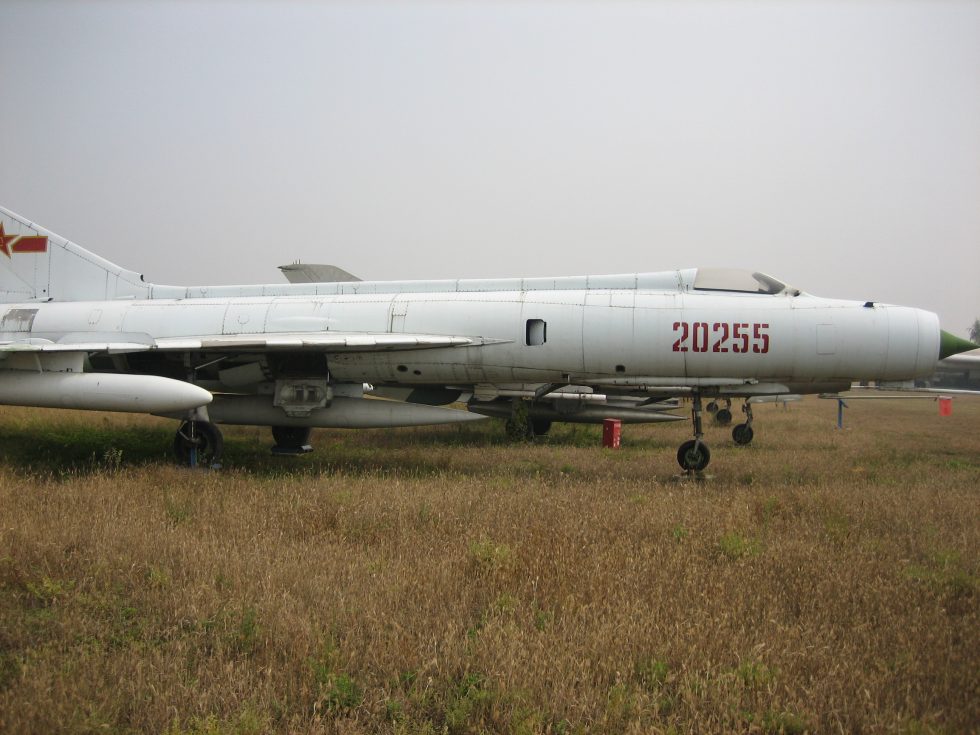
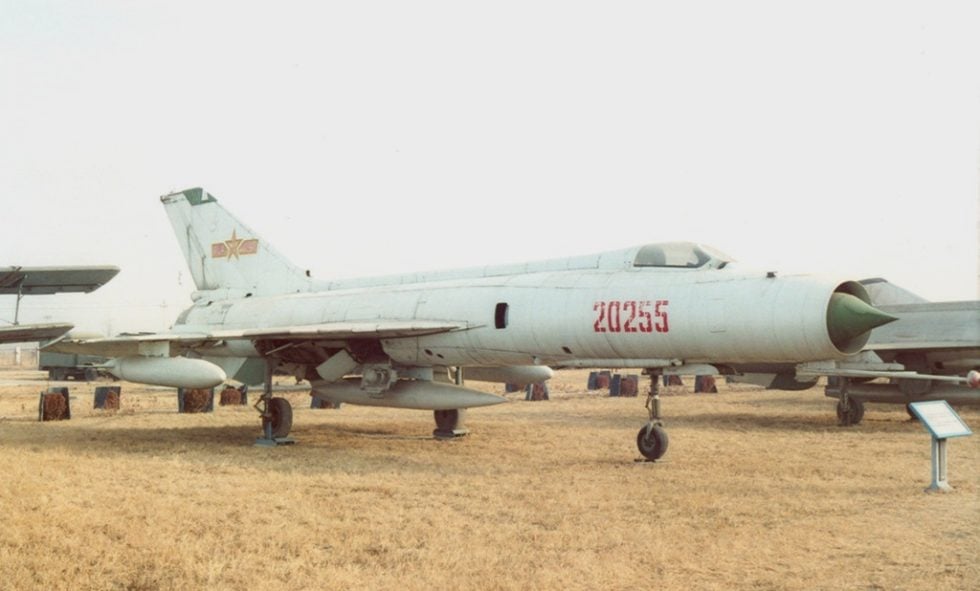
The J-8 in pictures
Where the J-8 flew
An interceptor that rarely fired in anger
The J-8 has no confirmed record of air-to-air victories in combat. For four decades its service has been one of vigilance — patrols, scrambles and interceptions along China’s coasts and borders that ended without a shot. The exception the world remembers is not a victory in any ordinary sense: the fatal mid-air collision with a U.S. Navy EP-3E off Hainan Island on 1 April 2001, in which the J-8II’s pilot, Wang Wei, was lost. That incident, described factually in the stories and Q&A on this page, is how many first heard the aircraft’s name.
See the wider combat record of every military aircraft. The 2001 Hainan Island incident is presented neutrally, from both the U.S. and Chinese accounts, elsewhere on this page.
Everything people ask about the J-8
Can I fly in a J-8?
How fast is the J-8?
What is the difference between the J-8 and the J-8II?
What happened in the 2001 Hainan Island incident?
Is the J-8 still in service?
What weapons does the J-8 carry?
You can’t fly the J-8.
These, you can.
Some legends only live in museums — others are fuelled and waiting. MiGFlug has put civilians in real military jet cockpits since 2004.
 Fly the L-39 AlbatrosThe world’s most-flown jet trainer — aerobatics included
 Fly the F-104 Starfighter“The missile with a man in it”
 Fly the MiG-21The Cold War’s most-produced jet
 Fly the T-33 Shooting StarAmerica’s first jet trainer
 Fly the DH VampireA piece of early jet history
 Fly the S.211Agile Italian jet trainer
 Fly the MB-326The classic Aermacchi jet
 Fly the MiG-15The Soviet legend of the Korean War
Continue the tour
Every fact, checked
- GlobalSecurity.org — Shenyang J-8IIDevelopment history, the intake redesign, radar and armament, and programme dates.
- The War Zone — When Grumman helped modernise a Chinese fighterDetailed account of the Peace Pearl programme, the APG-66 radar and its cancellation.
- The Aviation Geek Club — The Hainan incidentNarrative of the 1 April 2001 collision, the EP-3E and pilot Wang Wei.
- U.S. Naval History & Heritage Command — EP-3 collisionThe U.S. institutional record of the Hainan incident, detainment and homecoming.
- MilitaryFactory — Shenyang J-8Specifications, dimensions, weights and a variant-by-variant list.
- The National Interest — F-16 “DNA” and the J-8IIThe Peace Pearl programme’s origins, costs and termination after 1989.
- AeroCorner — Shenyang J-8Reference figures for dimensions, engines, performance and armament.
- MiGFlug Afterburner — MagazineMiGFlug’s own long-form aviation history and analysis.