
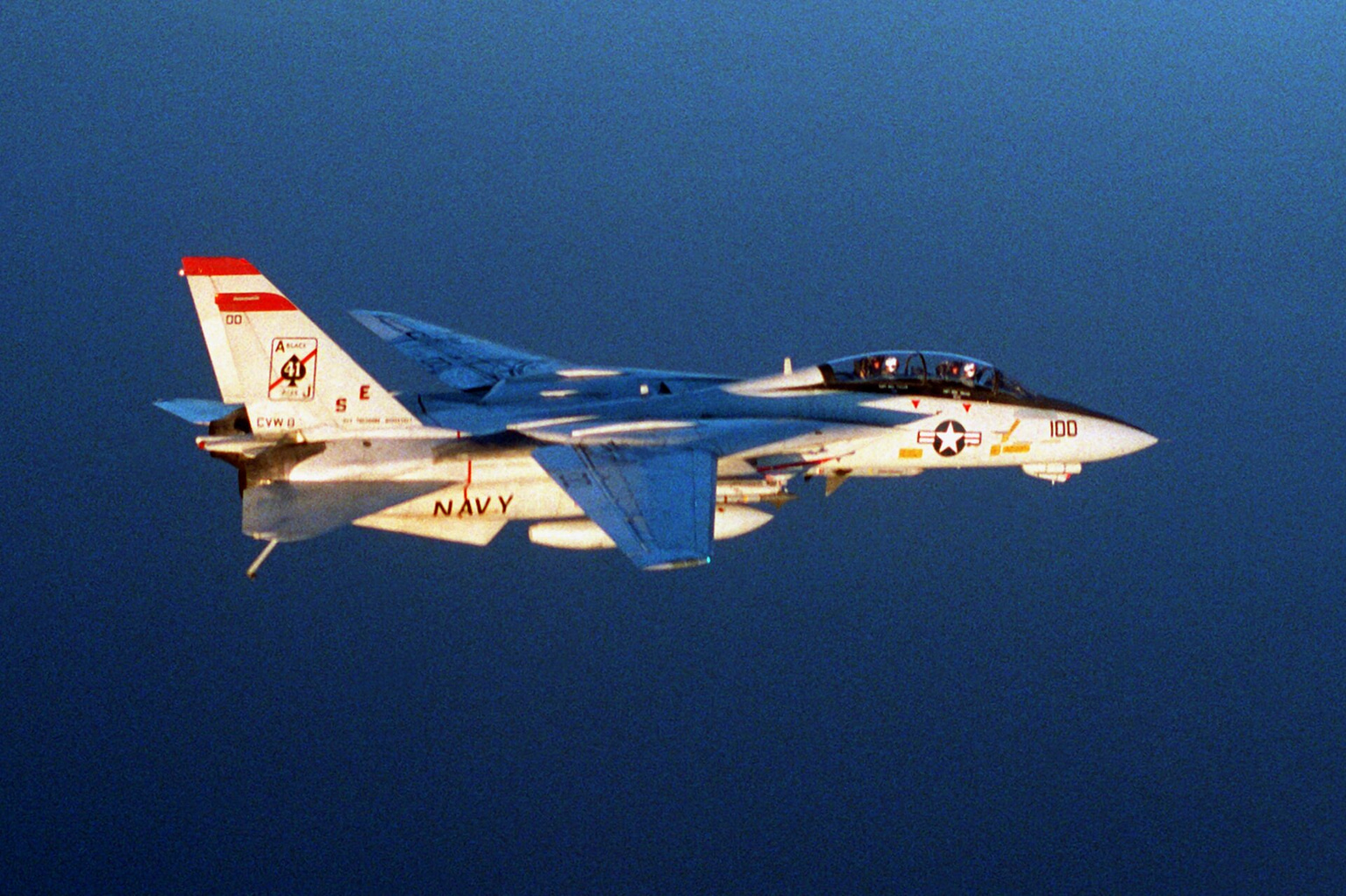
Grumman F-14
“Tomcat”
The US Navy’s swing-wing fleet-defense interceptor — a two-seat carrier fighter whose AWG-9 radar and 100-mile AIM-54 Phoenix missile gave it the longest reach in the sky, and whose Top Gun fame made it the most famous fighter on Earth.
The Tomcat: the fighter born from a failure
The F-14 was born from a failure. In the 1960s the US Navy was tied into the joint TFX programme that produced the General Dynamics F-111; its naval variant, the F-111B, was meant to be the fleet’s long-range missile-carrying interceptor. Overweight and hopeless off a carrier deck, the F-111B was cancelled in 1968. The Navy launched its own VFX competition, which Grumman won with its Model 303.
Grumman built the airframe around the mission systems the Navy actually wanted: the Hughes AWG-9 radar וה- AIM-54 Phoenix long-range missile, both inherited from the F-111B. The result was a large, twin-engine, two-seat carrier fighter with a variable-sweep “swing” wing — the feature that let it dogfight slow and cruise fast from the same airframe. Its Cold War job was fleet air defense: standing off from the carrier group and killing Soviet bombers and cruise missiles before they got in range.
First flown on 21 December 1970, the Tomcat entered US Navy service in 1974 (VF-1 and VF-2 aboard USS Enterprise). Around 712 were built — the troubled TF30-engined F-14A, the re-engined F-14B, and the fully modernised F-14D “Super Tomcat.” The Navy retired the type in 2006. Its only export customer was Imperial Iran under the Shah, and Iran remains the F-14’s only remaining operator — a dwindling, disputed fleet in 2026.
01The F-14 Tomcat’s AWG-9 and AIM-54 Phoenix: the fighter that killed what it could barely see
No fighter before or arguably since matched the Tomcat’s fleet-defense reach. The Hughes AN/AWG-9 was a giant pulse-Doppler radar that could track up to 24 targets in track-while-scan and cue six AIM-54 Phoenix missiles against six different targets at once. The Phoenix flew over 100 miles, zoom-climbing to the edge of space before diving on its target — a weapon built to swat down Soviet bombers and cruise missiles far beyond visual range, long before they threatened the carrier. The AWG-9 could pick up bomber-sized targets at 150-plus nautical miles.
In a celebrated 1970s test, a single F-14 salvoed six Phoenix missiles at six drones and hit most in one pass. The upgraded APG-71 radar of the F-14D pushed detection ranges further still. This sensor-and-shooter combination — not raw agility — was the Tomcat’s real superpower, and the AIM-54 remained unique to the F-14 for its entire career.
What makes the F-14 special
The swing wing
The Tomcat’s wings pivoted from about 20° spread for slow carrier approaches and dogfighting to about 68° fully swept for supersonic dash. A central air-data computer moved them automatically with speed and altitude, so the jet always flew at the optimum sweep without the pilot touching a lever. The wide “pancake” fuselage between the gloves itself generated lift.
AWG-9 & AIM-54 Phoenix
A fighter built as a flying missile battery: the AWG-9 radar tracked 24 targets and could guide six AIM-54 Phoenix missiles against six of them simultaneously, each flying 100-plus miles. Nothing else on a carrier deck came close to that reach for decades, and the Phoenix was never carried by any other aircraft.
Two crew & the RIO
The back-seater — the Radar Intercept Officer — ran the AWG-9, sorted the tactical picture and managed the Phoenix engagements, freeing the pilot to fly and fight. The Tomcat was fundamentally a two-person weapon system, which is why Top Gun’s Maverick always had Goose behind him.
02The F-14’s engines: the TF30 problem and the F110 that fixed it
The F-14A’s Pratt & Whitney TF30 turbofans were the aircraft’s Achilles’ heel — prone to compressor stalls under hard manoeuvring and blamed for numerous losses and fatal flat spins. The Navy itself called them unsuited to the airframe. The General Electric F110-GE-400 re-engine of the F-14B and F-14D finally gave the Tomcat reliable, powerful, carefree-throttle performance — roughly 27,000–28,000 lbf in afterburner per engine — and the aircraft the pilots always felt it deserved.
03The F-14’s Phoenix reach: 24 tracks, six shots, one hundred miles
The heart of the Tomcat was never the airframe — it was the weapon system. The AWG-9 could hold two dozen tracks in track-while-scan and hand six of them to six Phoenix missiles at once. Each AIM-54 climbed above 80,000 ft and dived on its target from more than 100 miles out. It was designed to break up massed Soviet bomber and cruise-missile raids far from the fleet, and its only combat use came in Iranian hands during the Iran–Iraq War. No other fighter of its era — and few since — could reach out and kill at that range.
Full F-14 specifications
Airframe & Performance (F-14D)
- צוות
- 2 (pilot + RIO)
- מֶשֶׁך
- ~19.1 m (62 ft 9 in)
- Wingspan (spread / swept)
- ~19.55 m / ~11.58 m
- גוֹבַה
- ~4.88 m (16 ft)
- Max takeoff weight
- ~33,720 kg (74,350 lb)
- Max speed
- ~Mach 2.34 · ~2,485 km/h
- תקרת השירות
- ~15,200 m (~50,000 ft)
- רדיוס לחימה
- ~500 nmi (~925 km, approx.)
- Ferry range
- ~1,600 nmi (~2,960 km)
Propulsion & Systems
- Engines (B/D)
- 2 × GE F110-GE-400
- Thrust (B/D)
- ~27,800 lbf each in reheat
- Engines (A)
- 2 × P&W TF30-P-414A (~20,900 lbf)
- Radar
- AN/AWG-9 (A/B) · APG-71 (D)
- Gun
- 1 × M61A1 Vulcan 20 mm (675 rds)
- Missiles
- AIM-54 Phoenix, AIM-7, AIM-9 (+ “Bombcat” JDAM/LGB)
- First flight
- 21 December 1970
- Number built
- ~712
- Unit cost
- ~$38 million (F-14D, 1990s USD)
- Cost per flight hour
- ~$30,000+ (2000s estimate)
04The F-14’s cost: an expensive, maintenance-heavy cat
Hard cost figures for the Tomcat vary widely and are rarely inflation-normalised. A flyaway unit cost of roughly $38 million is commonly cited, but sources give figures from around $38 million to $60 million-plus depending on variant and year — treat any single number with caution. There is no reliably published cost-per-flight-hour: the F-14 was notoriously maintenance-intensive, and figures well above US$30,000 per hour are often repeated but not solidly sourced. That expense — and the fact that the multirole F/A-18E/F Super Hornet could do the same jobs more cheaply — is exactly why the Navy retired the Tomcat in 2006.
From VFX to the last cat
The F-111B is cancelled
The Navy’s overweight F-111B fleet-interceptor is killed off; the VFX competition for a purpose-built Navy fighter is launched.
Grumman wins VFX
Grumman’s Model 303 wins; F-14 development begins around the AWG-9 radar and AIM-54 Phoenix.
First flight
The F-14 prototype flies. Days later the first aircraft is lost to a hydraulic failure, but the programme presses on.
Fleet service
The Tomcat enters US Navy service with VF-1 and VF-2 aboard USS Enterprise; the AIM-54 Phoenix is operational.
First kills
Two VF-41 Tomcats down two Libyan Su-22 Fitters over the Gulf of Sidra — the F-14’s first air-to-air victories.
Iran–Iraq War
Iran’s Shah-era F-14As become the war’s dominant fighters — the Tomcat’s most intense combat, and the only combat use of the Phoenix.
“Tomcats 4, Gaddafi 0”
Two VF-32 Tomcats down two Libyan MiG-23s near Tobruk in a second Gulf of Sidra engagement.
The Bombcat
With LANTIRN pods the Tomcat becomes a precision striker, dropping LGBs and JDAMs over the Balkans, Iraq and Afghanistan.
US Navy retirement
The Navy retires the F-14 after 32 years. Iran remains the sole operator — a fleet dwindling and disputed through 2026.
Twelve things to know about the Tomcat
Top Gun (1986)
The movie that made the Tomcat a legend.
Read the full story
Top Gun: Maverick (2022)
The retired jet flies again — on screen.
Read the full story
The Phoenix’s reach
A 100-mile air-to-air kill.
Read the full story
Gulf of Sidra
“Tomcats 4, Gaddafi 0.”
Read the full story
Iranian Tomcats
American aces flying under Iran’s flag.
Read the full story
The swing wing
A wing that reshapes itself in flight.
Read the full story
Bombcat
The interceptor that became a bomber.
Read the full story
“Anytime baby”
The Tomcat community’s swagger.
Read the full story
The TF30 problem
A great jet’s bad heart.
Read the full story
Dale “Snort” Snodgrass
The world’s most famous Tomcat pilot.
Read the full story
The final USN flight
The last cat comes home.
Read the full story
The RIO
Half the crew, all the picture.
Read the full story
The Tomcat in pictures
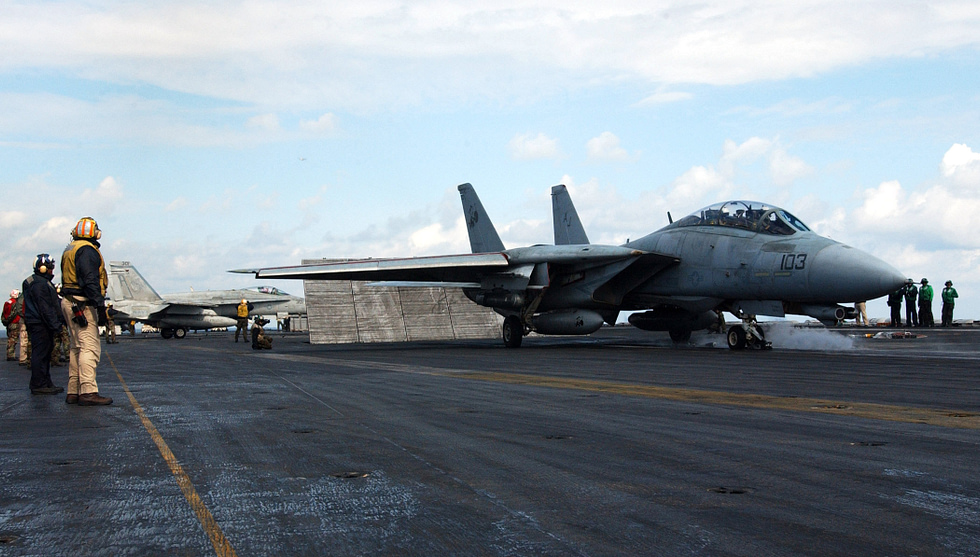
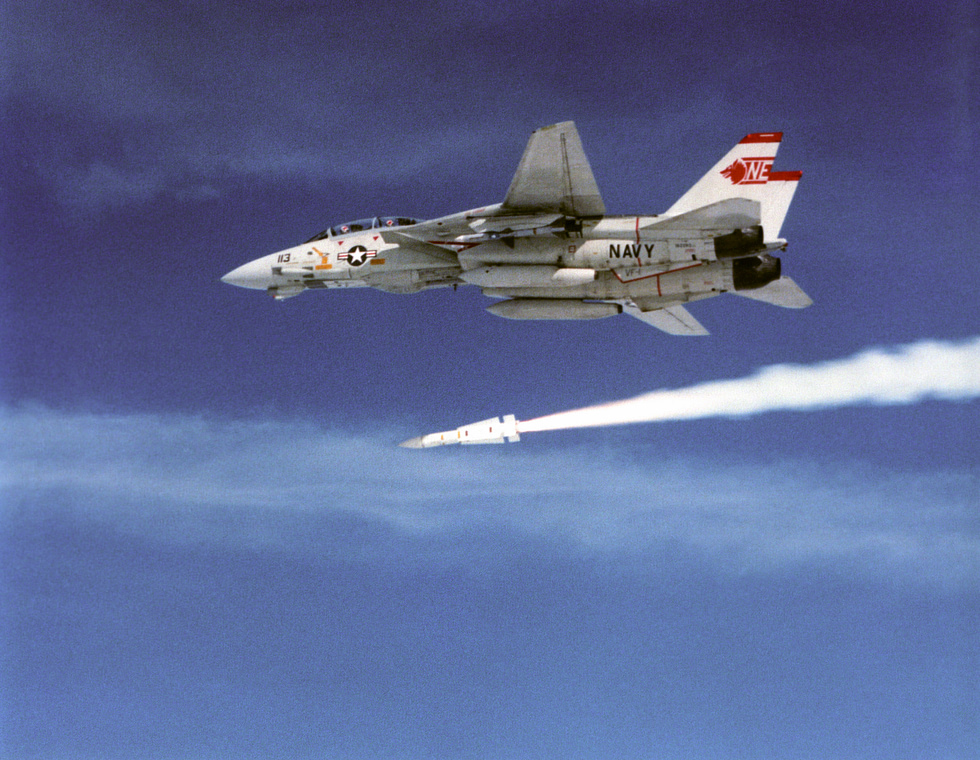
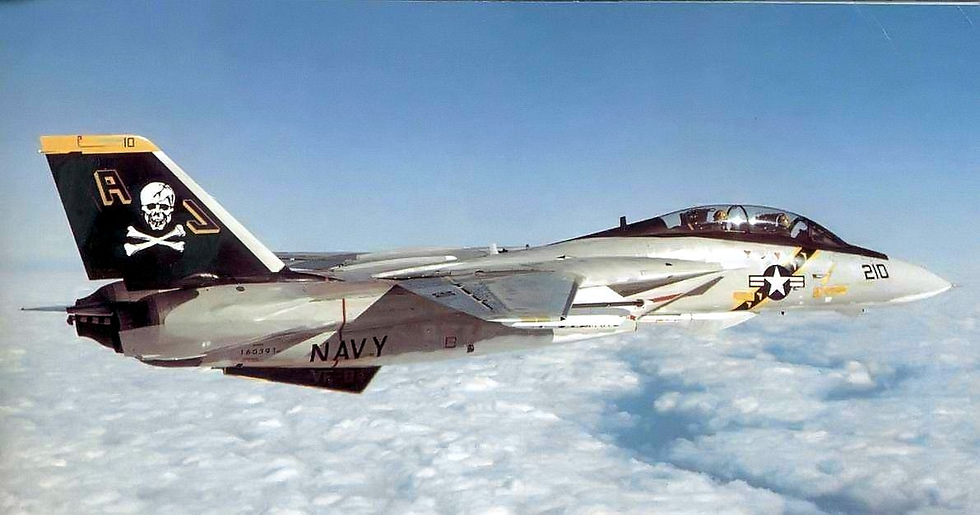
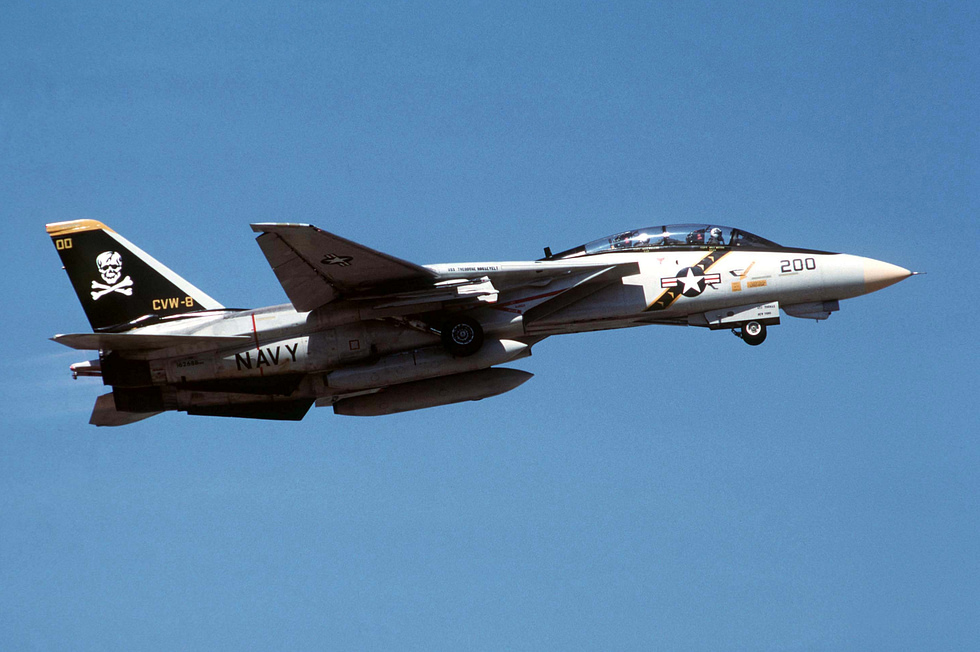
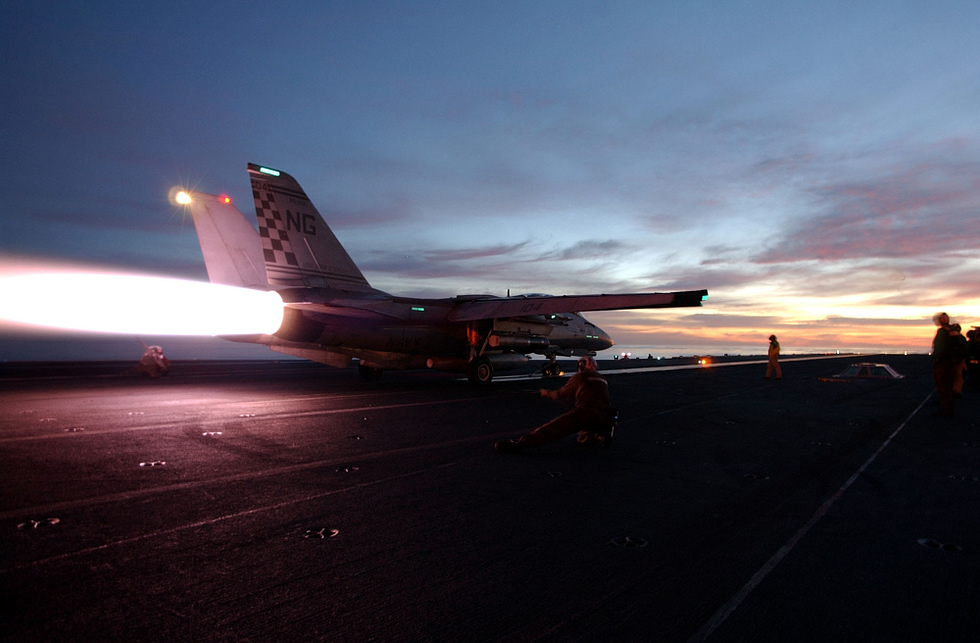
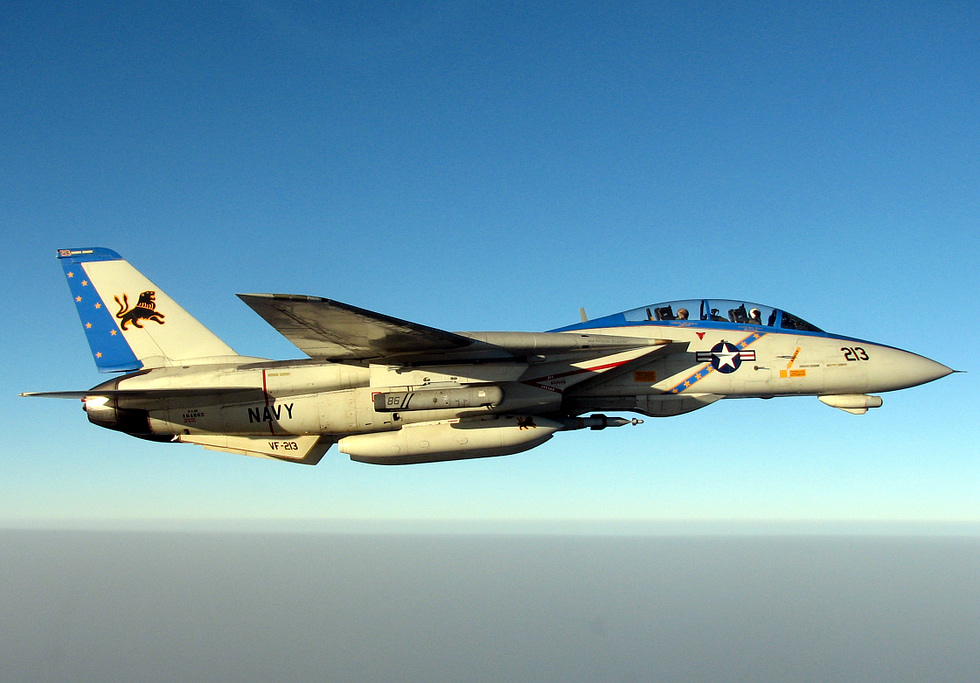
The Tomcat in motion
A documentary look at the Grumman F-14 Tomcat — the swing-wing legend that defended the fleet for 32 years.
Where the Tomcat flew
The longest reach in naval aviation
US Navy Tomcats fought cleanly over the Gulf of Sidra — two Libyan Su-22s in 1981, two MiG-23s in 1989 — and flew CAP and strike missions from Desert Storm to Afghanistan. But the F-14’s most intense combat came in Iranian hands during the 1980–88 Iran–Iraq War, where Shah-era F-14As dominated and fired the only AIM-54 Phoenix shots ever used in anger. Iranian crews claimed dozens of victories — some accounts well over 100 — but these totals are heavily contested and rarely independently verified. In 2026 Iran’s surviving fleet is dwindling and disputed after Israeli airstrikes on its Tomcat base.
Compare the combat record of every military aircraft. Figures as of July 2026; Iranian totals are disputed.
Everything people ask about the F-14
Can I fly in an F-14 Tomcat?
How fast was the F-14?
Why was the F-14 retired?
What was the AIM-54 Phoenix?
What were the swing wings for?
Was it really the Top Gun jet?
Who still flies the F-14?
You can’t fly the F-14.
These, you can.
Some legends only live in museums — others are fuelled and waiting. MiGFlug has put civilians in real military jet cockpits since 2004.
 Fly the L-39 AlbatrosThe world’s most-flown jet trainer — aerobatics included
 Fly the F-104 Starfighter“The missile with a man in it”
 Fly the MiG-21The Cold War’s most-produced jet
 טסו על ה-T-33 Shooting StarAmerica’s first jet trainer
 Fly the DH VampireA piece of early jet history
 Fly the S.211Agile Italian jet trainer
 Fly the MB-326The classic Aermacchi jet
 Fly the MiG-15The Soviet legend of the Korean War
Continue the tour
Every fact, checked
- Naval History and Heritage Command (NNAM)Official US Navy history: F-14 origins, first flight, specifications and combat record.
- The AviationistThe AWG-9 radar (24-target track / six-engage) and the Tomcat’s fleet air-defense role.
- The Aviation Geek Club“Tomcat 4 – Qaddafi 0”: the January 1989 Gulf of Sidra engagement.
- The War Zone (TWZ)Iran’s “Persian Tomcats” and the 2026 Israeli airstrikes on their base (contested).
- 19FortyFiveReporting on the disputed status of Iran’s surviving F-14s in 2026.
- NPR“The long, strange saga of Iran’s F-14 fighter jets” (2026).
- The Museum of Flight / National Naval Aviation MuseumVariants, the Bombcat era and the 2006 retirement.