

Gloster Gauntlet
The RAF’s last open-cockpit fighter and, for a couple of years in the mid-1930s, its fastest — an elegant biplane that bridged the gap to the Gladiator and the monoplane age.
At a Glance
Gloster Gauntlet: key facts
הסיפור
The Gloster Gauntlet: the RAF’s last open-cockpit fighter
In the middle years of the 1930s the Royal Air Force fielded a fighter that looked backward and forward at the same time. The Gloster Gauntlet was a fabric-covered, wire-braced biplane with a fixed undercarriage and an open cockpit — the last of a line that ran straight back to the First World War. Yet when it entered service in 1935 it was also, briefly, the fastest fighter the RAF possessed.
The Gauntlet grew out of a long Gloster development programme led by the designer Henry Folland. A series of experimental single-seat fighters — the SS.18, SS.19 and their variants — were reworked and re-engined through the late 1920s and early 1930s, gradually shedding weight and drag. The definitive form, powered by the Bristol Mercury radial, was ordered into production and named Gauntlet.
The first production Gauntlets reached No. 19 Squadron at Duxford in May 1935. With a top speed of around 230 mph, the Gauntlet was some way faster than the Bristol Bulldog it replaced, and for roughly two years — until the monoplane Hurricane arrived — it was the quickest fighter in RAF service. It was also, by common consent, a delight to fly: light, responsive and beautifully balanced.
That agility made the Gauntlet a natural display aircraft. Through the mid-1930s, tied-together formation aerobatics by Gauntlet squadrons — most famously No. 19 and No. 25 Squadrons — were a highlight of the Hendon RAF Displays, and newsreel cameras captured their looping and rolling formations for cinema audiences across Britain. For many people in the 1930s, the Gauntlet was the public face of the modernising RAF.
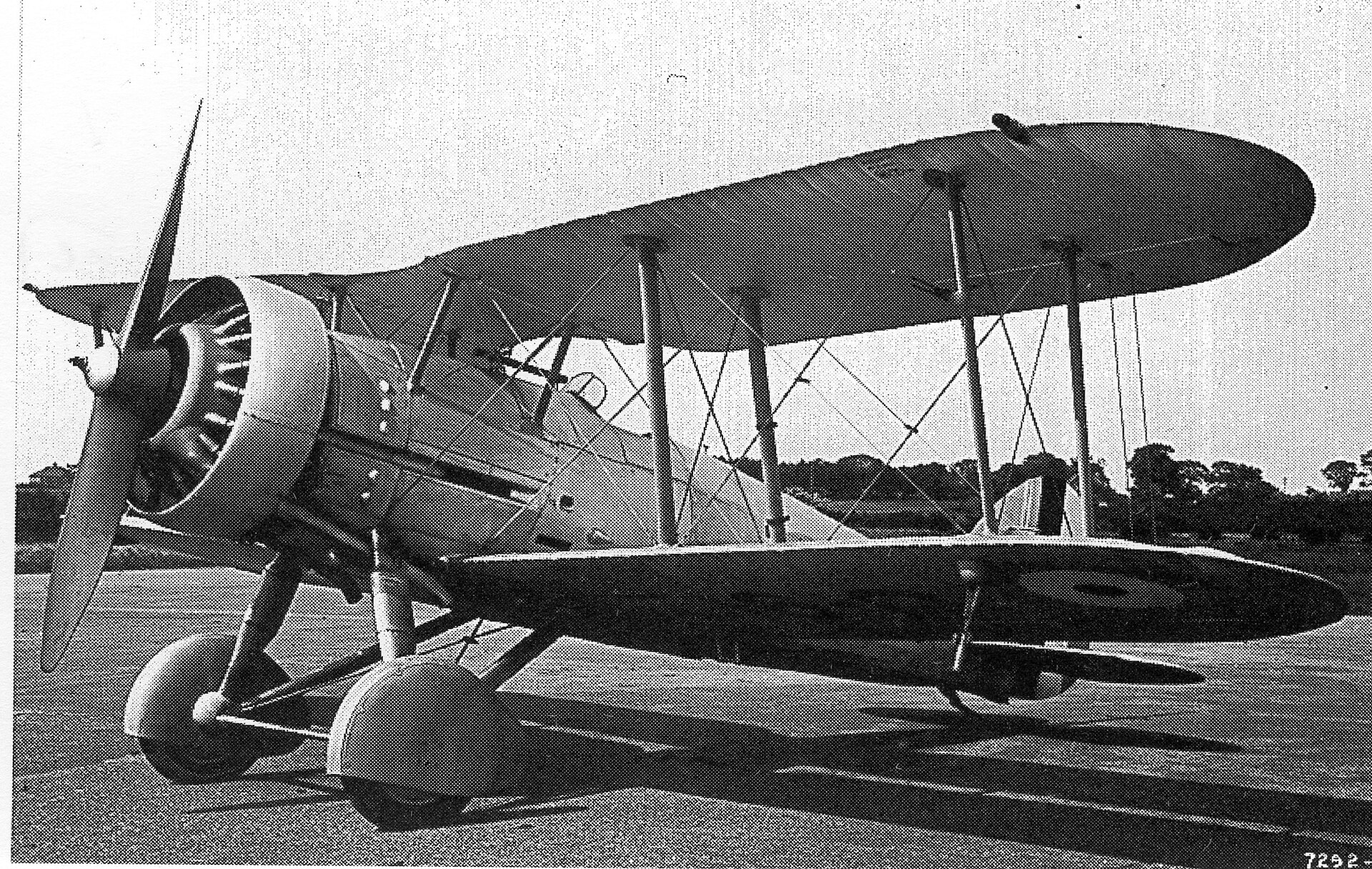
Under the skin it was a conventional but well-made machine: a metal-framed, fabric-covered biplane with two synchronised .303-inch Vickers machine guns firing through the propeller. Two guns had been the RAF standard since 1918, and the Gauntlet kept to it — one of the ways in which it belonged, for all its speed, to an older generation of fighters.
The Gauntlet also has a genuine claim to a footnote in the history of air defence. During the radar and interception experiments of the late 1930s, a Gauntlet is widely reported to have been directed onto its target by ground controllers using early radar plots — one of the first ground-controlled interceptions, a technique that would prove decisive in the Battle of Britain a few years later. Sources differ on the exact date and details, but the episode places the little biplane at the very start of modern air defence.
Its front-line reign was short. The same revolution that had briefly made the Gauntlet the RAF’s fastest fighter swept past it almost at once. Its direct successor, the Gloster Gladiator, was essentially a Gauntlet with an enclosed cockpit and four guns; and behind the Gladiator came the monoplane Hurricane and Spitfire. By the late 1930s the Gauntlet was already obsolescent, and it was steadily relegated to training and second-line duties.
It was exported and licence-built abroad as well. Denmark built Gauntlets under licence, and Finland flew them — including during the Winter War against the Soviet Union — while South Africa, Southern Rhodesia and Australia also operated the type. When the Second World War came, a handful of Gauntlets even saw action in the skies over East Africa and the Middle East, long after they had left Britain’s front line.
By 1943 the Gauntlet had disappeared from service. It had never fought the great battles of its era in the way the Gladiator, Hurricane and Spitfire did — but it had been, for a moment, the sharp point of the RAF’s sword, and it had helped carry British fighter aviation from the open-cockpit biplane into the world of radar, enclosed cockpits and monoplanes.
01The Gloster Gauntlet’s origins: how Gloster’s biplanes reached their peak+
The Gauntlet was the product of years of patient refinement rather than a single clean-sheet design. Through the 1920s Gloster and its chief designer Henry Folland built a succession of experimental single-seat fighters — among them the SS.18 and SS.19 — testing different engines, gun fits and aerodynamic details in the search for extra speed.
The breakthrough came with the fitting of the supercharged Bristol Mercury radial and a series of drag-reducing refinements. The resulting aircraft, ordered by the Air Ministry, became the Gauntlet. It was a conventional biplane in layout, but a carefully optimised one, and it gave the RAF a worthwhile jump in performance over the Bulldog.
In that sense the Gauntlet was the near-final flowering of the Gloster biplane fighter line. Only one step remained — the enclosed-cockpit, four-gun Gladiator — before the whole biplane tradition was rendered obsolete by the monoplane.
02Why the Gloster Gauntlet was obsolescent almost as soon as it peaked+
The Gauntlet entered service in 1935 as the RAF’s fastest fighter, but the ground was already shifting beneath it. Within a year or two the monoplane fighters were arriving: the Hurricane first flew in 1935 and the Spitfire in 1936, and both were around a hundred miles an hour faster, with retractable undercarriages, enclosed cockpits and eight guns.
A biplane’s two wings and bracing wires create drag that caps its speed no matter how much engine power is available. The Gauntlet had squeezed close to the practical limit of the layout; there was simply nowhere left to go. Even its own successor, the Gladiator, could only add a canopy and two more guns, not break the speed barrier.
So the Gauntlet’s moment at the top was brief. What it retained was the biplane’s traditional virtue — superb agility — and a reputation as one of the nicest aircraft of its day to fly. But as a front-line fighter it was overtaken almost as soon as it had arrived.
Design & Engineering
How the Gloster Gauntlet was built to fight
The Gauntlet paired a traditional fabric-and-metal biplane airframe with a modern supercharged radial engine. It was fast, agile and pleasant to fly — but it kept the open cockpit and two-gun armament of an older generation.
An open cockpit and two guns
The Gauntlet was the RAF’s last fighter with an open cockpit — the pilot sat exposed to the slipstream behind a small windscreen. It carried two synchronised .303-inch Vickers machine guns firing through the propeller, the standard British fighter armament since 1918.
The Bristol Mercury radial
Power came from a single Bristol Mercury air-cooled radial of roughly 640–645 horsepower, driving a two-blade propeller. The supercharged Mercury gave the light biplane its lively performance and a top speed a shade over 230 mph — enough, briefly, to make it the RAF’s fastest.
Agile by design
Fabric-covered over a metal frame, wire-braced and fixed-undercarriage, the Gauntlet was light and strong. Its low wing loading made it wonderfully manoeuvrable — the quality that made it a star of the 1930s RAF display circuit and a favourite of the pilots who flew it.
03The Gloster Gauntlet and the RAF display era: tied-together aerobatics+
In the 1930s the RAF’s annual Hendon Display was a national spectacle, and the Gauntlet was one of its stars. Squadrons such as No. 19 and No. 25 flew close-formation aerobatics — loops and rolls performed in tight groups, sometimes with the aircraft literally tied together with light cords to demonstrate the precision of the formation.
These displays were widely filmed by the newsreel companies, and footage of Gauntlets looping and rolling in formation reached cinema audiences across Britain. The aircraft’s light, responsive handling made it ideal for the role, and for many members of the public the Gauntlet was the visible symbol of a modern, expanding air force.
It was a fitting swansong for the biplane fighter. Within a few years the display teams would be flying monoplanes, and the open-cockpit formation aerobatics of the Gauntlet era would belong to a vanished age.
Full Specifications
Gloster Gauntlet Mk II — specifications
Figures are for the Gauntlet Mk II with the Bristol Mercury radial; sources vary by a few mph and a few hundred feet, and values are given as approximate.
| צוות | 1 (pilot) |
|---|---|
| מֶשֶׁך | ~8.05 m (26 ft 5 in) |
| מוּטַת כְּנָפַים | ~9.99 m (32 ft 9 in) |
| גוֹבַה | ~3.12 m (10 ft 3 in) |
| אזור הכנף | ~29.3 m² (315 sq ft) |
| משקל ריק | ~1,256 kg (2,770 lb) |
| Loaded weight | ~1,800 kg (3,970 lb) |
| Powerplant | 1 × Bristol Mercury VIS2 radial |
| Power | ~640–645 hp (~480 kW) |
| מהירות מקסימלית | ~230 mph / 370 km/h at ~15,800 ft |
|---|---|
| Cruising speed | ~175 mph / 282 km/h |
| לָנוּעַ | ~460 mi / 740 km |
| תקרת השירות | ~33,500 ft / 10,200 m |
| קצב הטיפוס | ~2,300 ft/min (est.) |
| הְתחַמְשׁוּת | 2 × .303 in (7.7 mm) Vickers machine guns |
| Cockpit | Open (the RAF’s last open-cockpit fighter) |
| Unit cost | Not reliably recorded (interwar) |
| Cost per flight hour | Not reliably recorded (interwar) — a modern airworthy example is estimated at several thousand pounds per hour (warbird estimate) |
04The Gloster Gauntlet’s variants: Mk I, Mk II and the Danish licence aircraft+
The two main RAF marks were the Gauntlet Mk I and the improved Mk II. The Mk I came from the original production contract; the Mk II introduced a modified structure using Hawker-style construction methods after Gloster became part of the Hawker Siddeley group, along with detail improvements. In the air the two were very similar.
Abroad, Denmark built Gauntlets under licence at its Army Aircraft Factory, and export and second-hand aircraft reached Finland, South Africa, Southern Rhodesia and Australia. Total production is usually given as around 230 aircraft including the Danish licence machines and prototypes, though the exact figure varies between sources depending on how prototypes and conversions are counted.
05The Gloster Gauntlet’s operating costs: what an interwar biplane cost+
Reliable unit and running costs for the Gauntlet in the 1930s are not well recorded in the public sources, and any single figure should be treated with caution. As a fabric-and-metal biplane with a single radial engine it was a relatively cheap fighter by the standards of the day — far less costly than the all-metal monoplanes that soon replaced it.
The only meaningful modern benchmark is what it costs to keep a vintage warbird of this kind flying. A hand-built radial engine, fabric covering and irreplaceable parts mean that operating such an aircraft is commonly estimated at several thousand pounds per flying hour once maintenance, insurance and engineering are included — but that is an estimate for a preserved aircraft, not an interwar cost.
For a visitor the practical point is simple: you cannot buy a seat in a Gauntlet at any price. It is a single-seat fighter and the survivors are irreplaceable museum pieces. What you can do is fly in a genuine military jet instead — which is exactly what MiGFlug offers.
Reference Data
Gloster Gauntlet: structure, engine and production
Background reference data spanning the Gauntlet’s design, service and the world’s surviving airframes.
| Manufacturer | Gloster Aircraft Company |
|---|---|
| Country of origin | בְּרִיטַנִיָה |
| Chief designer | Henry Folland |
| Development lineage | Gloster SS.18 / SS.19 / SS.19B |
| RAF service entry | May 1935 (No. 19 Squadron, Duxford) |
| Primary operator | Royal Air Force (Fighter Command) |
| Construction | Metal frame, fabric-covered biplane |
| Cockpit | Open (no canopy) |
| Undercarriage | Fixed, spatted mainwheels; tailwheel |
| Propeller | Two-blade |
| Engine family | Bristol Mercury air-cooled radial |
| Number built | ~230 (figures vary) |
| Licence production | Denmark (Army Aircraft Factory) |
| Direct successor | Gloster Gladiator (enclosed cockpit, 4 guns) |
| Surviving airframes | Very few; a Finnish museum example and a UK survivor |
Powerplant & Heritage
Engines, names and the Gauntlet’s place in history
06The Bristol Mercury: the engine behind the Gloster Gauntlet+
The Gauntlet was built around the Bristol Mercury, a nine-cylinder air-cooled radial that was one of the most important British aero engines of the 1930s. In the Gauntlet it produced roughly 640 horsepower, and its supercharger helped the light biplane to a top speed a little over 230 mph — fast for its day.
The Mercury was famously reliable and was built in large numbers, powering aircraft from the Gauntlet and Gladiator to the Bristol Blenheim bomber. Air-cooled and rugged, it needed no vulnerable radiator and could operate in climates from northern winters to the desert.
That dependable radial was central to the Gauntlet’s character. It gave a modest, elegant airframe a genuinely lively performance, and it linked the Gauntlet to a whole family of RAF aircraft that would carry the same engine into the Second World War.
07Where the Gloster Gauntlet’s name and lineage come from+
Like many RAF fighters of its era, the Gauntlet took a suitably martial name — a gauntlet being the armoured glove of a knight, and “throwing down the gauntlet” a challenge to combat. It fitted the aggressive single-seat fighter well, and set a pattern of “G” names that Gloster continued with the Gladiator.
Its lineage ran directly forward as well as back. The Gladiator that followed it was essentially a developed Gauntlet with an enclosed cockpit and four guns, so the two aircraft are best understood as a pair — the open-cockpit original and its enclosed successor, the last two biplane fighters the RAF ever used.
That makes the Gauntlet a genuine hinge in RAF history: the last open-cockpit fighter, the immediate ancestor of the Gladiator, and one of the last of a biplane tradition that reached back to the First World War.
Variants
Every major Gloster Gauntlet version
From the experimental Gloster fighters that led to it, through the two RAF marks, to the Danish licence aircraft, the Gauntlet family was small but historically significant.
| Variant | מָנוֹעַ | Role | הערות |
|---|---|---|---|
| SS.18 / SS.19 | Various radials | Prototype | Experimental Gloster fighters that led to the Gauntlet |
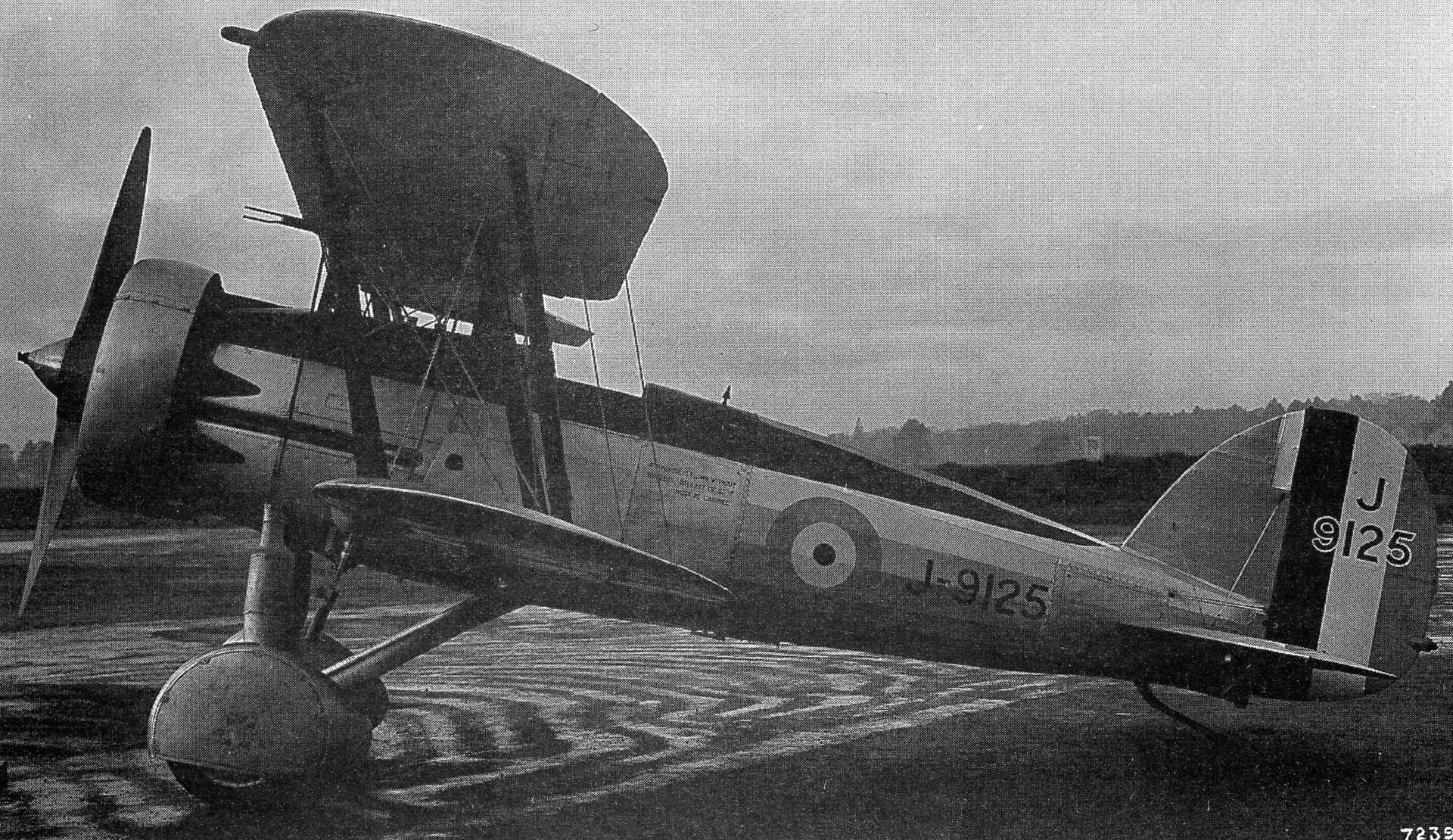
| SS.19B | Bristol Mercury | Prototype | Mercury-engined form (J9125) adopted as the Gauntlet |
| Gauntlet Mk I | Bristol Mercury VIS2 | Fighter | First production version; RAF service from May 1935 |
| Gauntlet Mk II | Bristol Mercury VIS2 | Fighter | Revised construction (Hawker methods) and detail changes |
| Danish Gauntlet | Bristol Mercury | Fighter | Licence-built by the Danish Army Aircraft Factory |
| Export / second-hand | Bristol Mercury | Fighter | Aircraft supplied to Finland, South Africa, Southern Rhodesia and Australia |
Notable Operations
The Gloster Gauntlet in service
RAF home defence, 1935–39
At its peak the Gauntlet equipped around fourteen RAF home-defence fighter squadrons, forming a large part of Britain’s interwar fighter strength before the monoplanes arrived.
Hendon displays, 1930s
Gauntlet squadrons flew celebrated tied-together formation aerobatics at the Hendon RAF Displays, filmed by newsreel cameras and watched by huge crowds.
Radar interception trials
A Gauntlet is widely reported to have taken part in one of the first ground-controlled interceptions guided by early radar, in the late-1930s air-defence experiments (details vary).
The Winter War, 1939–40
Finland flew Gauntlets during the Winter War against the Soviet Union, mainly on reconnaissance and liaison work in extreme cold.
East Africa, 1940–41
RAF, South African and Rhodesian-manned Gauntlets flew army-cooperation and light attack sorties in the East African campaign against Italian forces.
Middle East, early WWII
Surviving Gauntlets served in the Middle East in the war’s early years, well after the type had left Britain’s front line.
Denmark, licence service
Danish-built Gauntlets served with the Army Aviation Troops until the German occupation of Denmark in 1940.
Training & second line
From the late 1930s most surviving RAF Gauntlets passed to training and communications units as monoplanes took over the fighter role.
In Context
The Gloster Gauntlet among its contemporaries
In 1935 the Gauntlet was the RAF’s fastest fighter. Within a few years the monoplanes had left it far behind — and even its own successor, the Gladiator, showed how little further the biplane could go.
| כְּלִי טַיִס | Configuration | Top speed | הְתחַמְשׁוּת | First flight |
|---|---|---|---|---|
| Gloster Gauntlet | Biplane | ~230 mph | 2 × .303 in | 1933 (SS.19B) |
| Bristol Bulldog | Biplane | ~178 mph | 2 × .303 in | 1927 |
| Gloster Gladiator | Biplane | ~257 mph | 4 × .303 in | 1934 |
| Hawker Hurricane Mk I | Monoplane | ~324 mph | 8 × .303 in | 1935 |
| Supermarine Spitfire Mk I | Monoplane | ~362 mph | 8 × .303 in | 1936 |
| Fiat CR.32 | Biplane | ~220 mph | 2 × 12.7 mm | 1933 |
Figures are approximate and vary by sub-variant and source; they are intended for broad comparison only.
Timeline
The Gloster Gauntlet: a service record
Stories & Eyewitnesses
The Gloster Gauntlet in twenty stories
Briefly the RAF’s fastest fighter
For about two years the Gauntlet held the RAF speed crown.
קרא עוד
When it entered service in 1935 the Gauntlet, at around 230 mph, was the fastest fighter in the RAF — markedly quicker than the Bulldog it replaced.
That distinction lasted only until the monoplane Hurricane arrived a couple of years later, but for a brief window the elegant biplane was the sharp edge of British air power.
The last open cockpit
The Gauntlet was the RAF’s last fighter flown from an open cockpit.
קרא עוד
Its pilot sat exposed to the slipstream behind a small windscreen, as fighter pilots had since the First World War. Every RAF fighter after it — starting with the Gladiator — had an enclosed canopy.
That makes the Gauntlet the very end of the open-cockpit fighter tradition in British service, a distinction it holds to this day.
Tied-together aerobatics
Gauntlet squadrons thrilled crowds with formation aerobatics.
קרא עוד
At the 1930s Hendon RAF Displays, Gauntlets of squadrons such as No. 19 and No. 25 flew loops and rolls in tight formation, sometimes literally tied together to show off their precision.
Newsreel film of these displays reached cinemas across Britain, making the Gauntlet one of the public faces of the modernising RAF.
At the birth of air defence
A Gauntlet features in the early radar-interception story.
קרא עוד
During the late-1930s experiments that created modern air defence, a Gauntlet is widely reported to have been guided onto its target by ground controllers using early radar plots — one of the first ground-controlled interceptions.
Sources differ on the exact date and circumstances, so the detail should be treated with caution, but it places the little biplane at the very start of the system that would win the Battle of Britain.
Ancestor of the Gladiator
The Gladiator was essentially a developed Gauntlet.
קרא עוד
Gloster’s next fighter, the Gladiator, took the Gauntlet’s airframe and added an enclosed cockpit and four guns instead of two. The two are best understood as a closely related pair.
So the Gauntlet is the direct ancestor of the more famous Gladiator — the open-cockpit original from which the enclosed successor grew.
Gauntlets over the Winter War
Finland flew Gauntlets against the Soviet Union.
קרא עוד
Finland acquired Gauntlets in the late 1930s and used them during the Winter War of 1939–40, mainly for reconnaissance and liaison in the bitter northern cold.
They were second-line aircraft by then, but their Finnish service is one of the more unexpected chapters of the Gauntlet’s career, and a Finnish museum still preserves one today.
Built under licence in Denmark
Denmark manufactured its own Gauntlets.
קרא עוד
The Danish Army Aircraft Factory built Gauntlets under licence for the Army Aviation Troops, an unusual step for a small air arm and a mark of the type’s reputation.
The Danish Gauntlets served until the German occupation of Denmark in 1940 brought their career to an abrupt end.
War in the African sky
A few Gauntlets fought in East Africa in 1940–41.
קרא עוד
When the Second World War reached East Africa, surviving Gauntlets — flown by RAF, South African and Rhodesian-manned units — carried out army-cooperation and light attack sorties against Italian forces.
It was a marginal, far-off campaign for an obsolete aircraft, but it meant the Gauntlet saw genuine wartime action long after leaving Britain’s front line.
A widely spread little fighter
The Gauntlet served well beyond the RAF.
קרא עוד
Besides the RAF, the Gauntlet was flown by Finland, Denmark, South Africa, Southern Rhodesia and Australia — a respectable spread for a fighter with such a short front-line life.
That export success reflected the type’s good reputation and helps explain why a few examples survive in museums today.
A pilot’s aeroplane
Pilots loved the way the Gauntlet flew.
קרא עוד
The Gauntlet had a reputation as one of the most delightful aircraft of its day to fly: light on the controls, responsive and beautifully balanced, with the low wing loading typical of a biplane.
That agility was what made it such a natural display aircraft — and what its pilots remembered most fondly long after the type was gone.
An older kind of firepower
The Gauntlet kept the RAF’s traditional two guns.
קרא עוד
Its armament of two synchronised .303-inch Vickers machine guns, firing through the propeller, was the standard the RAF had used since 1918. It was adequate against the fabric aircraft of the early 1930s.
The very next generation changed everything: the Gladiator carried four guns and the Hurricane and Spitfire eight. In firepower, as in speed, the Gauntlet belonged to the older era.
Backbone of a growing RAF
The Gauntlet equipped much of Fighter Command.
קרא עוד
At its height the Gauntlet served with around fourteen home-defence squadrons, a large part of the RAF’s fighter strength during the mid-1930s expansion.
As the monoplanes arrived, those squadrons re-equipped one by one, and the Gauntlet passed steadily into training and second-line roles.
Between two worlds
The Gauntlet sat on the hinge of a revolution.
קרא עוד
It entered service in the last years of the biplane and left it in the first years of the monoplane, flying alongside aircraft — the Hurricane and Spitfire — that made everything about it obsolete.
Few aircraft mark the turn of an era so precisely: the Gauntlet is the last open-cockpit RAF fighter, standing right at the threshold of the modern age.
A useful afterlife
Retired Gauntlets found new jobs.
קרא עוד
Once withdrawn from the fighter role, surviving Gauntlets served on as trainers, communications hacks and squadron aircraft, their gentle handling making them well suited to the work.
It is the common fate of obsolescent aircraft, and the Gauntlet performed these quieter duties with the same reliability it had shown as a front-line fighter.
The rare few that remain
Very few Gauntlets survive today.
קרא עוד
Unlike the Gladiator, the Gauntlet is extremely rare in preservation. A Finnish museum keeps an example (GT-400), and a small number of other airframes and rebuilds survive, including in the United Kingdom.
Seeing a Gauntlet at all is now a rare privilege — and any that fly do so only as carefully maintained, single-seat museum pieces, not as passenger aircraft.
Remembered as a bridge
The Gauntlet is remembered for where it sat in history.
קרא עוד
It fought no famous battles in RAF hands and is far less known than the Gladiator or Spitfire. Yet it holds a genuine place in the story: the last open-cockpit RAF fighter, the ancestor of the Gladiator, and a footnote in the birth of radar defence.
That is why the Gauntlet still matters — not as a war-winner, but as the elegant last step before the monoplane changed everything.
A fighter for the Union
South Africa flew Gauntlets into the war.
קרא עוד
The South African Air Force operated Gauntlets in the late 1930s, and a small number went to war in the East African campaign against Italian forces from 1940.
It was one of the ways the type saw genuine combat long after leaving Britain’s front line, flown by pilots of the Union in the skies over Africa.
Rhodesian Gauntlets in Africa
Southern Rhodesian airmen flew Gauntlets too.
קרא עוד
Southern Rhodesian-manned units of the RAF operated Gauntlets in East Africa during the opening campaigns of the Second World War, carrying out army-cooperation and light attack work.
It was hard, marginal flying with an obsolete aircraft, but it added another far-flung chapter to the Gauntlet’s surprisingly wide service.
Down under
The Royal Australian Air Force used the Gauntlet.
קרא עוד
A small number of Gauntlets served with the Royal Australian Air Force, giving the type a presence in the Pacific as well as Europe, Africa and Scandinavia.
It reflected the Gauntlet’s spread through the air forces of the British world in the years before the monoplane took over everywhere.
Throwing down the gauntlet
The Gauntlet’s name set a Gloster pattern.
קרא עוד
A gauntlet is the armoured glove of a knight, and “throwing down the gauntlet” is an old challenge to combat — a fitting name for an aggressive single-seat fighter.
Gloster kept the theme with the Gladiator that followed, so the two related biplanes share both a bloodline and a martial, arena-fighting spirit in their names.
The Gauntlet in Depth
The Gloster Gauntlet, chapter by chapter
Ten closer looks at how the Gauntlet served — and why it mattered.
08The Gloster Gauntlet as the RAF’s fastest fighter+
When the Gauntlet reached No. 19 Squadron in 1935 it gave the RAF a real jump in performance. At around 230 mph it was some 50 mph faster than the Bristol Bulldog it replaced, and for roughly two years it was the fastest fighter in British service.
That lead was quickly overtaken. The Hawker Hurricane, which first flew in 1935, was around a hundred miles an hour faster, and the Spitfire faster still. The Gauntlet’s spell at the top was a brief high point at the very end of the biplane era.
But it was a genuine one. For a short time the elegant open-cockpit Gauntlet, not a sleek monoplane, was the quickest thing the RAF could put into the air — a fact that surprises many people today.
09The Gloster Gauntlet and the Hendon displays+
The Gauntlet’s agility made it a natural for the RAF’s public displays. At Hendon in the mid-1930s, Gauntlet squadrons flew formation aerobatics of a precision that astonished crowds — loops and rolls carried out in tight groups, sometimes with the aircraft tied together with light cords.
These set-pieces were filmed by the newsreel companies and shown in cinemas across the country, making the Gauntlet one of the most visible symbols of Britain’s expanding air force in the years before the war.
It was the last hurrah of the biplane display. Within a few years the RAF’s show aircraft would be monoplanes, and the open-cockpit formation aerobatics of the Gauntlet era would be a memory.
10The Gloster Gauntlet and the birth of radar interception+
One of the Gauntlet’s more intriguing claims to fame belongs to the story of air defence. During the late-1930s experiments that developed radar and ground control, a Gauntlet is widely reported to have been directed onto its target — an aircraft it could not initially see — by controllers using early radar plots.
This is often cited as one of the first successful ground-controlled interceptions, the technique that, refined into the Dowding System, would prove decisive in the Battle of Britain. Accounts differ on the precise date and details, so the episode is best treated as a well-known but imperfectly documented story.
Whatever the exact circumstances, it is a striking image: an obsolescent open-cockpit biplane taking part in the birth of the modern, radar-directed air defence that would soon make it, and every other biplane fighter, redundant.
The point of those experiments was never the aircraft but the system — the chain of radar station, plotting room, controller and fighter that could put an interceptor in the right piece of sky before the enemy arrived. That the aircraft at the end of the chain, on at least one celebrated occasion, was a Gauntlet is a small but genuine part of how the RAF learned to fight the coming war.
11The Gloster Gauntlet in Finland and the Winter War+
Finland acquired Gauntlets in the late 1930s, and when the Soviet Union attacked in the Winter War of 1939–40 the type was pressed into service. By then it was thoroughly obsolete as a fighter, and the Finns used their Gauntlets mainly for reconnaissance, liaison and training.
Operating in extreme cold from rough strips and frozen surfaces, the Gauntlets did useful, unglamorous work during Finland’s desperate defence. A few remained in use into the Continuation War that followed.
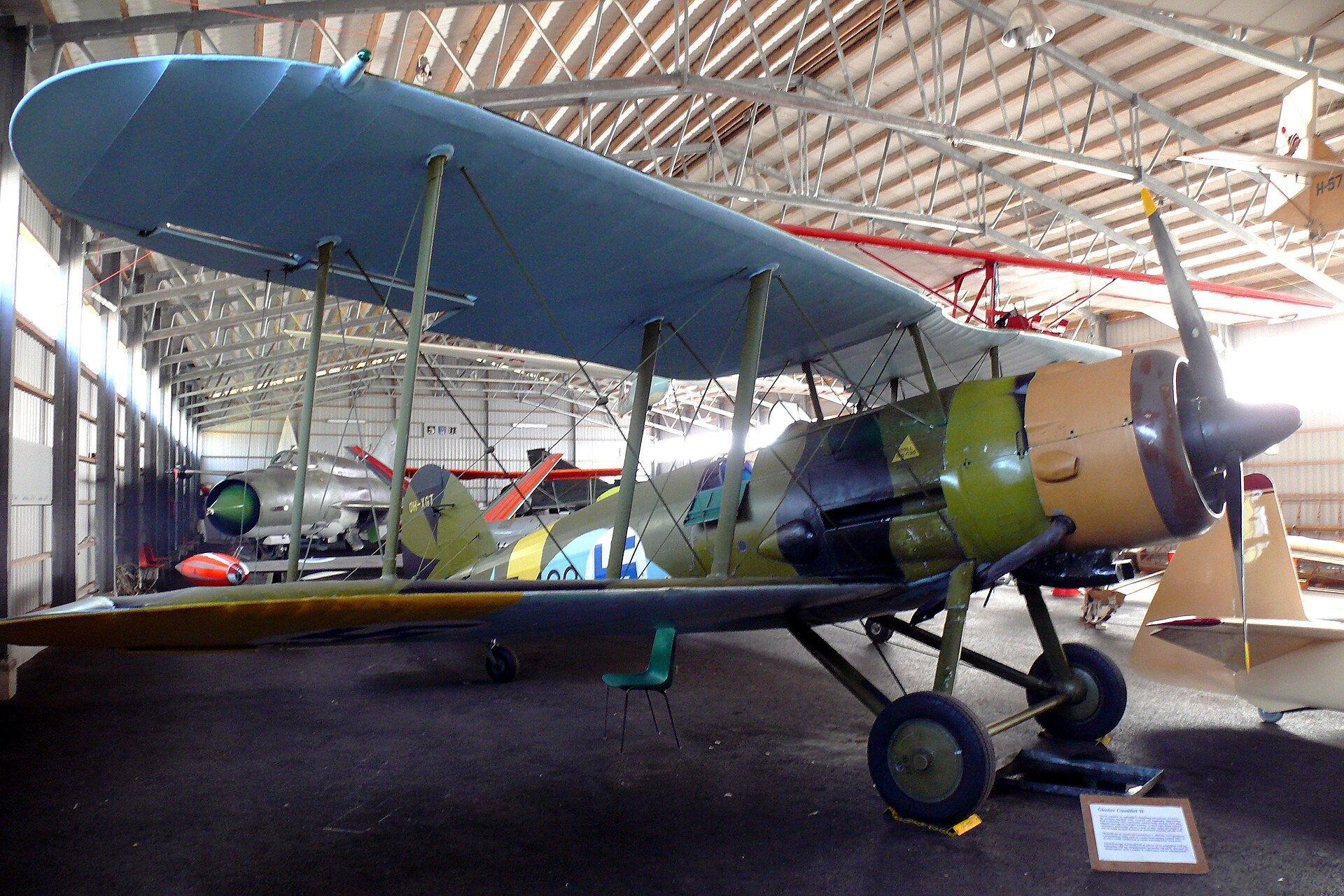
It is thanks partly to this Finnish service that a Gauntlet survives today: the Finnish aviation-museum aircraft (GT-400) is one of the very few complete examples left in the world.
12The Gloster Gauntlet built under licence in Denmark+
Denmark thought highly enough of the Gauntlet to build it under licence. The Danish Army Aircraft Factory manufactured a batch of Gauntlets for the Army Aviation Troops — an unusual undertaking for a small air arm and a real compliment to the design.
The Danish Gauntlets equipped a fighter squadron and took part in the country’s modest interwar air defence. Their service ended abruptly with the German occupation of Denmark in April 1940.
Danish licence production is one reason the usual production total of around 230 aircraft should be treated with care — different sources count the Danish machines, prototypes and conversions in different ways.
13The Gloster Gauntlet in East Africa and the Middle East+
A number of Gauntlets were still in service overseas when the Second World War began, and some saw genuine action. In the East African campaign of 1940–41, Gauntlets flown by RAF, South African and Southern Rhodesian-manned units carried out army-cooperation and light attack sorties against Italian forces.
Operating in heat, dust and over great distances, the rugged air-cooled Gauntlet did work that more sophisticated fighters would have struggled to sustain in such conditions. Others served in the wider Middle East in the war’s early years.
These were marginal operations by an obsolete aircraft, but they meant that the Gauntlet — a fighter designed for the peacetime RAF of the early 1930s — actually fired its guns in anger in the Second World War.
14The Gloster Gauntlet’s armament: the last of the two-gun fighters+
The Gauntlet carried two synchronised .303-inch Vickers machine guns, mounted in the fuselage and firing through the propeller arc. This was the armament the RAF had used since 1918, and against the fabric-covered aircraft of the early 1930s it was considered adequate.
The very next generation of fighters transformed the picture. The Gladiator doubled the battery to four guns, and the Hurricane and Spitfire quadrupled it to eight. Against armoured monoplanes, two rifle-calibre guns were no longer enough.
So the Gauntlet was, in effect, the last RAF fighter of the classic two-gun type — another way in which it marks the end of one era of air fighting and the start of another.
15How fast was the Gloster Gauntlet, really?+
The Gauntlet Mk II had a top speed of about 230 mph (370 km/h). In 1935 that made it the fastest fighter in the RAF, a genuinely impressive figure for an open-cockpit biplane.
By the standards of just a few years later it was slow. The monoplane fighters that followed exceeded 320 mph and could out-climb and out-dive the Gauntlet comfortably. The biplane’s twin wings and bracing wires simply could not be pushed much faster.
What the Gauntlet had instead was agility, and a reputation as a beautiful aircraft to fly. Its speed was a brief triumph; its handling was a lasting one, remembered fondly by the pilots who flew it.
It is worth remembering, too, that “fast” is always relative to its moment. In 1935 the Gauntlet’s 230 mph was genuinely at the front of the field; it was only the extraordinary leap of the monoplane a year or two later that made the same figure look pedestrian. The aircraft did not get slower — the world got faster.
16The Gloster Gauntlet and the Gloster Gladiator: a closely related pair+
The Gauntlet and Gladiator are best understood together. The Gladiator was developed directly from the Gauntlet, keeping the same broad configuration but adding an enclosed sliding cockpit, four guns instead of two, and other refinements.
In effect the Gauntlet is the open-cockpit ancestor and the Gladiator its enclosed successor — the last two biplane fighters the RAF ever operated, one after the other. The Gladiator went on to war fame over Norway and Malta; the Gauntlet, a little older, mostly did not.
Understanding the Gauntlet as the Gladiator’s immediate predecessor is the key to its place in history — and it is why the two aircraft so often appear together in accounts of the RAF’s last biplane fighters.
17The Gloster Gauntlet’s decline and retirement+
The Gauntlet’s front-line career was short. From 1937 onward its squadrons began to re-equip with the Gladiator and then the monoplane Hurricane, and by the outbreak of war in 1939 it had largely left first-line fighter service in Britain.
It did not vanish, though. Surviving aircraft passed to training and communications units, to overseas commands, and to the export operators who kept them flying a little longer. The last examples served until about 1943.
Its retirement was the natural end of a design that had been overtaken by the monoplane revolution almost as soon as it peaked. But by then the Gauntlet had already earned its modest, genuine place in the RAF’s story.
More on the Gauntlet
The Gloster Gauntlet: rivals, numbers and questions
18Why the Gloster Gauntlet was obsolete when war came+
The Gauntlet’s problem was timing. It was designed in the era when the biplane fighter still made sense and reached its peak just as the monoplane came of age. By 1939 it was comprehensively outclassed by the Hurricanes and Spitfires entering service.
A biplane’s drag caps its speed, and the Gauntlet had already been pushed close to the limit of the layout. There was no way to make it competitive with an aircraft a hundred miles an hour faster, carrying four times the guns.
That it still saw some wartime service in secondary theatres says more about how short the RAF was of aircraft in 1940 than about the Gauntlet’s fighting value by then.
The lesson of the Gauntlet is really a lesson about the pace of 1930s aviation. An aircraft could be the best of its kind and the fastest in its air force, and yet be effectively obsolete within three or four years, simply because the whole basis of fighter design had changed underneath it.
19The Gloster Gauntlet versus the Bristol Bulldog+
The Gauntlet replaced the Bristol Bulldog, the RAF’s standard fighter of the early 1930s, and the contrast shows how fast performance was climbing. The Gauntlet was around 50 mph faster, at roughly 230 mph against the Bulldog’s 178, while keeping the same two-gun armament.
Both were open-cockpit biplanes, but the Gauntlet’s more powerful, supercharged Mercury and cleaner design gave it a decisive edge in speed and climb. To a pilot moving from one to the other it was a noticeable step up.
The two aircraft together frame the mid-1930s RAF fighter story: the Bulldog the workhorse of the early decade, the Gauntlet its faster successor — and both about to be swept aside by the monoplane.
20The Gloster Gauntlet versus the monoplanes+
Set beside the Hurricane and Spitfire, the Gauntlet belongs to a different age. Where it was an open-cockpit, fixed-undercarriage biplane with two guns and a top speed of 230 mph, the monoplanes had enclosed cockpits, retractable gear, eight guns and speeds well above 320 mph.
The gap was not one of degree but of kind. The monoplane broke the speed ceiling the biplane could never pass, and it did so while carrying four times the firepower. Nothing about the Gauntlet’s layout could answer that.
This is why the Gauntlet’s front-line life was so short. It was not a bad fighter; it was simply the finest example of a type that had just been made obsolete.
21The Gloster Gauntlet’s place in the Gloster story+
The Gauntlet was one of the last biplane fighters Gloster built, followed only by the Gladiator. But the company’s story did not end with biplanes: within a decade Gloster would build Britain’s first operational jet fighter, the Meteor.
That leap — from the open-cockpit Gauntlet to the jet-powered Meteor in little more than ten years — captures the astonishing pace of aviation in the 1930s and 1940s. The Gauntlet sits near the start of that arc, at the last moment of the biplane.
So the Gauntlet’s significance is partly as a marker: the RAF’s last open-cockpit fighter, from a company that would soon help usher in the jet age.
22How many Gloster Gauntlets were built?+
Production of the Gauntlet is usually given as around 230 aircraft, a total that includes the two RAF marks, the Danish licence-built machines and the prototypes — but the exact figure varies between sources depending on how prototypes, conversions and licence aircraft are counted.
The great majority served with the RAF, equipping a large slice of Fighter Command in the mid-1930s. A smaller number went to export operators or were built abroad under licence in Denmark.
Whatever the precise total, the Gauntlet was built in modest numbers compared with the monoplanes that followed — the Hurricane and Spitfire ran to many thousands each. It was the last of a smaller, older kind of fighter.
Those modest numbers, and the type’s short front-line life, are also why so few Gauntlets survive today. Most were scrapped or lost in second-line and overseas service, leaving only a tiny handful of complete aircraft for later generations to preserve.
Equipment & Operations
The Gloster Gauntlet: cockpit, guns and survivors
23Inside the Gloster Gauntlet: the open cockpit+
The Gauntlet’s pilot sat in an open cockpit behind a small windscreen, exposed to the freezing slipstream as fighter pilots had been since the First World War. Ahead of him was a simple instrument panel, a control column, rudder pedals and the firing controls for the two guns.
It was a fighter of its time in every respect: no armour, no self-sealing tanks, a fixed undercarriage and a hand-swung or cartridge-started radial engine. But it was light, well balanced and honest, and pilots found it a genuine pleasure to handle.
That open cockpit is one of the Gauntlet’s defining features. It was the last RAF fighter without a canopy — its successor, the Gladiator, enclosed the pilot for the first time.
24The Gloster Gauntlet’s guns and gunsight+
The Gauntlet’s two .303-inch Vickers machine guns were mounted in the fuselage and synchronised to fire through the propeller arc. Aiming was through a simple ring-and-bead or reflector sight of the period.
Two rifle-calibre guns were the RAF standard set in 1918, and against the aircraft of the early 1930s they were considered enough. The short firing time and light calibre would soon be exposed, but in the Gauntlet’s heyday they were normal.
It was the last RAF fighter built to that old two-gun standard. Everything after it carried more — the Gladiator four guns, the Hurricane and Spitfire eight — as air combat moved decisively on.
25The Gloster Gauntlet in second-line service+
Once withdrawn from front-line fighter units, the Gauntlet found a useful afterlife. Surviving aircraft served as trainers, communications hacks and station aircraft, their gentle handling making them well suited to the work.
Overseas, Gauntlets lingered longer than in Britain, and it was often these second-line and export aircraft that saw the type’s only real wartime action, in East Africa and the Middle East.
It is the common fate of an obsolescent design: retired from combat, it soldiers on in the quiet, essential jobs that keep an air force running. The Gauntlet did so until the last examples were retired around 1943.
26Surviving Gloster Gauntlets today+
The Gauntlet is far rarer in preservation than its Gladiator successor. Only a handful of examples and rebuilds survive anywhere in the world, which makes any encounter with one a genuine rarity.
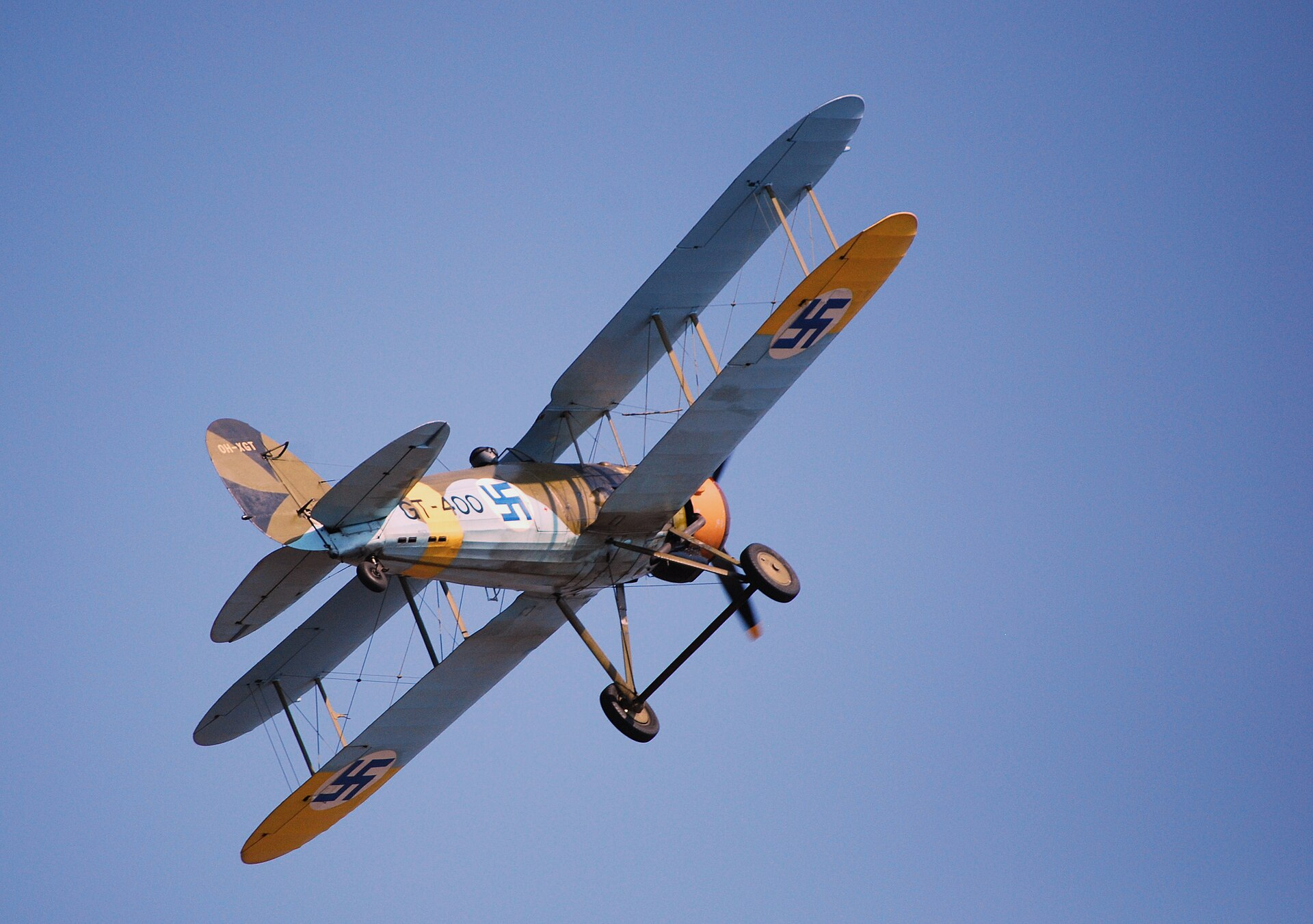
The best-known complete survivor is the Finnish museum aircraft GT-400 (registered OH-XGT), preserved by an aviation-museum collection in Finland and, for a time, flown in Finnish Air Force markings; a United Kingdom example has also been restored and displayed. Airworthiness of the surviving aircraft has varied over the years, so any “flying Gauntlet” claim should be checked against the aircraft’s current status.
Whether flying or static, these few aircraft are single-seat museum pieces. You can hope to see a Gauntlet at a museum or, very occasionally, an airshow — but you cannot book a seat in one.
For anyone who wants to go beyond looking, the honest answer is the same one this page gives throughout: the way to actually fly in a piece of military-aviation history is a genuine two-seat military jet, which is exactly what MiGFlug offers — not a ride in an irreplaceable single-seat 1930s biplane.
More on the Gauntlet
The Gloster Gauntlet: development, engine and afterlife
Eight further close-ups on where the Gauntlet came from and where it went.
27The long road to the Gloster Gauntlet: the SS.18 and SS.19+
The Gauntlet did not appear from nowhere. It was the end product of a Gloster development programme that ran through the late 1920s and early 1930s under Henry Folland, built around a series of experimental single-seat fighters designated SS.18 and SS.19.
These aircraft were repeatedly re-engined and reworked — different radial engines, different gun fits, aerodynamic tidying — as Gloster chased the extra speed the Air Ministry wanted. The prototype J9125 passed through several forms, including the SS.19A and the Mercury-powered SS.19B.
It was the SS.19B that finally offered the performance jump worth ordering, and it entered production as the Gauntlet. The type’s untidy, experimental origins are the reason its early history can be confusing — it was an evolution, not a single design.
28The Bristol Mercury and the Gauntlet’s performance+
The single most important ingredient in the Gauntlet’s success was its engine. The supercharged Bristol Mercury radial gave roughly 640 horsepower and, crucially, held its power up to altitude, which is where the Gauntlet’s speed advantage over the Bulldog was most marked.
The Mercury was a robust, widely produced engine, and fitting it to a clean, light airframe was what turned a promising experimental fighter into the fastest aircraft in the RAF. The same engine family would go on to power the Gladiator and the Blenheim.
For all the Gauntlet’s traditional biplane layout, then, its heart was thoroughly modern for 1935 — a reliable, supercharged radial that briefly put an open-cockpit biplane at the top of the RAF’s performance table.
29The Gloster Gauntlet Mk I and Mk II compared+
The two production marks differed mainly in construction rather than performance. The Mk I came from the original contract and used Gloster’s own methods. After Gloster became part of the Hawker Siddeley group, the Mk II adopted Hawker-style construction techniques, along with detail improvements.
In the air the two were very similar, with the same Mercury engine, the same two-gun armament and much the same performance. Many Mk I aircraft also remained in service alongside the later machines.
The distinction matters mostly to historians and modellers; to a 1930s squadron pilot, a Gauntlet was a Gauntlet — a fast, delightful biplane whichever mark it happened to be.
30The Gloster Gauntlet in Danish service+
Denmark was the only country to build the Gauntlet under licence. The Danish Army Aircraft Factory produced a batch for the Army Aviation Troops, equipping a fighter squadron in the country’s modest interwar air defence.
The Danish Gauntlets were a genuine mark of the type’s standing: it was unusual for a small air arm to invest in licence production of a foreign fighter. They served through the late 1930s until the German invasion of Denmark in April 1940 ended their career at a stroke.
This Danish chapter is one reason the usual production figure of around 230 aircraft should be treated with care — sources count the licence machines in different ways.
31The Gloster Gauntlet in the wider British world+
Beyond the RAF and Denmark, the Gauntlet reached several air forces of the British world. Finland flew it in the Winter War; South Africa and Southern Rhodesian-manned units took it to war in East Africa; and a small number served with the Royal Australian Air Force.
For a fighter with such a short front-line life in Britain, that is a respectable spread. It reflected both the Gauntlet’s good reputation and the way surplus RAF aircraft found second careers across the Empire and beyond as newer types arrived at home.
It also means that when the Gauntlet finally saw combat, it did so in the hands of several different nations, in theatres its designers in early-1930s Gloucestershire could never have imagined.
32What it was like to fly the Gloster Gauntlet+
By all accounts the Gauntlet was a joy to fly. Pilots praised its light, responsive controls, its crisp handling and its willingness to aerobat — qualities that came from the low wing loading of a well-designed biplane.
The open cockpit meant cold, noise and wind, but it also gave superb visibility and the visceral sense of flight that later, enclosed fighters muted. For the display pilots of the mid-1930s it was close to ideal.
That reputation as a pilot’s aeroplane is a large part of why the Gauntlet is remembered so fondly by those who knew it, even though its front-line career was brief and it fought no great battles.
33The Gloster Gauntlet and the coming of the monoplane+
The Gauntlet’s service life coincided almost exactly with the monoplane revolution. It entered service in 1935, the year the Hurricane first flew; by the time the Spitfire reached squadrons, the Gauntlet was already being pushed aside.
The change was fundamental. Retractable undercarriages, enclosed cockpits, stressed-skin monoplane wings and eight-gun batteries together produced fighters that were faster, better armed and better protected than any biplane could be. The Gauntlet had no answer.
Its role in that story is as the last of the old order — the final open-cockpit fighter to hold the RAF’s front line before the monoplanes swept everything before them.
34Why the Gloster Gauntlet deserves to be better known+
The Gauntlet is overshadowed by the aircraft around it — the war-famous Gladiator that followed, the Hurricane and Spitfire that replaced it. It fought no Battle of Britain and defended no Malta, and so it slips out of the popular story.
Yet its list of distinctions is real: the RAF’s fastest fighter for around two years, its last open-cockpit fighter, its last two-gun fighter, the direct ancestor of the Gladiator, and a participant in the birth of radar interception. Few aircraft sit so exactly on the turn of an era.
To understand how the RAF crossed from the biplane age into the monoplane war, the Gauntlet is exactly the aircraft to look at — which is why it deserves a place in the story of its own.
There is also something quietly appealing about the aircraft itself: an elegant, open-cockpit biplane, loved by its pilots, thrilling the crowds at Hendon, and then bowing out gracefully as the machines that made it obsolete took over. It is the kind of aircraft that rewards a second look — a small, near-forgotten hinge in the history of air power.
Photo Gallery
The Gloster Gauntlet in photographs
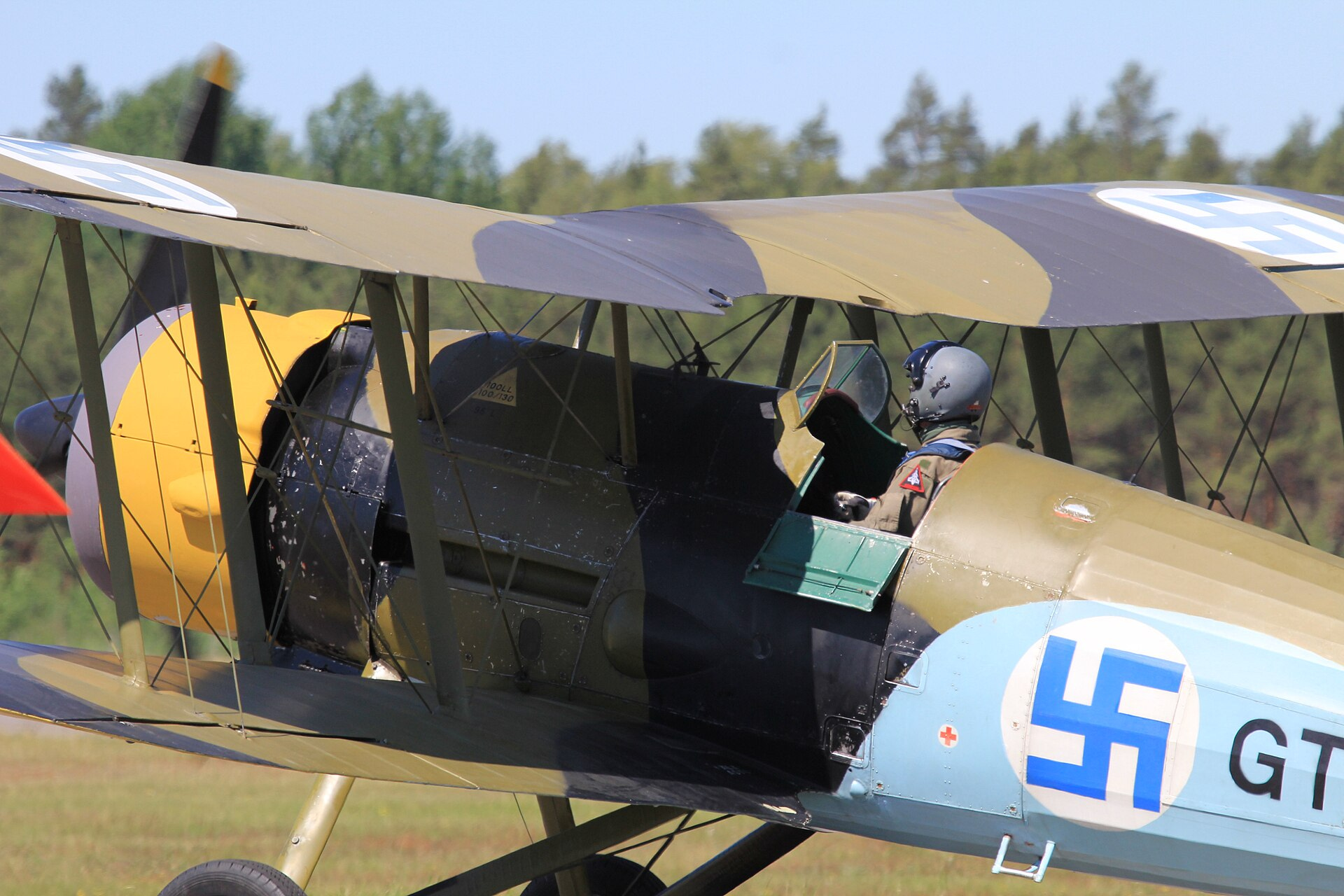
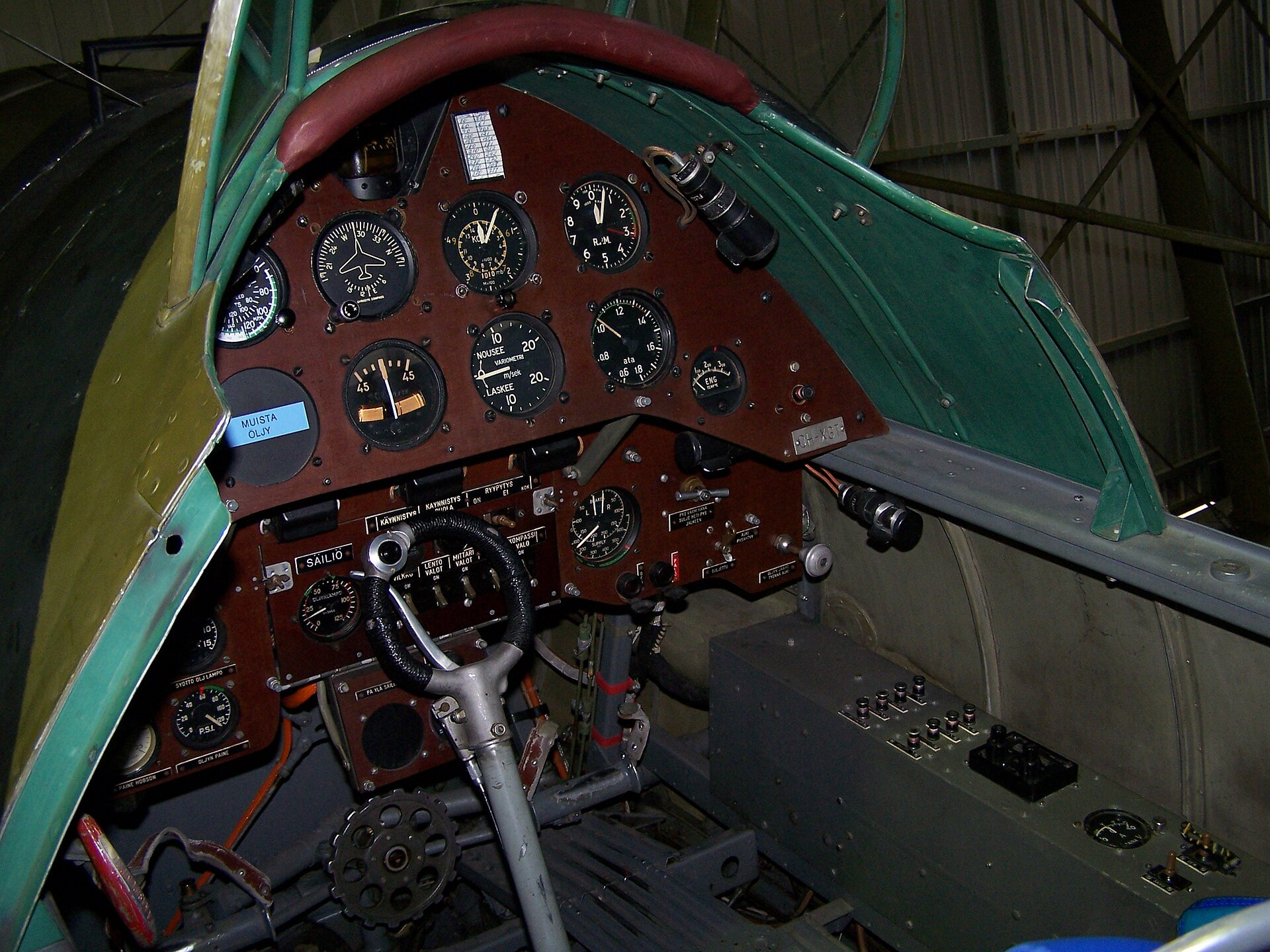
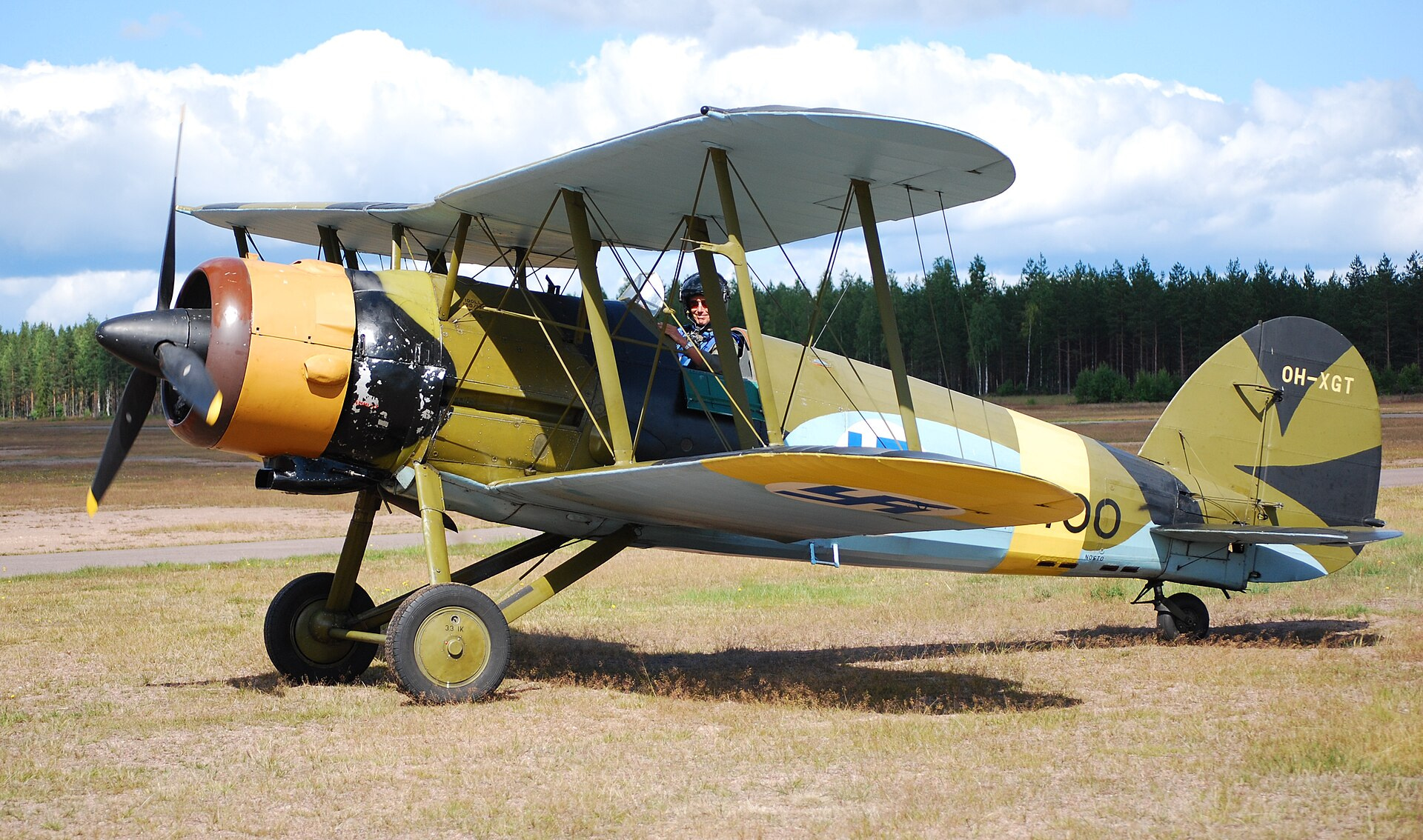
All images are from Wikimedia Commons and credited individually above; licences are noted in each caption.
On Film
The Gloster Gauntlet on film
Genuine 1935 newsreel footage of RAF Gauntlets flying formation aerobatics — loops and rolls performed in tight formation — from a major historical film archive.
“RAF’s New Fighters” — British Movietone newsreel of 20 June 1935 showing Gloster Gauntlet fighters in formation aerobatics, preserved by AP Archive (a major newsreel archive). A short authentic period clip rather than a high-view documentary.
Operations Map
Where the Gloster Gauntlet served
A British home-defence fighter that was also exported and licence-built: flown by the RAF, made under licence in Denmark, operated by Finland, South Africa, Southern Rhodesia and Australia, and flown in anger over the Winter War and East Africa. Toggle the categories to explore its operators, combat theatres and surviving airframes.
By the Numbers
The Gloster Gauntlet by the numbers
A short summary of the RAF’s last open-cockpit fighter’s scale and service.
Where to See One
Surviving Gloster Gauntlets on display
The Gauntlet is a rare survivor — only a handful remain, chiefly in Finland and the United Kingdom.
Finland
Finnish aviation museum collection. The best-known complete Gauntlet, GT-400 (OH-XGT), is preserved in Finland.
A legacy of Finland’s Winter War service, this aircraft has been displayed and, for a time, flown in Finnish Air Force markings. Its airworthiness has varied over the years, so current status is best checked before travelling.
בְּרִיטַנִיָה
UK collections. A restored Gauntlet has been preserved and displayed in Britain, the type’s home country.
Survivors and rebuilds in the UK keep the RAF’s last open-cockpit fighter on show in the country where it served — though, as with all Gauntlets, only as a single-seat museum aircraft.
A rare survivor
Very few remain. Unlike the Gladiator, the Gauntlet survives in only tiny numbers worldwide.
That scarcity makes any Gauntlet sighting a genuine rarity. If you want to actually fly in a piece of military-aviation history, a bookable military-jet flight is the realistic route — not a seat in a single-seat 1930s biplane.
Survivor details and airworthiness change over time; figures and current status should be verified with the museums concerned.
Legacy
Remembering the Gloster Gauntlet
It would be easy to overlook the Gauntlet. It fought no famous battle in RAF hands, it is far less known than the Gladiator or the Spitfire, and its front-line career lasted only a few years before the monoplane swept it aside. By the cold measures of speed and firepower, it was an aircraft overtaken almost as soon as it arrived.
But the Gauntlet holds a real place in the story of British air power. For about two years it was the fastest fighter the RAF owned. It was the last of the service’s open-cockpit fighters and the last of its two-gun fighters. It was the immediate ancestor of the Gladiator, and it even brushed against the birth of radar-guided air defence. In Finland and East Africa it fired its guns in a second war it had never been designed for.
That is why the elegant little biplane still deserves to be remembered — not as a war-winner, but as the last graceful step of the open-cockpit era, and the bridge between the biplane fighters of the First World War and the monoplanes that would win the Second.
Questions & Answers
Gloster Gauntlet: your questions answered
Can I fly in a Gloster Gauntlet?
No — not as a paying passenger. The Gauntlet is a single-seat fighter, and no company, including MiGFlug, offers passenger flights in one. Only a handful of Gauntlets survive anywhere in the world, chiefly in museums in Finland and the United Kingdom, and any that fly do so as carefully maintained, single-seat display aircraft — not bookable rides.
If you want to actually fly in a piece of military-aviation history, though, you can. MiGFlug offers flights in genuine military jets, from the L-39 Albatros to the MiG-29 Fulcrum — see migflug.com/flights-prices/ for what is bookable today.
Was the Gloster Gauntlet really the RAF’s fastest fighter?
Yes, for a short time. When it entered service in 1935 the Gauntlet, at around 230 mph, was the fastest fighter in the RAF — markedly quicker than the Bristol Bulldog it replaced. It held that distinction for roughly two years, until the monoplane Hawker Hurricane arrived and left it far behind.
Was the Gauntlet the predecessor of the Gloster Gladiator?
Yes. The Gladiator was developed directly from the Gauntlet, keeping the same broad configuration but adding an enclosed cockpit and four guns instead of two. The Gauntlet is best understood as the open-cockpit original and the Gladiator as its enclosed successor — the last two biplane fighters the RAF operated.
Why is the Gloster Gauntlet called the RAF’s last open-cockpit fighter?
Because it was the last RAF fighter in which the pilot sat in an open cockpit, exposed to the slipstream, as had been standard since the First World War. Every RAF fighter after it — beginning with the Gladiator — had an enclosed, canopied cockpit.
Did the Gloster Gauntlet see combat?
Only in a limited way. In RAF hands it was mainly a peacetime home-defence fighter of the mid-1930s and was largely obsolete by the war. But surviving and exported aircraft did see action: Finland flew Gauntlets in the Winter War of 1939–40, and RAF, South African and Rhodesian-manned Gauntlets carried out sorties in the East African campaign of 1940–41.
Is it true a Gauntlet was used in an early radar interception?
It is widely reported. During the late-1930s experiments that developed radar-based air defence, a Gauntlet is said to have been guided onto its target by ground controllers using early radar plots — one of the first ground-controlled interceptions. Accounts differ on the exact date and details, so the story is best treated as well known but not precisely documented.
How many Gloster Gauntlets were built?
Around 230, a total that usually includes the two RAF marks, the prototypes and the Danish licence-built aircraft — though figures vary between sources depending on how prototypes, conversions and licence machines are counted. Denmark built Gauntlets under licence, and the type was also exported to Finland, South Africa, Southern Rhodesia and Australia.
Are there any Gloster Gauntlets left today?
Very few. The best-known complete survivor is the Finnish museum aircraft GT-400 (OH-XGT), and a restored example has been preserved in the United Kingdom. The Gauntlet is much rarer than its Gladiator successor, and any “airworthy Gauntlet” claim should be checked against the aircraft’s current status.
What engine did the Gloster Gauntlet have?
The Gauntlet was powered by a single Bristol Mercury air-cooled radial engine of roughly 640–645 horsepower. The Mercury was supercharged, holding its power to altitude, and this — combined with a clean, light airframe — was what briefly made the Gauntlet the fastest fighter in the RAF. The same engine family also powered the Gloster Gladiator and the Bristol Blenheim.
What replaced the Gloster Gauntlet in RAF service?
In the fighter role the Gauntlet was succeeded first by its close relative the Gloster Gladiator — essentially a Gauntlet with an enclosed cockpit and four guns — and then, decisively, by the monoplane Hawker Hurricane and Supermarine Spitfire. From the late 1930s the Gauntlet passed into training and second-line duties, and the last examples were retired around 1943.
You can’t fly the Gloster Gauntlet. These, you can.
The Gauntlet is a rare museum piece — a single-seat 1930s biplane you can hope to see, but never book a seat in. What you can do is fly in a genuine military jet with MiGFlug.
Fighter Jet Flights
Take the controls of a real ex-military jet with an experienced pilot.
Related Aircraft
More from the Aircraft Museum
 Gloster GladiatorThe Gauntlet’s direct successor — the RAF’s last biplane fighter, with an enclosed cockpit and four guns.
 Bristol BulldogThe RAF’s standard fighter of the early 1930s, the biplane the Gauntlet replaced.
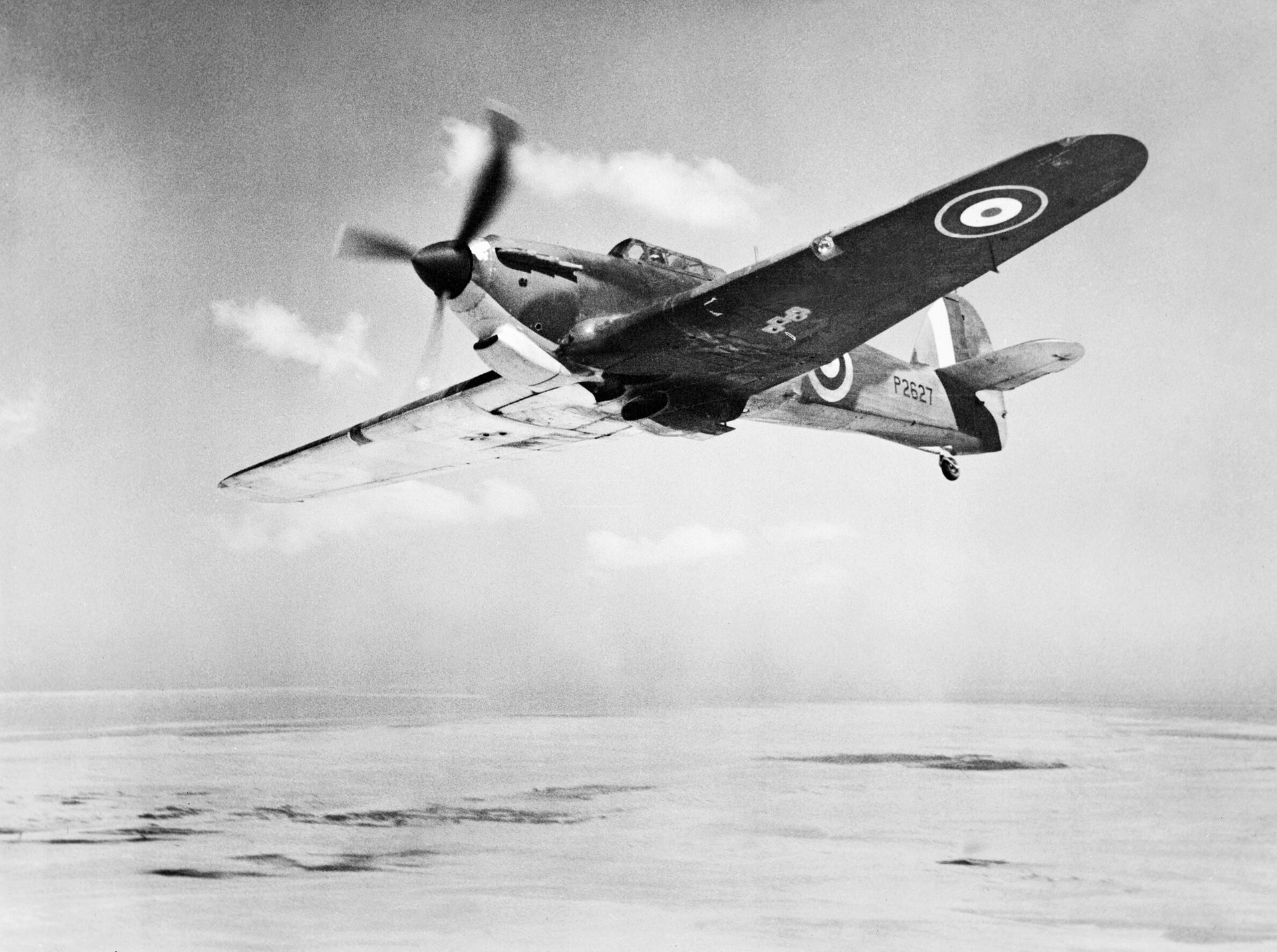 Hawker HurricaneThe monoplane that made the Gauntlet obsolete and went on to win the Battle of Britain.
Sources & Further Reading
Where this page’s facts come from
Figures for speed, weights, production and operators are drawn from the museum and reference sources above; where sources differ, values are given as approximate and marked as estimates. The early radar-interception episode and current survivor airworthiness are presented with appropriate caution. Images are from Wikimedia Commons and credited individually in the gallery.