
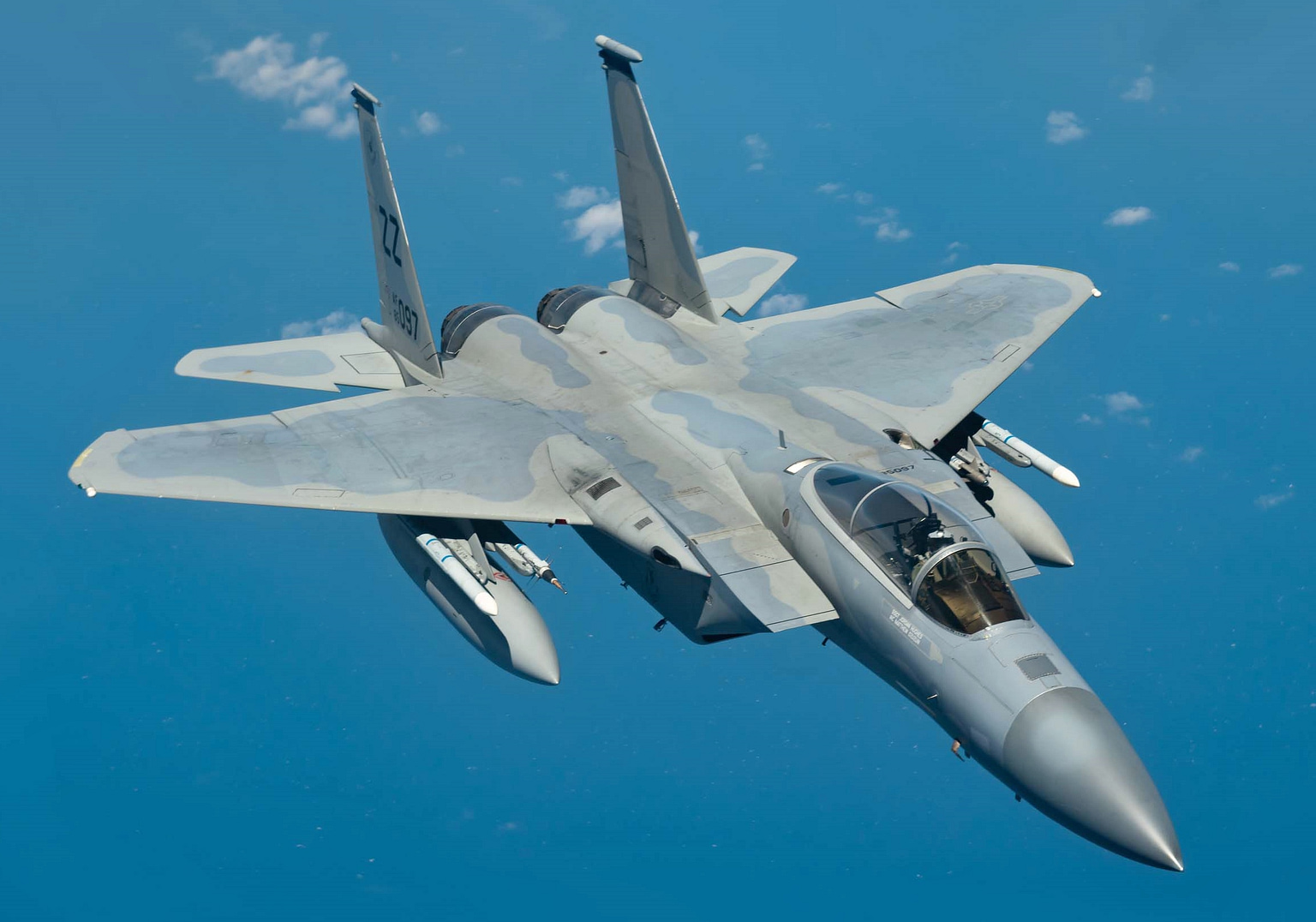
McDonnell Douglas F-15
“Eagle”
The West’s definitive air-superiority fighter — a big-winged, twin-engine dogfighter built on the mantra “not a pound for air-to-ground.” Across American, Israeli and Saudi service the F-15 has an air-to-air record no other modern fighter can match: roughly 104 kills and no confirmed air-to-air losses.
The Eagle that never lost
The F-15 was born out of alarm and disappointment. In 1967 the Soviet Union unveiled the giant MiG-25 “Foxbat” at Domodedovo, and Western analysts — overestimating it — feared a new super-fighter. At the same time, dogfights over Vietnam were exposing how poorly heavy, missile-only interceptors like the F-4 Phantom handled nimble MiGs. The U.S. Air Force’s answer was the F-X study and a single, ruthless design rule: “not a pound for air-to-ground.” This would be a pure air-superiority fighter, optimised to win the dogfight and nothing else.
McDonnell Douglas won the contract on 23 December 1969. The F-15A first flew on 27 July 1972, the two-seat F-15B followed in 1973, and the type entered service in 1976 with the 1st Tactical Fighter Wing at Langley. Improved F-15C and D models arrived from 1979 with more fuel, provision for conformal tanks and better avionics. Around 1,200 A/B/C/D Eagles were built.
What followed made the F-15 a legend. Israeli Eagles opened the scoreboard in 1979 and gutted the Syrian Air Force over the Bekaa Valley in 1982; American F-15Cs scored the largest single haul of the 1991 Gulf War; Saudi Eagles added kills of their own. The aggregate air-to-air record — often quoted as 104 to 0 — is best framed honestly as no confirmed air-to-air losses: adversaries have periodically claimed an Eagle, but none has been substantiated with wreckage or corroboration.
01The F-15 Eagle’s origin: how the MiG-25 scare created the West’s best dogfighter
The F-15 is, in a sense, a child of the MiG-25. When the Foxbat appeared in the late 1960s, its huge wing and blistering speed convinced Western intelligence that the Soviets had built a maneuverable super-fighter — a misreading only corrected after Viktor Belenko defected with one to Japan in 1976. But the fear did its work: it pushed the U.S. Air Force to fund a fighter that could out-fly anything in the sky.
Combined with the hard lessons of Vietnam — where agile MiG-17s and MiG-21s embarrassed heavier American jets — the F-X programme produced an aircraft with an enormous wing, low wing loading and two powerful afterburning turbofans. The result had a thrust-to-weight ratio above one at combat weight, letting the Eagle accelerate vertically. The Foxbat scare had, ironically, produced its own antidote.
What makes the F-15 special
Big wing, brute thrust
The Eagle’s defining trait is its enormous ~56.5 m² wing and low wing loading, paired with two afterburning turbofans. Together they give a thrust-to-weight ratio greater than one at combat weight — the F-15 can accelerate while climbing vertically. That excess energy is exactly what wins turning dogfights and lets the jet zoom to extreme altitude.
Look-down, shoot-down radar
ה AN/APG-63 pulse-Doppler radar (later upgraded to AESA) gave the Eagle true look-down/shoot-down capability — the ability to pick low-flying targets out of ground clutter. Paired with the AIM-7 Sparrow, later the AIM-120 AMRAAM, and the AIM-9 for close-in work, crews could detect, identify and kill before the enemy knew the fight had begun.
Twin F100 turbofans
Two Pratt & Whitney F100 afterburning turbofans (the -PW-100/-220/-229 series) each produce roughly 23,500–29,000 lbf of thrust, driving the Eagle past Mach 2.5. Two engines also mean redundancy — an Eagle can lose one and still fly home, a margin that has saved airframes and crews more than once.
02The F-15 Eagle’s thrust-to-weight: why it can climb straight up
Most fighters trade away energy in a hard turn or a steep climb. The F-15 was designed so it did not have to. With a big low-loaded wing generating lift cheaply and two F100s producing more thrust than the jet’s combat weight, the Eagle has surplus power in almost every part of the envelope. It can point its nose at the sky and keep accelerating — the same energy margin that let a stripped “Streak Eagle” shatter eight time-to-climb records in 1975, and that lets a combat Eagle regain lost speed and altitude faster than its opponent.
03The F-15 Eagle’s radar and missiles: winning before the merge
Air combat since the 1970s has been decided as much by sensors as by turning ability. The APG-63 gave the F-15 a long-range pulse-Doppler picture with genuine look-down/shoot-down performance, so a low-flying target could no longer hide in ground return. Married to the semi-active AIM-7 Sparrow and later the fire-and-forget AIM-120 AMRAAM, that radar let Eagle crews shoot at range and turn away — the pattern behind many of the type’s Gulf War kills, where Iraqi jets were destroyed before they ever detected the Eagle hunting them.
Full F-15C specifications
Airframe & Performance
- צוות
- 1 (C) / 2 (D)
- מֶשֶׁך
- 19.43 m
- מוּטַת כְּנָפַים
- 13.05 m
- גוֹבַה
- 5.63 m
- אזור הכנף
- ~56.5 m²
- Max takeoff weight
- ~30,845 kg
- Max speed
- Mach 2.5+ · ~2,650 km/h
- תקרת השירות
- ~20,000 m
- Ferry range
- ~5,550 km with tanks
Propulsion & Armament
- Engines
- 2 × P&W F100-PW-220 or -229
- Thrust
- ~23,500–29,000 lbf each (reheat)
- Cannon
- 1 × M61A1 Vulcan 20 mm (940 rds)
- Missiles
- AIM-7, AIM-9, AIM-120
- First flight
- 27 July 1972
- Built (A–D)
- ~1,200
- Unit cost
- ~US$30 million (historic)
- Cost per flight hour
- No single reliable public figure
04The F-15 Eagle’s cost: what an air-superiority fighter is worth
Historic flyaway figures for the F-15A/C cluster around US$30 million apiece (roughly $29.9M is commonly cited), though such numbers vary by variant, year and how you count development. Operating costs are harder still: no single reliable public cost-per-flight-hour figure exists for the A–D Eagle, and quoted numbers depend heavily on the accounting method and the fleet’s age. What is clear is that the F-15 was a deliberately expensive, no-compromise machine — the opposite philosophy to the cheap, mass-built MiG-21 it was meant to defeat. The new-build F-15EX Eagle II carries a far higher modern price tag again.
Fifty years of the Eagle
F-X studies
The USAF studies a dedicated air-superiority fighter, spurred by the MiG-25 and poor air-combat results over Vietnam.
McDonnell Douglas wins
MDD is selected to build the F-15 under the strict “not a pound for air-to-ground” rule.
F-15A first flight
The prototype Eagle flies for the first time; the two-seat F-15B follows in 1973.
Streak Eagle records
A stripped F-15A sets eight time-to-climb records, reaching 30,000 m in 207.8 seconds.
Enters service
The F-15 joins the 1st Tactical Fighter Wing at Langley AFB.
First blood
An Israeli F-15 downs Syrian MiG-21s — the type’s first air-to-air kills, before America ever fired one in anger.
Bekaa Valley
Israeli F-15s and F-16s destroy scores of Syrian aircraft for no air-to-air losses.
Satellite kill
Maj Wilbert Pearson’s F-15A launches an ASM-135 missile and destroys the Solwind satellite in space.
Desert Storm
USAF F-15Cs score around 33 aerial victories over Iraq — the Eagle’s largest single haul.
F-15EX Eagle II
A new-build Eagle enters U.S. service, extending the line past its fiftieth year.
From the flight line: twelve Eagle stories
No Eagle ever shot down in a dogfight
~104 kills, zero confirmed air-to-air losses across three air forces.
Read the full story
A stripped F-15 out-climbed everything
In 1975 a lightened Eagle set eight time-to-climb records.
Read the full story
An Eagle flew home missing a wing
In 1983 an Israeli F-15D landed after losing most of a wing in a collision.
Read the full story
The only fighter to score a kill in space
In 1985 an F-15A destroyed a satellite with an ASAT missile.
Read the full story
Israel gutted the Syrian Air Force
In June 1982 F-15s helped down scores of Syrian jets for no losses.
Read the full story
F-15Cs opened the air war over Iraq
In 1991 Eagles scored around 33 of the coalition’s aerial kills.
Read the full story
The dogfight that shocked the Eagle
In 2004 outnumbered F-15Cs were bested by Indian jets in an exercise.
Read the full story
The purest air-superiority fighter of its era
The F-15 was banned from carrying strike weapons by design.
Read the full story
The F-15 went to war for Israel before America
The type’s combat debut came in Israeli hands in 1979.
Read the full story
Radar that finally saw the low threats
The APG-63 let crews win before the enemy knew the fight had begun.
Read the full story
Fifty years on, the line still grows
New-build F-15EX Eagle IIs entered service in the 2020s.
Read the full story
A handful became aces in the Eagle
Some F-15 pilots scored multiple kills across the type’s wars.
Read the full story
The Eagle in pictures
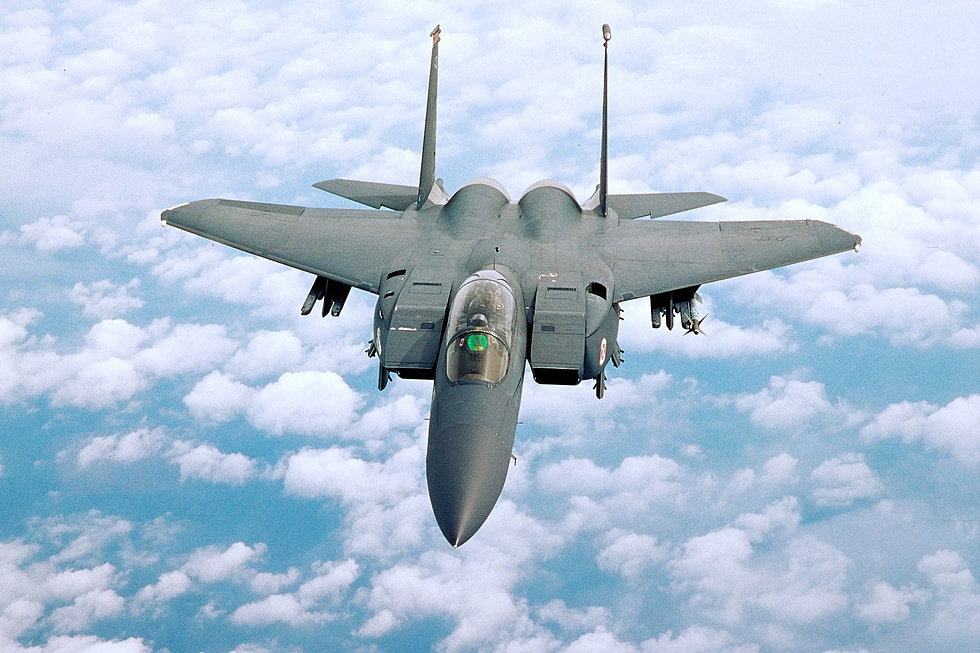
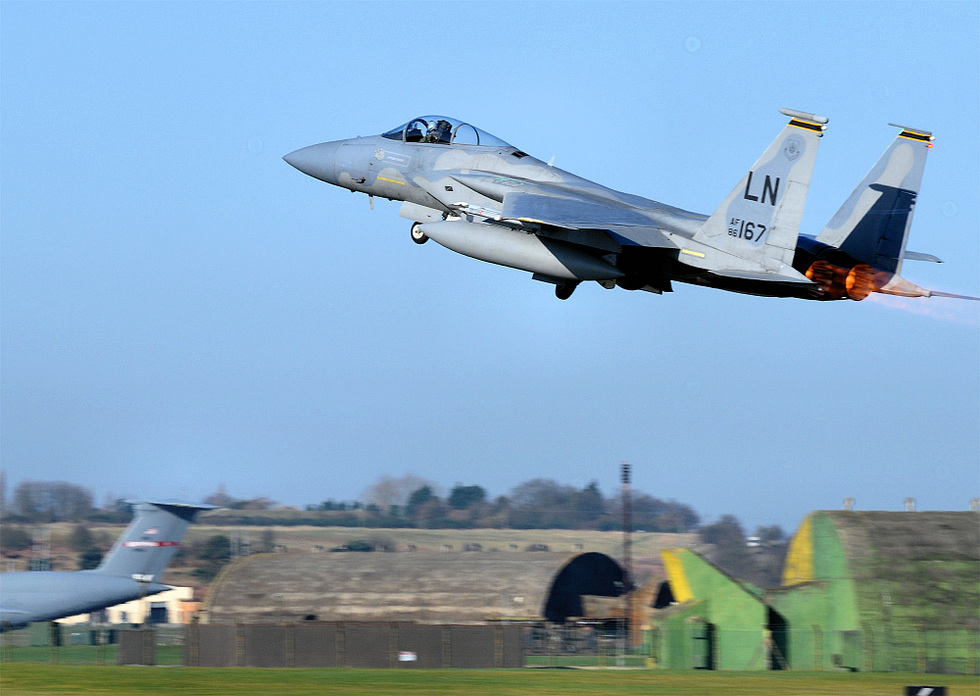
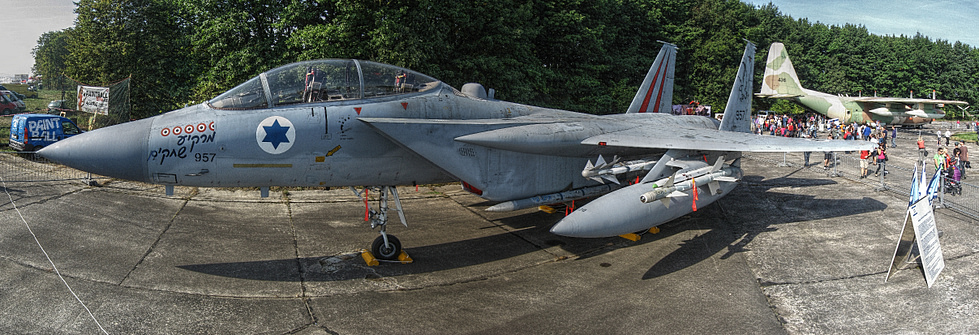
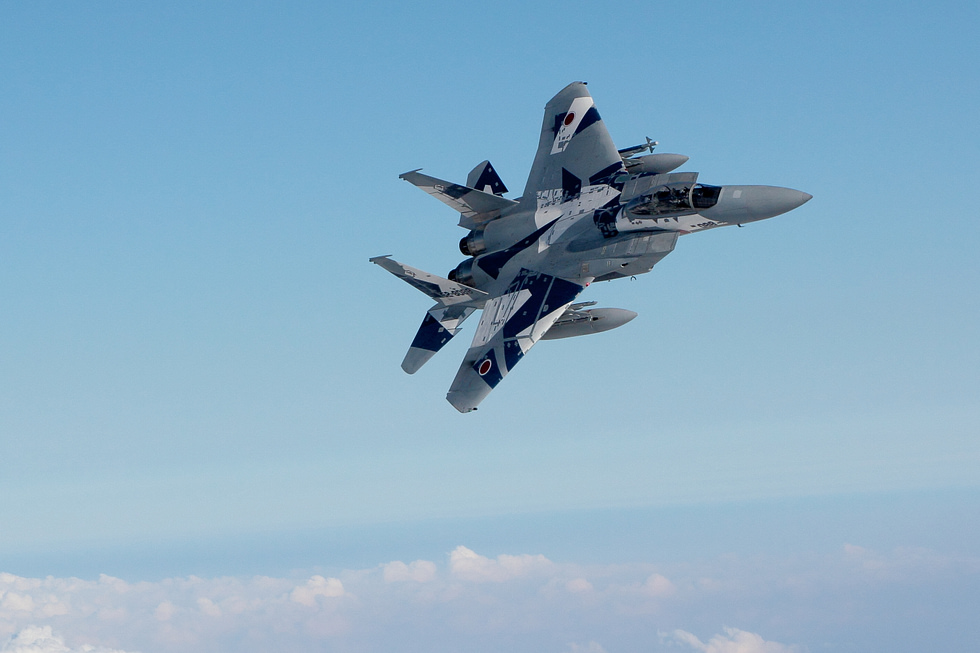
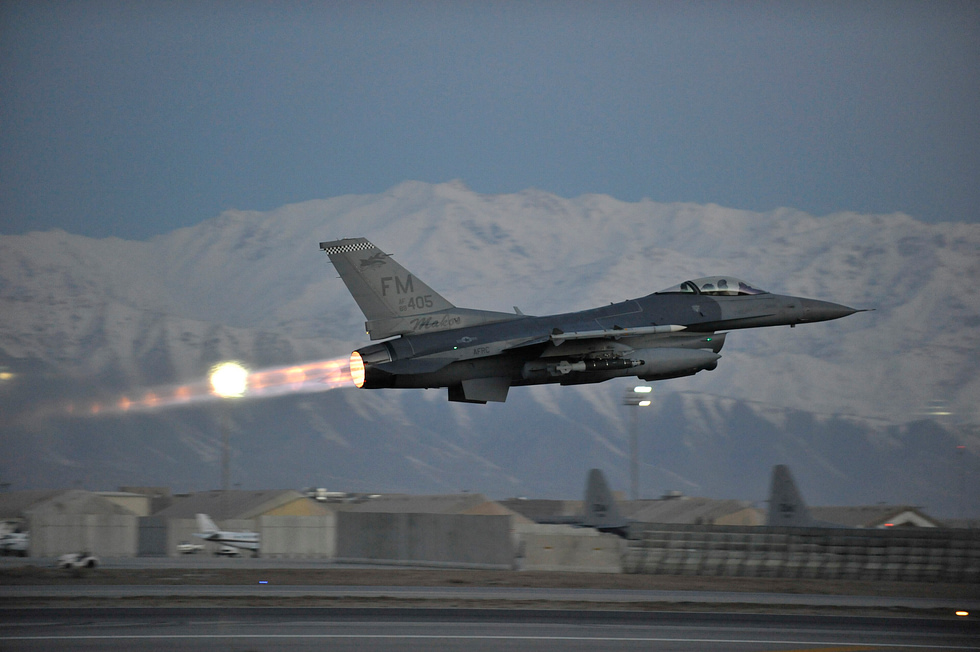
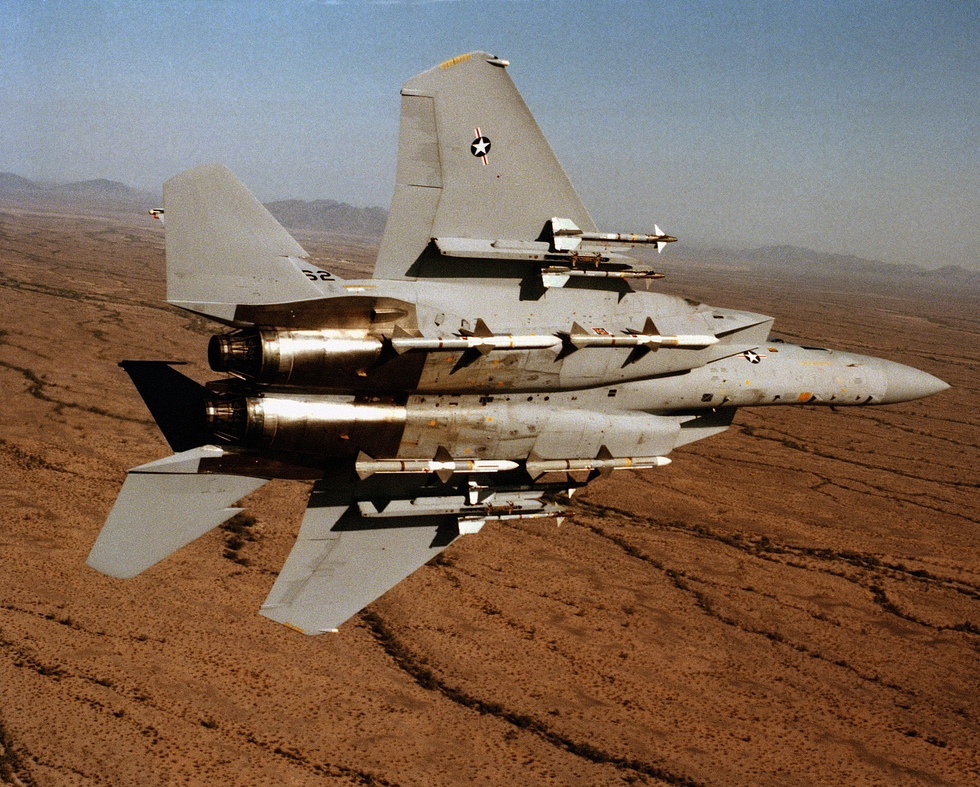
The Eagle in motion
A documentary look at the F-15A–D Eagle is coming soon.
Where the Eagle flies
The undefeated air-superiority fighter
The F-15’s air-to-air record is unique among modern fighters: across American, Israeli and Saudi service it is credited with roughly 104 kills for no confirmed air-to-air losses. That figure is an aggregate, and enemy claims of downed Eagles have surfaced over the years — but none has ever been substantiated, so it is best cited as “no confirmed losses.”
Compare the combat record of every military aircraft. Figures as of July 2026.
Everything people ask about the F-15 Eagle
Can I fly in an F-15?
How fast is the F-15?
Is the F-15 really undefeated?
Is the F-15 still in service?
How does the F-15 compare with the Su-27?
How many F-15s were built?
What is the difference between the F-15 and the F-15E?
Why was the F-15 built?
You can’t fly the F-15.
These, you can.
Some legends only live in museums — others are fuelled and waiting. MiGFlug has put civilians in real military jet cockpits since 2004.
 Fly the L-39 AlbatrosThe world’s most-flown jet trainer — aerobatics included
 Fly the F-104 Starfighter“The missile with a man in it”
 Fly the MiG-21The Cold War’s most-produced jet
 טסו על ה-T-33 Shooting StarAmerica’s first jet trainer
 Fly the DH VampireA piece of early jet history
 Fly the S.211Agile Italian jet trainer
 Fly the MB-326The classic Aermacchi jet
 Fly the MiG-15The Soviet legend of the Korean War
Continue the tour
Every fact, checked
- GlobalSecurity.orgF-15 specifications, powerplant and production overview.
- RJLee.org — Gulf War air-to-air victoriesDetailed accounting of USAF F-15C kills in Desert Storm.
- The Aviation Geek ClubThe 1975 “Streak Eagle” time-to-climb records.
- The AviationistThe 1983 one-wing landing and the 2004 Cope India exercise.
- Smithsonian Magazine“The First Space Ace” — the 1985 ASM-135 satellite kill.
- The National InterestThe Eagle’s 1979 combat debut in Israeli service.
- GlobalMilitary.netProduction totals and operator breakdown for the A–D Eagle.
- National Museum of the U.S. Air ForceThe preserved Streak Eagle and F-15 development history.