
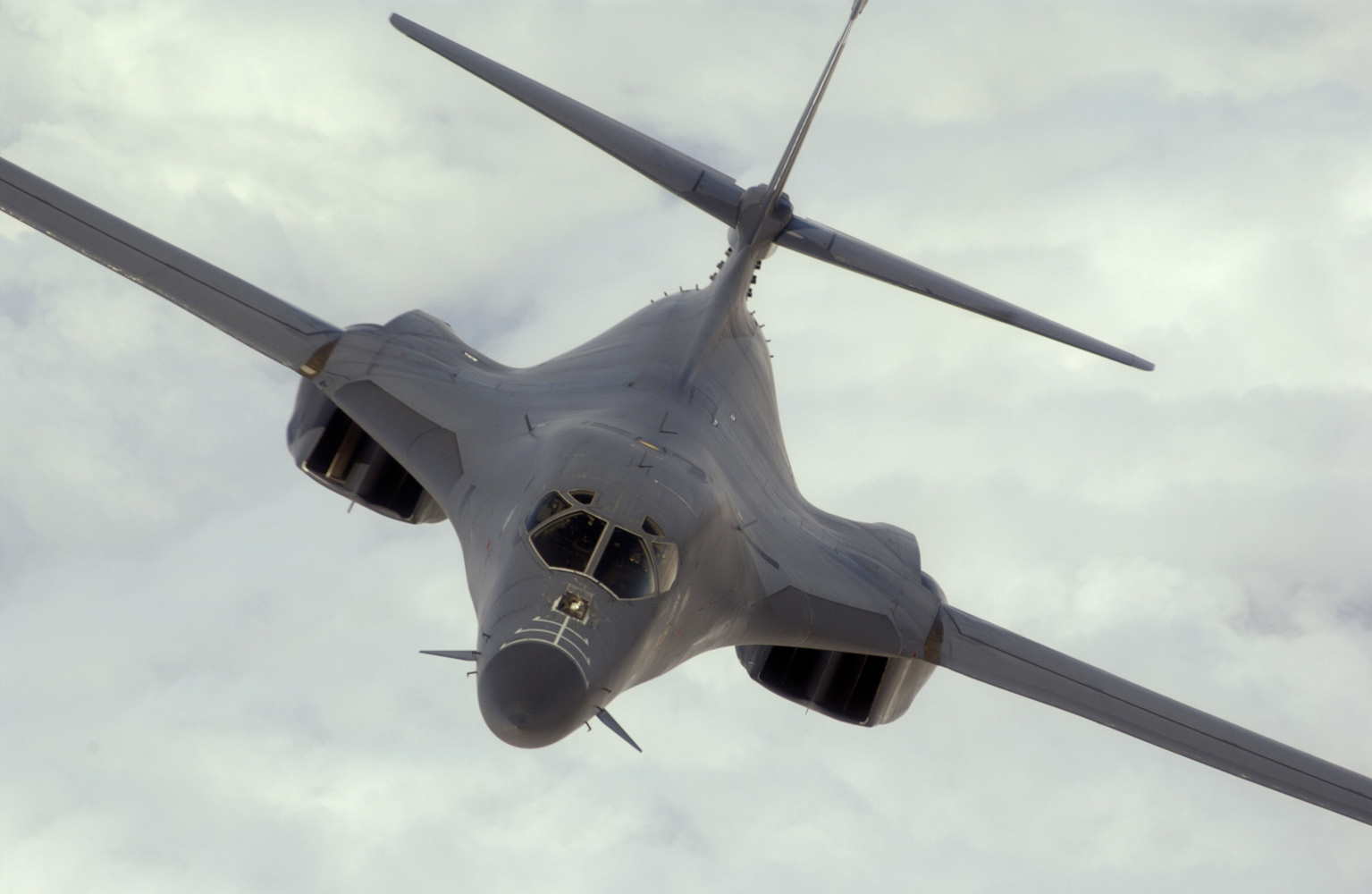
Rockwell B-1 Lancer
“The Bone”
A variable-sweep, four-engine supersonic heavy bomber — cancelled by one president, revived by another, and turned from a nuclear penetrator into the conventional-strike workhorse of America’s wars.
Cancelled, revived, and sent to war
The B-1 was born to solve a Cold-War problem: how to get a manned bomber through increasingly dense Soviet air defences after the high-flying B-52 had become vulnerable to surface-to-air missiles. Rockwell’s answer was the B-1A — a sleek, variable-sweep-wing bomber able to dash at high altitude and, crucially, sprint fast and low under radar. It first flew on 23 December 1974. But it was expensive, and in June 1977 President Jimmy Carter cancelled the B-1A, betting instead on cruise missiles and the emerging technology of stealth.
The programme did not die. President Ronald Reagan revived it in 1981 as the B-1B — a redesigned aircraft optimised not for high-altitude speed but for low-level penetration, with a strengthened airframe, a far greater payload and a dramatically reduced radar signature. The first B-1B flew on 18 October 1984 and the type entered service in 1986. One hundred were built, nicknamed the “Bone” — a play on “B-One.”
Ironically, the nuclear penetrator never dropped a bomb in anger during the Cold War. Through the 1990s and 2000s the B-1 was reoriented away from the nuclear mission entirely and rebuilt as a conventional bomber — and in that role it found its true career. Carrying the largest internal payload of any bomber in the US inventory, it became the workhorse of American air power over Iraq, Kosovo, Afghanistan and against ISIS, dropping vast tonnages of precision JDAMs. Now, as the stealthy B-21 Raider enters service, the ageing Bone is finally being retired.
01The Rockwell B-1 Lancer’s cancellation and revival: how one bomber survived two presidents
When Jimmy Carter cancelled the B-1A on 30 June 1977, he did so believing that air-launched cruise missiles carried by B-52s, together with the still-secret stealth bomber programme that would become the B-2, made a costly new penetrating bomber unnecessary. The decision was hugely controversial and became a political flashpoint.
Ronald Reagan campaigned partly on restoring it, and in 1981 his administration approved 100 B-1B aircraft. The revived jet was not the old B-1A: it traded the A-model’s Mach-2-plus high-altitude dash for a stronger structure, higher weights, fixed engine inlets and radar-absorbent shaping that cut its radar cross-section to roughly a hundredth of the B-52’s. It was, in effect, a different aircraft built for a different way of getting to the target — fast and low, rather than high and fast.
What makes it special
Variable-sweep wing and a blended body
The Bone’s wings pivot from 15° spread for takeoff and efficient cruise to 67.5° fully swept for high-speed, low-level dashes. Married to a blended wing-body that smooths airflow and helps carry fuel and payload, the design lets a 200-tonne bomber fly fast and low, hugging the terrain to slip beneath enemy radar — the core idea of the B-1B.
The largest internal payload in the fleet
Three cavernous internal weapons bays give the B-1B the largest internal payload of any bomber in US service — up to about 34,000 kg (75,000 lb) of ordnance. It can carry 84 Mk 82 bombs, 24 GBU-31 JDAMs or 24 JASSM cruise missiles internally, with no drag or radar penalty from external pylons. That deep magazine is what makes it a conventional-strike heavyweight.
Four F101 turbofans and a smaller signature
Power comes from four General Electric F101-GE-102 augmented turbofans, each around 137 kN (30,780 lbf) in afterburner — the engine core that later spawned the F110 and F118. Combined with serpentine intakes and radar-absorbent design, the B-1B has a radar cross-section far smaller than the B-52’s — not stealthy like the B-2, but far harder to see than the jet it was meant to replace.
02The B-1B Lancer’s variable-sweep wing: why a heavy bomber needed swing wings
A bomber built to penetrate at low level faces a contradiction. To take off heavy, loiter efficiently and land safely it wants a long, straight wing; to punch through the dense low-altitude air at high speed without being torn apart by turbulence it wants a short, sharply swept one. The variable-sweep wing solves both: spread to 15° for takeoff and cruise, and swept back to 67.5° for the high-speed dash. The penalty is weight and mechanical complexity in the wing pivot, but for the B-1B’s fast-and-low mission it was judged worth it — the same reasoning that gave swing wings to the F-111, F-14 and Soviet Tu-160.
03The B-1 Lancer’s conversion from nuclear to conventional: the bomber that changed jobs
The B-1B entered service as a nuclear penetrator, but it never carried nuclear weapons in combat. After the Cold War the type was progressively removed from the nuclear mission — its nuclear wiring and hardware stripped out through the 1990s and formally accounted for under later arms-control treaties — and rebuilt as a purely conventional bomber. Upgrades gave it precision JDAMs, a targeting pod, a moving-target radar and a data link, turning a jet designed to deliver free-fall nuclear bombs into the most prolific precision-strike platform of the post-9/11 wars. It is one of the clearest examples of a strategic aircraft finding an entirely new career.
Full specifications
Figures are for the production B-1B. Contested or variable values (ceiling, exact payload) are hedged; performance depends heavily on load and configuration.
Airframe & Performance
- צוות
- 4 (pilot, co-pilot, 2 weapon systems officers)
- מֶשֶׁך
- 44.5 m (146 ft)
- Wingspan (spread)
- 41.8 m (137 ft) at 15°
- Wingspan (swept)
- 24.1 m (79 ft) at 67.5°
- גוֹבַה
- 10.4 m (34 ft)
- Max takeoff weight
- ~216,000 kg (477,000 lb)
- Max speed
- ~Mach 1.25 at altitude
- תקרת השירות
- ~18,000 m (~60,000 ft)
- לָנוּעַ
- ~11,999 km intercontinental, air-refuelable
Propulsion, Payload & Cost
- Engines
- 4 × GE F101-GE-102 afterburning turbofans
- Thrust (each)
- ~137 kN (30,780 lbf) with afterburner
- Internal payload
- ~34,000 kg (75,000 lb) across 3 bays
- Typical weapons
- 84 Mk 82, 24 GBU-31 JDAM or 24 JASSM
- First flight
- B-1A 23 Dec 1974 · B-1B 18 Oct 1984
- Built
- 100 B-1B (plus 4 B-1A prototypes)
- Unit cost
- ~US$317 million (1998, program flyaway)
- Cost per flight hour
- ~US$60,000–70,000 (commonly cited, estimate)
04The B-1 Lancer’s operating costs: why the Bone is expensive to keep flying
The B-1 is a big, complex, ageing four-engine aircraft, and it costs accordingly. Program flyaway costs in the late 1990s were commonly cited around US$280–320 million per aircraft, and the cost per flight hour is frequently quoted in the US$60,000–70,000 range — among the higher figures in the bomber fleet. Low-altitude, high-speed flying is hard on airframes, and years of heavy use over Afghanistan and Iraq wore the fleet down. Rising maintenance costs and airframe fatigue are among the reasons the US Air Force is retiring the type as the B-21 Raider comes online. Treat any single dollar figure as an order-of-magnitude estimate rather than an audited number.
From AMSA to the B-21 handover
B-1A first flight
Rockwell’s variable-sweep B-1A prototype makes its maiden flight on 23 December 1974, aimed at high-altitude supersonic penetration.
Carter cancels the B-1A
President Carter halts production in June 1977, betting on cruise missiles and the secret stealth-bomber programme instead.
Reagan revives it as the B-1B
The Reagan administration approves 100 redesigned B-1B bombers, optimised for low-level penetration rather than high-altitude dash.
B-1B first flight
The first production-standard B-1B flies on 18 October 1984, with a stronger structure and a far smaller radar signature.
Enters service
The B-1B reaches initial operational capability at Dyess AFB in October 1986 as a nuclear penetrator for Strategic Air Command.
Combat debut — Desert Fox
On 17–18 December 1998 the B-1B drops its first bombs in anger over Iraq, twelve years after entering service.
The conventional workhorse
Kosovo, Afghanistan and Iraq turn the denuclearised Bone into America’s go-to precision bomber, dropping huge JDAM loads.
The anti-ISIS campaign
B-1s fly long strike sorties over Syria and Iraq against ISIS, at times delivering a large share of the coalition’s bomb tonnage.
Retirement for the B-21
The Air Force begins drawing down the fleet in 2021, with full retirement planned as the stealthy B-21 Raider enters service.
Twelve B-1 Lancer stories
The bomber Carter killed
In 1977 President Carter cancelled the B-1A, calling it unnecessary in the age of cruise missiles.
Read the full story
Reagan brings it back
Ronald Reagan revived the programme in 1981, ordering 100 redesigned B-1B bombers.
Read the full story
Why they call it the Bone
Crews nicknamed the B-1 the “Bone” — a play on writing out B-One.
Read the full story
Wings that swing
The B-1’s wings pivot from 15 degrees to 67.5 degrees to fly both slow and supersonic.
Read the full story
The deepest magazine in the fleet
No US bomber carries more ordnance internally than the B-1B.
Read the full story
A twelve-year wait for war
The B-1B did not drop a bomb in anger until 1998, over a decade after entering service.
Read the full story
Loitering gunship of the sky
Over Afghanistan the B-1 became an on-call bomb truck for troops below.
Read the full story
Bomb tonnage over Syria
During the campaign against ISIS, B-1s delivered a huge share of the coalition’s ordnance.
Read the full story
Sixty-plus world records
The B-1 has set dozens of FAI-recognised records for speed, payload and distance.
Read the full story
A nuclear jet with no nukes
Through the 1990s the B-1 was stripped of its nuclear role entirely.
Read the full story
Four crew, one Bone
The B-1 flies with a crew of four on ejection seats — not the lone pilot of a fighter.
Read the full story
Making way for the Raider
As the stealthy B-21 arrives, the Bone is finally heading for retirement.
Read the full story
The Bone in pictures
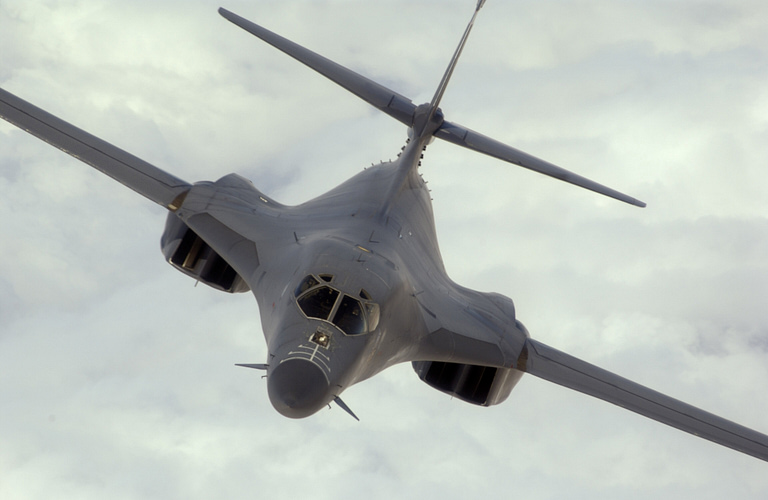
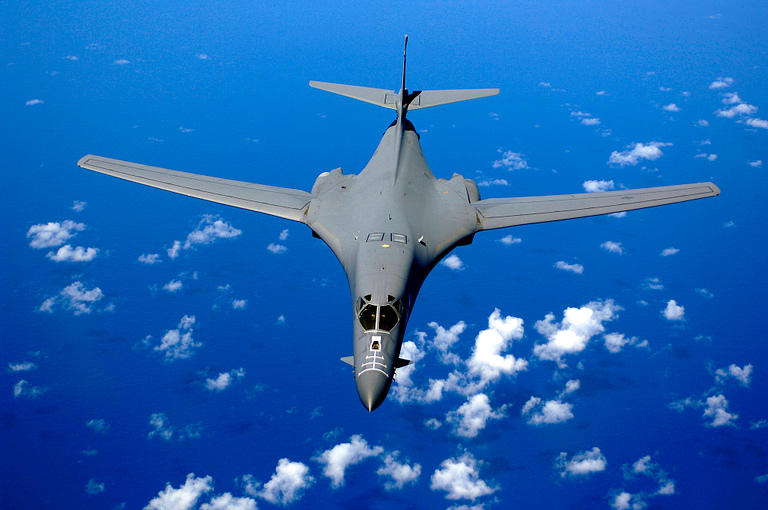
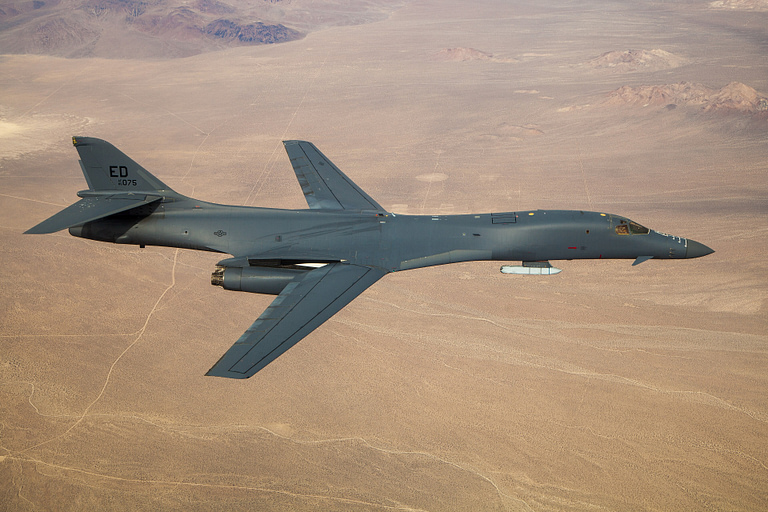
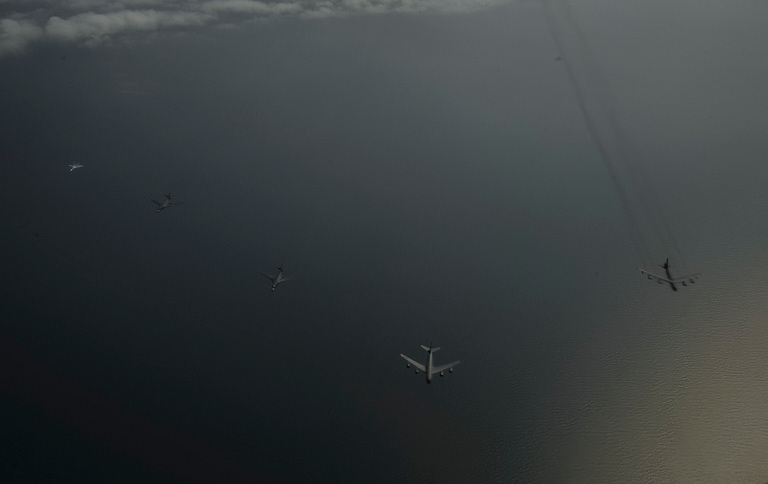
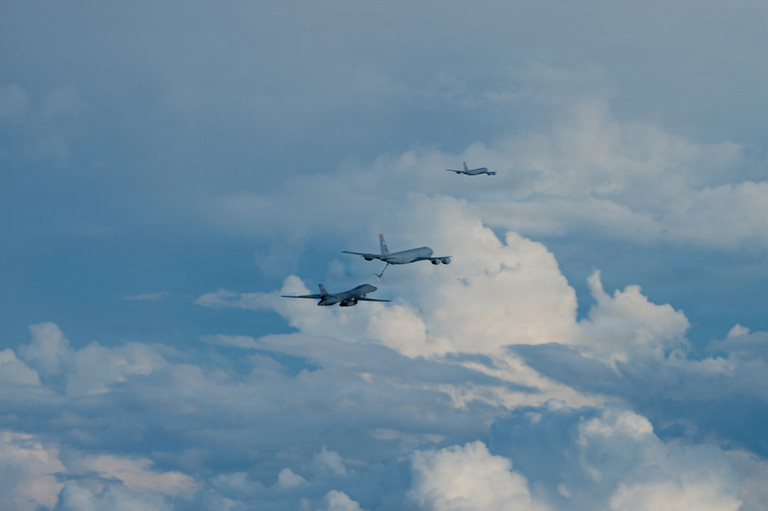
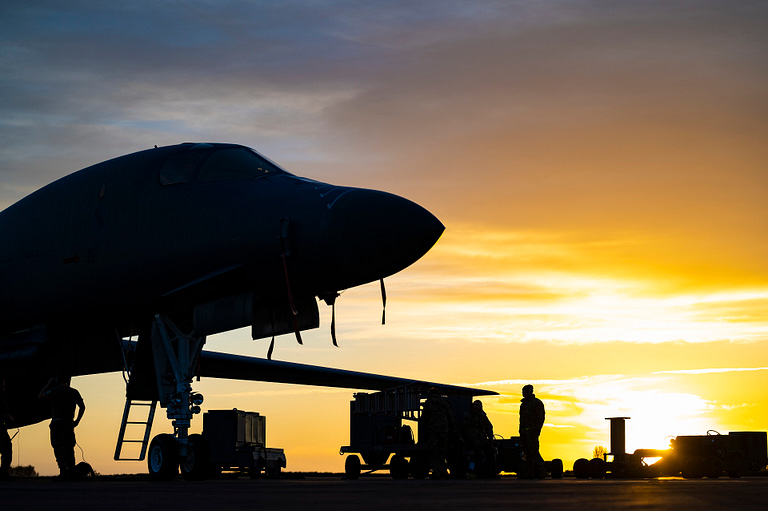
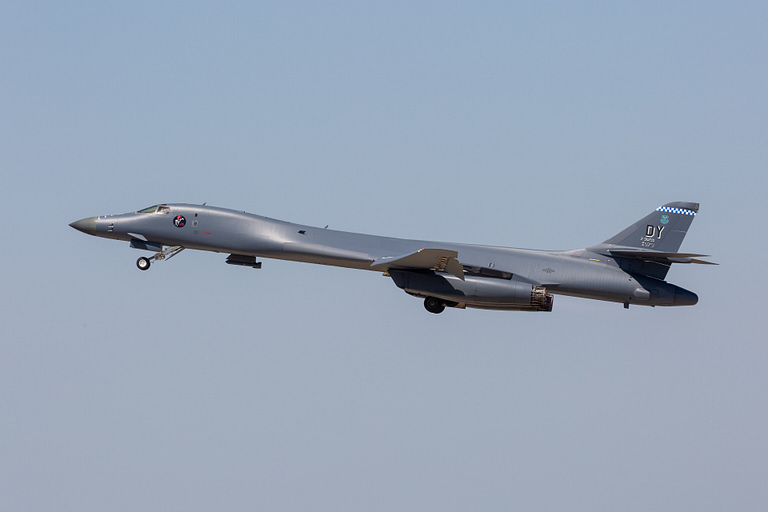
The B-1 Lancer in motion
A curated video feature for the B-1 Lancer is coming soon. In the meantime, explore the photo gallery above and the operations map below.
Where the B-1 flies
The record that defines it
The B-1 is not an air-to-air fighter and holds no aerial kills — its record is written in bomb tonnage. Built as a nuclear penetrator it never fought the Cold War, but after being reborn as a conventional bomber it became one of the hardest-working strike aircraft in the US inventory. Its combat debut came in Operation Desert Fox over Iraq in December 1998; it went on to serve over Kosovo, Afghanistan and Iraq, and during the campaign against ISIS it repeatedly delivered a large share of the coalition’s bombs. Along the way B-1 crews have set dozens of world records for speed, payload and distance.
Compare the combat record of every military aircraft. Figures as of July 2026.
Everything people ask about the B-1 Lancer
Can I fly in a B-1?
Why was the B-1 cancelled and then revived?
Why is the B-1 nicknamed the “Bone”?
Does the B-1 carry nuclear weapons?
How much can a B-1 carry?
How fast is the B-1?
Is the B-1 being retired?
You can’t fly the B-1.
These, you can.
Some legends only live in museums — others are fuelled and waiting. MiGFlug has put civilians in real military jet cockpits since 2004.
 Fly the L-39 AlbatrosThe world’s most-flown jet trainer — aerobatics included
 Fly the F-104 Starfighter“The missile with a man in it”
 Fly the MiG-21The Cold War’s most-produced jet
 טסו על ה-T-33 Shooting StarAmerica’s first jet trainer
 Fly the DH VampireA piece of early jet history
 Fly the S.211Agile Italian jet trainer
 Fly the MB-326The classic Aermacchi jet
 Fly the MiG-15The Soviet legend of the Korean War
Continue the tour
Every fact, checked
- U.S. Air Force — B-1B Lancer fact sheetOfficial specifications, payload, crew and service history.
- U.S. Strategic Command — 25 years since the B-1’s combat debutThe 1998 Operation Desert Fox combat debut and later operations.
- Air & Space Forces Magazine — B-1 weapons profileDimensions, engines, production numbers and first-flight dates.
- Smithsonian — “The Bone Is Back”On the aircraft’s reinvention as a conventional bomber and its nickname.
- The National Interest — the B-1 from the Cold War to SyriaCancellation, revival and the anti-ISIS bombing campaign.
- The Aviationist — Rockwell B-1 LancerDesign, variable-sweep wing and denuclearisation background.
- Airman Magazine — B-1B LancerCrew perspective, mission role and the “Bone” nickname.
- National Museum of the U.S. Air Force — B-1B LancerProgramme history and preserved-airframe reference.