
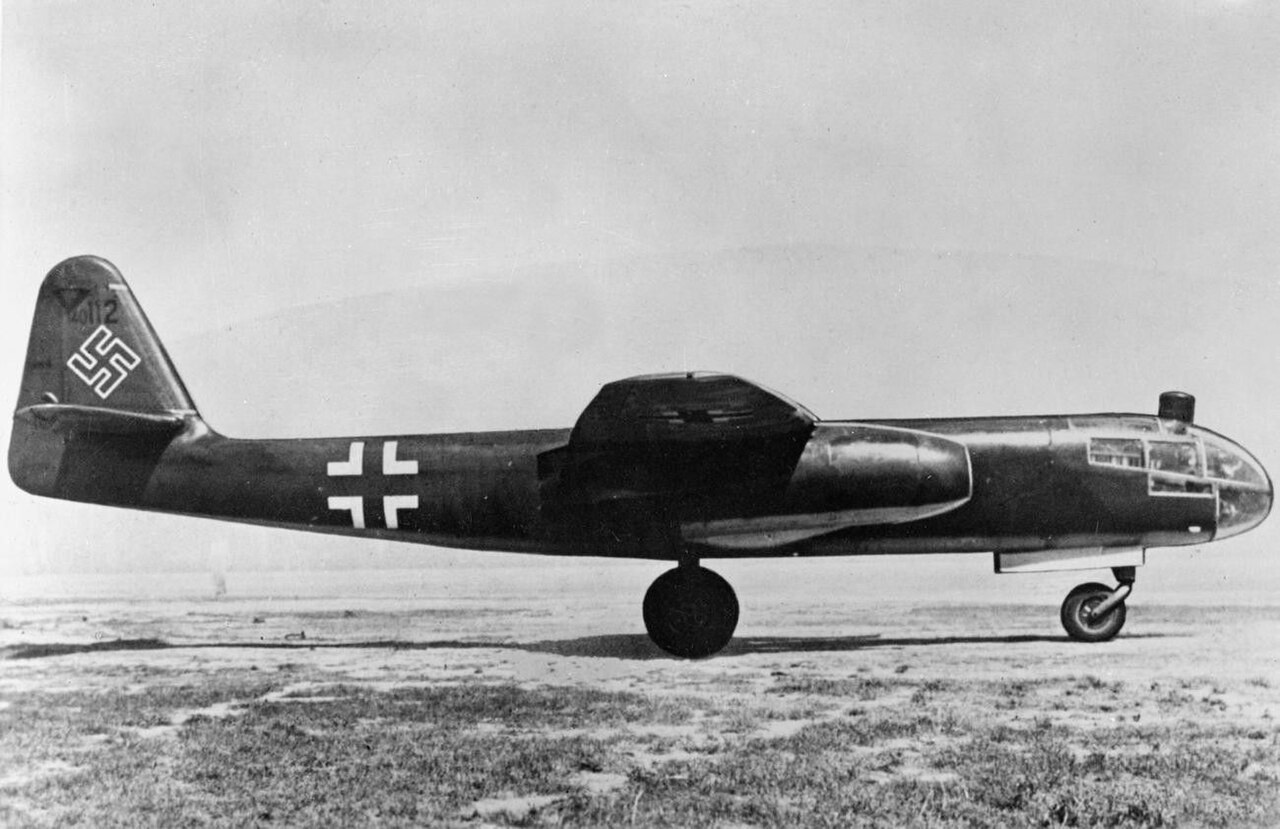
Ar 234 Blitz
The world’s first jet bomber
Too fast to catch and too late to matter — Arado’s twin-jet Blitz flew reconnaissance no Allied fighter could touch, and dropped the first bombs of the jet age.
The Ar 234 Blitz: the first bomber of the jet age
In the last year of the war, Allied troops and radar crews began reporting a strange, fast aircraft they could neither catch nor identify: a slim, twin-jet machine that crossed the front at nearly 500 mph and simply vanished. It was the Arado Ar 234 Blitz — “Lightning” — the world’s first operational jet bomber, and for a few months it flew over Allied territory almost at will.
Designed by Walter Blume’s team at Arado, it began life as a jet reconnaissance aircraft. To save weight and drag, the earliest prototypes had no landing gear at all: they took off from a jettisonable wheeled trolley and landed on skids, then had to be craned back onto the trolley. Production Ar 234Bs got a conventional tricycle undercarriage, but the philosophy never changed — everything was sacrificed to speed. A single pilot sat in a fully glazed nose, and to aim his bombs he switched on an autopilot and sighted through a periscope, because there was no bombardier and no room for one.
Its reconnaissance career was a genuine success. From August 1944 the Ar 234 flew photo missions over Britain and the Allied beachhead in Normandy that piston-engine fighters simply could not intercept; it was the last German aircraft to overfly the United Kingdom during the war, in April 1945, and among its most valuable images were those of the Rhine bridges.
As a bomber it was far less effective. In the war’s final months, Ar 234s of Kampfgeschwader 76 struck targets in the Low Countries and, most famously, made repeated raids on the captured Ludendorff Bridge at Remagen in March 1945 — carrying 1,000 kg bombs, flying through heavy flak, and mostly missing. There were never enough of them: only about 210 were built, hobbled by shortages of fuel, engines and skilled labour, and by Jumo 004 turbojets that wore out after roughly ten hours of running.
It was a technological marvel that arrived with an empty fuel tank. Like the Me 262 jet fighter and the Me 163 rocket interceptor, the Blitz showed what German jet engineering could achieve — and how little difference it could make by 1945, when the Reich had neither the fuel to fly its jets nor the time to build them in numbers.
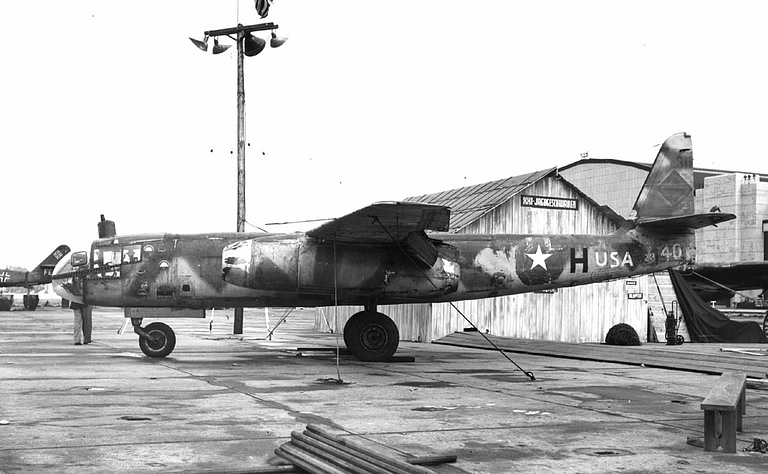
One Ar 234 survives: a B-2 bomber captured in Norway, shipped to America aboard a British carrier, and now displayed at the Smithsonian — the only complete example of the aircraft that opened the age of the jet bomber, a lineage that runs from this slim grey machine straight to the stealth bombers of today.
01Why the Ar 234 Blitz couldn’t change the war
The Ar 234 could do things no Allied aircraft could — outrun every fighter, photograph the front at will, drop bombs from the jet age. And none of it mattered, because there were only about 210 of them and Germany was collapsing. The Jumo 004 engines were unreliable and thirsty; fuel was almost gone; trained pilots and mechanics were scarce; and most airframes sat grounded or were destroyed on the ground.
The Blitz, like the Me 262 and Me 163, is a lesson in how technology alone does not win wars. It was years ahead of its time and arrived far too late to use that lead.
How the Ar 234 Blitz was built
Built for speed alone
The Blitz was a slim, clean airframe wrapped around two jet engines and almost nothing else — no gun turrets, no bomb bay, no second crewman. Everything not essential to going fast was left out, which is exactly why nothing the Allies flew could catch it.
Trolley, skids — then wheels
Early prototypes had no undercarriage at all: they took off on a jettisonable wheeled trolley and landed on retractable skids. Production Ar 234Bs added conventional tricycle landing gear, and rocket pods could be fitted under the wings to shorten the long jet takeoff run.
One pilot, an autopilot and a periscope
A single pilot flew from a fully glazed nose. With no bombardier, he aimed by engaging an autopilot coupled to a periscope bombsight; the reconnaissance versions carried cameras in the rear fuselage instead of bombs.
02The Ar 234’s Jumo 004 engines: the jets that wore out in ten hours
The Blitz was powered by two Junkers Jumo 004 axial-flow turbojets — the same engines as the Me 262, and the first mass-produced jet engines in the world. They were a genuine breakthrough, but a fragile one: starved of the scarce heat-resistant alloys jet turbines need, they burned out after only about ten hours of running and had to be overhauled or replaced constantly.
Combined with Germany’s collapsing fuel supply and Arado’s competition for engines with the Me 262 and other programmes, the unreliable Jumo 004 was one of the main reasons the Ar 234 was built in such small numbers and flew so rarely.
03The Ar 234’s takeoff and landing: trolleys, skids and rocket assistance
To keep the early prototypes light, Arado gave them no landing gear: an Ar 234 took off riding a three-wheeled trolley that was jettisoned once airborne, and landed on a sprung skid under the fuselage and two more under the engines. Test pilot Erich Sommer likened the brakeless skid landings to sliding “on soap.”
Production Ar 234Bs replaced this with a normal retractable tricycle undercarriage. Even then the jet’s takeoff run was long, so Walter HWK rocket pods were often slung under the wings to boost it into the air — especially when carrying a full bomb load.
Arado Ar 234 B-2 specifications
Airframe & Performance
- クルー
- 1
- 長さ
- 12.64 m (41 ft 5 in)
- 翼幅
- 14.11 m (46 ft 3 in)
- 空虚重量
- 5,200 kg (11,460 lb)
- Max takeoff weight
- 9,800 kg (21,600 lb)
- Max speed
- 742 km/h (461 mph) at 6,000 m
- サービス天井
- 10,000 m (32,800 ft)
- 範囲
- ~1,556 km with a 500 kg bomb load
Propulsion, Armament & Programme
- Engines
- 2 × Junkers Jumo 004B turbojets, ~8.8 kN (1,990 lbf) each
- Bombload
- Up to 1,500 kg on external racks (no internal bomb bay)
- Defensive armament
- 2 × 20 mm rearward, periscope-aimed — usually omitted
- First flight
- 30 July 1943
- Built
- ~210
- Operator
- Nazi Germany (Luftwaffe — KG 76 and reconnaissance units)
- Cost per flight hour
- Not recorded — a WWII type, retired 1945
- Survivors
- One (Smithsonian) — the only complete Ar 234 left
04The Ar 234’s variants: the B, the four-engine C, and the paper projects
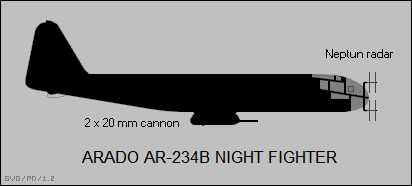
The main service version was the twin-jet Ar 234B, split between B-1 reconnaissance aircraft with cameras and B-2 bombers. A four-engine Ar 234C, using four smaller BMW 003 jets in paired nacelles, was developed for more power and speed, but only about fourteen were completed by the surrender, most without engines. Night-fighter conversions and further C, D and P projects were drawn up but never reached service. In all, only around 210 aircraft of all types were built.
05The one that survived: the Smithsonian’s Ar 234
The sole surviving Ar 234 is a B-2 bomber, Werk-Nummer 140312, that served with Kampfgeschwader 76 in the final weeks of the war and surrendered to British forces in Norway. Famously, test pilot Eric “Winkle” Brown arranged to trade it to the Americans in exchange for an interview with the captured Hermann Göring. Shipped to the United States in 1945, it eventually passed to the Smithsonian and is now displayed at the Udvar-Hazy Center — with its rocket takeoff pods fitted, possibly the only such units mounted on the type that used them.
The Ar 234 Blitz, from trolley to the Smithsonian
A jet recon aircraft is ordered
Germany’s air ministry issues a tender for a fast jet reconnaissance aircraft; only Arado responds.
First flight
On 30 July the first Ar 234 takes off — from a jettisonable trolley — at Rheine.
Wheels, then war
The tricycle-geared V9 flies in March; the first jet reconnaissance mission is flown on 2 August.
Unseen over Britain
Ar 234s photograph Britain and the Normandy front, uncatchable by Allied fighters.
The Remagen raids
In March, KG 76 Ar 234s repeatedly bomb the captured Ludendorff Bridge at Remagen.
Last over Britain
In April an Ar 234 makes the last German overflight of the United Kingdom of the war.
The end
Germany surrenders in May; surviving Ar 234s are captured and evaluated by the Allies.
The last Blitz
One Ar 234 B-2 survives, displayed at the Smithsonian.
The Ar 234 Blitz in eight stories
Photographs the Allies couldn’t stop
It flew over Britain and no fighter could reach it.
The full story
A jet with no wheels and no brakes
Early Ar 234s took off on a trolley and slid home on skids.
The full story
Bombing the bridge that wouldn’t fall
The Blitz’s most famous mission was a failure.
The full story
Jets that burned themselves out
The Jumo 004 was a breakthrough that kept breaking.
The full story
Bombing by autopilot
There was no bombardier — just a pilot and a gadget.
The full story
How the last Blitz reached America
A survivor was swapped for an interview.
The full story
The jet that couldn’t change the war
About 210 were built, and it made no difference.
The full story
The only one left
One complete Ar 234 survives, at the Smithsonian.
The full story
The Ar 234 Blitz in photographs
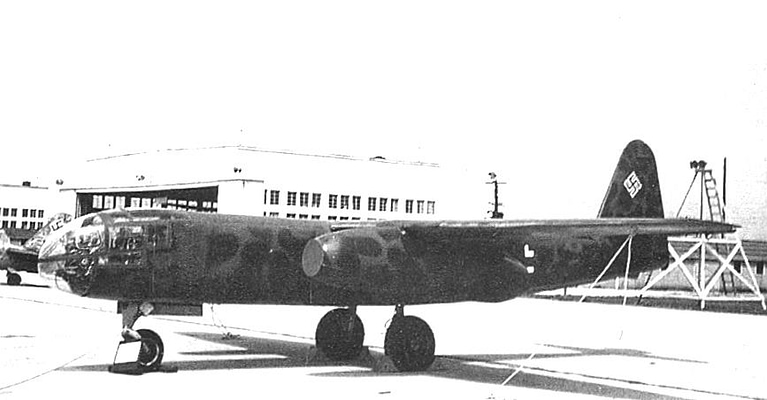
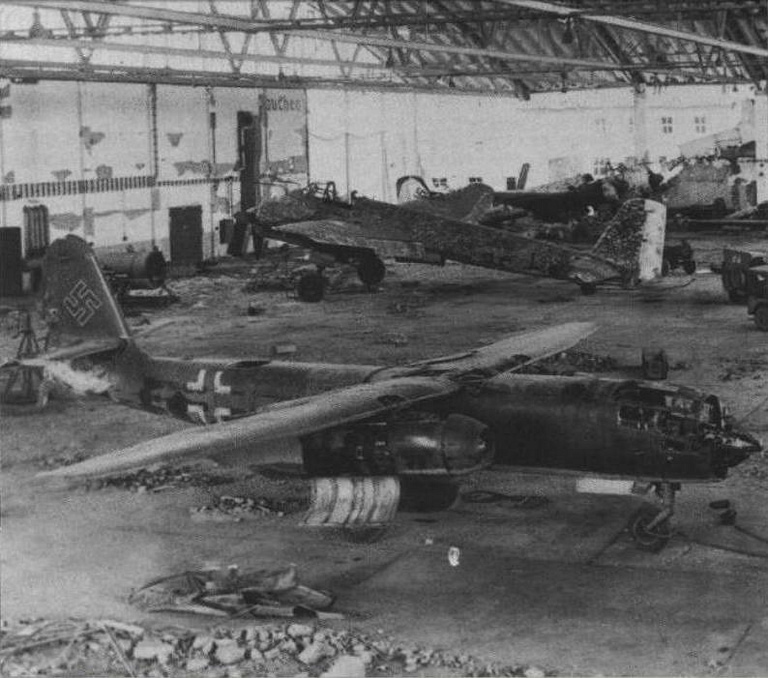
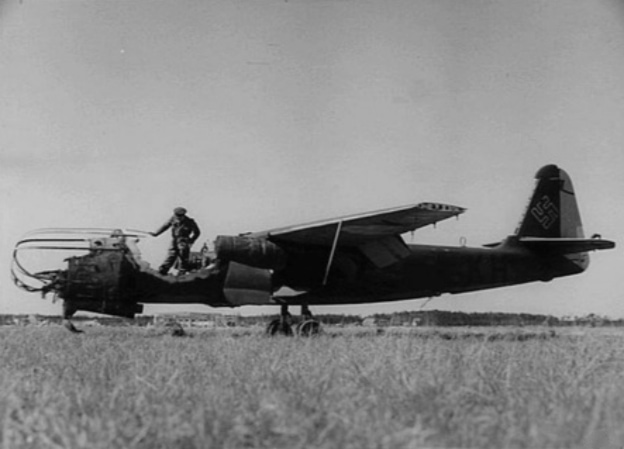
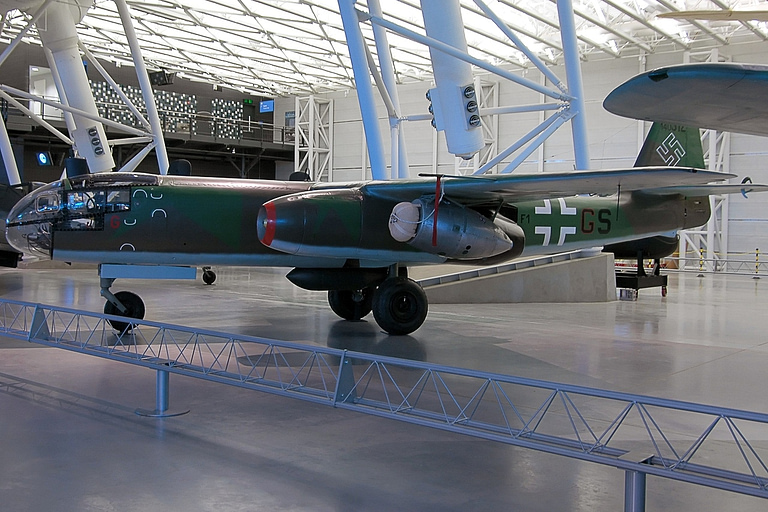
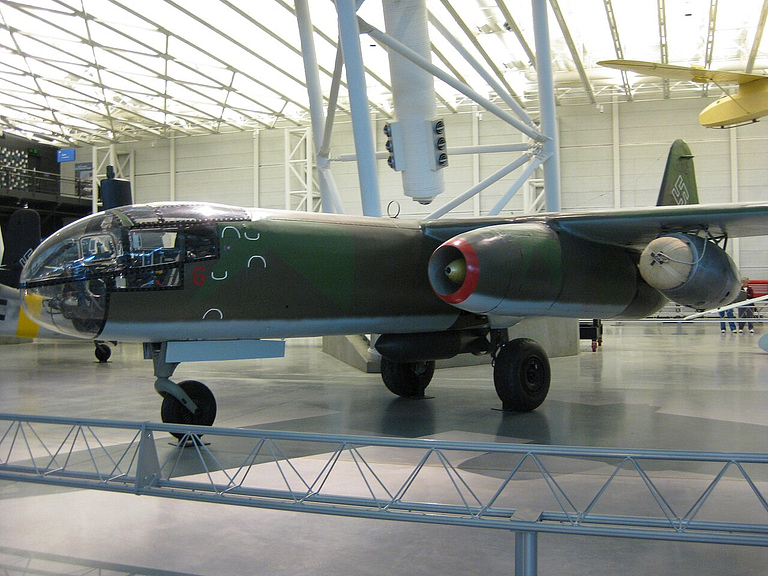
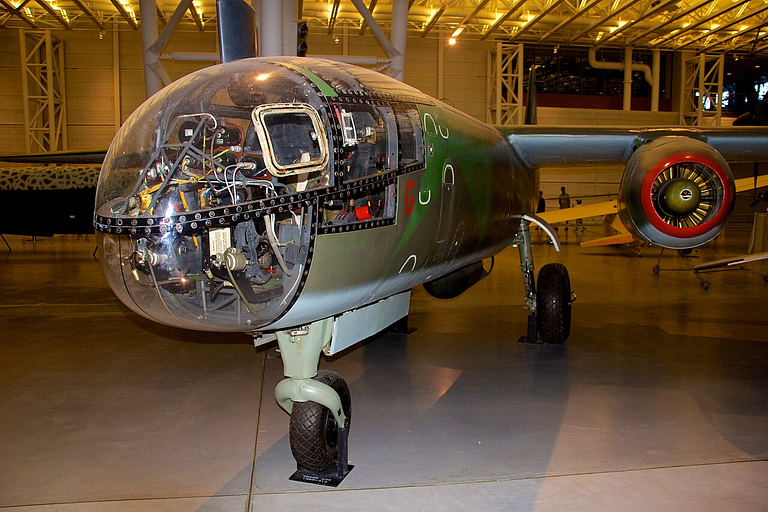
The first jet bomber
The story of the world’s first jet bomber — its reconnaissance triumphs, its bombing failures, and the variants that never came.
The Arado Ar 234 — the first jet bomber, and its variants (Military History Visualized).
Where the Ar 234 Blitz flew — and survives
First in the sky, and far too few
The Ar 234 was a reconnaissance triumph and a bombing footnote. It gathered intelligence no Allied fighter could stop — but as a bomber it was too few, too late and too inaccurate to change anything.
Its lasting achievement was reconnaissance the Allies could not intercept; as a bomber, shortages and inaccuracy kept it from mattering. Compare the combat record of every military aircraft.
Ar 234 Blitz: your questions, answered
Can I fly in an Arado Ar 234?
No — only one Ar 234 survives, in a museum, and it is not airworthy. But you can fly in a real military jet today: MiGFlug offers flights in genuine fighters and jet trainers such as the L-39 Albatros and the MiG-29. See migflug.com/flights-prices.
Was the Ar 234 the first jet bomber?
Yes — the Arado Ar 234 Blitz was the world’s first operational jet-powered bomber, and it also flew the first jet reconnaissance missions in history.
How fast was the Ar 234?
About 742 km/h (461 mph) — fast enough that Allied piston-engine fighters could not intercept it on its reconnaissance flights.
How did the Ar 234 take off and land?
Production aircraft used a conventional tricycle undercarriage. The early prototypes had no landing gear at all — they took off from a jettisonable trolley and landed on skids.
What did the Ar 234 do in the war?
Mostly high-speed reconnaissance over Britain and the Western Front, plus late-war bombing raids — most famously the repeated, largely unsuccessful attacks on the Remagen bridge in March 1945.
Why were so few Ar 234s built?
Shortages of fuel, engines and skilled labour, and unreliable Jumo 004 turbojets that wore out in about ten hours, held production to roughly 210 aircraft.
Do any Ar 234s survive?
One — a B-2 bomber at the Smithsonian’s Udvar-Hazy Center, the only complete Ar 234 left in the world.
You can’t fly the Ar 234 Blitz.
These, you can.
The Blitz belongs to history — but you can still strap into a genuine military jet. MiGFlug flies civilians in real fighters and jet trainers around the world.
 Fly the L-39 AlbatrosThe world’s most-flown jet trainer — aerobatics included
 Fly the F-104 Starfighter“The missile with a man in it”
 Fly the MiG-21The Cold War’s most-produced jet
 T-33シューティングスターを操縦しようAmerica’s first jet trainer
 Fly the DH VampireA piece of early jet history
 Fly the S.211Agile Italian jet trainer
 Fly the MB-326The classic Aermacchi jet
 Fly the MiG-15The Soviet legend of the Korean War
Related aircraft
Where this chapter comes from
- Smithsonian National Air and Space MuseumHolds the world’s only surviving Ar 234, with detailed history of the aircraft.
- National Museum of the U.S. Air ForceReference material on the Ar 234 and German jet development.
- Imperial War MuseumOn the Allied air war and the German jet and rocket programmes.
- イギリス空軍Context on the reconnaissance and bombing campaigns over the Western Front.
- MiGFlug — AfterburnerMiGFlug’s aviation magazine, on the German wonder-weapons and the dawn of the jet age.
Some Ar 234 figures — including the exact first-flight date and production totals — vary between sources; the most widely cited values are used here.