
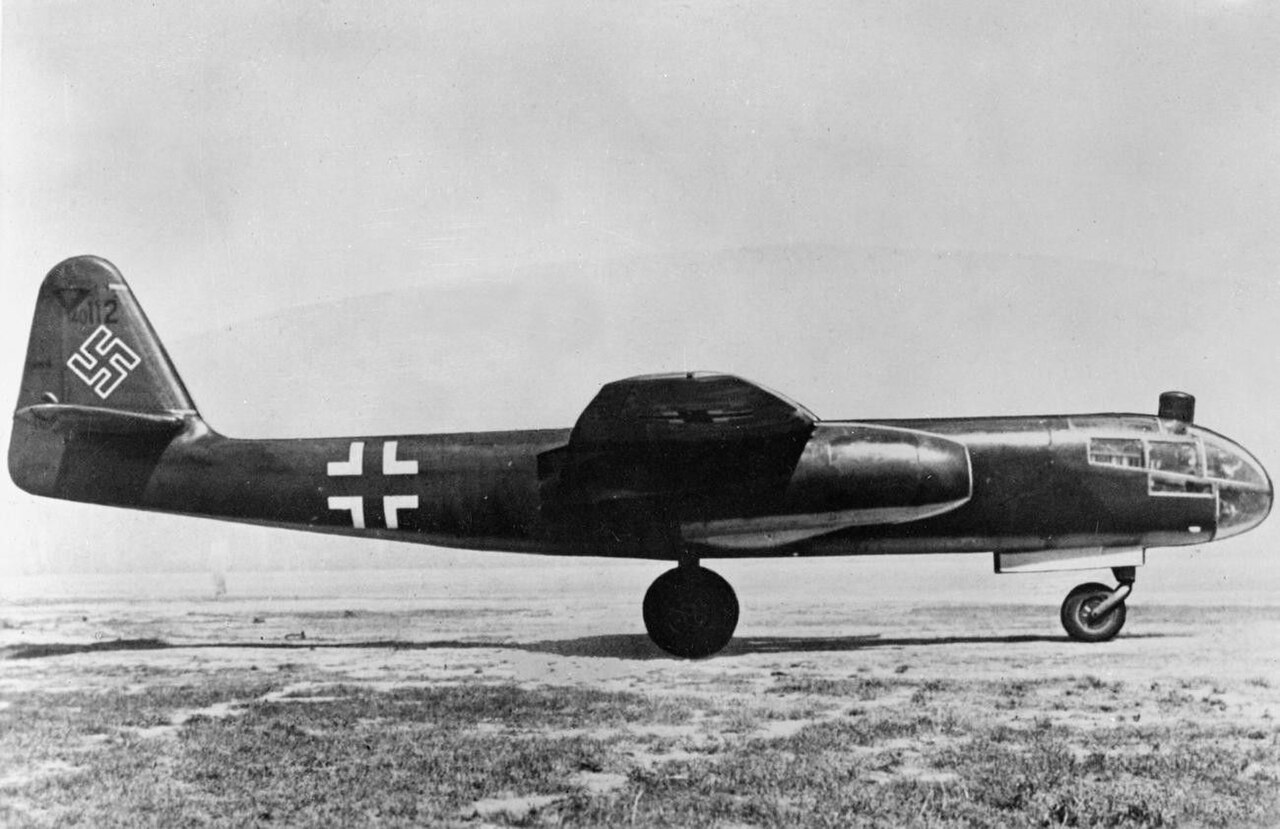
Ar 234 Blitz
The world’s first jet bomber
Too fast to catch and too late to matter — Arado’s twin-jet Blitz flew reconnaissance no Allied fighter could touch, and dropped the first bombs of the jet age.
The Ar 234 Blitz: the first bomber of the jet age
In the last year of the war, Allied troops and radar crews began reporting a strange, fast aircraft they could neither catch nor identify: a slim, twin-jet machine that crossed the front at nearly 500 mph and simply vanished. It was the Arado Ar 234 Blitz — “Lightning” — the world’s first operational jet bomber, and for a few months it flew over Allied territory almost at will.
Designed by Walter Blume’s team at Arado, it began life as a jet reconnaissance aircraft. To save weight and drag, the earliest prototypes had no landing gear at all: they took off from a jettisonable wheeled trolley and landed on skids, then had to be craned back onto the trolley. Production Ar 234Bs got a conventional tricycle undercarriage, but the philosophy never changed — everything was sacrificed to speed. A single pilot sat in a fully glazed nose, and to aim his bombs he switched on an autopilot and sighted through a periscope, because there was no bombardier and no room for one.
Its reconnaissance career was a genuine success. From August 1944 the Ar 234 flew photo missions over Britain and the Allied beachhead in Normandy that piston-engine fighters simply could not intercept; it was the last German aircraft to overfly the United Kingdom during the war, in April 1945, and among its most valuable images were those of the Rhine bridges.
As a bomber it was far less effective. In the war’s final months, Ar 234s of Kampfgeschwader 76 struck targets in the Low Countries and, most famously, made repeated raids on the captured Ludendorff Bridge at Remagen in March 1945 — carrying 1,000 kg bombs, flying through heavy flak, and mostly missing. There were never enough of them: only about 210 were built, hobbled by shortages of fuel, engines and skilled labour, and by Jumo 004 turbojets that wore out after roughly ten hours of running.
It was a technological marvel that arrived with an empty fuel tank. Like the Me 262 jet fighter and the Me 163 rocket interceptor, the Blitz showed what German jet engineering could achieve — and how little difference it could make by 1945, when the Reich had neither the fuel to fly its jets nor the time to build them in numbers.
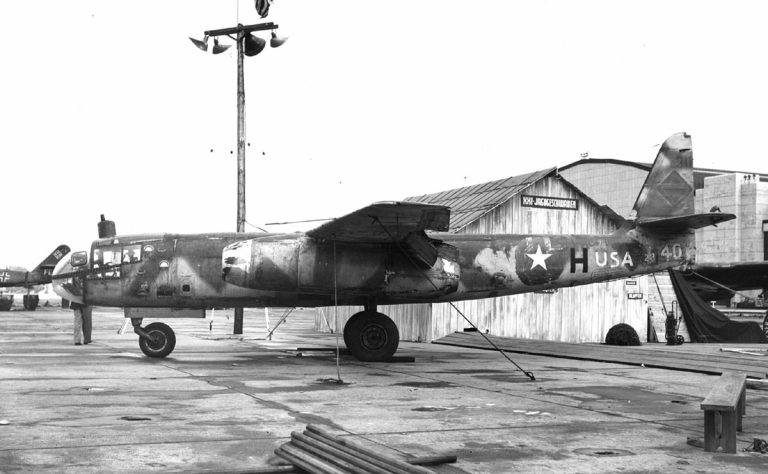
One Ar 234 survives: a B-2 bomber captured in Norway, shipped to America aboard a British carrier, and now displayed at the Smithsonian — the only complete example of the aircraft that opened the age of the jet bomber, a lineage that runs from this slim grey machine straight to the stealth bombers of today.
01Why the Ar 234 Blitz couldn’t change the war
The Ar 234 could do things no Allied aircraft could — outrun every fighter, photograph the front at will, drop bombs from the jet age. And none of it mattered, because there were only about 210 of them and Germany was collapsing. The Jumo 004 engines were unreliable and thirsty; fuel was almost gone; trained pilots and mechanics were scarce; and most airframes sat grounded or were destroyed on the ground.
The Blitz, like the Me 262 and Me 163, is a lesson in how technology alone does not win wars. It was years ahead of its time and arrived far too late to use that lead.
How the Ar 234 Blitz was built
Built for speed alone
The Blitz was a slim, clean airframe wrapped around two jet engines and almost nothing else — no gun turrets, no bomb bay, no second crewman. Everything not essential to going fast was left out, which is exactly why nothing the Allies flew could catch it.
Trolley, skids — then wheels
Early prototypes had no undercarriage at all: they took off on a jettisonable wheeled trolley and landed on retractable skids. Production Ar 234Bs added conventional tricycle landing gear, and rocket pods could be fitted under the wings to shorten the long jet takeoff run.
One pilot, an autopilot and a periscope
A single pilot flew from a fully glazed nose. With no bombardier, he aimed by engaging an autopilot coupled to a periscope bombsight; the reconnaissance versions carried cameras in the rear fuselage instead of bombs.
02The Ar 234’s Jumo 004 engines: the jets that wore out in ten hours
The Blitz was powered by two Junkers Jumo 004 axial-flow turbojets — the same engines as the Me 262, and the first mass-produced jet engines in the world. They were a genuine breakthrough, but a fragile one: starved of the scarce heat-resistant alloys jet turbines need, they burned out after only about ten hours of running and had to be overhauled or replaced constantly.
Combined with Germany’s collapsing fuel supply and Arado’s competition for engines with the Me 262 and other programmes, the unreliable Jumo 004 was one of the main reasons the Ar 234 was built in such small numbers and flew so rarely.
03The Ar 234’s takeoff and landing: trolleys, skids and rocket assistance
To keep the early prototypes light, Arado gave them no landing gear: an Ar 234 took off riding a three-wheeled trolley that was jettisoned once airborne, and landed on a sprung skid under the fuselage and two more under the engines. Test pilot Erich Sommer likened the brakeless skid landings to sliding “on soap.”
Production Ar 234Bs replaced this with a normal retractable tricycle undercarriage. Even then the jet’s takeoff run was long, so Walter HWK rocket pods were often slung under the wings to boost it into the air — especially when carrying a full bomb load.
Arado Ar 234 B-2 specifications
Baseline note: the figures below describe the Arado Ar 234 B-2 as delivered to Kampfgeschwader 76 from the autumn of 1944 — the only version of the Blitz built in quantity, with two Junkers Jumo 004B-1 turbojets, a conventional retractable tricycle undercarriage and its bombs hung outside the aeroplane. Deltas for the undercarriage-less Ar 234 A prototypes, for the camera-equipped B-1 and for the four-engined C-3 are given in grey. Two warnings apply to the whole page. Arado never completed a full acceptance programme for any mark, so several headline numbers come from factory calculation and from short Allied and Soviet test flying in 1945 and 1946 rather than from squadron experience; and the published authorities disagree with each other more than usual, notably on empty weight (4,650 kg in German sources, 4,900 kg on the Smithsonian’s own airframe data plate research, 5,200 kg in William Green) and on service ceiling (10,000 m in Green, 12,000 m in the German literature). Where they disagree, both figures are given.
Dimensions & weights
- Crew
- 1 — pilot, navigator, bomb aimer and, in the prototypes, his own tail gunner. The B-2/N night fighter added a radar operator in a cramped compartment behind him; the projected C-5 and C-7 would have seated two side by side.
- Length
- 12.64 m (41 ft 6 in)
- Wingspan
- 14.41 m (47 ft 3 in), unswept, shoulder-mounted
- Height
- 4.30 m (14 ft 1 in)
- Wing area
- 26.40 m² (284 sq ft)
- Aspect ratio
- 7.6 — a long, thin, high-lift wing chosen for range, not for speed. The Ar 234 was fast because it had jets, not because it was aerodynamically daring, and it never approached the compressibility trouble the Me 262 met.
- Empty weight
- 4,650 kg (10,250 lb) in the German sources; the Smithsonian gives 4,900 kg (10,800 lb) and William Green 5,200 kg (11,460 lb) for the same mark
- Equipped weight
- 5,006 kg (11,040 lb), the aircraft with crew, oil and fixed equipment but no fuel or bombs
- Maximum take-off weight
- 9,408 kg (20,740 lb); 9,968 kg (21,980 lb) with two Walter Starthilfe rockets slung under the outer wings. Green gives 9,800 kg (21,600 lb).
- Wing loading
- 197 kg/m² (40.4 lb/sq ft) at maximum weight — high enough that the take-off run, not the enemy, was the most dangerous part of most sorties
- Maximum bomb load
- 1,500 kg (3,310 lb) on three external racks. There was no bomb bay: the fuselage was full of fuel from the cockpit bulkhead to the tail.
- Undercarriage, Ar 234 B
- Retractable tricycle gear, mains folding forward into the mid-fuselage and the nosewheel rearward — fitted first to the V9 prototype on 12 March 1944, and the change that turned an experiment into an operational aeroplane
- Undercarriage, Ar 234 A
- None at all. The aircraft rode a jettisonable three-wheeled trolley for take-off and came down on three retractable skids, one under the fuselage centre section and one under each engine nacelle — eight prototypes were built this way and the A-series never entered production
Performance
- Maximum speed, clean
- 742 km/h (461 mph) at 6,000 m (19,700 ft)
- Maximum speed with 1,000 kg of bombs
- 665 km/h (413 mph) at the same height — the number that actually mattered. External carriage cost the Blitz roughly 80 km/h, and it was in that condition, low and slow over Remagen, that American gunners and Allied fighters were able to reach it.
- Cruising speed
- 700 km/h (435 mph) at 6,000 m
- Rate of climb
- 22 m/s (4,330 ft/min) clean at low level; Green gives 13 m/s (2,560 ft/min), which is the figure at operational weight with bombs aboard
- Time to 8,000 m
- 6 minutes (26,250 ft) — roughly twice the rate of a loaded Ju 88, and the reason a reconnaissance Blitz could be over the English coast before the standing patrols had finished turning
- Service ceiling
- 10,000 m (32,800 ft) in Green; German sources give 12,000 m (39,400 ft). Photographic sorties were routinely flown around and above 10,000 m, which is consistent with the higher figure.
- Range, clean
- 1,400 km (870 miles); Green gives 1,556 km (967 miles) with a 500 kg bomb, and the original requirement had asked for over 2,000 km, which no version ever met
- Range with bombs
- 1,100 km (685 miles)
- Combat radius
- ~450 km (280 miles) on a bombing sortie — enough for Antwerp, Liège, Bastogne and the Rhine crossings from bases in western Germany, and nothing beyond
- Endurance
- About two hours at economical height on internal fuel — generous by the standards of 1945 jets, and a direct consequence of a fuselage that was essentially a flying fuel tank with a cockpit bolted on the front
- Take-off run
- About 1,200 m (3,940 ft) at full weight without assistance, halved by the two Walter rockets. Long take-offs from cratered or soft strips killed more Ar 234 pilots than Allied fighters did.
- For comparison: Gloster Meteor F.3
- 668 km/h (415 mph) at sea level — the only Allied jet in squadron service in 1945, and the only aeroplane on the other side with any theoretical hope of catching a clean Ar 234
- For comparison: Hawker Tempest V
- 700 km/h (435 mph) — fast enough to catch a bomb-laden Blitz on the run-in or a clean one on the landing approach, and not fast enough for anything else
Propulsion & systems
- Engines
- 2 × Junkers Jumo 004B-1 axial-flow turbojets (RLM designation 109-004), one in a nacelle beneath each wing. The Ar 234 C had four BMW 003A-1s in twinned nacelles instead.
- Thrust
- 8.83 kN (1,984 lbf, 900 kp) each, 17.7 kN (3,970 lbf) total
- Engine layout
- Eight-stage axial compressor, six individual flame cans, single-stage turbine; 745 kg (1,640 lb) dry apiece. Anselm Franz’s design was deliberately conservative — an axial compressor of modest pressure ratio that could be built by unskilled labour out of materials Germany still had.
- Engine life
- 25 hours nominal between overhauls, and frequently ten or fewer in service — the single fact that governs everything else about the Ar 234’s war. Nickel, cobalt and molybdenum had run out, so hot-section parts were mild steel with an aluminium coating and Cromadur turbine blades, and they crept, cracked and burned. Squadrons flew with engine hours counted like ammunition; when the Germans destroyed the engine logbooks in May 1945, the RAF pilots who ferried captured Ar 234s across the North Sea had no idea how much life was left in them.
- Starting
- Riedel 10 hp two-stroke flat-twin buried in the intake bullet of each engine, spinning the shaft up to light-off — hand-cranked if the electrics failed
- Throttle handling
- Deliberate and slow. A brisk movement of either lever produced a flameout or a turbine fire, so the pilot who most needed thrust — low, heavy, on the approach or lifting off — was the pilot least able to ask for it
- Fuel
- J2 synthetic kerosene distilled from brown coal; 3,800 litres (836 imp gal, 1,004 US gal) in two fuselage tanks, 1,800 litres ahead of the wing and 2,000 litres behind it. The A-series had a third, 830 litre mid-fuselage tank; it was deleted on the B to make room for the main undercarriage bays, and the other two were enlarged to compensate.
- Take-off assistance
- 2 × Walter HWK 109-500A-1 Starthilfe rocket pods, 4.905 kN (1,103 lbf) each for about half a minute, hung under the outer wings, jettisoned after burnout and lowered on parachutes for reuse
- Braking parachute
- Housed in the tail cone and streamed after touchdown — a jet landing at that weight on a wartime grass or pierced-steel strip needed it, and the Ar 234 was among the first aircraft in the world to carry one as standard equipment
- Autopilot
- Patin PDS (Patin-Dreirudersteuerung) three-axis autopilot with an LKS 7D control unit — one of the first three-axis autopilots in operational service anywhere, and the thing that made single-crew jet bombing possible at all
- Bombsight, level attack
- Lotfe 7K tachometric sight set into the cockpit floor, coupled to the PDS — the pilot swung the control column aside on its hinge, lay forward over the eyepiece and let the sight fly the aeroplane down the bombing run
- Bombsight, glide attack
- BZA 1B computing sight working through a PV 1B periscope in the cockpit roof — the same periscope served as the pilot’s only rearward view and, in the prototypes, as the sight for the tail guns. Flipped forward for bombing it presented an inverted image, which no amount of practice made intuitive.
- Cameras
- 2 × Rb 50/30 or Rb 75/30 in the rear fuselage, canted outward, fitted as Rüstsatz b — every reconnaissance B-1 was a B-2 airframe converted with this kit rather than a separate production run
- Cockpit and escape
- Fully glazed nose, entered through a hatch in the roof; no ejection seat in any production aircraft. One was ordered after Flugkapitän Selle died in the V2 on 2 October 1943, and no drawing or build description showing a fitted seat has ever surfaced. Getting out of a stricken Ar 234 in flight was close to impossible, which is why so many of its accidents were fatal
- Radio and identification
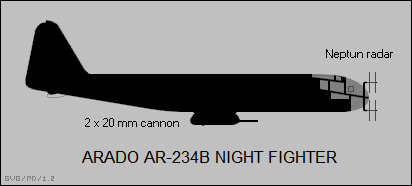
- FuG 16ZY VHF set with homing facility and FuG 25a IFF; FuG 218 Neptun VHF air-interception radar on the two B-2/N night fighters, installed not at Arado but in the Deutsche Lufthansa workshop at Werneuchen
04The Ar 234’s variants: the B, the four-engine C, and the paper projects
The main service version was the twin-jet Ar 234B, split between B-1 reconnaissance aircraft with cameras and B-2 bombers. A four-engine Ar 234C, using four smaller BMW 003 jets in paired nacelles, was developed for more power and speed, but only about fourteen were completed by the surrender, most without engines. Night-fighter conversions and further C, D and P projects were drawn up but never reached service. In all, only around 210 aircraft of all types were built.
05The one that survived: the Smithsonian’s Ar 234
The sole surviving Ar 234 is a B-2 bomber, Werk-Nummer 140312, that served with Kampfgeschwader 76 in the final weeks of the war and surrendered to British forces in Norway. Famously, test pilot Eric “Winkle” Brown arranged to trade it to the Americans in exchange for an interview with the captured Hermann Göring. Shipped to the United States in 1945, it eventually passed to the Smithsonian and is now displayed at the Udvar-Hazy Center — with its rocket takeoff pods fitted, possibly the only such units mounted on the type that used them.
Armament & payload
The Ar 234 hung its bombs in the slipstream and gave one man the job of flying, navigating and aiming
Everything about the Blitz’s armament follows from one design decision taken in 1941: the fuselage was to be filled with fuel, because the specification asked for 2,000 km of range from engines nobody had yet built. That left no bomb bay, so the bombs went outside — one station under the fuselage and one under each engine nacelle — and external carriage cost about 80 km/h, which is to say it cost the aircraft precisely the margin that made it uninterceptable. The Ar 234 B-1 reconnaissance aircraft and the B-2 bomber carried no gun at all: the two fixed rearward-firing MG 151/20 fitted to the prototypes were aimed through a roof periscope, were judged useless by the pilots who tried them, and were deleted. A Blitz pilot’s entire defensive armament was his throttle, and on a bombing run with a tonne of ordnance under him it was not enough. Gun fits below the B-2 standard belong to prototypes, to two night-fighter conversions and to a C-series that was still being flight-tested when the war ended; treat them as intention rather than as service practice.
Gun
- None on the Ar 234 B-1 and B-2, the two versions that flew almost every operational sortie. The standard Blitz went to war unarmed
- 2 × 20 mm MG 151/20 fixed and firing rearward in the tail of the Ar 234 A prototypes, aimed through the cockpit-roof periscope. The installation was found worthless in practice and omitted from the B-series
- 2 × 20 mm MG 151/20 in a Magirusbombe conformal ventral pod on the rear-fuselage hardpoint — the Ar 234 B-2/N Nachtigall night fighter, of which two were converted
- 2 × 20 mm MG 151/20 in a ventral pack beneath the nose on the four-engined Ar 234 C-3; the projected C-4 armed reconnaissance version was to carry four
- The MG 151/20 itself: 20 × 82 mm, roughly 700 rounds per minute, around 700 m/s with the thin-walled Minengeschoss high-explosive shell — the standard German 20 mm of the late war, and a perfectly good weapon on an aeroplane built to use it
Air-to-air
- Nothing on the production aircraft. No forward-firing gun, no gunsight, no rocket rail. The Blitz was never meant to fight and never did
- The one operational attempt was Kommando Bonow, a Luftflotte Reich trials unit with two Ar 234 B-2/N carrying FuG 218 Neptun radar on a shortened Hirschgeweih aerial array and a radar operator squeezed in behind the pilot. It began operating in March 1945, proved wholly unsuited to night fighting — too fast for the closing geometry, too blind, too short of endurance for a patrol — and scored no kills
- Projected night fighters went further on paper: the C-3/N with two MG 151/20 and two 30 mm MK 108 behind FuG 218, and the C-7 with side-by-side seating and the centimetric FuG 245 Bremen O magnetron radar. Neither flew
- The strangest air-to-air scheme was carried rather than fired. The Arado E.381 Kleinstjäger was a rocket-powered parasite with a prone pilot and a frontal cross-section of 0.45 m² — about a quarter of a Bf 109’s — slung under an Ar 234 and dropped into a bomber stream with a single MK 108. Four unpowered wooden airframes and a mock-up were built in 1944 and nothing else
- The R4M air-to-air rocket, in use on Me 262s by March 1945, was never fitted to an Ar 234
Air-to-surface guided
- None carried, none cleared, none seriously proposed for the B-series. Germany had the best air-launched guided weapons of the war and the Ar 234 used none of them
- The Fritz X armour-piercing glide bomb and the Henschel Hs 293 rocket-boosted missile were Do 217, He 111 and He 177 weapons; both needed a second crew member on a control stick watching the weapon all the way down, and the Blitz had neither the seat nor the eyes to spare
- The card matters because of what its emptiness cost. At Remagen in March 1945 the Ar 234 had to attack a defended bridge with free-fall bombs from low level, straight into the guns, because it had no stand-off weapon — and that is exactly the target a guided bomb had been invented for
- The only guided-weapon association ran the other way. Under Mistel 6 an Ar 234 C would have ridden and steered an unmanned Arado E.377 flying bomb, releasing it at the target and flying home. It never left the drawing board
- The BT 1400 Bombentorpedo that the Ar 234 could carry was a shaped free-fall anti-shipping weapon, not a guided one
Bombs
- Three external stations: one under the fuselage, semi-recessed, and one under each engine nacelle. No internal bay existed on any mark
- Normal load 2 × SC 500 (500 kg, 1,100 lb) under the nacelles, or a single SC 1000 (1,000 kg, 2,200 lb) under the fuselage. Maximum 1,500 kg (3,310 lb), typically one SC 1000 and two SC 500
- The V9 prototype managed 672 km/h at 5,000 m carrying three SC 500 — faster with a full bomb load than any other Luftwaffe bomber flew empty, and the whole argument for the type in one number
- SD thick-walled bombs for hardened targets and AB cluster containers for anti-personnel work were intended for the C-3 ground-attack role
- BT 1400 bomb-torpedo, 1,510 kg (3,330 lb): carried with marginal ground clearance, a reduced fuel load and rocket assistance for take-off. Whether it was ever released operationally is not established
Rockets
- No offensive rocket armament was ever fitted. The rockets an Ar 234 carried existed to get it off the ground
- 2 × Walter HWK 109-500A-1 Starthilfe pods, 4.905 kN (1,103 lbf) each for roughly thirty seconds, hung under the outer wings, jettisoned after burnout and recovered by parachute. The surviving airframe at the Udvar-Hazy Center is displayed with a pair fitted, which may be the only Walter units anywhere still mounted on a type that actually used them
- The Werfer-Granate 21 mortar tube and the R4M salvo rack, both in Luftwaffe use by 1945, were never cleared on the Ar 234
- The Ar 234 R would have thrown the turbojets away entirely: a rocket motor in the tail, a tow behind an He 177 to 8,000 m, a self-powered climb to 17,000 m over the target and an unpowered glide home. Project only, and a measure of how badly the Luftwaffe wanted photographs it could not otherwise get
- The E.381 parasite’s third proposed version would have swapped its MK 108 for six rockets. Like the rest of the E.381, it stayed on paper
Pods & other stores
- Rüstsatz b, the reconnaissance kit: two Rb 50/30 or Rb 75/30 cameras in the rear fuselage, canted outward to widen the covered swathe. Every B-1 was a B-2 airframe fitted with it, which is why reconnaissance and bomber Blitzes are so hard to separate in the production records
- The Magirusbombe conformal gun pod of the B-2/N night fighter, carried on the fuselage station that would otherwise have taken a bomb
- Drop tanks could be carried on the nacelle racks in place of bombs to stretch a reconnaissance sortie — this fit is less well documented than the bomb loads and should be treated with more caution
- No radar warning receiver, no chaff, no jamming equipment, no armour worth the name. The Soviet test pilot Alexander Kubyshkin, who flew a captured B-series five times at Rechlin between January and February 1946, marked it down for exactly that: inadequate cockpit protection, and two engine fires in five flights
- No ejection seat, no drogue chute for the pilot, and a roof hatch as the only way out. Everything the Ar 234 carried was for the mission; nothing was for the man flying it
Three typical loadouts
- Photographic reconnaissance, Rheine, autumn 1944
- Clean airframe, two Rb 50/30 cameras in the rear fuselage, no external stores, full internal fuel. Climb to 10,000 m, cross the coast at better than 700 km/h, hold the camera run straight and level, come home. Around fifty such sorties were flown between July and October 1944 alone, and Allied piston fighters could not reach the aircraft flying them.
- Bridge attack, Remagen, 9–14 March 1945
- One SC 1000 semi-recessed under the fuselage, aimed in a shallow glide through the roof periscope and the BZA 1B because level bombing from height could not hit a railway bridge. Release low, over five American anti-aircraft battalions fielding more than eighty .50-calibre Brownings on quadruple half-track mounts, a heavy gun battalion on the west bank and SCR-584 radar direction from noon on 9 March. Nine sorties by III./KG 76 over six days, no hits on the bridge, and seven jets lost from the whole jet force committed.
- First jet bombing raid in history, Liège, 24 December 1944
- Nine Ar 234 B-2 of KG 76 under Diether Lukesch, each with an SC 500 under either nacelle or a single SC 1000, released from height with the Lotfe 7K driving the Patin PDS autopilot. The pilot swung his control column aside, lay over the sight, let the autopilot fly the run, released, and pulled the column back to fly home. Nobody had ever bombed from a jet before.
Sourcing caveat: bomb and equipment fits come from Arado handbooks and Luftwaffe loading tables captured in 1945, from the Allied technical reports written on the airframes shipped out aboard HMS Reaper, and from the Bundesarchiv production and allocation returns. Night-fighter and C-series armament rests on very small numbers of converted or part-finished aircraft, and the D, P and R armament is drawing-office proposal only.
Variants
Thirty designations, one production standard, and 214 aeroplanes that arrived too late to matter
The Ar 234 began as a paper answer to a tender nobody else bothered to enter. In the closing months of 1940 the Reichsluftfahrtministerium asked for a jet-powered high-speed reconnaissance aircraft with a range of a little over 2,000 km; Arado alone responded, with Professor Walter Blume’s E.370, and six prototypes were ordered on 17 April 1942. The V1, Werknummer 130001, coded TG+KB, was finished at Brandenburg on 15 June 1943 and had to be carried to Rheine inside an Ar 232 transport because the Brandenburg runway was too short to fly it off. On the evening of 30 July 1943 it made a fourteen-minute first flight in the hands of Flugkapitän Selle — not June 1943, as is sometimes stated. Selle was killed on 2 October when the V2 caught fire in its port engine and dived in from 1,200 m. Later that year Hitler was shown the V3 at Insterburg, was enthusiastic, and authorised two hundred aircraft by the end of 1944.
The extraordinary part of the early aeroplane was underneath it. To hold the weight down and keep the fuselage full of fuel, Arado gave the Ar 234 A no undercarriage whatsoever. It took off from a jettisonable three-wheeled trolley and landed on three retractable skids, one under the fuselage and one under each nacelle, the main skid originally designed as a channel section running on nine wooden rollers. It worked, in the narrow sense that the aeroplane flew. It failed in every operational sense. Erich Sommer, who flew the skid machines, said that landing one on wet grass was "like greased lightning" and "like soap", because there was no braking of any kind. Worse, an Ar 234 A could not move once it had stopped: it sat where it had slid, in the middle of the landing ground, waiting for a crane and a dolly while the next aircraft circled. A squadron operating this way would have scattered its aeroplanes across the aerodrome and blocked its own runway, and any airfield without the cranes, trolleys and prepared surface to service it was simply unusable. Eight prototypes were built to this standard and the A-series never entered production. The cure was the V9 of 12 March 1944: a conventional retractable tricycle undercarriage, mains folding forward, nosewheel aft, bought at the cost of the 830 litre mid-fuselage tank, which was deleted to make room and made up by enlarging the forward and aft tanks. Every operational Blitz was a B.
Production was concentrated at Alt-Lönnewitz in Saxony, code name Altan, and ran from July 1944 to March 1945. Two hundred and fourteen aircraft were completed — 150 of them in the four months from October 1944 to January 1945 — of which 202 were issued to the Luftwaffe from August 1944. A hundred and one had to go back to the modification industry between November 1944 and March 1945 because they were not fit to fly as delivered; 42 of those went to Umrüstkommando A for conversion to reconnaissance configuration and 57 came back as bombers. Kampfgeschwader 76 received 132 Ar 234 between August 1944 and March 1945, more than half of all the Blitzes ever built, and never had more than a fraction of them serviceable at once. The English-language literature usually gives 210 rather than 214; the German figure comes from the Alt-Lönnewitz completion returns and is the better-sourced of the two.
What could 214 aeroplanes do? As reconnaissance machines, a great deal more than their numbers suggest. From July 1944 the prototypes and then the B-1s photographed southern England, the Normandy lodgement, the Scheldt, the Ardennes front and northern Italy at will, and the Allies had no answer: piston fighters could not reach the height and speed together, and by the time a Meteor squadron might have tried, the Ar 234 had already photographed what it came for. On 10 April 1945 an Ar 234 made the last Luftwaffe overflight of the United Kingdom of the entire war, and it came home. As a bomber the type achieved almost nothing. Nine aircraft with a tonne apiece cannot close a rail junction, and the Ar 234 never flew a raid larger than a squadron. Its most concentrated bomber effort, Remagen, failed: the Ludendorff bridge fell on 17 March 1945 from accumulated damage after the German demolition charge had failed, not from a jet bomb. The Blitz proved that a jet could outrun everything in the sky and photograph a continent; it also proved that a strategic air force cannot be conjured from a few dozen airframes, a fuel shortage and an engine that lasts twenty-five hours.
- Arado E.370 (1941, project)
- Blume’s tender submission: shoulder-wing all-metal monoplane, two Jumo 004 under the wings, trolley take-off and skid landing, three fuselage tanks of 1,430, 830 and 1,540 litres.
- Ar 234 A, V1 to V8 (1943–44, 8)
- The trolley-and-skid aircraft. V1 first flew 30 July 1943; V2 crashed fatally on 2 October 1943; V6 and V8 were re-engined with four BMW 003s and became the first four-engined jet aircraft in the world to fly. The A-series was never produced.
- Ar 234 V7 (1944, 1)
- A skid-equipped prototype that went to war: it flew the first jet reconnaissance sortie in history and, with the V5, operated over southern England from Juvincourt near Reims in July 1944.
- Ar 234 B-0 (1944, 20)
- Pre-production aircraft to the new tricycle-undercarriage standard set by the V9, delivered by the end of June 1944 while the production lines were still being laid out.
- Ar 234 B-1 (1944–45, converted airframes)
- Reconnaissance version: two Rb 50/30 or Rb 75/30 cameras aft, fitted as Rüstsatz b to B-2 airframes rather than built as a separate batch. This was the version that did the type’s useful work.
- Ar 234 B-2 (1944–45, the bulk of the 214)
- The bomber, and the only Blitz built in quantity: Lotfe 7K in the floor, BZA 1B and roof periscope for glide attacks, Patin PDS autopilot, 1,500 kg on three external racks, no defensive gun.
- Ar 234 B-2/N Nachtigall (December 1944–1945, 2 converted from 3 allocated)
- Night fighter: FuG 218 Neptun radar fitted at the Lufthansa works at Werneuchen, two MG 151/20 in a Magirusbombe ventral pod, radar operator behind the pilot. Flown by Kommando Bonow from March 1945; no kills.
- Ar 234 C-1, C-2 and C-3 (1944–45, 14 airframes, fewer than half with engines)
- Four BMW 003A-1 in twinned nacelles, freeing Jumo 004s for the Me 262 and adding about a fifth to the top speed; reshaped cockpit with eight glazed panels instead of thirteen and a faired periscope. C-1 reconnaissance, C-2 bomber, C-3 multi-role with two MG 151/20 under the nose. The first two, Werknummern 250002 and 250004, flew from Alt-Lönnewitz on 27 March 1945 and reached 15,000 m and roughly 900 km/h in test; Green gives a more sober 853 km/h at 6,000 m. Three airworthy examples with III./EKG 1 were blown up at Kaltenkirchen before the British arrived.
- Ar 234 C-4 to C-8 (1944–45, projects and conversions)
- Armed reconnaissance with four cannon (C-4), side-by-side two-seaters (C-5, C-6), a night fighter with the centimetric FuG 245 Bremen O (C-7) and a single-seat bomber on two uprated Jumo 004D (C-8). The V31 and V32 were converted towards C-5 and C-6 standard; none was completed for service.
- Ar 234 D-1 and D-2 (1944–45, 10 started, none completed)
- Two-seat reconnaissance and bomber versions on a B fuselage with a cleaner canopy and two Heinkel HeS 011 turbojets. The HeS 011 never reached quantity production and neither did the D.
- Ar 234 P-1 to P-5 (1944–45, projects)
- A family of two- and three-seat radar night fighters with four BMW 003A-1, HeS 011 or Jumo 004D, 13 mm cockpit armour and up to five cannon. None was built.
- Ar 234 R and the composites (1944–45, projects)
- The R was a rocket-powered high-altitude reconnaissance version, towed to 8,000 m by an He 177 and climbing to 17,000 m on its own motor. Mistel 6 paired an Ar 234 C with an unmanned Arado E.377 flying bomb, and the V21 was to have carried the Arado E.381 prone-pilot parasite fighter. Only wooden E.381 airframes and a mock-up were ever made; a model of the V21 and E.381 combination is displayed at the Technikmuseum Speyer.
Survivors: exactly one original Ar 234 exists anywhere in the world, and there is no reproduction, no replica and no flying example. It is Ar 234 B-2 Werknummer 140312, one of nine Blitzes handed over to British forces at Sola airfield near Stavanger in Norway in May 1945; it had flown with 9./KG 76 in the final weeks after earlier service with the 8th Staffel, and carried the code F1+GS. Eric "Winkle" Brown, commanding the RAE’s Enemy Aircraft Flight, traded this aircraft and three others to the USAAF’s Operation Lusty teams in exchange for access to interview Hermann Göring. It was flown from Sola to Cherbourg on 24 June 1945, sailed for Newark aboard HMS Reaper on 20 July with thirty-odd other captured German aircraft, was reassembled and flown to Freeman Field, Indiana as FE-1010, and went on to Wright Field, where flight testing finished on 16 October 1946. It was stored at Orchard Place, Park Ridge, Illinois, transferred to the Smithsonian Institution on 1 May 1949, and moved to the Paul Garber facility at Suitland in the early 1950s. Restoration ran from 1984 to February 1989; because every trace of paint had been stripped before the Smithsonian received it, it was finished in the markings of 8./KG 76, the first unit to take the Blitz to war. Willi Kriessmann, the last Luftwaffe pilot to fly 140312, was reunited with it in 1990 and gave his logbooks to the museum. It was displayed on the Mall from 1993 in an exhibition pointedly titled "Wonder Weapon? The Arado Ar 234", and in 2005 became one of the first aircraft moved into the Steven F. Udvar-Hazy Center at Chantilly, Virginia, where it stands today beside the sole surviving Dornier Do 335 — the two of them shipmates once already, on the deck of HMS Reaper in July 1945.
The Ar 234 Blitz, from trolley to the Smithsonian
A jet recon aircraft is ordered
Germany’s air ministry issues a tender for a fast jet reconnaissance aircraft; only Arado responds.
First flight
On 30 July the first Ar 234 takes off — from a jettisonable trolley — at Rheine.
Wheels, then war
The tricycle-geared V9 flies in March; the first jet reconnaissance mission is flown on 2 August.
Unseen over Britain
Ar 234s photograph Britain and the Normandy front, uncatchable by Allied fighters.
The Remagen raids
In March, KG 76 Ar 234s repeatedly bomb the captured Ludendorff Bridge at Remagen.
Last over Britain
In April an Ar 234 makes the last German overflight of the United Kingdom of the war.
The end
Germany surrenders in May; surviving Ar 234s are captured and evaluated by the Allies.
The last Blitz
One Ar 234 B-2 survives, displayed at the Smithsonian.
The Ar 234 Blitz in eight stories
Photographs the Allies couldn’t stop
It flew over Britain and no fighter could reach it.
The full story
A jet with no wheels and no brakes
Early Ar 234s took off on a trolley and slid home on skids.
The full story
Bombing the bridge that wouldn’t fall
The Blitz’s most famous mission was a failure.
The full story
Jets that burned themselves out
The Jumo 004 was a breakthrough that kept breaking.
The full story
Bombing by autopilot
There was no bombardier — just a pilot and a gadget.
The full story
How the last Blitz reached America
A survivor was swapped for an interview.
The full story
The jet that couldn’t change the war
About 210 were built, and it made no difference.
The full story
The only one left
One complete Ar 234 survives, at the Smithsonian.
The full story
The Ar 234 Blitz in photographs
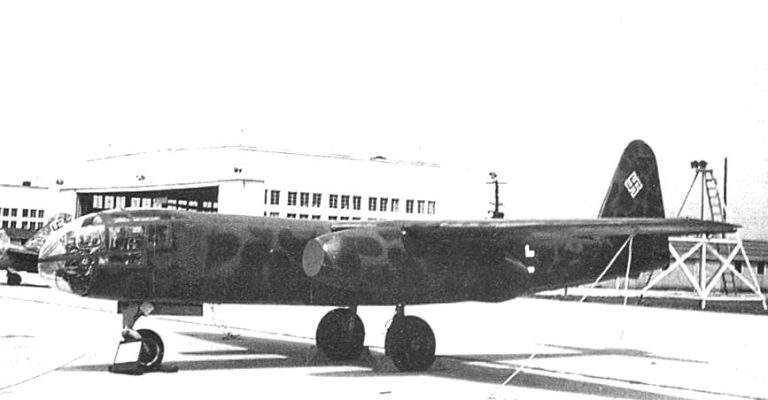
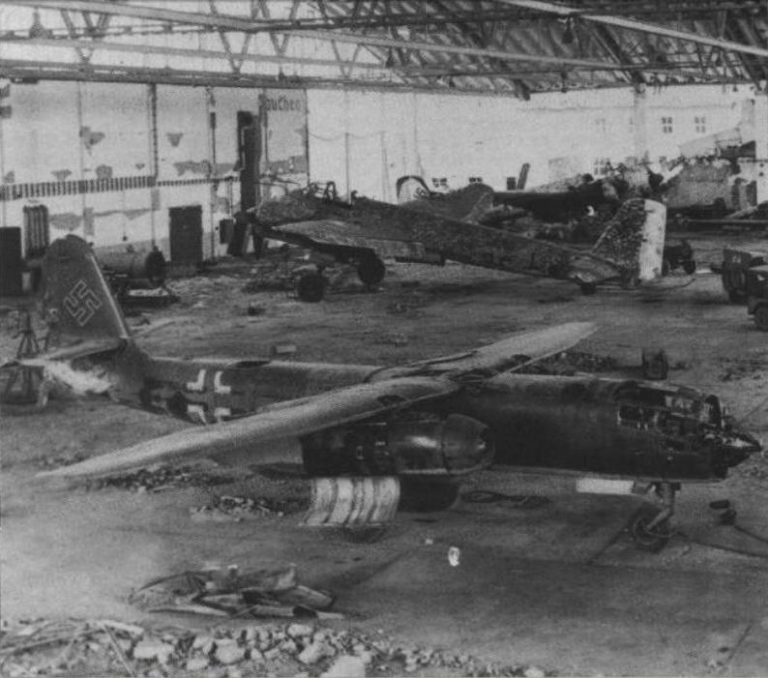
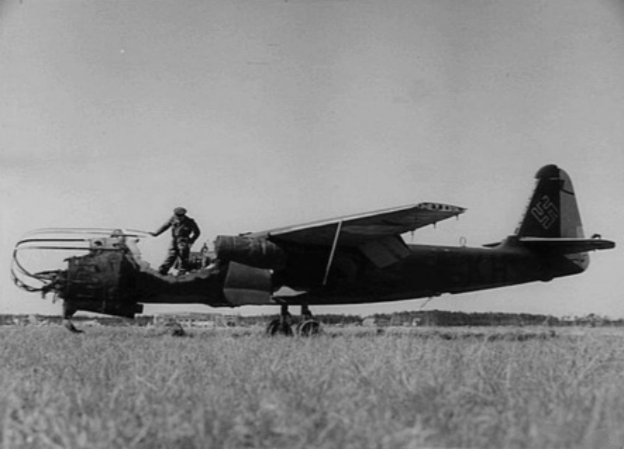
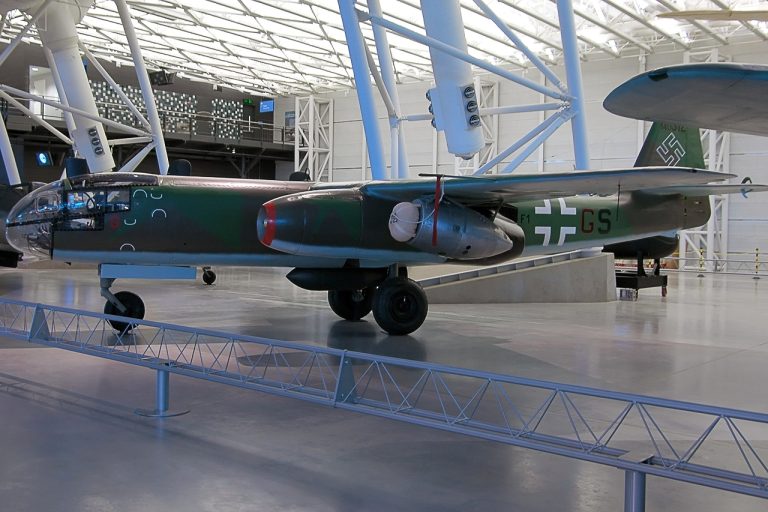
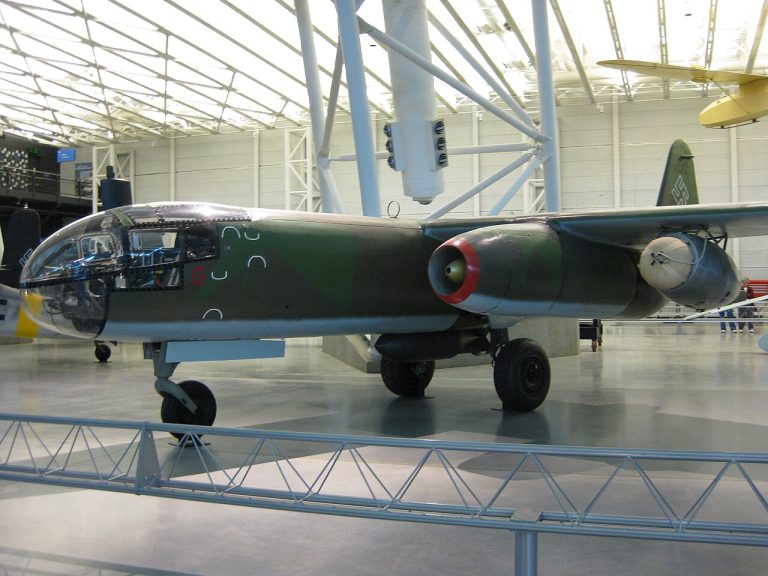
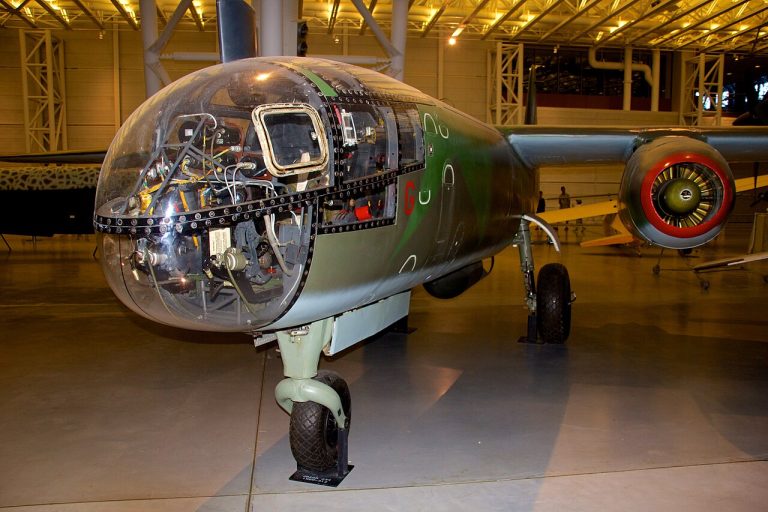
The first jet bomber
The story of the world’s first jet bomber — its reconnaissance triumphs, its bombing failures, and the variants that never came.
The Arado Ar 234 — the first jet bomber, and its variants (Military History Visualized).
Where the Ar 234 Blitz flew — and survives
First in the sky, and far too few
The Ar 234 was a reconnaissance triumph and a bombing footnote. It gathered intelligence no Allied fighter could stop — but as a bomber it was too few, too late and too inaccurate to change anything.
Its lasting achievement was reconnaissance the Allies could not intercept; as a bomber, shortages and inaccuracy kept it from mattering. Compare the combat record of every military aircraft.
Ar 234 Blitz: your questions, answered
Can I fly in an Arado Ar 234?
No — only one Ar 234 survives, in a museum, and it is not airworthy. But you can fly in a real military jet today: MiGFlug offers flights in genuine fighters and jet trainers such as the L-39 Albatros and the MiG-29. See migflug.com/flights-prices.
Was the Ar 234 the first jet bomber?
Yes — the Arado Ar 234 Blitz was the world’s first operational jet-powered bomber, and it also flew the first jet reconnaissance missions in history.
How fast was the Ar 234?
About 742 km/h (461 mph) — fast enough that Allied piston-engine fighters could not intercept it on its reconnaissance flights.
How did the Ar 234 take off and land?
Production aircraft used a conventional tricycle undercarriage. The early prototypes had no landing gear at all — they took off from a jettisonable trolley and landed on skids.
What did the Ar 234 do in the war?
Mostly high-speed reconnaissance over Britain and the Western Front, plus late-war bombing raids — most famously the repeated, largely unsuccessful attacks on the Remagen bridge in March 1945.
Why were so few Ar 234s built?
Shortages of fuel, engines and skilled labour, and unreliable Jumo 004 turbojets that wore out in about ten hours, held production to roughly 210 aircraft.
Do any Ar 234s survive?
One — a B-2 bomber at the Smithsonian’s Udvar-Hazy Center, the only complete Ar 234 left in the world.
You can’t fly the Ar 234 Blitz.
These, you can.
The Blitz belongs to history — but you can still strap into a genuine military jet. MiGFlug flies civilians in real fighters and jet trainers around the world.
 Fly the L-39 AlbatrosThe world’s most-flown jet trainer — aerobatics included
 Fly the F-104 Starfighter“The missile with a man in it”
 Fly the MiG-21The Cold War’s most-produced jet
 Fly the T-33 Shooting StarAmerica’s first jet trainer
 Fly the DH VampireA piece of early jet history
 Fly the S.211Agile Italian jet trainer
 Fly the MB-326The classic Aermacchi jet
 Fly the MiG-15The Soviet legend of the Korean War
Related aircraft
Where this chapter comes from
- Smithsonian National Air and Space MuseumHolds the world’s only surviving Ar 234, with detailed history of the aircraft.
- National Museum of the U.S. Air ForceReference material on the Ar 234 and German jet development.
- Imperial War MuseumOn the Allied air war and the German jet and rocket programmes.
- Royal Air ForceContext on the reconnaissance and bombing campaigns over the Western Front.
- MiGFlug — AfterburnerMiGFlug’s aviation magazine, on the German wonder-weapons and the dawn of the jet age.
Some Ar 234 figures — including the exact first-flight date and production totals — vary between sources; the most widely cited values are used here.