
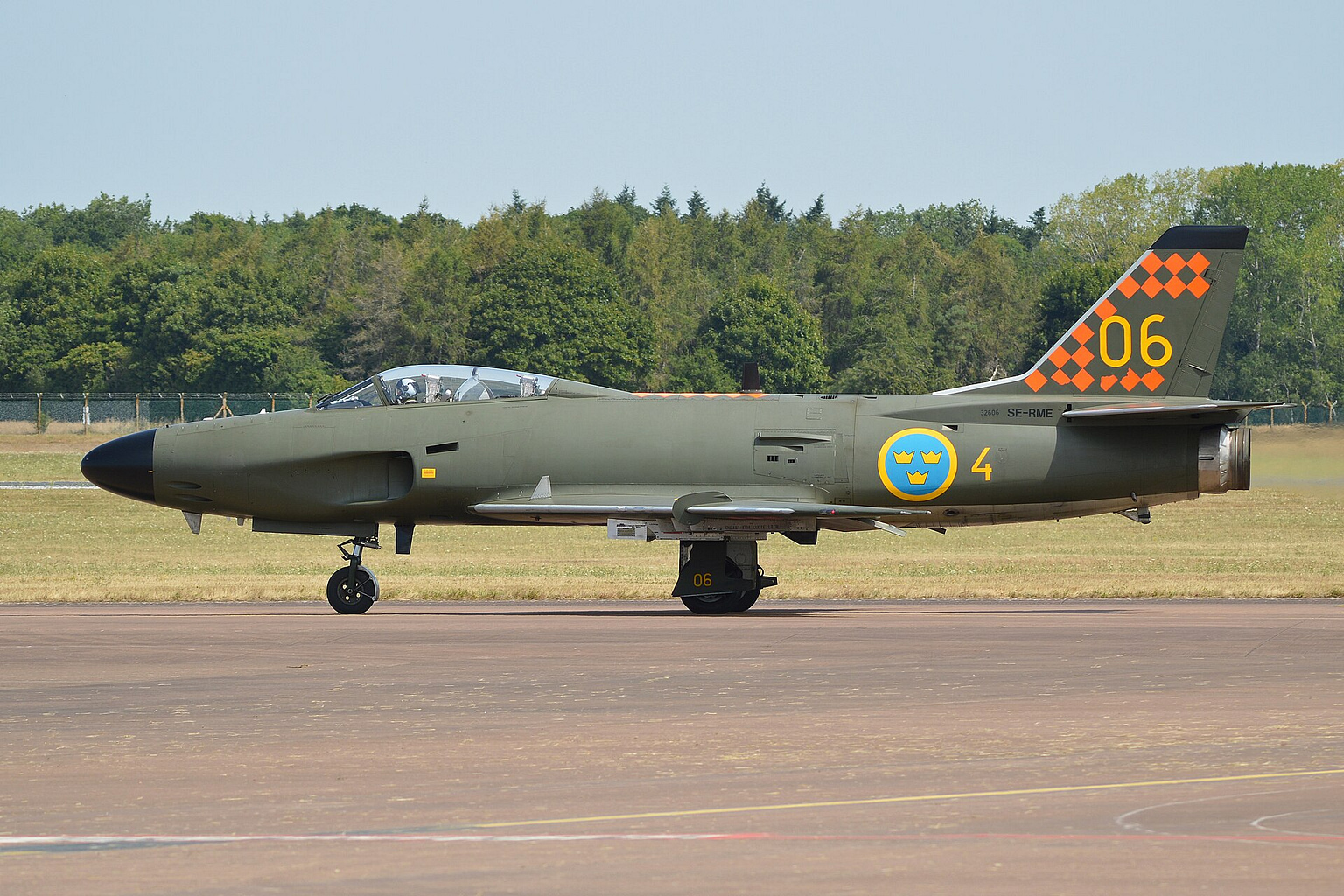
Saab 32 Lansen
“The Lance”
Sweden’s first purpose-built transonic combat jet — a big, swept-wing two-seater that struck ships, hunted bombers in all weather, flew reconnaissance, and, uniquely, kept flying as a test and sampling aircraft for more than half a century without ever firing a shot in anger.
Neutral Sweden’s transonic workhorse
In the late 1940s a neutral Sweden, wedged between NATO and the Soviet Union, decided it needed a modern jet attack aircraft able to hit an invasion fleet anywhere along its long Baltic coastline in any weather. In 1948 the air force issued the requirement, and Saab — already building the barrel-shaped J29 Tunnan — answered with a clean-sheet design of remarkable ambition for a country of seven million people: a large, 35-degree swept-wing two-seater built around a single licence-built Rolls-Royce Avon. It became the Saab 32 Lansen (“the Lance”).
The prototype first flew on 3 November 1952, and on 25 October 1953 a Lansen slipped past the speed of sound in a shallow dive — a first for a Swedish aircraft. From 1955 it entered service in three very different guises: the A32A attack aircraft that could carry the Rb 04 anti-ship missile, the radar-equipped J32B all-weather fighter, and the camera-and-sensor S32C reconnaissance platform. Around 450 were built, and they became the backbone of Swedish air power through the late 1950s and 1960s.
The Lansen never fired a weapon in combat — Sweden stayed out of every war it might have fought. Instead its long life was written in trials and training: as a target-tug, an electronic-warfare aggressor, an engine and systems testbed, and finally as an airborne laboratory that flew air-sampling missions. The last three were kept airworthy by the Swedish Air Force Historic Flight and flew on until 2012 — sixty years after the type first left the ground.
01How neutral Sweden built a world-class combat jet on its own terms
Sweden’s Cold War doctrine of armed neutrality demanded a domestic aircraft industry that could equip the air force without relying on either superpower. The Lansen was an early proof that a small nation could do it. Saab pioneered design methods that were advanced for the era — the aircraft is often cited as one of the first developed using a mathematical coordinate system rather than traditional full-scale lofting — and paired the airframe with a licence-built British engine and a mix of Swedish and imported electronics.
Just as important was how it was meant to fight. Sweden planned to disperse its air force away from vulnerable main bases onto a network of reinforced public roads (the Bas 60 system), so the Lansen was built rugged, simple to service in the field, and able to operate from short, austere strips. That philosophy — survivable, dispersed, self-reliant — ran straight through the Lansen to the Draken and Viggen that followed.
What makes the Saab 32 Lansen special
A swept wing built for the transonic edge
The Lansen’s 35-degree swept wing and carefully area-ruled fuselage let it cruise fast and dive through the sound barrier — it reached roughly Mach 1.12 in a shallow dive in 1953. Power came from a single licence-built Rolls-Royce Avon: the attack A32A used the Svenska Flygmotor RM5A2 (about 34 kN dry, ~47 kN in reheat), while the fighter J32B stepped up to the more powerful afterburning RM6A.
An all-weather radar fighter
の J32B turned the Lansen into a genuine night and all-weather interceptor — a hard thing to build in the 1950s. It carried an Ericsson air-intercept radar and a Saab fire-control system, four heavy 30 mm Aden cannon, and Rb 24 (licence-built AIM-9B Sidewinder) missiles, letting it hunt Soviet bombers over the Baltic in darkness and cloud.
Rugged multirole & road-base ready
One airframe did three jobs. The A32A carried up to 3 tonnes of bombs, rockets and the pioneering Rb 04 radar-homing anti-ship missile; the S32C packed cameras and reconnaissance radar. All were built tough enough to fly from dispersed road bases with conscript ground crews — the core of Sweden’s survivable Cold War air defence.
02The Rb 04: how the Lansen carried one of the world’s first anti-ship missiles
The A32A was designed around the maritime strike mission, and its signature weapon was the Swedish Rb 04 — among the world’s first air-launched anti-ship missiles with an active radar seeker, entering service in the late 1950s. A Lansen could approach an invasion fleet low and fast, launch the Rb 04 from stand-off range, and let the missile find the ship on its own. It gave neutral Sweden a credible way to break up a seaborne landing before it reached the coast — a genuinely advanced capability for its day, and a direct ancestor of the later Rb 15.
03One airframe, four careers: attack, fighter, recon — and testbed
Few aircraft stretched across so many roles. The A32A flew attack and maritime strike from 1955; the J32B flew all-weather interception from 1958; the S32C flew photo and radar reconnaissance. As the frontline role passed to the Draken and Viggen, surviving Lansens were converted into J32D target-tugs and J32E electronic-warfare jamming aircraft, and others served as flying testbeds for engines and systems. That versatility — and the type’s honest, forgiving handling — is why a handful were still earning their keep in the 2000s.
Full Saab 32 Lansen specifications
Airframe & Performance
- クルー
- 2 (pilot + navigator/radar operator)
- 長さ
- ~14.94 m
- 翼幅
- ~13.0 m
- 身長
- ~4.65 m
- 翼領域
- ~37.4 m² · 35° sweep
- 空虚重量
- ~7,400–7,500 kg
- Max takeoff weight
- ~13,500 kg
- Max speed
- ~1,125 km/h · ~Mach 1.12 in a dive
- サービス天井
- ~15,000–16,000 m
- 範囲
- ~2,000–3,200 km (variant / fuel dependent)
Propulsion & Systems
- Engine (A32A)
- 1 × Svenska Flygmotor RM5A2 (RR Avon)
- Engine (J32B)
- 1 × Svenska Flygmotor RM6A (RR Avon), afterburning
- Thrust
- ~34–47 kN (RM5) · up to ~65 kN reheat (RM6)
- Radar
- Ericsson air-intercept (J32B); recon radar (S32C)
- Guns
- 4 × 20 mm Bofors (A32A) or 4 × 30 mm Aden (J32B)
- Missiles
- Rb 04 anti-ship; Rb 24 (AIM-9B Sidewinder)
- Other stores
- Bombs, 75 mm rocket pods, up to ~3,000 kg
- First flight
- 3 November 1952
- Built
- ~450 (1953–1960)
- Unit cost
- No reliable public figure (state programme)
04Why exact Saab 32 Lansen figures vary between sources
The Lansen was a Swedish state programme, never sold on an open market, so many of its numbers come from museum plates, air-force manuals and enthusiast records rather than a single official spec sheet — and they differ. Production is usually given as about 450 (roughly 287 A32A, ~118 J32B and ~44–45 S32C), but totals of 447–456 appear depending on how prototypes and conversions are counted. Speed, ceiling and range vary by variant, fuel load and whether reheat is used, and no credible flyaway unit price or cost-per-flight-hour exists in public sources. Treat any single precise figure as an approximation.
From coastal striker to flying laboratory
The requirement
Sweden issues a specification for a jet attack aircraft able to strike an invasion fleet along its coast in any weather. Saab begins the design.
First flight
The prototype flies on 3 November with test pilot Bengt Olow at the controls.
Through the sound barrier
On 25 October a Lansen exceeds Mach 1 in a shallow dive — the first Swedish aircraft to do so.
A32A enters service
The attack variant reaches the squadrons, soon armed with the pioneering Rb 04 anti-ship missile.
J32B & S32C join
The all-weather radar fighter and the reconnaissance variant enter service, completing the Lansen family.
Handing over the front line
The A32A attack role passes to the AJ 37 Viggen; the J32B fighter is retired by the late 1970s.
End of active service
The last J32D target-tugs and J32E electronic-warfare Lansens are withdrawn from military use.
The final flights
Heritage Lansens fly air-sampling missions through Iceland’s 2010 volcanic ash cloud; the last airworthy examples are grounded in 2012.
From the archive: twelve Saab 32 Lansen stories
A jet to guard a coastline
Neutral Sweden needed to sink an invasion fleet in any weather — and built the Lansen to do it.
Read the full story
Bengt Olow takes it up
The prototype Lansen flew on 3 November 1952, opening Sweden’s transonic age.
Read the full story
Sweden goes supersonic
On 25 October 1953 a Lansen passed Mach 1 in a shallow dive — a national first.
Read the full story
Drawn by mathematics
The Lansen is often cited as one of the first aircraft laid out on a mathematical coordinate system.
Read the full story
The Rb 04 anti-ship missile
The A32A carried one of the world’s first air-launched anti-ship missiles with its own radar seeker.
Read the full story
Hunting in the dark
The radar-equipped J32B could intercept bombers over the Baltic at night and in cloud.
Read the full story
Fighting from the roads
The Lansen was built to disperse onto public highways under Sweden’s Bas 60 system.
Read the full story
Eyes over the Baltic
The S32C carried cameras and radar to watch the sea approaches to Sweden.
Read the full story
A combat jet that never fought
Across nearly six decades of service the Lansen never fired a weapon in anger.
Read the full story
Tugs, jammers and testbeds
As frontline units retired, Lansens became target-tugs, ECM aircraft and flying laboratories.
Read the full story
Flying through a volcano’s ash
Heritage Lansens flew sampling missions into the 2010 Icelandic ash cloud.
Read the full story
The last Lansens land
The final airworthy examples, flown by the Swedish Air Force Historic Flight, were grounded in 2012.
Read the full story
The Saab 32 Lansen in pictures
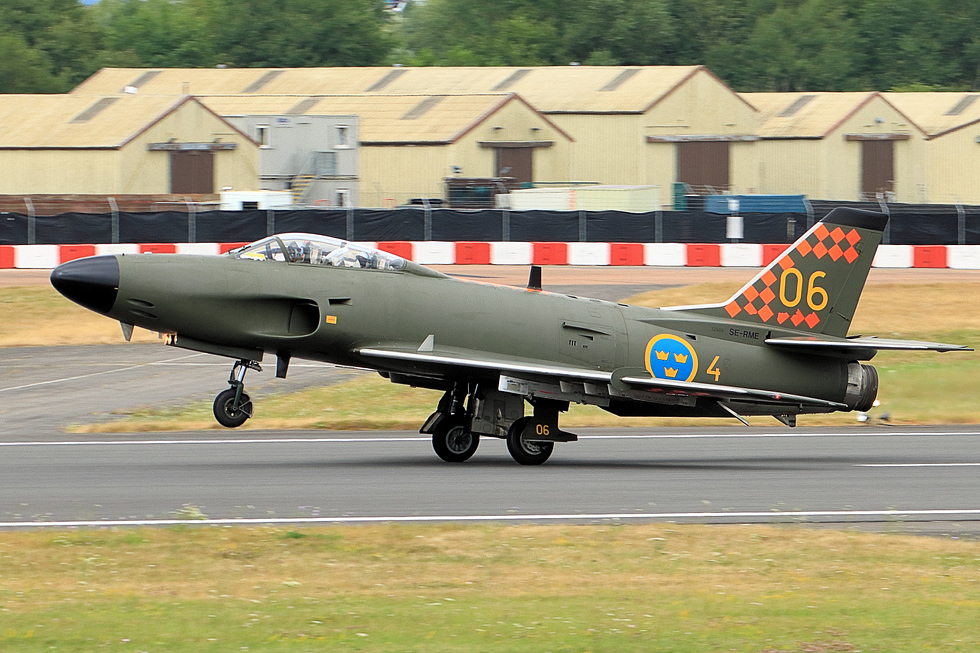
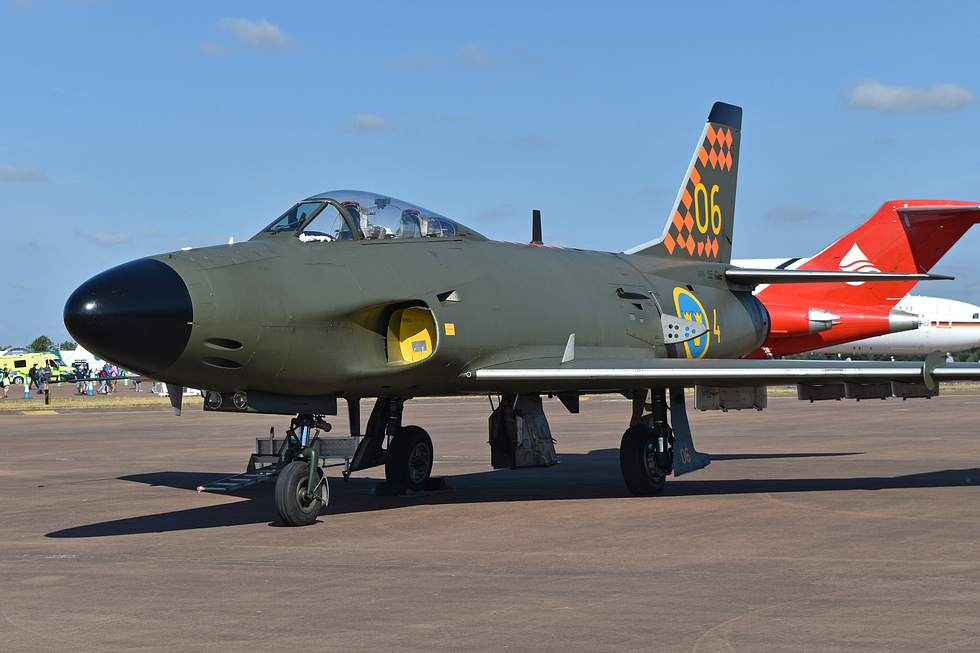
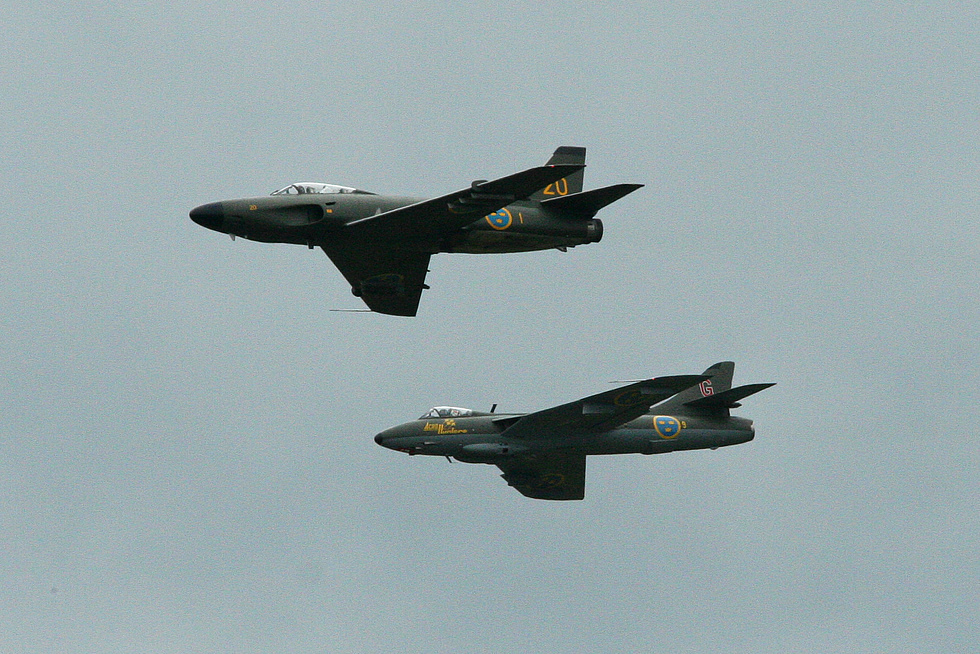
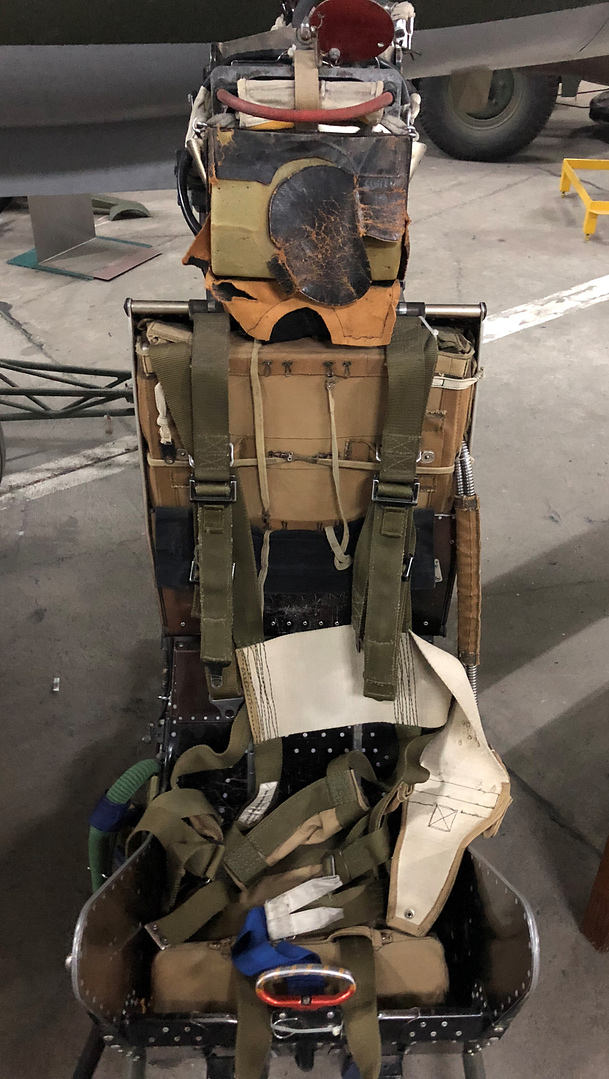
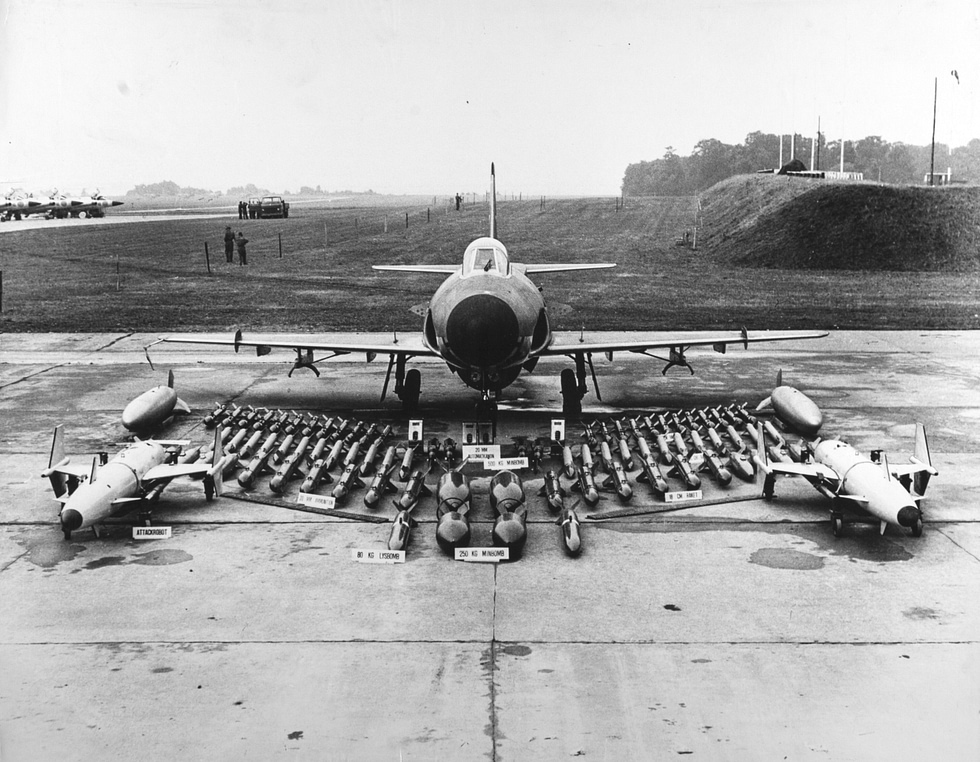
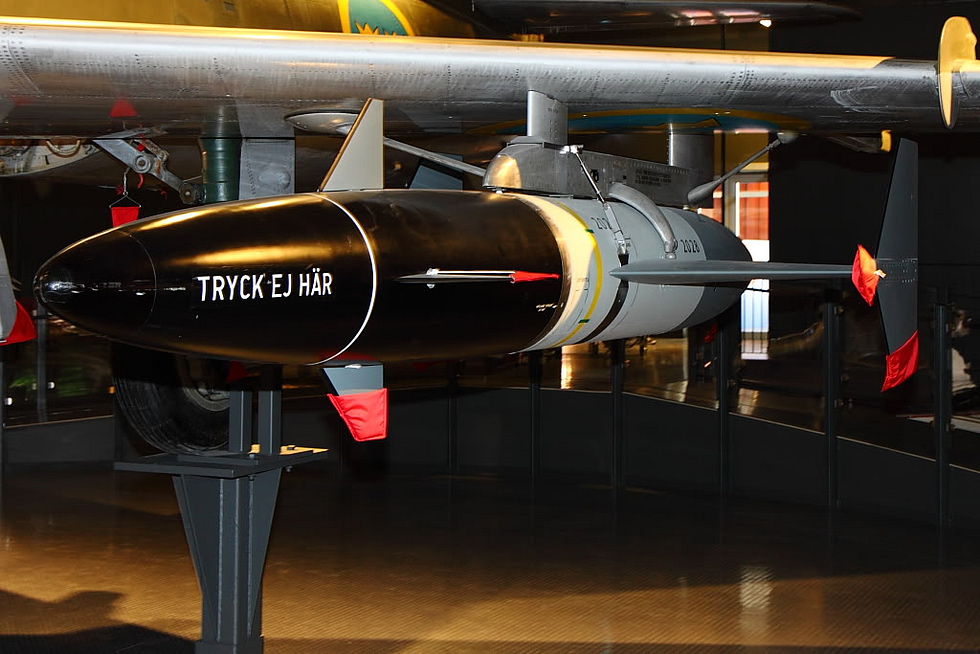
The Saab 32 Lansen in motion
A dedicated Saab 32 Lansen video feature is coming soon. In the meantime, explore the gallery above and the stories below — and see the surviving Lansens preserved across Sweden’s aviation museums.
The Lansen in motion
Not A Pound For Air To Ground — one of the most-watched Lansen films on YouTube.
Where the Saab 32 Lansen flew
The record of a jet that never fought
The Saab 32 Lansen is one of the rare Cold War combat aircraft with a blank combat record — and that is exactly what its designers wanted. Sweden’s policy of armed neutrality kept it out of every war, so the Lansen never fired a shot in anger. Its value was measured not in kills but in deterrence, readiness and a remarkably long working life.
Compare the combat record of every military aircraft. Figures as of July 2026.
Everything people ask about the Saab 32 Lansen
Can I fly in a Saab 32 Lansen?
What was the Saab 32 Lansen used for?
Did the Saab 32 Lansen ever see combat?
How fast was the Saab 32 Lansen?
What engine did the Saab 32 Lansen use?
How many Saab 32 Lansens were built?
Why did some Lansens fly until 2012?
Is the Saab 32 Lansen still in service?
You can’t fly the Saab 32 Lansen.
These, you can.
Some legends only live in museums — others are fuelled and waiting. MiGFlug has put civilians in real military jet cockpits since 2004.
 Fly the L-39 AlbatrosThe world’s most-flown jet trainer — aerobatics included
 Fly the F-104 Starfighter“The missile with a man in it”
 Fly the MiG-21The Cold War’s most-produced jet
 T-33シューティングスターを操縦しようAmerica’s first jet trainer
 Fly the DH VampireA piece of early jet history
 Fly the S.211Agile Italian jet trainer
 Fly the MB-326The classic Aermacchi jet
 Fly the MiG-15The Soviet legend of the Korean War
Continue the tour
Every fact, checked
- Plane Encyclopedia — Saab 32 LansenDevelopment, variants, production numbers and service history.
- Military Factory — Saab J32 LansenSpecifications, dimensions, powerplant and armament reference.
- flugzeuginfo.net — Saab-32 LansenTechnical data cross-check for weights, performance and engines.
- Aviastar — Saab 32 LansenDesign background and the A32/J32/S32 variant breakdown.
- European Airshows — Lansen first flightFirst-flight date and early flight-test milestones.
- LetLetLet Warplanes — Saab 32 LansenVariant histories, roles and the type’s later testbed careers.
- All-Aero — Saab J-32 LansenEngine, radar and weapons detail including the Rb 04 and Rb 24.
- Wikimedia Commons — Saab 32 LansenSource and licensing for the photographs on this page.