
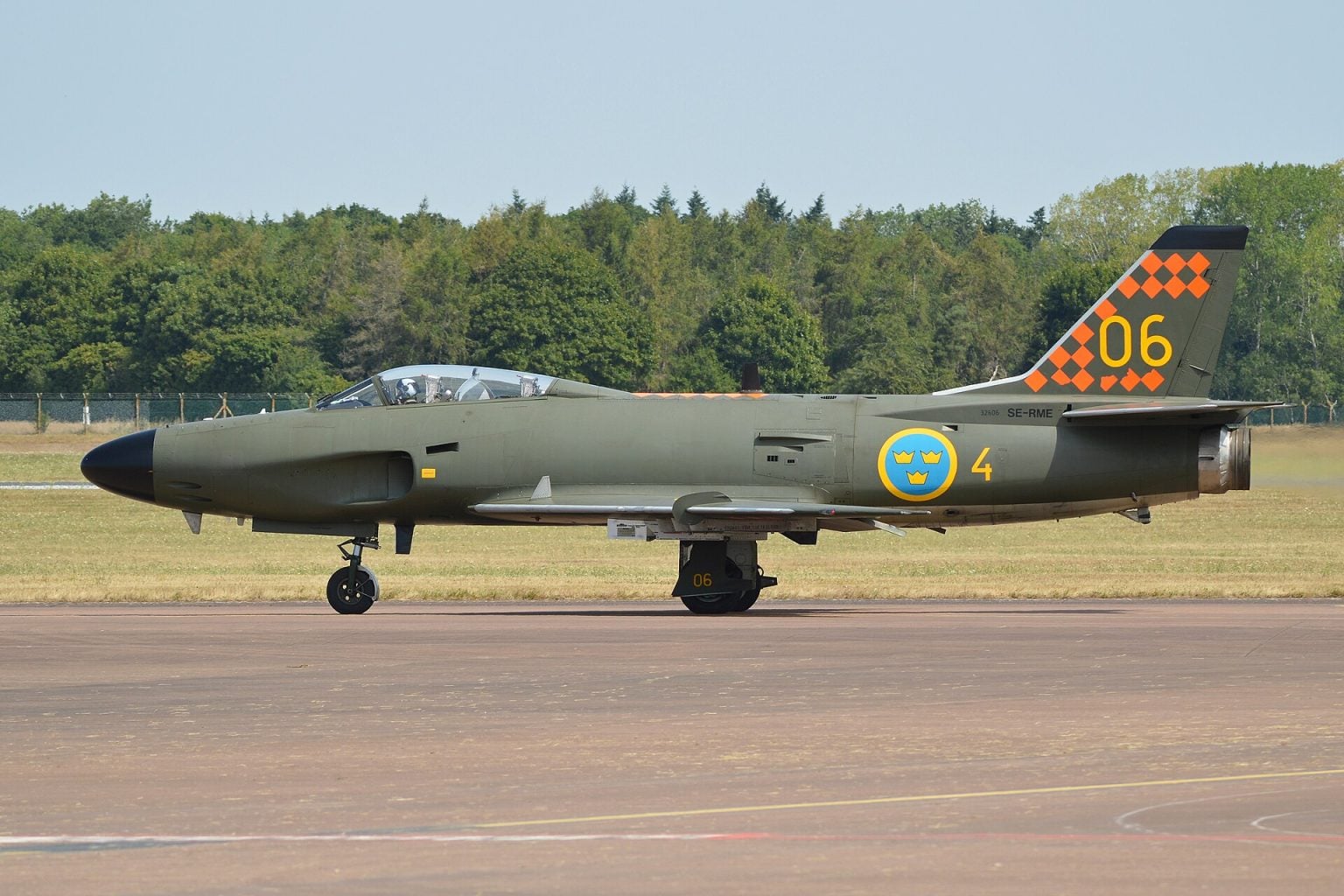
Saab 32 Lansen
“The Lance”
Sweden’s first purpose-built transonic combat jet — a big, swept-wing two-seater that struck ships, hunted bombers in all weather, flew reconnaissance, and, uniquely, kept flying as a test and sampling aircraft for more than half a century without ever firing a shot in anger.
Neutral Sweden’s transonic workhorse
In the late 1940s a neutral Sweden, wedged between NATO and the Soviet Union, decided it needed a modern jet attack aircraft able to hit an invasion fleet anywhere along its long Baltic coastline in any weather. In 1948 the air force issued the requirement, and Saab — already building the barrel-shaped J29 Tunnan — answered with a clean-sheet design of remarkable ambition for a country of seven million people: a large, 35-degree swept-wing two-seater built around a single licence-built Rolls-Royce Avon. It became the Saab 32 Lansen (“the Lance”).
The prototype first flew on 3 November 1952, and on 25 October 1953 a Lansen slipped past the speed of sound in a shallow dive — a first for a Swedish aircraft. From 1955 it entered service in three very different guises: the A32A attack aircraft that could carry the Rb 04 anti-ship missile, the radar-equipped J32B all-weather fighter, and the camera-and-sensor S32C reconnaissance platform. Around 450 were built, and they became the backbone of Swedish air power through the late 1950s and 1960s.
The Lansen never fired a weapon in combat — Sweden stayed out of every war it might have fought. Instead its long life was written in trials and training: as a target-tug, an electronic-warfare aggressor, an engine and systems testbed, and finally as an airborne laboratory that flew air-sampling missions. The last three were kept airworthy by the Swedish Air Force Historic Flight and flew on until 2012 — sixty years after the type first left the ground.
01How neutral Sweden built a world-class combat jet on its own terms
Sweden’s Cold War doctrine of armed neutrality demanded a domestic aircraft industry that could equip the air force without relying on either superpower. The Lansen was an early proof that a small nation could do it. Saab pioneered design methods that were advanced for the era — the aircraft is often cited as one of the first developed using a mathematical coordinate system rather than traditional full-scale lofting — and paired the airframe with a licence-built British engine and a mix of Swedish and imported electronics.
Just as important was how it was meant to fight. Sweden planned to disperse its air force away from vulnerable main bases onto a network of reinforced public roads (the Bas 60 system), so the Lansen was built rugged, simple to service in the field, and able to operate from short, austere strips. That philosophy — survivable, dispersed, self-reliant — ran straight through the Lansen to the Draken and Viggen that followed.
What makes the Saab 32 Lansen special
A swept wing built for the transonic edge
The Lansen’s 35-degree swept wing and carefully area-ruled fuselage let it cruise fast and dive through the sound barrier — it reached roughly Mach 1.12 in a shallow dive in 1953. Power came from a single licence-built Rolls-Royce Avon: the attack A32A used the Svenska Flygmotor RM5A2 (about 34 kN dry, ~47 kN in reheat), while the fighter J32B stepped up to the more powerful afterburning RM6A.
An all-weather radar fighter
The J32B turned the Lansen into a genuine night and all-weather interceptor — a hard thing to build in the 1950s. It carried an Ericsson air-intercept radar and a Saab fire-control system, four heavy 30 mm Aden cannon, and Rb 24 (licence-built AIM-9B Sidewinder) missiles, letting it hunt Soviet bombers over the Baltic in darkness and cloud.
Rugged multirole & road-base ready
One airframe did three jobs. The A32A carried up to 3 tonnes of bombs, rockets and the pioneering Rb 04 radar-homing anti-ship missile; the S32C packed cameras and reconnaissance radar. All were built tough enough to fly from dispersed road bases with conscript ground crews — the core of Sweden’s survivable Cold War air defence.
02The Rb 04: how the Lansen carried one of the world’s first anti-ship missiles
The A32A was designed around the maritime strike mission, and its signature weapon was the Swedish Rb 04 — among the world’s first air-launched anti-ship missiles with an active radar seeker, entering service in the late 1950s. A Lansen could approach an invasion fleet low and fast, launch the Rb 04 from stand-off range, and let the missile find the ship on its own. It gave neutral Sweden a credible way to break up a seaborne landing before it reached the coast — a genuinely advanced capability for its day, and a direct ancestor of the later Rb 15.
03One airframe, four careers: attack, fighter, recon — and testbed
Few aircraft stretched across so many roles. The A32A flew attack and maritime strike from 1955; the J32B flew all-weather interception from 1958; the S32C flew photo and radar reconnaissance. As the frontline role passed to the Draken and Viggen, surviving Lansens were converted into J32D target-tugs and J32E electronic-warfare jamming aircraft, and others served as flying testbeds for engines and systems. That versatility — and the type’s honest, forgiving handling — is why a handful were still earning their keep in the 2000s.
Full Saab 32 Lansen specifications
Baseline note: the figures below describe the A 32A, the attack version that made up 287 of the 450 Lansens built and the reason the aeroplane existed at all — a two-seat all-weather machine built to put a heavy load of ordnance onto shipping anywhere along 2,000 km of Swedish coast, in cloud, at night, within an hour of leaving a central base. Its engine is the Svenska Flygmotor RM5A2, the licence-built Rolls-Royce Avon Mk 21 with a Swedish-designed afterburner bolted on the back. Deltas for the J 32B all-weather fighter with the far stronger RM6A, for the S 32C reconnaissance aircraft, and for the late J 32D target tug and J 32E jammer are given in grey. Two warnings before the numbers. First, the specification block most widely reproduced in English-language references describes the J 32B, not the attack aeroplane, and its 1,200 km/h and 2,000 km entries do not survive checking against Swedish sources or against the fuel load; both are given here in their corrected form with the disagreement stated. Second, Swedish practice quoted thrust in kiloponds and weights as tabulated by the Flygförvaltningen, so kN figures converted from kp and kN figures quoted directly differ in the last digit across reference works.
Dimensions & weights
- Crew
- 2 — pilot and navigator/radar operator in tandem under a single clamshell canopy with a second windscreen between them, fitted specifically so that the back-seater would not be blasted if the canopy departed on its own. The Lansen was the Swedish Air Force’s first two-seat jet, and the second man is the whole point of the aircraft: someone had to work the radar while the pilot flew at 100 m over the Baltic in cloud
- Length
- 14.94 m (49 ft 0 in) over the tailplane; 14.47 m (47 ft 6 in) fuselage only
- Wingspan
- 13.00 m (42 ft 8 in)
- Height
- 4.65 m (15 ft 3 in)
- Wing area
- 37.4 m² (403 sq ft)
- Wing
- 35° sweep, NACA 64A010 section, 10 per cent laminar profile, aspect ratio 4.51 — with Fowler flaps, hydraulically boosted ailerons, one stall fence per wing and small triangular fences added at the roots during flight test to fix airflow at high angle of attack. A leading-edge slot on the prototypes was found unnecessary and deleted
- Empty weight
- 7,438 kg (16,398 lb) for the A 32A. J 32B 8,077 kg (17,807 lb) — the heavier engine and the four 30 mm guns cost it 639 kg. S 32C 7,520 kg (16,579 lb)
- Maximum take-off weight
- 13,600 kg (29,983 lb) for the A 32A, the heaviest of the family. J 32B 13,450–13,500 kg (29,652–29,762 lb); S 32C 12,500 kg (27,558 lb), which carried cameras and photoflash bombs rather than ordnance
- Internal fuel
- ~2,800 kg (~3,500 litres, ~770 imp gal) in wing and fuselage tanks, as tabulated for the J 32B. A single 600-litre (132 imp gal, 440 kg) drop tank could be hung on the centreline. The J 32B was later forbidden to fly with it after the fault that killed seven civilians at Vikbo in 1960
- External load
- 3,000 kg (6,614 lb) is the disposable-load figure Swedish tables give, and it is not what the aeroplane actually carried. The heaviest real weapon load was three 600 kg minbomb m/50, which come to 1,843 kg (4,063 lb) with fuzes. Treat 3,000 kg as a structural allowance and ~1,850 kg as the operational maximum
- Wing loading
- 321 kg/m² (66 lb/sq ft) at 12,000 kg — heavy for 1955, and the reason the Lansen needed the longest runways of any aircraft in Swedish service
- Load factor
- +5.5 g / −2 g above 1,700 litres of fuel, +6 g / −2.3 g below — +8 g / −3 g maximum safe, with an ultimate factor of +12 g / −8 g. Generous, and it is one reason so many airframes outlived their squadrons as test and target machines
- Undercarriage
- Tricycle, single wheel on each unit — wheelbase 4.56 m (15 ft 0 in), track 3.00 m (9 ft 10 in). Narrow track and a single nosewheel; not a configuration that loves a wet 12-metre road strip
Performance
- Maximum speed
- 1,125 km/h (699 mph, 607 kn), Mach 0.91, for the A 32A. This is the Swedish figure and it is the one to use
- Maximum speed, J 32B
- 1,173 km/h (729 mph, 633 kn), Mach 0.95 in level flight, and 1,272 km/h (790 mph, 687 kn), Mach 1.03, in a dive. The 1,200 km/h that English-language reference works quote sits between the two and matches neither
- Fastest recorded
- Mach 1.12 in a shallow dive on 25 October 1953, by the second prototype. The Lansen was never a supersonic aeroplane, but it went through the barrier eleven months before the first armed prototype flew
- Cruising speed
- 988 km/h (614 mph, 533 kn), Mach 0.8, for the J 32B
- Landing speed
- 250 km/h (155 mph, 135 kn) — fast, and unforgiving on a short field at night
- Rate of climb
- 60 m/s (11,800 ft/min) for the A 32A; 100 m/s (19,700 ft/min) for the J 32B. The difference is entirely the engine, and it is the largest single performance gap in the family
- Service ceiling
- 15,000 m (49,200 ft) as generally tabulated. The Swedish J 32B monograph gives 14,000 m (45,900 ft) for the fighter, which is the more careful figure
- Range on internal fuel
- 925 km (575 miles, 500 nmi) for the A 32A and S 32C; ~1,000 km (~620 miles, ~540 nmi) for the J 32B. The 2,000 km that circulates in English-language sources exceeds the ferry range with a drop tank and cannot be right
- Ferry range
- 1,850 km (1,150 miles, 999 nmi) with the centreline tank
- Combat radius
- ~320–400 km (~175–215 nmi) on a low-level anti-shipping profile with two Rb 04 — reconstructed from range and fuel, not a published figure. The design requirement was reach, not radius: any point on 2,000 km of coast within one hour of a scramble from a central base
- Take-off
- Normally made with the afterburner lit, shut down at 400 km/h — not for performance but because a fully loaded A 32A had barely enough dry thrust to get airborne safely. The type needed the longest fields in the Swedish Air Force; when F 15 Söderhamn converted to the A 32A in 1960 its runways had to be lengthened first
- Design requirement
- Attack anywhere on Sweden’s 2,000 km (1,245 miles) of coast within one hour of launch from a central base, in any weather, day or night. Laid down in December 1948, and the single sentence that explains every design choice in this aircraft
Propulsion & systems
- Engine, A 32A and S 32C
- 1 × Svenska Flygmotor RM5A2 afterburning turbojet — the licence-built Rolls-Royce Avon Mk 21 (RA.3 family), a 12-stage axial machine. RM5A1 gave 3,460 kp (33.9 kN, 7,630 lbf) dry and 4,700 kp (46.1 kN, 10,360 lbf) with reheat; the A2 had a larger nozzle and a little more. Sweden bought around fifty British engines, designated RM5AE, and built the rest at Trollhättan
- Engine, J 32B
- 1 × Svenska Flygmotor RM6A — the Avon Mk 47A, a 15-stage compressor with eight flame tubes and a two-stage turbine, giving 4,880 kp (47.9 kN, 10,760 lbf) dry and 6,500 kp (63.7 kN, 14,330 lbf) with reheat. Its dry thrust alone matched the RM5A’s output with the afterburner alight, which is why the fighter was nicknamed "Lansen sport". 104 built under licence as RM6AS; about thirty British RM6AE engines went into the first aircraft
- Afterburner
- Swedish design throughout — the Avon 100 series had none, so Svenska Flygmotor built its own. The unit on the RM6A was designated EBK typ 61 and weighed 366 kg on its own
- Intended engine
- STAL Dovern — the indigenous turbojet the Lansen was drawn around, abandoned on time and technical grounds in favour of the Avon. Sweden built world-class airframes and radar; it never quite managed a world-class engine of its own, and the RM designations are all licences
- Engine access
- The entire rear fuselage detaches — an engine change at a dispersed base meant unbolting the back half of the aeroplane and pulling it off on a trolley. Crude, fast and completely deliberate
- Radar, A 32A
- PS-431/A search radar in the nose, with PN-50/A navigation radar and a radar altimeter — a map-like picture of ships, coastlines and islands, and the first built-in search radar in Swedish service. Not every A 32A actually had the set fitted; unlike the S 32C, the attack fleet was equipped in part
- Radar and sights, J 32B
- PS-42/A fire-control radar, S-6A radar-reflex sight, PN-505 navigation radar, PN-794 IFF, PH-11/A radar altimeter, SA-04 autopilot — the radar could fire the 75 mm rocket pods automatically when it computed a hit, so the pilot only had to fly the steering dot. That is how you shoot down a bomber at night in 1959 without a guided missile
- Radar, S 32C
- PS-432/A, a longer-ranged development of the PS-431 — about 100 km ahead and 50 km to each side. Roughly 1,000 km² of sea or coast could be searched in detail in about 40 minutes. Every S 32C carried it
- Cameras, S 32C
- Six from 1962: 1 × SKa 15 (Williamson F.49), 3 × SKa 16 (Vinten F.95), 2 × SKa 23 (Fairchild K-47) — replacing an unsatisfactory 1958 fit of two SKa 17 and two SKa 18, of which only aircraft 32901 ever flew the original set. The bulges above the intakes grew to take the later cameras and are the S 32C’s recognition feature
- Bombing sight, A 32A
- Saab BT9C dive-bombing and rocket sight with a ballistic computer — an analogue fire-control computer in a 1955 attack aircraft, and a large part of why Gunston and Gilchrist rate the A 32A as unusually accurate for its generation
- Self-protection
- Radar warning receiver F9/3 (PQ-19) from 1960, F9/5 from 1968, Box 3 chaff dispenser — F9/3 had three rearward antennas covering four, six and eight o’clock; F9/5 added two more for two and ten, and a forward warner (Apparat 11) built into the chaff pod. The Box 3 had to be balanced by an inert bomb on the opposite wing
- Hardpoints
- 13 stations (balklägen) — six under each wing numbered outward from the root, plus one ventral station. Stations 2 and the ventral took bombs over 620 kg, station 5 up to 280 kg, station 4 the 630 kg-class anti-ship missile; the rest carried rockets and light bombs. A normal A 32A fit was eight light A-beams and four heavy B-beams
04Why exact Saab 32 Lansen figures vary between sources
The Lansen was a Swedish state programme, never sold on an open market, so many of its numbers come from museum plates, air-force manuals and enthusiast records rather than a single official spec sheet — and they differ. Production is usually given as about 450 (roughly 287 A32A, ~118 J32B and ~44–45 S32C), but totals of 447–456 appear depending on how prototypes and conversions are counted. Speed, ceiling and range vary by variant, fuel load and whether reheat is used, and no credible flyaway unit price or cost-per-flight-hour exists in public sources. Treat any single precise figure as an approximation.
Armament & payload
The Lansen was built around one weapon it would not receive for four years: a fire-and-forget anti-ship missile that beat the rest of the West by a decade
Everything about the A 32A follows from a single December 1948 requirement: reach any point on 2,000 km of Swedish coast within an hour of launch, in any weather, and destroy shipping when you get there. That produced a big two-seat aeroplane with a radar in the nose, thirteen pylon stations, four 20 mm cannon behind hydraulic doors, and a bombing computer of a sophistication no other 1955 attack aircraft carried. For the first years of service it went to war with iron bombs and unguided rockets, which is to say it would have had to fly into the anti-aircraft envelope of the ships it was attacking.
Then the Robot 04 arrived. Sweden had asked for a radar-guided air-launched anti-ship missile in 1949, tested one from a Saab 29 Tunnan in early 1955, and had the Rb 04C on A 32A squadrons by the turn of the decade. It weighed 625 kg, carried about 300 kg of blast and pre-fragmented warhead, skimmed the sea at roughly 10 m under a radar altimeter, and hunted with its own active radar seeker. The launch aircraft found the ship, programmed the missile, released it and went home. There is no comparable Western weapon in service at that date — the Americans were still flying Bullpup by eye down a joystick, and Exocet was fifteen years away. For a neutral country of seven million people this was an extraordinary piece of engineering, and it is the single strongest claim the Lansen has on anyone’s attention.
The fighter went the other way. The J 32B swapped the four 20 mm for four 30 mm ADEN, hung Sidewinders on the same pylons the attack aircraft used for its missile, and carried a weapon most air forces had already given up on: radar-triggered 75 mm rockets, fired automatically by the fire-control set the instant it computed a hit. For a night fighter with no guided air-to-air weapon at all in 1958, that was a serious answer. Fits varied sharply between the attack, fighter and reconnaissance versions, and again between 1955 and 1978; the J 32D and J 32E conversions lost their guns and radar entirely.
Gun
- Four 20 mm automatkanon m/49 in the lower nose of the A 32A — a Bofors weapon developed from the akan m/45, firing at 775 rounds per minute, which was fast for its calibre in 1955. The muzzles sat behind hydraulically operated doors that closed flush when the guns were not in use, a small piece of drag-hunting typical of this airframe
- Magazines held 180 rounds per gun, but the tactical manual specifies flying with 90 (originally 80). The rest of the weight went into fuel and bombs. Standard natures were the 20 mm mingranat m/52, a thin-walled high-capacity blast round, and the Hispano-derived 20 mm granat m/47 armour-piercing incendiary with a nose and a base charge
- Four 30 mm automatkanon m/55 in the J 32B — the licence-built ADEN revolver cannon, 90 rounds per gun, over 1,200 rounds per minute. Sweden acquired the weapon with the Hawker Hunter (J 34) in 1955 and built it at FFV from 1956. Three natures only: mine shell, tungsten-cored armour-piercing and ballasted practice, none of them tracer
- For gunnery training two of the J 32B’s four 30 mm could be swapped for 8 mm kulspruta m/22 machine guns with 220 rounds each — cheap ammunition, same sight picture
- The S 32C carried no gun at all; the four cannon bays became the camera bay. The J 32D and J 32E conversions lost both guns and radar when they went to the target flight in 1971–72
Air-to-air
- Rb 24B — the Swedish designation for the AIM-9B Sidewinder. Trials began in July 1959 on aircraft 32542 under the test designation robot 324, and the missile was in the J 32B’s arsenal before the end of that year. Initially one per wing, very quickly two, on Balk S rails at stations 2 and 4
- The J 32B could slave the seeker to the PS-42/A radar and fire the missile into a radar-derived direction in the hope that the seeker would acquire — a genuinely useful trick at night, and not something a first-generation Sidewinder aircraft usually had
- 75 mm sprängraket m/57B in the 75 mm raketkapsel m/57 pod, nineteen rockets per pod, one pod per wing on Balk C at station 2. Intended for strategic bombers: one direct hit with the m/57 mine charge was reckoned enough to destroy any bomber then flying
- The rocket pods were wired to the fire-control radar, which fired them automatically the moment it computed a certain hit. The pilot flew the steering commands and did not aim. This was the J 32B’s primary night weapon before Sidewinder arrived, and it was cheaper and, at first, more trusted
- Two indigenous air-to-air missiles, robot 321 and robot 340, were planned for the J 32B and both were abandoned on development grounds — which is why Sweden went to Washington in 1958. The A 32A and S 32C carried no air-to-air weapon of any kind
Air-to-surface guided
- Robot 04 — the reason the A 32A matters. A 625 kg sea-skimming anti-ship missile 4.45 m long, 500 mm in diameter, spanning 1.94 m, with a roughly 300 kg blast and pre-fragmented warhead, an AGA active radar seeker and a solid boost-sustain motor. Two per aircraft, one under each wing, on the dedicated Balk GV and GH at stations V4 and H4. Nothing else in Swedish service could carry it
- The Lansen’s PS-431 radar found the target and programmed the missile; after release the Rb 04 flew itself, holding about 10 m over the water on a radar altimeter and hunting with its own seeker with no further help from the aircraft. That is fire-and-forget, in 1959–61, from a neutral country of seven million people, and it beat every comparable Western weapon into service by the better part of a decade — the Arboga robot museum’s claim that it was the first working anti-ship missile in the West is defensible
- Rb 04C (in service 1959 by one account, 1961 by the museum’s; KR 16C motor, 235 kp for 43 seconds) had two attack modes: an area attack against a formation, which would only engage a ship within 1,000 m of another, and a selective attack against a single vessel. Changing that 1,000 m figure meant a workshop and a soldering iron — early electronics in the most literal sense
- Rb 04D, from the late 1960s, kept the airframe and swapped in the longer-burning KR 16D2 motor (195 kp for 65.6 seconds), a Philips radar altimeter and maintenance-free thermal batteries. Rb 04E, operational from 1975, added a frequency-hopping monopulse seeker that would home on a jammer that tried to blind it; it went to the AJ 37 Viggen and was cleared on the A 32A as well
- The Rb 04 never fired in anger. It came closest in October 1981, when Viggens with Rb 04E drawn from bunkers stood alert during the grounding of Soviet submarine S-363 outside Karlskrona. Its body and warhead were reused wholesale in the RBS-15, which is still in service — the Lansen’s missile outlived the Lansen by fifty years. No other guided weapon was ever carried: no laser designation, no data link, no pod
Bombs
- Heavy: 250 kg minbomb m/50, 500 kg minbomb m/56, 500 kg brandbomb m/58 and 600 kg minbomb m/50, on B-beams at wing stations 2 and 5 and on the D-beam at the ventral station. Three 600 kg minbomb m/50 with fuzes come to 1,843 kg and are the heaviest load the aircraft is documented as carrying
- Light: 50 kg sprängbomb m/42 and m/47, 120 kg sprängbomb m/61, 15 kg övningsbomb m/55 and the 80 kg lysbomb m/60 flare bomb, one per A-beam on any of the twelve wing stations
- The S 32C carried two to twelve 75 kg fotobomb m/62 photoflash bombs, dropped horizontally and fired on a timer synchronised to the cameras — the only ordnance the reconnaissance version used, and the reason it could work at night
- Aiming was done with the Saab BT9C sight and its ballistic computer. The J 32B could hang the same bombs on the same thirteen stations but had no bomb sight, so in practice it did not
- The A 32A was the intended carrier for a Swedish nuclear weapon. The programme ran through the 1950s and 1960s and no weapon was ever built, so this remains a plan rather than a capability — but it is why the aeroplane was sized as it was
Rockets
- 18 cm halvpansarraket m/49 / m/49B — the heavy semi-armour-piercing rocket, one per A-beam, so twelve on a full fit. The classic Swedish anti-ship rocket, meant to go through a hull below the waterline
- 15 cm sprängraket m/51, m/51A, m/51B and 14.5 cm pansarsprängraket m/49B, two per A-beam, twenty-four on a full fit — the general-purpose loads against landing craft, vehicles and shore targets
- 13.5 cm sprängraket m/56B and m/56C, two per beam, and the 6 cm m/54 and 6.3 cm m/60 practice rockets one per beam. Rocket trials against a mock-up A 32 wing ran at the Försökscentralen as early as July 1950, before the aircraft had flown
- The J 32B could carry every one of these — the pylons and wiring were identical — and had no rocket sight, only its air-to-air gunsight. Swedish accounts say usable accuracy could still be had with the right technique, and the capability was kept as a mobilisation reserve rather than trained for routinely
- Unguided rockets, not bombs, were the A 32A’s expected anti-shipping weapon before the Rb 04 arrived, and remained the cheap answer afterwards. A 1960 F 17 aircraft with eight A-beams and four B-beams is the standard photograph of the type
Pods & other stores
- 600-litre drop tank on the ventral station — the only external fuel the type had. After the Vikbo crash of 1960, in which a drop-tank-related fault caused an engine failure and an unmanned A 32A destroyed a farmhouse and killed all seven people in it, the J 32B was forbidden to fly with the tank at all
- Remsfällare Box 3 chaff dispenser, on a modified B-beam at right station 5, from 1966 on the S 32C and fitted to the A 32A. It needed a counterweight on the opposite wing — either an inert 250 kg bomb or two inert 120 kg bombs
- Adrian and Petrus jamming pods on the J 32E. Adrian worked S and C bands against land-based and naval radars in concert with the internal G24 transmitter; Petrus worked X band against airborne and missile radars and doubled as a radar warner
- Internally the J 32E carried the Ingeborg signals-intelligence receiver with antennas in the radome covering S, C and L bands, the G24 jammer, the Apparat 91B broadband transmitter, MERA for VHF and UHF search and jamming, and an FB-6 tape recorder used to broadcast false radio traffic. All of it was run by the man in the back seat
- The J 32D carried target-towing gear and streamed banner targets for gunnery and missile practice. Later, both types carried air-sampling tubes under the wings for radiation and particulate measurement — the job that kept Lansens flying long after every other role had gone
Three typical loadouts
- Anti-shipping strike, A 32A, Baltic, mid-1960s
- Two Rb 04C on the dedicated beams at wing station 4, a 600-litre tank on the centreline, 90 rounds per gun in the four 20 mm. Launched from a coastal wing on a radar plot, flown low, missiles released some 20 km out and the aircraft turned away before the target’s own radar could resolve it. This is the sortie the Lansen was designed for and the only one that mattered.
- Coastal attack, A 32A, against a landing force
- Eight A-beams and four B-beams: twelve 18 cm halvpansarraket m/49B, or twenty-four 15 cm sprängraket m/51, or two 600 kg minbomb m/50 on the inner heavy stations with rockets outboard. Aimed with the BT9C sight in a shallow dive, guns used on the pull-off. Cheap, accurate by the standards of 1960, and entirely unguided.
- Night interception, J 32B, 1960
- Four Rb 24B on Balk S at stations 2 and 4, or two 75 mm raketkapsel m/57 at station 2 with two Rb 24B outboard, plus 90 rounds per gun in the four 30 mm. Vectored by ground control, final closure on the PS-42/A, and for the rocket attack the radar itself pulled the trigger. For three years, until the J 35 Draken arrived in useful numbers, this was Sweden’s front-line fighter.
Sourcing caveat: Swedish weapon documentation is unusually good and unusually badly translated. Designations here follow the Swedish Air Force’s own conventions — akan for cannon, srak for high-explosive rocket, psrak for armour-piercing, hprak for semi-armour-piercing, rb for missile, balkläge for pylon station — and the loadout tables come from the Flygförvaltningen’s own weapons-carriage documents as reproduced by the Arboga Elektronikhistoriska Förening. English-language sources routinely render the 20 mm akan m/49 as a "Bofors 20 mm" and the 30 mm akan m/55 as an "ADEN" without noting that both were made in Sweden; both descriptions are true and neither is complete. Where the Rb 04’s service date is concerned, English sources say 1959 and the Arboga robot museum says 1961; the difference is almost certainly first delivery against full operational clearance.
Variants
One airframe, three jobs, two engines and a second career as the aircraft nobody else could spare
The Lansen was conceived in 1946 as one airframe that would replace four: the B 18 bomber, the S 18 reconnaissance aircraft, the A 21R attack aircraft and the J 30 Mosquito night fighter. Saab actually pulled it off, which is rarer than it sounds. The attack, reconnaissance and fighter versions share a fuselage, a wing and thirteen pylon stations, and differ in the nose — guns and search radar, cameras and a better search radar, or guns and a fire-control radar — and, in the fighter’s case, in the engine.
This was the high-water mark of Swedish rearmament. In 1957 the Flygvapnet was reckoned the fourth most powerful air force in the world, with around a thousand modern aircraft in front-line service, all of them designed and most of them built at home. Sweden went from the piston-engined B 18 to the Tunnan, the Lansen, the Draken and then the Viggen inside twenty-five years, a rate of renewal that no other small country came close to, and paid for it with an aircraft industry and a conscript air force that between them absorbed an extraordinary share of the national budget.
One correction is worth making plainly, because the Lansen is often folded into the road-base story. The Bas 60 dispersal system — roughly forty wartime bases and thirty widened stretches of public road, 1,500 to 2,000 m long and 12 m wide — came out of a 1954 inquiry and the 1958 defence plan, years after the Lansen’s configuration was frozen. And the Lansen was the type that fitted it worst: it needed the longest fields in the Swedish Air Force, so much so that Söderhamn had to have its runways lengthened before F 15 could convert in 1960, and a fully loaded A 32A took off with reheat lit for safety, not speed. The aircraft designed around the road base was the Viggen, with its thrust reverser and its 500-metre strips. The Lansen was the aeroplane that showed Sweden why it needed one.
What kept it alive was the back seat and the airframe’s strength. When the fighters were withdrawn in 1970, twenty-four J 32B went to the Målflygdivisionen and were rebuilt as target tugs and jammers — jobs that need two crew, endurance and pylons, and reward nobody for being fast. That second career ran twenty-seven more years: to midsummer 1997 for the target flight, and to 1999 for the last J 32E, which stayed with FMV Prov because the Sk 37E Viggen meant to replace it was not ready.
Then a third career, which is usually described the wrong way round. After Chernobyl the target flight’s J 32s carried air-sampling equipment for the Swedish Radiation Safety Authority, and when the unit was wound up in 1997 that equipment was salvaged and fitted to veteran-flight aircraft — 32606 and 32620, with 32542 already so equipped — based at F 7 Såtenäs. The atmospheric research therefore began in earnest after 1997 rather than ending then. In May 2010 civil-registered Lansens flew with sampling tubes under their wings to measure the Eyjafjallajökull ash plume for the Swedish Defence Research Agency (FOI), checking the computer forecasts on which the closure of European airspace rested. A 1955 attack aeroplane was the instrument Sweden reached for, because nothing else it owned combined the pylons, the second crewman and a willingness to fly slowly through volcanic dust.
- P1150 prototypes 32-1 to 32-4 (1952–54, 4 built)
- Aircraft 32-1 flew on 3 November 1952 with neither afterburner nor armament; 32-2 followed on 15 December 1953 with reheat and took the type past Mach 1 in a dive; 32-3, first flown 15 April 1954, was the first armed machine; 32-4 was built to production drawings. A half-scale Lansen wing was flown first on a modified Saab Safir as the Saab 202.
- A 32A (1955–57, 287 built, s/n 32001–32287)
- The all-weather attack version and the heart of the programme: four 20 mm akan m/49, PS-431/A radar, BT9C bombing computer, thirteen stations and the Rb 04. Ordered in four batches totalling 300, of which 287 were delivered from December 1955. Served with F 6, F 7, F 14, F 15 and F 17; the last squadron sortie was flown at F 6 Karlsborg on 15 February 1978, though a few soldiered on as trials aircraft to 1985. Ninety-eight were written off in accidents.
- J 32B (1958–60, 118 built plus 2 prototypes, s/n 32501–32620)
- The all-weather fighter, and Saab’s own description was that it was "to all intents a new aircraft": RM6A engine, four 30 mm akan m/55, PS-42/A fire-control radar, Rb 24B Sidewinder and radar-fired rocket pods. First flight 7 January 1957. Aileron buzz between Mach 0.95 and 1.03, and fin flutter in steep high-altitude dives, were known from the A 32A and had been left alone because the attack aircraft never went there; the J 32B forced both to be fixed, and the fixes went back onto the A 32A and S 32C.
- S 32C (1958–59, 45 built, s/n 32901–32945)
- Maritime and photographic reconnaissance, developed alongside the A 32A. Unarmed, with the longer-ranged PS-432/A radar and a camera nose whose bulges above the intakes are the recognition feature. Served with F 11 Nyköping alone; last flight 18 November 1978. Its tactic was to run in at the lowest possible height in the enemy’s radar shadow, pop up for the photographs and dive away, which is why it received a radar warning receiver in 1960 and a better one in 1968.
- J 32D (1972 conversions, 6: s/n 32545, 32548, 32603, 32606, 32610, 32615)
- Target tugs for the Målflygdivisionen, converted from J 32B and stripped of radar and guns. They towed banners for gunnery and missile practice until mid-1997, then carried the air-sampling equipment for the Swedish Radiation Safety Authority.
- J 32E (1972 and 1979 conversions, 12 plus 3)
- Electronic warfare and jamming trainers, so that fighter controllers and pilots could practise in a jammed environment. Ingeborg receiver, G24 and Apparat 91B jammers, MERA for VHF and UHF, Adrian and Petrus pods. Twelve were converted in 1972 and three more in 1979 after a 1975 loss — fifteen in all, where English-language sources usually say fourteen.
- J 32S / J 16 (1969–71, 1 to 4 converted)
- The strangest Lansen of all: a J 32B with wings and tail removed, a cabin bolted on top and a square duct under the jet pipe, used at F 21 Luleå to melt snow and ice off runways with engine exhaust. Swedish sources disagree on whether one airframe (32583) or four were done. Cancelled in 1971 for poor effect, high fuel burn and cracked welds in the duct.
- A 32B and A 32D (1956, 1965 — none built)
- Two attempts to keep the attack Lansen alive. The A 32B would have given the attack aircraft the fighter’s RM6A; the A 32D of 1965 was a new-build airframe with the RM6C of the J 35F Draken and Viggen weapons including the Rb 05, offered as an insurance policy in case the AJ 37 programme failed. It did not, and neither was built.
- J 32U (1954 — none built)
- The supersonic Lansen: Rolls-Royce Avon RA.19R of 5,669 kp with reheat, wings 6 per cent thinner and swept 40° instead of 35°, a narrower fin, an all-flying tailplane and an optional rocket booster. Kept on the books until 1958 as a J 32B replacement, then dropped on the political judgement that the J 32B would last eight more years and a Draken variant should follow it. That variant was the J 35F.
- J 32AD (1953 — none built)
- A single-seat lightweight day fighter without radar, four 20 mm and one 30 mm cannon, meant to bridge the gap between the J 29 Tunnan and the J 35 Draken. Sweden bought 120 Hawker Hunters instead and designated them J 34 — a decision that also handed the Flygvapnet the 30 mm ADEN it would build as the akan m/55 and fit to the J 32B.
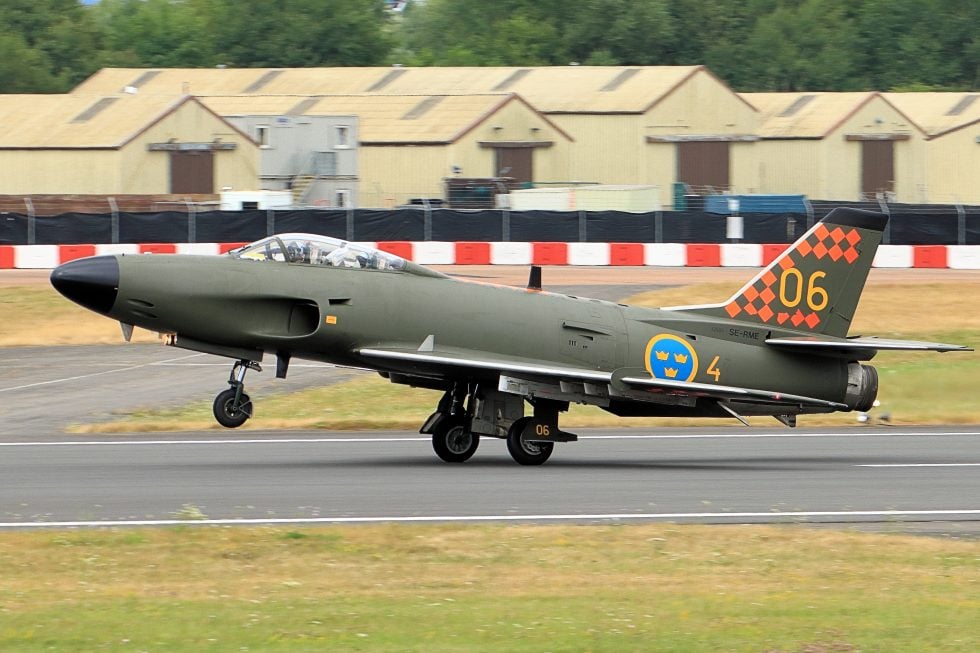
Where they are now: no air force flies the Lansen, and it left Swedish service in stages — the J 32B in 1970 (struck off charge 1973), the A 32A and S 32C in 1978, the Målflygdivisionen’s J 32D and J 32E at midsummer 1997, and the last J 32E of all in 1999. Attrition had already done most of the work: of 450 built, about a third were destroyed in accidents over 25 years — 98 A 32A, 26 J 32B and 14 S 32C — killing 100 aircrew, plus seven civilians on the ground at Vikbo in 1960. That is the ugly half of this aeroplane’s record and it should not be softened: the Lansen entered service technically immature, into an air force whose night and bad-weather training was not yet good enough for it. Survivors are all original airframes; no Lansen reproduction has ever been built or proposed. Six A 32A are preserved in Sweden (32070 with the Swedish Air Force Historic Flight, restored but not airworthy and not on the civil register; 32085 at the F 15 museum in Söderhamn; 32127 at Halmstad, rebuilt from three airframes; 32151 at the F 17 museum in Kallinge; 32197 at the Flygvapenmuseum in Linköping; 32259 as gate guardian at Karlsborg), with 32284 abroad at the Estrella Warbirds Museum in Paso Robles, California. Only two S 32C survive anywhere: 32917 at the Flygvapenmuseum and 32940 at the F11 Museum in Nyköping, the latter assembled from three airframes that had been used for fire practice and as gunnery targets. Fighter-derived airframes are more widely spread, including 32510 at the Österreichisches Luftfahrtmuseum at Graz, 32512 at the Aeroseum at Säve and 32543 at the Museo del Aire at Cuatro Vientos in Madrid. Three Lansens are airworthy, all of them civil-registered and flown by the Swedish Air Force Historic Flight from F 7 Såtenäs: SE-RMD (32542, fin 23), SE-RME (32606, a J 32D, fin 06) and SE-RMF (32620, fin 20, the last Lansen built). All three were reported airworthy in 2025 and the type still appears on the European display circuit, which makes the Lansen one of very few 1950s jet strike aircraft anywhere that can still be seen flying. Note that English-language sources give SE-RMD’s production number as 32543; 32543 is the aircraft in Madrid, and the flying machine is 32542.
From coastal striker to flying laboratory
The requirement
Sweden issues a specification for a jet attack aircraft able to strike an invasion fleet along its coast in any weather. Saab begins the design.
First flight
The prototype flies on 3 November with test pilot Bengt Olow at the controls.
Through the sound barrier
On 25 October a Lansen exceeds Mach 1 in a shallow dive — the first Swedish aircraft to do so.
A32A enters service
The attack variant reaches the squadrons, soon armed with the pioneering Rb 04 anti-ship missile.
J32B & S32C join
The all-weather radar fighter and the reconnaissance variant enter service, completing the Lansen family.
Handing over the front line
The A32A attack role passes to the AJ 37 Viggen; the J32B fighter is retired by the late 1970s.
End of active service
The last J32D target-tugs and J32E electronic-warfare Lansens are withdrawn from military use.
The final flights
Heritage Lansens fly air-sampling missions through Iceland’s 2010 volcanic ash cloud; the last airworthy examples are grounded in 2012.
From the archive: twelve Saab 32 Lansen stories
A jet to guard a coastline
Neutral Sweden needed to sink an invasion fleet in any weather — and built the Lansen to do it.
Read the full story
Bengt Olow takes it up
The prototype Lansen flew on 3 November 1952, opening Sweden’s transonic age.
Read the full story
Sweden goes supersonic
On 25 October 1953 a Lansen passed Mach 1 in a shallow dive — a national first.
Read the full story
Drawn by mathematics
The Lansen is often cited as one of the first aircraft laid out on a mathematical coordinate system.
Read the full story
The Rb 04 anti-ship missile
The A32A carried one of the world’s first air-launched anti-ship missiles with its own radar seeker.
Read the full story
Hunting in the dark
The radar-equipped J32B could intercept bombers over the Baltic at night and in cloud.
Read the full story
Fighting from the roads
The Lansen was built to disperse onto public highways under Sweden’s Bas 60 system.
Read the full story
Eyes over the Baltic
The S32C carried cameras and radar to watch the sea approaches to Sweden.
Read the full story
A combat jet that never fought
Across nearly six decades of service the Lansen never fired a weapon in anger.
Read the full story
Tugs, jammers and testbeds
As frontline units retired, Lansens became target-tugs, ECM aircraft and flying laboratories.
Read the full story
Flying through a volcano’s ash
Heritage Lansens flew sampling missions into the 2010 Icelandic ash cloud.
Read the full story
The last Lansens land
The final airworthy examples, flown by the Swedish Air Force Historic Flight, were grounded in 2012.
Read the full story
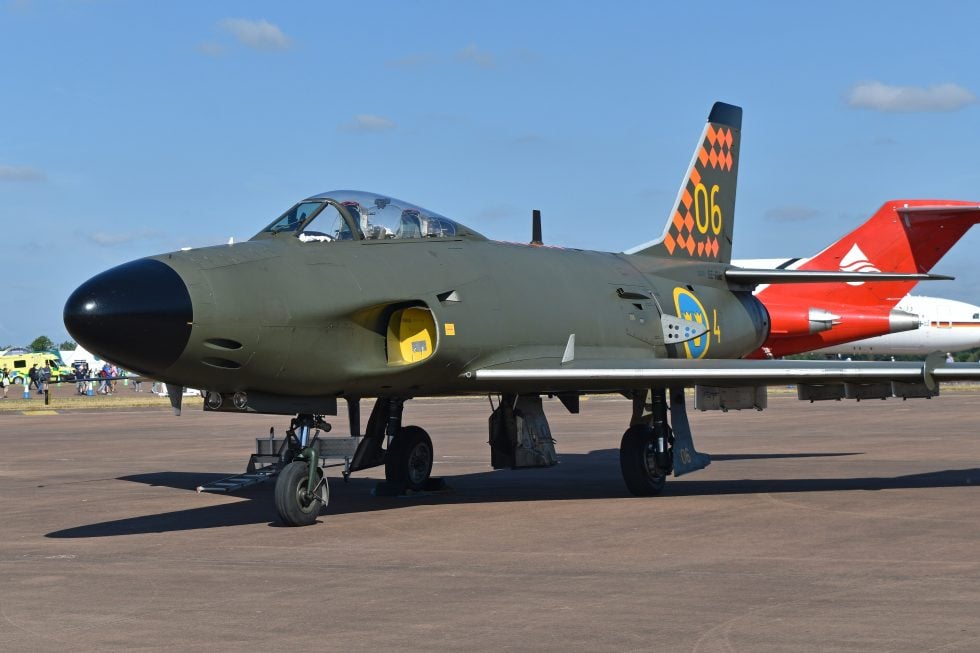
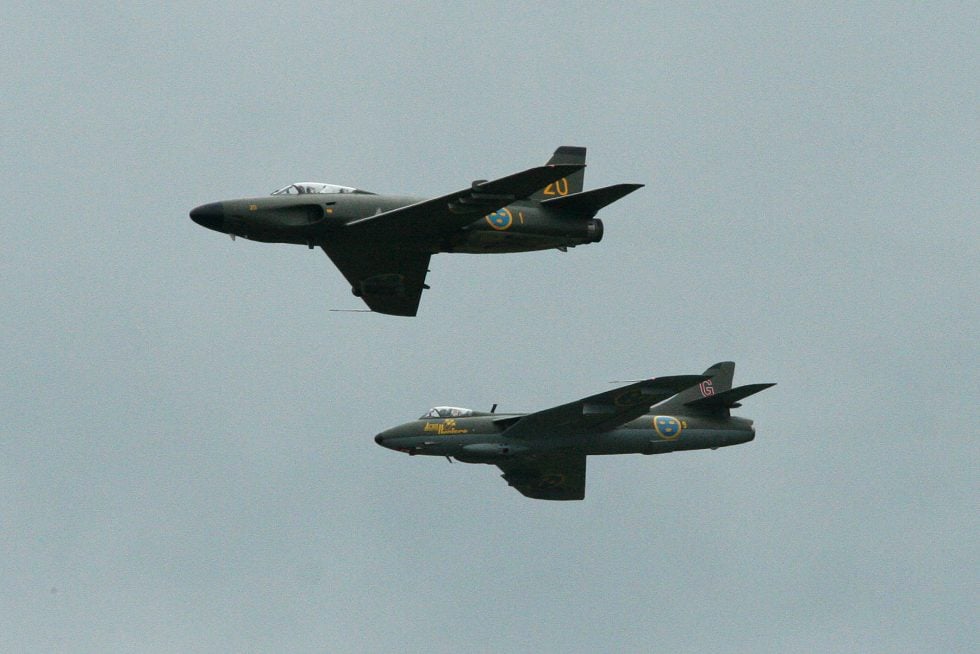
The Saab 32 Lansen in pictures
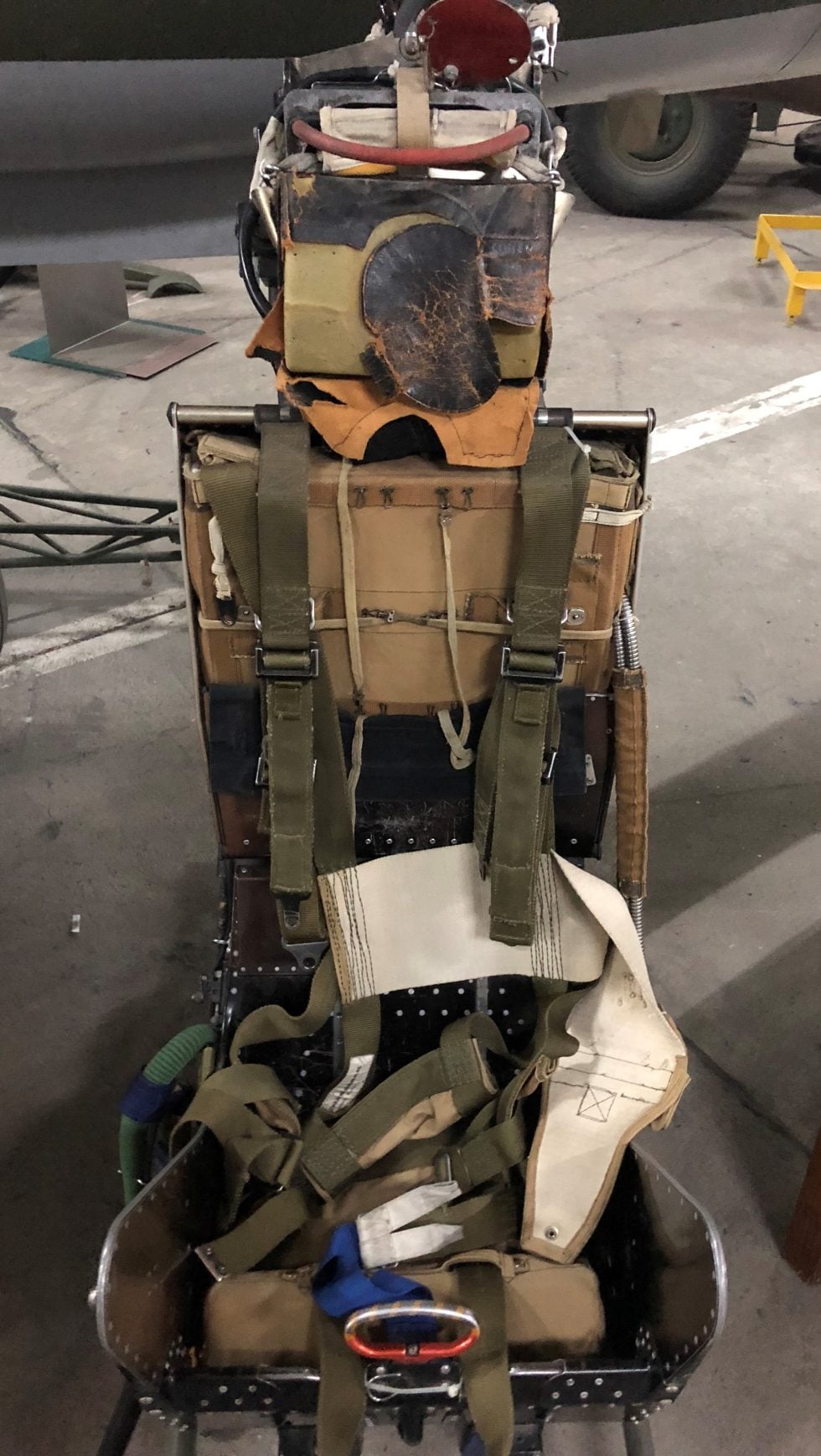
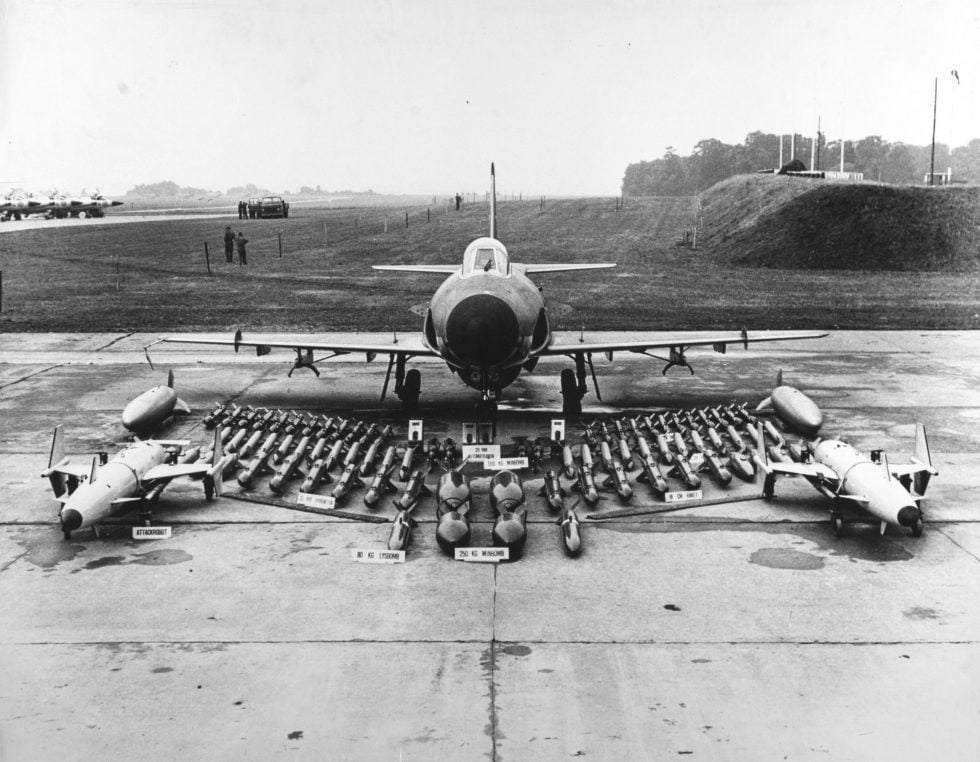
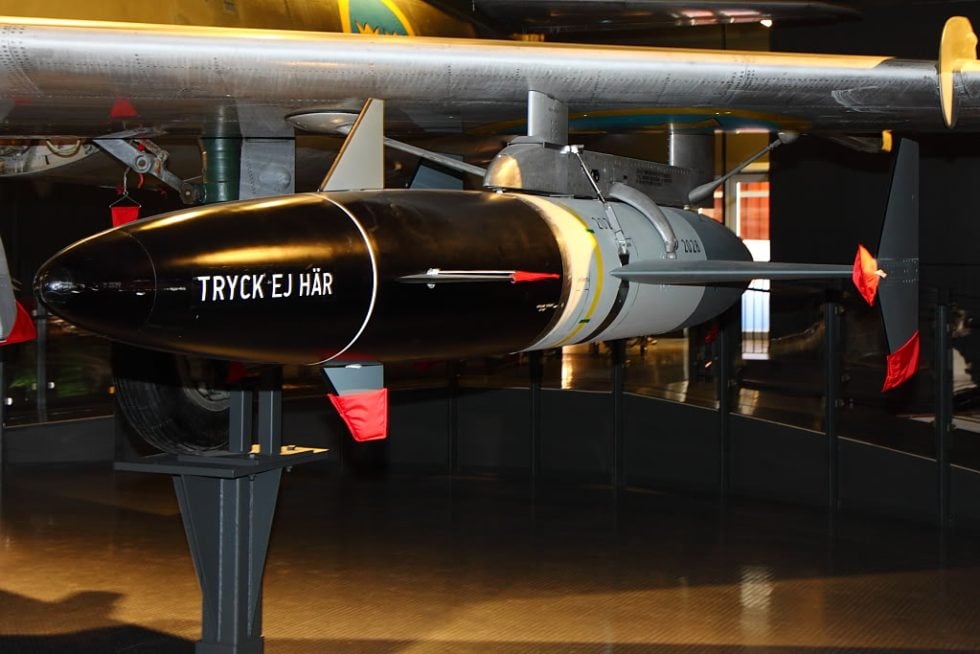
The Saab 32 Lansen in motion
A dedicated Saab 32 Lansen video feature is coming soon. In the meantime, explore the gallery above and the stories below — and see the surviving Lansens preserved across Sweden’s aviation museums.
The Lansen in motion
Not A Pound For Air To Ground — one of the most-watched Lansen films on YouTube.
Where the Saab 32 Lansen flew
The record of a jet that never fought
The Saab 32 Lansen is one of the rare Cold War combat aircraft with a blank combat record — and that is exactly what its designers wanted. Sweden’s policy of armed neutrality kept it out of every war, so the Lansen never fired a shot in anger. Its value was measured not in kills but in deterrence, readiness and a remarkably long working life.
Compare the combat record of every military aircraft. Figures as of July 2026.
Everything people ask about the Saab 32 Lansen
Can I fly in a Saab 32 Lansen?
What was the Saab 32 Lansen used for?
Did the Saab 32 Lansen ever see combat?
How fast was the Saab 32 Lansen?
What engine did the Saab 32 Lansen use?
How many Saab 32 Lansens were built?
Why did some Lansens fly until 2012?
Is the Saab 32 Lansen still in service?
You can’t fly the Saab 32 Lansen.
These, you can.
Some legends only live in museums — others are fuelled and waiting. MiGFlug has put civilians in real military jet cockpits since 2004.
 Fly the L-39 AlbatrosThe world’s most-flown jet trainer — aerobatics included
 Fly the F-104 Starfighter“The missile with a man in it”
 Fly the MiG-21The Cold War’s most-produced jet
 Fly the T-33 Shooting StarAmerica’s first jet trainer
 Fly the DH VampireA piece of early jet history
 Fly the S.211Agile Italian jet trainer
 Fly the MB-326The classic Aermacchi jet
 Fly the MiG-15The Soviet legend of the Korean War
Continue the tour
Every fact, checked
- Plane Encyclopedia — Saab 32 LansenDevelopment, variants, production numbers and service history.
- Military Factory — Saab J32 LansenSpecifications, dimensions, powerplant and armament reference.
- flugzeuginfo.net — Saab-32 LansenTechnical data cross-check for weights, performance and engines.
- Aviastar — Saab 32 LansenDesign background and the A32/J32/S32 variant breakdown.
- European Airshows — Lansen first flightFirst-flight date and early flight-test milestones.
- LetLetLet Warplanes — Saab 32 LansenVariant histories, roles and the type’s later testbed careers.
- All-Aero — Saab J-32 LansenEngine, radar and weapons detail including the Rb 04 and Rb 24.
- Wikimedia Commons — Saab 32 LansenSource and licensing for the photographs on this page.