

Boulton Paul Defiant
The RAF’s turret fighter with no forward guns — lethal from astern, defenceless head-on, and reborn as one of the deadliest night fighters of the Blitz.
At a Glance
Boulton Paul Defiant: key facts
ストーリー
The Boulton Paul Defiant: the fighter that shot backwards
In the mid-1930s the Royal Air Force built a fighter unlike any other in front-line service: a single-engine monoplane with not one gun pointing forward. Every weapon the Boulton Paul Defiant carried — four .303 inch Browning machine guns — was packed into a power-operated turret mounted behind the pilot and aimed by a second crewman. It was a fighter designed to shoot sideways and backwards, and for a few weeks in 1940 it was one of the most dangerous aircraft in the sky. Then, almost overnight, it became one of the most dangerous aircraft to fly.
The idea behind it was not madness but doctrine. In the years before the war the Air Ministry expected the main threat to Britain to come from massed formations of enemy bombers, not fighters — the escort fighter with the range to reach Britain barely existed yet. A “turret fighter” could formate alongside a bomber stream and rake it with concentrated, trainable fire from angles a fixed-gun fighter could never hold. Air Ministry Specification F.9/35 called for exactly such an aircraft, and Boulton Paul Aircraft of Wolverhampton, under chief designer John Dudley North, answered it.
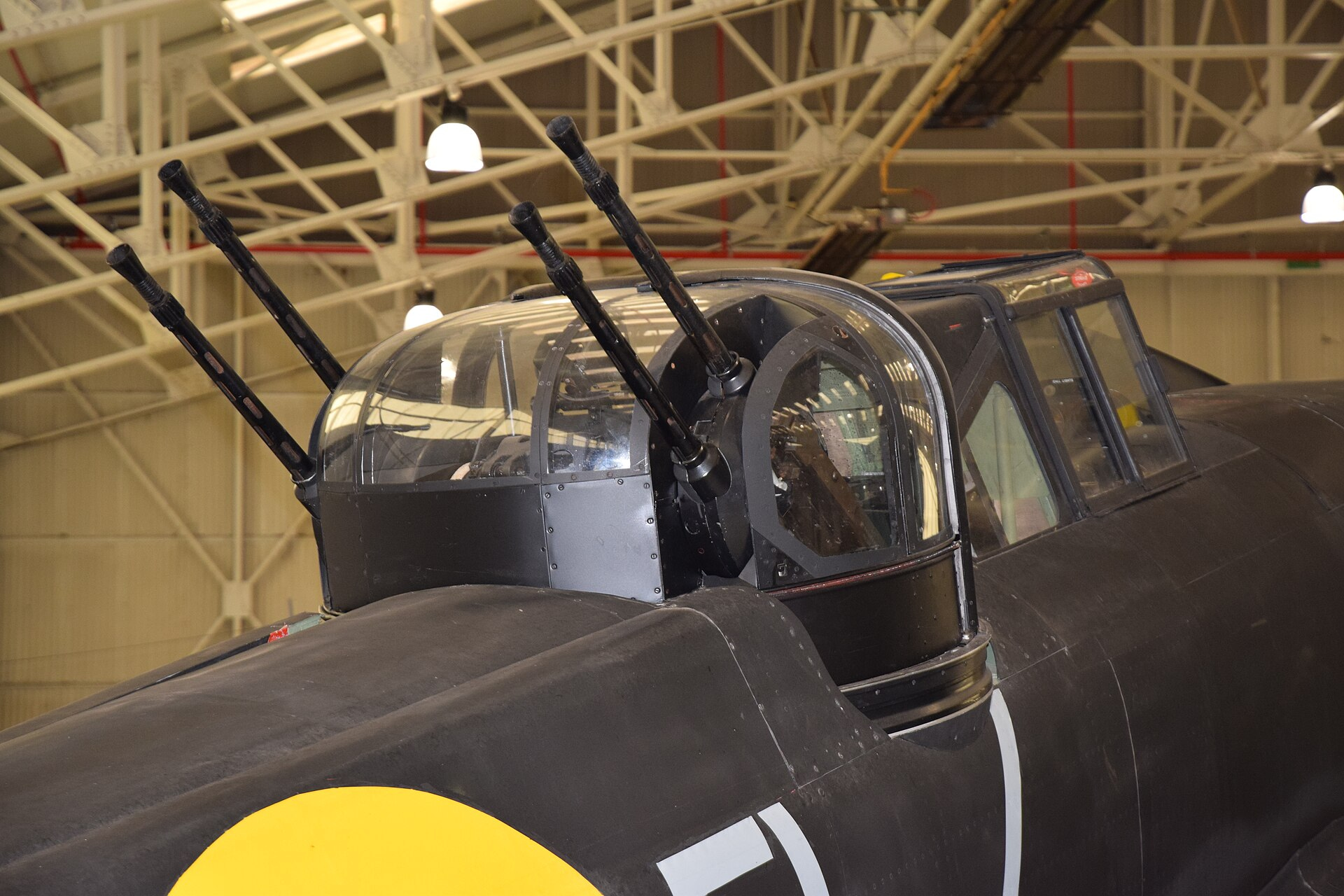
North built the Defiant around a Boulton Paul Type A turret — a compact hydraulic dome derived from a French SAMM design — carrying four Brownings. Power came from a single Rolls-Royce Merlin, the same engine that drove the Hurricane and Spitfire. But the Defiant had to haul a heavy turret, its hydraulics and a second man, and it paid for them in performance: at around 304 mph it was slower than a Hurricane and had no forward armament at all. The prototype first flew on 11 August 1937, and No. 264 Squadron received the first Mk Is in December 1939.
On paper this was still a modern, capable aircraft. It was an all-metal, stressed-skin monoplane with a retractable undercarriage and an enclosed cockpit — everything the RAF’s obsolescent biplanes were not. The problem was not the airframe but the philosophy bolted into the middle of it. A conventional fighter concentrated its firepower and its pilot’s attention in the same direction; the Defiant split them, asking one man to fly and another, sealed in a turret behind him, to fight.
When the Defiant went to war over France and Dunkirk in May 1940, it enjoyed a startling early success. On 29 May, No. 264 Squadron claimed a large number of German aircraft in a single day. The reason was tactical surprise: from head-on or in silhouette the Defiant looked much like a Hurricane, and Luftwaffe fighter pilots who dived on it from astern — the safe quarter against a normal fighter — flew straight into the massed fire of its turret. As with every claim made in the confusion of 1940, the totals were later found to be exaggerated, but the shock the Defiant delivered was real.
It did not last. Once German pilots understood what they were fighting, the trick collapsed. They attacked from below and from head-on, where the Defiant had no guns whatsoever, and used its sluggishness against it. On 19 July 1940 No. 141 Squadron was bounced by Bf 109s off Folkestone and lost six of its nine aircraft in a matter of minutes. Through August, No. 264 Squadron was mauled again in the Battle of Britain. By late summer the verdict was unavoidable: as a day fighter, the turret-fighter concept had failed. The Defiant was withdrawn from daylight combat.
And then it found its second life. In the dark, the very features that doomed the Defiant by day became strengths. A night fighter did not dogfight; it stalked. The Defiant’s pilot could ease his aircraft underneath a raider and hold formation while the gunner fired upward into its unprotected belly — an almost ideal use of a trainable turret. Through the Blitz of 1940–41, Defiant squadrons defending British cities did remarkably well; for a stretch of that winter the Defiant destroyed more German aircraft at night than any other RAF type. Later aircraft carried early airborne interception (AI) radar, giving the crew eyes in the dark.
As purpose-built night fighters such as the Beaufighter and Mosquito arrived, the Defiant was eased out of the front line — but not out of work. Hundreds were converted into target tugs, which became the type’s longest and most numerous career. Others flew air-sea rescue, spotting and dropping dinghies to aircrew down in the Channel, and some flew electronic-countermeasures missions under the codenames “Moonshine” and “Mandrel,” spoofing and jamming German radar. In all, about 1,064 Defiants of all marks were built before production ended.
There is a temptation to laugh at the Defiant, and it is worth resisting. Its crews were not fools, and neither were the men who ordered it. They were answering the problem as it appeared before the war — the fear of the self-defending bomber fleet — with the best technology and the clearest doctrine they had. That the war then delivered a different problem, the fast escort fighter, is not a charge that can fairly be laid at the aircraft. The Defiant did exactly what it was designed to do; it was the design brief that was wrong.
The turret idea was not even unique to Boulton Paul. The Royal Navy ordered its own turret fighter, the Blackburn Roc, on the same reasoning, and the concept had serious advocates across the inter-war RAF. When it failed, it failed as a whole school of thought, not as one company’s blunder — which is part of why the Defiant is such an instructive aircraft to study rather than simply to mock.
It is also worth being precise about the aircraft it is so often compared with. The Hurricane and Spitfire carried eight forward-firing guns and a single pilot; the Defiant carried four guns in a turret and two men. Against bombers, the two philosophies were closer than they look. Against fighters, they were worlds apart — and 1940 was, above all, a fighter’s war. Once that became clear, the RAF did the sensible thing: it stopped using the Defiant in the role that killed its crews and found the roles in which it could still do good work.
The Boulton Paul Defiant is remembered, then, as a brave and well-made answer to the wrong question — a sound aircraft whose founding premise was flawed for daylight fighting, yet which redeemed itself over blacked-out British cities and in the unglamorous support roles that kept others flying. Only one original survives today, and it does not fly. That is why it belongs in a museum — and why the story of its turret is worth telling in full.
01The Boulton Paul Defiant’s turret-fighter concept: why a fighter had no forward guns+
The Defiant was built to Air Ministry Specification F.9/35, which asked for a two-seat day and night fighter whose armament was concentrated in a single power-operated turret rather than in fixed, forward-firing guns. The thinking reflected the doctrine of the mid-1930s: planners expected unescorted bomber formations to be the main threat, and believed a fighter that could pull alongside and hold its fire on a bomber from any angle would be more effective than one that could only shoot straight ahead.
Boulton Paul’s answer placed four .303 Brownings in a Type A turret behind the pilot, operated by a dedicated gunner. Crucially, the pilot had no guns of his own and no gunsight for forward fire; he flew the aircraft into position and the gunner did the shooting. It was a genuine attempt to solve a real problem — but it built an aircraft optimised for a kind of air war that 1940 did not deliver.
02Why the Boulton Paul Defiant failed as a day fighter+
Against a modern single-seat fighter the Defiant’s weaknesses were fatal. It had no forward armament, so it could not attack head-on or make a conventional fighter pass. The weight of the turret, its hydraulics and a second crewman made it slower and less agile than a Hurricane or a Bf 109. And it had a defenceless cone below and ahead, precisely the angles a determined attacker would choose once the novelty had worn off.
After the early surprise over Dunkirk, the Luftwaffe learned to dive from head-on or from underneath, and the day-fighter losses became unsustainable — No. 141 Squadron’s mauling on 19 July 1940 being the sharpest example. The failure was not one of courage or construction; it was that the turret-fighter concept itself was unsound for daylight combat against agile fighters.
03Dunkirk 1940: the Boulton Paul Defiant’s brief triumph, then slaughter+
Over Dunkirk in late May 1940 the Defiant briefly looked like a war-winner. On 29 May No. 264 Squadron claimed dozens of German aircraft in a day, because enemy pilots, mistaking the Defiant for a Hurricane, attacked from astern and were met by four guns firing back. Contemporary claims were greatly inflated, as claims on all sides were in 1940, but the squadron genuinely inflicted real losses and real alarm.
Within weeks the advantage evaporated. As German pilots recognised the type and changed their angle of attack, the same squadrons that had scored so heavily began to suffer catastrophic losses. The Defiant’s war in daylight lasted barely a season before it was withdrawn — one of the most abrupt rises and falls of any fighter of the war.
Design & Engineering
How the Boulton Paul Defiant was built to fight
The Defiant was a clean, modern monoplane built around one radical decision — to put all its guns in a turret — and everything else about the airframe followed from, and paid for, that choice.
A fighter built around a turret
The heart of the Defiant was the Boulton Paul Type A power-operated turret, carrying four .303 in Browning machine guns and mounted directly behind the pilot. Hydraulically driven and derived from a French SAMM design, it let the gunner train concentrated fire through a wide arc — but it dictated the whole aircraft, from its two-seat layout to its weight and drag.
One Rolls-Royce Merlin
Like the Hurricane and Spitfire, the Defiant was powered by a single Rolls-Royce Merlin — the Merlin III of about 1,030 hp in the Mk I, and the more powerful Merlin XX in the Mk II. But the Defiant asked that one engine to carry a turret, its hydraulics and a second man, so the same Merlin delivered noticeably less speed and climb than it gave a single-seat fighter.
Two crew and a defensive gap
The Defiant carried a pilot and a turret gunner, with no dual controls and no forward guns. The pilot manoeuvred the aircraft while the gunner fought; teamwork was everything. The price was a blind, gunless cone below and ahead — the exact quarter enemy fighters exploited once they understood the type, and the reason the concept unravelled so quickly in daylight.
Design in Detail
The Boulton Paul Defiant, part by part
Beyond the turret, the Defiant was a thoroughly modern late-1930s monoplane. These are the details that defined how it flew and fought.
Airframe and construction
The Defiant was an all-metal, stressed-skin monoplane with a retractable undercarriage, enclosed cockpit and flaps — fully up to date for its day. Aerodynamically it was clean; the penalty it carried was structural, in the mass and drag of the turret and the second crew station rather than in any crudeness of the airframe itself.
Cockpit and crew stations
Pilot and gunner sat in tandem but worked in near-isolation, linked only by intercom. The pilot had no guns and no gunsight for forward fire; the gunner had no flying controls. Escaping the turret in an emergency was difficult, and the awkwardness of bailing out was one of the aircraft’s genuine and much-criticised dangers.
Armament and ammunition
The four .303 in Browning machine guns in the turret were belt-fed and power-aimed, giving a heavy, concentrated burst through a wide arc. But rifle-calibre guns were already marginal against armoured 1940 aircraft, and the turret carried a finite supply of ammunition with no forward-firing reserve if the guns or hydraulics failed.
16The Boulton Paul Type A turret mechanism+
The Type A turret was hydraulically powered, driven by a pump on the engine, which let the gunner slew and elevate the four guns quickly and precisely — a real advance over the hand-worked positions of earlier aircraft.
That power operation was the turret’s great strength, but it also added weight, complexity and a dependence on the hydraulic system. A failure there could leave the gunner with a heavy, sluggish turret and the aircraft with no working armament at all.
The same Boulton Paul turret technology, licensed and developed from de Boysson’s French SAMM design, went on to arm many RAF bombers, making it one of the company’s most important contributions to the air war.
17The Rolls-Royce Merlin III and Merlin XX in the Defiant+
The Mk I Defiant used the Merlin III of roughly 1,030 hp — the same mark that powered early Hurricanes and Spitfires. It gave the Defiant adequate but unspectacular performance once the weight of the turret was accounted for.
The Mk II introduced the Merlin XX of around 1,280 hp, with a two-speed supercharger that improved performance at altitude. Combined with extra fuel, it made a distinctly better night fighter.
In both cases the engine was never the problem. The Merlin was superb; it was simply being asked to lift a heavier, more complex airframe than it carried in the single-seat fighters.
18Handling and the danger of bailing out+
In the air the Defiant was pleasant enough to fly and reasonably manoeuvrable for its weight, but it lacked the sparkling performance of a single-seat Merlin fighter, and pilots learned that they could not fight it like one.
The most notorious hazard was escape. Getting the gunner out of the turret in a stricken aircraft was difficult, and the type gained a grim reputation for the number of gunners lost when Defiants went down.
These were not the failings that doomed the Defiant as a day fighter — that was the concept — but they added to the human cost paid by its crews during the aircraft’s brief and bloody front-line career.
仕様
Boulton Paul Defiant Mk I specifications
Representative figures for the Defiant Mk I; sources differ on weights and speeds, so contested values are given as approximate.
| クルー | 2 (pilot and turret gunner) |
|---|---|
| 長さ | 10.77 m (35 ft 4 in) |
| 翼幅 | 11.99 m (39 ft 4 in) |
| 身長 | ~3.45 m (11 ft 4 in) |
| 翼領域 | 23.2 m² (250 sq ft) |
| 空虚重量 | ~2,760 kg (6,078 lb) — approx |
| Max takeoff weight | ~3,820 kg (8,420 lb) — approx |
| Powerplant | 1 × Rolls-Royce Merlin III (Mk I) |
| Power | ~1,030 hp (768 kW) |
| 最高速度 | ~489 km/h (304 mph) at 5,180 m (Mk I); ~504 km/h (313 mph) Mk II — figures vary |
|---|---|
| Cruising speed | ~319 km/h (198 mph) — approx |
| 範囲 | ~750 km (465 mi) — approx |
| サービス天井 | ~9,250 m (30,350 ft) — approx |
| 武装 | 4 × .303 in Browning MGs in a power-operated dorsal turret |
| Fixed forward guns | なし |
| First flight | 11 August 1937 |
| Unit cost | Not reliably recorded (WWII) |
| Cost per flight hour | Not applicable — no airworthy example |
04The Boulton Paul Defiant’s variants: Mk I, Mk II and the target tugs+
The main fighter marks were the Mk I, powered by the Merlin III, and the Mk II, with the more powerful Merlin XX and extra fuel to improve its performance as a night fighter. Many later aircraft were completed or converted for the night-fighter role and carried AI radar.
The largest single group of later Defiants, however, were not fighters at all: hundreds were built or converted as TT Mk I and TT Mk III target tugs, and others served in air-sea rescue and electronic-countermeasures roles. In total about 1,064 Defiants were built, though the exact split between marks and roles varies between sources.
05The Boulton Paul Defiant’s costs: what it cost then, and why you cannot fly one now+
No reliable unit cost for the Defiant is recorded in the way modern aircraft prices are quoted, and wartime cost-per-flying-hour figures were never compiled to any comparable standard — so both are best treated as “not reliably recorded.” The Defiant was a mass-produced 1940 fighter, procured in wartime under conditions that make a clean modern-style figure impossible.
There is also no cost-per-hour to fly one today, for the simplest of reasons: no Defiant is airworthy anywhere in the world. Only one original survives, as a static museum exhibit, so unlike some warbirds there is no flying example to operate. If you want the experience of flying a genuine military aircraft, MiGFlug can arrange it in other types — see migflug.com/flights-prices/.
Reference Data
Boulton Paul Defiant: design, service and production
Background reference data spanning the Defiant family, from the F.9/35 specification to the sole surviving airframe.
| Manufacturer | Boulton Paul Aircraft Ltd, Wolverhampton |
|---|---|
| Country of origin | イギリス |
| Design specification | Air Ministry F.9/35 (two-seat turret fighter) |
| Chief designer | John Dudley North |
| Prototype first flight | 11 August 1937 |
| Service entry | December 1939 (No. 264 Squadron) |
| Turret | Boulton Paul Type A (hydraulic, 4 × .303 Browning) |
| Primary operator | イギリス空軍 |
| Number built | ~1,064 (all marks; figures vary) |
| Main variants | Mk I, Mk II, TT Mk I/III (target tug), ASR |
| Withdrawn (day fighter) | August 1940 |
| Night-fighter service | 1940–1942 |
| Later roles | Target tug, air-sea rescue, radar-jamming (ECM) |
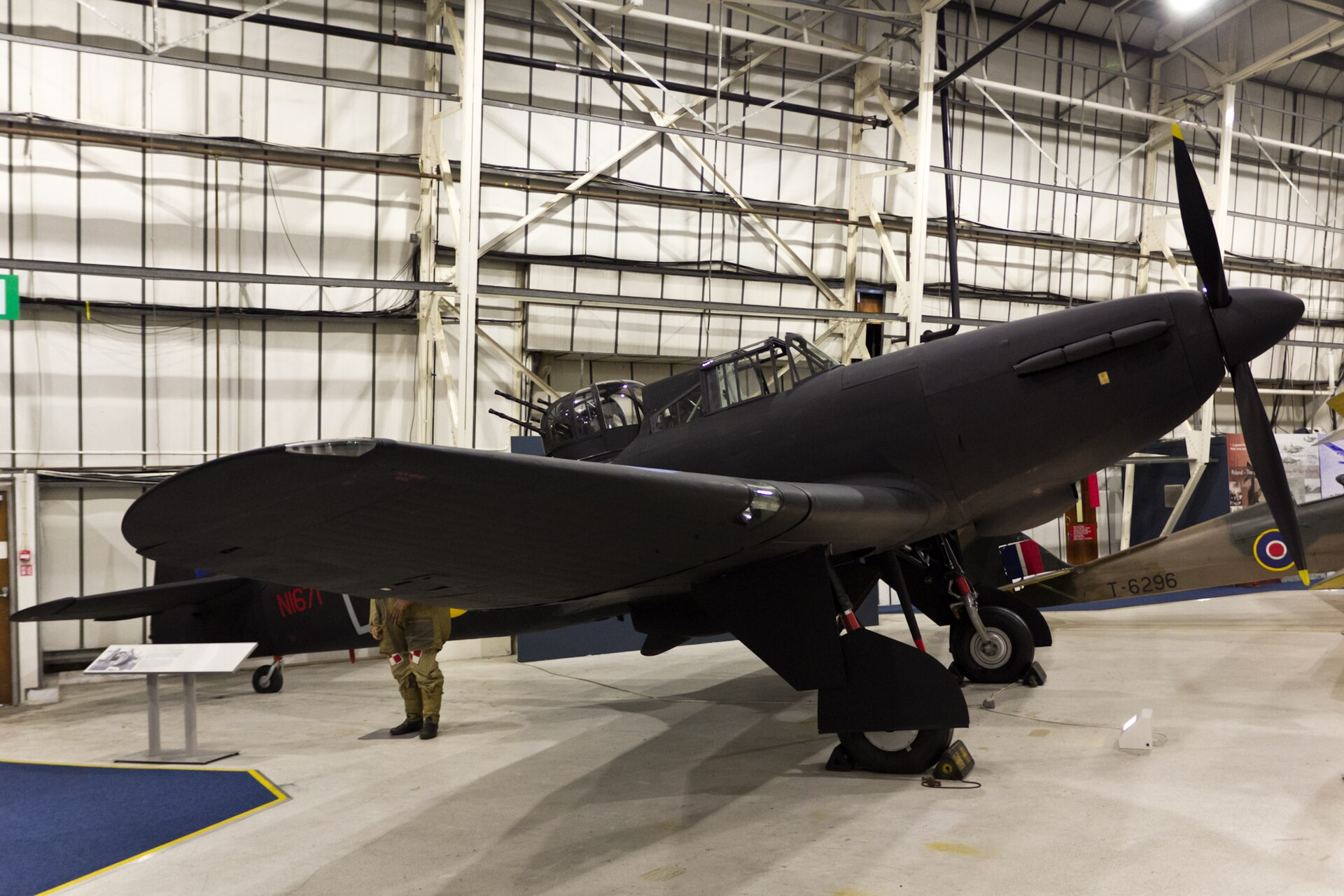
| Surviving original | One (N1671, RAF Museum Midlands / Cosford) |
| Mark | Engine, role and notes |
|---|---|
| Defiant Mk I | Rolls-Royce Merlin III (~1,030 hp); original day/night fighter with the Type A turret |
| Defiant Mk II | Rolls-Royce Merlin XX (~1,280 hp); improved night fighter, extra fuel, often AI radar |
| Defiant TT Mk I | Purpose-built target tug with towing gear; the type’s most numerous later role |
| Defiant TT Mk III | Fighter airframes converted to target tugs for training duties |
| Air-sea rescue | Defiants adapted to carry and drop dinghies to downed aircrew |
Powerplant & Heritage
The engine, the turret and the Defiant’s second career
06The Rolls-Royce Merlin: the engine that powered the Boulton Paul Defiant+
The Defiant shared its heart with Britain’s most famous fighters: the Rolls-Royce Merlin, a liquid-cooled V12 that also powered the Hurricane, Spitfire, Lancaster and Mosquito. The Mk I used the Merlin III of roughly 1,030 hp; the Mk II adopted the Merlin XX of around 1,280 hp, which restored some of the performance lost to the turret and gave the night-fighter version useful extra height and speed.
The same engine that made the single-seat fighters so formidable could only do so much for the Defiant, because it had to lift a turret, its hydraulics and a second crewman. That is the essential engineering story of the aircraft: a first-class engine asked to carry a heavier, more complex airframe than its rivals.
07The Boulton Paul Defiant’s second career: night fighter, target tug and radar-jammer+
Withdrawn from daylight combat, the Defiant became a genuinely effective night fighter during the Blitz of 1940–41. At night the trainable turret came into its own: the pilot could slide beneath a bomber and hold station while the gunner fired up into it. For part of that winter the Defiant claimed more night victories than any other RAF type, and later aircraft carried early AI radar.
As dedicated night fighters replaced it, the Defiant moved into support work that would outlast its fighting career. Hundreds served as target tugs — towing sleeves for gunnery training — while others flew air-sea rescue, dropping dinghies to downed aircrew, and a number flew “Moonshine” and “Mandrel” electronic-countermeasures sorties, spoofing and jamming German radar. It was an unglamorous but valuable end to the story of Britain’s turret fighter.
In Depth
The Boulton Paul Defiant, examined
Nineteen deeper questions about the turret fighter — its rivals, its crews, its makers, its night war, its overseas service, its preservation and its meaning.
08The Boulton Paul Defiant vs the Hurricane and Spitfire+
The comparison is unavoidable, because all three shared the same Rolls-Royce Merlin. The Hurricane and Spitfire were single-seat fighters with eight forward-firing .303 Brownings; the Defiant was a two-seat fighter with four guns in a turret and none pointing ahead.
The extra crewman, the turret and its hydraulics cost the Defiant perhaps 30–40 mph against a Hurricane and far more against a Spitfire, and denied it any ability to fight head-on or make a slashing pass. Against another fighter these were crippling handicaps.
Against a bomber, the gap narrowed — a Defiant crew could hold fire on a target from a beam position the single-seaters could not sustain. But 1940 was decided by fighter-versus-fighter combat, and there the Defiant was simply outclassed by its own stablemates.
09Inside the turret: the Boulton Paul Defiant gunner’s job+
The gunner sat in the power-operated Type A turret behind the pilot, with four Brownings and a reflector sight, cut off from his pilot except by intercom. He had no flying controls and, in an emergency, a notoriously difficult escape past the turret and the aircraft’s slipstream.
His job demanded a different kind of nerve from a single-seat pilot’s. He could not choose the aircraft’s path; he could only aim and fire as the pilot manoeuvred, trusting the man in front to put him in a firing position and to get them both home.
At night the partnership was everything: the pilot flew formation on a barely visible bomber while the gunner laid his guns and fired upward into it. When it worked, it was deadly; it also asked a great deal of two men working blind in the dark.
10Boulton Paul Aircraft: the company behind the Defiant+
Boulton Paul Aircraft, based at Pendeford in Wolverhampton, grew out of the earlier Boulton & Paul engineering firm of Norwich. By the 1930s it had become a specialist in one thing above all: powered gun turrets.
That expertise won the company the F.9/35 contract and shaped the Defiant. Boulton Paul turrets would go on to arm many British bombers, so the firm’s influence on the air war extended far beyond its own most famous aircraft.
Today the Boulton Paul Association preserves that heritage at the company’s old site, including a full-scale Defiant replica — a reminder that Wolverhampton, not just the great southern factories, helped build Britain’s air defences.
11John Dudley North and the design of the Defiant+
The Defiant was the work of Boulton Paul’s long-serving chief engineer and managing director, John Dudley North, one of the more thoughtful British aircraft designers of his generation and an early advocate of powered gun turrets.
North produced a clean, modern, all-metal monoplane that was, as a piece of aircraft design, perfectly sound. Its retractable undercarriage, enclosed cockpit and stressed-skin construction were fully up to date for the late 1930s.
The flaw lay not in North’s execution but in the requirement he was answering. He built exactly what the Air Ministry asked for — a turret fighter — and did it well; the concept, not the aircraft, was the mistake.
12The squadrons that flew the Boulton Paul Defiant+
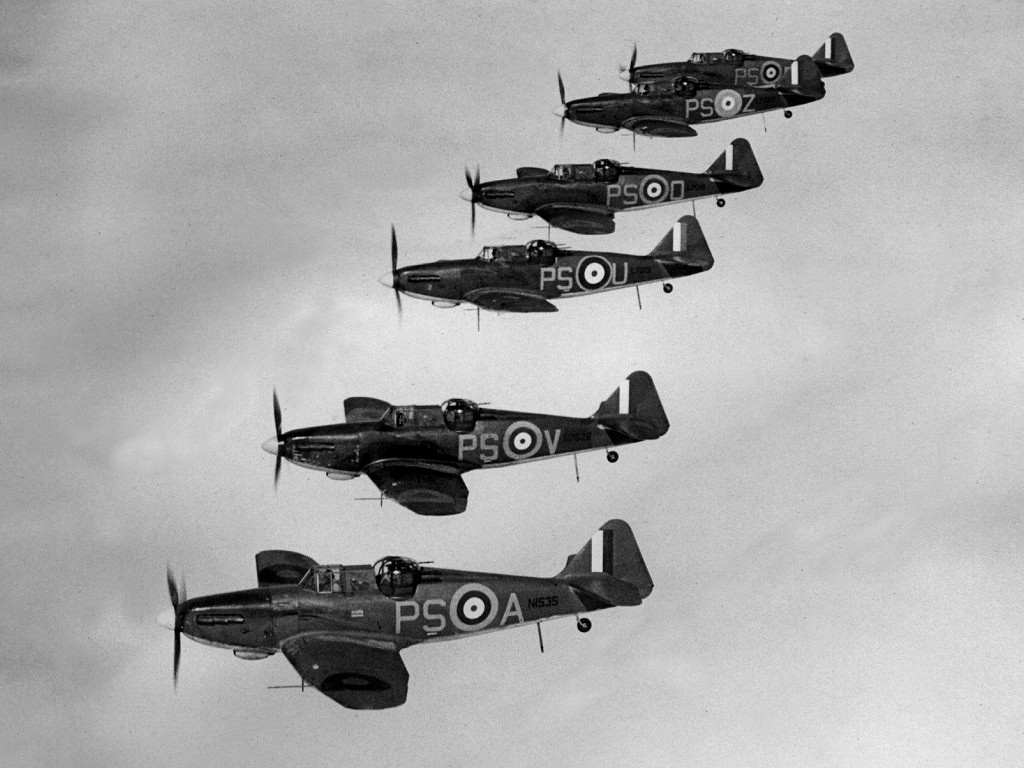
The Defiant is inseparable from a handful of squadrons. No. 264 Squadron was the pioneer, taking the type into action over Dunkirk and later making a success of it at night. No. 141 Squadron suffered the type’s worst single day on 19 July 1940.
In the night-fighter role, units such as Nos. 96, 151, 256 and 264 defended British cities through the Blitz, while No. 307 (Polish) Squadron — “Lwów” — flew Defiants including the survivor N1671.
Later, Defiant target-tug and air-sea-rescue flights served across the RAF and Fleet Air Arm at home and overseas, spreading the type far beyond the front-line fighter squadrons that first flew it.
13The Boulton Paul Defiant’s target-tug and support career+
Once withdrawn from fighting, the Defiant became one of the RAF’s standard target tugs. Purpose-built TT Mk I and converted TT Mk III aircraft towed sleeve targets for fighter and anti-aircraft gunnery training across Britain and in theatres such as India and the Middle East.
Air-sea-rescue Defiants searched coastal waters for downed aircrew, and small numbers flew the “Moonshine” and “Mandrel” electronic-countermeasures sorties that helped confuse German radar.
These roles were unglamorous, but they kept hundreds of airframes usefully employed for years, and they are the reason the Defiant’s total service life stretched well beyond its brief and bloody career as a fighter.
14How many Boulton Paul Defiants were built?+
Production is usually given as about 1,064 aircraft of all marks, though sources differ on the exact figure and on how the total divides between fighters, night fighters and target tugs.
The main fighter marks were the Merlin III–powered Mk I and the Merlin XX–powered Mk II, with large numbers of later airframes completed or converted as target tugs and for air-sea rescue.
Because so many were rebuilt from one role into another during their service, any precise breakdown should be treated with caution — which is why this page gives the total as approximate.
15Why the turret fighter failed — and what it teaches+
The Defiant failed as a day fighter for one fundamental reason: it was optimised for attacking bombers at a time when the decisive threat turned out to be enemy fighters. No amount of crew courage could compensate for having no forward guns and inferior performance.
The deeper lesson is about doctrine. British planners had built an aircraft around a confident prediction about the shape of the coming air war, and the prediction was wrong. When the escort fighter appeared, the whole category of turret fighters — Defiant and Blackburn Roc alike — was obsolete.
Yet the Defiant’s night-fighter and support careers show that a flawed aircraft is not always a useless one. Withdrawn from the role that killed its crews, it went on to do years of valuable work — a more nuanced story than the “worst fighter of the war” caricature suggests.
19How the Defiant actually worked as a night fighter+
Night fighting in 1940 was a slow, patient business. Ground controllers using early radar vectored a fighter toward a raider; searchlights and the glow of fires helped the crew make visual contact; then the fighter tried to close in without being seen.
This is where the Defiant’s turret paid off. Rather than needing to point the whole aircraft at the target, the pilot could formate slightly below and to one side of a bomber, matching its course, while the gunner trained his four guns and fired up into it.
It demanded fine flying and good teamwork, but it turned the Defiant’s day-fighter weakness — the inability to bring guns to bear head-on — into a night-fighter strength, letting the crew attack from a position the bomber’s own gunners could barely cover.
20The Defiant’s reputation: separating myth from record+
The Defiant is often written off as one of the worst fighters of the war. As a day fighter that verdict is essentially fair — the concept was unsound and the losses were severe. But as a blanket judgement on the aircraft it is misleading.
The same type that was slaughtered in daylight became, for a season, the RAF’s most successful night fighter, and then served usefully for years as a target tug, air-sea-rescue aircraft and radar-jammer.
A fairer summary is the one this page’s chosen video puts in its title: a good aircraft built around a flawed concept. Judged against what it was asked to do in daylight, it failed; judged as a whole career, it was far from useless.
21The Boulton Paul Defiant in the wider story of the air war+
The Defiant matters partly because of what it reveals about how air forces prepare for wars that have not yet happened. Britain built it in good faith to counter a threat — the unescorted bomber fleet — that the technology of escort fighters was about to reshape.
Its story runs alongside the Hurricane and Spitfire, the aircraft that actually won the daylight battle, and it throws their success into sharper relief: the difference between the turret fighter and the eight-gun single-seater was, in the end, the difference between the wrong idea and the right one.
That is why the Defiant is worth remembering honestly rather than mocking. It is a case study in doctrine, courage and adaptation — and in the men who took a flawed aircraft to war and made what they could of it.
22The human cost: Defiant losses and their crews+
The Defiant’s daylight failure was measured in men as well as machines. Each aircraft carried two, and the difficulty of escaping the turret meant that when a Defiant went down, the odds for its gunner were especially poor.
Squadrons such as No. 141 lost experienced crews in minutes on their worst days, and the aircraft’s reputation among aircrew suffered accordingly, even as its later night successes restored some of its standing.
It is a reminder that the debate over the turret-fighter concept was never merely technical. Behind every entry in the loss records was a pilot and a gunner, and the decision to withdraw the Defiant from daylight was, in part, a decision to stop spending their lives on a flawed idea.
23The Boulton Paul Defiant overseas and with the Fleet Air Arm+
Although the Defiant’s fighting was concentrated over Britain and the Channel, the aircraft served more widely in its support roles. Target-tug and air-sea-rescue Defiants operated in theatres including India and the Middle East, supporting training and rescue far from the home front.
The Fleet Air Arm also used Defiants for target-towing duties, and a small number of Defiant target tugs were operated by USAAF units based in Britain.
None of this was front-line combat, but it spread the type across several countries and kept airframes usefully employed, which is why the operations map shows the Defiant reaching well beyond its brief fighter career in north-west Europe.
24Preserving N1671: the last Boulton Paul Defiant+
The survival of N1671 was not guaranteed. Set aside in 1944 after service with No. 307 (Polish) Squadron and other units, it passed through storage and display before being carefully restored — work carried out by the Medway Aircraft Preservation Society at Rochester — and returned to the RAF Museum.
It has been displayed at Hendon and, since the early 2010s, at the RAF Museum Midlands site at Cosford, where it stands today as the sole surviving intact original of its type.
Because no Defiant flies, this one airframe carries the whole physical legacy of the design. It is the reason the turret fighter is more than a set of photographs and statistics — and the closest anyone will get to the real aircraft.
25The Defiant and the birth of RAF night-fighting+
When the Defiant was pushed into the night role in late 1940, RAF night-fighting was still in its infancy. Interceptions depended on ground-controlled radar stations vectoring a fighter roughly toward a raider, and on searchlights, moonlight and luck to complete the contact.
The Defiant arrived in this world as a stopgap, but a well-suited one. Its steady handling and trainable turret let crews attack bombers they could shadow but not out-turn, and its successes helped prove that radar-directed night interception could actually work.
By the time purpose-built types such as the Beaufighter and Mosquito matured, the techniques the Defiant had helped pioneer were established RAF practice. Its night career was brief, but it fell at a formative moment in the story of air defence.
26What became of the Defiants+
Very few Defiants survived the scrapping that followed the war. As a type with no post-war front-line future and a poor early reputation, it was disposed of in numbers, and unlike the Spitfire it attracted no wave of civilian preservation.
The result is one of the rarest survival records of any major RAF type: a single intact original, N1671, plus a full-scale replica at Wolverhampton and various turret and component relics in collections.
That scarcity is itself part of the Defiant’s story. The aircraft that embodied a discarded idea was, fittingly, almost entirely discarded — which makes the one that remains all the more worth preserving and understanding.
Operators & Units
Who flew the Boulton Paul Defiant
The Defiant was almost entirely a Royal Air Force aircraft, flown by a small group of famous squadrons in the fighter and night-fighter roles, then far more widely in support duties.
| No. 264 Squadron | First and most famous Defiant unit — Dunkirk, then night defence |
|---|---|
| No. 141 Squadron | Mauled on 19 July 1940; later a night-fighter unit |
| No. 307 (Polish) Squadron | Night fighters; flew the surviving airframe N1671 |
| Nos. 96, 151, 256 Squadrons | Blitz night-fighter defence of British cities |
| Royal Air Force (overseas) | Target-tug and air-sea-rescue flights in India and the Middle East |
| Fleet Air Arm | Target-towing duties with the Royal Navy |
| USAAF (in Britain) | Small numbers of Defiant target tugs operated from British bases |
Timeline
The Boulton Paul Defiant: a service record
From a 1935 specification to the end of second-line service a decade later — the compressed rise, fall and reinvention of Britain’s turret fighter.
Stories & Eyewitnesses
The Boulton Paul Defiant in twenty stories
From the specification that created it to the single airframe that survives, the Defiant’s story is one of a bold idea, a brutal reckoning and an unexpected second life. Scroll through the cards and open each for the detail.
A fighter designed to shoot backwards
The Defiant’s guns all pointed away from the direction of flight — a deliberate, doctrine-driven choice.
続きを読む
The Defiant carried no forward armament at all. Its four .303 Brownings sat in a power-operated turret behind the pilot, aimed by a gunner who could sweep them through a wide arc to the sides and rear.
The idea was that such a fighter could destroy bombers from angles a fixed-gun fighter could never hold — sliding alongside a formation and raking it, rather than making the fleeting head-on or stern pass of a conventional interceptor.
It was a serious answer to the air war planners expected in the mid-1930s. It was simply the wrong war. When the fast single-seat escort fighter arrived, an aircraft that could not shoot forwards was in deep trouble.
F.9/35: the Air Ministry orders a turret fighter
A 1935 requirement crystallised the turret-fighter idea into an official specification.
続きを読む
Specification F.9/35 called for a two-seat day and night fighter with its armament concentrated in a power-operated turret rather than in fixed guns. It was a genuine attempt to codify the “bomber destroyer” of the future.
Boulton Paul and Hawker both submitted designs. Boulton Paul’s, drawing on the firm’s turret expertise, won production as the Defiant; Hawker’s Hotspur was abandoned.
The specification reflected the conviction that unescorted enemy bombers, not fighters, would be the decisive threat over Britain — a conviction the events of 1940 would comprehensively overturn.
Four guns in a hydraulic dome
The Boulton Paul Type A turret was the aircraft’s reason for existing.
続きを読む
The Type A turret was a compact, power-operated design that Boulton Paul developed from a French SAMM turret designed by J. B. A. de Boysson. It carried four Browning machine guns and could be trained quickly through a wide arc.
The whole aircraft was built around it. The turret set the fuselage width, demanded the second crewman, added weight and drag, and drove the two-seat layout — every compromise in the Defiant traces back to that dome.
It was, in isolation, an impressive piece of engineering, and its power operation gave the gunner far better control than the hand-worked guns of earlier types. The problem was never the turret; it was the aircraft built to carry only that.
1937: the Defiant takes to the air
The prototype flew two years before the war it was built for.
続きを読む
The Defiant prototype, K8310, first flew on 11 August 1937 from Boulton Paul’s Pendeford works at Wolverhampton, initially without its turret fitted.
Turret installation, hydraulics and development flying took time, and the type did not reach an operational squadron — No. 264 — until December 1939, more than two years later.
By the time it entered service, fighter development had moved on again. The Bf 109 was faster and better armed, and the escort-fighter problem the Defiant ignored was already becoming real. It was, in a sense, obsolete on arrival.
29 May 1940: the day the trick worked
For one day over Dunkirk, the turret fighter looked unstoppable.
続きを読む
On 29 May 1940, covering the Dunkirk evacuation, No. 264 Squadron claimed a remarkable tally in a single day. German pilots, taking the Defiant for a Hurricane, dived on it from behind — and flew straight into the massed fire of its turret.
For a few hours the concept looked vindicated. The turret gave the Defiant a lethal surprise from exactly the angle a fighter pilot considered safe.
As with every claim made in the chaos of 1940, the totals were later found to be greatly inflated. But the squadron did inflict real losses, and the shock it delivered was real enough to spread caution through the German fighter units.
When the Luftwaffe learned the trick
The Defiant’s advantage depended entirely on the enemy’s mistake.
続きを読む
The surprise could only work once. Once German pilots recognised the Defiant’s silhouette and understood where its guns were, they simply attacked from head-on or from below, where it had no guns at all.
They also exploited its lack of speed and agility, using their superior performance to dictate every engagement. The turret’s wide arc meant nothing if the attacker never entered it.
The same aircraft that had scored so heavily over Dunkirk began to be shot down in numbers. The turret fighter’s brief day in the sun was over almost as soon as it had begun.
19 July 1940: six of nine
No. 141 Squadron’s first day-fighter action was a catastrophe.
続きを読む
On 19 July 1940 No. 141 Squadron sent nine Defiants to patrol off Folkestone. They were bounced by Bf 109s of JG 51 attacking from above and behind the turret’s effective arc.
Within minutes six of the nine had been shot down and others badly damaged; the squadron was effectively wrecked in a single engagement and was promptly pulled back north.
The action became the clearest single proof that the Defiant could not survive as a day fighter against modern single-seat opponents. It is still cited as the moment the turret-fighter idea died in daylight.
264 Squadron’s second mauling
Given another chance in the daylight battle, the Defiant was cut up again.
続きを読む
No. 264 Squadron, the type’s most experienced unit, was thrown back into the daylight Battle of Britain in late August 1940 and again suffered heavy losses in a matter of days.
Even skilled, battle-tested crews could not overcome the aircraft’s basic vulnerabilities against Bf 109s that chose the angle of every attack.
It confirmed what 141 Squadron’s disaster had already shown. By the end of August, Fighter Command had accepted that the Defiant had no future as a day fighter.
Pulled from the daylight battle
By late summer 1940 the verdict on the day fighter was in.
続きを読む
After the losses of July and August, the Defiant was withdrawn from daylight fighting. Fighter Command accepted, without ceremony, that the turret-fighter concept had failed in the role it was built for.
It was a rare and clear-eyed admission that an entire category of aircraft had been a mistake — made while the battle was still raging.
But rather than scrap the type, the RAF sent it into the dark. There, against a completely different tactical problem, the Defiant would find that its worst features hardly mattered.
Redemption after dark
The features that doomed the Defiant by day suited it by night.
続きを読む
A night fighter of 1940 did not dogfight; it stalked. Guided by ground control and searchlights, it crept up on a bomber it could barely see and tried to hold formation long enough to shoot.
For that, the Defiant was well suited. Its pilot could ease the aircraft beneath a raider and fly steady station while the gunner fired upward into the bomber’s unprotected belly — an almost ideal use of a trainable turret.
What had been a fatal blind spot by day became an advantage by night. The Defiant’s second career had begun.
The RAF’s top night-killer for a season
For a stretch of the winter, no RAF type shot down more at night.
続きを読む
During the height of the night Blitz in the winter of 1940–41, Defiant squadrons defending British cities did remarkably well, and for a period claimed more German aircraft after dark than any other RAF fighter type.
Squadrons such as No. 264 and No. 141 — the very units mauled in daylight — found new purpose and real success in the night role.
It was a genuine, if temporary, vindication of the aircraft, if not of the doctrine that created it: the right tool for the night war, even if it had been the wrong one for the day.
Eyes for the darkness
Later Defiants carried early airborne interception radar.
続きを読む
As airborne interception (AI) radar matured, it was fitted to Defiant night fighters, helping crews find their targets in the dark instead of relying on searchlights, ground control and luck.
The radar-equipped Defiant could close the final distance to a bomber more reliably, though its cramped two-seat layout made fitting and operating the early sets a challenge.
The Mk II, with its more powerful Merlin XX, made a better radar-carrying night fighter than the early Mk I, buying the type a little more time before purpose-built aircraft replaced it.
Beaufighter and Mosquito take over
Dedicated night fighters ended the Defiant’s front-line career.
続きを読む
The Defiant was always a stopgap night fighter. The Bristol Beaufighter and later the de Havilland Mosquito — twin-engined, radar-equipped and heavily armed with forward-firing cannon — were far more capable.
As those types reached the squadrons through 1941 and 1942, the single-engined, turret-armed Defiant was steadily withdrawn from front-line night defence.
It was the same story as in daylight: a well-meant interim design overtaken by aircraft built specifically for the job. But this time the Defiant had done real, valuable work before it stepped aside.
The Defiant’s longest career
More Defiants ended up towing targets than ever fought as fighters.
続きを読む
Hundreds of Defiants were built new or converted as TT Mk I and TT Mk III target tugs, towing sleeve and banner targets for air and ground gunnery practice across the RAF and Fleet Air Arm.
It was unglamorous but essential work: every gunner who trained against a towed target owed something to the aircraft dragging it around the sky.
The target-tug role became the type’s most numerous and longest-lasting job, keeping Defiants in service well after their fighting days were done.
Dinghies for downed aircrew
Defiants helped save the lives of airmen in the sea.
続きを読む
In the air-sea-rescue role, Defiants searched the Channel and North Sea for aircrew who had ditched or baled out, circling their positions and dropping dinghies, supplies and marker floats until rescue launches could reach them.
For a man in the water off the English coast, the sight of a circling Defiant could be the difference between rescue and death.
It was quiet, vital duty carried out well away from the headlines of the fighter war — and one of the more humane uses the aircraft was ever put to.
The Defiant that jammed radar
Some Defiants flew among the war’s earliest electronic-countermeasures missions.
続きを読む
A number of Defiants flew “Moonshine” and “Mandrel” sorties, carrying equipment to spoof and jam German early-warning radar. Moonshine re-transmitted enemy radar pulses to make a handful of aircraft look like a huge raid; Mandrel jammed the German Freya radar chain outright.
By faking raids and blinding radar, these Defiants helped draw German fighters into the wrong place and cover real bomber streams.
It was pioneering electronic-warfare work — yet another unexpected second life for an aircraft that had failed so publicly at its first.
The men in the turret
A Defiant’s fate rested on two men working almost blind to each other.
続きを読む
The Defiant’s gunner fought alone in his power-operated dome, linked to the pilot only by intercom, with no way to influence where the aircraft went. He could only aim and fire as the pilot manoeuvred beneath and around the enemy.
That made trust between the two men absolute. A good crew moved as one animal — the pilot reading the fight and positioning the aircraft, the gunner laying his four guns and firing at the fleeting moment they bore.
It also made the gunner terribly exposed. When a Defiant was hit, escaping the turret was hard, and the loss records show how many gunners never got out. Theirs was one of the most dangerous jobs in Fighter Command.
Flying a fighter you could not aim
Defiant pilots had to unlearn everything a fighter pilot expected.
続きを読む
A single-seat fighter pilot pointed his whole aircraft at the enemy and fired. A Defiant pilot could do no such thing; he had no guns, and his job was to fly his gunner into a firing position and hold it steady.
It demanded a different temperament — discipline and airmanship over the slashing aggression of the single-seater — and it worked best at night, when patience and precise formation flying counted for more than raw dogfighting.
By day, against Bf 109s that dictated every pass, even the best pilots could do little. By night, those same skills helped make the Defiant one of the RAF’s most effective interceptors of the Blitz.
The Defiant’s naval cousin
The Fleet Air Arm’s turret fighter shared the same flawed idea.
続きを読む
The Royal Navy pursued the same turret-fighter concept with the Blackburn Roc, a carrier fighter that also carried its four guns in a Boulton Paul turret and no fixed forward armament.
The Roc was heavier and slower even than the Defiant, and was an almost complete failure as a fighter, quickly relegated to second-line duties.
Seen together, the Defiant and the Roc show that the turret fighter was not one designer’s mistake but a whole strand of 1930s British thinking that the war swept away.
N1671: the only one left
A single original Defiant survives — and it does not fly.
続きを読む
The sole surviving intact original, Defiant Mk I N1671, is preserved at the RAF Museum Midlands at Cosford. It served as a night fighter with No. 307 (Polish) Squadron before being set aside in 1944.
A full-scale Defiant replica stands at the Boulton Paul Association in Wolverhampton, at the site where the type was built, keeping the company’s heritage alive.
No Defiant is airworthy anywhere in the world. That single static airframe at Cosford is as close as anyone can now get to Britain’s turret fighter.
Photo Gallery
The Boulton Paul Defiant in photographs
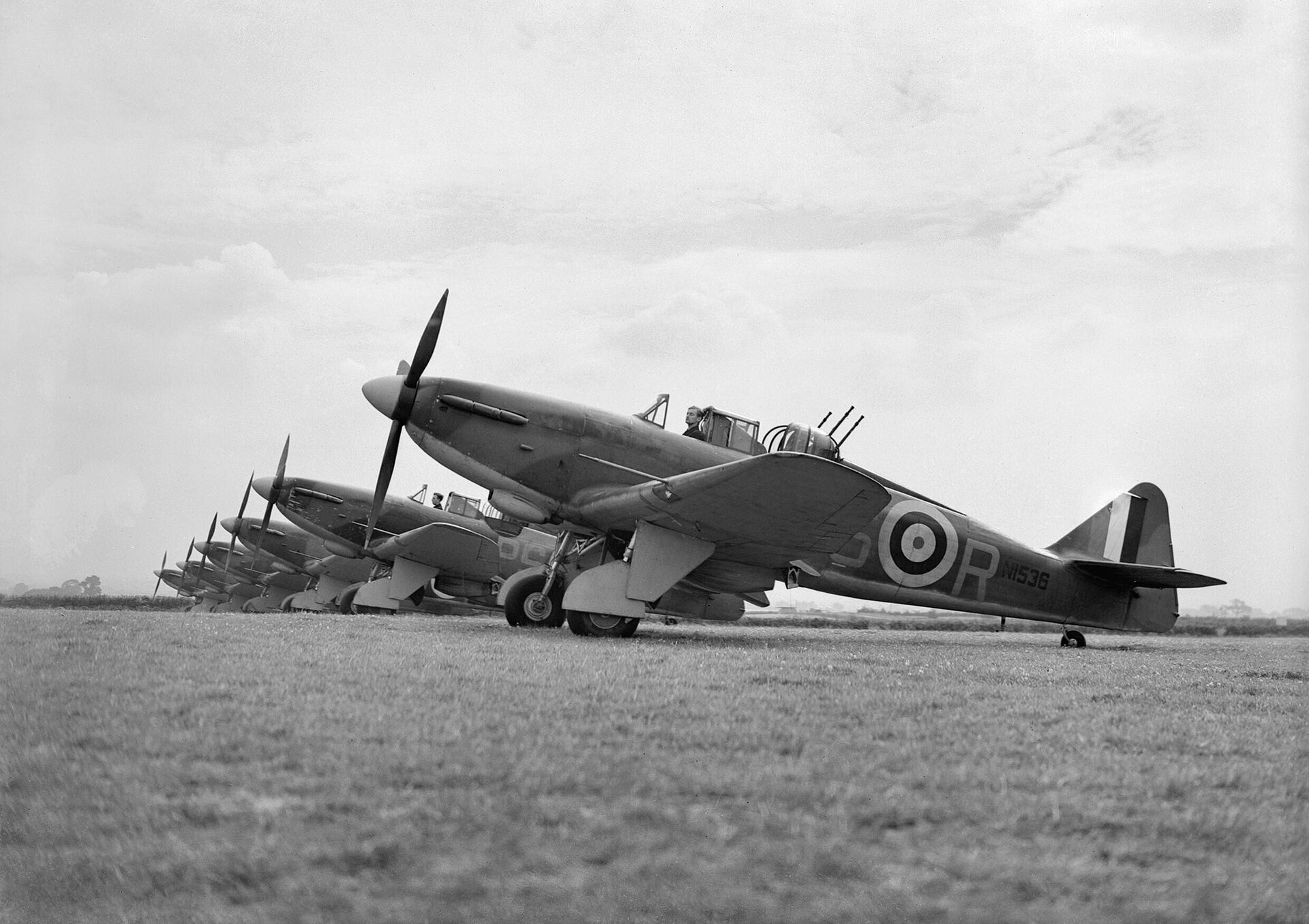
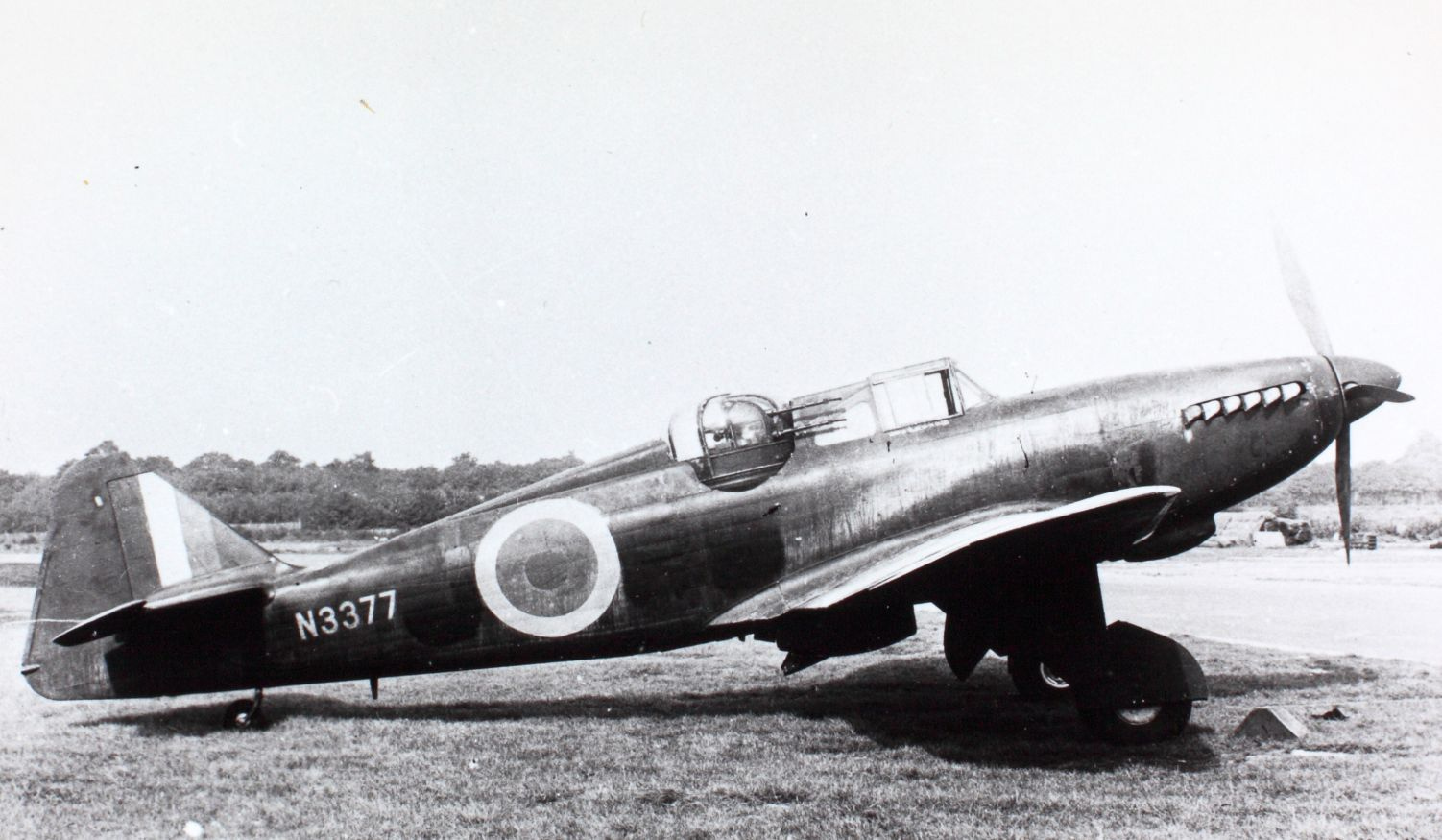
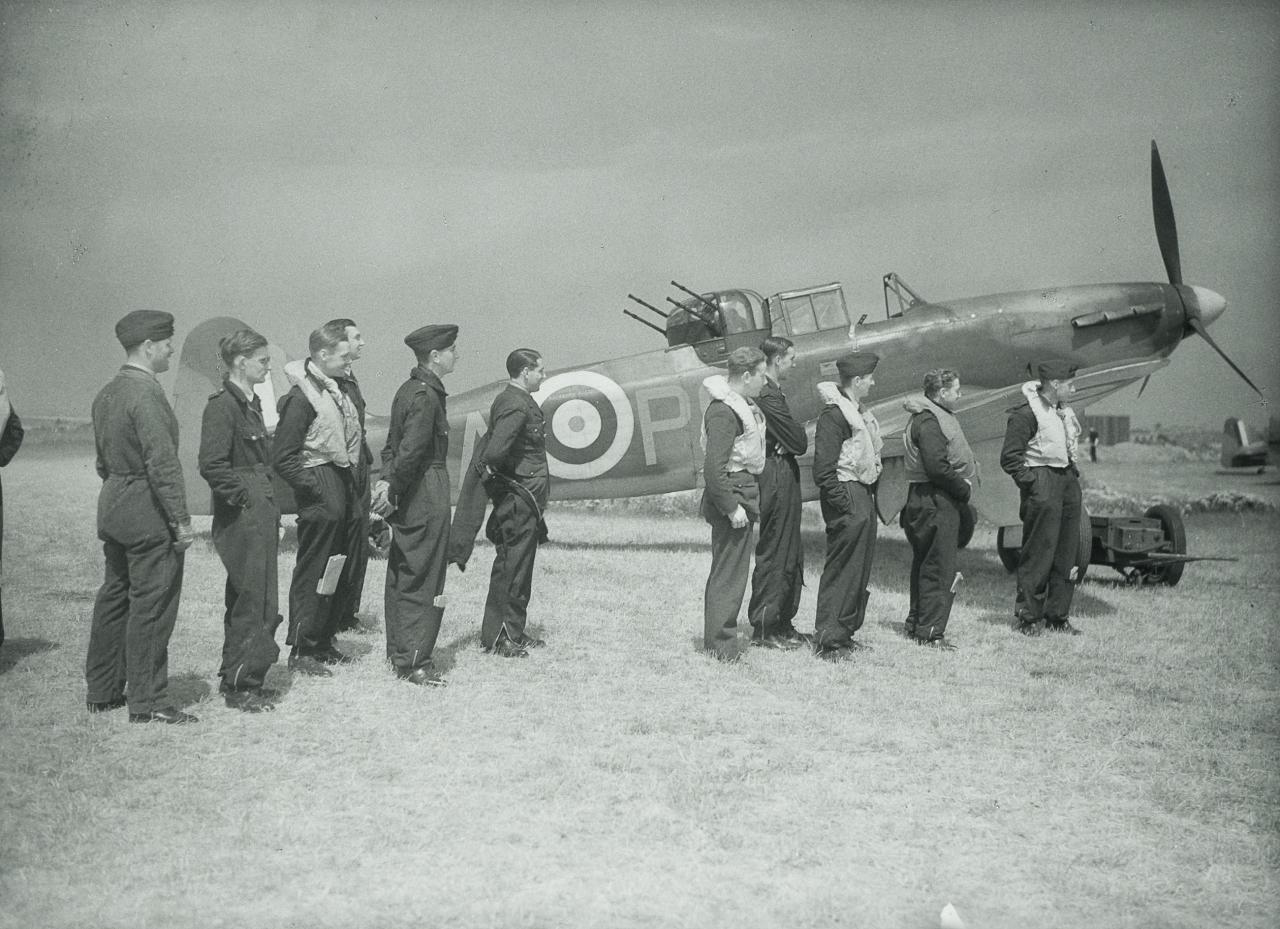
Wartime and museum photographs of the turret fighter — its squadrons, its distinctive four-gun turret and the sole surviving airframe. Each image is credited to its source below.
On Film
The Boulton Paul Defiant on video
A concise, well-sourced history of the turret fighter and why its concept faltered by day yet worked at night.
“Boulton Paul Defiant: Good Aircraft, Flawed Concept” by Not A Pound For Air To Ground — around 99,000 views and 4,100+ likes on an authoritative aviation-history channel.
Operations Map
Where the Boulton Paul Defiant served
A near single-nation aircraft: designed and built in Britain, fought over the Channel coast in 1940, and used in secondary roles further afield. Toggle the categories to explore where it operated — and where the last one survives.
By the Numbers
The Boulton Paul Defiant by the numbers
A short, honest summary of what the Defiant was — and what its concept cost. The figures capture both halves of the story: a large production run, a catastrophic day-fighter engagement, and the extreme rarity of what survives.
Combat Record
The Boulton Paul Defiant’s war, in context
The Defiant’s combat record falls into two utterly different halves, and it is impossible to understand the aircraft without holding both in view at once. In daylight, over roughly four months in 1940, it was one of the most costly aircraft in which an RAF crew could fly. At night, over the following winter, it was one of the most effective.
The daylight story is quickly told. Over Dunkirk in late May, No. 264 Squadron’s turret fighters inflicted a genuine shock on German fighter pilots who attacked from astern and met four guns firing back. But the surprise could not be repeated. Once the Luftwaffe understood the type, it attacked from head-on and below, and the Defiant’s lack of forward guns and inferior performance turned every engagement against it. The mauling of No. 141 Squadron on 19 July, and further heavy losses to No. 264 in August, settled the matter: the aircraft was withdrawn from daylight fighting.
The night story is the redemption. Withdrawn from the daylight battle, Defiant squadrons re-equipped for night defence and, through the Blitz of 1940–41, destroyed German bombers in numbers that for a time exceeded those of any other RAF fighter. The very turret that had been a liability by day became an asset in the dark, letting a gunner fire up into a bomber the pilot was shadowing from below.
Set against the Hurricane and Spitfire, the Defiant will always look like a failure, and as a day fighter it was. But its full record — a brief, bloody daylight career followed by real success at night and years of valuable support work — is more interesting, and more honest, than the caricature of “the worst fighter of the war.”
Where to See One
Surviving Boulton Paul Defiants
The Defiant is one of the rarest of all RAF fighters — a single original survives, alongside a full-scale replica, and none can fly.
RAF Museum Midlands (Cosford)
Defiant Mk I N1671. The sole surviving intact original Defiant is displayed at the Royal Air Force Museum at Cosford. It served with No. 307 (Polish) Squadron as a night fighter before being preserved — a static exhibit, not a flyable aircraft.
Restored over many years, N1671 is the closest anyone can get to a genuine Boulton Paul Defiant today.
Boulton Paul Association, Wolverhampton
Full-scale replica. At the aircraft’s birthplace, the Boulton Paul Association preserves the company’s heritage and displays a full-scale Defiant replica, keeping alive the story of the turret fighter built in Wolverhampton.
The Association is the custodian of the memory of Boulton Paul Aircraft and its most famous product.
No airworthy example — anywhere
None flies. Unlike the Spitfire or Hurricane, no Defiant is airworthy anywhere in the world, so it cannot be seen flying and cannot be flown in.
If you want to fly in a real military aircraft, MiGFlug can arrange it in other types — see migflug.com/flights-prices/.
Questions & Answers
Boulton Paul Defiant: your questions answered
Can I fly in a Boulton Paul Defiant?
No — it is not possible to fly in a Boulton Paul Defiant. No Defiant is airworthy anywhere in the world. Only one original survives, the Mk I N1671 at the RAF Museum Midlands (Cosford), and it is a static museum exhibit; there is also a full-scale replica at the Boulton Paul Association in Wolverhampton. Neither can be flown, and MiGFlug does not offer Defiant flights.
You can, however, fly in a genuine military aircraft with MiGFlug — from the L-39 Albatros jet trainer to the supersonic MiG-29 Fulcrum. See migflug.com/flights-prices/ for what is bookable today.
Why did the Boulton Paul Defiant have no forward-firing guns?
The Defiant was built to Air Ministry Specification F.9/35 as a “turret fighter,” whose entire armament — four .303 in Browning machine guns — was concentrated in a power-operated dorsal turret aimed by a second crewman. Pre-war doctrine expected unescorted bombers to be the main threat and believed a trainable turret would be more effective than fixed guns. The pilot flew the aircraft into position and the gunner did the shooting.
How fast was the Boulton Paul Defiant?
The Defiant Mk I had a top speed of about 304 mph (489 km/h), and the later Mk II around 313 mph (504 km/h). That made it noticeably slower than a Hurricane or Spitfire, because the single Rolls-Royce Merlin had to carry the weight of the turret, its hydraulics and a second crewman.
Was the Boulton Paul Defiant a good aircraft?
It was well built but fundamentally mismatched to daylight fighter combat. The turret-fighter concept failed against agile single-seat fighters that could attack from head-on or below, where the Defiant had no guns — and it suffered heavy day-fighter losses in 1940. As a night fighter during the Blitz, however, it was genuinely effective, and it went on to serve usefully as a target tug, in air-sea rescue and in radar-jamming roles.
Why was the Defiant successful at night but not by day?
By day, an enemy fighter could exploit the Defiant’s lack of forward guns and its poor performance, attacking from angles it could not defend. At night the fighting was completely different: the Defiant could stalk a bomber, slide beneath it and let the gunner fire upward into its belly. That made the trainable turret an asset, and for part of the winter of 1940–41 the Defiant claimed more night victories than any other RAF type.
How many Boulton Paul Defiants were built, and how many survive?
About 1,064 Defiants of all marks were built, although sources vary slightly. Today just one original survives intact — Mk I N1671 at the RAF Museum Midlands (Cosford) — together with a full-scale replica at the Boulton Paul Association in Wolverhampton. No Defiant is airworthy.
What engine did the Boulton Paul Defiant use?
Every Defiant was powered by a single Rolls-Royce Merlin, the same family of V12 engines that powered the Hurricane and Spitfire. The Mk I used the Merlin III of about 1,030 hp; the Mk II adopted the more powerful Merlin XX of roughly 1,280 hp to improve its performance as a night fighter.
Where can I see a Boulton Paul Defiant today?
The one surviving original Defiant, Mk I N1671, is on public display at the Royal Air Force Museum Midlands at Cosford in Shropshire. It is a static exhibit and does not fly.
There is also a full-scale Defiant replica at the Boulton Paul Association in Wolverhampton, on the site where the aircraft was built. No airworthy Defiant exists anywhere in the world.
What roles did the Boulton Paul Defiant serve in besides day fighting?
After its day-fighter career ended in 1940, the Defiant became an effective night fighter during the Blitz of 1940–41, later fitted with airborne interception radar. As newer night fighters replaced it, large numbers served as target tugs — the type’s most numerous role — as well as in air-sea rescue and in early electronic-countermeasures work jamming and spoofing German radar under the codenames “Moonshine” and “Mandrel.”
You can’t fly the Boulton Paul Defiant. These, you can.
The Defiant is a museum piece — no example flies anywhere in the world. But the thrill of flying a real military aircraft is not out of reach. MiGFlug puts you in the cockpit of genuine jets, from trainers to supersonic fighters.
Fighter Jet Flights
Take the controls of a real ex-military jet with an experienced fighter pilot.
L-39 アルバトロス
The classic jet trainer — aerobatics and low-level fun, in several countries.
Related Aircraft
More from the Aircraft Museum
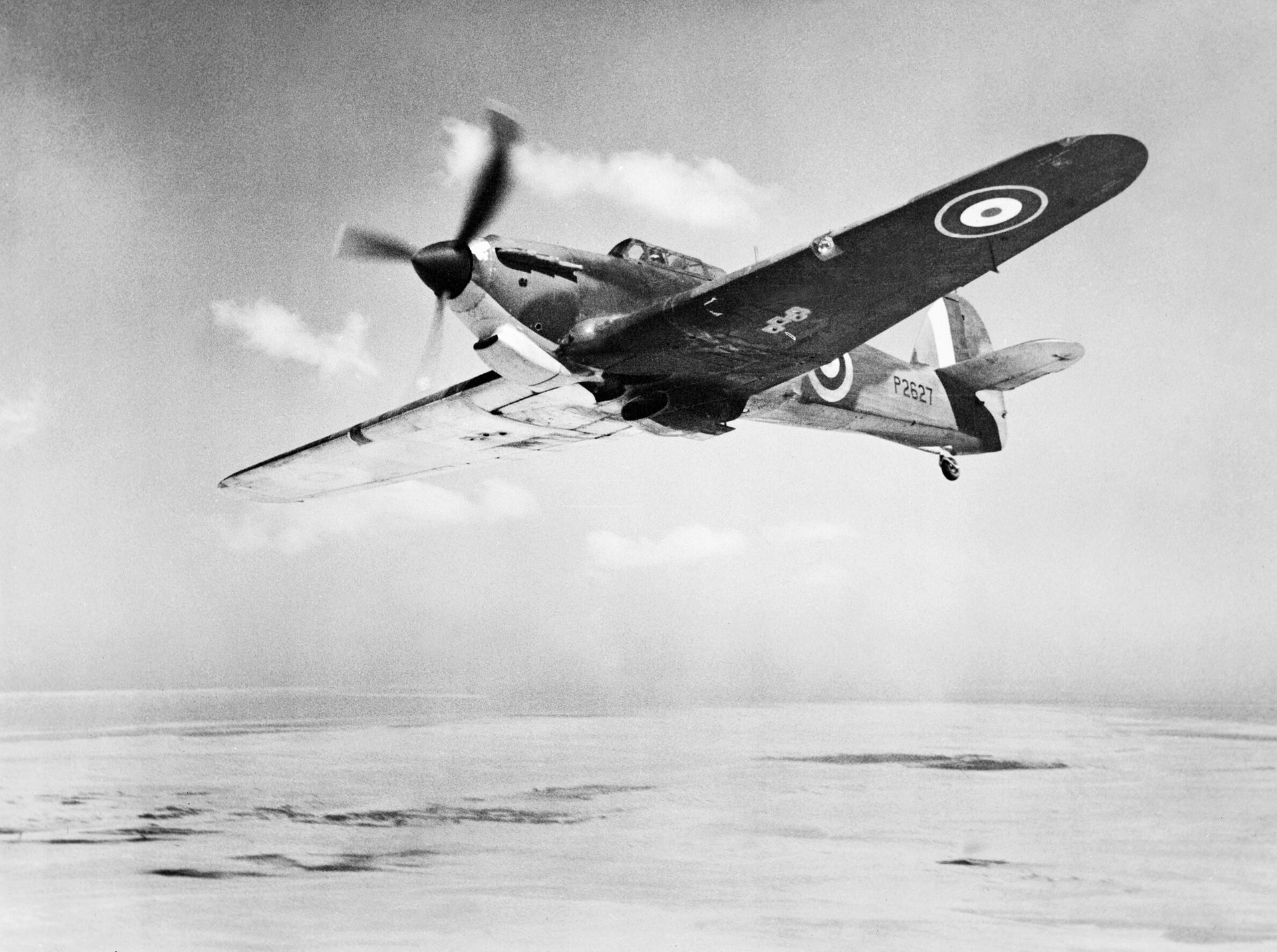 Hawker HurricaneThe RAF fighter that won the Battle of Britain — and the type the Defiant was so often mistaken for.
 Supermarine SpitfireBritain’s iconic single-seat fighter — everything the turret fighter was not.
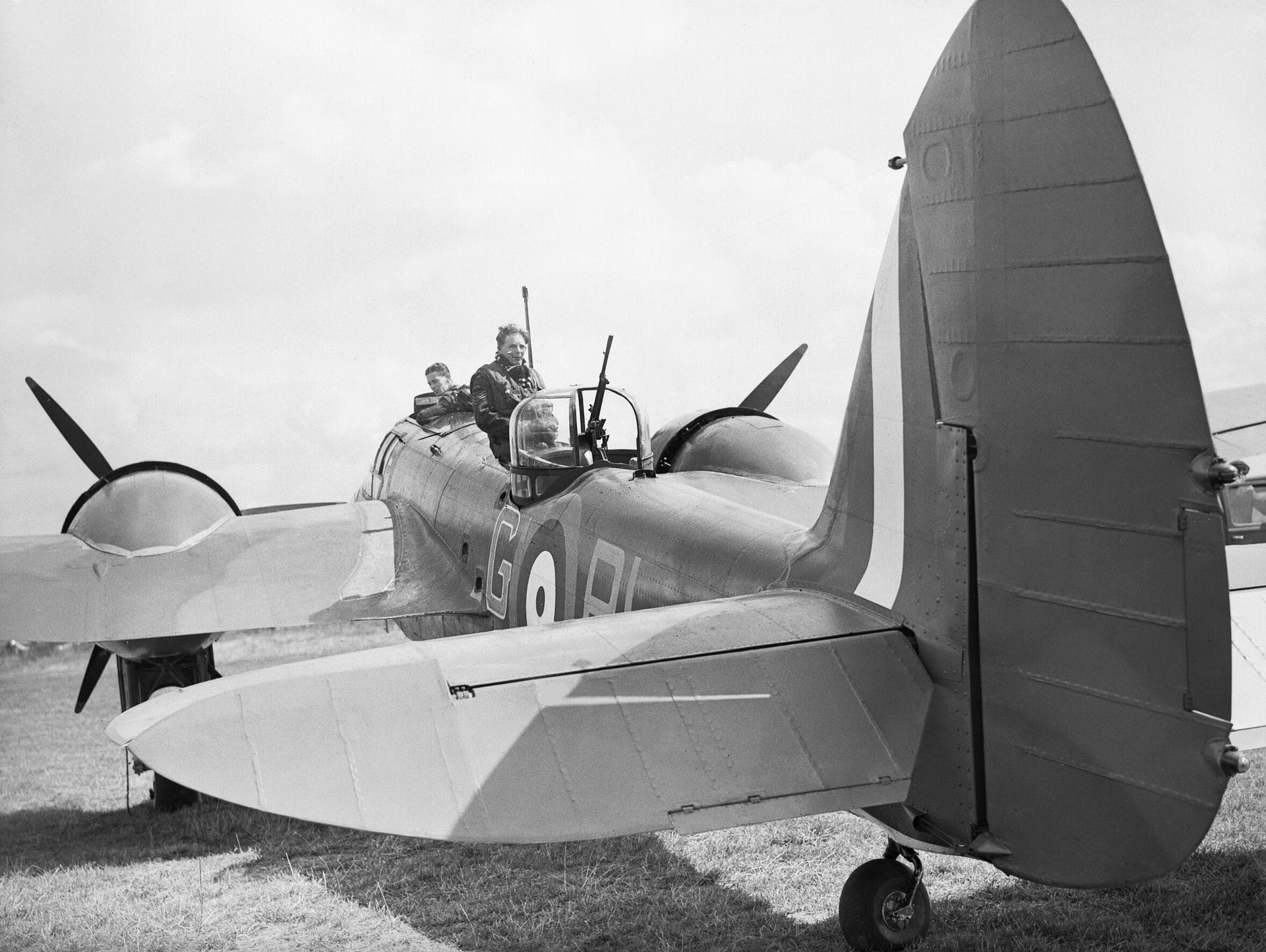 Bristol BlenheimThe fast bomber whose Mk IF fighter version shared the Defiant’s hard early-war lessons.
Legacy
How the Boulton Paul Defiant is remembered
The Defiant occupies an unusual place in aviation memory. It is famous less for what it achieved than for what it represents: the moment a confident pre-war idea about air combat collided with reality, and lost. For that reason it is often held up as a cautionary tale — the fighter that could not shoot forwards — even by people who know little else about it.
Yet those who look closer usually come away with more respect for it. The airframe was sound, the turret was a genuine feat of engineering, and the crews who flew it in daylight showed extraordinary courage in an aircraft they must have known was outmatched. When it was given a role that suited it, at night, it delivered. Its later years of target-towing, air-sea rescue and radar-jamming saved lives and trained gunners long after its fighting days ended.
Today the Boulton Paul Defiant survives as a single static airframe at Cosford and a replica at Wolverhampton, with no example anywhere able to fly. That rarity is part of why it belongs in a museum, and why its story deserves to be told in full rather than reduced to a punchline. It is the story of a brave answer to the wrong question — and of the men who made the best of it.
Sources & Further Reading
Where this page’s facts come from
Figures for speed, weights, production and losses are drawn from the museum and reference sources above; where sources differ, values are given as approximate and marked as estimates. Photographs are from Wikimedia Commons and are credited individually in the gallery.