
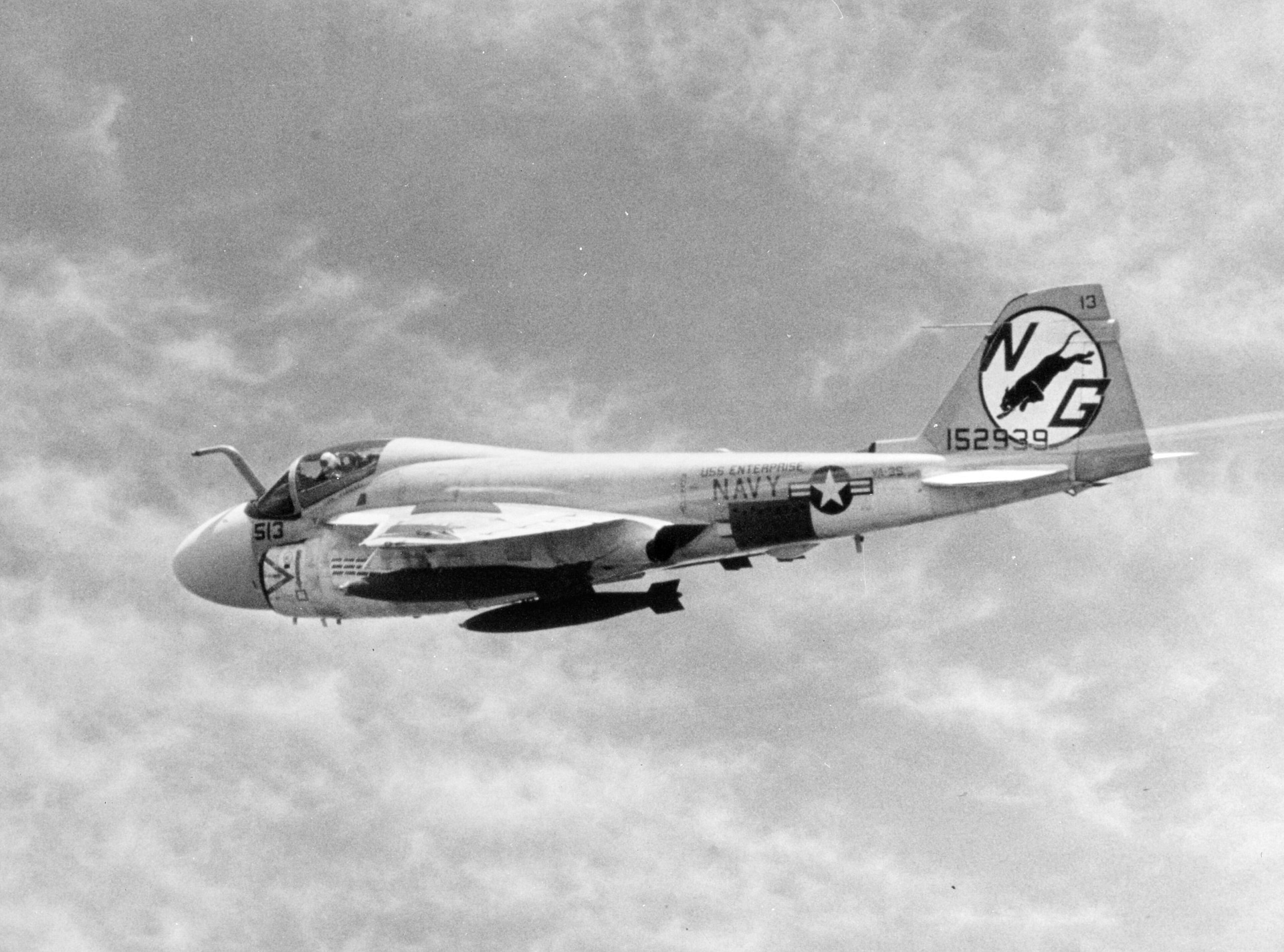
Grumman A-6 Intruder
“The Iron Tadpole”
The US Navy and Marine Corps’ all-weather bomb truck — a stubby, subsonic Grumman that could find and hit a pin-point target on the blackest night, in the worst weather, when nothing else in the fleet could.
The jet that owned the night
By the mid-1950s the US Navy had fast jets and nuclear jets, but it still could not reliably put an iron bomb on a small target in cloud, at night, or in a storm. In 1957 it issued a requirement for a carrier-based all-weather attack aircraft, and on 2 January 1958 Grumman’s Type G-128 design was chosen. What emerged was unlike the sleek supersonic fighters of the day: a broad, blunt-nosed, subsonic machine built around a radar, a computer and a huge load of bombs.
The A-6 first flew on 19 April 1960 and entered service in February 1963. Its heart was DIANE — the Digital Integrated Attack/Navigation Equipment — a search and track radar tied to one of the first airborne digital attack computers. The two-man crew sat side by side, pilot on the left and bombardier/navigator on the right, staring into the same radar picture. Together they could fly to a target they never saw with their eyes and drop on it accurately in zero visibility.
That capability made the Intruder the Navy and Marine Corps’ all-weather workhorse for more than thirty years. It carried the fleet’s heaviest conventional loads deep into the most heavily defended airspace of the Vietnam War, struck Libya in 1986, and served as the Navy’s primary laser-guided-bomb platform in the 1991 Gulf War before retiring in 1997. Its stretched electronic-warfare cousin, the EA-6B Prowler, jammed enemy radars for another two decades after that.
01The A-6 Intruder and DIANE: the computer that could bomb blind
At the core of the A-6 was DIANE, the Digital Integrated Attack/Navigation Equipment: a track-while-scan attack radar, a separate search radar, a ballistics computer and an inertial navigation system, all wired together. In an era when most attack pilots still bombed by eye in a dive, DIANE let the Intruder crew fly a low-level approach in cloud or darkness, have the computer solve the release point and drop unguided bombs with an accuracy nobody else could match at night.
The system was famously temperamental — early DIANE was maintenance-hungry and often only partly working — but when it worked it was revolutionary. It is the single reason the A-6 existed: not speed, not agility, but the ability to deliver ordnance precisely in weather and darkness that grounded everything else. Decades of upgrades, culminating in the A-6E TRAM with its turreted infrared and laser sensor, turned that promise into routine precision strike.
What makes the A-6 Intruder special
DIANE — all-weather attack, before anyone else
The Intruder was the first carrier aircraft that could genuinely find and hit a target in cloud and darkness. Its DIANE suite fused radar, an inertial platform and a digital bombing computer so the crew could bomb accurately without ever seeing the ground — the capability that defined the whole aircraft and kept it in front-line service for over three decades.
A carrier bomb truck built around payload
The A-6 traded speed for load and reach. Its deep, roomy fuselage held large internal fuel tanks and its five hardpoints could lift about 8,200 kg (18,000 lb) of ordnance — a heavier practical strike load, further, than the supersonic fighters around it. It could haul that from a pitching carrier deck deep into defended airspace and back.
The rugged, subsonic twin-J52 design
Two Pratt & Whitney J52 turbojets, buried in the wing roots, gave dependable, fuel-efficient thrust rather than raw speed — the Intruder never went supersonic. The blunt, tadpole-shaped airframe was tough, simple and forgiving, able to absorb battle damage and keep flying. There was no internal gun; the A-6 was a pure bomber.
02The A-6 Intruder’s side-by-side cockpit: why the crew sat shoulder to shoulder
Unlike almost every other attack jet, the A-6 seated its two crew side by side rather than in tandem, with the bombardier/navigator’s seat set slightly lower and to the right. The reason was DIANE: pilot and B/N needed to share the same radar scope and work the attack together, and side-by-side seating let them do that and communicate by glance and gesture. It made the cockpit wide — part of the Intruder’s bulbous, stubby look — but it turned the two-man crew into a single weapons system.
03The A-6 Intruder’s tilting tailpipes and the loss of a supersonic dream
Grumman’s original design gave the A-6 jet exhausts that could tilt downward to boost short-field and carrier performance. The feature was dropped early as unnecessary and heavy, and the fixed-tailpipe subsonic aircraft that entered service was slower and plainer than first imagined. It did not matter. The Intruder was never meant to win races; its job was to carry a heavy load a long way and put it on target in any weather, and the rugged, unglamorous machine that resulted did exactly that for thirty-four years.
Full A-6E Intruder specifications
Airframe & Performance
- クルー
- 2 (pilot + bombardier/navigator, side by side)
- 長さ
- 16.69 m (54 ft 9 in)
- 翼幅
- 16.15 m (53 ft 0 in)
- 身長
- 4.93 m (16 ft 2 in)
- Max takeoff weight
- ~26,600 kg (58,600 lb) catapult · ~27,400 kg shore
- Max speed
- ~1,040 km/h (560 kn) at sea level — subsonic
- Combat range
- ~1,700 km (hi-lo-hi, typical load)
- Ferry range
- ~4,400 km (2,380 nmi)
- サービス天井
- ~12,900 m (42,400 ft)
Propulsion & Systems
- Engines
- 2 × Pratt & Whitney J52-P-8B turbojets
- Thrust (each)
- ~41 kN (9,300 lbf)
- Attack system
- DIANE radar/computer nav & attack suite
- 武装
- ~8,200 kg (18,000 lb) on 5 stations · no gun
- First flight
- 19 April 1960
- Into service
- February 1963
- Built
- 693 (1962–1992)
- Unit cost
- ~$30–43 million (A-6E, program estimates)
- Cost per flight hour
- No reliable public figure
04What did an A-6 Intruder cost to buy and fly?
Because the Intruder was a government-procured Navy aircraft built across three decades, no single tidy price exists. Period program figures put the flyaway cost of an A-6E in the low tens of millions of dollars — very roughly $30–43 million depending on year and how research and development is counted — and no reliable, officially published cost-per-flight-hour figure exists in open sources. Any exact dollar number attached to an A-6 should be read as an estimate rather than a sourced fact.
From night-attack requirement to Gulf War veteran
The requirement
The US Navy asks industry for a carrier-based all-weather attack aircraft able to bomb accurately at night and in bad weather.
Grumman wins
Grumman’s Type G-128 design is selected on 2 January 1958 and becomes the A2F, later redesignated A-6.
First flight
The prototype flies on 19 April 1960 from Grumman’s Long Island facilities.
Enters service
The A-6A joins the fleet in February 1963; VA-75 takes it to sea and into combat by 1965.
Vietnam workhorse
Intruders fly the fleet’s toughest all-weather night interdiction missions; 84 are lost over Southeast Asia.
The definitive A-6E
The much-improved A-6E arrives, later gaining the TRAM turret for infrared imaging and laser-guided bombs.
Strike on Libya
Carrier A-6Es hit Libyan targets during Operation El Dorado Canyon and the Gulf of Sidra clashes.
Desert Storm
Navy and Marine A-6s fly thousands of sorties as the fleet’s primary laser-guided-bomb strike aircraft.
Retirement
The Marines retire the A-6 in 1993 and the Navy on 28 February 1997; the F/A-18 takes over the mission.
The Prowler bows out
The EA-6B Prowler, the Intruder’s electronic-warfare derivative, flies its last Marine Corps mission — the family’s final chapter.
From the flight deck: twelve Intruder stories
The bomb that needed a brain
A 1957 Navy requirement for all-weather bombing gave birth to a radar-and-computer jet.
Read the full story
Why it sat two side by side
The A-6’s wide cockpit put pilot and bombardier shoulder to shoulder over one radar scope.
Read the full story
The jet they kept sending into the dark
Nothing else could bomb as accurately at night, so the Navy flew the A-6 into the worst defences.
Read the full story
DIANE, the temperamental genius
The Intruder’s attack computer was revolutionary — and maddeningly unreliable at first.
Read the full story
Shot down over Beirut
A December 1983 strike on Syrian positions cost an A-6 and led to a famous prisoner release.
Read the full story
El Dorado Canyon
Carrier Intruders struck Libya in the 1986 raid answering a Berlin terrorist bombing.
Read the full story
The fleet’s laser-bomb truck
In Desert Storm the A-6 was the Navy’s primary precision strike aircraft.
Read the full story
Flight of the Intruder
A former A-6 bombardier turned the jet into a bestselling novel and a Hollywood film.
Read the full story
The KA-6D and the airborne gas station
Stripped of its bombing gear, the Intruder became the carrier air wing’s tanker.
Read the full story
The cousin that jammed the radars
The stretched, four-seat EA-6B Prowler turned the Intruder into an electronic-warfare legend.
Read the full story
Ugly, and beloved
Crews gave the Intruder rough nicknames — and trusted it with their lives.
Read the full story
What replaced the unreplaceable
The F/A-18 took the mission, but for years nothing matched the A-6’s range and load.
Read the full story
The Intruder in pictures
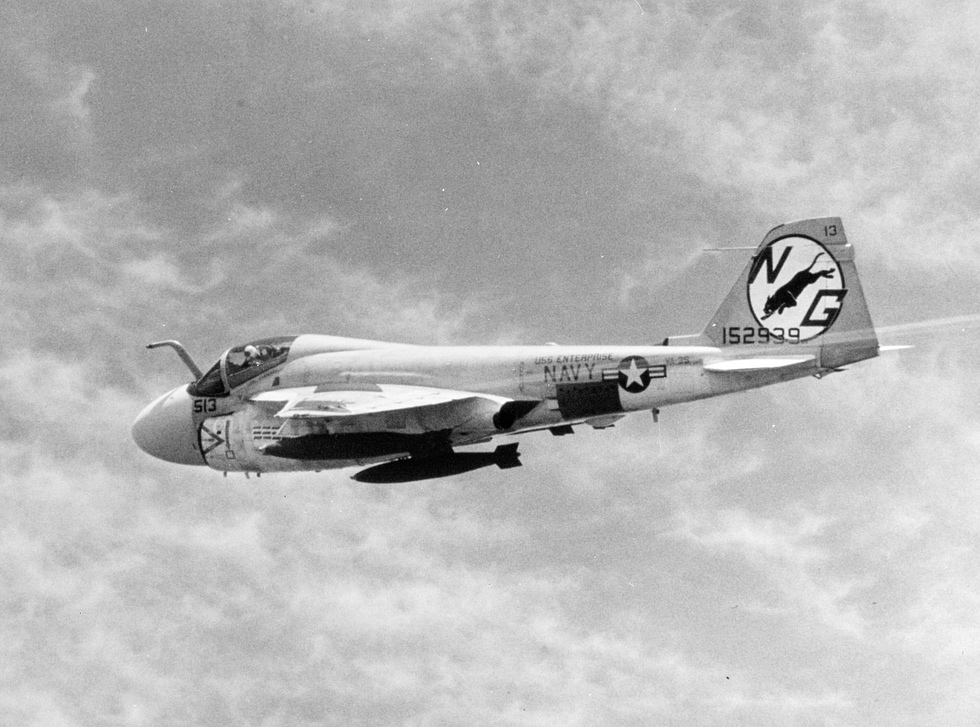
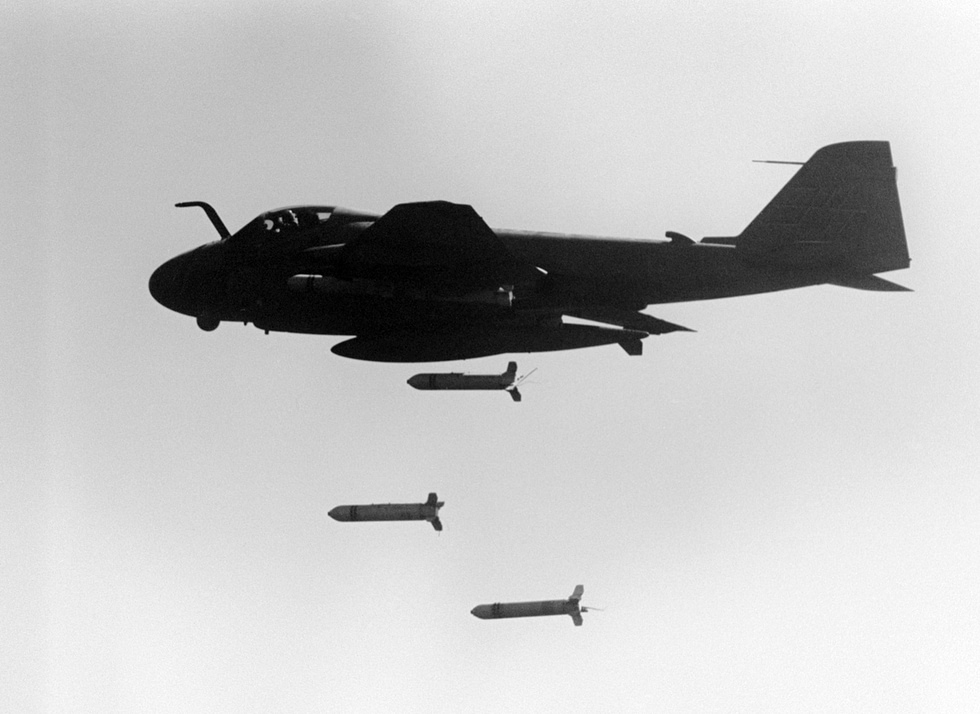
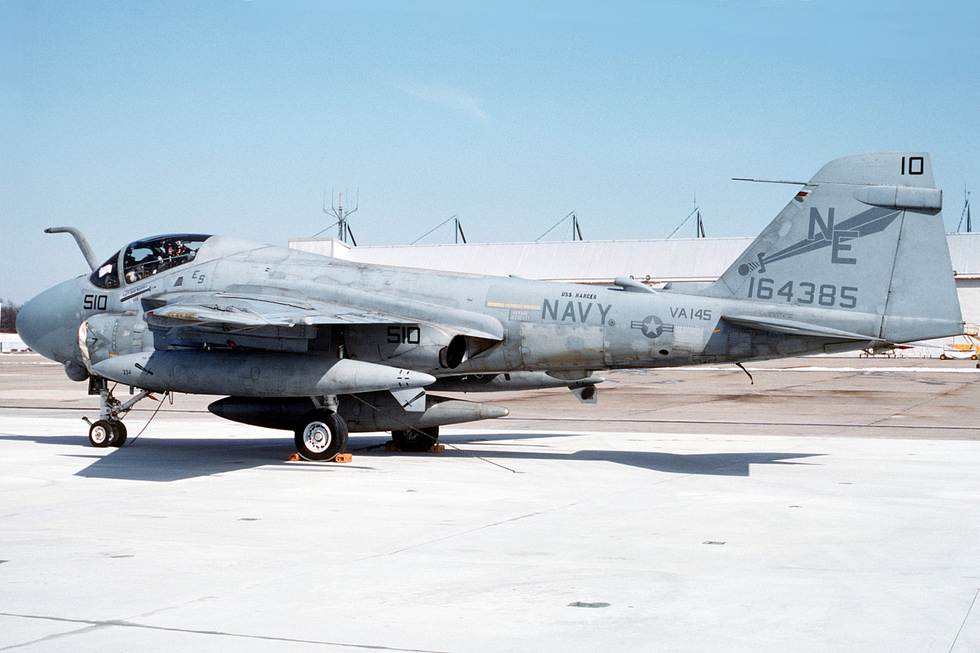
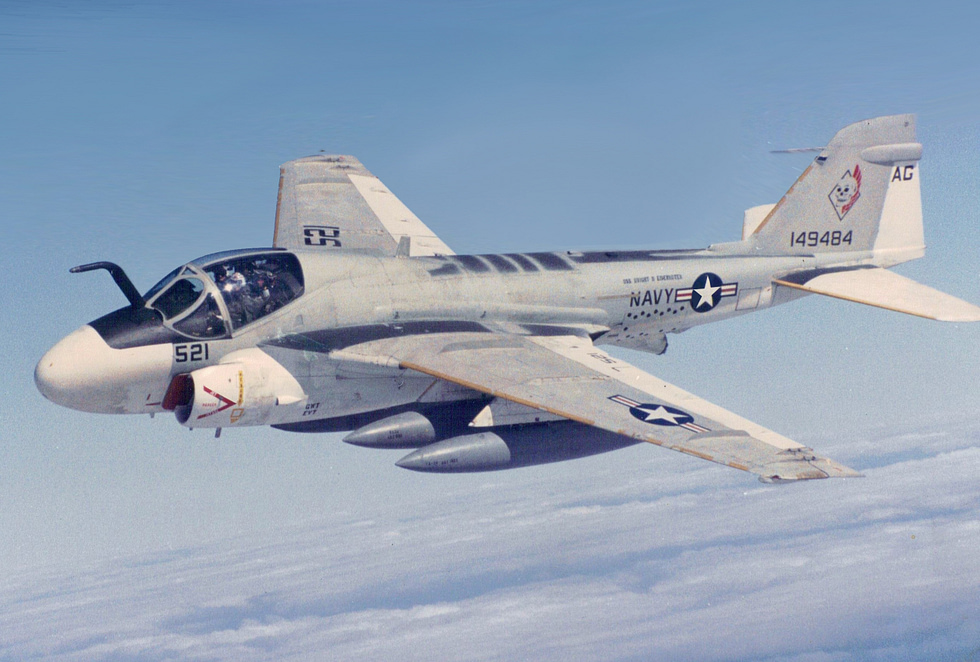
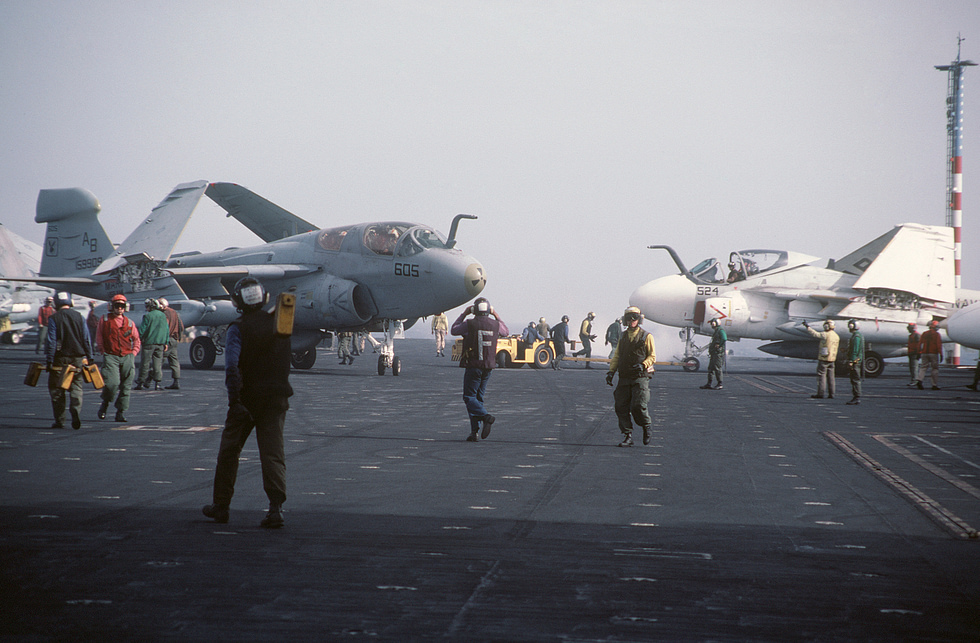
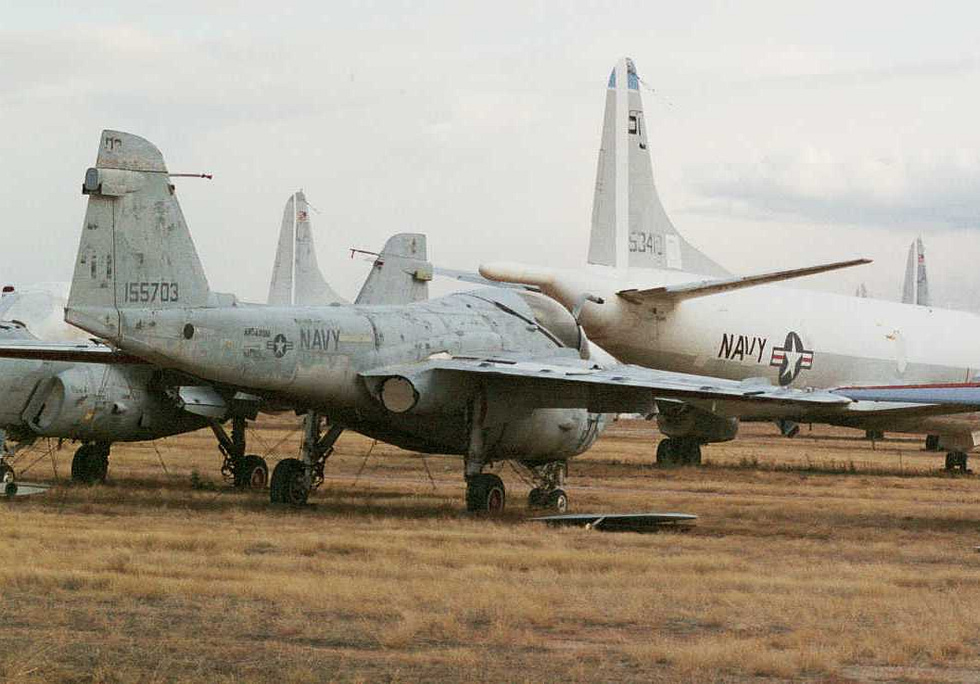
The A-6 Intruder in motion
A dedicated A-6 Intruder video feature is coming soon. In the meantime, explore the gallery above and the twelve stories from the flight deck.
Where the Intruder flew
The record that defines it
The Intruder was a bomber, not a dogfighter — it had no gun and never claimed an air-to-air kill. Its record is written in tonnage delivered precisely, in the worst weather and darkness, into the most heavily defended airspace of four decades of conflict. It paid for that in blood: it was vulnerable at the low altitudes where it worked best.
Compare the combat record of every military aircraft. Figures as of July 2026.
Everything people ask about the A-6 Intruder
Can I fly in an A-6 Intruder?
Can a civilian fly the A-6 Intruder?
Why was the A-6 Intruder so special?
How fast was the A-6 Intruder?
Did the A-6 Intruder have a gun?
What is the difference between the A-6 Intruder and the EA-6B Prowler?
What replaced the A-6 Intruder?
Where can I see an A-6 Intruder today?
You can’t fly the A-6 Intruder.
These, you can.
Some legends only live in museums — others are fuelled and waiting. MiGFlug has put civilians in real military jet cockpits since 2004.
 Fly the L-39 AlbatrosThe world’s most-flown jet trainer — aerobatics included
 Fly the F-104 Starfighter“The missile with a man in it”
 Fly the MiG-21The Cold War’s most-produced jet
 T-33シューティングスターを操縦しようAmerica’s first jet trainer
 Fly the DH VampireA piece of early jet history
 Fly the S.211Agile Italian jet trainer
 Fly the MB-326The classic Aermacchi jet
 Fly the MiG-15The Soviet legend of the Korean War
Continue the tour
Every fact, checked
- Naval History and Heritage Command — A-6E IntruderOfficial US Navy specifications, service history and retirement dates.
- The Intruder AssociationCrew-community history of the A-6 programme, DIANE and squadron service.
- GlobalSecurity.org — A-6 IntruderVariants, DIANE avionics and combat-deployment detail.
- The Aviation Geek Club — Intruders over LibyaFirst-hand crew accounts of the 1986 El Dorado Canyon raid.
- Smithsonian National Air and Space MuseumAirframe reference and development background for the A-6E.
- U.S. Naval Institute — EA-6B ProwlerThe Prowler’s electronic-warfare legacy and 2019 retirement.
- Stephen Coonts — Flight of the IntruderThe author, former A-6 bombardier/navigator, on the novel and its origins.
- National Naval Aviation MuseumPreserved A-6E reference and displayed-airframe detail.