
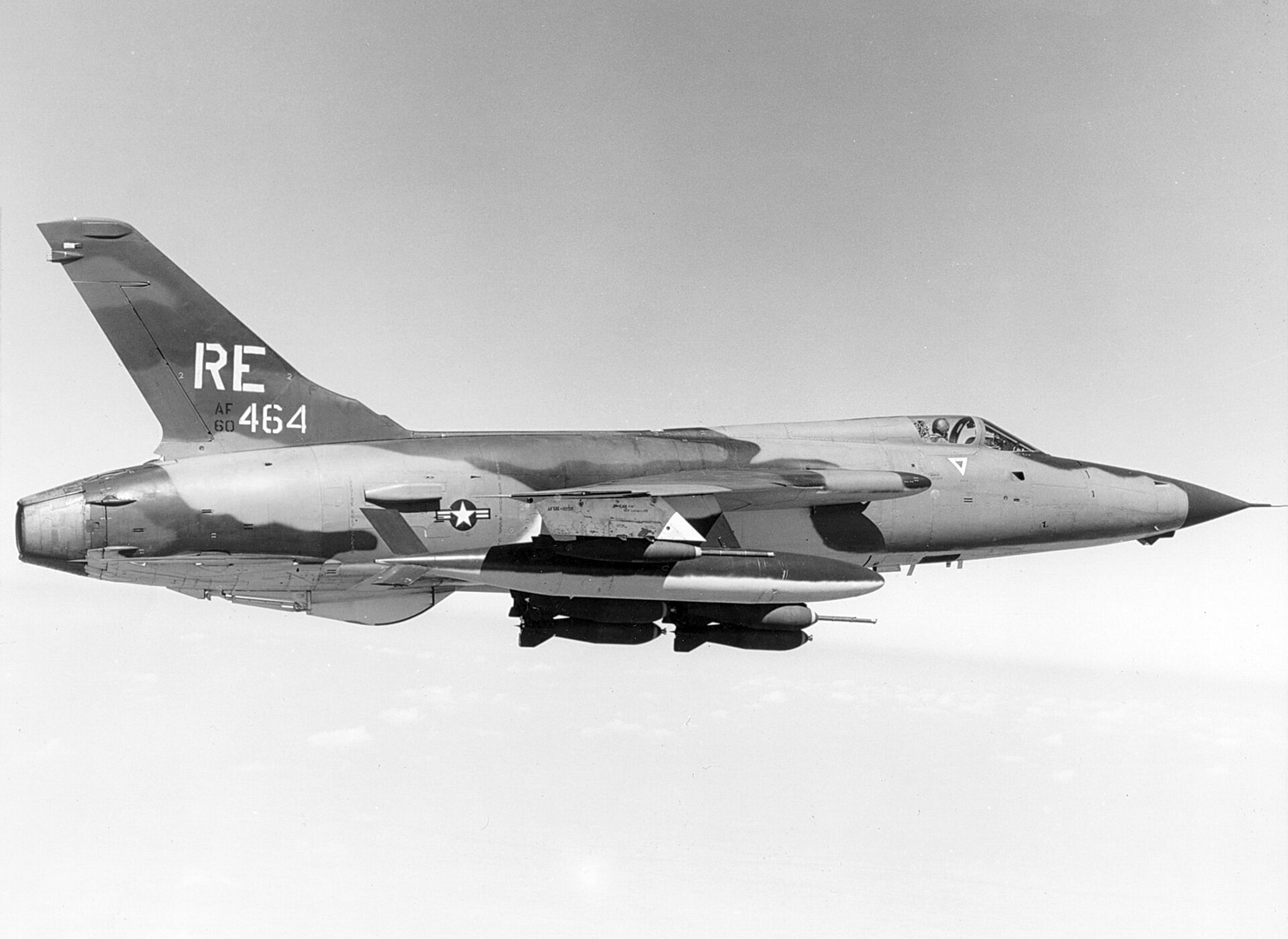
Republic F-105 Thunderchief
“Thud”
The largest single-seat, single-engine combat aircraft ever built — a Mach-2 nuclear strike bomber that became the workhorse of Rolling Thunder, and paid for it with nearly half its fleet over North Vietnam.
The nuclear bomber that fought a conventional war
The F-105 was never meant to do what history remembers it for. Republic Aviation’s chief designer Alexander Kartveli conceived it around 1951 as a private venture: a single-seat, single-engine machine that could dash across enemy territory at supersonic speed, low and fast, and drop a nuclear bomb carried in an internal bomb bay. Everything about it was built for that one mission — a huge airframe wrapped around a huge engine, with distinctive forward-swept air intakes feeding the intake air it needed at Mach 2.
The result, first flown as the YF-105A on 22 October 1955 and in squadron service from 1958, was the biggest single-seat, single-engine combat aircraft ever built. At over 23 tonnes fully loaded it was heavier than some World War II medium bombers, and it could carry a bigger bomb load than a B-17. Crews called it the “Thud” — part affection, part gallows humour about the sound they imagined it made hitting the ground.
Then came Vietnam. The nuclear bomb bay was plumbed for a fuel tank, the racks were hung with conventional iron bombs, and the Thud was sent north. From 1965 it flew the bulk of the Rolling Thunder strike campaign against the most heavily defended airspace on earth — and it was slaughtered there. It also, improbably, shot down MiGs with its gun and pioneered the most dangerous mission in the air force: hunting surface-to-air missiles as a Wild Weasel.
01Why the F-105 Thunderchief was so big: a fighter designed around a nuclear bomb bay
Most fighters grow around a cockpit and a pair of wings. The F-105 grew around a bomb bay. Kartveli’s team started from the volume needed to carry a Mark 28-class nuclear weapon internally — so that the aircraft stayed clean and fast on the low-level dash to the target — and then wrapped a Mach-2 airframe and the most powerful available engine around it. That is why the Thud ended up the largest single-seat, single-engine combat aircraft ever fielded, with an empty weight heavier than a fully loaded World War II fighter.
The irony is that the internal bay was almost never used for its intended purpose. Over Vietnam it usually carried a 1,500-litre fuel tank to extend the aircraft’s short legs, while the bombs hung outside on wing and centreline pylons. The Thud spent its whole combat career doing the opposite of what its shape was optimised for.
What makes the F-105 special
One giant engine, one giant airframe
The Thunderchief is built around a single Pratt & Whitney J75 turbojet delivering about 109 kN (24,500 lbf) in afterburner — then one of the most powerful engines in the world. Feeding it are the F-105’s signature forward-swept wing-root intakes, which used variable geometry to manage airflow past Mach 2. No other single-engine fighter of its generation was anywhere near its size.
The fastest ride down on the deck
Loaded with bombs, the Thud was clumsy in a turning dogfight — but at low level, wide open, it was breathtaking. Its wing loading and raw thrust made it rock-steady and blisteringly fast on the deck, faster than almost anything that tried to catch it near the ground. That low-altitude speed was the whole point of a nuclear striker, and it kept many Thud crews alive when they ran for the coast after a strike.
Wild Weasel: the SEAD pioneer
The two-seat F-105F and F-105G turned the Thud into the world’s first dedicated SAM-hunter. Carrying radar-warning receivers and the AGM-45 Shrike anti-radiation missile — later the larger AGM-78 Standard ARM — the “Wild Weasels” deliberately baited SA-2 missile radars into switching on, then killed them. It invented the suppression-of-enemy-air-defences mission that every air force still flies today.
02The F-105 Thunderchief’s Wild Weasel mission: ‘first in, last out’
When North Vietnam fielded Soviet SA-2 surface-to-air missiles in 1965, the USAF had no answer. The response was the Wild Weasel: two-seat Thuds crewed by a pilot and an electronic-warfare officer whose job was to fly into the missile envelope, provoke a radar lock, and destroy the site. The crews’ grim motto was “First In, Last Out” — they arrived ahead of the strike package to clear the SAMs and stayed until the bombers had left. When the concept was first briefed, one EWO’s reaction — “You gotta be sh***ing me”, abbreviated YGBSM — became the community’s badge of honour. It was statistically the most dangerous flying job of the war.
03The F-105’s MiG kills: a bomber that fought back with its gun
The Thud was a strike aircraft, not a fighter — yet it is credited with 27.5 confirmed MiG kills over Vietnam, and all but a couple were scored with its internal 20 mm M61 Vulcan cannon rather than with missiles. Heavy and fast, a clean F-105 that had already dropped its bombs could accelerate away from a MiG-17 and, in the right setup, turn the tables with a gun pass. It was never going to win a low-speed turning fight, but on its own terms the bomber occasionally became the hunter.
Full F-105D specifications
Airframe & Performance
- クルー
- 1 (2 in F-105F/G Wild Weasel)
- 長さ
- 19.58 m
- 翼幅
- 10.65 m
- 身長
- 5.99 m
- 空虚重量
- ~12,470 kg
- Max takeoff weight
- ~23,970 kg (52,838 lb)
- Max speed
- Mach 2.08 · ~2,237 km/h at altitude
- サービス天井
- ~12,560 m (41,000 ft)
- 戦闘半径
- ~1,250–1,480 km (mission-dependent)
Propulsion & Armament
- エンジン
- 1 × Pratt & Whitney J75-P-19W
- Thrust
- ~109 kN (24,500 lbf) with afterburner
- Gun
- 1 × 20 mm M61 Vulcan (1,028 rounds)
- Ordnance
- Up to ~6,400 kg (14,000 lb) bombs, rockets, Shrike/Standard ARM
- Bomb bay
- Internal (nuclear); usually a fuel tank in Vietnam
- First flight
- 22 October 1955 (YF-105A)
- Built
- 833 (1956–1964)
- Unit cost
- ~$2.1 million (1960s, F-105D)
04The F-105 Thunderchief’s cost: cheap to buy, brutally expensive to lose
The F-105D’s flyaway price is usually quoted at around $2.1 million in early-1960s dollars — roughly $20 million in today’s money and modest for a Mach-2 aircraft. But the meaningful cost of the Thud was measured in attrition, not procurement. With production having ended in 1964, every airframe shot down over North Vietnam was irreplaceable: the assembly lines were closed, and the fleet simply shrank with each mission. No reliable public cost-per-flight-hour figure exists for the type, and any precise dollar figure attached to it should be read as an estimate.
From nuclear striker to Vietnam workhorse
A private design begins
Republic’s Alexander Kartveli starts work on a supersonic nuclear strike bomber built around an internal bomb bay — the project that becomes the F-105.
First flight
The YF-105A prototype flies on 22 October and goes supersonic on its maiden flight, despite an interim engine.
Enters service
The F-105B joins Tactical Air Command as a nuclear-strike fighter-bomber.
The definitive F-105D
The all-weather F-105D, with its NASARR radar and R-14A fire-control system, becomes the main production version.
Rolling Thunder
The Thud becomes the primary USAF strike aircraft over North Vietnam and flies its first Wild Weasel SAM-hunting missions.
Two Medals of Honor
Wild Weasel pilots Merlyn Dethlefsen (10 March) and Leo Thorsness (19 April) earn the Medal of Honor in F-105Fs.
Handing over the strike role
With losses mounting and production long ended, the F-105D is progressively replaced in the strike role by the F-4 Phantom II; the F-105G Wild Weasel soldiers on.
Retirement
The last F-105s leave Air National Guard and Air Force Reserve service, closing the Thud’s 26-year career.
From the cockpit: twelve Thunderchief stories
The bomber that grew around a bomb
The F-105 was designed from the bomb bay outward, which is why it ended up so enormous.
Read the full story
Why it’s called the ‘Thud’
The nickname was affectionate, mocking and grimly prophetic all at once.
Read the full story
Forward-swept intakes
The Thud’s odd wing-root intakes were one of the first of their kind on a production fighter.
Read the full story
Carrying the war north
From 1965 the F-105 flew roughly three-quarters of the USAF strikes against North Vietnam.
Read the full story
Nearly half the fleet
The Thud’s loss rate over the North was so high the USAF risked running out of them.
Read the full story
First in, last out
The two-seat Thuds baited SAM radars into firing so they could destroy them.
Read the full story
The four-letter creed
The Weasel mission was so alarming its first briefing produced a permanent motto.
Read the full story
A bomber that shot down MiGs
The Thud scored 27.5 MiG kills — nearly all with its gun.
Read the full story
Thorsness over Hanoi
On 19 April 1967 Leo Thorsness earned the Medal of Honor on a single Wild Weasel mission.
Read the full story
Dethlefsen’s furnace
Six weeks earlier, another Thud pilot won the Medal of Honor pressing an attack through flak and MiGs.
Read the full story
Passing the torch to the Phantom
By the late 1960s the surviving Thuds were handing the strike role to the F-4.
Read the full story
The mission that outlived the jet
The Thud is gone, but every SEAD mission flown today descends from it.
Read the full story
The Thunderchief in pictures


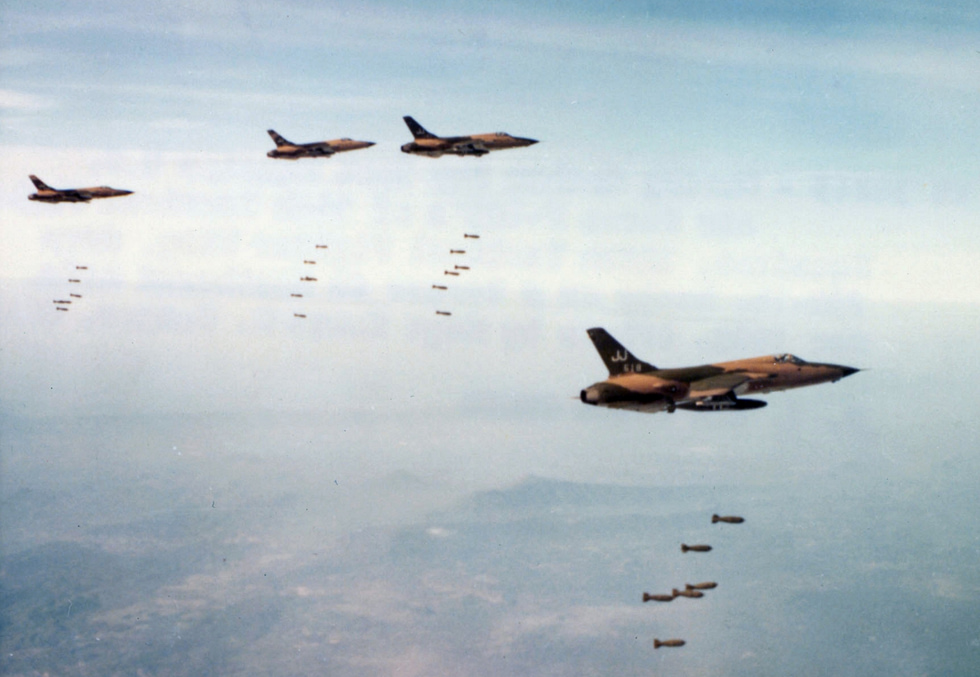

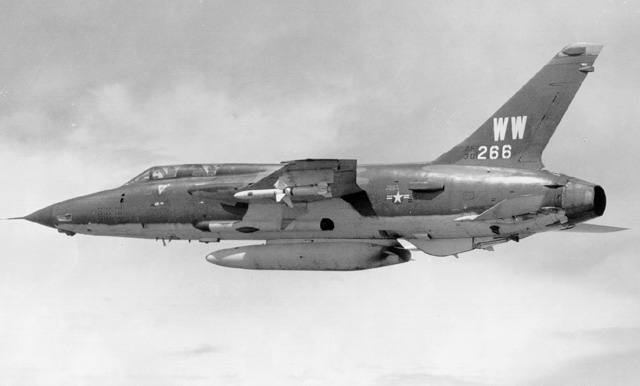
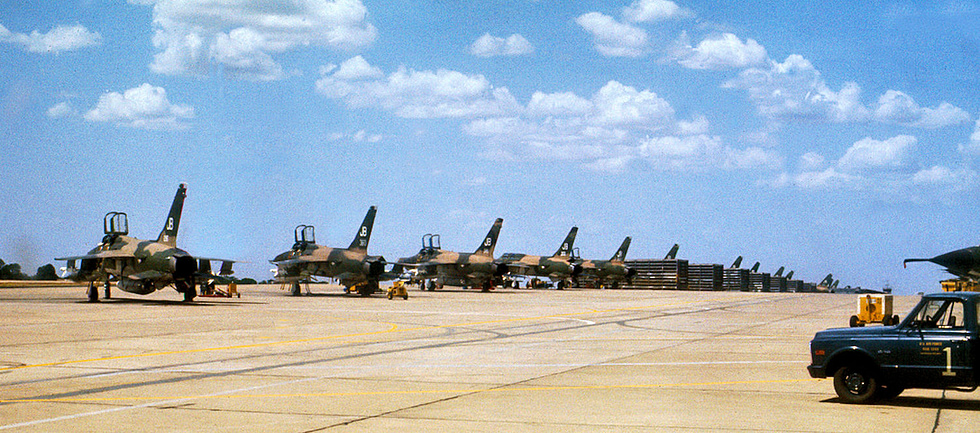
The F-105 Thunderchief in motion
Wings Over the Rockies Air & Space Museum — one of the most-watched F-105 Thunderchief films on YouTube.
Where the Thunderchief served
The score that defines it
The F-105’s record is a study in contradiction: a strategic nuclear bomber that fought a conventional war, took the heaviest losses of any American aircraft in Vietnam, and still shot down MiGs with its gun. Its combat figures — especially the loss numbers — vary between sources and should be read as widely-cited estimates rather than exact accounts.
Two of the Thud’s Wild Weasel pilots — Merlyn Dethlefsen and Leo Thorsness — received the Medal of Honor. Compare the combat record of every military aircraft. Figures as of July 2026.
Everything people ask about the F-105 Thunderchief
Can I fly in an F-105?
Why is the F-105 called the “Thud”?
How fast was the F-105?
Did the F-105 ever shoot down MiGs?
What was the F-105 Wild Weasel?
How many F-105s were lost in Vietnam?
Why was the F-105 retired so early?
You can’t fly the F-105.
These, you can.
Some legends only live in museums — others are fuelled and waiting. MiGFlug has put civilians in real military jet cockpits since 2004.
 Fly the L-39 AlbatrosThe world’s most-flown jet trainer — aerobatics included
 Fly the F-104 Starfighter“The missile with a man in it”
 Fly the MiG-21The Cold War’s most-produced jet
 T-33シューティングスターを操縦しようAmerica’s first jet trainer
 Fly the DH VampireA piece of early jet history
 Fly the S.211Agile Italian jet trainer
 Fly the MB-326The classic Aermacchi jet
 Fly the MiG-15The Soviet legend of the Korean War
Continue the tour
Every fact, checked
- National Museum of the U.S. Air ForceOfficial F-105 fact sheets: development, variants, service history and specifications.
- AirVectors — Greg GoebelDetailed technical and operational history of the Thunderchief and its variants.
- The Aviation Geek ClubThe F-105 loss rate during Rolling Thunder and the eight-month attrition warning.
- We Are The MightyThe Wild Weasel mission, YGBSM, and how the Weasels cleared the skies over Vietnam.
- 19FortyFiveThe Thud’s reputation, MiG-kill tally and loss statistics in Vietnam.
- Military FactoryDimensions, weights, engine and armament specifications for the F-105D.
- Vietnam Air Losses (Chris Hobson)Reference record of USAF aircraft losses over Southeast Asia, including the F-105.
- Smithsonian National Air and Space MuseumReference for preserved F-105 airframes and the Medal of Honor Wild Weasel actions.