
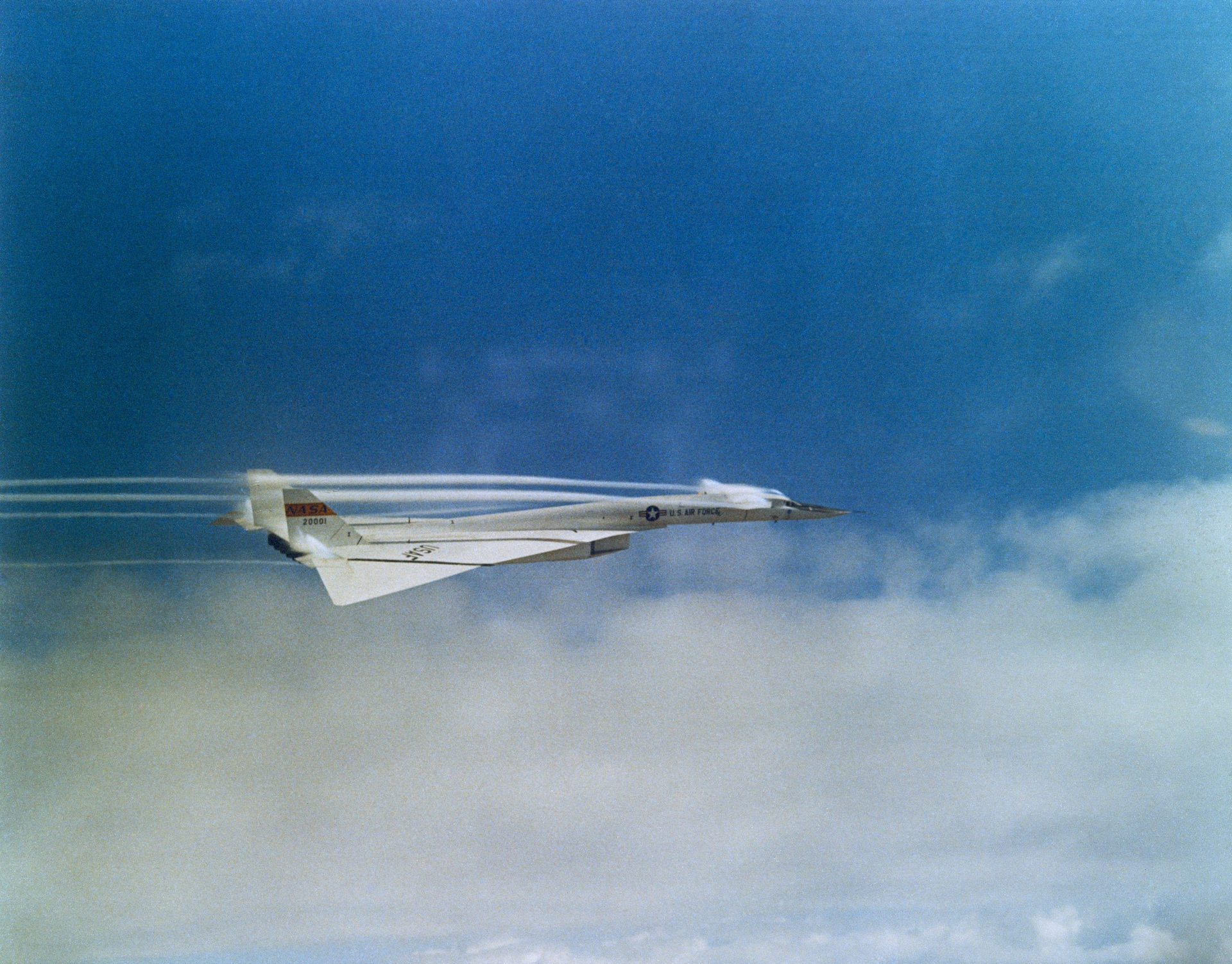
North American XB-70
“Valkyrie”
A six-engine, 250-tonne stainless-steel delta built to cruise at Mach 3 on its own shock wave — the ultimate Cold-War bomber, rendered obsolete before it ever carried a weapon, and remembered for one of aviation’s most tragic accidents.
The bomber that flew too late
In the mid-1950s the US Air Force wanted a bomber that could do what no interceptor could stop: cruise at Mach 3 and 70,000 feet, drive deep into the Soviet Union and deliver nuclear weapons faster than anything could climb to meet it. North American Aviation — makers of the P-51 Mustang and the X-15 — won the development contract in 1957. The result, the XB-70 Valkyrie, was one of the most extraordinary machines ever built: a 57-metre, six-engine stainless-steel delta finished in gleaming white, designed to ride its own shock wave across a continent.
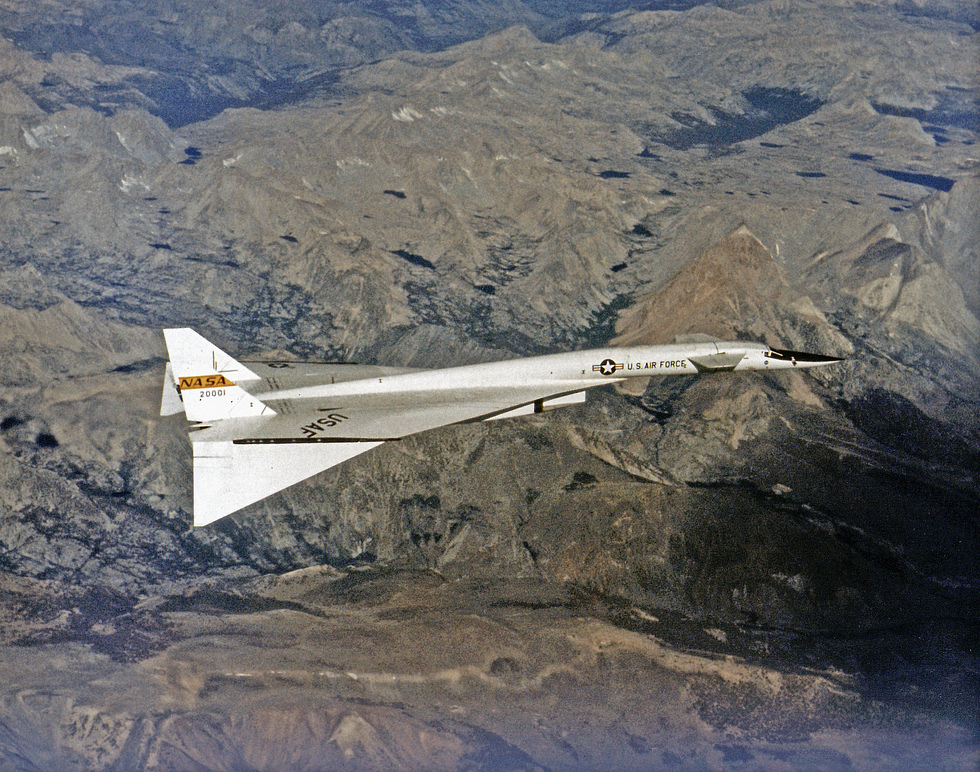
Its central trick was compression lift. At Mach 3 the wedge-shaped forward fuselage threw a powerful shock wave, and the wing was shaped to trap that high-pressure air beneath it — so the aircraft was held up, in part, by its own sonic boom. To make it work the outer wing panels, each the size of a fighter’s entire wing, folded down as much as 65 degrees in flight, sealing the shock under the wing and restoring the directional stability a slender delta loses at high Mach.
But the world shifted underneath the programme. On 1 May 1960 an SA-2 surface-to-air missile knocked Gary Powers’ U-2 out of the sky over Sverdlovsk. If a missile could reach 70,000 feet, then flying high and fast was no longer a defence — it was a target. At the same time the intercontinental ballistic missile arrived: cheaper, faster and unstoppable, with no crew to lose. In 1961 the Kennedy administration and Defence Secretary Robert McNamara cancelled the B-70 as a bomber. Only two airframes were completed, and they flew on as pure research aircraft.
The Valkyrie’s public story is inseparable from tragedy. On 8 June 1966 the second aircraft flew a tight formation of General Electric-powered jets for a company publicity photograph near Edwards Air Force Base. An F-104 chase plane, caught in the bomber’s powerful wingtip vortex, rolled into the Valkyrie, sheared off both of its vertical tails and sent it into an unrecoverable spin. NASA test pilot Joe Walker in the F-104 and Air Force co-pilot Carl Cross in the Valkyrie were killed; pilot Al White escaped in the aircraft’s encapsulated ejection seat. It is remembered as a needless loss on a flight that existed only for a photograph.
The surviving aircraft flew on for NASA, gathering the high-speed data that fed America’s supersonic-transport research, before making its final flight to the National Museum of the US Air Force on 4 February 1969. It has stood indoors at Dayton, Ohio ever since — the only XB-70 in the world, a monument to an idea that was brilliant, beautiful and obsolete almost before it left the ground.
01The XB-70 Valkyrie’s cancellation: why America built only two Mach 3 bombers
The Valkyrie grew out of the 1950s Weapon System 110A requirement for a Mach 3 intercontinental bomber to replace the B-52. It was a triumph of ambition — and it was overtaken by two technologies at once. High-altitude surface-to-air missiles, proven when an SA-2 downed a U-2 in 1960, erased the safety of flying high and fast. And the intercontinental ballistic missile offered the same nuclear reach without risking a crew. Facing a bomber that was expensive, vulnerable and arguably redundant, Robert McNamara cut the B-70 to a two-aircraft research programme in 1961. The Valkyrie never carried a weapon or entered squadron service; its value, in the end, was the flight-test data it produced.
What makes it special
It rode its own shock wave
The Valkyrie was designed around compression lift: at Mach 3 its wedge-shaped forebody generated a shock wave whose high pressure pushed up on the underside of the wing, supplying a large share of cruise lift almost for free. Its folding wingtips — drooping to 25° subsonic and a full 65° at high Mach — sealed that pressure under the wing and clawed back the directional stability a slim delta loses near Mach 3.
Six engines and a skin of steel
Thrust came from six General Electric YJ93 afterburning turbojets clustered in the rear fuselage — roughly 28,000–30,000 lbf each, and one of the loudest aircraft ever flown. To survive Mach 3 heat the airframe was built largely of brazed stainless-steel honeycomb sandwich panels, with titanium — only about 9% of the structure — reserved for the hottest areas.
Fighting the heat of Mach 3
At Mach 3.1 the nose and leading edges reached around 330 °C and the whole airframe grew measurably longer from thermal expansion. The fuel doubled as a heat sink, soaking up heat before it was burned; a special high-stability fuel, JP-6, resisted cooking, and empty tank space was filled with inert nitrogen so the hot fuel vapours could not ignite.
02The XB-70 Valkyrie’s folding wingtips: the largest movable surfaces ever flown
Each of the Valkyrie’s outer wing panels was, on its own, about the size of a fighter’s entire wing — and they were hydraulically hinged to fold downward in flight. Subsonic they hung at roughly 25°; above about Mach 1.4 they drooped to the full 65°. This did three jobs at once: it trapped the high-pressure air of the aircraft’s own shock wave under the wing to boost compression lift, it reduced drag, and it added side-area aft to restore directional stability at Mach 3. No aircraft before or since has flown movable surfaces on this scale.
03The XB-70 Valkyrie’s honeycomb skin: the manufacturing nightmare behind Mach 3
Building an aircraft that could survive sustained Mach 3 meant inventing a structure to match. North American turned to brazed stainless-steel honeycomb sandwich panels — two thin steel skins bonded to a honeycomb core — light, stiff and heat-tolerant in theory. In practice it was punishing to build: panels could delaminate and shed under heat and stress, and at least one Mach 3 flight ended with skin peeling away from the airframe. The technique was as much art as engineering, and its difficulties were among the reasons the Valkyrie stayed a two-aircraft experiment.
Full specifications
Airframe & Performance
- クルー
- 2 (the planned bomber was to carry 4)
- 長さ
- ~57 m (185 ft 10 in)
- 翼幅
- 32 m (105 ft)
- 身長
- ~9.4 m (30 ft 9 in)
- Max takeoff weight
- ~246,000 kg (~542,000 lb)
- Max speed
- Mach 3.1 · ~2,056 mph (~3,309 km/h)
- Demonstrated top speed
- Mach 3.08
- サービス天井
- ~23,000 m (~75,000 ft)
- 範囲
- ~6,900 km (~4,290 mi) design figure
Propulsion & Systems
- Engines
- 6 × General Electric YJ93-GE-3
- Thrust (each)
- ~28,000–30,000 lbf with afterburner
- Structure
- Brazed stainless-steel honeycomb; ~9% titanium
- Fuel
- JP-6, high-thermal-stability
- First flight
- 21 September 1964
- Number built
- 2 (a third airframe unfinished)
- Programme cost
- ~$1.5 billion (1960s, estimate)
- Cost per flight hour
- No reliable public figure
04The XB-70 Valkyrie’s cost: what a cancelled Mach 3 bomber was worth
Because the Valkyrie was a government research programme and never sold, no clean flyaway unit price exists. The research effort is commonly cited at around $1.5 billion in 1960s dollars, while the original full-scale bomber programme — development plus a planned operational fleet — was estimated near $2.5 billion before cancellation; per-aircraft figures around $700 million are also quoted. All of these should be read as estimates, not audited costs. No credible cost-per-flight-hour figure for the type exists in open sources.
From Mach 3 dream to museum piece
The requirement
The USAF frames Weapon System 110A: a Mach 3, high-altitude intercontinental bomber to replace the B-52.
North American wins
North American Aviation is selected to build the B-70, beating Boeing for the most ambitious bomber contract of the era.
Cancelled as a bomber
SAMs and ICBMs make a high-fast bomber vulnerable and redundant; McNamara cuts the B-70 to a two-aircraft research effort.
Rollout and first flight
AV-1 (62-0001) is rolled out on 11 May and makes its first flight on 21 September.
First Mach 3
On 14 October AV-1 reaches Mach 3.02; the refined AV-2 would go on to nine Mach 3 flights and the programme’s top speed of Mach 3.08.
The mid-air collision
On 8 June a chase F-104 strikes AV-2 during a formation photo shoot; the second Valkyrie is destroyed and two airmen die.
Research for the SST
The surviving AV-1 flies sonic-boom, turbulence and high-speed handling research that feeds the US supersonic-transport programme.
Final flight to the museum
On 4 February AV-1 makes its last flight, straight to the National Museum of the US Air Force, where it remains today.
From the programme: twelve Valkyrie stories
The bomber that outran everything
WS-110A demanded a Mach 3 bomber that no interceptor could catch at 70,000 ft.
Read the full story
Riding its own shock wave
Compression lift let the Valkyrie be held up, in part, by its own sonic boom.
Read the full story
The 65-degree folding wingtips
Outer panels the size of a fighter’s wing folded down in flight.
Read the full story
Six engines, one wall of noise
A cluster of six GE YJ93 turbojets made it one of the loudest aircraft ever.
Read the full story
The honeycomb-skin nightmare
Brazed stainless-steel honeycomb was cutting-edge — and hard to build.
Read the full story
Fuel as coolant, nitrogen as fireguard
At Mach 3 the airframe cooked, so the fuel absorbed the heat.
Read the full story
Obsolete before it entered service
SAMs and ICBMs erased the case for a high-fast bomber.
Read the full story
The collision that shocked the programme
A publicity photo shoot ended with a chase plane in the Valkyrie’s tails.
Read the full story
The pilot in the chase plane
NASA’s chief research pilot and a spaceflight veteran died in the F-104.
Read the full story
The capsule that saved Al White
The Valkyrie’s encapsulated ejection seat sealed a pilot into a survivable pod.
Read the full story
Grandfather of the supersonic transport
The survivor’s research fed America’s SST programme.
Read the full story
The last Valkyrie in the world
AV-1 flew its final flight straight into the museum in 1969.
Read the full story
The Valkyrie in pictures



Where the Valkyrie flew
A prototype that never went to war
The Valkyrie has no combat record — it never carried a weapon, never flew a mission and never entered squadron service. Its story is written instead in flight-test numbers: the speed it demonstrated, the altitude it held, and the research data it left behind. Two were built; one survives.
See how aircraft that did reach the front line compare in the combat record of every military aircraft.
Everything people ask about the XB-70
Can I fly in an XB-70?
How fast was the XB-70?
Why were only two XB-70s built?
What happened on 8 June 1966?
Where is the XB-70 now?
Was the XB-70 ever operational?
How much did the XB-70 cost?
You can’t fly the XB-70.
These, you can.
Some legends only live in museums — others are fuelled and waiting. MiGFlug has put civilians in real military jet cockpits since 2004.
 Fly the L-39 AlbatrosThe world’s most-flown jet trainer — aerobatics included
 Fly the F-104 Starfighter“The missile with a man in it”
 Fly the MiG-21The Cold War’s most-produced jet
 T-33シューティングスターを操縦しようAmerica’s first jet trainer
 Fly the DH VampireA piece of early jet history
 Fly the S.211Agile Italian jet trainer
 Fly the MB-326The classic Aermacchi jet
 Fly the MiG-15The Soviet legend of the Korean War
Continue the tour
Every fact, checked
- National Museum of the US Air Force — XB-70 Valkyrie fact sheetOfficial record for the surviving aircraft: specifications, history and the 1966 accident.
- NASA — XB-70 ValkyrieNASA’s account of the research programme, the SST work and the mid-air collision.
- Air & Space Forces Magazine — “The Ride of the Valkyrie”In-depth program history, politics and specifications.
- This Day in Aviation — 8 June 1966Detailed, well-sourced reconstruction of the collision, the aircraft and the crew.
- The Aviation Geek Club — Al White’s accountThe surviving pilot’s first-person recollection of the escape-capsule ejection.
- The Aviation Geek Club — the General Electric YJ93Engine thrust, JP-6 fuel and the thermal design of the powerplant.
- GlobalSecurity.org — B-70 ValkyrieWS-110A requirement, contract history and programme-cost estimates.
- Smithsonian National Air and Space MuseumReference material on the YJ93 engine and Mach 3 flight research.