

The caution panel lights up like a Christmas tree. The stick goes dead. The jet rolls left, nose pitching toward the Tigris River and the rooftops of Baghdad below. Captain Kim “Killer Chick” Campbell has maybe two seconds to decide: eject over one of the most hostile cities on earth — or fight for an airplane that no longer wants to fly.
She chooses the airplane.
What follows is one of the most extraordinary feats of airmanship in modern combat history. On April 7, 2003 — seventeen days into the invasion of Iraq — Campbell nursed a shattered A-10 Thunderbolt II more than 300 miles back to base using nothing but a system of mechanical cables and cranks designed for exactly this kind of impossible day. When ground crews counted the holes, they stopped at 150.
Quick Facts
Pilot: Captain Kim “Killer Chick” Campbell, 75th Fighter Squadron
Aircraft: A-10A Thunderbolt II, tail number 81-0987
Date: April 7, 2003 — Operation Iraqi Freedom
Mission: Close air support over Baghdad
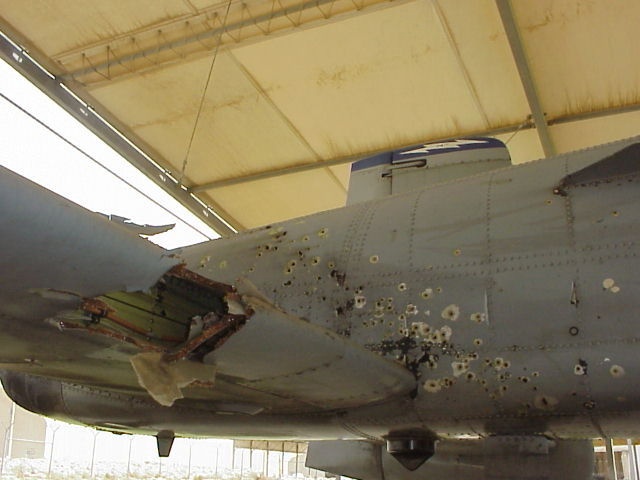
Damage: Hundreds of shrapnel holes, football-sized hole in right stabiliser, both hydraulic systems destroyed, one engine damaged
Recovery: Manual reversion flight — 300 miles on cables and cranks
Award: Distinguished Flying Cross
Troops in Contact
Campbell and her flight lead, Lieutenant Colonel Rick “Bino” Turner, launched from a forward base that morning with a standard tasking: strike Iraqi tanks and a command post. Weather made the mission difficult from the start — clouds forced them to hunt for the tanker, and Campbell later wrote in her diary that spatial disorientation set in while flying through the overcast.
Then the radio call came. American troops were taking fire from Iraqi Republican Guard forces near the Tigris River. The two A-10s were diverted to a troops-in-contact situation — the most urgent call a close air support pilot can receive. There was no time for detailed briefings. Campbell could see rocket-propelled grenades arcing into friendly positions from above.
The Warthog pilots went to work. Multiple passes with the legendary 30mm GAU-8 Avenger cannon. High-explosive rockets. The enemy was concentrated on the south side of the river, so they adjusted their attack runs accordingly. It was the kind of mission the A-10 was born for — low, slow, and lethal.
The Hit
It happened on the final rocket pass. Campbell felt something slam into her aircraft — hard. The sound was unmistakable. In her diary that night, she wrote simply: “I felt something hit the jet. At the same time, the jet rolled left and nose low. The hydraulics were gone instantly.”
A surface-to-air missile had detonated near the right horizontal stabiliser, sending a storm of shrapnel through the fuselage. The explosion severed both primary and backup hydraulic lines simultaneously — the one scenario the A-10’s designers hoped would never happen, but prepared for anyway. The hydraulic gauge dropped to zero. Every caution light on the panel screamed at once. The jet, suddenly uncontrollable, rolled hard left and pointed its nose at Baghdad.
Campbell’s first thought was brutal in its honesty. As she later admitted: she thought about how bad it would be to eject over Baghdad. Below her lay one of the most heavily defended cities on earth, teeming with Iraqi forces who had just watched her strafe their positions. An ejection meant capture — or worse.

Cranks and Cables
Every other fighter jet in the American inventory would have been finished. The F-16, the F-15, the F/A-18 — all fly-by-wire or hydraulic-dependent aircraft. Lose the hydraulics, lose the jet. But the A-10 Thunderbolt II was designed by people who expected it to get shot. Fairchild Republic built the Warthog to absorb punishment that would destroy anything else in the sky, and they gave it one last trick for the worst day imaginable: manual reversion.
Manual reversion is old-school engineering at its finest. Steel cables and mechanical linkages run from the control stick directly to trim tabs on the flight control surfaces. When hydraulics fail, a pilot can physically move these tabs through cranks and pulleys, and the tabs then deflect the larger control surfaces through aerodynamic force alone. It works. But the Air Force’s own 1982 study called the system’s pilot workload “unacceptable for the landing task.” Pilots compare it to driving a dump truck without power steering — at 250 knots.
Campbell engaged manual reversion. The jet responded. Slowly, painfully, she pulled the nose up and started climbing away from Baghdad. Anti-aircraft fire chased them from every direction as she and Turner manoeuvred south, trying to put distance between themselves and the city. The airplane was flyable — barely — but every input demanded enormous physical effort, and the controls responded with the precision of a shopping trolley with a broken wheel.
300 Miles on Muscle and Faith
Turner pulled alongside to assess the damage and deliver the news. He counted roughly a hundred holes in the fuselage and tail section on the right side alone, plus a football-sized hole punched clean through the right horizontal stabiliser. One engine was damaged. Large sections of the hydraulic controls were simply missing — ripped away by the blast.
The flight back to Ahmad Al-Jaber Air Base in Kuwait took over an hour. An hour of fighting a crippled jet through the sky with cable tension and arm strength. An hour of knowing that the landing — without hydraulics, without speed brakes, without nose-wheel steering, without normal brakes — would be the hardest part. Campbell relied on Turner’s calm voice and her own exhaustive training. She later reflected that the jet was performing so well in manual reversion that she never seriously considered ejecting.
Then came the approach. No speed brakes to slow down. No antiskid braking. No steering once the wheels touched. Campbell used emergency alternate braking procedures — techniques practised in simulators but almost never executed for real. She put the Warthog on the runway and brought it to a stop.
The Landing Nobody Expected
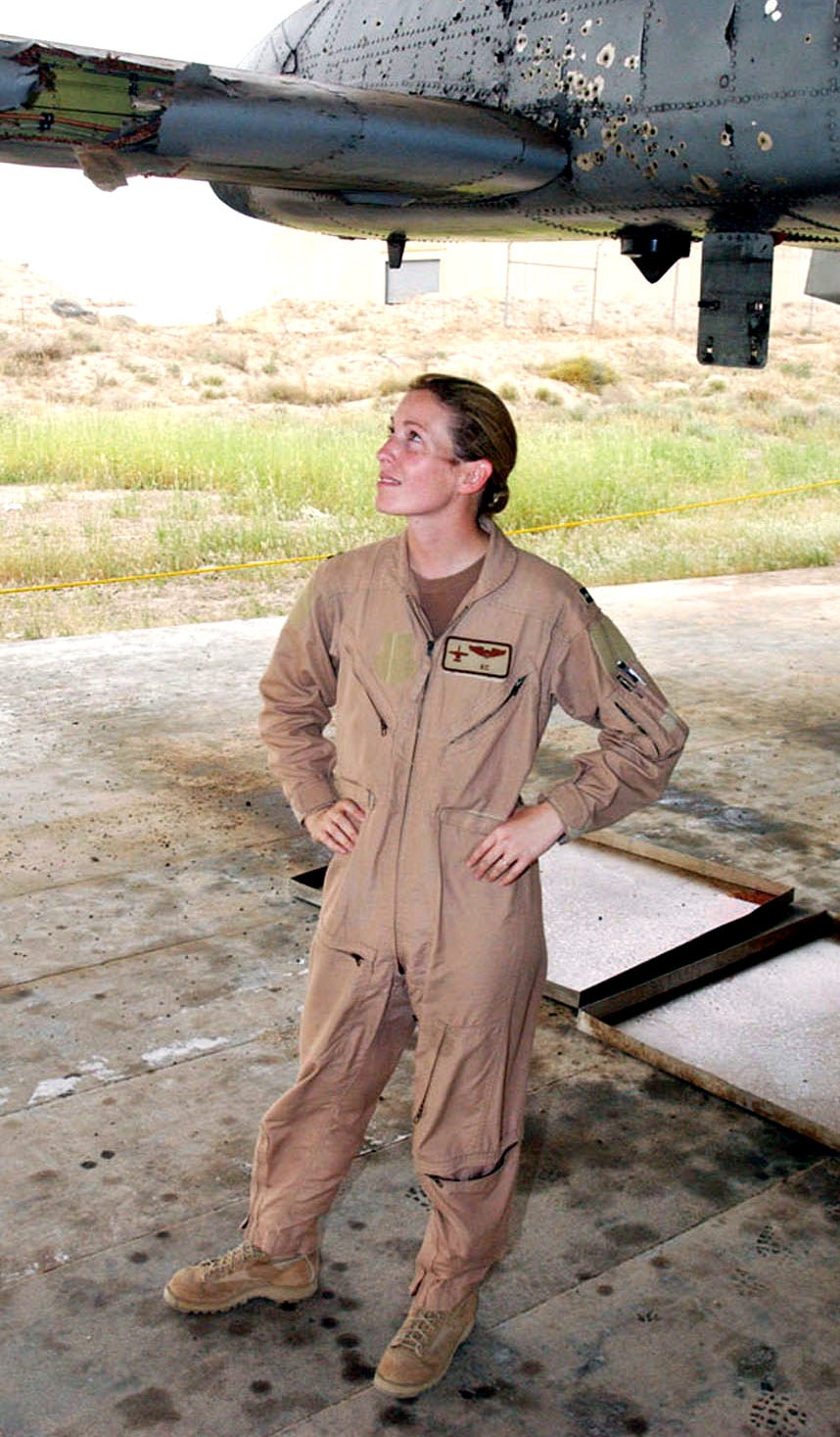
When the aircraft finally stopped rolling, the emotions hit. Campbell later described it as one of the most overwhelming moments of her life. In her diary, she wrote: “It was such a relief to touch down and feel the jet come to a stop, some serious emotions at that point.” Years later, she would say something even more remarkable: “To this day, I’m convinced it was one of the best landings I have ever done.”
The next morning — less than 24 hours after nearly dying over Baghdad — Campbell climbed into another A-10 and flew a combat mission. This time, she supported a search-and-rescue operation for a different downed A-10 pilot near the city. That is what fighter pilots do. You process later. You fly now.
General Richard Myers, then Chairman of the Joint Chiefs of Staff, later singled out Campbell’s feat in a speech at the Air Force Academy. His words cut to the heart of why this story matters.

A Fighter Pilot — No Adjective Required
Kim Campbell went on to fly 1,800 hours in the A-10 and complete more than 100 combat missions across Iraq and Afghanistan. She rose to the rank of Colonel, commanded the 612th Theater Operations Group at Davis-Monthan Air Force Base, and later served as Director of the Center for Character and Leadership Development at the Air Force Academy — the same institution where she had been cadet wing commander as a Class of 1997 graduate. Her husband, Colonel Scott Campbell, is also an A-10 pilot. They met at the Academy.
After retiring in 2021 following 24 years of service, she wrote a bestselling book, Flying in the Face of Fear: A Fighter Pilot’s Lessons on Leading with Courage, and now speaks to audiences around the world about leadership under pressure. When asked about being a woman in the fighter community, her answer is characteristically direct: “I’m just a fighter pilot, no adjective required.”
Her A-10 — tail number 81-0987, with its hundreds of patched holes and its missing stabiliser — was too badly damaged to ever fly again. It sits today on static display at Seymour Johnson Air Force Base in North Carolina, a monument to the aircraft that refused to die and the pilot who refused to give up on it.
Yarnhub recreates the day Kim Campbell brought her A-10 home — “Killer Chick in an A-10 Warthog.”
Sources: DVIDS / U.S. Air Force, Task & Purpose, The War Zone, Hush-Kit, Flight Global

 English
0 Comments