

Quick Facts
Operation: Epic Fury (US air campaign against Iran)
Duration: 39 days
Total Sorties: 13,000+
Aircraft Lost: 39 confirmed
Aircraft Damaged: 10+ additional
Manned Fighters Downed: 4 F-15Es, 1 A-10, 1 F-35A (damaged/ejected)
Drones Lost: Up to 24 MQ-9 Reapers
The Drone Toll
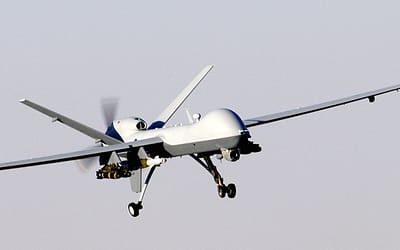
The single largest category of losses is unmanned. Up to 24 MQ-9 Reaper drones were destroyed during the campaign, according to CBS reporting — roughly 60 percent of total attrition. The Reaper, a workhorse of American ISR and strike operations for two decades, was designed for permissive environments where the enemy has no serious air defences. Iran’s integrated air defence network, built around Russian-supplied S-300 systems and domestically produced Bavar-373 batteries, is not a permissive environment. Each MQ-9 costs approximately $32 million. Losing 24 of them represents nearly $770 million in hardware — before counting the intelligence-gathering capability that went down with them.
Manned Losses: The Hardest Numbers
Five manned combat aircraft were shot down in flight. Four were F-15E Strike Eagles — the Air Force’s primary long-range strike fighter. One was an A-10 Warthog, the close air support aircraft that had been surged to the region to support ground-oriented missions. The most high-profile incident came on April 3, when an F-15E with the callsign Dude 44 was hit by a shoulder-fired missile over Iran’s Zagros Mountains, triggering a massive 155-aircraft combat search and rescue operation. Perhaps the most symbolically significant loss was an F-35A Lightning II that was hit over Iranian airspace. The pilot ejected safely, but the incident marked the first confirmed combat damage to a fifth-generation stealth fighter — a milestone that air forces around the world will study for years.
Friendly Fire and Operational Losses
Not all losses came from enemy action. Three F-15E Strike Eagles were shot down on March 1 in a friendly fire incident involving Kuwaiti Air Force F/A-18 aircraft — a tragedy that accounts for a significant portion of the manned fighter losses. Additional aircraft were deliberately destroyed during combat search and rescue operations in Iranian territory, when recovering the airframe was deemed too dangerous or impossible. Operational losses like these are an inevitable feature of sustained, high-intensity air campaigns. They happened in Desert Storm, in Allied Force over Serbia, and in the opening weeks of Iraqi Freedom. What distinguishes Epic Fury is the scale: 39 aircraft in 39 days, against an adversary with genuine air defence capability.What the Numbers Mean
The loss rate — roughly one aircraft per day — is sustainable for a military the size of America’s, at least in the short term. The US Air Force alone operates thousands of aircraft. But the composition of the losses matters as much as the quantity. Each F-15E, each Reaper, each AWACS represents years of training, maintenance, and institutional knowledge. Replacing the hardware is expensive. Replacing the crews, when they are lost, is impossible. For military planners worldwide, Operation Epic Fury is now a case study in what a modern air campaign against a near-peer air defence network actually looks like. The age of consequence-free precision bombing is over. Air power still works — but it bleeds.Sources: The War Zone, CBS News, Breaking Defense, Air & Space Forces Magazine
Related Questions
What was Operation Epic Fury?
Operation Epic Fury was a 39-day US air campaign against Iran involving more than 13,000 sorties. It was the most significant US air campaign since the 2003 invasion of Iraq and cost 39 aircraft confirmed lost plus more than ten damaged — the heaviest US combat aircraft losses since the Vietnam War.
How many aircraft did the US lose over Iran?
The US lost 39 aircraft confirmed during Operation Epic Fury, with more than ten others damaged. Up to 24 of the losses were MQ-9 Reaper drones — roughly 60 percent of total attrition — while five manned combat aircraft were shot down: four F-15E Strike Eagles and one A-10, with an F-35A also damaged.
Why were so many MQ-9 Reaper drones lost over Iran?
The MQ-9 Reaper was designed for permissive environments where the enemy lacks serious air defences, but Iran fielded an integrated network built around Russian-supplied S-300s and domestic Bavar-373 batteries. Up to 24 Reapers were destroyed at about $32 million each — nearly $770 million in hardware. Iran has a history of downing US drones.
What is the MQ-9 Reaper?
The MQ-9 Reaper is a US hunter-killer drone that has been a workhorse of American surveillance and strike operations for two decades. It excels in airspace without strong defences but is vulnerable to modern surface-to-air systems, as its heavy losses over Iran showed. Its predecessor, the MQ-1 Predator, also keeps resurfacing in headlines.
How strong is Iran's air defense network?
Iran operates an integrated air-defence network combining Russian-supplied S-300 systems with domestically produced Bavar-373 batteries. This layered defence turned Iranian airspace into a contested environment that inflicted the heaviest US aircraft losses in a generation. The war pushed regional powers to invest further — Israel ordered additional stealth squadrons afterward.
0 Comments