

Quick Facts
- Date: April 1, 2026
- Aircraft: F-16 Block 70 (Royal Bahraini Air Force)
- Target: Two Iranian drones
- Weapons: AIM-9X Sidewinder, AIM-120C-7 AMRAAM
- Significance: First air-to-air kills for the F-16 Block 70 variant worldwide
- Total Block 70s ordered: 148 aircraft by six nations
- Radar: Northrop Grumman APG-83 SABR (AESA)
The Block 70: A New Viper for a New Era
The F-16 Block 70 is not your father's Fighting Falcon. It represents the most advanced production version of a jet that first flew in 1974 and has been continuously upgraded ever since. At its heart sits the Northrop Grumman APG-83 Scalable Agile Beam Radar — an active electronically scanned array (AESA) derived from the F-35's AN/APG-81. It can track more targets, at greater range, and with better resolution than any radar previously fitted to an F-16. The cockpit has been modernised with a new Centre Pedestal Display, an advanced mission computer, and upgraded electronic warfare systems. The airframe incorporates structural improvements that extend the service life to 12,000 hours. Lockheed Martin's Sniper Advanced Targeting Pod rounds out the sensor suite, giving the pilot precision identification capability day or night. Bahrain ordered sixteen Block 70s in a deal worth approximately $3.8 billion, making it one of the first customers to receive the new variant. The first production aircraft arrived in March 2024, replacing the country's ageing fleet of F-16C/D Block 40 jets. Other Block 70 customers include Slovakia, Bulgaria, Jordan, Taiwan, and Morocco — a total backlog of 148 aircraft.
When the Patriot Missed
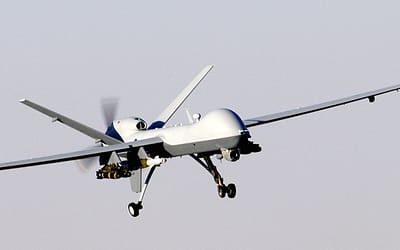
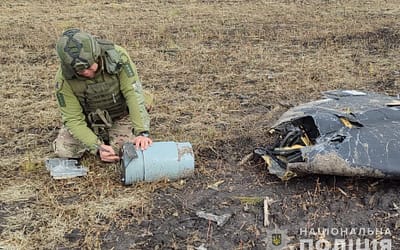
The context of the April 1 engagement matters as much as the result. Since late February, Bahrain had been under sustained attack from Iranian ballistic missiles and one-way attack drones. The island kingdom's Patriot PAC-3 batteries had intercepted dozens of threats — by early March, Bahraini officials reported shooting down over seventy missiles and fifty-nine drones. But air defense is a numbers game. No system catches everything. On the night of April 1, two Iranian drones penetrated the ground-based missile shield. Whether they flew too low, exploited radar gaps, or simply arrived during a moment of saturation is not publicly known. What is known is that the Bahraini Air Force was ready. The Block 70 pilot — whose name has not been released — was vectored onto the targets and engaged with a combination of AIM-9X Sidewinder heat-seeking missiles and AIM-120C-7 AMRAAM radar-guided missiles. Both drones were destroyed. It was a textbook intercept, executed under real combat pressure, against real threats that had already defeated another layer of defense.Why This Kill Matters Beyond Bahrain
First kills define an aircraft's reputation. The F-15 Eagle's undefeated air-to-air record began with a single engagement over the Bekaa Valley in 1982. The F-22 Raptor's combat credibility was cemented the moment it dropped bombs on ISIS targets in 2014. For the F-16 Block 70, the Bahrain intercept is that moment. Lockheed Martin has been selling the Block 70 as a cost-effective, fourth-generation-plus fighter capable of operating in modern threat environments. That sales pitch just became a lot more credible. Every air force evaluating the Block 70 — and there are several — now has a combat-proven data point to factor into their decision.
The Viper's Endless War
The F-16 Fighting Falcon has now been in service for nearly fifty years. It has been built in greater numbers than any other Western fighter since the F-86 Sabre. It has served in the air forces of more than twenty-five nations. And it keeps finding new ways to stay relevant. The Block 70 is proof that the basic F-16 design — a lightweight, single-engine, highly manoeuvrable airframe — still has room to grow. With an AESA radar, modern weapons, and a digital backbone that can integrate with fifth-generation networks, it is not a relic. It is a bridge between the fourth and fifth generation, and for many air forces, it is the most capable fighter they will ever operate. Bahrain's pilots just proved that in the most convincing way possible: under fire, at night, against threats that had already beaten the first line of defense. The Viper still bites.Sources: Aviation Week, The War Zone, Breaking Defense, Al Jazeera
Related Questions
What is the F-16 Block 70?
The F-16 Block 70 is the most advanced production version of the F-16 Fighting Falcon, a jet that first flew in 1974. Its centerpiece is the Northrop Grumman APG-83 SABR, an active electronically scanned array radar derived from the F-35's APG-81. It can track more targets at greater range than any earlier F-16 radar. Six nations have ordered 148 Block 70s.
Has the F-16 Block 70 ever been used in combat?
Yes. On April 1, 2026, a Royal Bahraini Air Force F-16 Block 70 destroyed two Iranian drones over Bahrain, scoring the first confirmed air-to-air kills for the variant anywhere in the world. The jet used an AIM-9X Sidewinder and an AIM-120 AMRAAM after ground-based Patriot batteries failed to stop the drones. Other operators fly the F-16 on NATO duty.
What weapons does the F-16 use for air-to-air combat?
The F-16 carries short-range heat-seeking AIM-9 Sidewinders and longer-range radar-guided AIM-120 AMRAAMs. Bahrain's Block 70 used both — an AIM-9X and an AIM-120C-7 — to down two Iranian drones in April 2026. Pilots announce these shots by codewords; the Fox One, Fox Two, Fox Three brevity calls are explained here.
What is an AESA radar?
An AESA, or active electronically scanned array, is a radar that steers its beam electronically rather than with a moving antenna. The F-16 Block 70's APG-83 AESA, derived from the F-35's radar, tracks more targets at greater range and resolution than older mechanically scanned sets, giving the upgraded Viper a major sensor advantage.
Why are fighter jets used to shoot down drones?
Ground-based defences like Patriot batteries can be overwhelmed or miss low, slow targets, so fighters provide a flexible backstop. In April 2026, two Iranian drones slipped past Bahrain's Patriots before an F-16 Block 70 destroyed both. Fighters can chase, identify, and engage drones across a wide area that fixed defences cannot fully cover.
0 Comments