
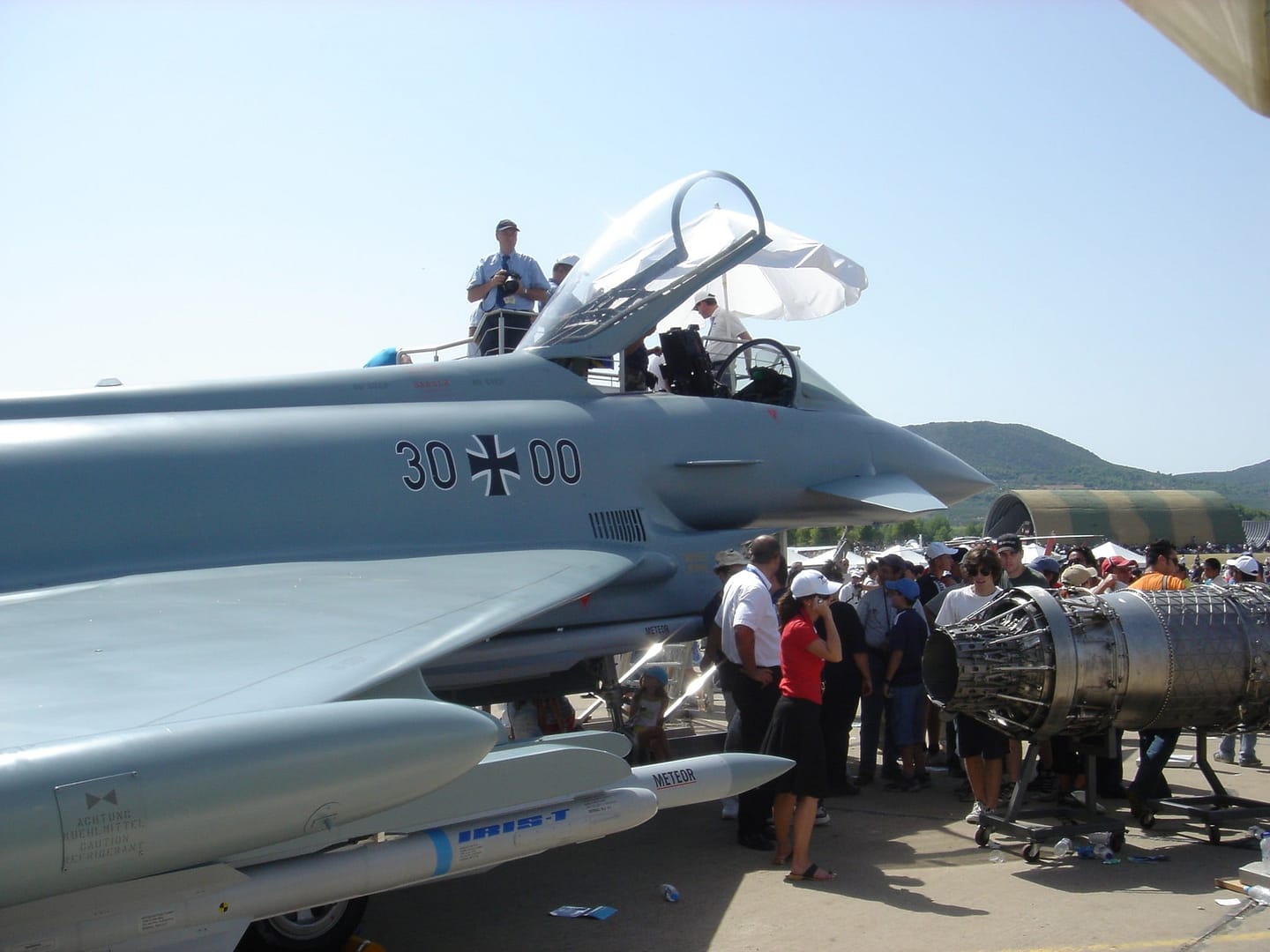
The Eurofighter Typhoon just proved what air forces have suspected all year: you don't need a $1 million missile to swat a $30,000 drone out of the sky. Last month, a RAF Typhoon test aircraft streaked across the range at Warton, Lancashire, and fired the APKWS (Advanced Precision Kill Weapon System)—a guidance kit that transforms plain-vanilla unguided Hydra 70 rockets into surgically precise precision weapons. The result? A direct hit on a ground target. Britain now joins the growing roster of nations experimenting with low-cost counter-unmanned systems, but this test represents something more significant: a fundamental shift in how modern air forces think about the economics of air combat.
For decades, the calculus was simple. Enemy fighter jet? Deploy an AMRAAM, priced at north of $400,000 per missile. Cruise missile threat? Fire a Meteor, costs roughly the same. The math worked when your adversary could afford to lose jets and missiles in return. But the arrival of Iranian-style drone swarms has shattered that equation. An adversary willing to send 100 cheap drones at you forces a decision: burn through a magazine of ultra-expensive air-to-air missiles and go broke, or find another way. The APKWS answers that question with elegant simplicity.
Quick Facts
| Weapon System | APKWS guidance kit on Hydra 70 rockets |
| Aircraft | Eurofighter Typhoon |
| Test Location | Warton, Lancashire, UK |
| Test Date | March 2026 (announced April 8) |
| Result | Direct hit on ground target |
| Next Phase | Air-to-air testing |
| Cost Advantage | Thousands per round vs. millions per missile |
From Dumb Rockets to Precision Strikes
The Hydra 70 has been around since the Vietnam War—a 2.75-inch unguided folding-fin aerial rocket that's proven in combat on everything from helicopters to ground-attack jets. Accurate? Not particularly. Spray and pray became doctrine. But the APKWS, developed by Orbital ATK (now Northrop Grumman), adds a laser-guidance seeker to the rocket's nose. Suddenly, what was once a shotgun became a rifle. The system can be retrofitted to existing rocket pods with minimal modification, which is why it's catching the attention of every air force scrambling to counter drones without mortgaging the next decade of procurement budgets.
BAE Systems mounted the APKWS in LAU-131 seven-round launch pods—the same hardware already in Typhoon weapon bays, just with different ordnance. Two pods mean fourteen guided rockets ready to fire. That's enough payload to handle a coordinated drone incursion without needing to develop entirely new carry-and-launch infrastructure. The test vindicated the concept. A direct hit means the system is ready for the next crucial step: proving it can track and engage aerial targets at realistic combat speeds.
Why This Matters Now
The drone asymmetry is reshaping air combat faster than air forces can adapt doctrine. Think about it: an AMRAAM costs $1.3 million. A Meteor costs roughly $2 million. A decent tactical drone—your Shahed 136 or similar—costs $20,000 to $50,000 to build. Send thirty drones, and the defender needs to spend $30-60 million in missiles just to survive the attack. That calculus is unsustainable. APKWS flips the script. At perhaps $150,000 to $200,000 per round (unconfirmed, but likely in that ballpark given the system's maturity), a Typhoon can carry fourteen rounds of highly accurate anti-drone firepower for a fraction of what a single Meteor costs.
This is why the UK Ministry of Defence greenlit the test. Britain faces the same long-range air threat calculus as every NATO partner: Russia to the east, asymmetric threats across the Middle East, and the growing menace of coordinated drone swarms. The Typhoon is a workhorse for the RAF—it'll be flying for decades. If APKWS integration proves viable for counter-UAS work, suddenly the Typhoon becomes a force multiplier for defending against the exact threat that keeps air commanders awake at night.

What Comes Next
The Warton test was specifically a ground-target validation. APKWS hit its mark, confirming the platform and weapon system can play nice together. The real proof comes when Typhoons take to the range and engage aerial targets—drones, RPVs, or decoys—at speed and altitude. That's the next frontier. Once air-to-air testing succeeds, expect rapid adoption announcements from RAF squadron commanders, followed by rapid-fire integration programs across allied Typhoon operators: Germany, Italy, Spain, Austria, the Saudis.
The implications ripple outward. If the Typhoon can carry cheap, guided anti-drone firepower, so can the F-16, the Gripen, the Rafale, and the F/A-18. The 4th-generation jet fleet just got a new mission set, and an old airframe got a rebirth. In an era when every nation is wrestling with budget constraints and the rising cost of air superiority, finding ways to leverage existing platforms is nothing short of revolutionary.
The Larger Picture
What we're witnessing isn't really about rockets. It's about the collision between two timescales in modern warfare. Expensive, highly capable aircraft can't be built fast enough. Cheap, expendable drones are proliferating faster than air defenses can respond. The nations winning this race aren't necessarily those building the most advanced fighters—they're the ones finding clever ways to leverage existing assets against new threats. APKWS on a Typhoon is an elegant hack: proven airframe, proven rocket, proven guidance system, new lethality against the threat that matters most right now. If the air-to-air tests deliver the same precision and effectiveness on a moving target, expect to see this system proliferate across Western air forces within 18 months. The era of cheap precision air defense just began.
Sources: BAE Systems, UK Ministry of Defence, Northrop Grumman APKWS specifications
Related Questions
What is the APKWS?
The APKWS (Advanced Precision Kill Weapon System) is a low-cost guidance kit that bolts onto the standard 70mm Hydra 70 rocket, turning an unguided rocket into a laser-guided precision weapon. Because each round costs only thousands of dollars rather than the millions a guided missile commands, it has become a favored tool for cheaply destroying drones and light targets.
What is the Hydra 70 rocket?
The Hydra 70 is a 2.75-inch (70mm) unguided, folding-fin aerial rocket in service since the Vietnam War. Cheap and widely stocked, it is fired from helicopters and ground-attack aircraft. On its own it is inaccurate, but fitted with the APKWS guidance kit it becomes a precise weapon effective against drones and ground targets.
What is the Eurofighter Typhoon?
The Eurofighter Typhoon is a twin-engine, delta-wing multirole fighter developed jointly by the UK, Germany, Italy and Spain. Highly agile and fast, it serves as a frontline air-defense and strike aircraft across European and allied air forces. In a 2026 trial at Warton, an RAF Typhoon used APKWS-guided rockets to hit a ground target.
How can fighter jets shoot down drones cheaply?
Fighters can defeat cheap drones affordably by using guided rockets instead of expensive missiles. A guidance kit like APKWS turns a roughly $30,000 problem—a small drone—into a target hit by a rocket costing only thousands, rather than firing an air-to-air missile worth hundreds of thousands or millions. This closes the costly imbalance of defending against mass-produced drones, much like other low-cost munition programs.
Why are guided rockets cheaper than missiles?
Guided rockets are cheaper because they start as simple, mass-produced unguided rockets and add only a low-cost guidance kit, rather than being purpose-built precision missiles with their own motors, seekers and airframes. A converted Hydra 70 with APKWS costs thousands per round, while a dedicated air-to-air or cruise missile can cost hundreds of thousands to millions.
0 Comments