
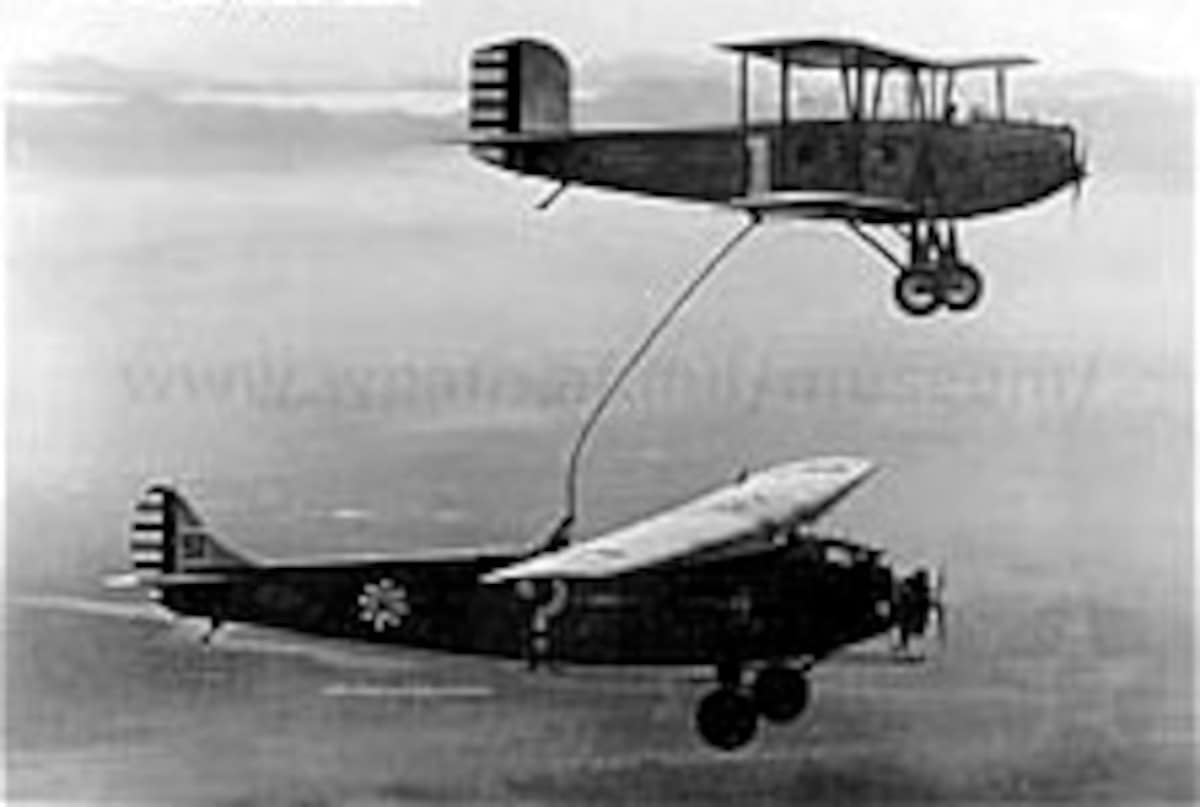
At 7:26 on the morning of New Year’s Day 1929, a fat, three-engined Fokker lifted off from a field near Los Angeles and simply refused to come down. For the next six days, seven hours and forty minutes, it stayed in the air — sleeping, eating, refuelling and flying in endless ovals over southern California.
They called it the Question Mark, because when anyone asked how long it would stay up, the crew answered: “That is the question.” The answer rewrote what an aeroplane could do — and it did it by inventing, in practice, the single most important trick in modern air power: refuelling in flight.
Quick Facts
- Aircraft: Atlantic-Fokker C-2A trimotor, the “Question Mark” (U.S. Army Air Corps)
- Feat: 150 hours, 40 minutes, 14 seconds aloft — 1–7 January 1929, over Los Angeles
- Method: 43 in-flight refuellings (12 at night) from two Douglas C-1 tankers
- Passed down in flight: 5,660 gallons of fuel, plus oil, food and mail
- Crew: Maj. Carl Spaatz, Capt. Ira Eaker, Lts. Harry Halverson & Elwood Quesada, Sgt. Roy Hooe
- No radio: orders were chalked on the sides of “blackboard” aircraft
- Legacy: proved aerial refuelling; the crew went on to run the WWII air war
A gas station in the sky
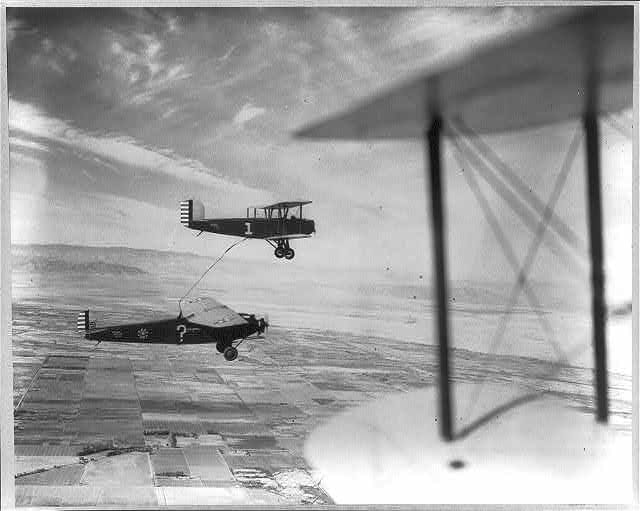
The idea was simple and terrifying. A modified Fokker C-2A, its cabin stuffed with extra fuel and oil tanks, would orbit a 110-mile racetrack while two Douglas C-1 tankers took turns flying just above it and lowering a weighted 50-foot fire hose. A crewman would grab the hose, ground it against a copper plate to kill any spark, jam it into a funnel, and fuel would gush down at up to 75 gallons a minute while a sergeant hand-pumped it into the tanks.
There were no autopilots and no radios. To pass instructions, ground crews chalked messages on the black-painted fuselages of pursuit planes that flew alongside — flying blackboards. Food, water, oil, even a spare cabin window and a portable bathtub came down the same hose line by rope.
Six days of tedium and terror
Most of the flight was mind-numbing: the same loop, hour after hour, the crew reading, playing cards and dozing in bunks laid across the fuel tanks. Then came the moments that were not boring at all. During one midnight refuelling, turbulence tore the hose from Major Carl Spaatz’s hands and drenched him in raw fuel. Fearing chemical burns, he stripped off his soaked clothes and carried on — appearing at the hatch for the next hook-up wearing little more than a parachute harness. He was doused three times in all.
Sergeant Roy Hooe, the lone enlisted man and the crew’s mechanic, earned his seat many times over. He hand-pumped every gallon, changed the engines’ oil in flight, and when trouble developed he climbed out onto a catwalk on the wing to work on a running engine, wearing a parachute and a lineman’s belt in the slipstream.
The engine that finally quit
What ended the flight was not the crew but metal fatigue. On 7 January the left engine died — a pushrod had failed and the rocker arms were worn out after a week of constant running. Hooe went out to try to fix it, but the two remaining engines could not carry the strain, and the Question Mark came home. It had covered some 11,000 miles, hooked up with its tankers 43 times, and stayed aloft more than twice as long as the previous record. Every man aboard received the Distinguished Flying Cross.
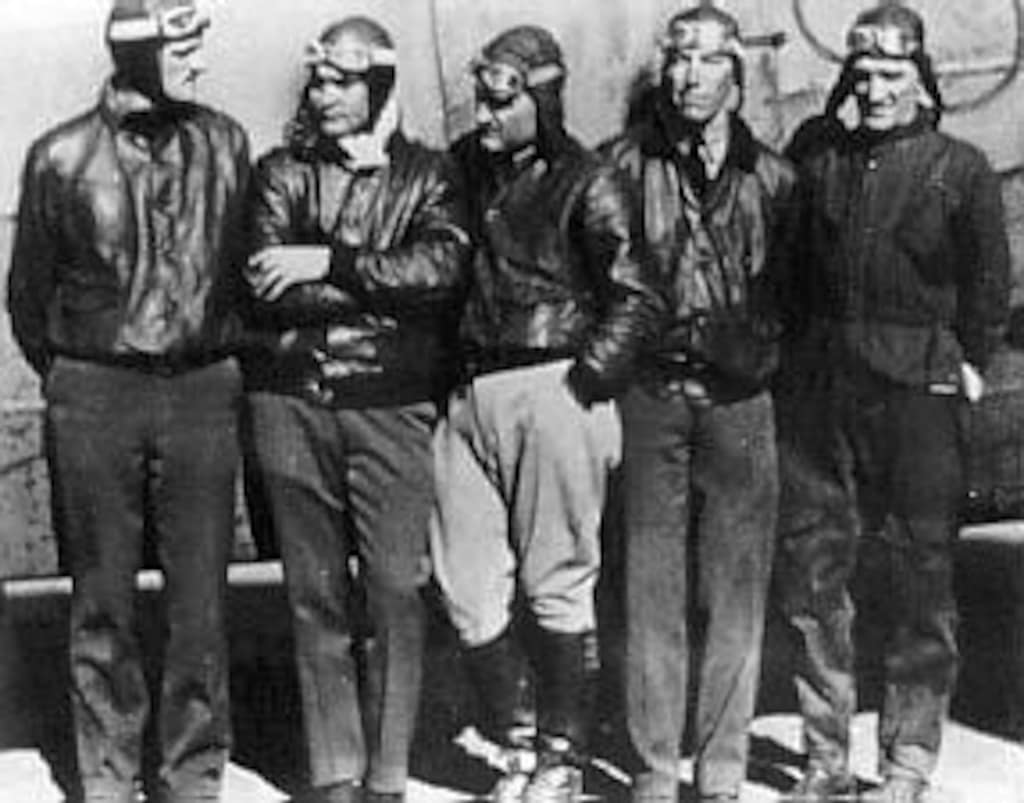
Spaatz’s report to the Chief of the Air Corps saw straight past the record to what really mattered.
The idea that had to wait
Astonishingly, the Army shelved aerial refuelling for the next twelve years, treating the Question Mark mostly as a publicity triumph. The men aboard did not fade away, though. Spaatz would command U.S. strategic air forces in Europe; Ira Eaker would lead the Eighth Air Force; Elwood Quesada would run a tactical air command; Harry Halverson would help lead the first raid on Ploesti; and Roy Hooe would end up in the Airlift/Tanker Association Hall of Fame. The trick they proved over Los Angeles in 1929 is now the quiet miracle behind every long-range mission flown today.
Sources: National Museum of the U.S. Air Force; Air & Space Forces Magazine (Walter J. Boyne); HistoricWings; Library of Congress.
0 Comments