
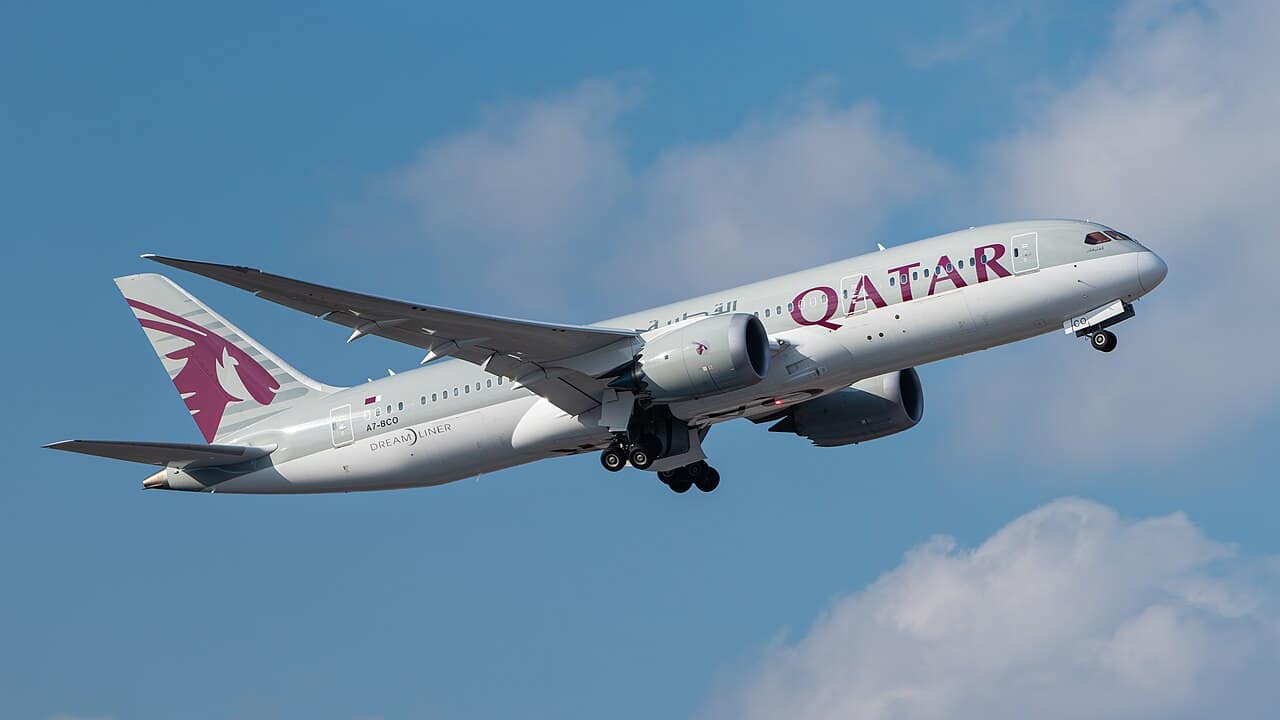
Qatar Airways finished its 2025/26 financial year with a net profit of US$1.94 billion. It is the highest annual profit in the airline's history. The carrier moved 41.8 million passengers, 1.43 million tons of cargo, and a 12% share of the entire global air freight market through a single hub at Hamad International. The numbers are silly. They are also true.
What Qatar Airways is doing with that profit is even more striking. On 14 May 2025 — during a meeting between US President Trump, Qatari Emir Sheikh Tamim bin Hamad al-Thani, and Boeing CEO Kelly Ortberg — the airline placed firm orders for 130 Boeing 787 Dreamliners and 30 Boeing 777-9s, plus options on 50 more. It is the largest widebody order in Boeing's 109-year history. The single 787 portion alone is the largest Dreamliner order ever signed.
Quick Facts
| Annual net profit | US$1.94 billion (FY 2025/26, ending 31 March 2026) |
| Operating profit | US$4.1 billion — Qatar Airways' highest ever |
| Passengers carried | 41.8 million |
| Cargo carried | 1.43 million tons — 12% global air freight market share |
| Boeing firm order | 130 × 787 + 30 × 777-9 (largest widebody order in Boeing history) |
| Boeing options | +50 additional 787s and 777Xs |
| Deal value | ~US$96 billion |
| Announcement date | 14 May 2025, Doha, during US presidential visit |
A profit that defies the regional context
The 2025/26 financial year was the most disrupted in the modern history of Gulf aviation. The Iranian airspace closure, ordered on the second day of the US-Israel strikes against Iranian nuclear infrastructure, forced every Gulf-based carrier into thousand-mile re-routings. Fuel burn rose. Crew rest cycles broke. The Strait of Hormuz remained passable but jittery. Qatar Airways absorbed all of this and still produced a record profit. The explanation, according to Group CEO Hamad Al-Khater, is operational discipline — and a hub geography that benefits even from chaos.
The final month of the financial year was the hardest: the closure of Qatari airspace in March 2026 forced Qatar Airways to temporarily suspend its scheduled operations altogether. The airline has been rebuilding its network ever since, restoring flights to more than 120 destinations by mid-May and targeting over 160 destinations by summer 2026.
A $96 billion bet on Boeing
The Boeing order is not just enormous. It is strategically significant. Qatar Airways already operates one of the largest 787 fleets in the world (62 aircraft) and one of the largest 777 fleets (53 aircraft). The new order doubles its widebody fleet over the next decade. The 130 new 787s will replace ageing 777-300ERs and 777-200LRs starting from 2030. The 30 777-9s come on top of the 777X orders Qatar Airways has held since 2013 for the much-delayed new Boeing flagship.
Equally significant: the order was placed with Boeing, not Airbus. Qatar Airways has a complicated history with Airbus, including a public legal dispute over the surface degradation of its A350 fleet that resulted in more than 20 A350s being grounded. The dispute was officially settled in early 2023 but the relationship has not fully recovered. The 787-favouring nature of the new order reflects this.
What this means for Emirates, Etihad, and Saudia
The Gulf carrier dynamic has not been this asymmetric in twenty years. Emirates remains the largest and most profitable Gulf carrier — its parent Emirates Group reported a record profit of US$6.6 billion for 2025/26, on far larger revenue. Etihad has spent the last decade reorganising and has yet to fully return to its pre-2018 financial scale. Saudia is in the middle of an enormous expansion drive associated with Saudi Vision 2030 and its sister carrier Riyadh Air, but neither has reported earnings of Qatar Airways' magnitude.
What Qatar Airways is doing with its profit — funding the largest widebody order in Boeing's history — is a competitive statement. The next ten years of Gulf aviation will be defined by which carrier scales the fastest. Qatar Airways has just placed its bet at $96 billion. Emirates and Etihad now need to answer.
Sources: Simple Flying; Boeing investor relations; Qatar Airways press releases; FlightGlobal; Airways Magazine; Travel and Tour World.
Related Questions
How much profit did Qatar Airways make in 2025/26?
Qatar Airways reported a net profit of US$1.94 billion for its 2025/26 financial year (ending 31 March 2026), the highest in its history, on operating profit of US$4.1 billion. The airline carried 41.8 million passengers and 1.43 million tons of cargo — about 12% of the global air-freight market — through its single Hamad International hub.
How many Boeing jets did Qatar Airways order in 2025?
On 14 May 2025, Qatar Airways placed firm orders for 130 Boeing 787 Dreamliners and 30 Boeing 777-9s, with options on 50 more — a deal worth roughly US$96 billion. It is the largest widebody order in Boeing's history, and the 787 portion alone is the biggest Dreamliner order ever signed.
What is the Boeing 777-9?
The 777-9 is the largest variant of Boeing's new 777X family and the world's largest twin-engined jet, pitched as a rival to the Airbus A350-1000. It has been delayed for years, with entry into service slipping toward 2027. Qatar Airways is a launch customer, even as dozens of early 777-9 airframes sit in storage awaiting retrofit.
How did Qatar Airways stay profitable despite Middle East airspace disruptions?
Qatar Airways absorbed a year of severe disruption — including the Iranian airspace closure that forced Gulf carriers into thousand-mile reroutings — and still set a profit record. Group leadership credited operational discipline and a hub geography in Doha that channels connecting traffic efficiently even when regional airspace becomes constrained.
Why are Gulf airlines like Qatar Airways so profitable?
Gulf carriers benefit from central geography, letting a single hub connect Europe, Africa, Asia and the Americas with one stop. Qatar Airways pairs that with a modern widebody fleet and a dominant cargo business — about 12% of world air freight. The model is now being copied by rivals such as Saudi Arabia's new Riyadh Air.
How big is Qatar Airways' Boeing order compared to others?
At about US$96 billion for up to 210 widebodies, it is the largest widebody order in Boeing's 109-year history and its single largest 787 order. The scale reflects a broader 2025-26 widebody buying surge, with carriers such as Singapore Airlines eyeing 50 new 777-9s and A350-1000s.

0 Comments