
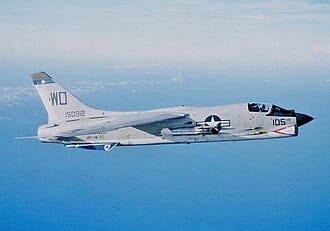
Quick Facts — Vought F-8 Crusader
First flight: 25 March 1955
Armament: 4 × 20mm Colt Mk 12 cannons + AIM-9 Sidewinders
Vietnam kills: 19 MiGs (16 MiG-17s, 3 MiG-21s)
Losses in air combat: 3
Kill ratio: ~6:1
Nickname: "The Last of the Gunfighters"
The Missile Myth
By the late 1950s, the Pentagon was convinced that the dogfight was dead. Missiles would do all the killing. The F-4 Phantom II was designed without an internal gun — a decision that would haunt the Navy and Air Force over the skies of North Vietnam when early Sparrow and Sidewinder missiles proved unreliable, and MiG-17s kept closing to knife-fight range where missiles could not track. The Crusader had no such problem. Vought had designed it as a dogfighter from the start: a single-seat, single-engine interceptor with a variable-incidence wing that tilted upward for slow-speed carrier approaches while keeping the fuselage level. The four 20mm cannons were baked into the design. When missiles became available, the F-8 carried Sidewinders too — but the guns stayed.Vietnam: The Proof
F-8 pilots scored 19 confirmed MiG kills in Vietnam against just 3 Crusaders lost in air-to-air combat — a 6-to-1 exchange ratio, the best of any American type in the war. Ironically, only 4 of those 19 kills actually came from the guns. The rest were Sidewinder shots. The 20mm cannons had a persistent tendency to jam under high-G manoeuvring, which somewhat undermined the gunfighter reputation. But the aggressive, close-in fighting style that the guns demanded — getting inside the merge, pressing the attack — produced better results than the Phantom's stand-off missile doctrine.The Ensign Eliminator
The Crusader was not forgiving. Pilots called it the "Ensign Eliminator" because its unforgiving handling characteristics — particularly during carrier landings — punished inexperience ruthlessly. The variable-incidence wing gave it excellent slow-speed performance, but the approach was tricky: too fast and you'd bolt off the deck; too slow and the wing would stop flying with very little warning. The French Navy flew Crusaders from the carriers Clemenceau and Foch until 1999 — the last operational users. The aircraft that the missile-age was supposed to make obsolete outlasted most of the missiles that were supposed to replace it. Sources: Dark Skies, US Naval Institute, Osprey Aviation Elite Units, Naval Aviation MuseumRelated Questions
What was the F-8 Crusader?
The Vought F-8 Crusader was a U.S. Navy carrier fighter that first flew in 1955, nicknamed the Last of the Gunfighters. Unlike missile-only jets of its era, it relied on four 20 mm cannon as its main weapon, making it the last American fighter designed primarily around guns.
Why is the F-8 Crusader called the last gunfighter?
Because it was the last U.S. fighter designed with guns as its primary armament. As the military shifted to missile-armed interceptors, the F-8's four 20 mm cannon made it the final aircraft of the classic gun-fighting tradition — hence Last of the Gunfighters.
How did the F-8 Crusader perform in Vietnam?
Very well. F-8 Crusaders shot down 19 MiGs over Vietnam — 16 MiG-17s and 3 MiG-21s — for the loss of just 3 in air combat, a kill ratio of about 6 to 1, among the best of any American fighter in the war.
What weapons did the F-8 Crusader carry?
It carried four 20 mm Colt Mk 12 cannon as its primary armament, backed by AIM-9 Sidewinder air-to-air missiles. That emphasis on guns set it apart from contemporaries that relied on missiles alone.
When did the F-8 Crusader first fly?
The F-8 Crusader first flew on 25 March 1955. It went on to a distinguished career with the U.S. Navy and Marine Corps, becoming famous for its dogfighting success in Vietnam.
0 Comments