
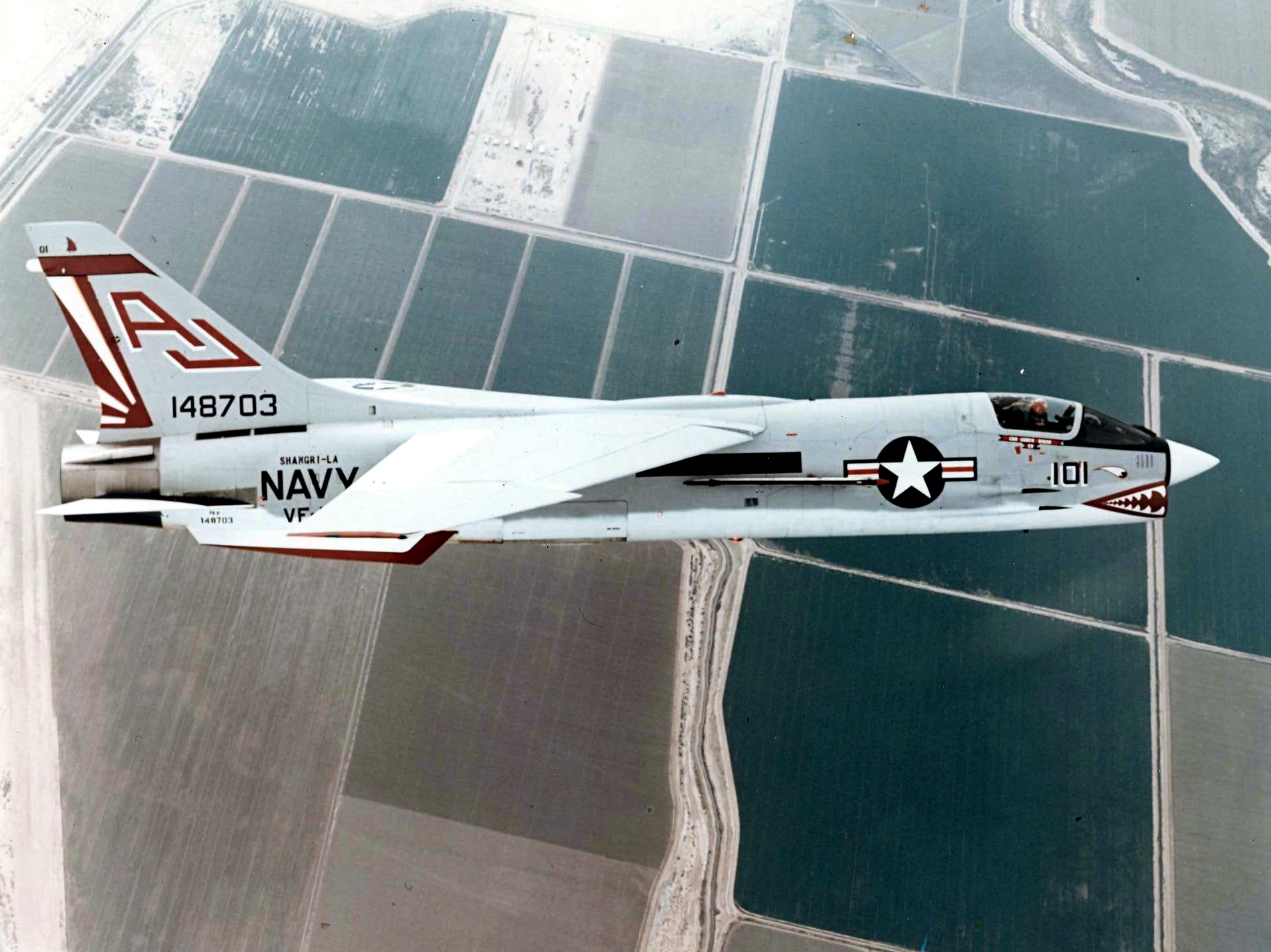
Vought F-8 Crusader
“The Last of the Gunfighters”
The US Navy’s first supersonic day fighter — a carrier-borne dogfighter with a wing that tilted for the deck, four 20 mm cannon, and the highest MiG kill-ratio claimed by any American jet over Vietnam.
The gunfighter the Navy nearly didn’t need
In the early 1950s the US Navy wanted a supersonic day fighter that could still be flown off a carrier deck — two goals that fought each other. Fast jets needed thin, sharply swept wings and high approach speeds; carriers needed slow, controllable approaches. Chance Vought’s answer, the XF8U-1, was one of the most elegant fixes in naval aviation: a variable-incidence wing that pivoted up at the fuselage so the aircraft could fly a nose-down, high-lift approach while the pilot kept a clear view of the deck. The prototype first flew on 25 March 1955 and reportedly went supersonic on that first flight.
Ordered into service in 1957, the Crusader became the first US carrier fighter capable of sustained flight past 1,000 mph, and in 1956 a Crusader set a national speed record above that mark. It was built around four 20 mm cannon at a moment when the rest of the fighter world was betting everything on the guided missile — which is why it is remembered as the “last of the gunfighters,” the last American fighter designed with guns as its primary weapon.
Roughly 1,261 were built. The Crusader flew hard over Vietnam, where it was credited with the best MiG kill-ratio of any US fighter of the war; its unarmed RF-8 photo-reconnaissance cousins flew some of the most important spy missions of the Cold War, including the low passes over Cuba in 1962 that photographed Soviet missile sites. The last of all Crusaders soldiered on with the French Navy until 1999.
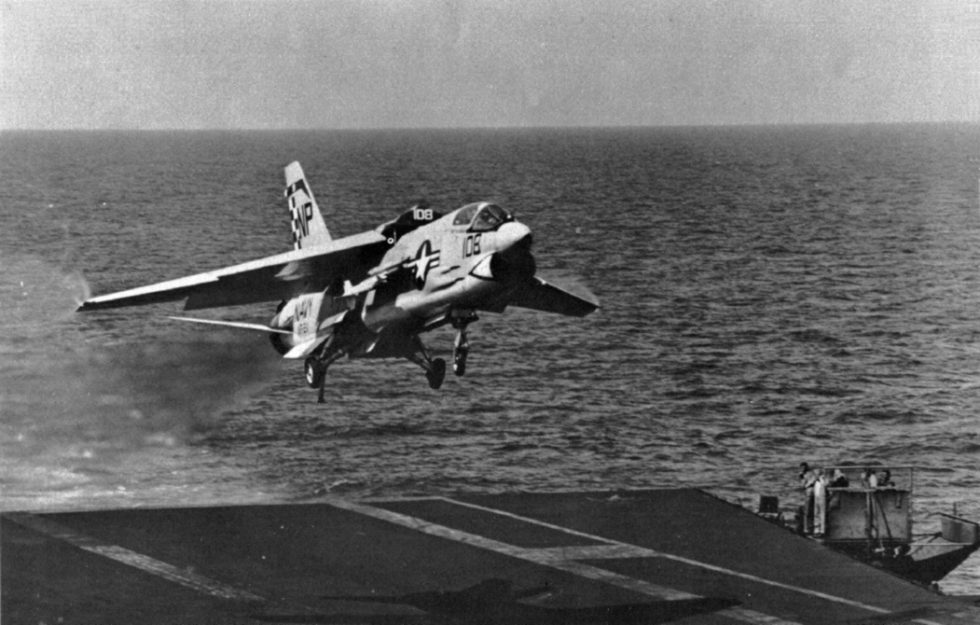
01The F-8 Crusader’s variable-incidence wing: how Vought squared supersonic speed with the carrier deck
The Crusader’s signature trick was a wing that pivoted. For takeoff and landing the whole wing hinged up about seven degrees at its trailing edge, raising the wing’s angle of attack for extra lift while leaving the fuselage — and the pilot’s line of sight — roughly level. That let a thin, fast supersonic wing fly a slow, controllable carrier approach without the pilot having to point the nose steeply skyward and lose sight of the deck. Combined with drooping leading edges, ailerons and flaps that deployed as the wing raised, it cut approach speed to something a carrier could accept.
It looked alarming — a jet apparently coming apart on the catapult — but it worked, and it defined the aeroplane. No other production fighter has used the idea in quite the same way.
What makes the F-8 Crusader special
The wing that tilted for the deck
The Crusader’s variable-incidence wing pivoted up about seven degrees for launch and recovery, raising lift while keeping the fuselage level so the pilot could see the carrier. It is the feature everyone remembers — and the reason a Mach-capable day fighter could operate from a 1950s flight deck at all.
One big J57, and Mach 1.8
Power came from a single Pratt & Whitney J57 afterburning turbojet — the same engine family as the F-100 and B-52 — giving roughly 18,000 lbf in reheat and a top speed around Mach 1.8. The Crusader was the first US carrier fighter able to sustain speeds past 1,000 mph, and it set a national speed record in 1956.
Four cannon — the ‘gunfighter’ ethos
Where its contemporaries were built around missiles, the F-8 kept four 20 mm cannon as its primary weapon, backed by AIM-9 Sidewinders. That made it the last US fighter designed with guns first — the “last of the gunfighters” — even though, in practice, most of its Vietnam kills were scored with Sidewinders.
02The F-8 Crusader’s guns vs missiles: what ‘last of the gunfighters’ really means
The nickname is a design statement, not a scoreboard. When the Crusader was conceived, the US establishment was moving toward all-missile fighters like the F-4 Phantom, which initially carried no gun at all. Vought kept four 20 mm Colt Mk 12 cannon as the F-8’s primary armament, making it the last American fighter designed that way.
Reality was messier. The Mk 12 cannon were prone to jamming under high-g manoeuvres, and by most accounts the large majority of the Crusader’s air-to-air victories over Vietnam were actually achieved with AIM-9 Sidewinder missiles, not guns. The “gunfighter” label captures the philosophy — a pilot’s dogfighter with a trigger — more than the statistics.
03The RF-8 Crusader: the unarmed spy that photographed the missiles in Cuba
The photo-reconnaissance RF-8 traded guns and radar for a fuselage packed with cameras. In October 1962, during the Cuban Missile Crisis, US Navy RF-8As of squadron VFP-62 flew fast, low passes over Cuba — the “Blue Moon” missions — and brought back the low-level photographs that confirmed Soviet ballistic missiles on the island. Those images gave Washington hard proof at a decisive moment. The RF-8 went on to fly extensively over Vietnam and served for decades, one of the longest-lived versions of the Crusader.
Full F-8 Crusader specifications
Baseline note: the figures below describe the F-8E (F8U-2NE) of 1961–64, the definitive American Crusader — 286 built, the largest single production block, one Pratt & Whitney J57-P-20A, the enlarged AN/APQ-94 radar in a lengthened nose, an infra-red scanner above it, and the first Crusader with underwing pylons and a genuine air-to-ground capability. Deltas for the F-8A, F-8B, F-8C and F-8D, for the RF-8A and RF-8G photo aircraft, for the French F-8E(FN) and for the Philippine F-8H are in grey. Six numbers have to be settled before anything below is read, because the standard references contradict each other on all six. Length: Vought data and Baugher give 54 ft 6 in (16.61 m) for the F-8E and 54 ft 3 in (16.54 m) for every earlier mark; the figure of 55 ft 11.6 in (17.06 m) now circulating in many online references appears to measure over the nose probe and is not used here. Wing area: 375 sq ft (34.84 m²) is the Vought figure quoted on the F-8C and F-8H, and 350 sq ft (32.52 m²) appears on the prototype and F-8E pages of the same source — the wing was never rebuilt between those marks, so one of the two is simply wrong, and 375 sq ft is the better attested. Dry thrust: the J57-P-20A is published as 10,700 lbf by Baugher, the Naval Aviation Museum and the engine literature, and as 11,400 lbf in some widely reproduced online tables; the afterburning figure of 18,000 lbf is not in dispute and is the one that matters. Maximum speed: 1,133 mph, Mach 1.72, at 35,000 ft is the tested F-8E figure; Mach 1.86 is a placard limit rather than a demonstrated speed. Combat radius: 600 miles (966 km) unrefuelled against 394 nautical miles (730 km) — the gap is a mission-profile difference, not a research error, and both are quoted below for what they are. Wing incidence: every account of the aeroplane says the wing pivots up 7 degrees, and every account of the French F-8E(FN) says that aircraft had its incidence raised "from 5 to 7 degrees". Those two statements cannot both describe the same measurement; the 7-degree figure for the American aircraft is far better attested and is used here, with the conflict flagged where it occurs. Production totals are similarly loose: 1,261 is the number always quoted, and the published sub-totals add to 1,262.
Dimensions & weights
- Crew
- 1 (exactly one two-seat Crusader was ever built — the TF-8A of 1962, converted from the 77th F8U-1, which cost the aeroplane two of its four cannon and the ventral rocket tray and was never ordered into production)
- Length
- 16.61 m (54 ft 6 in) for the F-8E, whose AN/APQ-94 radome is three inches longer than what came before. The F-8A, F-8B, F-8C, F-8D and the remanufactured F-8H are 16.54 m (54 ft 3 in)
- Wingspan
- 10.87 m (35 ft 8 in) — unchanged across every mark from the XF8U-1 of 1955 to the French F-8P of 1999
- Height
- 4.80 m (15 ft 9 in), measured with the wing down. With the wing raised for the deck the aeroplane is visibly taller and, to anyone standing on the flight deck, looks broken
- Wing area
- 34.84 m² (375 sq ft) — see the baseline note; 350 sq ft is also published and is almost certainly an error carried forward
- Wing geometry
- 42 degrees of sweep at the quarter chord, aspect ratio 3.4, 5 degrees of anhedral, and a dog-tooth notch in the leading edge at the fold line to fence the spanwise flow that would otherwise stall the tips first
- Variable wing incidence
- The wing pivots about its rear spar attachment and is driven up 7 degrees by a single hydraulic jack at the front — the signature feature of the type, and the reason the fuselage can stay level on the approach (the French F-8E(FN) is described as having had its incidence raised to 7 degrees from 5, which conflicts with the standard figure; see the note above)
- Tail
- All-moving one-piece stabilator with pronounced anhedral, plus two ventral strakes under the rear fuselage from the F-8C onward to hold directional stability at high Mach
- Empty weight
- 8,528 kg (18,800 lb). The F-8H, rebuilt from F-8D airframes, comes out fractionally lighter at 8,482 kg (18,700 lb)
- Gross weight
- 13,154 kg (29,000 lb) — the clean fighter weight with full internal fuel, four Sidewinders and a full magazine
- Maximum take-off weight
- 15,422 kg (34,000 lb), which is a catapult figure. Bringing that weight back aboard was never the plan; the Crusader landed light or it did not land well
- Internal fuel
- 5,102 l (1,348 US gal) in the F-8E. The F-8H and the RF-8G carry ~4,820 l (1,273 US gal); the F-8D bought part of its increase by giving up the ventral rocket tray, which became a fuel cell
- External stores
- Up to ~2,270 kg (5,000 lb) on the two underwing pylons introduced with the F-8E; 4,000 lb is also widely published and is the more realistic operational figure. The F-8A through F-8D had no underwing pylons at all
Performance
- Maximum speed
- 1,823 km/h (1,133 mph, 985 kn), Mach 1.72, at 10,670 m (35,000 ft). Mach 1.86 appears in some tables as a placard limit. The F-8C managed Mach 1.7 on less thrust; the F-8A, on the 16,200 lbf J57-P-4A, reached 1,631 km/h (1,013 mph)
- Cruising speed
- 496 km/h (308 mph, 268 kn) for maximum range — a slow, thirsty cruise for an aeroplane with a fixed chin intake and a single J57
- Stall speed
- 250 km/h (155 mph, 135 kn). The 1952 requirement had asked for a landing speed no higher than 160 km/h (100 mph); the variable-incidence wing was the concession that made the actual approach speed tolerable rather than lethal
- Rate of climb
- 138 m/s (27,200 ft/min) initial for the F-8E, comfortably beyond the 25,000 ft/min the Navy had asked for. The F-8C managed 110 m/s (21,700 ft/min)
- Service ceiling
- 17,983 m (59,000 ft); 58,000 ft is also published. The earlier marks are far lower — the F-8A and F-8C are credited with combat ceilings around 12,800 m (42,000 ft), which is the honest operational number rather than a zoom figure
- Combat radius
- ~966 km (600 miles) unrefuelled on the Vought profile; ~730 km (394 nmi) is the figure several widely reproduced tables carry, and the F-8H is published at 637 km (396 miles). All three are defensible against different fuel reserves
- Ferry range
- ~2,790 km (1,734 miles, 1,507 nmi). Note that the F-8A through F-8E carried no drop tanks — underwing fuel arrived only with the F-8J and RF-8G, so long-range Crusader flying meant tanking from an A-3 or A-4
- Wing loading
- 377 kg/m² (77 lb/sq ft) at gross weight, rising to 443 kg/m² (91 lb/sq ft) at maximum take-off weight — high for the era, and the direct reason the wing had to be pivoted rather than merely flapped
- Thrust-to-weight ratio
- 0.62 at gross weight, 0.53 at maximum take-off weight — better than the F-4B it was measured against in a turning fight, and the reason Crusader pilots believed what they believed about their aeroplane
- Level-flight speed record
- 1,634.2 km/h (1,015.428 mph) set by Commander R. W. "Duke" Windsor in an F8U-1 over China Lake on 21 August 1956 — the first US Navy aircraft past 1,000 mph, and worth the Thompson Trophy
- Transcontinental record
- 3 hours 23 minutes 8.4 seconds, Los Alamitos to Floyd Bennett Field, 16 July 1957: Major John Glenn USMC in an F8U-1P photo aircraft, Project Bullet — the first transcontinental flight to average supersonic speed, flown on three aerial refuellings
- Accident record
- 1,106 of the 1,261 Crusaders built were involved in a mishap at some point in their lives. That is 88 per cent of the fleet, and it is the single most important performance figure on this page
Propulsion & systems
- Powerplant
- 1 × Pratt & Whitney J57-P-20A afterburning axial-flow turbojet — the same engine family that powered the B-52, the F-100 and the U-2, and by 1961 a thoroughly mature piece of machinery
- Thrust
- 80.1 kN (18,000 lbf) with afterburner; 47.6 kN (10,700 lbf) dry, though 11,400 lbf is also published for the -20A. The afterburning figure is the one every source agrees on
- Engine by mark
- F-8A: J57-P-4A or -12, 16,200 lbf. F-8B: as F-8A. F-8C: J57-P-16, 16,900 lbf. F-8D, F-8E, F-8H, F-8J and F-8E(FN): J57-P-20 or -20A, 18,000 lbf. RF-8G: J57-P-22, later re-engined with the J57-P-429 in the 1970s refit
- Air intake
- A single fixed-geometry chin intake under the radome — the first US Navy fighter laid out that way, and clean enough to look modern thirty years later. It is also why the aeroplane stops at about Mach 1.7: there is no variable ramp, no spike, nothing to tailor the shock at higher speed
- Afterburner cooling
- Two scoops on the upper tailcone just aft of the fin, added on the F-8C and retained thereafter, because the original installation cooked its own rear fuselage
- Air refuelling
- A probe stowed in a bay in the port side of the forward fuselage, extended on the pilot’s command. Standard from the F8U-1 and heavily used: the Crusader’s internal fuel was never generous and its radius depended on tankers
- Radar and fire control
- F-8E: AN/APQ-94 search and fire-control radar with the AN/AWG-4 system. F-8A: AN/APG-30 ranging radar only, a gunsight aid rather than a search set. F-8B: AN/APS-67, giving a limited all-weather capability. F-8D: AN/APQ-83. F-8E(FN): Magnavox AN/APQ-104. In Vietnam the Crusader never once made first contact by its own radar — every intercept began with a ground or ship controller
- Infra-red sensor
- An AN/AAS-15 infra-red scanner in a small fairing above the nose on the F-8E, used to cue the Sidewinders. One of the earliest operational IR search aids on a Western fighter, and of modest practical value
- High-lift system
- Wing raised 7 degrees; leading-edge droops down 25 degrees; trailing-edge flaps and drooped ailerons. Boundary-layer control — engine bleed air blown over the flaps — was developed for the French F-8E(FN) and later retrofitted to American aircraft as part of the F-8J rebuild
- Carrier equipment
- Arrester hook, catapult attachments, folding outer wing panels — and a castering nose wheel with no steering, so the aeroplane had to be manhandled on a crowded deck. Combined with poor recovery from a high sink rate, this is most of the reason the type killed so many of its pilots
- Escape system
- Vought-designed ejection seat as built. The seventeen French aircraft rebuilt as F-8P in 1989–91 received a modern Martin-Baker seat, which by then was thirty years overdue
- Unit cost
- No flyaway unit cost for the Crusader appears in any of the standard references consulted, and figures circulating online cannot be traced to a primary source, so none is quoted here. What is documented is the second-hand market: the Philippine Air Force bought 35 stored F-8Hs from Davis-Monthan in late 1977, of which Vought refurbished 25 and the other 10 were broken for spares
04The F-8 Crusader’s cost: why a firm dollar figure is hard to pin down
The Crusader was a 1950s US Navy procurement, and clean, inflation-adjusted lifetime costs are not published in one authoritative place. Period sources put the flyaway price in the region of $1 million per aircraft in late-1950s dollars — useful as an order-of-magnitude figure rather than a precise number. No reliable modern cost-per-flight-hour figure exists for a type retired from US service in the 1980s; any exact dollar figure you see quoted should be treated as an estimate.
Armament & payload
The Crusader kept four cannon into the missile age, and then won its war with the Sidewinder
The Crusader was ordered in 1953 with four 20 mm Colt Mk 12 cannon at a moment when the United States Navy had decided that guns were finished. The F4D Skyray and F3H Demon were built around missiles, the F6D Missileer was conceived as a missile truck that would never manoeuvre at all, and the F4H-1 Phantom II that displaced the Crusader in the fleet was delivered with no gun of any kind. That the F-8 kept its cannon is why it is remembered as The Last of the Gunfighters, and the phrase is a good deal more romantic than the record behind it.
Here is the record. US Navy and Marine Crusaders claimed nineteen MiGs over North Vietnam — sixteen MiG-17s and three MiG-21s — and only about four of those claims were made with the guns. Every other kill was an AIM-9 Sidewinder. The Mk 12 was a good gun on a range and a poor one in a fight: its feed mechanism jammed under the g-loading of a hard turn, exactly when a pilot needed it, and 125 rounds a gun gave roughly seven seconds of fire. Pilots who had lived through a jam came back and shot Sidewinders. The National Naval Aviation Museum, incidentally, credits the type with eighteen MiGs rather than nineteen; the difference is one contested claim, and neither figure changes the arithmetic on the guns.
So the nickname is half myth, and it is worth being exact about which half. The Crusader was not a gunfighter that beat missiles; it was a missile fighter that happened to have kept its guns, and whose pilots were extremely glad of them for strafing, for the days the Sidewinder would not lock, and for morale. What the cannon really bought was an argument. The Crusader community used those four guns to insist, correctly and noisily, that a fighter without a gun is a fighter with a single point of failure — and the Navy conceded the point when it hung an external SUU-23 pod on Phantoms and then built the M61 into the F-14 and F/A-18. Fits varied sharply: only the F-8E and the later rebuilds had underwing pylons and a real bomb load, the RF-8 photo aircraft carried no armament at all, and the French F-8E(FN) traded two of its four Sidewinder rails for the Matra R530 and later flew with the Magic.
Gun
- 4 × 20 mm Colt Mk 12 single-barrel short-recoil cannon, two a side low in the forward fuselage under the cockpit, firing the 20 × 110 mm US Navy round at roughly 1,000 rounds per minute
- 125 rounds per gun on the F-8E for 500 rounds total, which is about seven seconds of firing. The XF8U-1 and F8U-1 carried 144 rounds per gun; the magazine shrank as the nose filled with radar
- The gun’s defect was the feed, not the barrel. Under sustained g the ammunition feed jammed, and it jammed most reliably in a hard turn behind a MiG-17 — the one circumstance the whole installation existed for
- Cold-soaking at altitude made it worse. Several documented Vietnam engagements record all four guns going silent within seconds of the first burst
- Against ground targets, where the aeroplane was straight and level and the guns were warm, the Mk 12 worked perfectly well, and Crusaders strafed a great deal more than they dogfought
Air-to-air
- 4 × AIM-9 Sidewinder on Y-shaped cheek rails either side of the fuselage — two rails from the F8U-1, doubled to four with the Y-pylons of the F8U-2. AIM-9B early, AIM-9D in the Vietnam years
- The Sidewinder made every Crusader MiG kill but a handful, including the first, on 12 June 1966, when Commander Harold Marr of VF-211 killed a MiG-17 with an AIM-9D from USS Hancock
- No radar-guided missile was ever carried by an American Crusader. The AIM-7 Sparrow needed a bigger radar and a second crewman, which is precisely what the F8U-3 Crusader III and then the F-4 Phantom II were for
- French F-8E(FN) only: 2 × Matra R530 semi-active radar or infra-red missiles on the fuselage pylons, replacing two of the Sidewinder positions. The R530 was heavy, slow and disliked; from 1973 the Athe Aeronavale fleweacute;ronavale flew the far better Matra R550 Magic, and Magic 2 from 1988
- The F-8 never engaged on its own radar. Ground-controlled interception put the pilot in the rear quarter and the Sidewinder did the rest — which is a doctrine, not a gunfight
Air-to-surface guided
- 2 × AGM-12 Bullpup radio command-guided missiles on the underwing pylons of the F-8E and the later rebuilds — the only guided air-to-ground weapon the type ever carried
- The Bullpup is flown to the target by the launching pilot, who must hold a steady run and watch a flare in the missile’s tail while the target shoots back. It is a bad idea executed competently, and the F-8E wore a distinctive hump over the wing centre section to house its guidance transmitter
- That hump is the quickest external way to tell an F-8E from an F-8D, and it was carried over to the F-8H and F-8J rebuilds
- No laser-guided bomb, no anti-radiation missile, no stand-off weapon of any kind. Crusader air-to-ground work was iron bombs, rockets and guns, aimed by eye
Bombs
- Up to about 2,270 kg (5,000 lb) across the two underwing pylons of the F-8E; 4,000 lb is the figure more often flown. The F-8A through F-8D had no underwing pylons and no bombing capability worth the name
- Mk 81 (250 lb), Mk 82 (500 lb), Mk 83 (1,000 lb) and Mk 84 (2,000 lb) general-purpose bombs, in low-drag and Snakeye retarded forms
- A typical Vietnam strike load was eight Mk 82s on multiple ejector racks — respectable, and still less than an A-4 Skyhawk half its price could carry further
- Marine Corps Crusaders did most of this work, flying close air support from Da Nang and Chu Lai while the Navy squadrons flew MiG-CAP off the carriers
- No nuclear capability. Unusually for a US fighter of its generation, the Crusader was never wired for a special weapon
Rockets
- 32 × 2.75 in (70 mm) Mk 4 folding-fin aircraft rockets in a retractable ventral tray behind the nose wheel — the original 1953 armament concept, an unguided salvo for bomber interception
- It was never once fired in anger. The tray was sealed shut on the F-8B, and on the F-8D the whole volume was given over to fuel, which was the better weapon
- Zuni 5 in (127 mm) rockets in four-round LAU-10 pods on the underwing pylons of the F-8E and later — the rocket the Crusader actually used, against trucks, sampans and gun positions
- The ventral tray is a small monument to how quickly 1953 assumptions aged: it was designed to kill Soviet bombers over the fleet, and the Crusader spent its war strafing trucks in Laos
Pods & other stores
- 2 × 300 US gal (1,136 l) drop tanks — but only from the F-8J and RF-8G onward. The F-8A through F-8E had no external fuel at all, which is an extraordinary thing to say about a carrier fighter and explains the Crusader’s dependence on tankers
- RF-8A and RF-8G: guns and missile rails deleted entirely, the lower forward fuselage flattened and squared off, and up to five cameras carried in four internal bays — Chicago Aerial trimetrogon and Fairchild units early, KA-45, KA-51 and KA-53 in the RF-8G. The photo Crusader was the fastest thing in the reconnaissance business and completely defenceless
- A radar warning receiver on the fin and afterburner cooling intakes were added to the RF-8G in the 1977 refit; earlier aircraft flew over Cuba and North Vietnam with no warning gear whatsoever
- No targeting pod, no electronic-attack pod, no gun pod — the aeroplane was too small and too short of pylons to carry any of it
- The French F-8P rebuild of 1989–91 added an ILS and a radar warning detector, which is a fair measure of how spartan the original fit had been
Three typical loadouts
- MiG-CAP over North Vietnam, Yankee Station, 1966
- Four AIM-9D Sidewinders on the fuselage cheek rails, 500 rounds for the four Mk 12s, wings clean, tanking from an A-3 on the way in and out. This is the configuration that produced nineteen claims for three losses, and it is a missile fit with a gun attached.
- Marine close air support, Da Nang, 1967
- Eight Mk 82 500 lb bombs or four LAU-10 Zuni pods on the two underwing pylons, guns loaded, one Sidewinder retained for self-defence. Flown by VMF(AW)-212, -232, -235 and -312 from land bases rather than decks — the Crusader work that nobody writes books about.
- Blue Moon low-level photo run over Cuba, 23 October 1962
- No guns, no missiles, no armour, no warning receiver. Five cameras, full internal fuel, two aircraft in company at roughly 350 knots and a few hundred feet, twice a day from Boca Chica. The RF-8A’s only defence was that it was faster than anything pointed at it and left before the guns traversed.
Sourcing caveat: the 19-to-3 kill ratio is US Navy claim accounting and should be read as such. The Vietnamese People’s Air Force credits its MiG-17 and MiG-21 regiments with materially more Crusaders than the three the Navy concedes, and the National Naval Aviation Museum itself publishes eighteen kills rather than nineteen. The figure of four gun kills is the number most commonly given and is itself soft — at least one of those engagements began with a Sidewinder and finished with cannon, and how it is scored depends on who is scoring. External load figures of 4,000 lb and 5,000 lb both appear in Vought-derived sources for the same aircraft. The RF-8 camera fit varied by bay, by batch and by mission and no single authoritative list exists; the types named above are those most often recorded.
Variants
Vought built the Crusader for nine years and then rebuilt it for thirty more
The Crusader had a short production life and a very long service life, and almost everything interesting about its designations comes from the difference. New-build ran for nine years, from the XF8U-1 of March 1955 to the last aircraft delivered on 3 September 1964 — about 1,261 airframes, in five fighter marks, one photo mark and one trainer. Then the money ran out, the Phantom took the mission, and Ling-Temco-Vought spent the second half of the 1960s pulling worn Crusaders apart and putting them back together as F-8H, F-8J, F-8K and F-8L. Three hundred and seventy-three aircraft went through that programme. It is why an aeroplane designed in 1953 was still flying combat air patrols over the Adriatic in 1999.
The variable-incidence wing is what holds the whole family together, and it is worth stating plainly what it did and what it cost. The F-8’s wing is swept 42 degrees and thin, because it had to reach Mach 1.7. A wing like that produces very little lift at approach speed, so to land it aboard a carrier the aeroplane would have to fly its approach at an enormous nose-up attitude — and a pilot in a nose-up Crusader cannot see the deck, the ball or the landing signal officer. The conventional answers were long undercarriage legs, or blown flaps, or both. Vought did something else: it hinged the entire wing at the rear spar and put a hydraulic jack at the front, so the wing could rotate up 7 degrees relative to the fuselage. The wing then flies at its landing angle of attack while the fuselage stays level, the pilot keeps his view over the nose, and the undercarriage can be short, light and stowed in a slim area-ruled fuselage. Raising the wing also exposes the centre section broadside to the airflow, which is a large and free speed brake, and it automatically droops the leading edges 25 degrees and the flaps and ailerons behind them. It was clever enough to win Vought, the Bureau of Aeronautics and Pratt & Whitney the Collier Trophy for 1956.
The cost was paid in three currencies. Weight and complexity first: a hinge, a jack and a lock in the primary structure, and every fuel line, hydraulic line, electrical run and control rod into the wing crossing a joint that moves. Second, a new way to die — the wing has a right position for each phase of flight, and getting it wrong is unforgiving in both directions. Third, and least discussed, the raised wing does not fix the Crusader’s real vice, which is behind the wing rather than on it: the aeroplane recovered badly from a high sink rate close to the deck, and the nose wheel castered freely instead of steering. The type was called the ensign eliminator for good reason. Of 1,261 Crusaders built, 1,106 were involved in a mishap. The French, who flew 42 of them, wrote off 28 in accidents — two-thirds of the fleet. Nothing else on this page is as revealing as those two numbers.
- XF8U-1 and F8U-1, later F-8A (1955–1958; 2 prototypes and 318 production)
- The original: J57-P-4A or -12 of 16,200 lbf, four Mk 12 cannon with 144 rounds each, two Sidewinder rails, the ventral rocket tray, and an AN/APG-30 ranging radar that was a gunsight accessory rather than a search set. John Konrad took the first prototype supersonic on its maiden flight on 25 March 1955; VF-32 was the first fleet squadron in March 1957.
- F8U-1E, later F-8B (1958–1959; 130 built)
- A bigger radome housing the AN/APS-67, giving a limited all-weather capability — the E in the designation. The rocket tray was sealed shut, having never been used. Otherwise an F-8A.
- F8U-2, later F-8C (1958–1960; 187 built)
- J57-P-16 of 16,900 lbf, two afterburner cooling scoops on the upper tailcone, two ventral strakes under the rear fuselage for high-Mach directional stability, and the Y-shaped cheek pylons that doubled Sidewinder capacity from two to four. The first Crusader that was properly finished.
- F8U-2N, later F-8D (1960–1961; 152 built)
- J57-P-20 of 18,000 lbf, AN/APQ-83 radar, an autopilot and an approach coupler for night and weather recoveries, and the ventral rocket tray finally deleted and replaced by a fuel cell. The night-fighter Crusader, and the airframe most of the later F-8H rebuilds came from.
- F8U-2NE, later F-8E (1961–1964; 286 built)
- The baseline for this page. J57-P-20A, the larger AN/APQ-94 in a nose three inches longer, an AN/AAS-15 infra-red scanner above it, and — the real change — two underwing pylons with Bullpup guidance in a hump over the wing. The Crusader stopped being purely a fighter here.
- F8U-1P, later RF-8A, and RF-8G (1957–1960; 144 built, 73 rebuilt as RF-8G 1965–70)
- Unarmed photo-reconnaissance: guns, rails and fire control removed, the lower forward fuselage flattened into a squared-off camera compartment with four bays. This is the aeroplane that flew the Blue Moon missions over Cuba from 23 October 1962, twice a day from Key West at a few hundred feet, and brought back some 160,000 negatives of the Soviet missile sites. VFP-62 received the first peacetime Navy Unit Commendation from President Kennedy on 26 November 1962. The RF-8G rebuild added ventral fins, underwing pylons, new navigation gear and, later, a radar warning receiver.
- F8U-1T, later TF-8A (1962; 1 built)
- The two-seat trainer, converted from the 77th F8U-1 with a tandem rear cockpit raised fifteen inches under a single clamshell canopy, a brake parachute unique in the family, and two of the four cannon and the rocket tray deleted to make room. First flown 6 February 1962; killed by the fiscal 1964 budget, so Crusader pilots learned the aeroplane by being launched off a carrier in one. It was destroyed in a crash near Dallas on 28 July 1978.
- F-8H, F-8J, F-8K and F-8L (1966–1970; 89, 136, 87 and 61 rebuilt — 373 in total)
- The remanufacture programme that kept the type in Vietnam: F-8D to F-8H with the J57-P-20A and F-8E pylons, F-8E to F-8J with drop tanks and the French boundary-layer-control wing, F-8C to F-8K and F-8B to F-8L with pylons and new cockpit lighting. F-8Js were the main fighter Crusaders on station in 1971–72 and scored not one MiG between them. Thirty-five stored F-8Hs went to the Philippine Air Force in late 1977 — 25 refurbished by Vought for the 7th Tactical Fighter Squadron at Basa, 10 broken for spares; grounded in 1988 for want of parts and written off in 1991 after Mount Pinatubo buried them in ash.
- F-8E(FN) and F-8P, French Navy (1964–1999; 42 built, 17 rebuilt as F-8P)
- The only export new-build, and the reason the Crusader outlived its own country’s service by 23 years. Clemenceau and Foch were much smaller than American decks, so the FN aircraft got greater wing incidence, two-segment leading-edge droops, greater flap deflection, a larger tailplane and, most importantly, boundary-layer control blowing engine bleed over the flaps — a system so useful the US Navy adopted it for the F-8J. Armament traded two Sidewinder positions for two Matra R530, later the far better R550 Magic and Magic 2. Flottilles 12F and 14F flew them over Djibouti, Lebanon in 1983–84, the Gulf, the Adriatic from 1993 and Kosovo in 1999; no French Crusader was ever credited with an air-to-air kill. Seventeen were rebuilt as F-8P (prolongprolongeeacute;) in 1989–91 with new wiring, flight controls, ILS, a radar warning detector and a Martin-Baker seat. The last one flew on 19 December 1999, replaced by the Rafale M.
- Dead ends and second careers (1958–1980s)
- The F8U-3 Crusader III was a new and much larger aeroplane sharing a name: a J75 of 29,500 lbf, Mach 2.39 demonstrated, and provision for a rocket motor. Five were built and three flew; it lost the 1958 fly-off to the F4H-1 Phantom II because a single pilot could not fly the intercept and work the Sparrows at once, and because the Phantom could also carry bombs. The F-8M rebuild of low-hours F-8As was proposed and abandoned for lack of airframes. Retired Crusaders became DF-8A and DF-8F drone controllers and QF-8A targets; NASA turned an F-8A into the Supercritical Wing testbed that proved Richard Whitcomb’s aerofoil in 1971, and an F-8C into the Digital Fly-By-Wire testbed that flew on Apollo guidance-computer hardware from 25 May 1972 and is the direct ancestor of every fly-by-wire airliner and fighter since.
Closing note on survivors: roughly fifty Crusaders survive, all of them original airframes — no Crusader has ever been reproduced, and the type is far too complex for anyone to try. None is airworthy and none has flown since 1999. Two American aircraft are under long-term restoration towards flight, an F-8K (BuNo 145592) and an F-8L (BuNo 145527) in Washington State, and neither has a date. The rest are static: about eight F-8As, three F-8Cs, one F-8D, one F-8E, seven F-8Ks, two F-8Js and two F-8Ls in the United States, roughly ten RF-8As and RF-8Gs including the record-holder at the Smithsonian, and four derelict Philippine F-8Hs. France keeps about eleven — two F-8E(FN) and nine F-8P — scattered across naval air stations and museums, which is a fair share for a fleet that lost two-thirds of itself to accidents. The single most historic airframe is RF-8G BuNo 146860 at the National Air and Space Museum: 7,475.2 flying hours, more than any other Crusader built, 8,896 landings, 689 arrested landings and 714 catapult shots, its last carrier trap in October 1986 and its last flight on 30 March 1987, when the US Navy retired the type. Counts of aircraft on display drift as airframes move between museums and gate guards, and this one should be read as an order of magnitude rather than a register.
From carrier day-fighter to the last Crusader
Contract won
Chance Vought wins the US Navy day-fighter competition with a design built around a variable-incidence wing and four cannon.
First flight
The XF8U-1 prototype flies on 25 March and reportedly exceeds Mach 1 on its maiden flight.
Past 1,000 mph
A Crusader sets a US national speed record above 1,000 mph, confirming the Navy’s first supersonic-class carrier fighter.
Enters service
The F8U-1 (later F-8A) joins the fleet. That year a photo-recon Crusader also sets a transcontinental speed record.
Eyes over Cuba
RF-8A reconnaissance Crusaders of VFP-62 fly low-level “Blue Moon” missions over Cuba, photographing Soviet missile sites.
Vietnam
The Crusader flies MiG combat air patrol and reconnaissance off Yankee Station, earning its reputation as a MiG-killer.
US withdrawal
The Navy retires its fighter Crusaders through the late 1970s; the last US RF-8G reconnaissance jets serve into 1987.
The last Crusaders
The French Navy retires its F-8E(FN) fleet in December, ending 44 years of Crusader operations worldwide.
From the deck: twelve F-8 Crusader stories
The wing that tilts
Vought’s answer to the carrier-vs-supersonic problem was a wing that pivoted up for the deck.
Read the full story
Faster than a thousand
In 1956 a Crusader became the first US carrier fighter to hold a speed record above 1,000 mph.
Read the full story
Project Bullet
A young Marine named John Glenn flew a photo-Crusader coast to coast, supersonic, in under three and a half hours.
Read the full story
Blue Moon over Cuba
Unarmed RF-8s brought back the low-level photos that proved Soviet missiles were in Cuba.
Read the full story
MiG combat air patrol
Off Yankee Station the F-8 was the fighter pilots wanted to be flying against MiGs.
Read the full story
The highest kill-ratio — with caveats
The F-8 is widely credited with the best MiG kill-ratio of any US fighter of the war.
Read the full story
When the guns jammed
The Crusader’s four cannon were its signature — and its most unreliable feature.
Read the full story
A pilot’s aeroplane
Fast, honest and a handful on the deck, the Crusader earned respect and a nickname or two.
Read the full story
The Aeronavale Crusader
France bought a navalised Crusader and flew it from its carriers for 35 years.
Read the full story
The last of all Crusaders
The final Crusaders anywhere flew with the French Navy until December 1999.
Read the full story
Foxbats of the East
The Philippine Air Force flew ex-US Crusaders as its supersonic interceptor in the 1970s and 80s.
Read the full story
Why it is remembered
A tilting wing, four cannon and a Cold-War spy career gave the F-8 a legend out of proportion to its numbers.
Read the full story
The F-8 Crusader in pictures
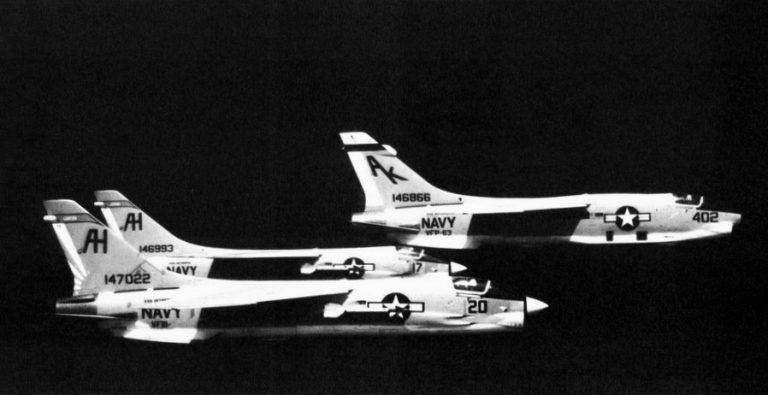
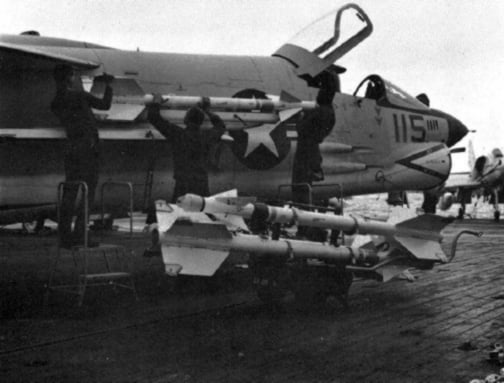
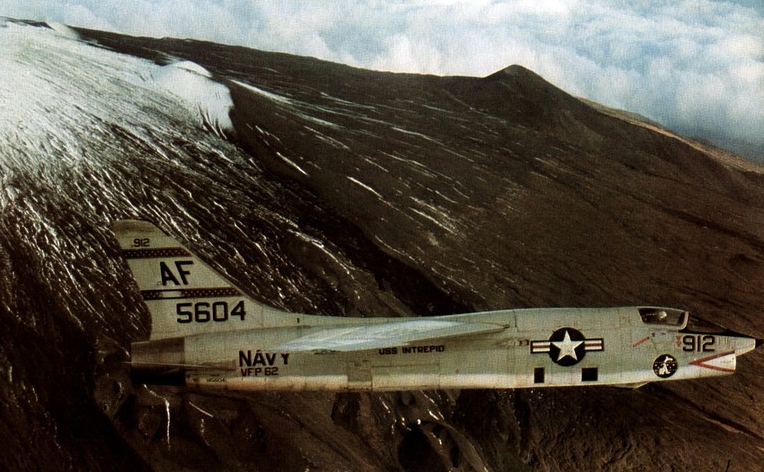
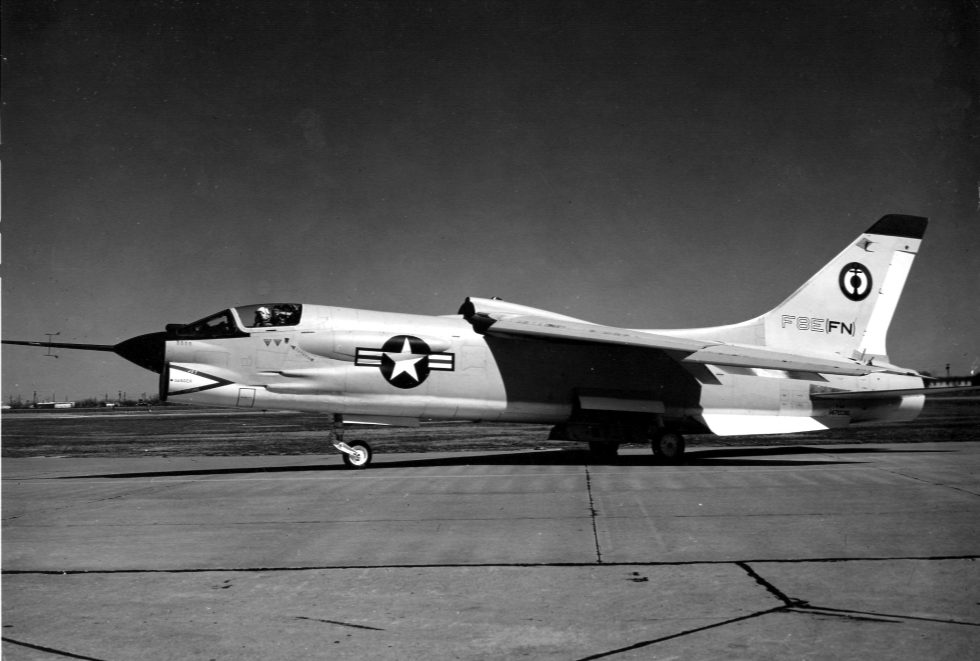
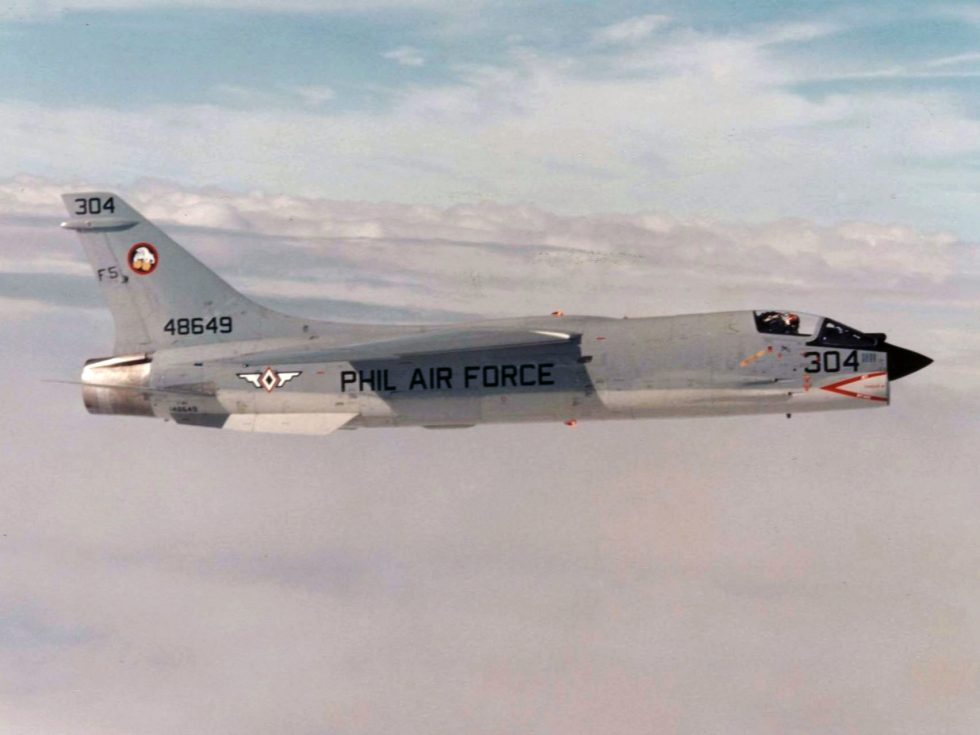
The F-8 Crusader in motion
Dark Skies — one of the most-watched F-8 Crusader films on YouTube.
Where the F-8 Crusader flew
The score that defines the F-8 Crusader
The Crusader is remembered above all for its air-to-air record over Vietnam, where it flew combat air patrol against the MiG-17. It is widely credited with the highest MiG kill-ratio of any US fighter of the war — a claim worth stating carefully, because exact totals vary between sources, several kills are debated, and most were scored with AIM-9 Sidewinders rather than the “gunfighter’s” cannon.
The same record has a harsher side: the F-8 also suffered heavy losses to surface-to-air missiles and anti-aircraft fire in the ground-attack and reconnaissance roles. Compare the combat record of every military aircraft. Figures as of July 2026.
Everything people ask about the F-8 Crusader
Can I fly in an F-8 Crusader?
Why is the F-8 called “the last of the gunfighters”?
What was the variable-incidence wing for?
How good was the F-8’s kill-ratio in Vietnam?
What did the RF-8 do in the Cuban Missile Crisis?
How fast was the F-8 Crusader?
Who flew the Crusader besides the US?
Can a civilian fly the F-8 Crusader?
You can’t fly the F-8 Crusader.
These, you can.
Some legends only live in museums — others are fuelled and waiting. MiGFlug has put civilians in real military jet cockpits since 2004.
 Fly the L-39 AlbatrosThe world’s most-flown jet trainer — aerobatics included
 Fly the F-104 Starfighter“The missile with a man in it”
 Fly the MiG-21The Cold War’s most-produced jet
 Fly the T-33 Shooting StarAmerica’s first jet trainer
 Fly the DH VampireA piece of early jet history
 Fly the S.211Agile Italian jet trainer
 Fly the MB-326The classic Aermacchi jet
 Fly the MiG-15The Soviet legend of the Korean War
Continue the tour
Every fact, checked
- HistoryNet — Unpacking the Myths of the F-8 Crusader in VietnamCareful reassessment of the kill-ratio, the role of guns vs Sidewinders, and the type’s operational losses.
- Smithsonian Air & Space — Have Gun, Will DogfightThe Crusader at 60: design, the gunfighter ethos and pilot recollections.
- Smithsonian National Air and Space Museum — RF-8G CrusaderReference on the photo-reconnaissance variant and its Cuban Missile Crisis missions.
- U.S. Naval Institute — Naval History MagazineCombat history, Vietnam operations and the Philippine Crusaders.
- The Aviation Geek ClubThe French Aeronavale’s F-8E(FN) service and the 1999 retirement.
- Vintage Aviation News — Boneyard Files: F-8 CrusaderDevelopment, specifications, records and variants.
- National museums & official referencesPreserved Crusader airframes and general reference data.