
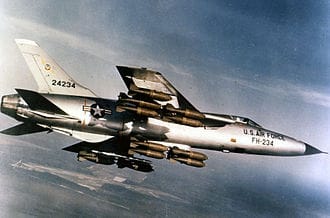
Quick Facts — Wild Weasels
Mission: SEAD — Suppression of Enemy Air Defences
Motto: "First In, Last Out" (official) / YGBSM (unofficial)
First kill: 22 December 1965, Captains Allen Lamb & Jack Donovan
Aircraft: F-100F (WW I), F-105F/G (WW III), F-4C (WW IV), F-4G (WW V), F-16CJ
Key weapon: AGM-45 Shrike anti-radiation missile
The SAM Problem
In July 1965, a Soviet SA-2 Guideline missile shot down an American F-4C over North Vietnam. It was the first SAM kill of the war, and it changed everything. US strike packages had been flying predictable routes at predictable altitudes — easy targets for a radar-guided missile that could reach 60,000 feet. Losses began to mount. The Air Force needed a way to kill the SAM sites. Nobody had ever done it before. Wild Weasel I was born in November 1965: modified two-seat F-100F Super Sabres fitted with radar homing and warning receivers that could detect SAM radar emissions. The concept was simple and suicidal — fly toward the radar signal, provoke the site into shooting, and destroy it with bombs or the new AGM-45 Shrike anti-radiation missile, which homed on the SAM's own radar beam.First Kill
On 22 December 1965, Captains Allen Lamb (pilot) and Jack Donovan (electronic warfare officer) scored the first Wild Weasel SAM kill northwest of Hanoi. The tactic worked: fly at the radar, force it to track you, and attack — Lamb destroyed the site with 2.75-inch rockets and 20 mm cannon fire. The margin for error was measured in seconds. By 1966, the programme had moved to the Republic F-105F Thunderchief — a two-seat variant of the fast, heavy fighter-bomber that bore the brunt of Rolling Thunder. The "Thud" was faster than the F-100 and could carry both Shrikes and conventional bombs, allowing Weasel crews to suppress a SAM site and then bomb it on the same pass. The F-105G followed with improved electronic warfare systems.First In, Last Out
The Wild Weasels' operational doctrine — "First In, Last Out" — was exactly what it sounded like. Before any strike package entered defended airspace, the Weasels went in first to find and suppress the SAM sites. While the bombers hit their targets, the Weasels orbited overhead, keeping the SAM operators busy. After the strikers egressed, the Weasels stayed behind to cover the withdrawal. It was the most dangerous job in combat aviation. SAM sites shot back. Triple-A filled the sky at low altitude. And the Weasels had to fly predictable profiles — toward the threat — while every other aircraft in the formation was flying away from it. The crews who volunteered for Wild Weasel duty knew exactly what they were signing up for. Donovan's four-letter reaction was not bravado. It was an accurate assessment.Related Questions
What are Wild Weasels?
Wild Weasels are U.S. Air Force aircraft and crews specialised in destroying enemy surface-to-air missile and radar sites — a mission called SEAD (Suppression of Enemy Air Defences). They deliberately fly toward the missiles trying to kill everyone else, earning the motto "First In, Last Out."
What does the SEAD mission involve?
SEAD — Suppression of Enemy Air Defences — means hunting and knocking out the radars and surface-to-air missile batteries that threaten friendly aircraft. Wild Weasel crews bait the enemy into switching on their radars, then home in and destroy the sites so other aircraft can operate safely.
What does YGBSM mean?
YGBSM is the unofficial Wild Weasel motto — a printable version being "You've Got to Be Kidding Me." It came from Captain Jack Donovan's reaction to being told he'd fly straight at North Vietnamese missile sites to destroy them before they destroyed him, and the acronym stuck.
When did the Wild Weasels begin?
The Wild Weasel mission began during the Vietnam War, with the first kill of a North Vietnamese missile site on 22 December 1965. The early crews flew modified F-100 fighters straight at the new Soviet-supplied SAM threat.
Why is the Wild Weasel motto 'First In, Last Out'?
Because they arrive before the main strike to clear enemy air defences and stay until everyone else has left, protecting other aircraft throughout. Flying first into the most dangerous airspace and leaving last captures the extreme risk these crews accept.
I was trained as a Missile Guidance and Control tech in the USAF in 1968 and was stationed in Las Vegas at Nellis AFB to be part of the Missile Shop that provided weapons for pilot training school there. We did AIM 7s, AIM 9s, AGM 12s, AGM 45s, and AGM 78s. As it turned out, there was an issue with the AGM 45s that never got straightened out until 1979. The control unit and the guidance unit were separated by the warhead, with a cable going between them. On the control unit, there were two separated connectors on the control unit. One for DIVE mode, the other for LOFT mode. The assembling crew had to make a decision for which one to use before the final assembly was made. This choice was not shown in the cockpit nor was it really told to the loader crews. The problem here being, a LOFT missile can’t be dived, and a DIVE missile can’t be lofted. I had to start marking which ones were which after reading the firing reports that came back to me at the shop. In the end, the pilot trainers refused to believe me it was a problem.