
✈ Quick Facts
- Official name: Korean People's Army Air and Anti-Air Force (KPAAF)
- Estimated combat aircraft: ~550–570 (most non-operational)
- Personnel: ~110,000
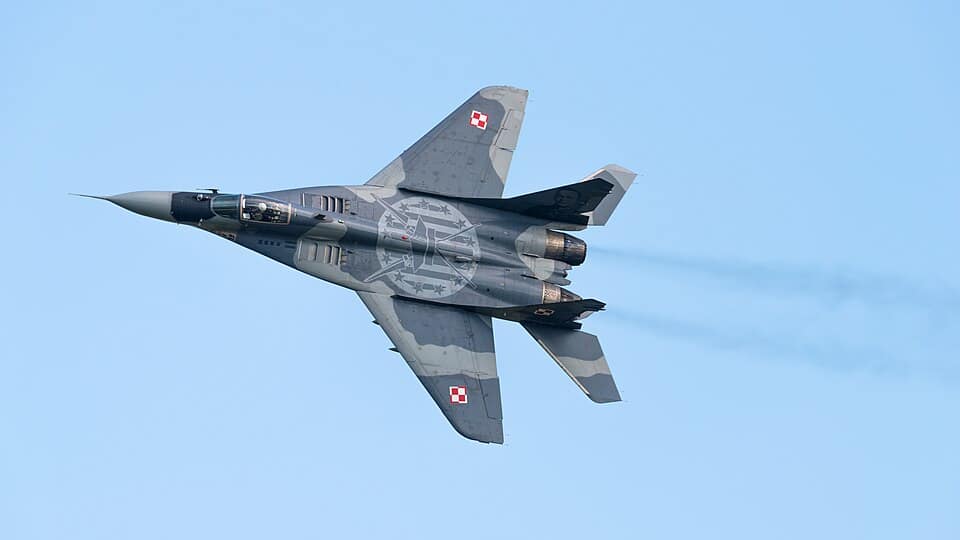
- Most advanced fighter: MiG-29 Fulcrum (estimated 35–40 in inventory)
- Bulk of fleet: MiG-21, MiG-23, Shenyang J-5/J-6 (1950s–1960s designs)
- Annual flight hours per pilot: Estimated 15–25 hours (vs. ~180+ for USAF, ~135 for ROKAF)
- Last confirmed air combat: 1973 (KPAAF MiG-21 pilots engaged Israeli F-4s during the Yom Kippur War; a KPAAF MiG-21 also downed a U.S. EC-121 in 1969)
An Air Force Frozen in Time
The KPAAF's inventory reads like a timeline of Soviet Cold War aviation exports. The backbone of the fighter fleet consists of aircraft that belong in museums: Shenyang J-5s (Chinese-built MiG-17s, a 1950s design), Shenyang J-6s (MiG-19 copies from the early 1960s), and MiG-21 Fishbeds — still capable in the right hands, but hopelessly outmatched by anything with a modern radar and beyond-visual-range missiles. A smaller number of MiG-23 Floggers provide a marginal improvement — variable-geometry wings, a look-down/shoot-down radar, and medium-range R-23 missiles — but the MiG-23 was considered obsolescent by the Soviet Union itself by the mid-1980s. The KPAAF's only remotely modern fighters are an estimated 35–40 MiG-29 Fulcrums, acquired from the Soviet Union in the late 1980s and possibly from Belarus or other former Soviet states in the 1990s. The MiG-29 is a genuine fourth-generation fighter — fast, maneuverable, and equipped with an infrared search-and-track system and R-73 high-off-boresight dogfight missiles. But North Korea's MiG-29s are early-model variants without the upgrades that have kept the type competitive in other air forces. They likely lack modern electronic countermeasures, GPS-aided navigation, and compatibility with newer weapons. Their radars — the N019 Rubin — are limited in range and vulnerable to jamming. Against an F-35 or F-22, they would be fighting blind.The Training Problem
Even with better equipment, the KPAAF would face a crippling disadvantage in pilot quality. North Korean fighter pilots are estimated to fly only 15 to 25 hours per year — less than one-sixth the training rate of their South Korean counterparts (approximately 135 hours per year) and less than one-eighth of a typical U.S. Air Force fighter pilot (180+ hours). This is not a matter of doctrine. North Korea simply cannot afford the fuel. Aviation fuel is imported, expensive, and subject to international sanctions. Every flight hour burned by a MiG-29 is fuel that the regime cannot use for other purposes. The result is a pilot corps that is minimally proficient at basic aircraft handling and almost certainly incapable of the complex tactical operations — beyond-visual-range engagements, electronic warfare integration, multi-ship coordinated attacks — that define modern air combat. The comparison is stark. A South Korean F-15K pilot has likely fired live air-to-air missiles in training, participated in Red Flag or similar multinational exercises, and practiced against dissimilar aircraft with full electronic warfare support. A North Korean MiG-29 pilot has likely flown a few circuits around the airfield, practiced basic formation flying, and perhaps fired the aircraft's cannon at a ground target."Quantity has a quality all its own" — the quote often attributed to Stalin. But in modern air warfare, quantity without training, without maintainable aircraft, and without modern weapons is just a target-rich environment.
— Assessment based on IISS Military Balance and RAND Corporation air power studies
The Underground Fortress
What the KPAAF lacks in capability, it partially compensates for with concealment. North Korea has invested heavily in underground air bases — hardened shelters carved into mountainsides with taxiways that lead directly to runway thresholds. Satellite imagery has identified multiple such facilities, with aircraft shelters designed to survive conventional bombing. The concept is survivability through dispersal and hardening. Even if the KPAAF cannot contest air superiority, the regime calculates that some aircraft can survive the initial strikes and sortie from underground bases for kamikaze-style or harassment attacks. Whether this is realistic against modern intelligence, surveillance, and precision strike capabilities is debatable — but it reflects a rational assessment of the KPAAF's actual role.The Real Mission
The KPAAF's true wartime mission is probably not air superiority — which it cannot achieve — but three more limited roles. First, special operations insertion. North Korea maintains a fleet of An-2 biplanes (yes, biplanes) specifically for infiltrating special forces behind South Korean lines. The An-2's extremely low speed and radar cross-section make it genuinely difficult to detect on radar — a 1940s aircraft invisible to modern sensors for the same reason a bicycle is invisible: it is too slow and too small to trigger automated detection thresholds. Second, artillery spotting and close air support in the opening hours of a conflict, before coalition air superiority is established. Even obsolete aircraft can deliver ordnance on ground targets when the enemy is still scrambling. Third, deterrence through existence. As long as the KPAAF nominally exists, South Korea and the United States must allocate resources to counter it — air defense batteries, combat air patrols, and suppression of enemy air defense missions that could be directed elsewhere.The Paper Tiger That Still Bites
The KPAAF is not a serious conventional air force. It cannot control its own airspace against a modern opponent, it cannot sustain combat operations beyond the first hours, and its pilot training is inadequate for any engagement more complex than a single pass at low altitude. But writing it off entirely would be a mistake. Nine hundred aircraft, even old ones, still require attention. Underground bases still need to be struck. And a regime willing to accept catastrophic losses — as North Korean military doctrine appears to accept — can extract a cost from any adversary, even one with overwhelming technological superiority. The ghost air force of North Korea is not dangerous because it is good. It is dangerous because it exists, it is large, and its commanders may not care how many of their pilots come back. Sources: IISS Military Balance 2025, RAND Corporation "North Korean Conventional Military Threats," 38 North satellite imagery analysis, ROK Ministry of National Defense White Paper, Joseph Bermudez Jr. (CSIS Korea Chair)Related Questions
How big is North Korea's air force?
North Korea's air force, the KPAAF, has an estimated 550–570 combat aircraft and around 110,000 personnel, making it large on paper. But most of its aircraft are obsolete and many are non-operational, so its real fighting strength is far smaller.
What aircraft does North Korea's air force fly?
The bulk of the fleet is made up of 1950s–1960s designs such as the MiG-21, MiG-23 and Chinese J-5 and J-6. Its most advanced fighters are an estimated 35–40 MiG-29s — still decades behind the modern fighters flown by its neighbours.
How often do North Korean pilots fly?
Very rarely. North Korean pilots are estimated to log only about 15–25 flight hours a year, compared with roughly 135 for South Korea and over 180 for the U.S. Air Force. With so little training, the force's combat effectiveness is severely limited.
Is North Korea's air force effective?
Despite its size, it is considered weak. Ageing aircraft, fuel shortages and minimal flight time leave most pilots poorly trained and many jets grounded. The KPAAF would struggle badly against the modern air forces of South Korea or the United States.
When did North Korea last fight in air combat?
Its last confirmed air combat was in 1973, when KPAAF MiG-21 pilots engaged Israeli F-4 Phantoms while deployed to the Middle East. North Korea's own skies have seen no major air combat for decades.
0 Comments