
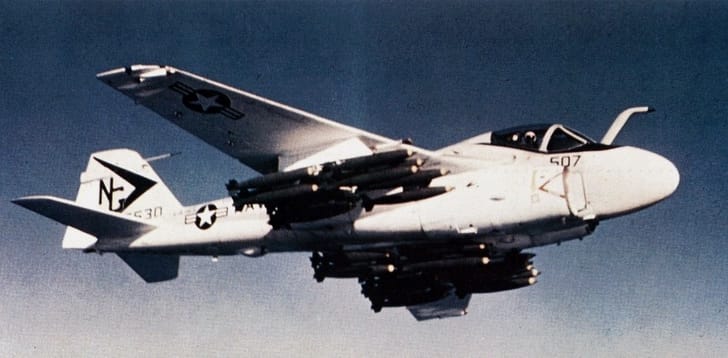
The Grumman A-6 Intruder was not fast. It was not pretty. It could not dogfight. What it could do was find a target in zero visibility — in monsoon rain, in fog, at night, in conditions that grounded every other aircraft on the carrier deck — and put bombs on it. For three decades, the A-6 was the U.S. Navy's premier all-weather attack aircraft, and nothing else in the arsenal could do what it did.
From the jungle-covered ridgelines of Vietnam to the burning oil fields of Kuwait, the Intruder carried the heaviest loads the farthest distances in the worst weather. Its two-man crew — pilot and bombardier/navigator sitting side by side — formed one of the most effective human-machine partnerships in combat aviation history. When the A-6 retired in 1997, the Navy lost a capability it has never fully replaced.
✈ Quick Facts
- First flight: April 19, 1960
- Entered service: February 1963 (VA-42)
- Retired: February 28, 1997 (last flight, VA-75 "Sunday Punchers")
- Engine: 2× Pratt & Whitney J52-P-8B (later P-408)
- Max speed: 644 mph (1,037 km/h) — subsonic
- Range: 1,627 nautical miles (3,013 km)
- Payload: 18,000 lbs (8,165 kg) on five hardpoints — more than a B-17
- Total built: 693
- Key system: DIANE (Digital Integrated Attack Navigation Equipment) — revolutionary for the 1960s
- Operators: U.S. Navy, U.S. Marine Corps
DIANE: The Brain Behind the Brawn
What made the A-6 revolutionary wasn't its airframe — it was its avionics. The DIANE system (Digital Integrated Attack Navigation Equipment) combined a search radar, track radar, inertial navigation, computer-generated attack solutions, and a ballistics computer into one integrated package. In 1963, this was science fiction. No other tactical aircraft in the world could autonomously navigate to a target and deliver weapons with precision in instrument meteorological conditions.
The bombardier/navigator (B/N) sat to the pilot's right, hunched over a radar scope and a bewildering array of switches. The B/N's job was to find the target on radar, lock the system, and guide the pilot down the attack run — all without ever seeing the ground. In Vietnam, A-6 crews routinely attacked targets in weather that kept the rest of the air wing on deck.
When the weather went to zero-zero and the Phantoms and Corsairs were sitting in the ready room, the Intruder crews were walking to their jets. That was our job — the missions nobody else could fly.
How A-6 crews described the all-weather mission
Vietnam: Night and All-Weather War
The A-6 arrived in Vietnam in 1965 and immediately changed the character of naval air warfare. While other aircraft were limited to clear-weather daylight strikes, the Intruder could operate around the clock, in any conditions. A-6s flew deep into North Vietnam's most heavily defended areas — Hanoi, Haiphong, the Red River bridges — delivering precision attacks using radar-guided bombing techniques that were a decade ahead of their time.
The losses were brutal. The A-6 community suffered some of the highest casualty rates of any aircraft type in the war. Sixty-eight Intruders were lost in combat over Vietnam — shot down by SAMs, anti-aircraft guns, and occasionally MiGs that caught the subsonic bombers without fighter escort. But the Intruder kept flying, night after night, because no other aircraft could do what it did.
Desert Storm: The Final War
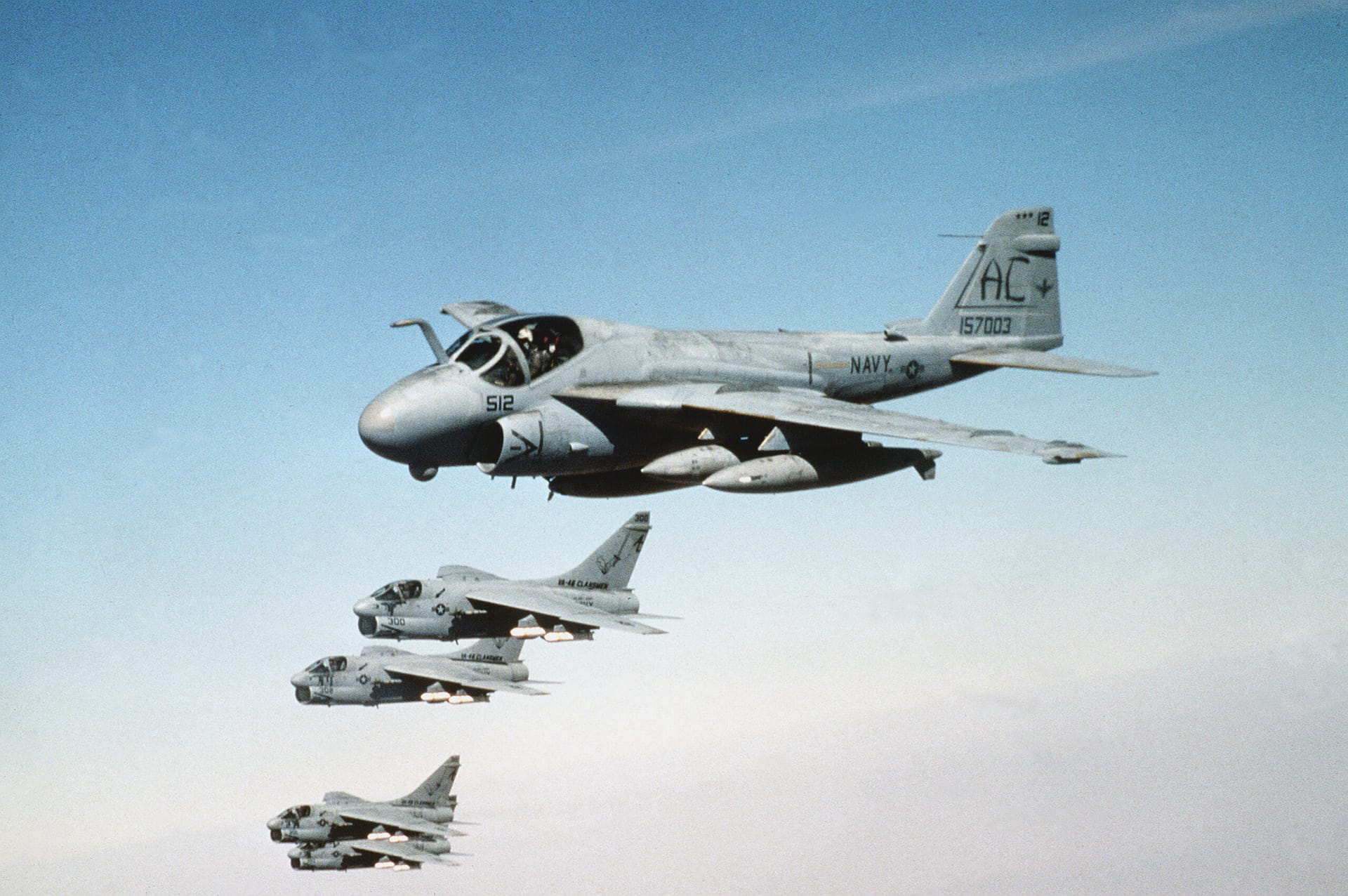
By 1991, the A-6E was showing its age — the airframes were cracking, and maintenance hours per flight hour were climbing steeply. But when Desert Storm began, the Intruder community delivered. A-6Es flew from carriers in the Red Sea and the Persian Gulf, hitting Iraqi armor, bridges, airfields, and command bunkers. Marine A-6s flew from shore bases in Saudi Arabia and Bahrain.
The A-6's ability to carry 18,000 pounds of ordnance — more than a World War II B-17 — made it the Navy's most effective bomb truck. In a single sortie, an Intruder could carry 28 Mk 82 500-pound bombs, or a mix of laser-guided weapons, Harpoon anti-ship missiles, and HARM anti-radiation missiles. Three A-6Es were lost in combat during the Gulf War.
The Intruder could carry more bombs farther in worse weather than anything else on the ship. When the tasking order came down and it said 'A-6,' everyone knew — this was the one that had to get through.
A sentiment widely echoed within the A-6 community
A Capability Never Replaced
The A-6 retired on February 28, 1997, when VA-75 "Sunday Punchers" flew the last operational sorties. The Navy intended to replace it with the A-12 Avenger II stealth bomber — a program that was cancelled in 1991 in the most expensive weapons procurement failure in Pentagon history. The F/A-18E/F Super Hornet eventually absorbed the strike mission, but it carries less, flies shorter distances, and was designed as a fighter first.
More than a quarter century later, the Navy still talks about the "Intruder gap" — the loss of a dedicated, long-range, heavy-payload, all-weather attack platform. The F/A-XX, if it ever flies, is partly an attempt to close that gap. The A-6 community would say it's about time.
Sources: Naval Aviation Museum, "Intruder: The Operational History of Grumman's A-6" (Mark Morgan & Rick Morgan), U.S. Navy Historical Center, Ward Carroll / The Hustle, The Aviation Geek ClubRelated Posts
- Operation El Dorado Canyon: When Reagan Bombed Libya
- Navy's F/A-XX Rescued by $900M Funding Surge
- The Dassault Rafale in Combat
Related Questions
What was the A-6 Intruder?
The Grumman A-6 Intruder was a U.S. Navy and Marine Corps all-weather attack aircraft that served from 1963 to 1997. Subsonic but extremely capable, it could find and hit targets in darkness and bad weather that other aircraft of its era simply couldn't.
What made the A-6 Intruder special?
Its revolutionary DIANE system (Digital Integrated Attack Navigation Equipment) let it locate and strike targets in total darkness or foul weather. Combined with an 18,000-lb bomb load — more than a World War II B-17 — this made the Intruder the Navy's premier all-weather bomber for decades.
How much could the A-6 Intruder carry?
The Intruder could haul about 18,000 lbs (8,165 kg) of ordnance across five hardpoints — a heavier payload than a four-engined B-17 of World War II, despite being a twin-engined carrier jet.
When did the A-6 Intruder retire?
The A-6 Intruder made its last flight on 28 February 1997 with squadron VA-75, the "Sunday Punchers," ending a 34-year career. A total of 693 were built after the type first flew in 1960.
Was the A-6 Intruder supersonic?
No. The A-6 was strictly subsonic, with a top speed of about 644 mph (1,037 km/h). It was built for range, payload and all-weather precision rather than speed, which is why it stayed effective for more than three decades.
0 Comments