
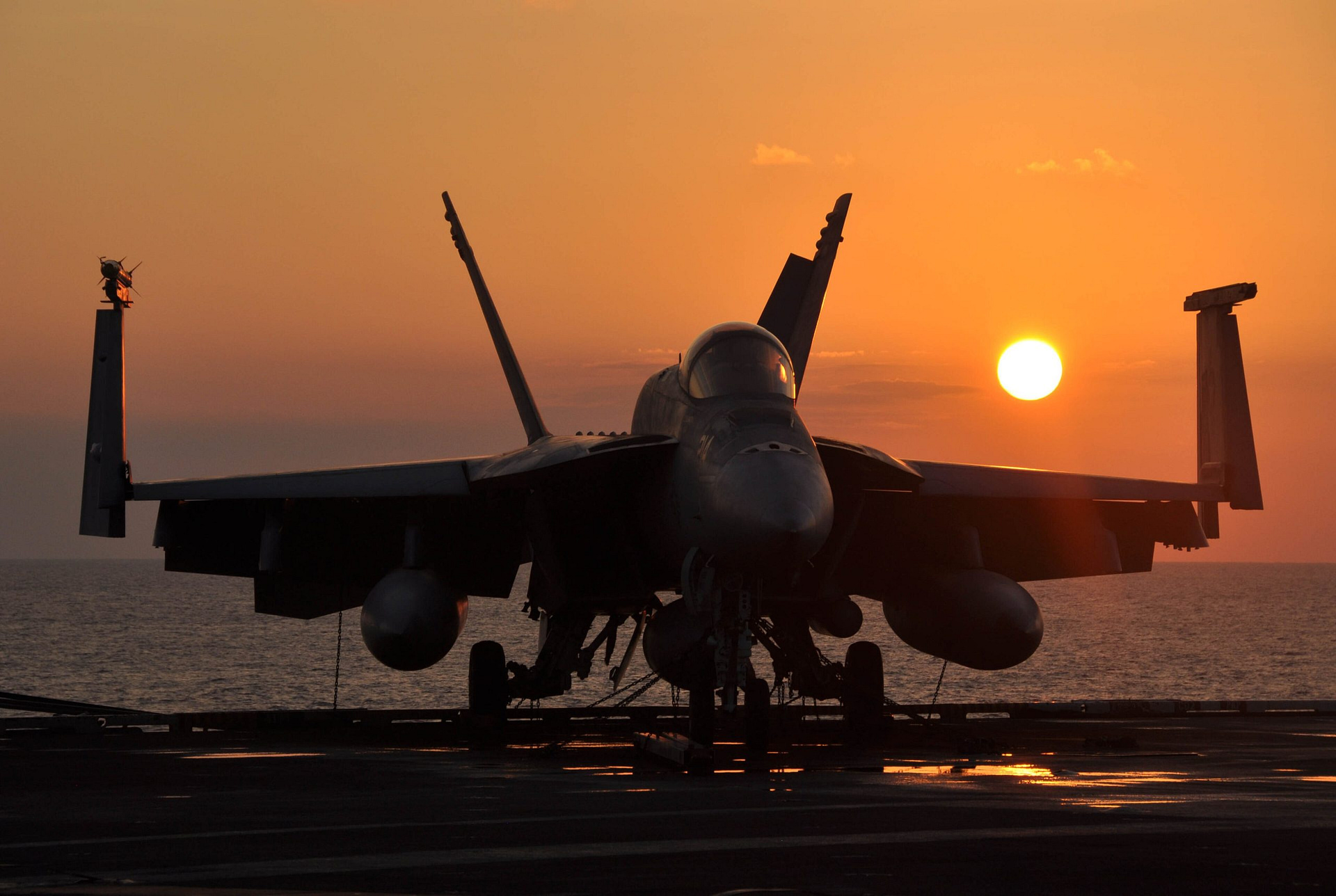
Boeing F/A-18E/F
Super Hornet
Not an upgraded Hornet but a larger, essentially new aircraft — roughly 20% bigger, longer-legged and harder-hitting than the legacy F/A-18, and today the backbone of the US Navy’s carrier air wings.
A new jet wearing an old jet’s name
By the late 1980s the US Navy had a problem. The A-6 Intruder and A-7 Corsair were ageing, the F-14 Tomcat was expensive to run, and the stealthy A-12 Avenger II attack jet meant to replace them collapsed in a spectacular 1991 cancellation. McDonnell Douglas offered a lower-risk answer that had been on the drawing board for years as “Hornet 2000”: take the proven, well-liked F/A-18 Hornet and grow it into something far more capable.
The result only looks like the legacy Hornet. The F/A-18E/F Super Hornet is about 20% larger, some 3,200 kg heavier empty, and shares only a fraction of its predecessor’s parts. The fuselage was stretched by about 86 cm, the wing grew by a quarter, the rounded intakes of the legacy jet became distinctive rectangular “caret” inlets, the leading-edge root extensions (LERX) were enlarged, two more weapons stations were added, and two new General Electric F414 engines replaced the F404. It first flew on 29 November 1995.
The payoff was reach and payload: roughly 40% more mission range and 50% more endurance than the legacy Hornet, the ability to bring thousands of kilograms of unused ordnance back to the carrier, and a built-in role as the fleet’s aerial tanker. Entering service in 2001, the Super Hornet — together with its EA-18G Growler electronic-attack sibling — became the aircraft the US Navy now builds its carrier air wings around.
01Why the Super Hornet is a new aircraft, not an F/A-18 upgrade
It is tempting to read “Super Hornet” as a mid-life refit of the F/A-18C/D. It is not. The two aircraft share a name, a general layout and a family resemblance, but the E/F is dimensionally larger in almost every axis, structurally different, and built around new engines, new intakes and a different wing. Where the legacy Hornet is a nimble, medium-weight fighter, the Super Hornet trades a little agility for markedly greater fuel, range, payload and growth room.
That is exactly why MiGFlug lists it as its own exhibit. The legacy F/A-18 Hornet has its own story — the Super Hornet is a related but genuinely different jet, closer in weight and reach to an F-15-class aircraft than to the original Hornet it is named after.
What makes the Super Hornet special
Two F414 engines — a third more thrust
The Super Hornet is powered by two General Electric F414-GE-400 afterburning turbofans, each rated around 22,000 lbf (98 kN) — roughly 35% more thrust than the F404s of the legacy Hornet. That extra power feeds the bigger, heavier airframe while preserving carrier-launch and bring-back margins. The enlarged, rectangular caret intakes that feed them are one of the quickest ways to tell an E/F from a legacy C/D at a glance.
A growth airframe built for range and payload
Stretching the fuselage and enlarging the wing let designers pack in far more internal fuel and add two extra hardpoints, for eleven in total. The result is about 41% more mission range and 50% more endurance than the legacy Hornet, plus the ability to recover to the carrier carrying more than 4,000 kg of unspent fuel and weapons — a capability the smaller Hornet never had.
AESA radar and modern avionics
From Block II (around 2005) the Super Hornet carries the Raytheon AN/APG-79 active electronically scanned array (AESA) radar, able to track air and ground targets simultaneously and resist jamming. Later additions — the ALQ-214 defensive suite, an infrared search-and-track (IRST) pod and, in Block III, large-area cockpit displays — keep the airframe competitive against far newer designs.
02The Super Hornet as the carrier air wing’s tanker
When the S-3 Viking was retired, the US Navy lost its dedicated carrier tanker — and the Super Hornet stepped in. Fitted with a centreline buddy refuelling store, F/A-18E/Fs now pass fuel to other aircraft in the air wing, and a large share of every carrier’s Super Hornet sorties are flown purely to keep other jets airborne. It is an unglamorous but critical role, and one reason the type is so central to carrier operations. The purpose-built MQ-25 Stingray drone is intended to eventually take over much of this mission and free the Super Hornets for combat.
03Carrier suitability: designed around the boat
Everything about the Super Hornet is shaped by the aircraft carrier. The wing folds; the structure is stressed for catapult launches and arrested landings; the approach is deliberately stable and forgiving. The enlarged wing and leading-edge extensions improve low-speed handling for the carrier approach, and the generous bring-back weight means a pilot can return to the deck without dumping expensive ordnance into the sea. These are the compromises that make it a heavier, less agile dogfighter than a land-based fighter — but a superb one from a pitching flight deck.
Full specifications
Airframe & Performance
- Crew
- 1 (F/A-18E) or 2 (F/A-18F)
- Length
- 18.31 m
- Wingspan
- 13.62 m (over missiles)
- Height
- 4.88 m
- Empty weight
- ~14,550 kg
- Max takeoff weight
- ~29,900 kg
- Max speed
- Mach 1.6+ (some sources ~1.8)
- Combat radius
- ~720 km (interdiction)
- Ferry range
- ~3,330 km
- Service ceiling
- ~15,000 m
Propulsion & Systems
- Engines
- 2 × GE F414-GE-400
- Thrust (each)
- ~98 kN (22,000 lbf) with afterburner
- Radar
- AN/APG-79 AESA (Block II+)
- Gun
- 1 × 20 mm M61A2 rotary cannon
- Hardpoints
- 11 (vs 9 on the legacy Hornet)
- First flight
- 29 November 1995
- Introduced
- 2001 (US Navy)
- Built
- 600+ (production winding down mid-2020s)
- Unit cost
- ~$60–70 million (estimate)
04The Super Hornet’s cost: cheaper to buy and run than the jets around it
Exact figures vary by year, block and how you count, but the Super Hornet’s big selling point has always been value. Flyaway unit prices are commonly cited in the region of $60–70 million, and Boeing and the US Navy have long argued its cost per flight hour — frequently quoted around $10,000–$18,000 depending on the source and era — is markedly lower than that of the F-35 or the F-22. Treat any single number as an estimate: procurement accounting is notoriously slippery. But the through-life economics, more than raw performance, are why the Navy keeps buying and upgrading the type.
From “Hornet 2000” to the fleet’s backbone
The Hornet 2000 concept
McDonnell Douglas studies an enlarged, longer-ranged Hornet derivative — the seed of the Super Hornet.
Programme launched
With the stealthy A-12 cancelled, the US Navy backs the lower-risk F/A-18E/F as its next strike fighter.
First flight
The first Super Hornet flies on 29 November 1995 — visibly larger than the legacy jet it is named after.
Boeing takes over
McDonnell Douglas merges into Boeing; low-rate production of the Super Hornet begins.
Enters service
Strike Fighter Squadron VFA-115 reaches initial operating capability with the F/A-18E.
Combat debut
First strikes over Iraq during Operation Southern Watch (2002), then full combat in the 2003 invasion.
The Su-22 kill
An F/A-18E downs a Syrian Su-22 near Raqqa — the first US air-to-air kill of a crewed aircraft since 1999.
Block III and beyond
Upgraded Block III jets enter service; the EA-18G Growler soldiers on as production of new airframes winds down.
Twelve Super Hornet stories
Not an upgrade — a new jet
The Super Hornet grew ~20% larger than the legacy Hornet and shares only a fraction of its parts.
Read the full story
A bigger Hornet takes off
The first F/A-18E flew on 29 November 1995, kicking off a test programme that ran smoother than most.
Read the full story
Into the fleet
Strike Fighter Squadron VFA-115 took the F/A-18E to sea and declared it ready for combat in 2001.
Read the full story
First bombs over Iraq
VFA-115 dropped the type’s first combat ordnance in November 2002 during Operation Southern Watch.
Read the full story
The Su-22 shootdown
On 18 June 2017 an F/A-18E downed a Syrian Su-22 — the US’s first crewed-aircraft kill since 1999.
Read the full story
Years over Iraq and Syria
Super Hornets flew thousands of strike and tanker sorties against ISIS in Operation Inherent Resolve.
Read the full story
The fleet’s flying gas station
A large share of Super Hornet sorties are flown purely to refuel other aircraft in the air wing.
Read the full story
An AESA radar and a digital cockpit
From Block II the Super Hornet gained the APG-79 AESA radar and, later, large-area displays.
Read the full story
The F414 engines
Two F414 turbofans give the Super Hornet about a third more thrust than the legacy Hornet’s F404s.
Read the full story
The EA-18G electronic-attack sibling
The EA-18G Growler turns the Super Hornet into a dedicated radar-jamming and electronic-attack platform.
Read the full story
Keeping it current
Block III upgrades and new-build jets are extending the Super Hornet’s front-line life into the 2030s and beyond.
Read the full story
Australia, Kuwait — and the ones that got away
Only Australia and Kuwait bought new Super Hornets; many competitions went to the F-35 instead.
Read the full story
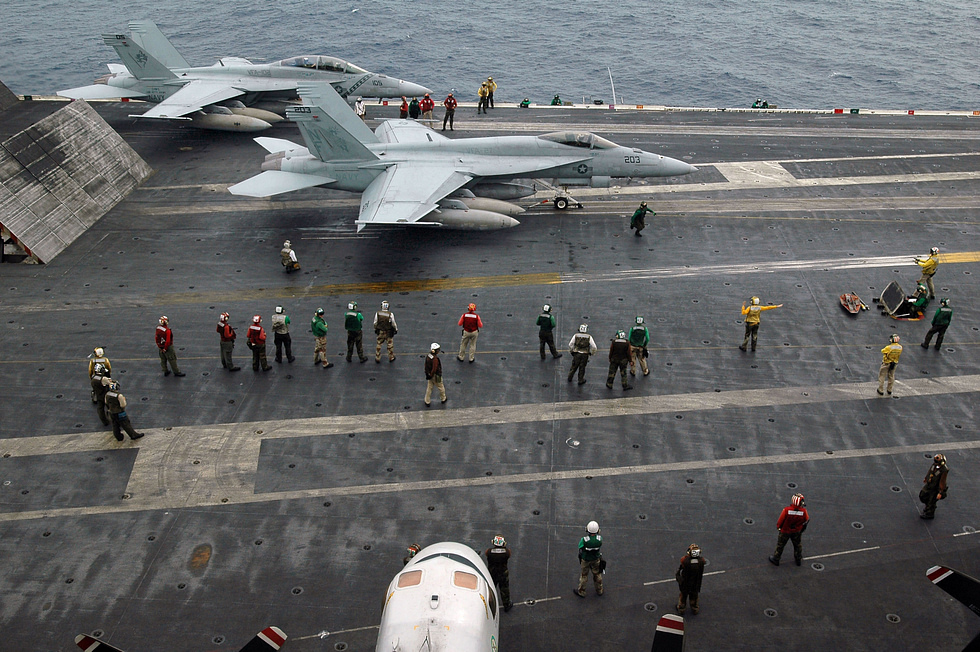
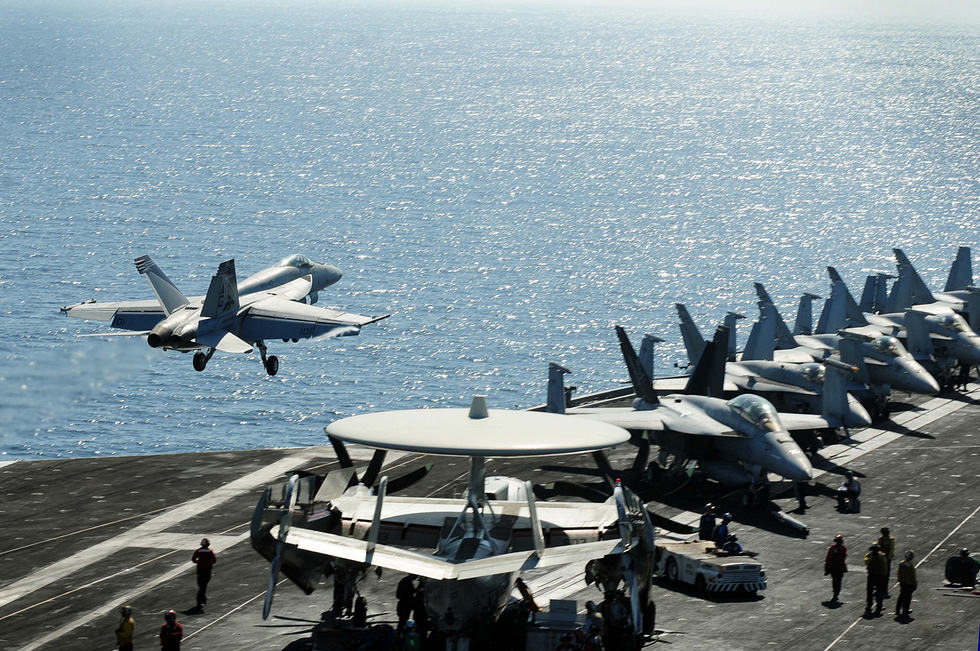
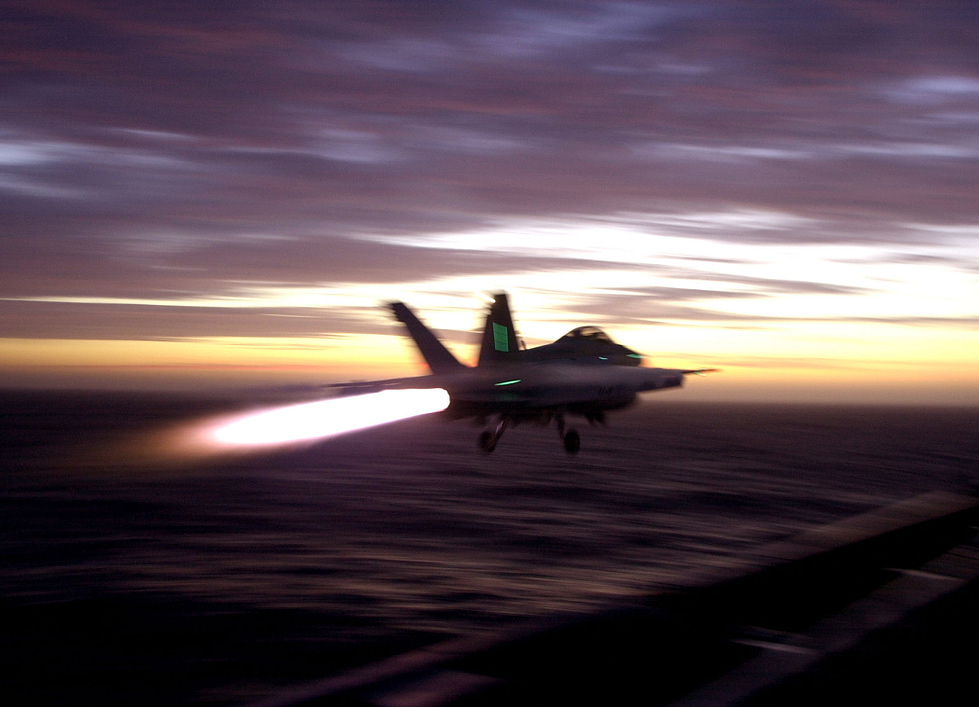
The Super Hornet in pictures
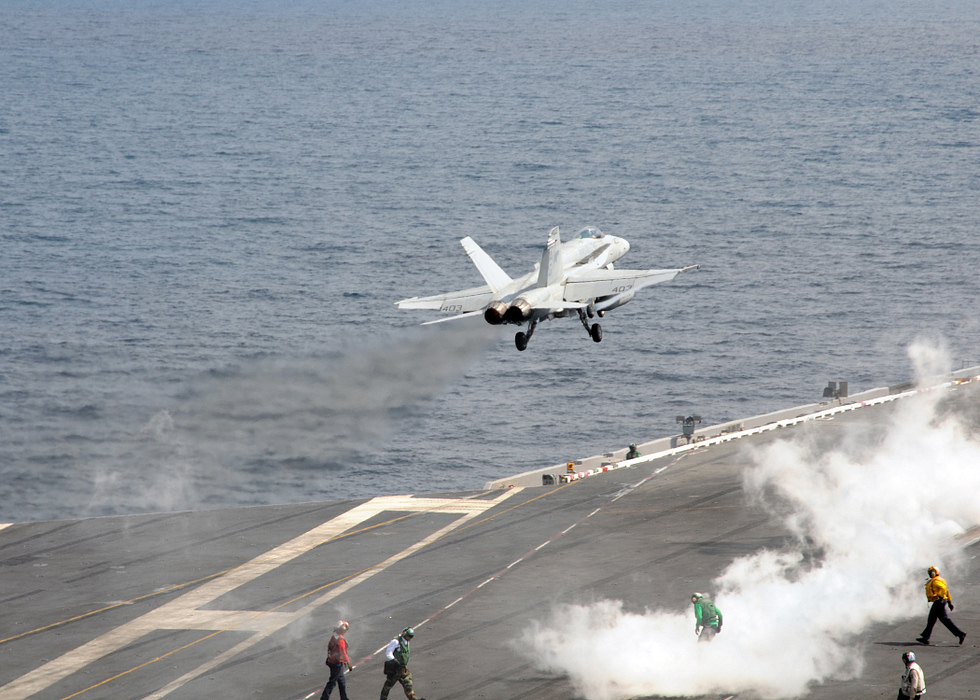
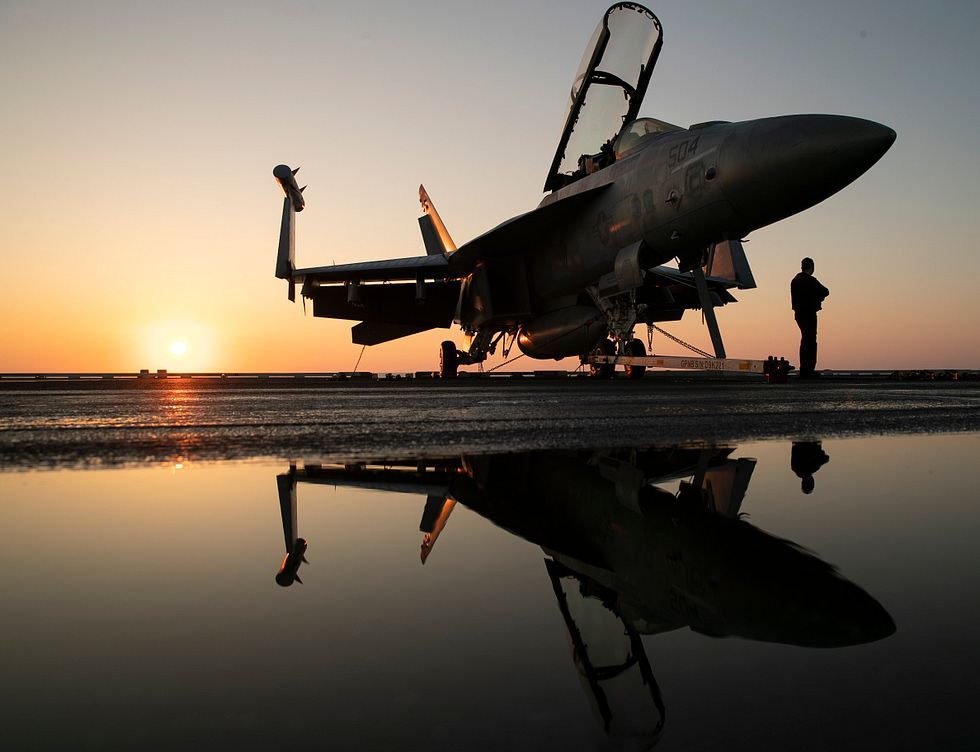
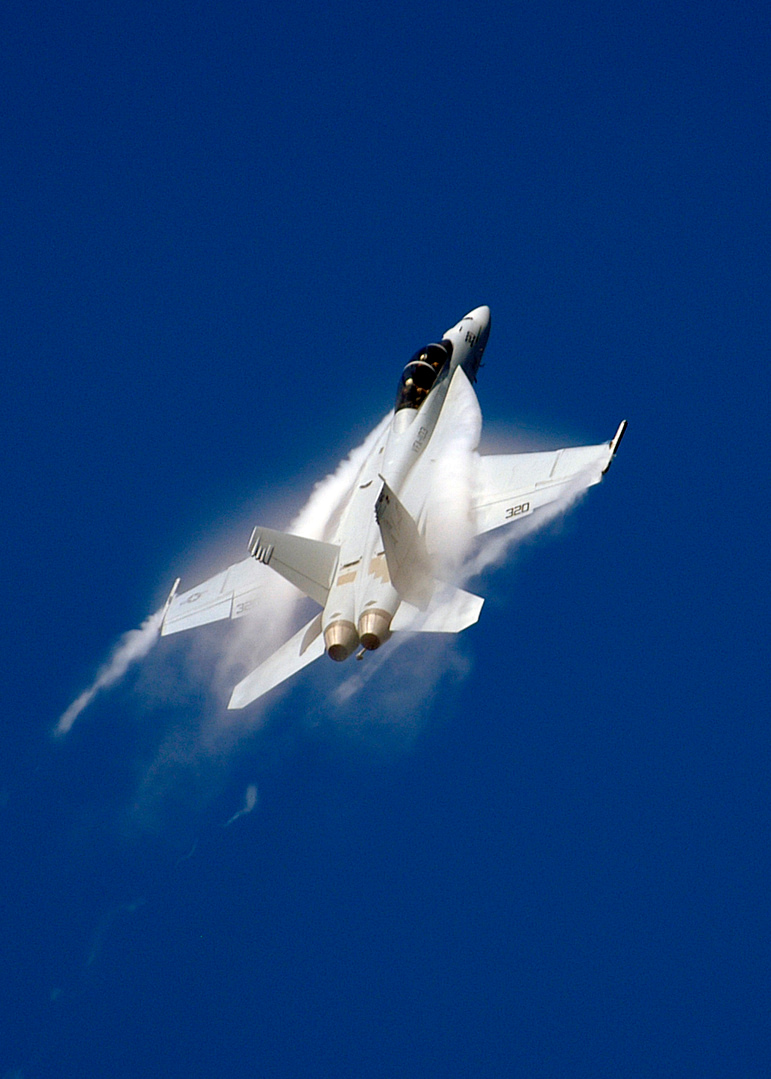
The Super Hornet in motion
DroneScapes — one of the most-watched Super Hornet films on YouTube.
Where the Super Hornet flies
The score that defines it
The Super Hornet is above all a strike aircraft, and most of its combat record is written in bombs dropped over Iraq, Afghanistan and Syria and in fuel passed to other jets. But it also holds a rare distinction: the only air-to-air kill scored by any Hornet variant in US service this century.
The 2017 kill — an AIM-120 AMRAAM downing a Fitter that had bombed US-allied ground forces — was the first US air-to-air kill of a crewed aircraft since the 1999 Kosovo campaign. Compare the combat record of every military aircraft. Figures as of July 2026.
Everything people ask about the Super Hornet
Can I fly in an F/A-18 Super Hornet?
What is the difference between the Super Hornet and the legacy Hornet?
How fast is the Super Hornet?
Did a Super Hornet ever shoot down another aircraft?
What is the EA-18G Growler?
Is the Super Hornet a stealth aircraft?
Who flies the Super Hornet?
Is the Super Hornet still in service and production?
You can’t fly the Super Hornet.
These, you can.
Some legends only live in museums — others are fuelled and waiting. MiGFlug has put civilians in real military jet cockpits since 2004.
 Fly the L-39 AlbatrosThe world’s most-flown jet trainer — aerobatics included
 Fly the F-104 Starfighter“The missile with a man in it”
 Fly the MiG-21The Cold War’s most-produced jet
 Fly the T-33 Shooting StarAmerica’s first jet trainer
 Fly the DH VampireA piece of early jet history
 Fly the S.211Agile Italian jet trainer
 Fly the MB-326The classic Aermacchi jet
 Fly the MiG-15The Soviet legend of the Korean War
Continue the tour
Every fact, checked
- Naval Air Systems Command (NAVAIR)Official US Navy programme page for the F/A-18E/F Super Hornet.
- Boeing — F/A-18 Super HornetManufacturer specifications, Block III details and production history.
- Airforce TechnologyAirframe, engine and avionics detail and export customer history.
- The War Zone (TWZ)First-hand account of the 18 June 2017 Su-22 shootdown from the pilots.
- Navy TimesThe inside story of Lt Cdr Tremel’s air-to-air kill and Distinguished Flying Cross.
- The Aviation Geek ClubDetailed comparison of the legacy Hornet and the Super Hornet.
- JanesKuwaiti Super Hornet order and delivery status.
- Simple FlyingOverview history of the US F/A-18E/F Super Hornet programme.