
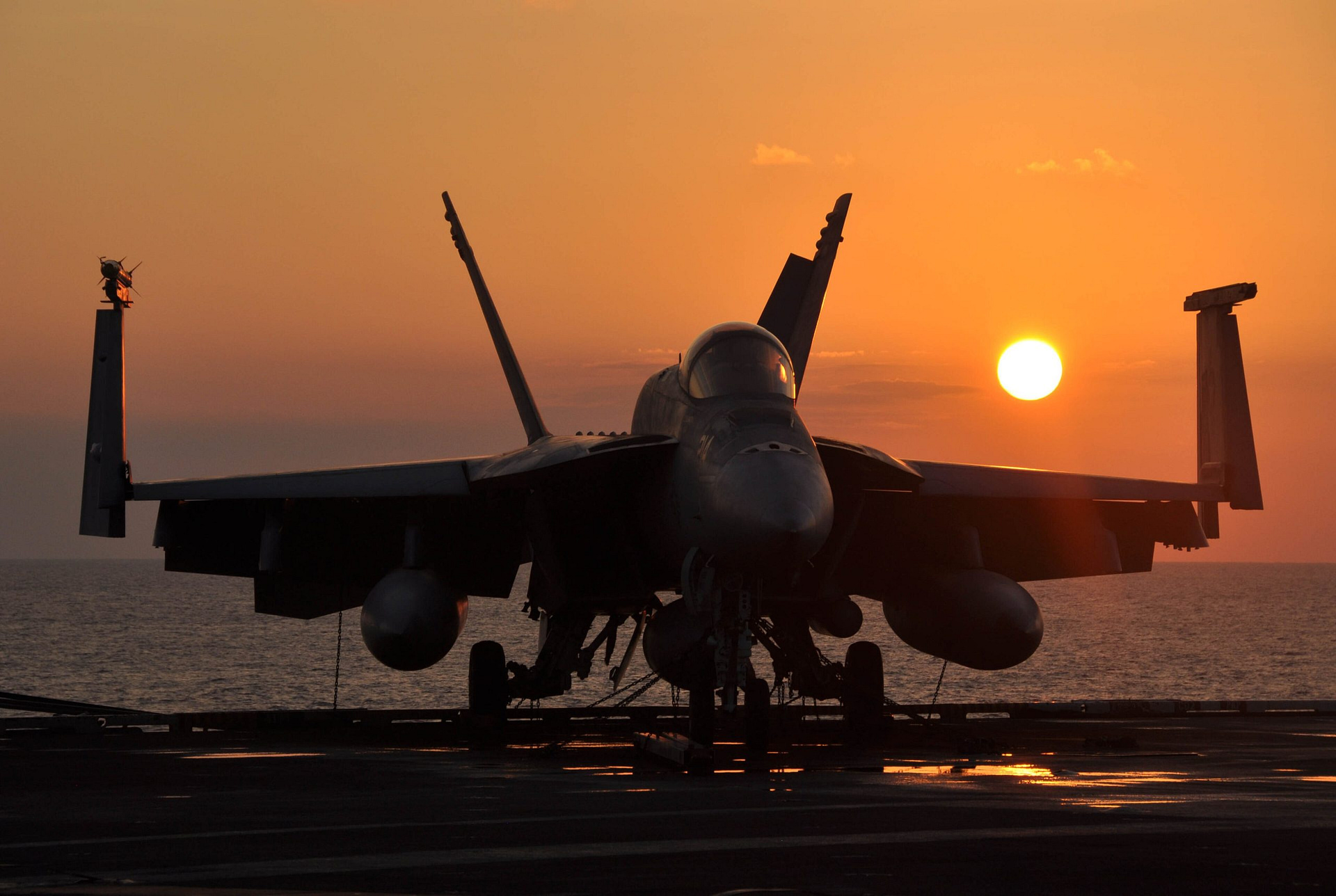
Boeing F/A-18E/F
Super Hornet
Not an upgraded Hornet but a larger, essentially new aircraft — roughly 20% bigger, longer-legged and harder-hitting than the legacy F/A-18, and today the backbone of the US Navy’s carrier air wings.
A new jet wearing an old jet’s name
By the late 1980s the US Navy had a problem. The A-6 Intruder and A-7 Corsair were ageing, the F-14 Tomcat was expensive to run, and the stealthy A-12 Avenger II attack jet meant to replace them collapsed in a spectacular 1991 cancellation. McDonnell Douglas offered a lower-risk answer that had been on the drawing board for years as “Hornet 2000”: take the proven, well-liked F/A-18 Hornet and grow it into something far more capable.
The result only looks like the legacy Hornet. The F/A-18E/F Super Hornet is about 20% larger, some 3,200 kg heavier empty, and shares only a fraction of its predecessor’s parts. The fuselage was stretched by about 86 cm, the wing grew by a quarter, the rounded intakes of the legacy jet became distinctive rectangular “caret” inlets, the leading-edge root extensions (LERX) were enlarged, two more weapons stations were added, and two new General Electric F414 engines replaced the F404. It first flew on 29 November 1995.
The payoff was reach and payload: roughly 40% more mission range and 50% more endurance than the legacy Hornet, the ability to bring thousands of kilograms of unused ordnance back to the carrier, and a built-in role as the fleet’s aerial tanker. Entering service in 2001, the Super Hornet — together with its EA-18G Growler electronic-attack sibling — became the aircraft the US Navy now builds its carrier air wings around.
01Why the Super Hornet is a new aircraft, not an F/A-18 upgrade
It is tempting to read “Super Hornet” as a mid-life refit of the F/A-18C/D. It is not. The two aircraft share a name, a general layout and a family resemblance, but the E/F is dimensionally larger in almost every axis, structurally different, and built around new engines, new intakes and a different wing. Where the legacy Hornet is a nimble, medium-weight fighter, the Super Hornet trades a little agility for markedly greater fuel, range, payload and growth room.
That is exactly why MiGFlug lists it as its own exhibit. The legacy F/A-18 Hornet has its own story — the Super Hornet is a related but genuinely different jet, closer in weight and reach to an F-15-class aircraft than to the original Hornet it is named after.
What makes the Super Hornet special
Two F414 engines — a third more thrust
The Super Hornet is powered by two General Electric F414-GE-400 afterburning turbofans, each rated around 22,000 lbf (98 kN) — roughly 35% more thrust than the F404s of the legacy Hornet. That extra power feeds the bigger, heavier airframe while preserving carrier-launch and bring-back margins. The enlarged, rectangular caret intakes that feed them are one of the quickest ways to tell an E/F from a legacy C/D at a glance.
A growth airframe built for range and payload
Stretching the fuselage and enlarging the wing let designers pack in far more internal fuel and add two extra hardpoints, for eleven in total. The result is about 41% more mission range and 50% more endurance than the legacy Hornet, plus the ability to recover to the carrier carrying more than 4,000 kg of unspent fuel and weapons — a capability the smaller Hornet never had.
AESA radar and modern avionics
From Block II (around 2005) the Super Hornet carries the Raytheon AN/APG-79 active electronically scanned array (AESA) radar, able to track air and ground targets simultaneously and resist jamming. Later additions — the ALQ-214 defensive suite, an infrared search-and-track (IRST) pod and, in Block III, large-area cockpit displays — keep the airframe competitive against far newer designs.
02The Super Hornet as the carrier air wing’s tanker
When the S-3 Viking was retired, the US Navy lost its dedicated carrier tanker — and the Super Hornet stepped in. Fitted with a centreline buddy refuelling store, F/A-18E/Fs now pass fuel to other aircraft in the air wing, and a large share of every carrier’s Super Hornet sorties are flown purely to keep other jets airborne. It is an unglamorous but critical role, and one reason the type is so central to carrier operations. The purpose-built MQ-25 Stingray drone is intended to eventually take over much of this mission and free the Super Hornets for combat.
03Carrier suitability: designed around the boat
Everything about the Super Hornet is shaped by the aircraft carrier. The wing folds; the structure is stressed for catapult launches and arrested landings; the approach is deliberately stable and forgiving. The enlarged wing and leading-edge extensions improve low-speed handling for the carrier approach, and the generous bring-back weight means a pilot can return to the deck without dumping expensive ordnance into the sea. These are the compromises that make it a heavier, less agile dogfighter than a land-based fighter — but a superb one from a pitching flight deck.
Full specifications
Baseline note: the figures below describe the single-seat F/A-18E at Block II standard — the version the United States Navy has flown in bulk for two decades and the one with published NATOPS and Standard Aircraft Characteristics data behind it. Deltas for the two-seat F, for Block III and for the EA-18G Growler in grey. The legacy F/A-18A/B/C/D Hornet is a different and smaller aeroplane and has its own page; nothing here describes it.
Dimensions & weights
- Equipe
- 1 (2 in the F/A-18F and the EA-18G, which is always flown with an electronic warfare officer in the back)
- Comprimento
- 18.31 m (60 ft 1 in) — the fuselage was stretched 86 cm (34 in) over the legacy Hornet
- Envergadura
- 13.62 m (44 ft 9 in) including wingtip missile rails; the wing is 25 per cent larger in area than the legacy Hornet’s
- Altura
- 4.88 m (16 ft 0 in)
- Área da asa
- 46.5 m² (500 sq ft)
- Peso vazio
- 14,552 kg (32,081 lb) — marginally heavier empty than an F-15C, which tells you how little of the "derivative" story was true
- Combustível interno
- 6,668 kg (14,700 lb); F/A-18F 6,241 kg (13,760 lb), the second seat costing about a tonne of fuel
- Gross weight, fighter escort
- 21,320 kg (47,000 lb)
- Maximum external load
- ~8,050 kg (~17,750 lb) across eleven stations
- Carrier bringback
- 4,491 kg (9,900 lb) for the E, 4,082 kg (9,000 lb) for the F — unspent fuel and ordnance the aircraft may still be carrying at the moment it catches a wire. This number, more than any other, is what the Super Hornet was built to raise
- Peso máximo de decolagem
- 29,937 kg (66,000 lb)
- Store stations
- 11 — two wingtips, six under-wing and three under-fuselage. Every under-wing pylon is canted a few degrees outboard
- Wing loading
- 459 kg/m² (94.0 lb/sq ft) at fighter-escort weight; 620 kg/m² (127 lb/sq ft) at maximum take-off weight
Performance
- Velocidade máxima
- Mach 1.8 (about 1,915 km/h / 1,190 mph) at altitude — the United States Navy fact file publishes "Mach 1.8+" and nothing more precise
- Velocidade de cruzeiro
- 893 km/h (555 mph), 482 kn, on the fighter escort profile
- Transonic acceleration
- Poorer than the legacy F/A-18C it replaced — a real and acknowledged regression, driven partly by size and partly by the outward-canted pylons, whose drag penalty is marginal in cruise but substantial transonically and supersonically
- velocidade de estol
- 239 km/h (148 mph), 129 kn, power-off
- Teto de serviço
- 15,940 m (52,300 ft)
- Raio de combate
- ~1,033 km (~642 mi; 558 nmi) hi-lo-hi with two GBU-10, one AIM-120, two AIM-9 and three drop tanks
- Range with two AIM-9
- 2,346 km (1,458 mi)
- Ferry range
- 3,330 km (2,070 mi)
- Taxa de subida
- 228 m/s (44,880 ft/min)
- Pitch rate
- Over 40° per second — the enlarged, recontoured leading-edge extensions relaxed the static stability margin and gave the aircraft its very high resistance to departure
- Design load factor
- +7.5 g
- Thrust-to-weight
- 0.93 at fighter-escort weight; about 1.1 at loaded weight with half internal fuel
Propulsion & systems
- Engines
- 2 × General Electric F414-GE-400 afterburning turbofans — developed from the legacy Hornet’s F404 but incorporating work done for the cancelled A-12’s F412, and about 35 per cent more powerful across most of the envelope
- Thrust, each
- 57.8 kN (13,000 lbf) dry, 97.9 kN (22,000 lbf) with afterburner
- Fuel and refuelling
- 6,668 kg internal plus up to five external tanks of 1,817 litres (480 US gal); with the A/A42R-1 Aerial Refuelling Store on the centreline the aircraft carries about 13,150 kg (29,000 lb) of fuel and passes it to others through a hose reel
- Radar
- Raytheon AN/APG-79 active electronically scanned array from 2005 (Hughes AN/APG-73 mechanically scanned on Block I aircraft; 135 earlier airframes were retrofitted with AESA from 2008)
- Infrared search and track
- Lockheed Martin AN/ASG-34(V)1 IRST21, carried in the nose of a modified FPU-13/A centreline tank whose capacity drops to 340 US gal to make room. Declared operational in January 2025 after years of delay
- Targeting pods
- Raytheon AN/ASQ-228 ATFLIR, being replaced by the AN/AAQ-28(V) Litening
- Cockpit and sights
- Joint Helmet-Mounted Cueing System; Block III replaces every multifunction display with a single 10 × 19 in touchscreen large-area display, the Advanced Cockpit System
- Defensive aids
- AN/ALQ-214 integrated countermeasures, AN/ALE-55 fibre-optic or AN/ALE-50 towed decoy, AN/ALR-67(V)3 radar warning receiver, ALE-47 dispensers; S-duct intakes and edge alignment cut the frontal radar cross-section without any pretence of being a stealth aircraft
- assento ejetor
- Martin-Baker SJU-17(V) NACES, zero-zero
- Airframe life
- 6,000 flight hours as designed; 10,000 hours for Block III, and Block II aircraft passing through Service Life Modification are brought to the same standard
- First flight
- 29 November 1995; EA-18G Growler 15 August 2006
- Service entry
- Fleet service 1999, initial operating capability September 2001; Growler 22 September 2009
- Number built
- ~632 F/A-18E/F delivered by April 2020, when the last Block II was handed over, plus 172 EA-18G by October 2021. Northrop Grumman confirmed in late January 2026 that it had finished the last centre and aft fuselage shipset; Boeing expects final new-build deliveries in 2027, after which St Louis converts Block II airframes rather than building new ones
04The Super Hornet’s cost: cheaper to buy and run than the jets around it
Exact figures vary by year, block and how you count, but the Super Hornet’s big selling point has always been value. Flyaway unit prices are commonly cited in the region of $60–70 million, and Boeing and the US Navy have long argued its cost per flight hour — frequently quoted around $10,000–$18,000 depending on the source and era — is markedly lower than that of the F-35 or the F-22. Treat any single number as an estimate: procurement accounting is notoriously slippery. But the through-life economics, more than raw performance, are why the Navy keeps buying and upgrading the type.
Armament & payload
The Super Hornet carries the widest weapons set in United States naval aviation, and one of its stores is a surface-to-air missile
Eleven stations, 17,750 lb of external load and a clearance list that runs from a 20 mm gun to a stand-off anti-ship missile: the Super Hornet inherited every job the Navy used to spread across the F-14, the A-6, the S-3 and the KA-6D, and the weapons list is what that consolidation looks like. The genuinely new entry is the AIM-174B Gunslinger, an air-launched SM-6 — a ship’s surface-to-air missile with the booster removed, hung under a fighter’s wing. It is 16.5 ft long and weighs 1,830 lb, roughly five times an AMRAAM, and it gives the Navy its first very-long-range air-to-air weapon since the AIM-54 Phoenix went in 2004. The other thing worth knowing about this aircraft’s payload is less glamorous: a large share of Super Hornet flying is spent carrying fuel for other Super Hornets. Clearances differ by block and by operator: Block III aircraft carry weapons and networking that Block I aircraft never will, the Growler gives up its gun entirely, and Australian and Kuwaiti fleets fly a narrower subset than the United States Navy.
Gun
- 1 × M61A2 Vulcan 20 mm six-barrel rotary cannon, 412 rounds, mounted in the upper nose above the radar
- A lightened M61A2 rather than the legacy Hornet’s M61A1 — the same gun, roughly 20 kg less of it
- About 6,000 rounds per minute, which means the magazine is gone in roughly four seconds of continuous fire
- O EA-18G Growler has no gun: the cannon bay is given over to a mounting plate for the electronic attack equipment, and the wingtips carry ALQ-218 receivers instead of missiles
Air-to-air
- AIM-120C and AIM-120D AMRAAM — the standard fit is seven AMRAAM and two Sidewinders on the fighter escort profile; the "Murder Hornet" combat load of five AIM-120 and four AIM-9X has been flown operationally
- AIM-9X Sidewinder, cued by the helmet-mounted sight and by IRST21, which lets a shot be taken without the radar ever transmitting
- AIM-174B Gunslinger: the air-launched SM-6, revealed at RIMPAC in July 2024, publicly confirmed at 240 km (150 mi) and widely believed to reach considerably further, Mach 3.5, 140 lb blast-fragmentation warhead. It is carried by no other aircraft in the world, and has deployed aboard four Nimitz-class carriers
- A four-Gunslinger load alongside three AMRAAM and two AIM-9X has been photographed on a test aircraft; there is no evidence yet that the fleet flies it that way
- AIM-7 Sparrow remains cleared and is effectively historical; the AIM-260 JATM is expected but almost nothing about it is public
Air-to-surface guided
- AGM-84H/K SLAM-ER land-attack missile and AGM-84 Harpoon anti-ship missile
- AGM-158C LRASM — the long-range anti-ship missile that is the Navy’s answer to being outranged in the Pacific; AGM-158 JASSM for land targets
- AGM-154 JSOW glide weapon, including the unpowered stand-off variants used heavily over Yemen and Iraq
- AGM-88 HARM and the AGM-88E AARGM, with the extended-range AGM-88G AARGM-ER in integration — the Growler’s principal shooting weapon
- AGM-65E and AGM-65F Maverick; the Joint Strike Missile is stated for future integration
Bombs
- JDAM family: up to ten GBU-32, GBU-35, GBU-38 or laser-JDAM GBU-54, or four 2,000 lb GBU-31
- Paveway laser-guided bombs, GBU-10, GBU-12, GBU-16 and GBU-24
- GBU-53/B StormBreaker, the Small Diameter Bomb II, with a tri-mode seeker that can hit a moving vehicle through weather — four to a rack, which is what makes eleven stations worth having
- Mk 80 series unguided bombs, still carried for range work and for targets that do not justify a kit
- Mk 62, Mk 63 and Mk 65 Quick Strike naval mines — a job almost nothing else in the carrier air wing can do
Rockets
- None in the fleet configuration. No unguided or guided rocket pod appears on the Super Hornet’s published stores list, and fleet aircraft do not carry one
- This is worth stating plainly because it is often assumed otherwise: it is the Marine Corps’ legacy F/A-18C/D Hornets, not the Super Hornet, that have been fitted with laser-guided APKWS II rockets for shooting down cheap drones
- The Red Sea campaign against Houthi drones from 2023 onwards made the arithmetic embarrassing — a million-dollar AMRAAM against a drone costing a few thousand — and has driven interest across all the United States services in a cheap guided rocket
- For now the Super Hornet’s cheap options are the gun and the AIM-9X, and the gun has four seconds of ammunition
Pods & other stores
- A/A42R-1 Aerial Refuelling Store: a 330 US gal centreline tank with a hose reel, four 480 US gal tanks alongside it, and about 29,000 lb of transferable fuel. Between a fifth and a third of Super Hornet sorties are flown as recovery tanking, and that flying burns airframe fatigue life faster than almost anything else the type does
- AN/ASQ-228 ATFLIR and AN/AAQ-28(V) Litening targeting pods; the IRST21 sensor in its modified centreline tank
- AN/ALE-50 and AN/ALE-55 towed decoys; SUU-42A/A flare and chaff dispenser pods; AWW-13 advanced data link pod for controlling stand-off weapons
- Up to twelve ADM-141C TALD decoys — gliders that imitate an attacking aircraft to make defenders switch their radars on
- Growler-specific: ALQ-99 high- and low-band jamming pods, up to five, being replaced by the AESA-based Next Generation Jammer; ALQ-218 wideband receivers in the wingtip pods
Three typical loadouts
- Fighter escort and outer air battle
- Seven AIM-120 and two AIM-9X, or the heavier long-range fit of four AIM-174B, three AIM-120 and two AIM-9X with the IRST21 tank on the centreline and an ATFLIR pod. The AIM-174B fit exists because a carrier air wing that cannot shoot at four hundred kilometres cannot protect its own tankers and radar aircraft.
- Maritime strike
- Two AGM-158C LRASM on the outboard wing stations, two AIM-120 and two AIM-9X for self-defence, two 480 US gal tanks, ATFLIR. Launched hundreds of kilometres from the target and flown autonomously to it — a mission the Navy gave up when the A-6 went and only recovered in the 2010s.
- Recovery tanker
- A/A42R-1 refuelling store on the centreline, four 480 US gal drop tanks, no weapons but the gun. This is what a meaningful fraction of Super Hornet flight hours actually looks like, and it is the single strongest argument for the MQ-25 Stingray tanker drone now being built to take the job away.
Sourcing caveat: weapon fits follow the United States Navy fact file, the F/A-18E/F NATOPS manuals and Standard Aircraft Characteristics documents in the public domain, Boeing and Raytheon statements and Naval Air Systems Command releases. AIM-174B data is unusually thin: the missile was a surprise when it appeared at RIMPAC in July 2024, its official nickname was not published until May 2025, and its true range has never been stated. The 240 km figure is the confirmed floor, not an estimate of what it can do. The proportion of Super Hornet sorties flown as tanking is quoted at between a fifth and a third depending on the source and the deployment; no single authoritative figure exists, so the range is given rather than a false precision.
Variants
An almost entirely new aeroplane kept an old designation so that Congress would buy it
The honest description of the F/A-18E/F is that it is a new aircraft wearing an old name. When the McDonnell Douglas A-12 Avenger II collapsed in 1991, taking the Navy’s A-6 replacement with it, and the navalised F-22 died alongside it, the service needed something that Congress would fund quickly and without a fight. McDonnell Douglas had the "Hornet 2000" study on the shelf. The Navy kept the F/A-18 designation deliberately, to sell the programme as a low-risk derivative — and the resulting aircraft shares its forward fuselage, some avionics, the ejection seat and the maintenance procedures with the legacy Hornet, and very little else. It is a quarter larger in wing area, 86 cm longer, and empty it weighs slightly more than an F-15C.
Two engineering stories from that development are worth keeping. The first is wing drop: an uncommanded roll in transonic manoeuvring that showed up in flight test and was fixed, after a long and unhappy investigation, with a dogtooth on the wing leading edge and a strip of porous skin at the wing fold to bleed the airflow. The second is the pylons. Early wind-tunnel work suggested released stores might strike the airframe, so every under-wing pylon was canted a few degrees outboard. It was later established that this had never been necessary — but the production tooling was already cut and re-clearing the flight envelope would have cost time and money, so the cant stayed. It costs the aeroplane transonic and supersonic drag to this day.
The third story is Block III, and it is a story about a promise quietly withdrawn. Block III was sold on conformal fuel tanks that would add 3,500 lb of fuel and roughly 480 km of combat range. In 2021 the Navy dropped them over cost, schedule and performance — among other things they hurt transonic acceleration through added wave drag. What Block III actually delivers is a sensors-and-networking aircraft: a new cockpit, a networked targeting processor, IRST21 and a 10,000-hour airframe. Those are real and useful. They are not the range increase the brochures implied.
- F/A-18E (first flight 29 November 1995; fleet service 1999)
- The single-seat baseline: eleven stations, F414 engines, caret intakes, 25 per cent more wing and 42 per cent fewer structural parts than the legacy Hornet.
- F/A-18F (from 1999)
- Two-seat version. Not a trainer — the back seat is a weapon systems officer’s, and the F is the fleet’s preferred aircraft for forward air control, long-range strike coordination and anything demanding two heads. Costs about a tonne of internal fuel.
- Block I (1999–2005)
- Original production standard, with the mechanically scanned AN/APG-73 radar carried over from the legacy Hornet to hold development cost down.
- Block II (2005–April 2020; final aircraft delivered 23 April 2020)
- AN/APG-79 AESA radar, larger displays, joint helmet-mounted cueing. The bulk of the fleet, and the standard most of the type’s combat record was flown at.
- Block III (first delivered 2021; conversions running to about 2033)
- Advanced Cockpit System with a single large-area touchscreen, Distributed Targeting Processor-Networked and the Tactical Targeting Network Technology datalink, open mission systems architecture, IRST21 and a 10,000-hour airframe. Conformal fuel tanks were cancelled in 2021 and are not part of it.
- EA-18G Growler (first flight 15 August 2006; in service 22 September 2009; 172 built by October 2021)
- Carrier electronic attack aircraft replacing the EA-6B Prowler. Gun deleted, wingtips given over to ALQ-218 receivers, up to five ALQ-99 jamming pods now giving way to the Next Generation Jammer. Nine stations remain for weapons. Three Growlers working together can geolocate an emitter in real time.
- NEA-18G (2 aircraft)
- Two F/A-18Fs converted as Growler prototypes.
- Advanced Super Hornet (proposed, not adopted)
- The 2013 demonstrator with conformal tanks, an enclosed low-observable weapons pod and further radar cross-section reduction. The Navy declined it; the cockpit and IRST elements were salvaged into Block III, and the conformal tanks and signature work remain of stated interest to Australia.
- F/A-18F, Royal Australian Air Force (24, ordered 2007, in service from December 2010)
- Bought to bridge the gap left by the F-111C’s retirement; twelve were wired from build so they could be converted to Growlers, though in the event Australia bought Growlers outright instead.
- F/A-18E/F, Kuwait (28 — 22 E and 6 F)
- The only other export sale, ordered in 2018 after long delays. Kuwait’s legacy F/A-18C/D fleet has been sold on to Malaysia.
- Legacy Hornet, F/A-18A/B/C/D (cross-reference only)
- A separate and smaller aircraft, descended from the Northrop YF-17, with its own page in this encyclopedia. It shares a name and a forward fuselage with the Super Hornet and should not be counted with it.
Closing caveat: variant boundaries here follow Naval Air Systems Command and Boeing usage. "Block" is a procurement label rather than a fixed configuration — individual aircraft within a block differ by retrofit, and Block II airframes passing through Service Life Modification emerge with Block III capability, so a photograph cannot reliably tell you which block you are looking at.
From “Hornet 2000” to the fleet’s backbone
The Hornet 2000 concept
McDonnell Douglas studies an enlarged, longer-ranged Hornet derivative — the seed of the Super Hornet.
Programme launched
With the stealthy A-12 cancelled, the US Navy backs the lower-risk F/A-18E/F as its next strike fighter.
First flight
The first Super Hornet flies on 29 November 1995 — visibly larger than the legacy jet it is named after.
Boeing takes over
McDonnell Douglas merges into Boeing; low-rate production of the Super Hornet begins.
Enters service
Strike Fighter Squadron VFA-115 reaches initial operating capability with the F/A-18E.
Combat debut
First strikes over Iraq during Operation Southern Watch (2002), then full combat in the 2003 invasion.
The Su-22 kill
An F/A-18E downs a Syrian Su-22 near Raqqa — the first US air-to-air kill of a crewed aircraft since 1999.
Block III and beyond
Upgraded Block III jets enter service; the EA-18G Growler soldiers on as production of new airframes winds down.
Twelve Super Hornet stories
Not an upgrade — a new jet
The Super Hornet grew ~20% larger than the legacy Hornet and shares only a fraction of its parts.
Read the full story
A bigger Hornet takes off
The first F/A-18E flew on 29 November 1995, kicking off a test programme that ran smoother than most.
Read the full story
Into the fleet
Strike Fighter Squadron VFA-115 took the F/A-18E to sea and declared it ready for combat in 2001.
Read the full story
First bombs over Iraq
VFA-115 dropped the type’s first combat ordnance in November 2002 during Operation Southern Watch.
Read the full story
The Su-22 shootdown
On 18 June 2017 an F/A-18E downed a Syrian Su-22 — the US’s first crewed-aircraft kill since 1999.
Read the full story
Years over Iraq and Syria
Super Hornets flew thousands of strike and tanker sorties against ISIS in Operation Inherent Resolve.
Read the full story
The fleet’s flying gas station
A large share of Super Hornet sorties are flown purely to refuel other aircraft in the air wing.
Read the full story
An AESA radar and a digital cockpit
From Block II the Super Hornet gained the APG-79 AESA radar and, later, large-area displays.
Read the full story
The F414 engines
Two F414 turbofans give the Super Hornet about a third more thrust than the legacy Hornet’s F404s.
Read the full story
The EA-18G electronic-attack sibling
The EA-18G Growler turns the Super Hornet into a dedicated radar-jamming and electronic-attack platform.
Read the full story
Keeping it current
Block III upgrades and new-build jets are extending the Super Hornet’s front-line life into the 2030s and beyond.
Read the full story
Australia, Kuwait — and the ones that got away
Only Australia and Kuwait bought new Super Hornets; many competitions went to the F-35 instead.
Read the full story
The Super Hornet in pictures
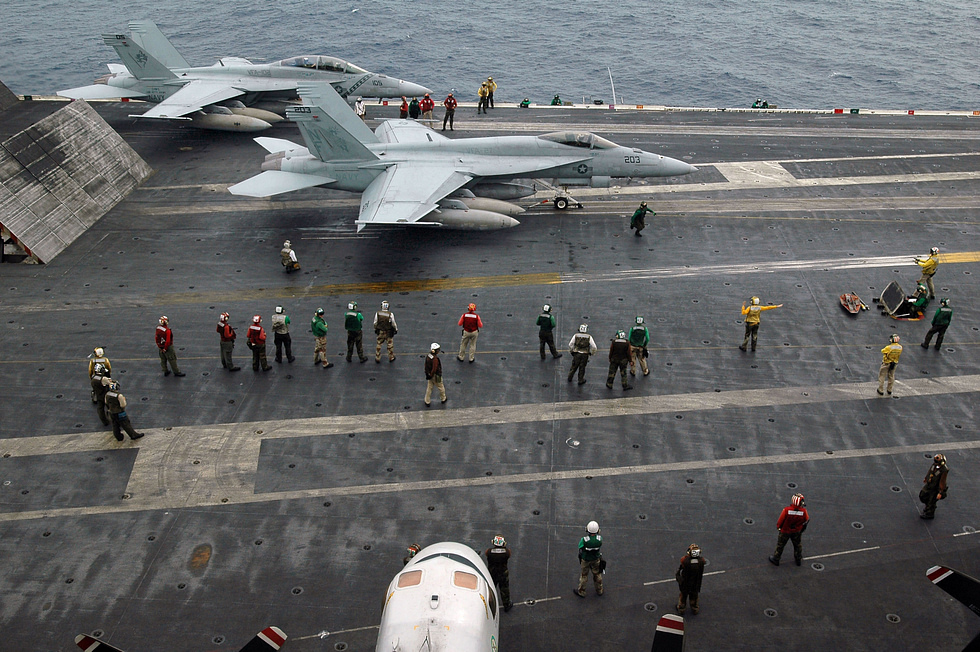
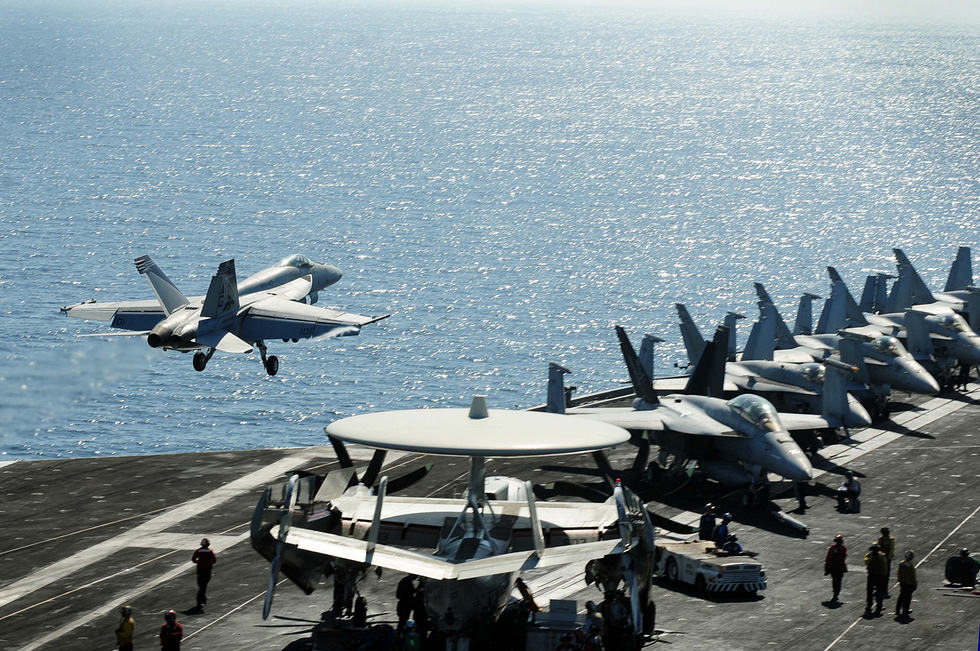
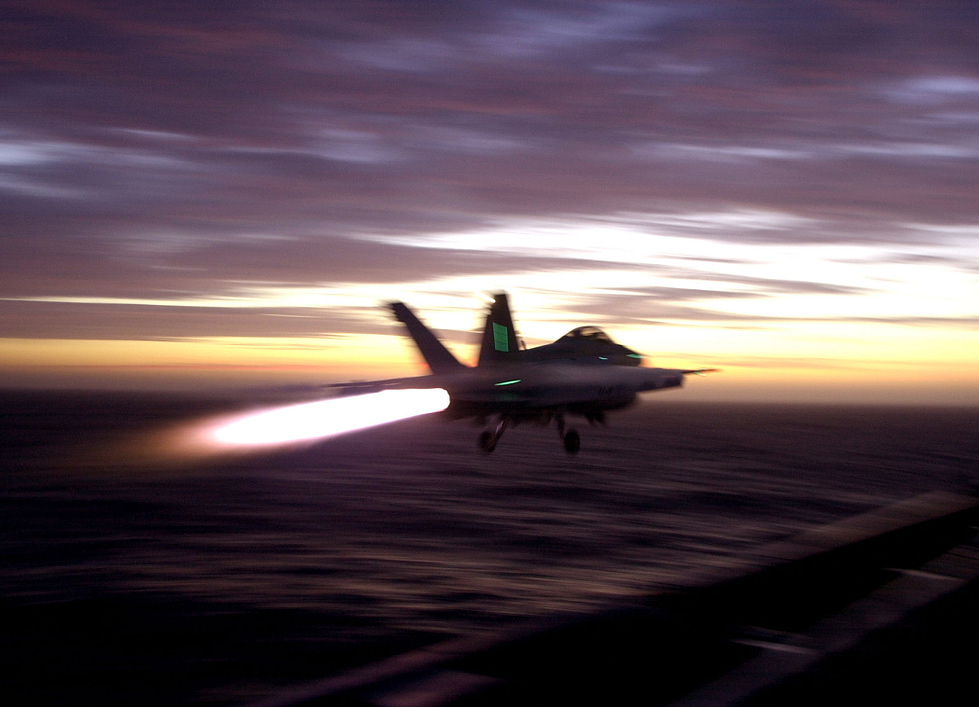
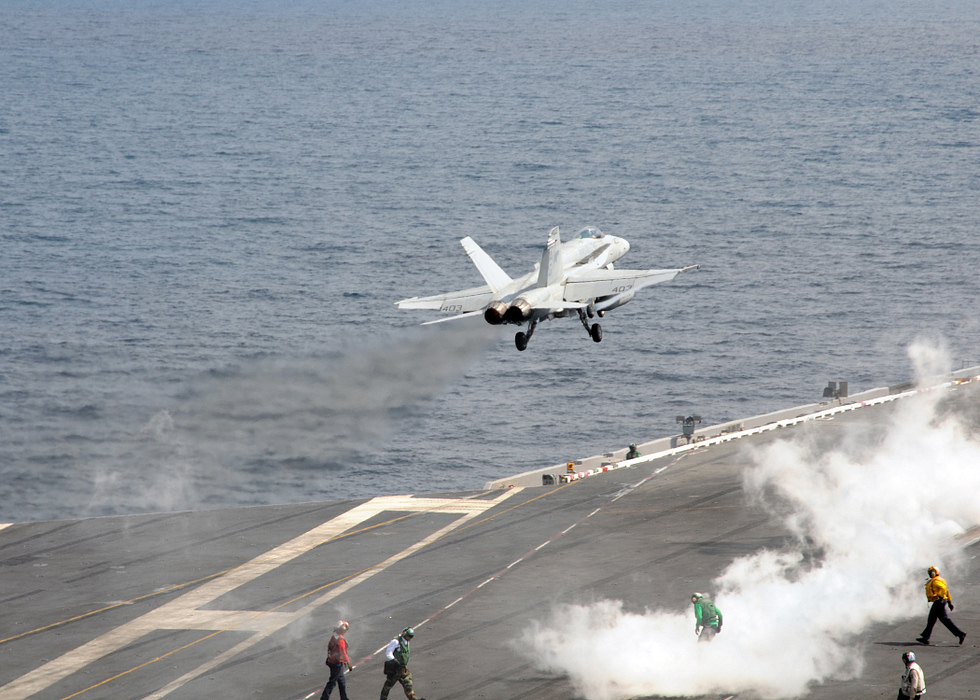
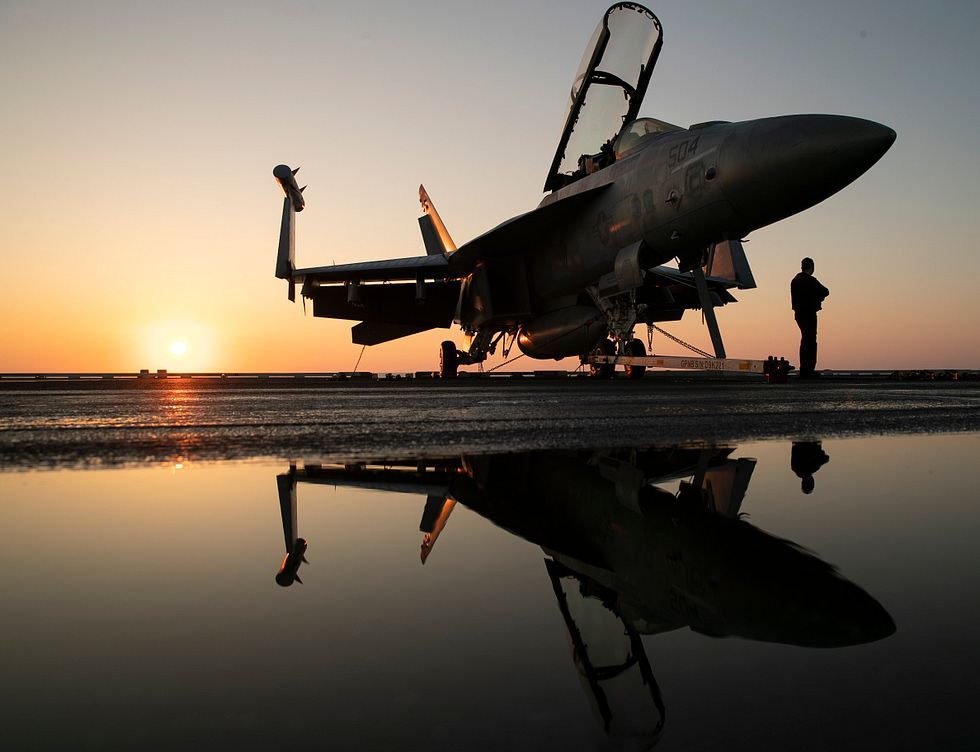
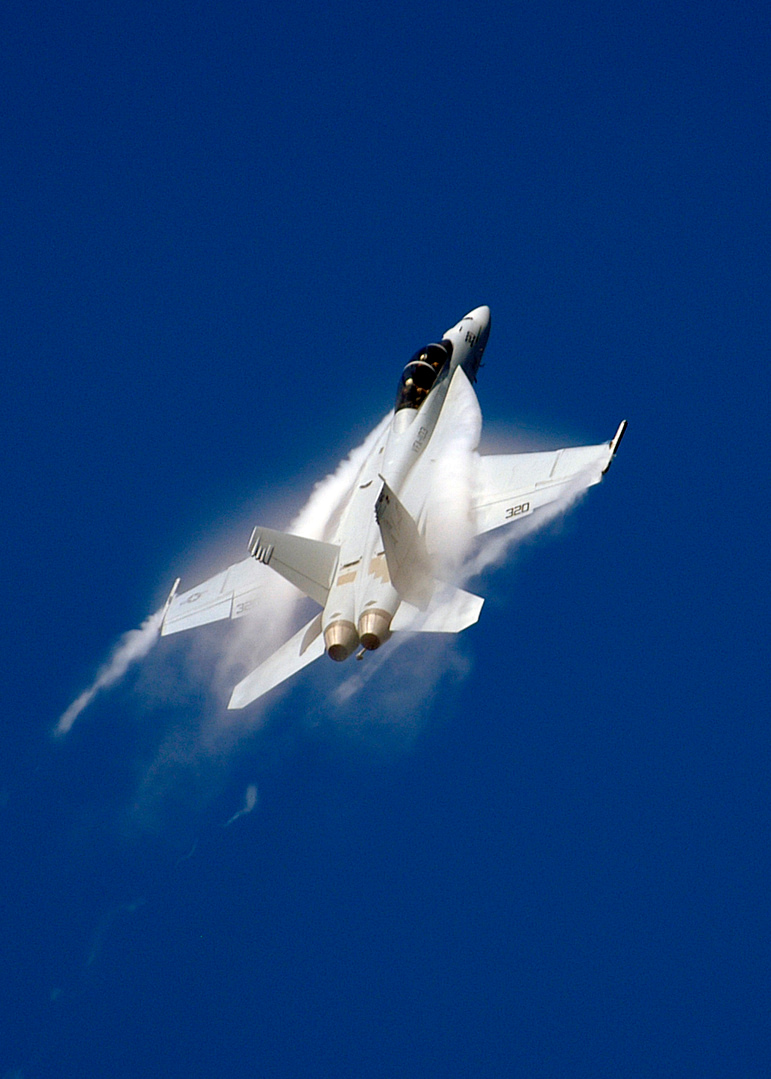
The Super Hornet in motion
DroneScapes — one of the most-watched Super Hornet films on YouTube.
Where the Super Hornet flies
Operators today
Two air arms fly the Super Hornet, and one of them owns almost all of them
This is a very short list for an aircraft built in the hundreds, and the shortness is the point: the Super Hornet was designed around a catapult and an arrestor wire, and almost nobody else has those. The United States Navy holds the overwhelming majority. Australia is the only other operator with aircraft in front-line squadrons that can be corroborated from published order of battle. The bars separate the strike fighters from the Growlers because they are different aircraft doing different jobs, not two marks of the same one.
These are estimates of delivered, in-service aircraft, and the list is deliberately this short. The United States Navy figure covers roughly 416 F/A-18E/F in service in 2025 with a further 93 on order; those on order are excluded here. Australia took 24 F/A-18F from December 2010 and twelve EA-18G by July 2017 — it actually bought thirteen Growlers, because one was destroyed by an engine fire after an aborted take-off at Nellis Air Force Base on 29 January 2018, written off that August, and an attrition replacement was purchased. Kuwait ordered 28 aircraft, 22 F/A-18E and 6 F/A-18F, and Boeing has reported completing that delivery run, but no current operational squadron strength has been published and it is therefore listed here rather than charted. The United States Marine Corps declined the Super Hornet entirely and flies legacy Hornets and F-35s instead; no other country operates the type. Sources: United States Navy and Naval Air Systems Command releases, Royal Australian Air Force order of battle, IISS The Military Balance and FlightGlobal World Air Forces; entries that could not be corroborated are omitted.
The score that defines it
The Super Hornet is above all a strike aircraft, and most of its combat record is written in bombs dropped over Iraq, Afghanistan and Syria and in fuel passed to other jets. But it also holds a rare distinction: the only air-to-air kill scored by any Hornet variant in US service this century.
The 2017 kill — an AIM-120 AMRAAM downing a Fitter that had bombed US-allied ground forces — was the first US air-to-air kill of a crewed aircraft since the 1999 Kosovo campaign. Compare the combat record of every military aircraft. Figures as of July 2026.
Everything people ask about the Super Hornet
Can I fly in an F/A-18 Super Hornet?
What is the difference between the Super Hornet and the legacy Hornet?
How fast is the Super Hornet?
Did a Super Hornet ever shoot down another aircraft?
What is the EA-18G Growler?
Is the Super Hornet a stealth aircraft?
Who flies the Super Hornet?
Is the Super Hornet still in service and production?
You can’t fly the Super Hornet.
These, you can.
Some legends only live in museums — others are fuelled and waiting. MiGFlug has put civilians in real military jet cockpits since 2004.
 Fly the L-39 AlbatrosThe world’s most-flown jet trainer — aerobatics included
 Fly the F-104 Starfighter“The missile with a man in it”
 Fly the MiG-21The Cold War’s most-produced jet
 Pilote o T-33 Shooting StarAmerica’s first jet trainer
 Fly the DH VampireA piece of early jet history
 Fly the S.211Agile Italian jet trainer
 Fly the MB-326The classic Aermacchi jet
 Fly the MiG-15The Soviet legend of the Korean War
Continue the tour
Every fact, checked
- Naval Air Systems Command (NAVAIR)Official US Navy programme page for the F/A-18E/F Super Hornet.
- Boeing — F/A-18 Super HornetManufacturer specifications, Block III details and production history.
- Airforce TechnologyAirframe, engine and avionics detail and export customer history.
- The War Zone (TWZ)First-hand account of the 18 June 2017 Su-22 shootdown from the pilots.
- Navy TimesThe inside story of Lt Cdr Tremel’s air-to-air kill and Distinguished Flying Cross.
- The Aviation Geek ClubDetailed comparison of the legacy Hornet and the Super Hornet.
- JanesKuwaiti Super Hornet order and delivery status.
- Simple FlyingOverview history of the US F/A-18E/F Super Hornet programme.