
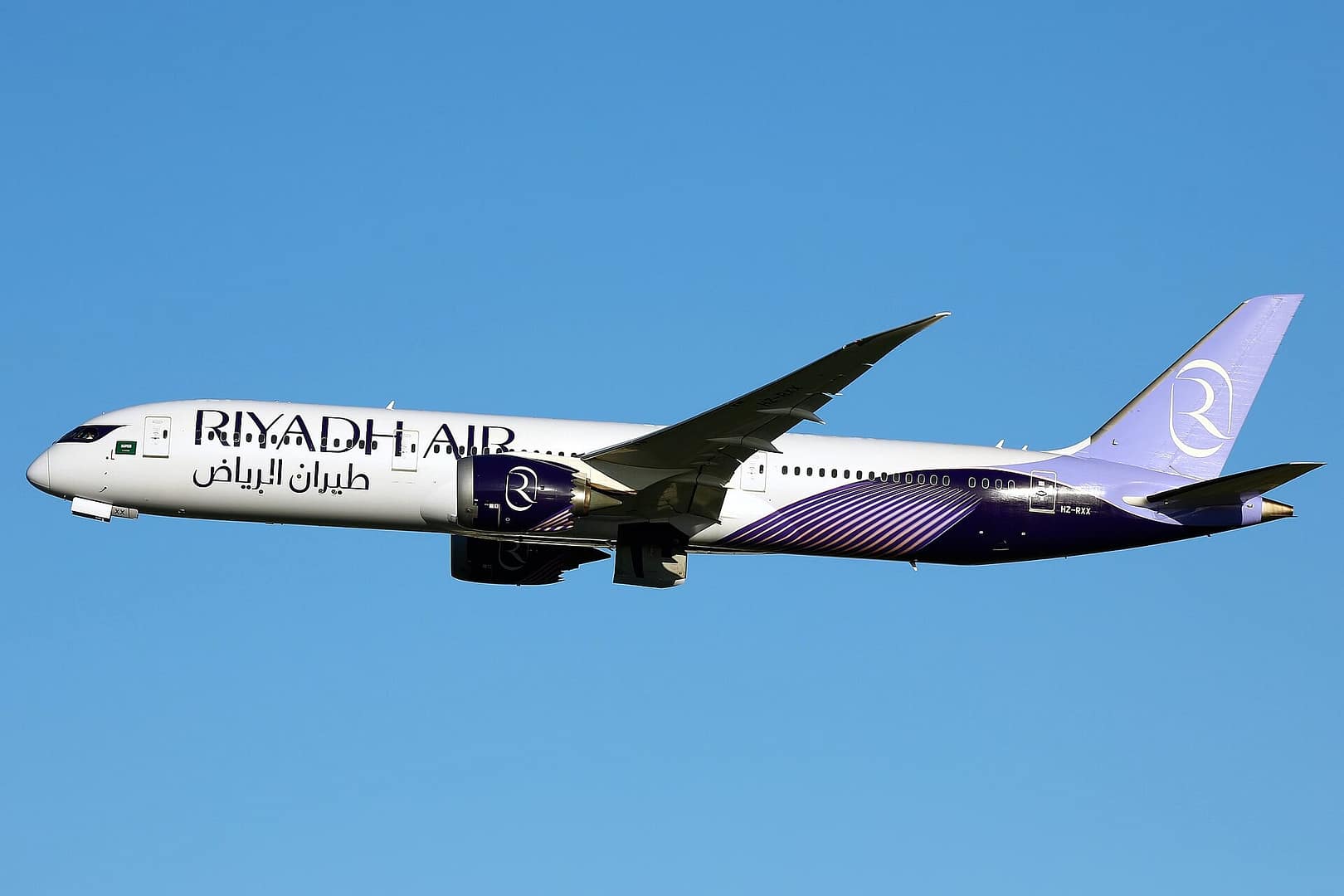
On 10 June 2026, a Boeing 787-9 in a striking deep-violet livery rolled to a stop at London Heathrow. For most travellers it was just another widebody from the Gulf. For the aviation industry, it was the moment a three-year-old PowerPoint finally became a real airline.
That was Riyadh Air’s first revenue flight — and Saudi Arabia’s loud, well-funded entry into a Gulf long-haul market already ruled by Emirates, Qatar Airways and Etihad.
Quick Facts
- Airline: Riyadh Air (RX), Saudi Arabia’s new flag carrier, owned by the Public Investment Fund
- Launch: first commercial flight Riyadh–London Heathrow, 10 June 2026 — brought forward about three weeks
- Fleet: Boeing 787-9 Dreamliner; first three delivered in early June 2026
- Launch routes: London, Jeddah, Dubai, Cairo, Madrid and Manchester
- CEO: Tony Douglas
- The goal: turn Riyadh into a global hub under Saudi Vision 2030
From Launch Video to Heathrow
Riyadh Air was unveiled in 2023 as a wholly owned venture of Saudi Arabia’s sovereign wealth fund, the Public Investment Fund. For three years it existed mostly as branding: a much-admired lavender-and-indigo livery, a slick marketing campaign, and a very large order book. The actual flying kept slipping into the future.
Then the jets started arriving. Riyadh Air took its first two 787-9 Dreamliners on 5 June 2026 and a third two days later, and with metal finally on the ramp it pulled its launch forward by roughly three weeks. London went first.
Six Cities in Six Weeks
The launch schedule is deliberately aggressive. After London on 10 June come Jeddah (14 June), Dubai (18 June), Cairo (25 June), Madrid (17 July) and Manchester (23 July) — every one of them flown by the 787-9. It is a statement of intent rather than a cautious toe in the water.
Douglas, who previously ran Etihad, knows exactly how hard it is to build a Gulf hub carrier from scratch — and how lucrative it can be if it works.

The Vision 2030 Bet
Riyadh Air is not really an airline project; it is a national one. Saudi Arabia wants to convert its geography — perched between Europe, Africa and Asia — into the same kind of connecting machine that made Dubai and Doha global names. The plan calls for Riyadh to handle vast passenger volumes and to anchor the kingdom’s push to diversify away from oil.
The obstacles are real: the Gulf hub market is crowded, the incumbents are formidable, and brand loyalty takes decades to build. But Riyadh Air has the one thing every startup airline dreams of — effectively bottomless backing — and, as of June 2026, it finally has passengers.
Sources: Riyadh Air; Public Investment Fund; AeroTime; One Mile at a Time; Aerospace Global News.
Related Questions
What is Riyadh Air?
Riyadh Air (RX) is Saudi Arabia’s new flag carrier, wholly owned by the Public Investment Fund, the kingdom’s sovereign wealth fund. It flew its first commercial flight, Riyadh to London Heathrow, on 10 June 2026, as a centrepiece of Saudi Vision 2030’s push to turn Riyadh into a global hub.
When did Riyadh Air start flying?
Riyadh Air operated its first commercial flight on 10 June 2026, from Riyadh to London Heathrow — a launch brought forward by about three weeks. The airline had previously targeted a first passenger flight on 1 July before accelerating the schedule.
What aircraft does Riyadh Air fly?
Riyadh Air launched with the Boeing 787-9 Dreamliner, with its first three aircraft delivered in early June 2026. The widebody Dreamliner suits the long-haul routes the carrier is building from its Riyadh base.
What are Riyadh Air’s first routes?
Riyadh Air’s launch routes include London, Jeddah, Dubai, Cairo, Madrid and Manchester. The network is designed to quickly establish Riyadh as a connecting hub between Europe, the Middle East and beyond.
Who is the CEO of Riyadh Air?
Riyadh Air is led by chief executive Tony Douglas, formerly of Etihad Airways. He oversaw the carrier’s build-up from a 2023 brand launch to its first flights in 2026.
Who owns Riyadh Air?
Riyadh Air is wholly owned by Saudi Arabia’s Public Investment Fund (PIF), the sovereign wealth fund driving many Vision 2030 projects. Like Gulf rival Qatar Airways, it is backed by deep state resources and large aircraft orders.
Related Posts
0 Comments