
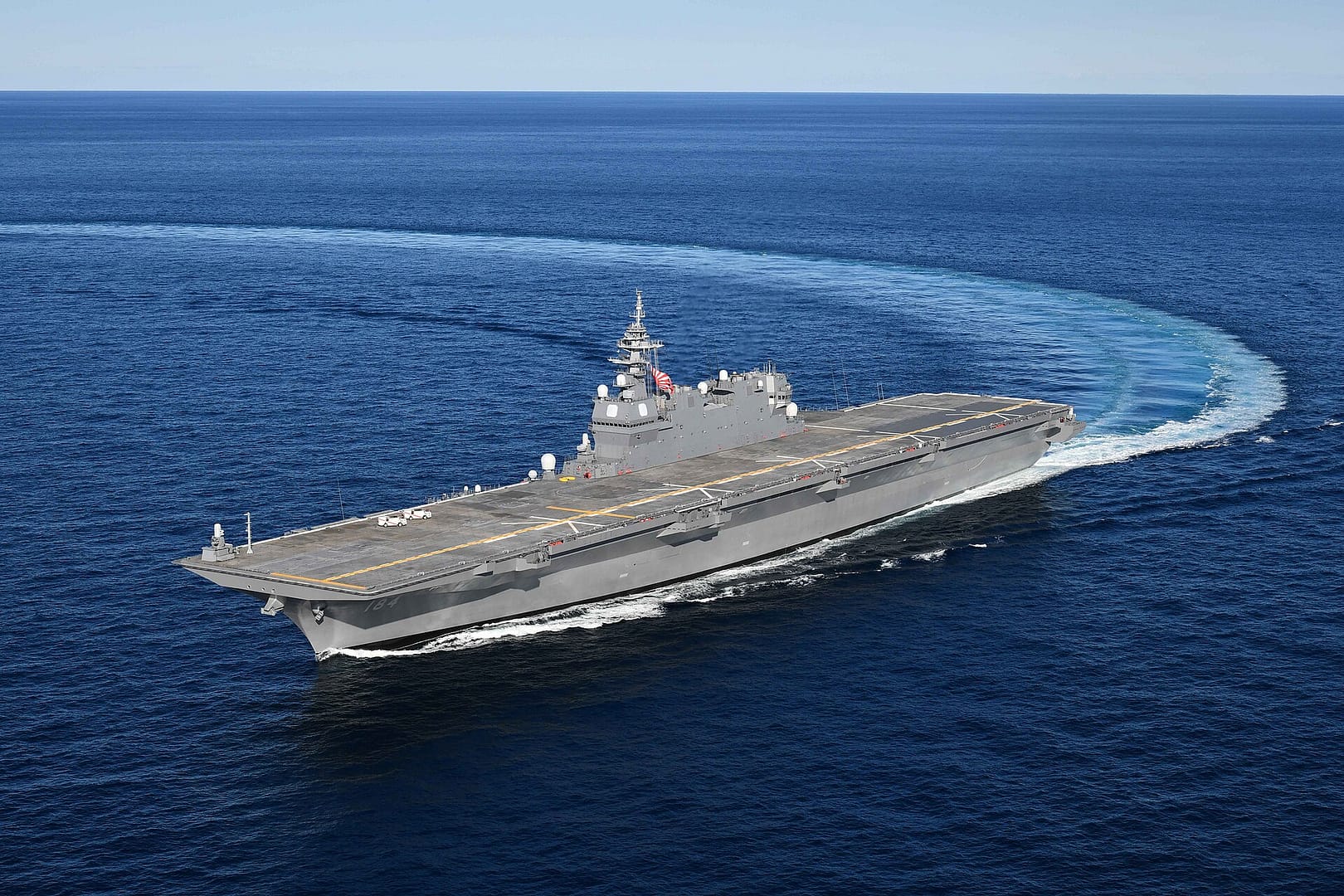
A grey warship longer than three football fields is steaming through the Pacific, and stealth fighters are dropping onto its deck. For most navies that would be unremarkable. For Japan, it is something close to historic — because for eighty years, Japan insisted it did not, and would not, operate aircraft carriers.
The ship is JS Kaga, and through June, U.S. Marine Corps F-35Bs have been taking off and landing from its flight deck. Officially it is still a “helicopter destroyer.” In practice, Japan is learning to fly fighters from the sea again.
QUICK FACTS
| Ship | JS Kaga (DDH-184) — Japan’s largest warship |
| Size | Over 800 ft long, about 27,000 tons |
| Origin | An Izumo-class “helicopter destroyer,” converted into an F-35B carrier |
| June 2026 | U.S. Marine F-35Bs conducting take-off and landing drills aboard |
| Japan’s F-35Bs | 42 on order; carrier conversion finishes around March 2029 |
| Why | Preparing Kaga’s crew to operate fixed-wing fighters at sea |
The carrier Japan said it would never build
JS Kaga is the second of two Izumo-class ships, and at over 800 feet and roughly 27,000 tons it is the largest warship Japan has built since the Second World War. It was designed as a flat-topped helicopter carrier — a politically careful label in a country whose post-war constitution renounced offensive military power. Calling it a “destroyer” was always a bit of a fiction. Now even the fiction is fading.
Japan is reworking both Izumo-class ships to operate the short-takeoff, vertical-landing F-35B, and has ordered 42 of the jets. Kaga’s heat-resistant deck and reshaped bow have already been modified; the second and final stage of its conversion is due to wrap around March 2029.
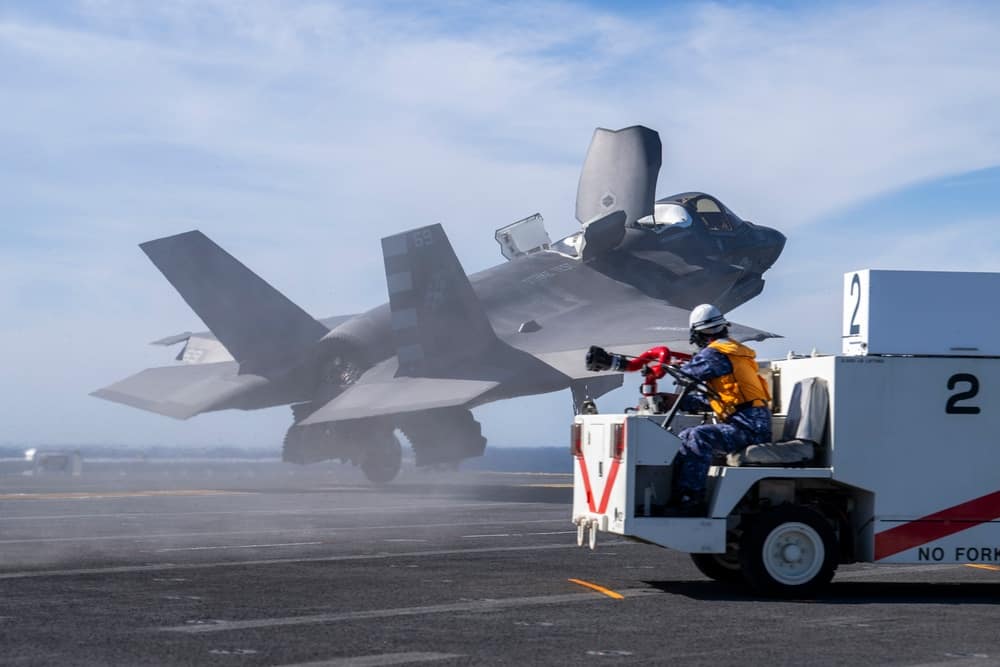
Why Marines are landing on it now
Japan does not yet have its own carrier-qualified F-35B pilots, so it is borrowing expertise from the people who wrote the book on jump-jet carrier operations: the U.S. Marine Corps. In early June, Kaga made a port call at Marine Corps Air Station Iwakuni to load equipment, and later in the month Marine F-35Bs conducted cross-deck drills from its deck.
The point of these exercises is not the jets — the Marines already know how to fly them. It is the ship’s crew, who are learning the choreography of fixed-wing flight operations: the deck handling, the timing, the fuelling, the thousand small routines that turn a flat deck into a working carrier. Kaga did its first F-35B sea trials off California back in 2024; June’s drills are the next step toward the day Japanese pilots do it themselves.

An old name, a new mission
There is a ghost in this story. The most famous ship ever to carry the name Kaga was an Imperial Japanese Navy aircraft carrier — one of the four sunk at the Battle of Midway in June 1942, the carriers whose loss broke Japan’s naval air power. Eighty-four years later, almost to the month, a new Kaga is launching fighters again.
This time the jets are American-built, the partner is the United States, and the target on everyone’s mind is the growing power of China across the East and South China Seas. For Japan, a carrier is no longer unthinkable. It is steaming, and it is learning to fly.
Sources: USNI News; DVIDS / F-35 Pax River ITF; The National Interest; Naval News.
Related Questions
What is the JS Kaga?
JS Kaga (DDH-184) is Japan’s largest warship, an Izumo-class vessel over 800 feet long and about 27,000 tons. Originally built as a “helicopter destroyer,” it is being converted to operate F-35B stealth fighters — effectively Japan’s first aircraft carrier since the Second World War.
Why did Japan say it had no aircraft carriers?
For decades Japan’s post-war constitution renounced offensive military power, so it labelled flat-topped ships like Kaga “helicopter destroyers” rather than carriers. Converting Kaga to fly F-35Bs ends that distinction, marking a historic shift in Japanese defence policy.
What is the F-35B?
The F-35B is the short-takeoff, vertical-landing (STOVL) variant of the F-35 Lightning II, able to operate from short decks and rough strips. Japan has ordered 42 of them for its carriers; the same jet has also landed on highways in Finland.
When will Kaga’s carrier conversion be finished?
Kaga’s heat-resistant deck and reshaped bow have already been modified. The second and final stage of the conversion is due to be completed around March 2029. In June 2026, U.S. Marine F-35Bs conducted take-off and landing trials aboard the ship.
Why were U.S. Marines flying from a Japanese ship?
Japan does not yet have its own carrier-qualified F-35B pilots, so U.S. Marine Corps F-35Bs conducted the first fixed-wing trials aboard Kaga, helping prepare the ship and its crew for fixed-wing operations at sea.
How big is the JS Kaga?
Kaga is over 800 feet long and displaces roughly 27,000 tons, making it the largest warship Japan has built since the Second World War. Flying fast jets from its deck is among the most demanding tasks in naval aviation.


 English
0 Comments