
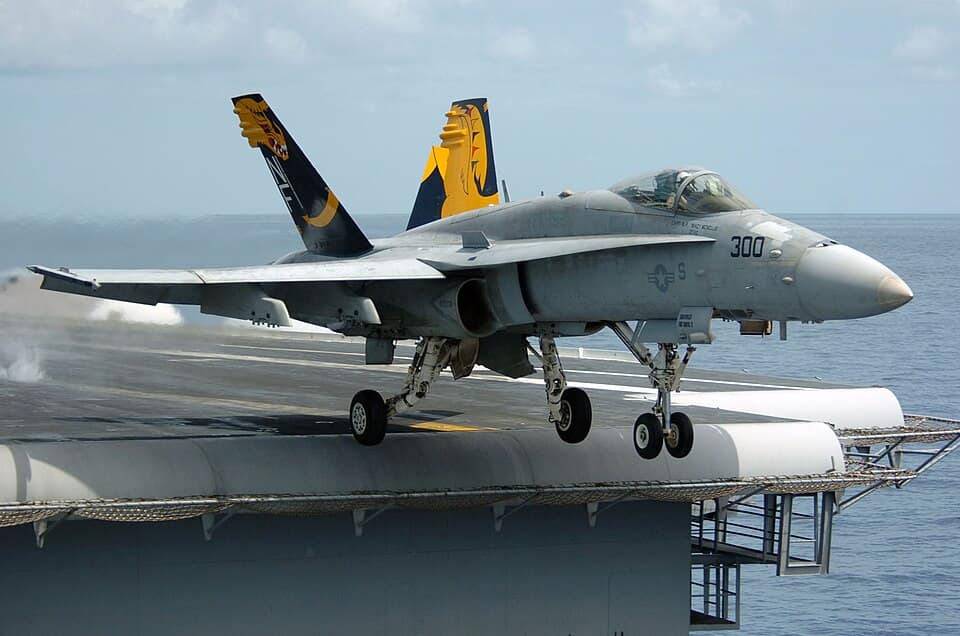
Here's something the U.S. Navy doesn't put in the recruitment brochures: the hardest thing a naval aviator will ever do isn't dogfighting, or dodging surface-to-air missiles, or threading a low-level attack run through a mountain valley. It's coming home. Specifically, it's landing a 30-ton aircraft on a 600-foot-long runway that's moving at 30 knots in three different directions at once — in complete darkness, with no horizon, no depth perception, and no room for error. Navy pilots call it "the night trap." They also call it the scariest routine in aviation. They're not joking.
Ask a carrier pilot what they dread most, and the answer is almost never "combat." It's Tuesday night at 0200, fifty miles off the coast, fuel state getting uncomfortable, ceiling at 300 feet, pitching deck, and a Fresnel lens that keeps disappearing behind the waves. That's the nightmare. That's every week. And the Navy has been doing it, voluntarily, for eight decades — because the alternative is not having carrier aviation at all.
This is the story of what it actually takes to land on a ship at night — and why the Navy considers it the single most difficult skill a human being can master.
Quick Facts
- Landing area: ~600 feet long, ~100 feet wide (about 1/20th of a normal runway)
- Approach speed: 125–155 knots depending on aircraft type
- Arresting wires: 4 cables, spaced 40 feet apart — the #3 wire is the target
- Acceptable touchdown zone: ~49 feet long
- Deck motion: Up to 30 feet of vertical heave in heavy seas
- Decision altitude: 200 feet — below that, you're committed
- Bolter rate: ~3–5% of all traps result in a missed wire (bolter)
- Key landing aid: IFLOLS (Improved Fresnel Lens Optical Landing System) — "the ball"
- Night qualification requirement: Minimum 10 night traps for initial carrier qualification
The Problem With Darkness
In daytime, a carrier landing is merely very difficult. You've got a visual horizon, a clearly visible ship, a sense of scale and motion. Your brain can process the geometry — angle of approach, closure rate, glideslope — using the same spatial reasoning you'd use to park a car, just much faster and with significantly higher stakes.
At night, all of that disappears. Literally. A carrier operating under EMCON (emissions control) conditions reduces its lighting to an absolute minimum. The flight deck is marked by a dim outline of deck-edge lights. The ship's wake is invisible. The horizon — the single most important reference for any pilot — is gone. You are flying a multi-million-dollar aircraft into what looks like a black hole with a small cluster of dim lights at the bottom.
The human visual system was not designed for this. Without a horizon, the vestibular system in your inner ear starts lying to you. You feel level when you're not. You perceive motion that isn't there. The phenomenon is called spatial disorientation, and it has killed more carrier pilots than enemy fire. Your instruments say one thing; your body screams another. Trust the instruments. Every time. Without exception.

Following the Ball Into the Black
The key to night carrier landings is a device called the IFLOLS — the Improved Fresnel Lens Optical Landing System. Pilots call it "the ball," or "the meatball," and it is quite literally the only thing keeping them alive during those final 18 seconds of approach.
The ball is a set of Fresnel lenses mounted on a gyro-stabilized platform on the port side of the flight deck. It projects a bright amber light — the "meatball" — that moves up and down relative to a row of green reference lights. If the ball is above the green line, you're high. Below the line, you're low. Dead center, you're on glideslope. In daytime, it's a useful reference. At night, it's the only reference. You fly the ball. That's it. That's the entire job.
Meanwhile, a Landing Signal Officer (LSO) — typically a senior pilot standing at the edge of the deck with a headset and a pair of "pickle" switches — is watching your approach and talking you in. "Power." "Right for lineup." "You're going low." The LSO can give you a wave-off at any point — a mandatory go-around signaled by flashing red lights. If you see the red lights, you add full power immediately and climb away, no discussion, no hesitation. The LSO's word is law.
The Controlled Crash
Here's the part that really makes no sense: a carrier landing is not actually a landing. It's a controlled crash. The pilot does not flare — does not raise the nose to reduce the sink rate, the way every land-based pilot is trained to do. Instead, the pilot flies the aircraft into the deck at a descent rate of roughly 600 to 800 feet per minute. The hook catches a wire, and the aircraft goes from 140 knots to zero in about two seconds. The deceleration force is approximately 4G.
And here's the really fun part: as the pilot flies into the deck, they push the throttles to full power. Every time. This is called "bolter protection" — if the hook misses all four wires (a "bolter"), the aircraft needs to be at full power to fly off the end of the deck and go around for another attempt. So you're simultaneously trying to stop and trying to go. You hit the deck at full military power, the hook catches a wire, and the engines are screaming at maximum thrust as the wire drags you to a halt. Then — and only then — you pull the throttles back.
At night, you do this while staring at a small amber light on the side of the ship, hoping your brain doesn't convince you the ship isn't where it obviously is.

The Deck That Won't Stay Still
Everything above assumes the ship is stable. It never is. An aircraft carrier displaces roughly 100,000 tons, but the ocean doesn't care. In moderate seas, the flight deck can move 10 to 15 feet vertically in a slow, rolling heave. In heavy weather, that number doubles. The deck is also pitching — the bow goes up while the stern goes down, then reverses. And it's rolling — tilting side to side. Sometimes all three motions happen simultaneously, in different phases, creating a landing surface that is quite literally a moving target in three dimensions.
The IFLOLS is gyro-stabilized to compensate for deck motion, so the ball remains steady even as the ship moves. But the pilot still has to put the hook on a specific piece of deck that is rising and falling at unpredictable intervals. The wires are spaced 40 feet apart. The target — the #3 wire — is in a zone roughly 49 feet long. Miss it forward and you catch the #4 wire (acceptable but not ideal). Miss it aft and you bolter. Miss it too far forward and you hit the ramp — the rounded edge of the flight deck — which is exactly as catastrophic as it sounds.
Why They Do It Anyway
The Navy has spent decades trying to make night carrier landings less terrifying. Automatic carrier landing systems (ACLS) can fly the aircraft to within a few hundred feet of the deck using data-linked guidance from the ship. The newest system, JPALS (Joint Precision Approach and Landing System), uses GPS and ship-based transponders to achieve even greater accuracy. But at the bottom of every approach, a human being still has to look at the ball, make a judgment call, and fly the aircraft into a piece of steel that may or may not be where it was a second ago.
The F-35C Lightning II has introduced some of the most advanced landing aids ever fitted to a carrier aircraft, including a helmet-mounted display that projects flight-path information directly onto the pilot's visor. Coupled with JPALS, it has reduced the workload somewhat. But the physics haven't changed. The deck is still moving. The night is still dark. And the pilot still has to get it right, every single time.
Naval aviators don't talk about night traps casually. It's the thing they've all done a hundred times that still makes their palms sweat. When carrier pilots gather at a bar and swap stories, the combat tales come out first — but the night trap stories come out later, quieter, after a few more drinks. Because those are the ones that actually scared them.
The next time you watch a carrier landing video and think, "That doesn't look too hard," remember: you're watching the daytime version. At night, the camera can't even see the ship.
Sources: U.S. Navy NATOPS carrier landing procedures; CAPT John Chesire USN (Ret.), personal accounts; Naval Aviation News; 19FortyFive, "The Reason Naval Aviators Would Rather Fly Combat" (2026); U.S. Naval Institute proceedings.
Related Questions
Why are night carrier landings so dangerous?
Landing a jet on a carrier at night means hitting a moving deck only about 600 feet long and 100 feet wide — roughly one-twentieth of a normal runway — with almost no visual references. The deck can heave up to 30 feet in heavy seas, and below a 200-foot decision altitude the pilot is committed to landing.
What is 'the ball' in a carrier landing?
'The ball' refers to the IFLOLS, or Improved Fresnel Lens Optical Landing System, a set of lights beside the flight deck that shows pilots their glide path. A centred ball means they are on the correct approach angle; a high or low ball warns they must correct immediately.
What is a bolter in naval aviation?
A bolter is when an aircraft touches down but its tailhook misses all the arresting wires, forcing the pilot to apply full power and take off again for another attempt. Bolters happen on roughly 3–5% of all carrier landings, which is why pilots always land at full throttle.
How many arresting wires are on an aircraft carrier?
A carrier flight deck has four arresting wires, spaced about 40 feet apart. Pilots aim for the third wire, considered the safest and most consistent target. A tailhook beneath the jet catches a wire and stops the aircraft from roughly 150 mph in about two seconds.
How fast do jets land on an aircraft carrier?
Carrier aircraft approach at around 125 to 155 knots depending on type, flying onto an acceptable touchdown zone only about 49 feet long. There is no flare or gentle touchdown — the jet is essentially flown straight onto the deck at full landing weight and speed.
How many night landings are required to qualify on a carrier?
Initial carrier qualification requires a minimum of ten night traps — successful arrested landings in darkness. Night work is treated as a separate, harder skill than daytime landings, and pilots must requalify periodically to stay current on the carrier.
What aircraft land on modern aircraft carriers?
Modern carriers operate fast jets such as the F/A-18 Super Hornet and, increasingly, the F-35. Some navies use short-takeoff jets instead of arrested landings — for example Japan's JS Kaga operating F-35Bs. You can also read about the carrier-borne F-14 Tomcat.
What happens if a fighter has a problem on approach to a carrier?
If something goes wrong close in, the pilot may bolter, be waved off, or in an emergency divert or eject. Mechanical trouble is especially serious over water — see what happens when a fighter jet's engine fails — because there is no runway to glide to.
Related Posts
What Happens When a Fighter Jet's Engine Fails
Navy's F/A-XX Rescued by $900M Funding Surge
Two Engines, One Nose: Japan's Kawasaki Ki-64
0 Comments