
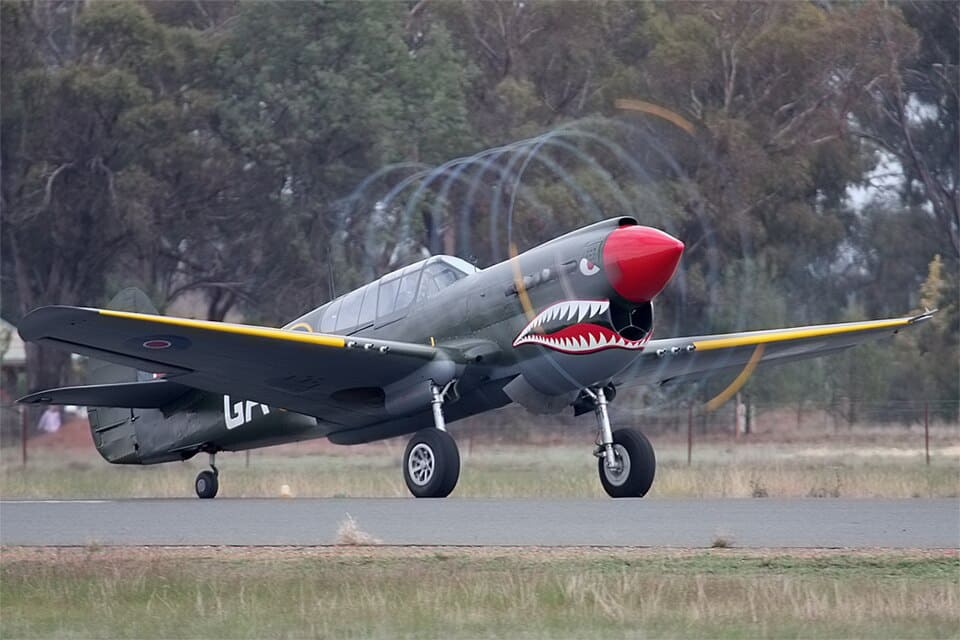
The Curtiss P-40 Warhawk was never the fastest, highest-climbing, or most manoeuvrable fighter of the Second World War. What it was, in every theatre from North Africa to China to the Aleutians, was available — and in the hands of pilots who understood its strengths, it was deadly. No aircraft is more closely associated with the shark-mouth nose art and the volunteer American pilots who flew against Japan before the United States officially entered the war.
- First flight: 14 October 1938 (XP-40 prototype)
- Role: Single-seat fighter / fighter-bomber
- Manufacturer: Curtiss-Wright Corporation
- Engine: Allison V-1710 liquid-cooled V-12 (later models: Packard V-1650 Merlin)
- Top speed: 360 mph (580 km/h) — P-40N variant
- Built: 13,738
- Operators: United States, United Kingdom, Soviet Union, China, Australia, and 20+ other nations
A Workhorse, Not a Thoroughbred
The P-40 evolved from the earlier Curtiss P-36 Hawk, replacing its radial engine with an inline Allison V-1710. The redesign gave it better speed and a sleeker profile, but the Allison's lack of a supercharger meant performance dropped off sharply above 15,000 feet. Against the Messerschmitt Bf 109 and Mitsubishi A6M Zero at high altitude, the P-40 was outclassed.
Below 15,000 feet, however, the picture changed. The P-40 could dive faster than almost any opponent, absorbed tremendous battle damage thanks to its rugged construction and self-sealing fuel tanks, and carried six .50-calibre machine guns that could shred anything they hit. Pilots who fought on the P-40's terms — diving attacks, high-speed slashing passes, never turning with a Zero — achieved remarkable results.
Chennault's Flying Tigers
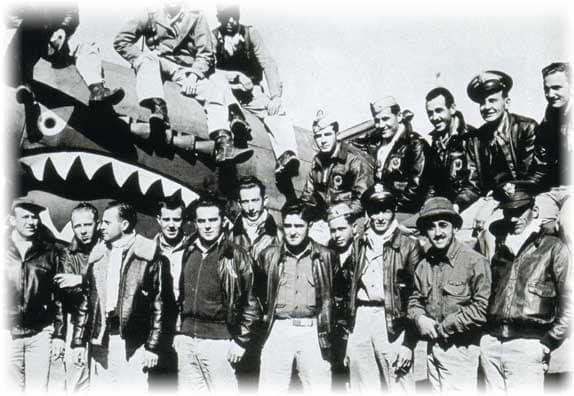
The aircraft's legend was sealed in the skies over Burma and southern China. In 1941, retired U.S. Army Air Corps officer Claire Lee Chennault recruited roughly 100 American volunteer pilots and 200 ground crew to defend China against Japanese air attacks. Officially designated the 1st American Volunteer Group (AVG), they became known worldwide as the Flying Tigers.
Flying P-40B and P-40C Tomahawks — the export designation — the AVG entered combat on 20 December 1941, just days after Pearl Harbor. Over the next seven months, Chennault's pilots claimed 296 confirmed aerial victories against Japanese aircraft while losing only 14 pilots in air combat. The kill ratio was extraordinary, and it was achieved with an aircraft that was technically inferior to its Japanese opponents on paper.
The secret was tactics. Chennault had spent years studying Japanese air combat methods in China and drilled his pilots relentlessly: never dogfight a Zero, always maintain speed, attack from above, make one pass and break away. The P-40's superior dive speed and sturdy airframe made these tactics work. Top AVG aces included Robert Neale with more than 13 kills, David "Tex" Hill with 12.25, and Gregory "Pappy" Boyington with 3.5 victories before he transferred to the Marine Corps, where he would become one of the war's most famous aces.
The Shark Mouth
The P-40's most recognisable feature was never designed by Curtiss. The shark-mouth nose art — gaping jaws painted around the air intake — was first applied by No. 112 Squadron RAF on their P-40 Tomahawks in North Africa in 1941. When photographs reached Chennault's pilots in China, they immediately copied the design. The image became so iconic that it remains one of the most recognised pieces of military nose art in aviation history, appearing on everything from modern A-10 Thunderbolt IIs to civilian warbird restorations.
Global Service
Beyond the Flying Tigers, the P-40 served in virtually every theatre of the war. RAF Kittyhawks fought across North Africa alongside Australian and South African squadrons. Soviet pilots flew Lend-Lease P-40s on the Eastern Front. The aircraft saw action in the Mediterranean, the China-Burma-India theatre, the Aleutian Islands campaign, and the defence of Darwin, Australia. With 13,738 built, it was one of the most-produced American fighters of the war — not because it was the best, but because factories could build it quickly and pilots could learn to fly it fast.
By 1944, newer types like the P-51 Mustang and P-47 Thunderbolt had largely replaced the P-40 in frontline fighter roles. But the Warhawk continued serving as a fighter-bomber and ground-attack aircraft until the end of the war, proving that toughness and availability often matter more than raw performance.
Related Questions
What was the Curtiss P-40 Warhawk?
The Curtiss P-40 Warhawk was an American single-seat fighter of the Second World War, first flown on 14 October 1938. Built by Curtiss-Wright, it was never the fastest or most agile fighter, but it was rugged, available in huge numbers, and deadly below 15,000 feet. With 13,738 built, it served with the US, UK, Soviet Union, China and more than 20 other nations.
Who were the Flying Tigers?
The Flying Tigers were the American Volunteer Group (AVG), roughly 100 American pilots recruited in 1941 to fight for China against Japan before the United States formally entered the war. Flying shark-mouthed P-40s under Claire Chennault, they claimed 296 confirmed victories in seven months while losing only 14 pilots in air combat.
Was the P-40 Warhawk a good fighter?
The P-40 was a good fighter when flown to its strengths. It was outclassed above 15,000 feet because its Allison engine lacked a supercharger, but below that altitude it could out-dive almost any opponent, absorb heavy battle damage, and hit hard with six .50-calibre machine guns. Pilots who used diving, slashing attacks rather than turning dogfights achieved excellent results.
Why did the P-40 have a shark mouth painted on it?
The shark-mouth nose art was copied from Britain's No. 112 Squadron RAF, which painted it on P-40s in North Africa in 1941. When photographs reached Chennault's pilots in China, they adopted the design, and it became forever associated with the Flying Tigers. It remains one of the most recognised pieces of military nose art in history.
How many P-40 Warhawks were built?
A total of 13,738 P-40s were built, making it one of the most-produced American fighters of the war. Only a handful of designs, such as the Soviet Il-2 Sturmovik, were built in larger numbers. The P-40 served in virtually every theatre, from North Africa and the Eastern Front to China and the Pacific.
Who commanded the Flying Tigers?
Claire Lee Chennault, a retired US Army Air Corps officer, created and led the Flying Tigers. He had studied Japanese air-combat tactics in China and drilled his volunteer pilots relentlessly: never dogfight a Zero, keep your speed up, attack from above, and make one pass before breaking away. Top AVG aces included Robert Neale and David 'Tex' Hill.
Why couldn't the P-40 fight well at high altitude?
The P-40's Allison V-1710 engine lacked a supercharger, so its performance fell off sharply above about 15,000 feet. At high altitude it was outclassed by the Messerschmitt Bf 109 and Mitsubishi A6M Zero. Below 15,000 feet the picture reversed, where its dive speed, toughness and heavy armament made it dangerous.
What tactics did P-40 pilots use against the Japanese Zero?
P-40 pilots never tried to turn with the more agile Zero. Instead they used boom-and-zoom tactics: dive from above at high speed, make a single slashing pass, then climb away rather than circle. This exploited the P-40's superior dive speed and rugged airframe. The same Pacific air war produced P-38 aces like Richard Bong and daring missions such as Operation Vengeance.
Sources
- Wikipedia — Curtiss P-40 Warhawk
- Wikipedia — Flying Tigers (1st American Volunteer Group)
- National Museum of the USAF — Curtiss P-40E Warhawk
0 Comments