
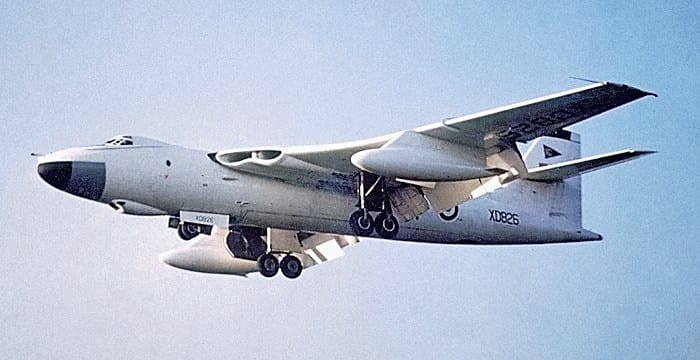
On a May morning in 1957, over the Pacific near Christmas Island, a Vickers Valiant called XD818 opened its bomb bay and released a device that fell away, dropped for long seconds, and then turned the sky white. Britain had just become a thermonuclear power — and it was a Valiant that delivered the blow. The aircraft that did it still exists today, quietly preserved in a museum, a survivor of a fleet that vanished almost overnight.
The Valiant is the least glamorous of Britain’s three V-bombers. It is also the one that did the most, first.
QUICK FACTS
| Aircraft | Vickers Valiant — Britain’s first V-bomber |
| First flight | 18 May 1951 |
| In service | 1955 — the first of the three V-bombers |
| Engines | Four Rolls-Royce Avon turbojets |
| Claim to fame | Dropped Britain’s first atomic and hydrogen bombs |
| End | Grounded 1965 after fatigue cracks — scrapped fast |
First in line
When Britain decided in the late 1940s to build a jet-powered nuclear bomber force, it hedged its bets by ordering three very different designs. The Avro Vulcan and Handley Page Victor were radical, exotic machines that would take years to perfect. The Vickers Valiant was the safe choice — a clean, conventional swept-wing bomber that could be built quickly and put into service while the others matured.
It worked exactly as intended. The Valiant flew in 1951 and entered RAF service in 1955, becoming the first V-bomber to stand nuclear alert. For several years, Britain’s deterrent rested on its four Rolls-Royce Avon engines.

The bombs it dropped
The Valiant’s résumé is remarkable. In October 1956 it dropped Britain’s first operational atomic bomb during a test in the Australian outback. Months later, in 1957, XD818 released the country’s first hydrogen bomb over the Pacific. And in between, during the Suez Crisis of 1956, Valiants flew real bombing missions against Egyptian airfields — making the Valiant the only V-bomber to drop bombs in anger until the Vulcan’s famous Falklands raid a quarter-century later.
A sudden, undignified end
Then it all came apart — literally. As Soviet surface-to-air missiles made high-altitude bombing suicidal, the RAF pushed its bombers down to low level, where thick, turbulent air hammers an airframe. The Valiant had never been designed for it. In 1964 inspectors found fatigue cracks in the wing spars, and testing revealed the problem was fleet-wide. Rather than pay to fix aircraft already being overtaken by the Vulcan and Victor, the RAF grounded the entire Valiant force in 1965 and sent almost all of them to the scrapyard.
It was a brutal ending for the bomber that had carried Britain into the nuclear age. Today only XD818 remains — the H-bomb dropper, saved for the nation it once armed. The Valiant was never the most beautiful or famous of the V-force. But it was the one that got there first, and did the hardest jobs before the others were ready.
Sources: Royal Air Force Museum; Imperial War Museum; British nuclear-test histories.
Related Questions
What was the Vickers Valiant?
The Vickers Valiant was the first of Britain’s three “V-bombers,” entering RAF service in 1955 to carry the country’s new nuclear deterrent. A four-engined, high-altitude jet bomber, it was the most conventional of the trio and the first into service.
What made the Valiant historically important?
The Valiant dropped Britain’s first atomic bomb during Operation Buffalo in Australia in 1956 and its first hydrogen bomb during Operation Grapple near Christmas Island in 1957. It was also the only V-bomber to drop bombs in combat during the 1956 Suez Crisis.
Why was the Valiant retired so quickly?
When high-flying bombers became vulnerable to surface-to-air missiles, the Valiant was switched to low-level flying, which it was never designed for. The stress cracked its wing spars, and in 1965 fatigue was found across the fleet. The RAF grounded and scrapped almost every Valiant within months.
How was the Valiant different from the Vulcan and Victor?
It was the least radical. Where the Avro Vulcan had its famous delta wing and the Handley Page Victor its crescent wing, the Valiant used a fairly conventional swept-wing layout. That made it quicker to build and field first, but gave it less growth potential than its exotic siblings.
Do any Valiants survive?
Only one complete Valiant survives: XD818, the aircraft that dropped Britain’s first hydrogen bomb, now preserved at the Royal Air Force Museum. The sudden 1965 scrapping of the fleet means almost nothing else remains of Britain’s first nuclear bomber.
0 Comments