
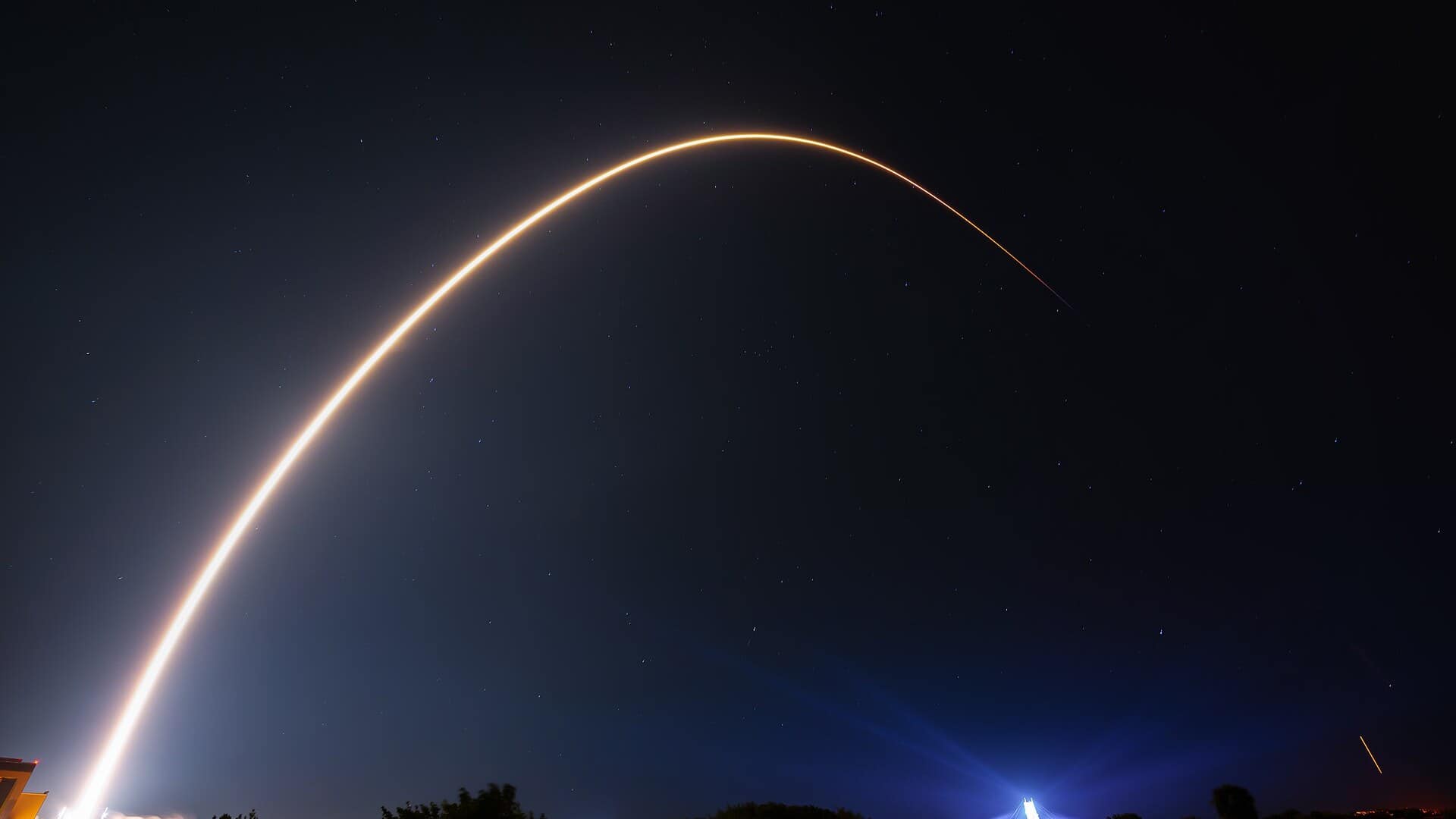
For half a century, the West has tracked hostile aircraft the same way: a converted airliner with a radar dome, orbiting on station for hours at 9,000 metres (30,000 feet) while a crew in the back stares into scopes. On 29 May 2026, the U.S. Space Force committed $4.16 billion to SpaceX to begin making that aircraft obsolete.
The award — among the largest in the young service’s history — funds the first tranche of the Space-Based Airborne Moving Target Indicator, or SB-AMTI: a constellation of satellites designed to detect and track moving airborne targets from orbit, anywhere on Earth. Fighter aircraft, bombers, cruise missiles and, potentially, hypersonic weapons.
The Space Force wants an initial constellation flying by 2028. If it works, the implications reach far beyond one award: they touch the E-3 Sentry’s retirement, the political fight over the E-7 Wedgetail, and NATO’s decision this year to buy Swedish radar jets.
Quick Facts: SB-AMTI
| Programme | Space-Based Airborne Moving Target Indicator (SB-AMTI) |
| Award | $4.16 billion Other Transaction Authority (OTA) agreement, announced 29 May 2026 |
| Prime | SpaceX — first of a multi-vendor pool, with further awards expected |
| Mission | Detect and track aircraft, cruise missiles and other airborne threats from orbit |
| Initial constellation | Targeted for 2028 |
| Awarding office | USSF Portfolio Acquisition Executive for Space Based Sensing & Targeting |
The deal that is not a contract
Strictly speaking, SpaceX did not win a contract. The award is an Other Transaction Authority agreement — an OTA — a legal instrument that lets the Pentagon skip much of the traditional federal procurement rulebook and move at something closer to commercial speed. The Space Force is pairing it with an Indefinite Delivery/Indefinite Quantity ordering structure, so it can keep ordering satellites, from more vendors, as the architecture grows.
The agreement was issued by the service’s acting Portfolio Acquisition Executive for Space Based Sensing & Targeting and announced by Space Systems Command in El Segundo. CNBC and SpaceNews both put the value at $4.16 billion. SpaceX enters as the first publicly identified member of a vendor pool — reportedly nine companies — assembled through earlier competitive OTAs and disclosed by Air Force Secretary Troy Meink at the Space Symposium in April 2026.
More awards are expected within the coming year. The Space Force says it deliberately wants several suppliers building to the same architecture, so that no single company — not even SpaceX — owns the constellation.
A radar picture with no blind spots
SB-AMTI is not one satellite but a system-of-systems: space-based sensors, secure and fast communication links, and resilient ground processing that fuses everything into a single air picture. The goal is custody — not a snapshot of a target, but an unbroken track from take-off to impact point, delivered to shooters in near real time.
The satellites are expected to build on Starshield, the government-focused sibling of SpaceX’s Starlink broadband network, according to CNBC. That points to proliferated low Earth orbit: large numbers of comparatively cheap satellites instead of a few exquisite ones, with persistence achieved through sheer quantity.
The Space Force’s stated reasoning is blunt. Big, slow radar aircraft cannot safely operate close to modern anti-access/area-denial systems — the dense webs of long-range missiles China and Russia have built precisely to push such aircraft back. A satellite overhead cannot be pushed back.
Does this kill the radar plane?
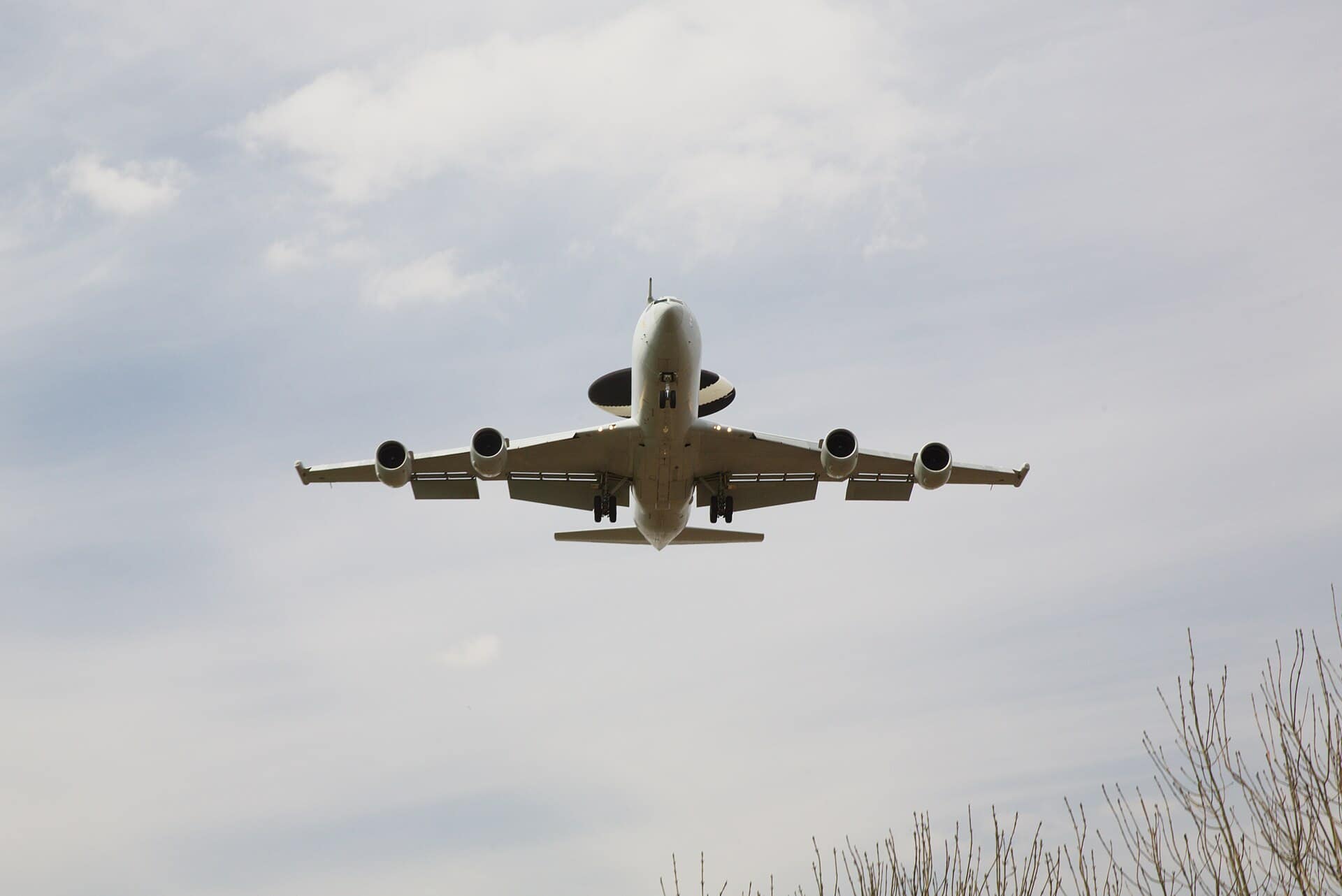
The timing is not subtle. The US Air Force is retiring its geriatric E-3 Sentry fleet, and the Pentagon’s 2025 budget proposal tried to cancel the planned E-7 Wedgetail buy outright, arguing space-based sensing would take over the mission. Congress refused and kept the Wedgetail alive — but the message from the building was clear: the department’s preferred long-term answer to airborne early warning is orbit, not another jet.
NATO drew a different conclusion. The alliance announced in 2026 that it will replace its own E-3s with the Saab GlobalEye — a decision we covered in detail — effectively betting that a modern radar aircraft remains indispensable well into the 2040s.
Both sides have physics on their side. An aircraft-mounted radar sees far, but its horizon is limited and its orbit predictable; it must also survive. Satellites offer persistent, global coverage that no missile belt can deny — but detecting and continuously tracking a fighter-sized, manoeuvring target against ground clutter from hundreds of kilometres up is an extraordinarily hard radar problem, and no nation has publicly fielded an operational air moving target indicator constellation before.
That is why the honest answer to “does space kill the radar plane?” is: not yet. The E-7 debate, the GlobalEye purchase and SB-AMTI are all hedges against the same uncertainty — nobody knows how fast the orbital option will mature.

The road to 2028
The first SB-AMTI satellites are projected to field by 2028 — a deliberately aggressive schedule meant to give combatant commanders an early capability against what the Space Force calls operational blind spots. Development and integration work began immediately upon award.
Scepticism is warranted on cost as much as schedule. OTAs trade oversight for speed, and $4.16 billion is only the opening instalment of an architecture that will need continual replenishment — low-orbit satellites re-enter and must be replaced in cycles of roughly five years. The counter-argument: SpaceX has already demonstrated, with Starlink, that it can mass-produce and launch satellites at a pace no defence prime has matched.
Whatever happens, the AWACS crews flying today will not be replaced by 2028. But for the first time since the rotodome appeared, the question is no longer whether the radar plane’s successor will fly — it is whether it will fly at all, or simply orbit.
Sources: Space Systems Command (U.S. Space Force), SpaceNews, CNBC, Breaking Defense, DefenseScoop
Related Questions
What is SB-AMTI?
SB-AMTI, the Space-Based Airborne Moving Target Indicator, is a planned U.S. Space Force constellation of satellites designed to detect and track moving airborne targets from orbit, anywhere on Earth. It would spot fighters, bombers, cruise missiles and potentially hypersonic weapons, taking on a mission historically flown by radar-dome aircraft like the AWACS.
What is AWACS?
AWACS stands for Airborne Warning and Control System: a converted airliner carrying a large rotating radar dome that orbits on station for hours at around 9,000 m (30,000 ft), while operators track hostile aircraft and coordinate friendly forces. For half a century it has been the West's primary way of seeing and managing the air battle from above.
Why is the US Space Force building space-based AWACS?
The Space Force wants to track moving airborne targets from orbit because satellites can watch anywhere on Earth continuously, without the vulnerability of a large, predictable aircraft orbiting near a threat. On 29 May 2026 it committed $4.16 billion to SpaceX to begin building SB-AMTI, aiming to eventually make the traditional radar-plane obsolete.
How much is the SpaceX SB-AMTI contract worth?
The U.S. Space Force awarded SpaceX $4.16 billion on 29 May 2026 to begin the first tranche of SB-AMTI, among the largest awards in the young service's history. The deal uses an Indefinite Delivery/Indefinite Quantity structure so the Space Force can keep ordering satellites, from multiple vendors, as the architecture grows.
When will the SB-AMTI constellation be operational?
The Space Force wants an initial SB-AMTI constellation flying by 2028. SpaceX is the first publicly identified member of a vendor pool reportedly numbering around nine companies, and more awards are expected within the following year, as the service deliberately spreads the work so no single supplier controls the whole system.
Will satellites replace the E-3 Sentry and E-7 Wedgetail?
Space-based tracking directly touches the future of airborne radar planes: the aging E-3 Sentry is heading for retirement, and there is a political fight over buying the E-7 Wedgetail as its replacement. If SB-AMTI works, it could reshape those decisions and NATO's own radar plans, though such aircraft, including new Swedish-built radar jets, remain in the mix for now.
What can SB-AMTI detect and track?
SB-AMTI is designed to detect and track moving airborne targets: fighter aircraft, bombers and cruise missiles, and potentially even hypersonic weapons. By working from orbit, it aims to provide continuous, global coverage of these fast-moving threats, rather than the limited-range, limited-endurance picture a single orbiting radar aircraft can offer.
Who is building SB-AMTI?
SpaceX is the first publicly named contractor on SB-AMTI, entering a vendor pool reportedly of about nine companies assembled through earlier competitive agreements. Air Force Secretary Troy Meink disclosed the pool at the Space Symposium in April 2026, and Space Systems Command in El Segundo announced the SpaceX award, with more awards expected to follow.


0 Comments