
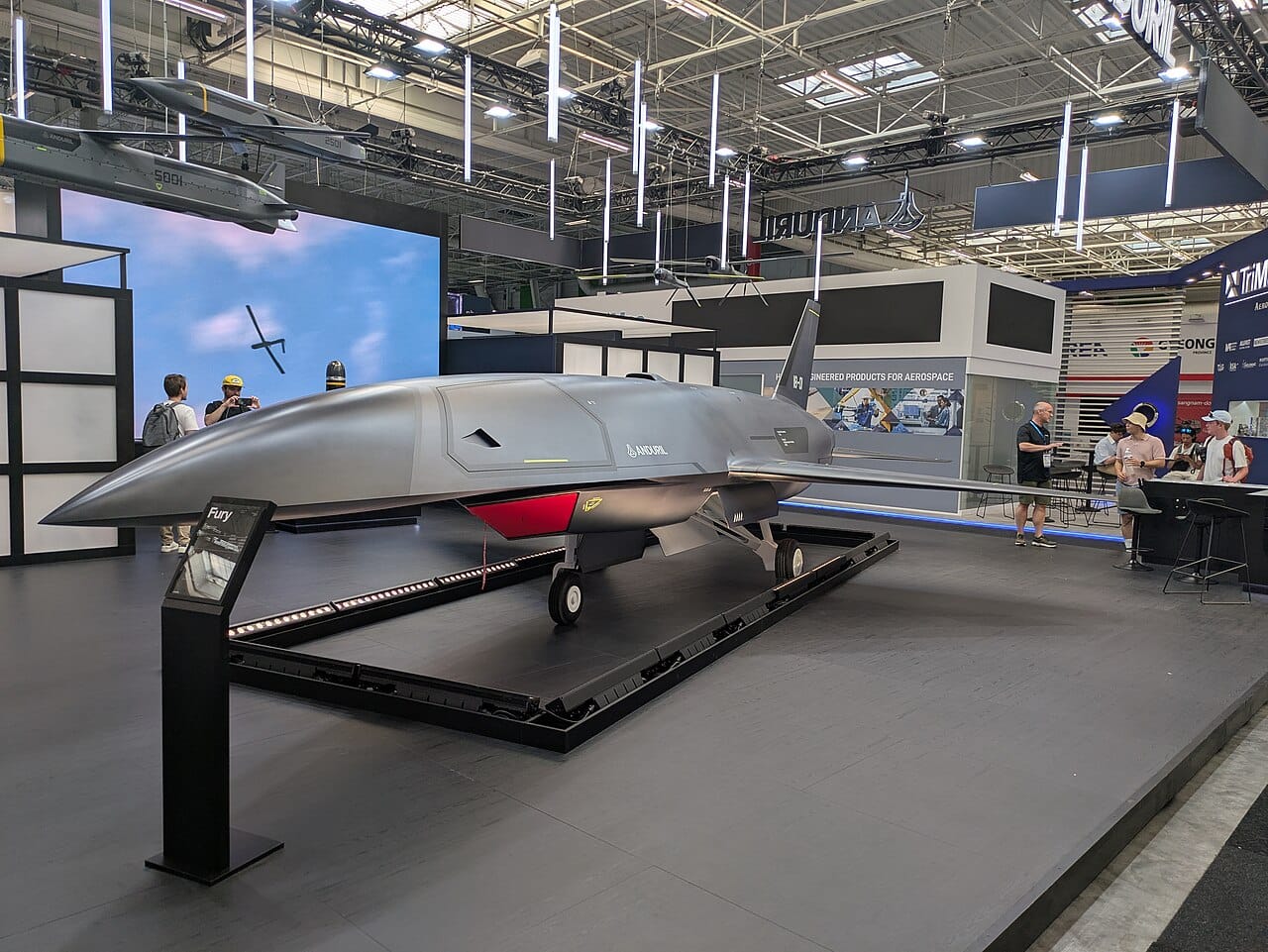
For decades, "fighter jet" meant a human strapped into a cockpit. On 17 June 2026, the U.S. Air Force quietly ended that monopoly. It signed production contracts for two jet-powered combat aircraft that have no cockpit, no ejection seat, and no pilot — and ordered them by the hundred.
The two winners are General Atomics' FQ-42A, nicknamed Dark Merlin, and Anduril's FQ-44A, called Fury. Both shed the "Y" that marks an experimental prototype the moment the Air Force decided they were ready to build for real. America now has not one but two robot fighters heading for the assembly line.
And the service didn't pick a single winner. It bought both — a deliberate hedge that tells you how seriously the Pentagon is taking the idea that the next air war will be fought by humans and machines flying together.
QUICK FACTS
What: U.S. Air Force awards Collaborative Combat Aircraft (CCA) Increment 1 production contracts
Who: General Atomics (FQ-42A "Dark Merlin") and Anduril (FQ-44A "Fury")
When: 17 June 2026 — roughly four months ahead of schedule
How many: At least 150 aircraft combined by the end of the decade; long-term goal around 1,000
Price tag: Target unit cost about $30 million — roughly one-third of an F-35
Mission: Air superiority, with a combat radius of about 700 nautical miles
From paper to production in under two years
What makes this remarkable is the speed. General David Allvin, the Air Force Chief of Staff, pointed out that these were not aircraft anyone had been flying for years.
The YFQ-42A made its first flight in August 2025. The YFQ-44A followed on 31 October 2025. Less than a year after those maiden flights, both designs had convinced the Air Force they were worth committing to — and the production decision landed four months earlier than planned.

The maths that makes them irresistible
The appeal is brutally simple economics. An F-35 costs roughly $80–90 million a copy and takes years to train a pilot to fly it. A CCA is meant to cost around $30 million — a third of the price — and there is no human inside to lose if it gets shot down.
That changes the calculus of a fight. A single piloted F-22, F-35, or the forthcoming F-47 could push a handful of these drones ahead of it as sensors, missile trucks, jammers, or decoys. The expensive human-flown jet stays back; the cheap robots go into the teeth of the enemy's air defences first.
Why the Air Force bought both
Keeping both General Atomics and Anduril in the game is a strategy as much as a purchase. It preserves competition, hedges against one design running into trouble, and keeps two production lines warm. Anduril, a Silicon Valley defence upstart, building combat aircraft alongside a legacy drone-maker like General Atomics is itself a statement about how the Pentagon wants its future force built.
Increment 1 is only the beginning. The Air Force has spoken of eventually fielding something on the order of 1,000 Collaborative Combat Aircraft across multiple increments, each generation cheaper, smarter, and more autonomous than the last. The first 150-plus are simply the down payment.
The video below follows the YFQ-44A Fury from the workshop to its first flight over the California desert — the moment a startup's robot fighter actually left the ground.
For a century, air power has been measured in pilots. Starting now, it will also be measured in the machines that fly beside them — and the Air Force just ordered its first 150.
Sources: U.S. Air Force; Air & Space Forces Magazine; Breaking Defense; The War Zone; General Atomics Aeronautical.
Related Questions
What are Collaborative Combat Aircraft (CCA)?
Collaborative Combat Aircraft are uncrewed robot fighters designed to fly alongside crewed jets. In June 2026 the U.S. Air Force cleared its first two — General Atomics' FQ-42A Dark Merlin and Anduril's FQ-44A Fury — for production under the CCA Increment 1 program.
How much does a Collaborative Combat Aircraft cost?
Each CCA has a target unit cost of about $30 million — roughly a third the price of an F-35, which runs $80–90 million a copy. Low cost is the whole point: fielding large numbers of capable uncrewed fighters affordably.
What is a loyal wingman drone?
A loyal wingman is an uncrewed aircraft that flies alongside a piloted fighter under the pilot's control, acting as a sensor, missile carrier or jammer. CCAs are the U.S. Air Force's loyal wingmen — a single F-22, F-35 or F-47 could push several ahead of it in a fight.
How many CCAs will the U.S. Air Force buy?
The Air Force plans at least 150 from the first two designs by the end of the decade, with a long-term goal of around 1,000. The first production contracts were awarded on 17 June 2026 — about four months ahead of schedule.
What are the FQ-42A and FQ-44A?
They are the U.S. Air Force's first two production Collaborative Combat Aircraft. The FQ-42A Dark Merlin is built by General Atomics and the FQ-44A Fury by Anduril. Both were selected for CCA Increment 1 production in June 2026.
Why does the U.S. want uncrewed fighter jets?
The appeal is economics. A CCA costs about a third of an F-35 and has no pilot to lose if shot down, so commanders can risk it freely. Flown in numbers alongside crewed jets, drones multiply the sensors and weapons in the sky at a fraction of the cost.
When did the CCA prototypes first fly?
General Atomics' YFQ-42A made its first flight in August 2025, and Anduril's YFQ-44A followed on 31 October 2025. Less than a year after those maiden flights, both designs had convinced the Air Force to commit to production.
0 Comments