On April 28, a Boeing 787-9 Dreamliner in Alaska Airlines livery will push back from Seattle-Tacoma International Airport, point its nose east, and do something the airline has never done in its 94-year history: cross the Atlantic Ocean. The destination is Rome Fiumicino — the Eternal City — and the flight marks Alaska’s debut as a transatlantic carrier.
It is a milestone that seemed unthinkable five years ago. Alaska Airlines was a regional powerhouse built on the American West Coast, with a network stretching from Anchorage to San Diego and across the Pacific to Hawaii. Europe was not in the vocabulary. The 787-9, with its range of over 7,500 nautical miles, has rewritten the map.
Alaska Airlines has spent decades building a reputation as the best domestic carrier in the United States — consistently winning J.D. Power awards and customer loyalty surveys with a combination of reliability, friendly service, and intelligent route planning. Its merger with Hawaiian Airlines gave it a Pacific network. Its Oneworld alliance membership plugged it into British Airways, Cathay Pacific, and Japan Airlines.
An Alaska Airlines Boeing 787-9 in the carrier’s new global livery at Seattle-Tacoma International Airport — the same aircraft type that will fly the inaugural Seattle-Rome route. Wikimedia Commons
But transatlantic flying is a different game. It requires wide-body aircraft, premium cabins with lie-flat seats, catering for 10-hour flights, and ground operations at foreign airports with different regulations, languages, and labour agreements. The 787-9 solves the hardware problem — it has the range and the economics to make secondary transatlantic routes profitable. The question is whether Alaska can deliver a premium experience that competes with established European operators on the same routes.
Rome is a shrewd choice for the inaugural route. It is Italy’s busiest airport, a massive connecting hub for southern Europe, and a destination with enormous leisure demand from the US West Coast. There is no direct competition on the Seattle-Rome city pair, giving Alaska a monopoly on non-stop service. The daily frequency allows business travellers to consider it seriously rather than dismissing it as a seasonal leisure route.
What It Means for the Industry
Alaska’s European debut is part of a broader trend: mid-tier American carriers are using new-generation wide-body aircraft to break into markets that were once the exclusive domain of legacy carriers like United, Delta, and American. The 787’s economics — roughly 20% lower fuel burn per seat than the aircraft it replaces — make routes viable that would have bled money a decade ago.
For travellers, more competition on transatlantic routes means lower fares, better service, and more options. For Rome, it means a direct pipeline to the Pacific Northwest — tech workers from Seattle, tourists headed to Tuscany, and connecting traffic from Alaska’s vast domestic network.
Whether Alaska adds more European destinations depends on how Rome performs. But the aircraft are in the fleet, the alliance connections are in place, and the ambition is clear. The airline that started flying between Anchorage and McGrath with a single Stinson floatplane in 1932 just became a transatlantic carrier.
Sources: Aviation Week, Alaska Airlines, airline schedules data
Every fighter pilot trains for it. Most pray they'll never experience it. The moment a jet engine — the machine that keeps you flying at 500 knots and 30,000 feet — stops working. Whether it's a compressor stall that sounds like a cannon going off behind your seat, a...
Luca Parmitano has lived two lives that most people only dream about. In the first, he was a fighter pilot — flying AMX Ghibli attack jets for the Italian Air Force, deployed to Afghanistan, trained to fly low and fast into hostile territory. In the second, he became...
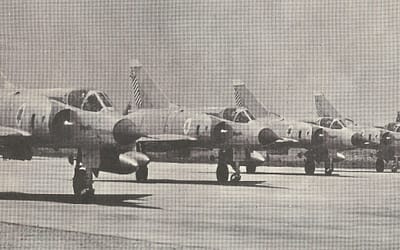
Before the Rafale, before the Mirage 2000, before the Mirage F1 — there was the Mirage III. Dassault's first supersonic fighter was a revelation when it entered service in 1961: a sleek, tailless delta that could break Mach 2, carry a nuclear bomb, and outfight...



 English
0 Comments