
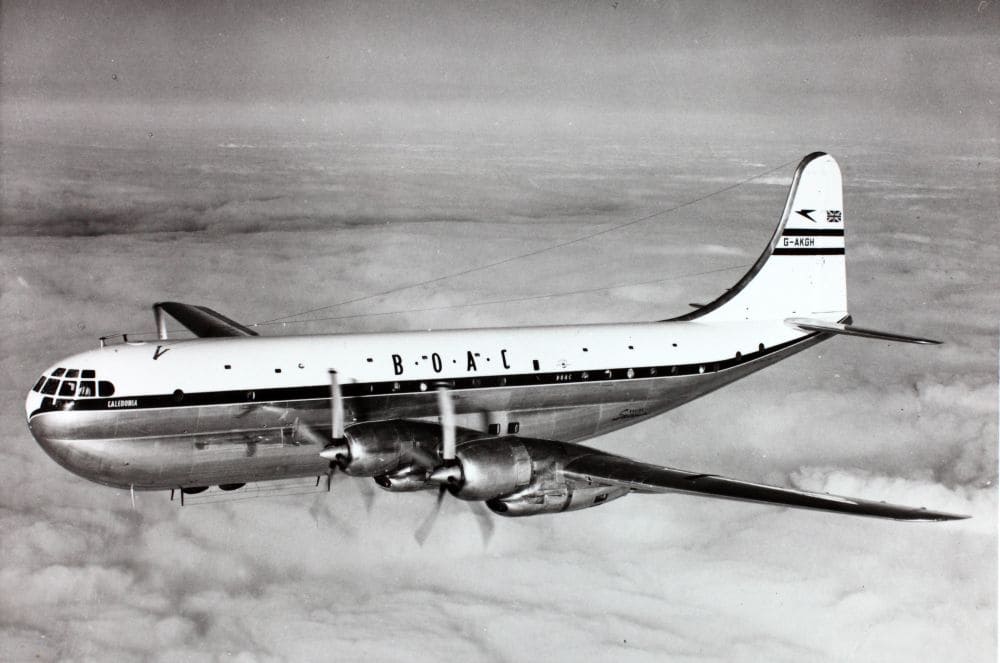
Imagine boarding a transatlantic flight, settling into your seat, and then, somewhere over the ocean, walking down a spiral staircase to a cocktail lounge for a drink and a hand of cards. That was not a fantasy in 1950. That was a Tuesday aboard the Boeing 377 Stratocruiser, the double-decked flagship of the golden age of air travel.
The Stratocruiser was the most luxurious airliner of its day: berths to sleep in, private staterooms, a downstairs bar, and a cabin the size of nothing else in the sky. It was also cursed with four of the most temperamental engines ever bolted to an airliner, a flaw that would, on more than one occasion, put its passengers into the sea.
Quick Facts
| Aircraft | Boeing 377 Stratocruiser |
| Layout | Double-deck, with a lower-deck cocktail lounge reached by a spiral staircase |
| Comforts | Sleeping berths, private staterooms, a 14-seat lounge |
| Engines | Four Pratt & Whitney R-4360 Wasp Major radials (28 cylinders each) |
| Entered service | 1949, with Pan American |
| Built | 56 |
| Operators | Pan Am, BOAC, Northwest, United, American Overseas |
| Legacy | Some airframes became the bulbous Aero Spacelines Guppies |
A Flying Ocean Liner
Boeing built the Stratocruiser on the muscular foundations of its wartime bombers, giving it a distinctive figure-eight, double-bubble fuselage. The upper deck carried the main cabin; the lower deck held that famous lounge. Passengers could recline in overhead berths, change in a proper dressing room, and dine on food from a full galley. For the transoceanic elite of the late 1940s, this was as good as flying got.
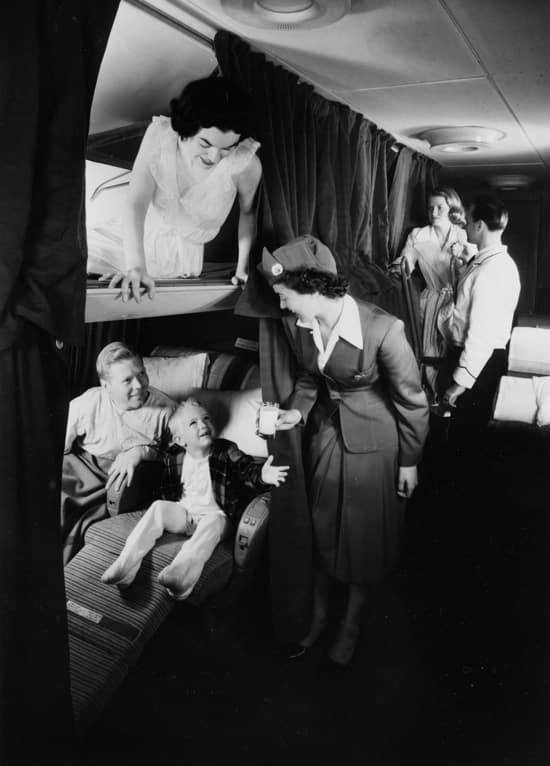
Pan Am, BOAC, Northwest and others flew it across the Atlantic and Pacific, and its promotional films sold a dream of effortless, glamorous travel above the weather. For a few years, the Stratocruiser was the flagship every airline wanted to be photographed beside.
The Engines From Hell
The problem lived under the cowlings. Pan Am boss Juan Trippe pushed for four Pratt & Whitney R-4360 Wasp Major engines, the most powerful piston radials ever mass-produced, with an astonishing 28 cylinders apiece arranged in four rows. They were magnificent on the test bench and miserable in service: complicated, hot-running, and desperately maintenance-hungry. Trippe, it is said, came to regret the choice.
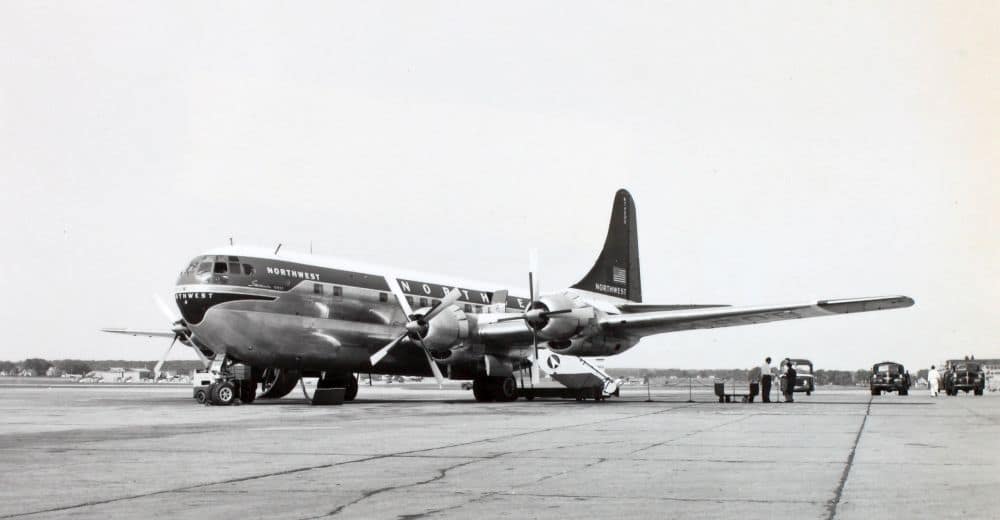
That is barely an exaggeration. The Stratocruiser suffered repeated propeller and engine failures, and on several occasions the results were dramatic. Twice, Pan Am Stratocruisers lost so much power over the Pacific that their crews had to ditch in the open ocean, once alongside a Coast Guard weather ship that plucked everyone from the water. Remarkably, in those famous ditchings the passengers survived, a testament to the crews and to the aircraft's sturdy hull.
The End of an Era
Only 56 Stratocruisers were built, and their reign was brief. When the jet age arrived in the late 1950s, the double-decker's leisurely luxury and thirsty, troublesome engines could not compete with a Boeing 707 that flew twice as fast and broke down far less. The airlines retired them quickly.
But the Stratocruiser refused to vanish. A handful of airframes were bought up and grotesquely rebuilt into the Aero Spacelines Guppies, the whale-shaped transports that would later haul rocket parts for the Apollo programme. It is a fitting afterlife for an aircraft that always thought big. The Stratocruiser sold a version of flying, spacious, unhurried, faintly decadent, that the industry has spent the decades since slowly taking away.
Sources: HistoryNet; CNN; Wikipedia; Mighty Travels; From the Travel Desk.

0 Comments